
What Is a Security Operations Center (SOC)?
Last Updated date: July 15, 2026
On this page
See Tech Prescient in Action
Automate access, reduce risk, and stay audit-ready
A Security Operations Center (SOC) is a centralized cybersecurity function that continuously monitors, detects, investigates, and responds to threats across an organization's IT infrastructure. It integrates people, defined processes, and technologies such as SIEM, EDR, threat intelligence platforms, and automation to reduce detection time and limit breach impact.
A SOC operates as the command function for security operations. Teams perform continuous monitoring of networks, endpoints, cloud environments, and identity systems. They triage alerts, investigate suspicious activity, conduct threat hunting, coordinate incident response, and oversee remediation. Advanced analytics and threat intelligence are used to identify valid threats and adapt to evolving attack techniques.
The objective of a SOC is measurable risk reduction. This includes lowering mean time to detect (MTTD) and mean time to respond (MTTR), containing incidents before lateral movement occurs, and maintaining operational continuity during active threats.
Organizations that have achieved an advanced, mature SOC capability deliver statistically significant superior security outcomes. IBM's 2025 Cost of a Data Breach Report notes that global data breach costs averaged $4.44 million, but those that matured in using AI and automation extensively within their security operations were able to save $1.9 million versus those that did not have those capabilities. Internal security teams now identify the compromise of systems in approximately 50% of breaches, thereby minimizing breach costs and timelines.
A SOC is not defined solely by technology. It represents an operational discipline built on skilled analysts, structured workflows, integrated tooling, and continuous improvement. When implemented effectively, it becomes the foundation for sustained threat visibility, controlled incident response, and resilience against ongoing cyber attacks.
Key Takeaways:
- SOC centralizes threat detection, incident response, and security monitoring functions
- Combines people, processes, and technology for comprehensive cybersecurity defense
- Reduces breach detection time and minimizes business impact through rapid response
- Supports regulatory compliance through continuous monitoring and documentation
What Does a SOC Do?
A Security Operations Center (SOC) provides continuous monitoring, detection, investigation, and coordinated response across an organization's IT environment. Its primary function is to identify threats early and contain them before they disrupt operations or compromise sensitive data.
SOC teams monitor networks, endpoints, cloud workloads, and identity systems using platforms such as SIEM, EDR, and threat intelligence tools. Analysts review and triage alerts, validate incidents, and determine scope and impact. When a threat is confirmed, the SOC coordinates containment, eradication, and recovery efforts across security and IT teams.
Beyond reactive response, mature SOCs conduct proactive threat hunting, analyze attack patterns, refine detection logic, and improve response workflows. This continuous cycle strengthens visibility and reduces mean time to detect (MTTD) and mean time to respond (MTTR).
The operational objective is measurable risk reduction: limiting attacker dwell time, preventing lateral movement, protecting sensitive assets, and maintaining system availability during active threats.
Core Functions of a SOC
A modern Security Operations Center (SOC) performs six core functions: threat monitoring, alert triage, incident response, threat hunting, vulnerability management, and compliance reporting. Together, these functions establish a structured and measurable security operations workflow.
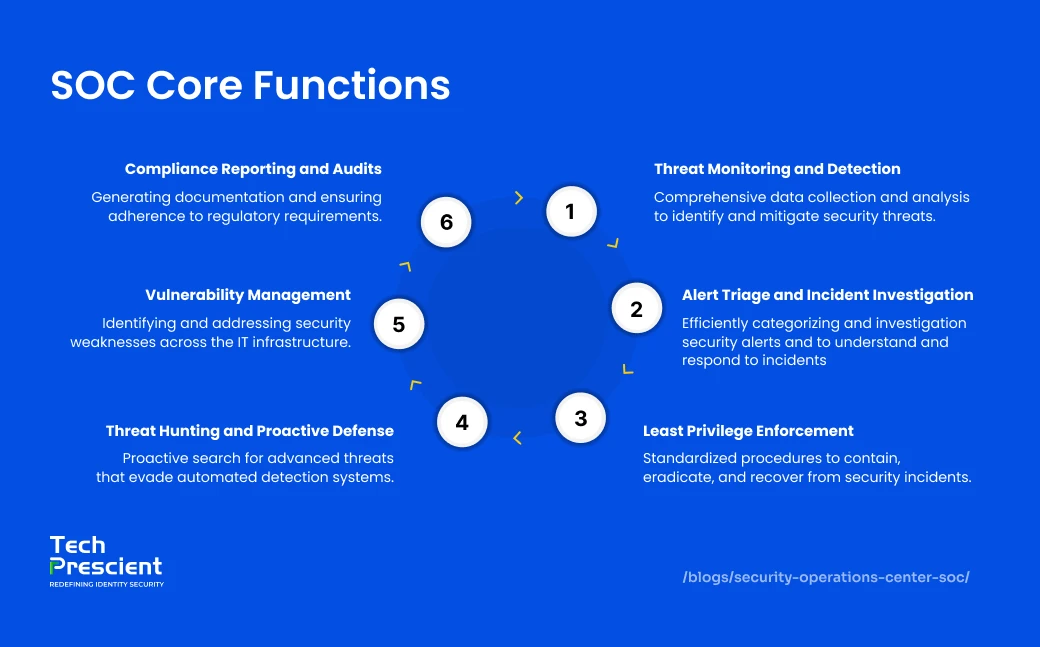
A SOC delivers continuous visibility, analysis, and coordinated response across the attack lifecycle, from initial detection through containment and remediation. The objective is controlled risk reduction, not broad claims of prevention.
Threat Monitoring and Detection
SOC operations begin with centralized data collection across the IT environment. Telemetry is aggregated from security controls, infrastructure systems, cloud platforms, and identity services to establish continuous visibility.
The main components of monitoring include:
- SIEM tools that aggregate log data from firewalls, intrusion detection systems, and endpoint protection tools
- Correlation analysis that identifies attack vectors that span multiple systems
- Real-time alerts of suspicious behavior across the network
Detection Approaches
- Signature-Based Detection: This type of detection utilizes hash values, behavioral signatures, and network indicators to identify known malware families and attack tools.
- Anomaly-Based Detection: This type of detection develops baselines of normal behavior for a system and its users and then flags deviance from that baseline for further review, knowing that deviation may indicate a compromise. Anomaly-based detection is frequently utilized in conjunction with machine learning algorithms to assist with event detection.
- User and Entity Behavior Analytics (UEBA): This type of analytics monitors authentication patterns, file access behaviors, and privilege usages in order to detect insider threats and compromised accounts. These systems may also generate alerts when users display behaviors that could be viewed as unusual, such as accessing atypical systems or downloading unusual amounts of data.
- Integration of Threat Intelligence: This involves external data about active attack campaigns, malware families, and indicators of compromise (IOCs) from commercial feeds and/or by virtue of sharing programs with the government.
- Network Traffic Analysis: This analysis involves the review of all communication patterns and data flows in order to identify indicators of command and control communications, data exfiltration attempts, and lateral movement events through the application of deep packet inspection.
Identity-based telemetry has become a primary detection vector. Monitoring authentication logs, privileged access activity, role changes, and abnormal entitlement usage helps SOC teams detect insider threats, lateral movement, and account compromise earlier than traditional network-only monitoring.
Alert Triage and Incident Investigation
SOC analysts receive thousands of security alerts daily from various monitoring systems.
Triage Process:
| Stage | Activity | Responsible Team |
|---|---|---|
| Initial Assessment | Eliminate false positives and gather preliminary data | Tier 1 analysts |
| Alert Correlation | Combine related events into cohesive incident records | Automated systems + analysts |
| Investigation | Conduct digital forensics and timeline analysis | Tier 2/3 analysts |
Investigation Techniques
Digital Forensics:
- Volatile memory analysis identifies running malware processes and network connections
- Disk forensics examines file systems and registry entries to reconstruct attacker activities
Timeline Analysis Correlates security events with system logs and user activity data to identify:
- Initial compromise vectors
- Lateral movement techniques
- Data access patterns
- Exfiltration methods
Evidence Preservation is responsible for maintaining chain of custody records and conducting forensic imaging for legal matters and regulatory investigations.
Incident Response and Remediation
When a security incident is confirmed, the SOC initiates structured response procedures to contain the threat, reduce operational impact, and restore system integrity. Actions are executed according to predefined incident classifications and severity levels to ensure consistency and control.
Response Framework
Detection → Containment → Eradication → Recovery → Post-Incident Analysis
Each phase is documented and coordinated across security, IT, and relevant business stakeholders.
Containment Strategies
- Network isolation of affected systems
- Disabling compromised or high-risk accounts
- DNS blocking to disrupt command-and-control communications
Eradication Activities
- Removal of malicious files, processes, and persistence mechanisms
- Patching exploited vulnerabilities
- Hardening controls to prevent recurrence of the same attack vector
System Recovery
- Deployment of clean system images
- Restoration of validated data from secure backups
- Verification of security control configurations prior to returning systems to production
Post-Incident Analysis
After containment and recovery, the SOC conducts structured review and documentation. This includes analyzing attacker techniques, identifying control gaps, refining detection logic, and updating the incident response playbook. The objective is continuous improvement and reduced response time in future events.
Expert Insight:
The most effective SOCs prioritize identity telemetry alongside network signals. Compromised credentials often surface before malware does.
Threat Hunting and Proactive Defense
Threat hunting is a proactive search for advanced threats that are evading detection from your automated detection systems.
Hunting Methodologies
Hypothesis-Driven Hunting: An example of this is when you examine specific attack techniques, such as living-off-the-land attacks, flightless attacks, or any unusual execution of PowerShell that may indicate fileless malware.
APT Hunting: There are threat hunting activities that directly target identifying advanced persistent threats (APTs).
- Covert channels in network traffic or data exfiltration patterns through your monitoring systems
- Memory dumps may also be reviewed to determine if there has been injected code and
- Investigate the authentication logs for possibly privileged escalation attempts
Behavioral Hunting: Threat hunting can simply be blended in with looking for the indicators of compromise (IOCs) in user activity or system activity. Some examples of IOCs are unusual sequences of file accesses or administrative activity outside normal business hours.
Detection Engineering: The result of the hunt can be utilized to create new SIEM rules, update the security tool configuration, or inform future needs for coverage of monitoring.
Vulnerability Management
SOC teams coordinate vulnerability assessment activities across the IT infrastructure.
Risk-Based Prioritization:
| Priority Level | Criteria | Action Timeline |
|---|---|---|
| Critical | Internet-facing systems + active exploitation | Immediate |
| High | High exploitability + critical assets | 24-48 hours |
| Medium | Moderate risk with compensating controls | Scheduled maintenance |
| Low | Limited exposure + low exploitability | Next patch cycle |
Patch Management Coordination:
- Emergency patching for zero-day vulnerabilities
- Scheduled maintenance windows for routine updates
- Compensating controls when immediate patching isn't feasible
Vulnerability Tracking:
- Monitors remediation progress and provides management visibility into exposure trends and effectiveness metrics
Compliance Reporting and Audits
SOC operations produce structured documentation and evidence to support regulatory compliance and independent security audits. Reporting processes are aligned with applicable legal, regulatory, and contractual requirements.
Compliance Activities:
Automated Reporting
- Extract security metrics from SIEM platforms, endpoint tools, and vulnerability management systems
- Generate dashboards and reports aligned to frameworks such as SOX, GDPR, HIPAA, and PCI DSS
- Provide audit-ready evidence of monitoring, detection, and response activities
Security Control Testing
- Validate that technical and administrative safeguards operate as designed
- Document testing methodologies, findings, and remediation actions
- Align control validation frequency with regulatory and policy requirements
Pro Tip:
If your SOC metrics don't track MTTD and MTTR weekly, you're measuring activity, not effectiveness. Mature SOCs manage outcomes, not just alert volumes.
Incident Documentation
- Maintain detailed records of security events, investigation steps, and response actions
- Document breach notification timelines and decision processes
- Track corrective actions through resolution
Audit Trail Preservation
- Archive security logs, access records, and configuration changes according to mandated retention periods
- Preserve data integrity to ensure evidentiary reliability
- Monitor for configuration drift and policy violations to maintain continuous compliance
The objective of compliance reporting within the SOC is defensible accountability: verifiable monitoring, documented response, and demonstrable control effectiveness.
Is Your SOC Missing Identity Visibility?
See how mature SOC teams are integrating identity intelligence in 2026.

SOC Workflow: Step-by-Step Incident Response Process
A Security Operations Center (SOC) follows a defined workflow to detect, analyze, contain, and remediate security incidents. Standardized response procedures improve consistency, reduce containment time, and limit operational impact.
Step 1. Detection
Security platforms, including SIEM, EDR, NDR, and identity monitoring systems, generate alerts based on suspicious activity, policy violations, behavioral anomalies, and known threat indicators.
Identity-driven telemetry is a primary early-stage signal. Indicators such as impossible travel logins, privilege escalation attempts, abnormal entitlement use, and dormant account activation often surface compromise before network-based indicators.
Step 2. Alert Triage
Tier 1 analysts validate alerts, eliminate false positives, assess severity, and determine whether escalation is required based on predefined criteria.
Step 3. Investigation
Tier 2 and Tier 3 analysts conduct deeper analysis, including forensic review, timeline reconstruction, scope determination, and attack path mapping to identify root cause and lateral movement.
Step 4. Containment
Confirmed threats trigger containment actions such as endpoint isolation, credential resets, domain blocking, session termination, and network segmentation to prevent further propagation.
Step 5. Eradication and Recovery
Malicious artifacts are removed, exploited vulnerabilities are remediated, and affected systems are restored from validated backups. Systems are returned to production only after security controls are verified.
Step 6. Post-Incident Review
The SOC performs structured review and documentation, updates detection logic and playbooks, and strengthens controls based on observed attack techniques.
This response lifecycle supports measurable performance improvement, particularly in reducing mean time to detect (MTTD) and mean time to respond (MTTR), two core indicators of SOC effectiveness.
Quick Self-Assessment:
Can your team contain a high-severity incident within hours, not days? If not, process gaps likely exist between detection and containment.
Key Roles in a SOC
A Security Operations Center (SOC) operates through defined roles, each responsible for specific stages of monitoring, investigation, response, and operational governance. Clear role definition ensures accountability, escalation control, and effective incident management.
Chief Information Security Officer (CISO)
The CISO provides executive-level security leadership and establishes the organization's overall cybersecurity strategy. While not involved in daily alert handling, the CISO defines risk tolerance, allocates resources, and ensures the SOC operates within regulatory and business requirements.
Key Responsibilities
- Establish and maintain an enterprise security strategy
- Communicate security posture and risk exposure to executive leadership and the board
- Oversee cybersecurity budgeting and investment decisions
- Align security initiatives with business objectives and risk management priorities
- Ensure regulatory compliance and governance oversight
The CISO sets the strategic direction under which SOC leadership and operational teams execute daily security functions.
SOC Manager
Oversee the daily operations of teams, tooling, workflows and activities while providing strategic leadership in security operations programs.
Key Responsibilities
| Area | Activities |
|---|---|
| Strategic Planning | Threat landscape assessment, technology roadmap development, security capability maturity advancement, business case development for security investments |
| Operational Management | Staff scheduling for 24/7 coverage, performance monitoring (MTTI/MTTC metrics), quality assurance programs, budget planning and resource allocation |
| Stakeholder Management | Executive leadership coordination, business stakeholder relationships, external service provider management, cross-functional security alignment |
Security Analysts (Tier 1-3)
Monitor distributed environments, investigate alerts and perform incident triage across a tiered approach ranging from basic triage of alerts through advanced forensic analysis.
Analyst Tier Structure
| Tier | Primary Focus | Key Activities | Requirements |
|---|---|---|---|
| Tier 1 | Initial Response | SIEM alert monitoring, alert triage and false positive elimination, basic incident documentation, escalation procedures | Security+ certification |
| Tier 2 | Deep Investigation | Detailed incident investigation, malware analysis and network forensics, containment strategy development, advanced forensic tools usage | Network forensics, malware analysis skills |
| Tier 3 | Advanced Expertise | Complex incident investigation, custom detection capabilities, malware reverse engineering, security architecture planning | GCFA, GCIH, or CISSP certifications |
Threat Hunters
Threat Hunters engage in proactive hunting for advanced threats and unknown adversaries through hypothesis-driven investigation techniques that extend beyond audit-based detection.
Core Capabilities
- Statistical Analysis: Personalized queries, behavioral analysis, integration of threat intelligence
- Technical Expertise: Network traffic analysis (Zeek, Suricata), EDR technologies, memory forensics
- Intelligence Analysis: Threat actor research, campaign tracking, indicator development
- Reports: New SIEM rules, advancement of monitoring capability, enhancement of detection capabilities
Incident Responders
Coordinate incident response activities in the event of security incidents to limit potential damage to the business and/or provide controls to more effectively contain the threat.
Response Framework
| Phase | Activities | Stakeholders |
|---|---|---|
| Containment | Malware containment, network isolation, evidence preservation | IT teams, Security engineers |
| Communication | Stakeholder notification, breach notification coordination | Legal, Executive leadership |
| External Coordination | Law enforcement, regulatory notifications, cyber insurance | External agencies |
| Post-Incident | Incident analysis, lessons learned, playbook updates | Security team, Management |
Security Engineers
Design and sustain the cybersecurity architecture, develop automation workflows, and optimize performance and efficiencies of the security tools.
Engineering Domains
- Platform Engineering: SIEM management, data integration, correlation rules, high availability
- Automation Development: Security orchestration, automated response, API programming
- Tooling Integration: Implementation of new technologies, custom dashboards, proof of concept testing
- Performance Optimization: System tuning, capacity planning, cost analysis
Types of SOC Models
Organizations typically implement one of four SOC operating models: in-house, outsourced (MSSP), hybrid, or global SOC (GSOC). The appropriate model depends on internal expertise, budget, regulatory requirements, operational scale, and risk tolerance.
In-house SOC
An in-house SOC provides direct control over security operations, data handling, and incident response coordination. Internal teams develop deep familiarity with organizational systems, applications, and business processes, which can improve investigation accuracy and response alignment.
However, building and maintaining an internal SOC requires sustained investment in skilled personnel, technology platforms, infrastructure, and ongoing training. Achieving continuous 24/7 coverage and maintaining detection maturity can be resource-intensive.
Outsourced SOC (MSSPs)
Managed Security Service Providers (MSSPs) deliver monitoring and response services across multiple client environments. This model provides access to established processes, specialized expertise, and shared technology platforms without the capital investment required to build an internal team.
Subscription-based pricing offers cost predictability, and providers often maintain broad threat intelligence visibility across industries. Tradeoffs may include reduced operational control, integration complexity, and dependency on external service-level agreements.
Hybrid SOC
SOC models bring together the benefits of both internal and outsourced SOCs. These organizations have an internal SOC team and utilize an external provider for its expertise and resources. Hybrid SOCs can balance the organization's level of control, cost, and access to specialized skills.
Global SOC (GSOC)
Large multinational organizations use Global SOC (GSOC) architectures to distribute their security operations to regionally-based centers while centralizing threat intelligence and policy management. According to Microsoft Security, very large organization with operations in multiple countries rely on a GSOC to coordinate their detection and response across multiple local SOCs. GSOC models operate continuously 24/7, as they use local security teams to provide optimal analyst alertness and regional expertise. Local teams will have the advantage of language capability and regulatory knowledge; however, consistent delivery of service across varied time zones and global coordination of incident response across the multiple teams creates exponential complexity.
SOC Model Comparison
| Feature | In-house SOC | Outsourced SOC (MSSP) | Hybrid SOC | Global SOC (GSOC) |
|---|---|---|---|---|
| Control Level | Maximum | Limited | Balanced | High (centralized oversight) |
| Initial Investment | Very High | Low | Medium | Very High |
| Operational Cost | High (ongoing) | Predictable (subscription) | Medium-High | Very High |
| Customization | Full | Limited | Moderate | Full |
| Expertise Access | Requires hiring | Immediate | Combined | Requires hiring + local expertise |
| Response Time | Immediate | Potential delays | Immediate (critical systems) | Immediate (regional) |
| 24/7 Coverage | Requires full staffing | Included | Optimized (follow-the-sun) | Built-in (regional teams) |
| Scalability | Limited by staff | High | High | Very High |
| Technology Costs | SIEM, tools, infrastructure | Included in service | Shared | SIEM + global infrastructure |
| Best For | Large enterprises with sensitive data | SMBs, organizations with limited security staff | Mid-large orgs seeking balance | Multinational corporations |
Why Organizations Need a SOC
Organizations require a Security Operations Center (SOC) to establish continuous threat visibility, reduce breach impact, meet regulatory obligations, and maintain operational continuity in a complex threat environment.
Point-in-time security controls and periodic assessments provide limited visibility. Vulnerability scans, standalone detection tools, and reactive incident handling do not offer continuous monitoring across identity, endpoint, network, and cloud environments. As a result, attackers may remain undetected for extended periods if activity does not trigger predefined alerts.
Proactive Defense Against Cyber Threats
- Traditional security approaches provide clues to the damaging cybersecurity breaches only after normal practices, including periodic scans for vulnerabilities, have borne fruit, and only after incident response was implemented when the breach was identified.
- This process allows cybercriminals to establish a persistent presence for days, weeks, or even months without detection! Advanced persistent threats may also enjoy this level of operation for varying lengths of time while organizations apply traditional security approaches.
- An SOC capability allows for continuous monitoring of network traffic, logs on systems, and user behaviors, in real time, to identify malicious traffic patterns and attack indicators. Threat intelligence can also be integrated to improve contextual sensing or visibility, as can behavioral analysis tools, which rely on machine learning, to identify the most sophisticated attacks against organizations, including zero-day exploits and living-off-the-land attacks, that evade traditional security controls.
Reduced Breach Damage and Costs
- Operational maturity in security operations directly affects breach impact. According to IBM's 2025 Cost of a Data Breach Report, organizations that extensively implemented AI and automation in their security operations reduced breach costs by approximately $1.9 million compared to those without these capabilities.
- Structured SOC processes reduce mean time to detect (MTTD) and mean time to respond (MTTR), limiting attacker dwell time. Industry reporting continues to show that breach identification and containment can take several months on average, with leading organizations achieving materially shorter timelines.
- Earlier detection reduces the opportunity for lateral movement, data exfiltration, and operational disruption. Coordinated containment procedures and predefined recovery workflows further limit financial and operational impact. Comprehensive incident documentation and evidence preservation also support regulatory review, legal defensibility, and post-incident reporting requirements. The outcome is measurable impact reduction, not elimination of risk, but controlled containment and faster recovery.
Improved Compliance Readiness
- Regulatory frameworks such as GDPR, HIPAA, SOX, and PCI DSS are increasingly requiring continuous monitoring and incident response capabilities commensurate with SOC operational capabilities. SOC operations will create the required security event logs, incident response documentation, and evidence of control testing, as required for regulatory compliance.
- Automated compliance reporting removes the documentation burden while offering the auditor evidence of security controls' operational effectiveness. The SOC capabilities will allow for a quick assessment of a breach so that the notification to the regulator is within an assigned time limit and the organization minimizes the potential for penalties and proves it had proactive compliance in place.
Strengthened Business Continuity and Stakeholder Trust
- Cybersecurity incidents disrupt operations and affect stakeholder confidence. A mature Security Operations Center (SOC) enables structured response, clear escalation, and controlled recovery, reducing operational instability during active events. Documented procedures, executive reporting, and coordinated communication improve decision-making under pressure and support continuity objectives.
- Demonstrable SOC capabilities also influence third-party risk assessments. Customers and partners often require evidence of continuous monitoring and incident response readiness. A functioning SOC provides verifiable proof of these controls. The outcome is operational resilience and defensible governance, measured through preparedness, response discipline, and documented accountability.
Where Does Your SOC Stand in 2026?
Assess detection maturity, identity visibility, automation readiness, and hidden risk gaps.
Benefits at a Glance
| Benefit Category | Key Impact | Measurable Outcome |
|---|---|---|
| Proactive Defense | Early threat detection | Identifies attacks before major damage |
| Cost Reduction | Faster response times | $1.9M average savings with AI/automation |
| Compliance | Automated documentation | Reduced audit burden, avoided penalties |
| Business Trust | Security maturity demonstration | Enhanced partnerships, investor confidence |
Future of SOCs
The evolution of Security Operations Centers (SOCs) is driven by increased automation, artificial intelligence (AI), extended detection and response (XDR), and cloud-native security architectures. These developments aim to improve detection accuracy, reduce analyst workload, and expand visibility across distributed environments.
Modern SOC transformation focuses on integrating human expertise with automated analysis to address growing alert volume, hybrid infrastructure complexity, and identity-centric attack patterns.
AI/ML in SOC Automation
Artificial intelligence (AI) and machine learning (ML) enhance, but do not replace, human analysts. Their primary value lies in processing large data volumes, identifying statistical patterns, and improving signal quality across detection systems.
- Automated Alert Correlation: Machine learning models correlate events across endpoints, networks, cloud platforms, and identity systems. This improves visibility into multi-stage attacks and reduces the manual effort required to connect related alerts.
- Threat Classification Automation: Natural language processing and behavioral analysis assist in categorizing alerts by severity, tactic, and likely attack type. Structured classification supports faster triage and consistent escalation decisions.
- Response Automation: Security orchestration and automated response (SOAR) capabilities execute predefined containment actions, such as endpoint isolation, account suspension, or domain blocking, based on validated severity thresholds. Automation reduces response latency while preserving human oversight for high-impact decisions.
- False Positive Reduction: Machine learning models analyze historical analyst decisions and threat intelligence to refine detection logic. Over time, this reduces repetitive alert noise and improves analyst efficiency.
- Predictive Analytics: Advanced analytics expand visibility across cloud workloads, containerized environments, and remote access infrastructure. Rather than predicting specific attacks, these systems identify elevated risk conditions and anomalous activity patterns that warrant investigation.
The future SOC is defined by disciplined automation, integrated telemetry, and controlled decision-making, improving speed and scale without compromising governance or analyst judgment.
Extended Detection and Response (XDR)
- XDR Platforms: Combines all security data from endpoints, network, cloud infrastructure, email systems, and identity platforms into one collective view. This allows for correlation across all security platforms, demonstrating complete attack timelines and improving responses to attacks by enabling faster coordination.
- Unified Data Correlation: Automatically correlates endpoint alerts with network traffic anomalies and cloud access habits to expose the attack path from one system to another.
- Cross-Platform Response: Allows actions to occur on all security tools simultaneously, isolating endpoints that may be compromised, blocking malicious traffic, and disabling accounts that may have been compromised, all in the same coordinated response.
- Attack Surface Visibility: Data provides visibility across a broad spectrum of cloud workloads, containerized applications, and remote access infrastructures that SOC tools fall short of providing.
- Threat Hunting Enhancement: Allows hunters to unify data access across all technology domains while lowering the complexity of tools used, leading to better security investigations and recommendations.
Cloud-Native SOCs
- Cloud-Native SOC Platforms: Service-based security capabilities enable scalable cloud computing and managed security services as an alternative to the traditional SOC model with regard to flexibility and cost-effectiveness, while scaling operationally according to business requirements.
- Elastic Scaling: Automatically adjusts computational resources based on the volumes of security events. This capacity allows organizations to effectively handle spikes in traffic when security events occur, without the hassle of investing in additional or excessive infrastructure.
- Serverless Security Functions: Enable you to manage and process security events and automatic responses in the cloud without a dedicated server, drastically lowering operational overhead and scaling seamlessly as needed.
- Global Accessibility: Enables security analysts and staff to conduct work on security operations center services from anywhere, supporting flexible work arrangements for both employees and freelancers, while certainly still meeting expectations for security.
- Cost Optimization: Enables security to be inherently based on consumption, thus higher security costs can be scaled as required, and provide predictable monthly expenses instead of fixed infrastructure commitments.
Autonomous SOCs for Real-Time Defense
- Autonomous Security Operations: Future Security Operations Center (SOC) capabilities will automatically detect, analyze, and respond to routine threats while escalating any complex incidents to human experts.
- Autonomous Threat Detection: Leverages a combination of artificial intelligence (AI), behavioral analysis, and threat intelligence to automatically detect security incidents with high confidence and to differentiate between legitimate business activity and malicious behaviors.
- Self-Healing Security Systems: Automatically take containment measures, apply security patches, and reconfigure security controls related to the threat detected while keeping detailed audit logs for human review.
- Continuous Learning: Improve detection accuracy and response effectiveness by automatically analyzing incident outcomes and updating the system's detection and response behavior based on new techniques used by the attacker.
- Human-Machine Collaboration: Provides security analysts AI-based insights and recommended actions while keeping human review on high-level strategic decisions and complex analysis activities.
- Fail-Safe Mechanisms: Ensure autonomous systems only operate within established parameters, with the ability to elevate unusual situations to human review before taking disruptive or overly aggressive action.
Conclusion
A Security Operations Center (SOC) is no longer optional, it's essential. As threats become faster, stealthier, and more identity-driven, organizations need continuous monitoring, rapid detection, and structured incident response to minimize impact. A mature SOC brings together skilled analysts, defined processes, and advanced technologies to reduce breach costs and response time.
Today's SOC is also evolving. AI-powered automation, XDR, cloud-native platforms, and autonomous response are transforming security operations into faster, smarter, and more proactive defense systems. The future of SOCs lies in intelligent, identity-aware security that combines machine speed with human expertise.
But without strong identity governance, even the best SOC faces visibility gaps. Orphaned accounts, privilege creep, and manual access controls create unnecessary risk and slow investigations.
FAQs
SOC stands for Security Operations Center, a centralized facility that houses cybersecurity teams, technologies, and processes for continuous monitoring and incident response. A SOC combines skilled security professionals, advanced technologies like SIEM platforms and threat intelligence feeds, and standardized processes to detect, analyze, and respond to cybersecurity threats across an organization's IT infrastructure, reducing the time between threat detection and response to minimize potential damage from cyberattacks.
SOC analysts monitor security systems, investigate potential threats, and coordinate incident response activities to protect organizational assets. They work in tiered structures: Tier 1 analysts handle initial alert triage and basic incident documentation; Tier 2 analysts perform in-depth incident investigation, malware analysis, and response coordination; Tier 3 analysts conduct advanced threat hunting, develop custom detection capabilities, and contribute to security architecture planning, with career progression involving specialization in areas like digital forensics, threat intelligence, or incident response management.
SOC and SIEM are complementary but different: SIEM (Security Information and Event Management) is a technology platform that aggregates and analyzes security data, while a SOC encompasses the entire security operations function including people, processes, and multiple technologies. SIEM provides the analytical engine with log collection, event correlation, and automated alerts, but SOCs add skilled analysts, standardized procedures, and management oversight along with additional tools like EDR, threat intelligence feeds, and security orchestration platforms to transform technological capabilities into effective security operations.
SOC capabilities address fundamental business risks from cybersecurity threats that can disrupt operations and damage reputation. Key benefits include: Risk Mitigation through rapid threat detection and incident response that prevents major damage; Operational Continuity by identifying threats to critical systems quickly; Regulatory Compliance with frameworks like GDPR, HIPAA, and PCI DSS through continuous monitoring and documentation; Cost Effectiveness by reducing breach costs through faster detection; and Stakeholder Trust by demonstrating security maturity that supports customer confidence and positive investor relations.
SOC operations fundamentally represent blue team activities in cybersecurity terminology, focusing on defensive security measures, including threat detection, incident response, and security control implementation. SOC blue team activities include continuous monitoring using SIEM platforms and endpoint detection systems, structured incident response procedures, proactive threat hunting, vulnerability management, and security architecture design. Contrast with red team activities that simulate attacker behaviors and purple team approaches that combine offensive and defensive perspectives for comprehensive security testing.


GET A PERSONALIZED DEMO
See Identity Confluence in Action
“One platform to govern identities, automate access decisions, and prove compliance; across every app, user, and system in your environment.”



Murli Ramsunder
Senior Architect, Vonage