
Context-Based Access Control (CBAC): What It Is and How It Works
Last Updated date: July 22, 2026
On this page
See Tech Prescient in Action
Automate access, reduce risk, and stay audit-ready
Context-Based Access Control (CBAC) is an access control model that evaluates real-time contextual signals such as device trust, location, user behavior, and network risk before granting or restricting access. Unlike static role-based models, CBAC dynamically adapts access decisions based on changing risk conditions.
As organizations adopt cloud applications, remote work, and Zero Trust security models, traditional access controls based solely on usernames and roles are no longer sufficient. Users now access systems from different locations, devices, and networks, often outside the corporate perimeter. Relying on static access rules in these environments increases the risk of unauthorized access, credential misuse, and data exposure.
In this blog, we'll explain what Context-Based Access Control is, how it works, real-world CBAC examples, how it compares to RBAC and ABAC, and why it plays a key role in modern Zero Trust and identity governance strategies.
Key Takeaways:
- CBAC evaluates real-time context, such as user behavior, device health, and location, before granting access
- Access decisions adapt dynamically based on risk, not just predefined roles
- CBAC aligns closely with Zero Trust principles and least-privilege access
- It improves security without adding unnecessary friction for trusted users
What is Context-Based Access Control?
Context-Based Access Control (CBAC) is an access control approach that makes decisions based on the situation surrounding an access request, not just who the user is. Instead of relying only on fixed roles or permissions, CBAC evaluates real-time factors each time access is requested.
These factors can include what resource is being accessed, the user's location, the security posture of the device, the network being used, and the timing or behavior of the session. By considering this broader context, CBAC can allow access when conditions are safe, require additional verification when risk increases, or block access entirely when the request looks suspicious.
Traditional access control models like role-based access control (RBAC) tie permissions to user roles derived from identity. Once access is granted based on that role, it typically remains the same over time, regardless of how, where, or under what conditions the user logs in.
In today's environments, where cloud applications, remote work, unmanaged devices, and global access are common, this assumption no longer holds. Static access models cannot adjust permissions as risk changes, which increases exposure when users authenticate from unfamiliar locations, insecure networks, or compromised devices.
For example, under RBAC, an employee with an admin role retains full access, regardless of whether they log in from a secure office network or a public Wi-Fi café. With Context-Based Access Control, that same login attempt from a higher-risk environment could trigger additional verification, such as MFA, or be blocked entirely.
Context-Based Access Control addresses this gap by continuously adjusting access based on real-time risk signals. Low-risk access requests can proceed seamlessly, while higher-risk scenarios prompt step-up authentication or denial. This ability to adapt access decisions dynamically makes CBAC a foundational component of modern identity security and Zero Trust architectures.
What Does 'Context' Mean in CBAC?
In Context-Based Access Control (CBAC), "context" refers to the real-time circumstances surrounding an access request at the moment it is made. Instead of relying only on who the user is, CBAC evaluates additional signals to determine whether the request is safe or risky in that specific situation.
Context includes environmental, situational, behavioral, and operational signals, such as the user's device, location, network, time of access, and recent activity. These signals provide a fuller picture of the access attempt beyond identity alone.
By adding this situational awareness, CBAC allows access decisions to change dynamically. The same user may be allowed seamless access in one scenario and required to verify their identity or denied access in another. This flexibility helps security teams respond to changing risk conditions without permanently restricting legitimate users.
Common context signals evaluated in CBAC include:
- User context looks at who the user is and how they normally behave. This includes their role, recent login patterns, and any calculated risk score based on past activity. Sudden behavior changes can raise risk.
- Device context evaluates the security posture of the device being used. Access from a managed, compliant corporate device is treated differently from access from a personal or unknown device.
- Location and network context consider where the request originates. Logins from trusted office networks are lower risk, while public Wi-Fi, foreign locations, or anonymized networks increase risk.
- Time and session behavior examines when and how access happens. Logins outside normal working hours, multiple simultaneous sessions, or unusual session activity can indicate higher risk.
By combining these signals, CBAC makes access decisions that are flexible, risk-aware, and better suited for modern work environments.
How Context-Based Access Control Works
Context-Based Access Control (CBAC) evaluates multiple real-time signals for each access request, applies policy-based risk evaluation, and enforces an adaptive access decision that allows, denies, or requires additional verification.
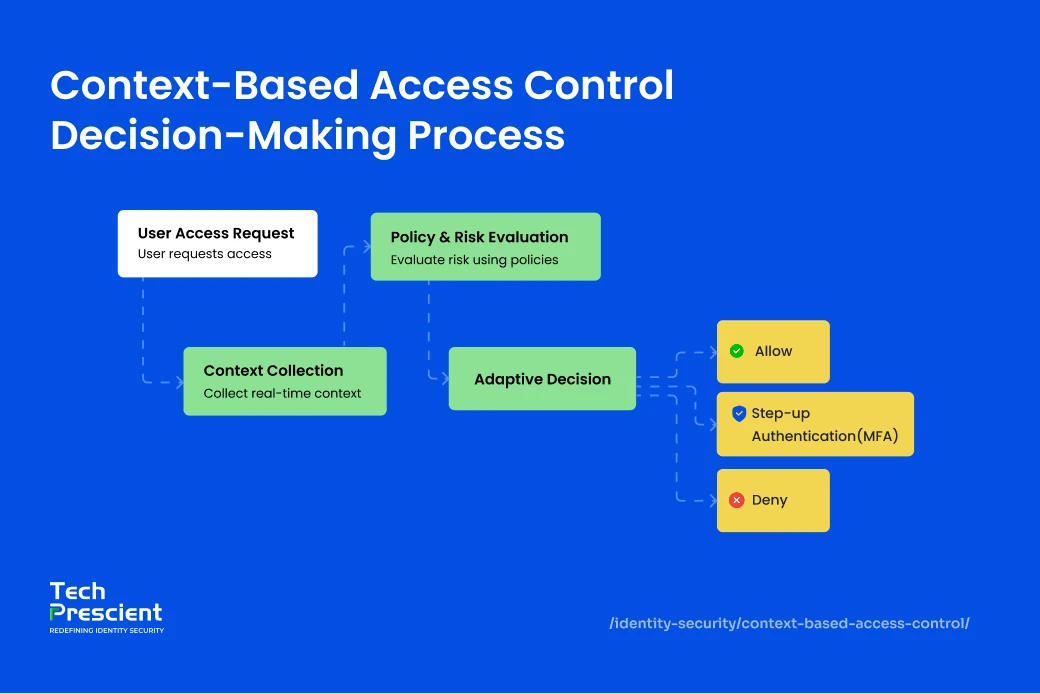
This is how it works:
Step 1. Access Request Initiated
A user attempts to access an application, system, or sensitive data. This request can originate from a browser, mobile app, VPN, API, or cloud service. At this point, access is not granted automatically; CBAC treats every request as untrusted until it is evaluated.
Step 2. Context Signals Collected
Before making a decision, the access control system collects multiple real-time context signals related to the request. These typically include:
- User context: identity, role, recent behavior, and risk history
- Device context: whether the device is managed, compliant, patched, or trusted
- Location and network: office network, home network, public Wi-Fi, or high-risk geography
- Session and time factors: unusual login hours, concurrent sessions, or abnormal activity
Together, these signals provide a real-time risk context for each access request.
Step 3. Risk Evaluated by Policy Engine
The policy engine evaluates the collected context against predefined access policies. Instead of relying on a single factor like role, CBAC weighs multiple signals together to calculate risk. For example, the same user may be considered low risk when accessing an app from a managed device at the office, but higher risk when accessing it from an unknown device on a public network.
Step 4. Decision Enforced Dynamically
Based on the calculated risk level, the system enforces an adaptive access decision:
- Allow: Access is granted seamlessly when the risk is low
- Step-up authentication: Additional verification, such as MFA, is required when risk increases
- Deny: Access is blocked entirely when risk exceeds acceptable thresholds
These decisions are enforced in real time and can change dynamically if context changes during the session.
Context-Based Access Control Example (Real World)
Context-Based Access Control (CBAC) adjusts access decisions in real time by evaluating risk, rather than relying on a fixed allow-or-deny rule.
Example Scenarios:
- Low risk: An employee logs in to a business application from a company-managed laptop during normal working hours on a trusted office network. Access is granted immediately, with no extra prompts.
- Medium risk: The same employee logs in late at night from a public Wi-Fi network. Access is allowed, but the system requires multi-factor authentication (MFA) to confirm identity.
- High risk: A login attempt is made using an unknown device from a high-risk or unusual location that does not match the user's normal behavior. Access is blocked to prevent potential compromise.
This illustrates how context-based access control adapts continuously to changing risk conditions while preserving seamless access for trusted users.
CBAC vs Traditional Access Control Models
Context-Based Access Control (CBAC) extends traditional access control models by continuously evaluating real-time risk and context, rather than relying only on predefined roles or static attributes.
CBAC vs RBAC vs ABAC: Comparison Table
| Feature / Aspect | RBAC (Role-Based Access Control) | ABAC (Attribute-Based Access Control) | CBAC (Context-Based Access Control) |
|---|---|---|---|
| Decision Basis | User role only | User, resource, and environment attributes | Role + real-time context + risk |
| Access Logic | Static and predefined | Policy-driven using attributes | Dynamic and adaptive |
| Context Awareness | None | Limited (mostly static attributes) | High (real-time signals) |
| Risk Evaluation | Not considered | Indirect | Explicit, risk-based |
| Examples of Inputs | Job role (e.g., Finance, HR) | Role, department, data sensitivity | Device health, location, network, time, behavior |
| Adaptability | Low | Medium | High |
| Zero Trust Alignment | Weak | Moderate | Strong |
| Best Fit For | Simple, stable environments | Policy-heavy environments | Cloud, remote work, Zero Trust architectures |
In simple terms:
- RBAC defines access based on role.
- ABAC defines access based on attributes and rules.
- CBAC evaluates role, attributes, and real-time context to adapt access based on risk.
This makes CBAC far better suited for modern environments with cloud apps, remote users, and constantly changing risk conditions.
Why CBAC is Critical for Zero Trust Security
Context-Based Access Control (CBAC) is fundamental to Zero Trust because it verifies every access request using real-time context rather than assumptions or past approvals.
Eliminates Implicit Trust
Zero Trust is built on the principle of "never trust, always verify." CBAC removes implicit trust by re-evaluating access every time a user attempts to log in or interact with a resource. Even if a user is already authenticated, access is not automatically granted unless the current context, such as device posture, location, and behavior, meets security expectations.
Supports Least-Privilege Access
CBAC enforces least privilege dynamically. Instead of granting broad, standing access based only on roles, it allows users to access only what they need, when they need it, and only under acceptable conditions. If the risk increases, access can be limited or revoked in real time, reducing the blast radius of compromised accounts.
Enables Adaptive Authentication
CBAC enables adaptive or step-up authentication based on risk. Low-risk access may proceed without friction, while higher-risk scenarios trigger additional controls such as MFA or session restrictions. This balances strong security with usability, protecting sensitive resources without slowing down trusted users.
CBAC in Modern Identity & IGA Architectures
Context-Based Access Control (CBAC) strengthens identity security by adding real-time context to how access is granted, reviewed, and governed across the entire access lifecycle.
CBAC + IAM: Smarter Authentication Decisions
When combined with IAM, CBAC helps decide how a user should authenticate based on risk. Instead of treating every login the same, IAM uses contextual signals, such as device trust, location, or behavior, to determine whether standard login is enough or if stronger authentication (like MFA or step-up verification) is required. This makes authentication adaptive rather than static.
CBAC + IGA: Policy Enforcement and Compliance
IGA focuses on who should have access and why. CBAC enhances this by enforcing those governance policies in real time. Access decisions are no longer based only on approved roles or entitlements, but also on the current context. This helps organizations enforce least privilege, support segregation of duties, and maintain audit-ready access controls even as conditions change.
Continuous Access Evaluation vs One-Time Approval
Traditional access models approve access once and assume it remains valid. CBAC enables continuous evaluation; access can be restricted, stepped up, or revoked if risk increases during a session. This approach aligns closely with modern governance needs, where access must remain compliant not just at approval time but throughout use.
Benefits of Context-Based Access Control
Context-Based Access Control (CBAC) strengthens security by adapting access decisions to real-world conditions, while still keeping the experience smooth for legitimate users.
Reduced breach risk
CBAC lowers the chances of unauthorized access by continuously evaluating risk signals such as device trust, location, and behavior. Even if credentials are compromised, risky access attempts can be blocked or challenged in real time.
Improved user experience
Trusted users don't face unnecessary friction. When context signals indicate low risk, such as access from a managed device on a corporate network, users can log in seamlessly without repeated authentication prompts.
Granular, adaptive access control
Instead of a simple allow-or-deny decision, CBAC enables flexible outcomes like step-up authentication, limited access, or temporary restrictions based on risk. This allows security teams to apply precise controls without disrupting productivity.
Better compliance alignment
By enforcing access based on real-time context and least-privilege principles, CBAC helps organizations meet regulatory expectations. It also improves audit readiness by ensuring access decisions are consistently justified, logged, and policy-driven.
Challenges & Best Practices for Implementing CBAC
Context-Based Access Control is highly effective when supported by well-defined policies, reliable context signals, and ongoing tuning to avoid unnecessary friction or blind spots.
Key Challenges in Implementing CBAC
While CBAC improves security, implementing it correctly can be complex. Organizations often struggle with selecting the right context signals, designing effective policies, and avoiding unnecessary access friction.
Inaccurate or unreliable context signals
CBAC depends on real-time inputs such as device posture, location, and user behavior. If these signals are incomplete, outdated, or poorly integrated, access decisions may be incorrect or inconsistent.
Overly complex access policies
As more context conditions are added, policies can quickly become difficult to manage. Complex rule logic increases the risk of misconfiguration, unexpected access denials, or excessive authentication prompts.
Increased user friction
Aggressive enforcement, such as frequent MFA challenges or unnecessary access blocks, can frustrate users and reduce productivity, especially when risk levels are not accurately assessed.
Limited governance and audit visibility
Without integration into identity governance systems, CBAC decisions may not be centrally logged, reviewed, or certified, making audits and compliance reporting more difficult.
Best Practices in Implementing CBAC
Successful CBAC implementation requires a balanced approach that improves security without disrupting users. Following proven best practices helps organizations deploy CBAC in a scalable, manageable, and effective way.
Start with High-Risk Resources
Begin by applying CBAC to systems and data that carry the highest risk, such as privileged applications, sensitive data stores, and remote access points. This approach delivers immediate security value while keeping the initial rollout manageable.
Avoid Overly Complex Policies
Overloading policies with too many conditions can make access decisions hard to understand and maintain. Keep rules simple and focused on the most meaningful context signals, then refine them gradually as you gain confidence and visibility.
Integrate with IGA and Device Management
CBAC works best when combined with Identity Governance and Administration (IGA) and endpoint management tools. IGA ensures access is appropriate and compliant over time, while device management provides reliable signals about device trust and health.
Continuously Monitor and Adjust Outcomes
Access patterns and risk levels change over time. Regularly review CBAC decisions, user behavior, and policy outcomes to identify false positives, gaps, or new risk trends. Continuous monitoring helps fine-tune controls and maintain a balance between security and usability.
Final Thoughts: Is CBAC Right for Your Organization?
Context-based access control reflects how access decisions need to work in modern environments. When users access applications from different devices, locations, and networks, static access rules are no longer enough. CBAC allows organizations to adapt access in real time based on risk, reducing exposure without slowing down trusted users.
If your organization relies on cloud applications, supports remote or hybrid work, or is moving toward a Zero Trust security model, CBAC is no longer a "nice to have." It becomes a foundational control for enforcing least privilege, improving security posture, and maintaining consistent access governance across dynamic environments.
FAQs
Context-based access control (CBAC) is a security model that makes access decisions using real-time signals such as user behavior, device health, location, network, and time. Instead of granting access based only on identity or role, CBAC evaluates the overall risk of each request before allowing, restricting, or blocking access.
RBAC grants access strictly based on predefined roles, which remain static over time. Contextual access control goes further by adjusting access dynamically using real-time context and risk signals, helping prevent misuse even when a user has the correct role.
A common example is allowing an employee to access an application from a managed corporate device during business hours, but requiring multi-factor authentication when the same user logs in late at night from public Wi-Fi or an unfamiliar location.
No. While CBAC is related to ABAC, it places greater emphasis on real-time and continuously changing context. ABAC often evaluates static attributes, whereas CBAC adapts access decisions dynamically based on current risk conditions at the time of access.


GET A PERSONALIZED DEMO
See Identity Confluence in Action
“One platform to govern identities, automate access decisions, and prove compliance; across every app, user, and system in your environment.”



Murli Ramsunder
Senior Architect, Vonage