
NIST CSF 2.0 Framework: Complete Guide for 2026
Last Updated date: July 18, 2026
On this page
See Tech Prescient in Action
Automate access, reduce risk, and stay audit-ready
NIST CSF 2.0 is a cybersecurity framework that helps organizations manage and reduce cyber risk using six core functions: Govern, Identify, Protect, Detect, Respond, and Recover. First introduced in 2014, the framework quickly became a global standard due to its flexibility across industries and organization sizes. The 2018 update, CSF 1.1, expanded guidance around supply chain risk and strengthened identity-related controls such as authentication and access management.
Released in February 2024, CSF 2.0 marks a major evolution. It introduces the Govern function, elevating cybersecurity to a leadership and board-level priority. The framework now includes six interconnected functions that operate continuously, aligning security with business goals, enterprise risk, and modern threats like cloud and third-party ecosystems.
According to IBM's Cost of a Data Breach Report 2024, the global average cost of a data breach reached $4.88 million, highlighting the need for structured risk management frameworks like CSF 2.0. Organizations with strong governance and risk alignment consistently reduce breach impact and recovery time. Let's explore how the NIST CSF 2.0 framework works, its six core functions, and how it maps to identity governance and enterprise risk.
Key Takeaways:
- NIST CSF 2.0 adds Govern as a sixth function, making cybersecurity a board-level, business risk priority.
- The framework uses six integrated functions to manage cyber risk continuously, from identification to recovery.
- It is flexible and applicable to all organizations, including cloud, SaaS, and modern digital ecosystems.
- Implementation Tiers and Profiles help assess maturity and guide improvement from current to target state.
- Strong alignment with identity governance enables better access control, risk reduction, and compliance.
What Is the NIST CSF 2.0 Framework?
The NIST Cybersecurity Framework (CSF) 2.0 is a voluntary cybersecurity risk management framework developed by the U.S. National Institute of Standards and Technology (NIST). It helps organizations identify, manage, and reduce cyber risk through a structured model built around six core functions.
To understand its relevance, it is important to look at what the framework is designed to achieve and how it is applied in practice:
1. Purpose and Approach
NIST CSF 2.0 provides a structured yet flexible approach to managing cybersecurity risk. It enables organizations to identify threats, protect critical assets, detect anomalies, respond to incidents, and recover effectively, while aligning cybersecurity efforts with broader business and enterprise risk objectives.
2. Voluntary and Adaptable Framework
The framework is voluntary and non-prescriptive, allowing organizations to tailor its guidance based on their size, industry, and risk maturity. This flexibility creates a common language between security, IT, and business teams, improving decision-making and prioritization.
3. Designed for Broad Adoption
Although originally developed for U.S. critical infrastructure, CSF 2.0 is now applicable across industries and organization types. Enterprises, SMBs, government agencies, and digital-first companies can all use the framework to strengthen their cybersecurity posture.
4. Expanded for Modern Cybersecurity Needs
With its 2024 update, CSF 2.0 extends beyond its original scope to support all industries and digital environments, including cloud and SaaS ecosystems. It introduces stronger governance, enhanced supply chain risk management, and measurable outcomes, helping organizations continuously assess, align, and improve their cybersecurity posture.

Pro Tip
Don't try to implement the entire NIST CSF 2.0 framework at once, start with a clear understanding of your current security posture and biggest risk areas. Focusing on high-impact gaps first makes adoption more practical, measurable, and aligned with business priorities.
Why Did CSF 2.0 Replace Version 1.1?
NIST CSF 2.0 replaces version 1.1 to address the shift from operational cybersecurity to enterprise-wide risk management and governance. While CSF 1.1 provided a strong foundation, it did not fully account for modern challenges such as supply chain attacks, cloud adoption, and the need for executive accountability.
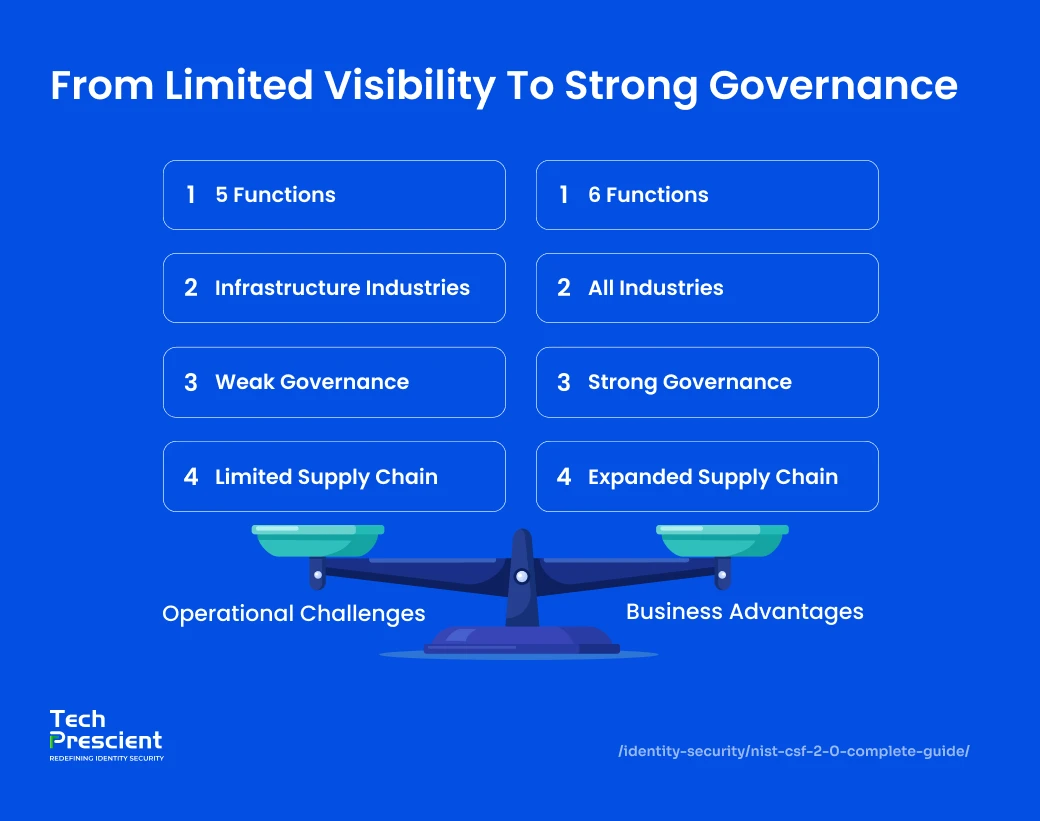
To understand this evolution, here are the key areas where CSF 2.0 improves upon 1.1.
1. Governance Becomes Central
CSF 1.1 treated governance as a supporting element, but CSF 2.0 introduces Govern as a dedicated function, making cybersecurity a board-level responsibility tied to business strategy and risk management.
2. Broader Scope Across All Organizations
The earlier version was primarily designed for critical infrastructure sectors, whereas CSF 2.0 is explicitly built for organizations of all sizes and industries, including modern digital and cloud-first environments.
3. Stronger Supply Chain and Risk Focus
CSF 2.0 significantly enhances supply chain risk management (SCRM) and introduces more continuous and measurable risk assessment practices, reflecting the rise of third-party and ecosystem risks.
4. Better Alignment with Modern Threats and Implementation Needs
The updated framework incorporates guidance for cloud security, AI-driven threats, ransomware, and zero trust architectures, along with more practical implementation guidance and improved usability.
Quick Comparison: NIST CSF 1.1 vs CSF 2.0
| Sr. No | CSF 1.1 | CSF 2.0 |
|---|---|---|
| 1 | CSF 1.1 includes five core functions: Identify, Protect, Detect, Respond, and Recover. | CSF 2.0 expands this model by adding a sixth function, Govern, to strengthen oversight and accountability. |
| 2 | CSF 1.1 was primarily focused on critical infrastructure sectors. | CSF 2.0 is designed to be applicable to organizations of all sizes and across all industries. |
| 3 | Governance in CSF 1.1 was limited and not explicitly defined as a core function. | CSF 2.0 introduces a dedicated governance function with clear emphasis on leadership and board-level accountability. |
| 4 | Supply chain risk management guidance in CSF 1.1 was limited in depth. | CSF 2.0 provides expanded and more detailed supply chain risk management guidance. |
| 5 | CSF 1.1 focused mainly on operational cybersecurity activities. | CSF 2.0 shifts toward enterprise-wide risk management aligned with business objectives. |
| 6 | Coverage of modern threats like cloud, AI, and ransomware was limited. | CSF 2.0 explicitly addresses modern environments and emerging threats, including cloud, SaaS, and AI-driven risks. |
| 7 | Implementation guidance in CSF 1.1 was relatively high-level. | CSF 2.0 offers more detailed, practical guidance and real-world implementation examples. |
Key difference
CSF 2.0 adds the Govern function, expands applicability across industries, and aligns cybersecurity with enterprise risk and business strategy.
The 6 Core Functions of NIST CSF 2.0
NIST CSF 2.0 is built around six core functions that together define the lifecycle of cybersecurity risk management. These functions operate continuously rather than sequentially, enabling organizations to manage cyber risk in a dynamic, real-world environment.
To understand how the framework works in practice, each function plays a distinct yet interconnected role:
Govern (GV) – New in CSF 2.0
The Govern function establishes the strategic direction for cybersecurity by aligning it with business objectives, enterprise risk, and regulatory expectations. It introduces executive-level ownership, ensuring that cybersecurity is not just an IT responsibility but a leadership priority. This function defines policies, assigns roles and responsibilities, and ensures ongoing oversight, including third-party and supply chain risk governance.
Identify (ID)
The Identify function focuses on building a comprehensive understanding of the organization's environment, including its assets, systems, and risk exposure. By identifying critical assets, business context, and potential vulnerabilities, organizations can prioritize their cybersecurity efforts effectively. It also incorporates supply chain considerations, ensuring risks from external dependencies are accounted for.
Protect (PR)
The Protect function is centered on implementing safeguards to secure systems, data, and operations. It includes access control, identity management, data protection, and employee awareness initiatives. These measures work together to ensure the confidentiality, integrity, and availability of information while reducing the likelihood and impact of cyber incidents.
Detect (DE)
The Detect function enables organizations to identify cybersecurity events in a timely manner. It relies on continuous monitoring, anomaly detection, and security event analysis to quickly recognize potential threats. Early detection is critical for minimizing damage and enabling a faster, more effective response.
Respond (RS)
The Respond function defines how organizations take action once a cybersecurity incident is detected. It includes executing incident response plans, managing communications with stakeholders, and implementing mitigation strategies to contain and reduce the impact of the incident. A well-defined response capability ensures operational stability during disruptions.
Recover (RC)
The Recover function focuses on restoring systems and operations after an incident while strengthening resilience for the future. It involves recovery planning, coordinated communication, and continuous improvement based on lessons learned. This function ensures that organizations can return to normal operations quickly and adapt to prevent similar incidents.
Together, these six functions provide a continuous, structured approach to cybersecurity, helping organizations proactively manage risk while aligning security efforts with business priorities.
Core Components of CSF 2.0
The core components of NIST CSF 2.0 include the Core, Implementation Tiers, and Organizational Profiles, which together help assess and improve cybersecurity maturity.
To understand how the framework translates into real-world implementation, let's break down each component:
1. The Core
The CSF Core is the foundation of the framework. It organizes cybersecurity activities into a structured hierarchy of Functions Categories Subcategories, providing clear guidance on desired security outcomes.
At the highest level, the Core consists of six functions: Govern, Identify, Protect, Detect, Respond, and Recover. These functions work continuously and in parallel, not as a linear sequence. Each function is further divided into categories and subcategories that define specific cybersecurity outcomes and practices.
For example, the Protect function includes areas such as identity management, awareness and training, and data security, giving organizations a practical way to implement safeguards across systems and users.
2. Implementation Tiers
Implementation Tiers describe how an organization approaches cybersecurity risk management, ranging from informal practices to highly adaptive strategies. These tiers are not a strict maturity ladder but a way to align cybersecurity efforts with business requirements and risk tolerance.
- Tier 1 (Partial): Risk management is ad hoc and reactive, with limited awareness of cybersecurity risks.
- Tier 2 (Risk-Informed): Risk practices are approved by management but are not consistently applied across the organization.
- Tier 3 (Repeatable): Formal policies are established, and risk management practices are consistently implemented.
- Tier 4 (Adaptive): Cybersecurity practices are continuously improved using real-time insights and predictive risk indicators.
Organizations may operate at different tiers across systems depending on their criticality. The goal is not to reach Tier 4 everywhere, but to achieve the right level of risk management.
3. Organizational Profiles
Organizational Profiles help translate the framework into a practical roadmap for improvement. They allow organizations to compare their current cybersecurity capabilities with their desired future state.
- The Current Profile represents the organization's existing cybersecurity posture, including implemented controls and capabilities.
- The Target Profile defines the desired state based on business objectives, risk appetite, and regulatory requirements.
By comparing these profiles, organizations can perform a gap analysis to identify areas that need improvement. This enables better prioritization of investments, clearer decision-making, and measurable progress toward stronger cybersecurity outcomes.
Together, these components make CSF 2.0 a practical and adaptable framework, enabling organizations to assess, prioritize, and continuously enhance their cybersecurity posture without requiring formal certification.
Who Should Use NIST CSF 2.0?
NIST CSF 2.0 is a flexible, risk-based framework designed for organizations of all sizes and industries. While it is voluntary, it is widely adopted as a foundation for managing cybersecurity risk, strengthening governance, and aligning security with business and regulatory requirements.
To understand its practical relevance, here is how different industries apply the framework based on their unique risk environments:
1. Healthcare
Healthcare organizations use CSF 2.0 to protect sensitive patient data, electronic health records (EHRs), and connected medical devices. With increasing reliance on digital systems, the framework helps manage risks across clinical and operational environments while supporting compliance with regulations such as HIPAA. It also enables healthcare providers to ensure data integrity, availability, and continuity of care, even during cyber incidents.
2. Financial Services
Financial institutions adopt CSF 2.0 to secure high-value financial data, transactions, and customer identities. The framework helps them manage risks related to fraud, ransomware, and third-party services while meeting strict regulatory expectations. By aligning cybersecurity with enterprise risk, banks and financial firms can improve threat detection, incident response, and overall resilience.
3. Government Agencies
Government organizations use CSF 2.0 to protect critical infrastructure, national security systems, and citizen data. The framework provides a standardized approach to managing cybersecurity across departments, improving coordination and accountability. It also helps agencies strengthen defenses against advanced persistent threats and nation-state attacks while ensuring service continuity.
4. SaaS and Cloud-First Companies
SaaS providers and cloud-native organizations rely on CSF 2.0 to secure multi-tenant environments, customer data, and cloud infrastructure. The framework helps address risks related to shared responsibility models, third-party integrations, and rapid scaling. It enables these organizations to implement consistent security controls, continuous monitoring, and strong access management practices.
5. Manufacturing and Industrial Systems
Manufacturers apply CSF 2.0 to secure operational technology (OT), industrial control systems (ICS), and intellectual property. As factories become more connected, the framework helps manage risks across IT and OT environments while addressing supply chain vulnerabilities. It also supports business continuity and resilience, ensuring production systems remain secure and operational.
In practice, organizations adopt NIST CSF 2.0 to standardize cybersecurity practices, improve risk visibility, and align security initiatives with business goals and compliance requirements, regardless of their industry or maturity level.
Mapping NIST CSF 2.0 to Identity Governance (IGA)
Identity Governance aligns with NIST CSF 2.0 by enforcing access control, visibility, and compliance across all six cybersecurity functions.
To understand this relationship, here is how Identity Governance aligns with each CSF 2.0 function.
How Identity Governance Supports Each CSF Function
| Sr. No | CSF Function | IGA Alignment |
|---|---|---|
| 1 | Govern | Identity Governance enforces access policies, role definitions, and access certifications, ensuring accountability and alignment with enterprise risk and compliance requirements. |
| 2 | Identify | It enables a complete identity inventory, including users, roles, and entitlements, helping organizations understand who has access to what across systems. |
| 3 | Protect | IGA strengthens access control and least privilege enforcement, ensuring only authorized identities can access critical systems and data. |
| 4 | Detect | Continuous monitoring of identities allows organizations to detect anomalous access patterns and suspicious behavior, supporting early threat detection. |
| 5 | Respond | Automated workflows such as deprovisioning, access revocation, and policy enforcement help quickly contain identity-related risks during incidents. |
| 6 | Recover | Identity systems support restoration of access, credential resets, and secure re-provisioning, ensuring business continuity after an incident. |
Why Identity Governance Is Central to CSF 2.0
Identity is now at the center of modern cybersecurity. The CSF 2.0 framework explicitly emphasizes identity management, authentication, and access control within its Protect function, reinforcing the importance of controlling who can access critical resources.
By aligning Identity Governance with CSF 2.0:
- Organizations can reduce unauthorized access and insider risks
- Strengthen Zero Trust security models through continuous verification
- Improve compliance readiness and auditability
In practice, Identity Governance acts as the execution layer of CSF 2.0, translating high-level framework guidance into enforceable access controls, visibility, and continuous risk management across the organization.
Common Challenge
Many organizations struggle with visibility into user access across cloud and SaaS environments, leading to over-permissioning and compliance gaps. Identity governance helps solve this by enforcing least privilege and continuous access monitoring.
Final Thoughts
The NIST CSF 2.0 framework provides a structured approach to managing cyber risk across governance, protection, detection, and recovery. With the introduction of the Govern function, it brings stronger board-level accountability, enterprise-wide risk alignment, and deeper focus on supply chain security. As organizations navigate complex digital ecosystems, adopting CSF 2.0 becomes essential to improving cybersecurity maturity, reducing risk exposure, and aligning security with business strategy.
Tech Prescient helps organizations strengthen identity governance, automate access controls, and operationalize CSF 2.0 across critical functions.
FAQs
The NIST CSF 2.0 framework is a voluntary cybersecurity framework designed to help organizations manage and reduce cyber risk. It provides structured guidance across six core functions: Govern, Identify, Protect, Detect, Respond, and Recover. Together, these functions create a lifecycle approach to building and improving cybersecurity maturity.
No, NIST CSF 2.0 is not mandatory and is intended to be a voluntary framework. However, many organizations adopt it because it is often referenced in regulations, contracts, and industry standards. In practice, it becomes a baseline for demonstrating strong cybersecurity and compliance readiness.
Yes, the NIST CSF 2.0 framework is completely free to use. Organizations can access the full framework, including the NIST CSF 2.0 PDF, through official NIST resources. This makes it highly accessible for businesses of all sizes looking to strengthen cyber risk management.
NIST CSF 2.0 was officially released on February 26, 2024. This update builds on the original 2014 version and introduces key enhancements like the Govern function. It reflects modern cybersecurity needs, including enterprise risk alignment and supply chain security.
You can download the NIST CSF 2.0 PDF directly from official NIST resources online. The document is publicly available and includes detailed guidance on functions, implementation tiers, and profiles. It is the best place to start if you are planning adoption or deeper evaluation.


GET A PERSONALIZED DEMO
See Identity Confluence in Action
“One platform to govern identities, automate access decisions, and prove compliance; across every app, user, and system in your environment.”



Murli Ramsunder
Senior Architect, Vonage