
Continuous Service Account Governance: Reviews, Rotation, and Ownership After Day 1
Last Updated date: October 13, 2026
On this page
See Tech Prescient in Action
Automate access, reduce risk, and stay audit-ready
A service account is a non-human identity that applications, scripts, and automation use to authenticate without a person logging in. Discovery, classification, and ownership assignment get an organization to Day 1. Keeping that inventory accurate afterward, as new accounts appear, owners change teams, and credentials age, is the harder problem, and the one most programs never solve.
Continuous service account governance closes that gap. It runs discovery, reviews, rotation, and ownership transfers as recurring processes instead of one-time operations. Here is the process Identity Confluence follows day to day, and what it changes for the security, compliance, and operations teams responsible for non-human identity governance.
TL;DR
- Ungoverned service accounts create three concrete risks: security exposure from leaked credentials, compliance failure from missing evidence, and weekly operational friction.
- New service accounts surface on the next identity provider sync, classified with assigned owners.
- Access reviews run on a defined timeline, so accounts get re-confirmed or removed instead of accumulating.
- Credential rotation intervals are set per account based on risk, with reminders sent to the assigned owner.
- Ownership transfers automatically when an owner leaves: to the manager, then a fallback user, and to the parent application owner by default. No NHI is left without an accountable owner.
- Every governance action generates an audit record, so compliance evidence builds itself as the system runs.
What Happens When Service Accounts Go Ungoverned
Service accounts authenticate to production databases, deploy code, move customer data between systems, and call internal APIs without anyone watching. When they are not actively governed, the consequences show up in three places.
Security exposure:
Service account credentials often live for years inside config files, scripts, and CI pipelines. The longer they sit unrotated, the more places they get copied, and the less anyone tracks where they ended up. A leaked credential on an ungoverned account gives an attacker quiet, persistent access to whatever that account can reach.
GitGuardian's State of Secrets Sprawl 2026 report found that nearly 64% of all credential(s), which had been proven to be valid in 2022, remained active and could potentially have been used by hackers as late as January 2026. The same research analyzing systems affected by the Shai-Hulud 2 breach reported that most secrets were replicated across eight different areas per machine, such as .env file content, shell history records, integrated development environment configurations, token cache, etc., and that nearly 60% of systems breached for this purpose were running Continuous Integration/Continuous Deployment (CI/CD) workloads, and not user-owned laptop computers.
Compliance failure:
Auditors ask three questions about every privileged account: who owns it, when it last rotated, and when its access was last reviewed. Without active NHI lifecycle management, the answers do not exist. The control fails on missing evidence, not on confirmed incidents.
Operational drag:
Ungoverned service accounts create steady, low-grade friction. A credential gets rotated without notifying the team that depends on it, and an integration goes down. Permissions added for a one-off project stay in place for years. Engineers spend hours tracing failures back to undocumented changes. Each incident is small enough to absorb. The cumulative cost is a team that spends its week on avoidable work.
Rather than running discovery every 6 months, which only seems to move the gap between where the company is now and where it should be, governance must run on the same cadence as the environment in which the company exists and grows continuously. It is a system that runs machine identity governance continuously, so these gaps never get the chance to open.
The Continuous Governance Process
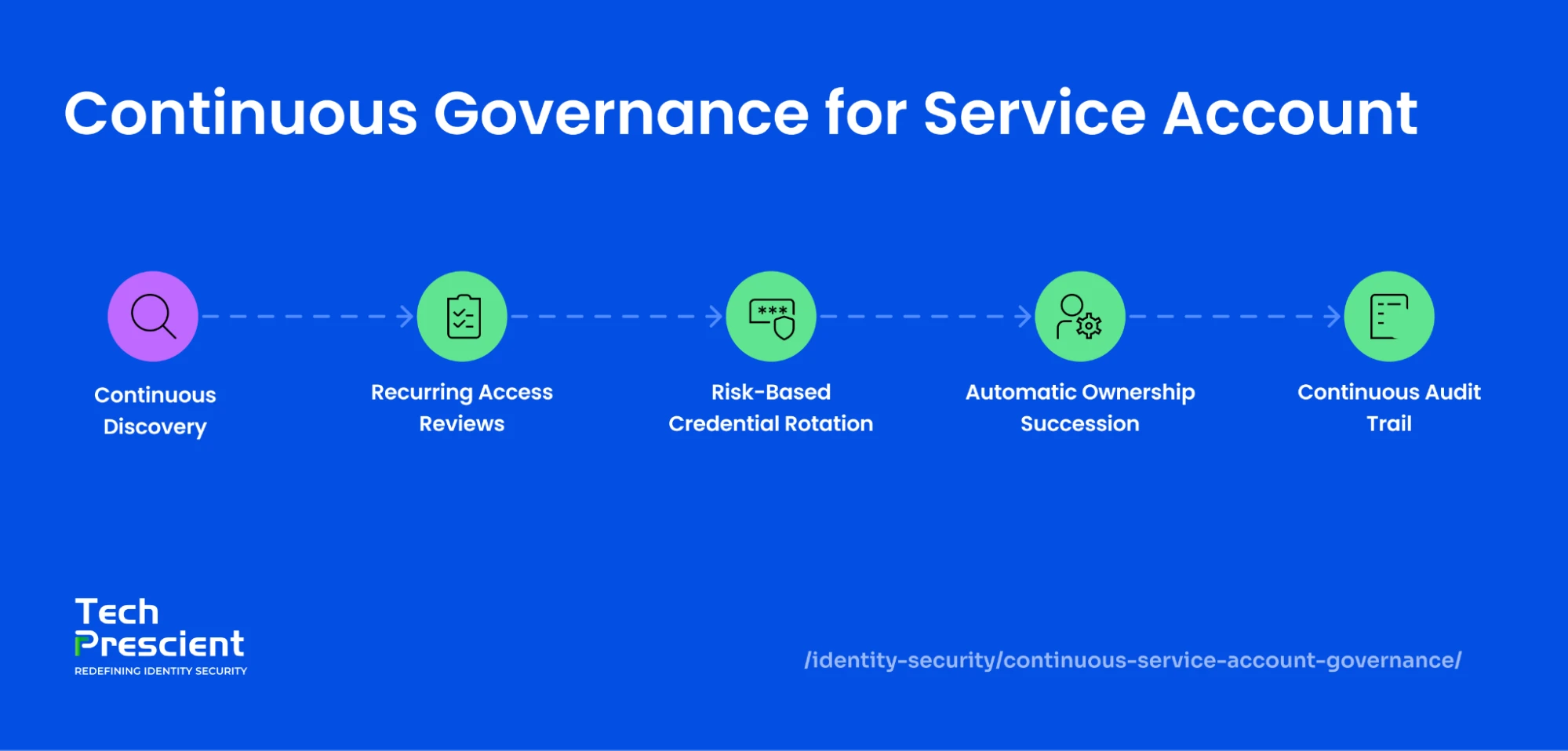
Tech Prescient's Identity Confluence keeps service accounts governed through five recurring loops that run on their own once configured. Each loop handles a different governance function, and together they replace the periodic initiative with a system that stays running by default.
Continuous Discovery on Every Identity Provider Sync
The identity provider sync that powers joiner, mover, and leaver workflows for human users does double duty for service accounts. Each time it runs, Identity Confluence reconciles accounts from connected applications and cloud platforms against the identity provider. Anything new that does not correlate to a human surface is a potential NHI on that same cycle.
Mostly, it needs to be running at all times since so many of those non-human accounts have no intention on going through an identity gap provisioning flow. According to Orchid Security's Identity Gap: 2026 Snapshot; about two-thirds (67%) of new non-human accounts were made directly within the application and not observable by IAM or otherwise inventoried as part of a single one time effort.
Recurring Access Reviews on a Defined Cadence
Service account governance falls apart without a recurring "is this still needed" question. Identity Confluence runs access reviews for service accounts the same way it runs them for human users. The assigned owner reviews each account on a defined interval, and either confirms the account is still serving an active purpose or submits a deprovisioning request.
Risk-Based Credential Rotation
The credential rotation policy is configured per account based on risk. A read-only API key to a non-critical system rotates every 90 days. A deployment credential with write access to production rotates every 30 days. Identity Confluence sends the owner a reminder at the configured interval. The owner rotates the credentials in the target system on their schedule. The action is logged. This pattern repeats indefinitely without intervention.
Application Insight:
Risk for a service account is calculated using the application it belongs to, the account itself, and the access it holds. Identity Confluence lets you set this formula once at the tenant level and override it per application, so a production database account and a read-only reporting account are never treated the same.
Automatic Ownership Succession When Owners Leave
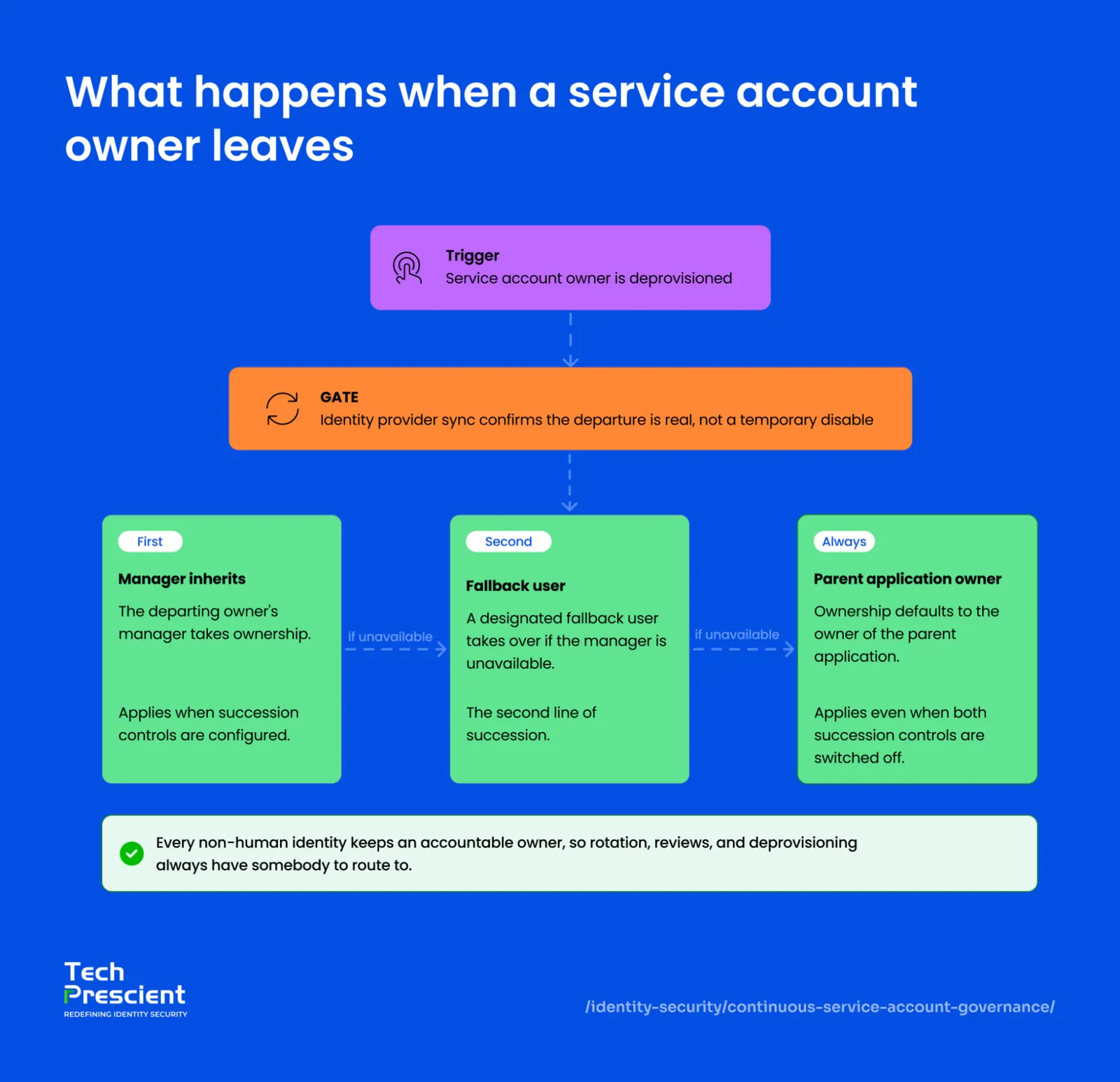
When a service account owner is deprovisioned, Identity Confluence transfers ownership automatically based on a pre-configured ownership succession policy. The handoff fires after the identity provider sync confirms the owner is truly gone, not on a temporary disable.
NHIs carry a structural guarantee here. If both succession controls are configured, the manager inherits ownership first, with a fallback user as the second line. Even if both controls are turned off, ownership defaults to the parent application owner. NHIs are never left without an accountable person.
Continuous Audit Trail Across Every Action
Every governance action generates a record. Discovery flags a new account. Classification assigns an owner. Rotation reminders go out. Access reviews are completed. Deprovisioning requests open tickets. Ownership transfers are timestamped after identity provider confirmation. Nobody assembles this at audit time. The evidence accumulates as a byproduct of the system running.
Want to self-assess first?
Score your service account governance against the 2026 NHI Checklist.
What Changes Under Continuous Governance?
The inventory stays accurate on its own, new accounts surface on the next sync, stale ones get caught in the next review, and the count you give an auditor today matches what is in the system today.
Compliance evidence builds itself as a benefit of the system functioning correctly, instead of being reconstructed before every audit. Forgotten service accounts stop being a breach vector because reviews, rotation, and succession keep every account accountable. Once the loops are running, the team's attention moves from chasing rotation deadlines to handling exceptions.
What Comes Next
Continuous service account governance is the operational layer that sits on top of discovery and ownership. Once the foundation is in place, the system runs on its own, and the work shifts from setup to oversight.
Tech Prescient's Identity Confluence sustains machine identity governance, with discovery, reviews, rotation, and succession all running on schedule.
FAQs
Service account credentials will rotate based on risk as opposed to having an individual (one) standard rotation period. For example; a read-only api key that does not provide critical access would rotate in 90 day increments. While a credential providing deployment access with write capability to your production environment, may be rotated at 30 day increments. In addition to setting the interval for each account, Identity Confluence also provides reminders to the owner of the account when the rotation date approaches.
Service-accounts transfer ownership automatically after identity provider sync confirms that the previous owner's status is no longer active but rather permanently disabled. If neither the automatic successor or the manual successor is available then ownership will default to the owning application regardless of whether either of these options were enabled by the organization.
A periodic audit produces an inventory that is accurate on the day it's taken and decays from there. Continuous governance runs discovery on every identity provider sync, reviews on a defined cadence, and rotation on per-account intervals, so the gap between reality and the record never widens.
Yes. Most compliance frameworks expect periodic certification of privileged access, and service accounts often hold more privilege than the people around them. Identity Confluence runs access reviews for service accounts on the same cadence as human users, with the assigned owner confirming or requesting deprovisioning.


GET A PERSONALIZED DEMO
See Identity Confluence in Action
“One platform to govern identities, automate access decisions, and prove compliance; across every app, user, and system in your environment.”



Murli Ramsunder
Senior Architect, Vonage