
Designing Least Privilege with RBAC and ABAC
Last Updated date: September 17, 2026
On this page
See Tech Prescient in Action
Automate access, reduce risk, and stay audit-ready
Every role has a baseline. Every attribute narrows it. Every provisioning event proves it was actually applied.
A new hire's access on day one rarely gets questioned again. The problem is that access granted during provisioning can become excessive as roles, departments, and projects change. When provisioning is manual, teams often grant everything someone might need instead of defining exactly what the person should have. That is where access creep, security risk, and audit gaps begin.
Tech Prescient's Identity Confluence takes a more structured approach to least privilege access control. RBAC establishes the baseline for a role, ABAC narrows that baseline using identity attributes, and workflows automate how the policy is applied. The result is a provisioning process that can be defined, executed, approved, and verified rather than handled as a series of manual access decisions.
TL;DR
- RBAC establishes predictable access based on business roles.
- ABAC narrows role-based access using attributes such as department and project.
- Birthright policies define the baseline access a role should receive.
- Identity Confluence Workflows applies these policies automatically during joiner events and other identity processes.
- Human approvals can remain part of the workflow for sensitive or elevated access.
- Sync-and-verify confirms that the access designed by policy is the access actually provisioned.
What RBAC and ABAC Solve
RBAC, or role-based access control, answers a simple question: What access should someone receive because of their role?
For example, a QA tester may have a defined set of applications associated with the QA role. That creates a predictable baseline instead of requiring an administrator to decide access application by application.
The problem is that roles can become too broad. Two employees with the same designation may work in different departments or projects and therefore need different access.
That is where ABAC, or attribute-based access control, adds precision. Attributes such as department, project code, or identity source can be used to narrow the access granted through the role.
The combination creates a practical least privilege access control model:
RBAC defines the baseline. ABAC constrains it. Workflows enforce it.
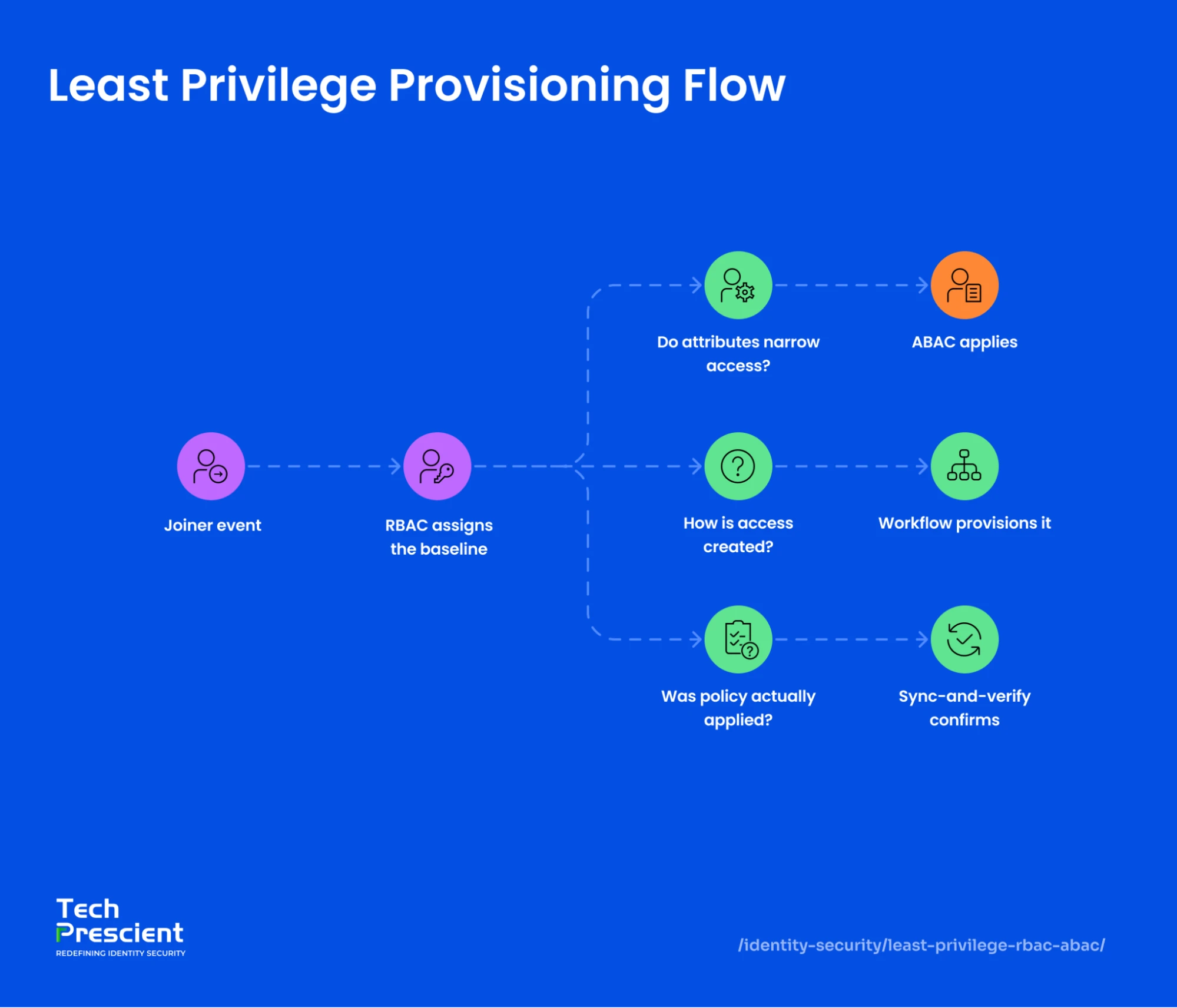
How Identity Confluence Applies the Model
Identity Confluence connects access policy with provisioning execution through Workflows.
A typical joiner process can work like this:
- A joiner event triggers the workflow. Instead of waiting for an administrator to manually create access, the identity event starts the defined provisioning process.
- The business role establishes baseline access. A birthright policy defines the standard entitlements associated with that role.
- Attributes narrow the baseline. Workflow logic evaluates attributes such as department or project code to determine whether additional access is relevant.
- Actions provision the required access. The workflow can provision applications and update roles or group memberships across connected applications.
- Sensitive access goes through approval. Where elevated access requires human judgment, the workflow can route the request to the appropriate approver before continuing.
- The result is synchronized and verified. Identity Confluence checks that the access defined by the policy was actually provisioned, closing the gap between intended access and actual access.
For example, a new Finance employee can receive the standard access associated with their business role. Workflow logic can then determine whether department-specific applications should be included. If access to a sensitive environment is required, the workflow can pause for manager approval before provisioning it.
Key Capabilities
Birthright Policies
Birthright policies establish the minimum baseline for a business role. Instead of treating baseline access as an administrator's judgment call, the policy defines what the role should receive when the identity is provisioned.
Attribute-Based Logic
ABAC logic adds context to role-based access. Department, project code, and other identity attributes can determine whether access should be included or excluded from the baseline.
Automated Provisioning Workflows
Identity Confluence Workflows uses triggers, actions, logic, integrations, and human input to automate repeatable identity processes. This allows joiner provisioning to follow a defined process instead of relying on repeated manual intervention.
Human Approvals
Automation does not have to eliminate human control. Sensitive or elevated access can be routed through approval steps while routine provisioning continues automatically.
Sync-and-Verify
Provisioning is not complete simply because a policy says access should exist. Sync-and-verify confirms that the intended access matches what was actually provisioned in identity management.
Execution Logging
Workflow activity provides a traceable history of provisioning actions, supporting audit review and helping teams understand how access decisions were executed.
Where This Model Fits
This approach is particularly relevant when organizations need to:
- Scale hiring: Apply consistent birthright access across large numbers of new employees.
- Manage project-based access: Give people with the same designation different access based on project requirements.
- Control departmental variation: Prevent broad roles from becoming catch-all access packages.
- Govern sensitive access: Automate routine provisioning while retaining approval for elevated permissions.
- Handle movers: Trigger role and access changes when an employee moves between departments.
- Prepare for audits: Use workflow history and provisioning verification to demonstrate how access was granted.
Where RBAC and ABAC Stop
RBAC and ABAC can make provisioning more precise, but least privilege is not a one-time provisioning problem.
An employee can change departments, move to another project, or take on different responsibilities. Access that was appropriate on day one may no longer be appropriate months later.
That makes the broader joiner-mover-leaver lifecycle important. The same workflow-driven approach used to provision access can be extended to role changes and revocations, ensuring access decisions continue to reflect the identity's current context.
The key distinction is simple: RBAC defines what the role should receive, ABAC determines what the context allows, and Identity Confluence Workflows turns that decision into an executable, auditable process.
If your current least privilege access control model still depends on administrators manually translating policies into application access, Identity Confluence provides a way to connect those policies directly to provisioning and verification.


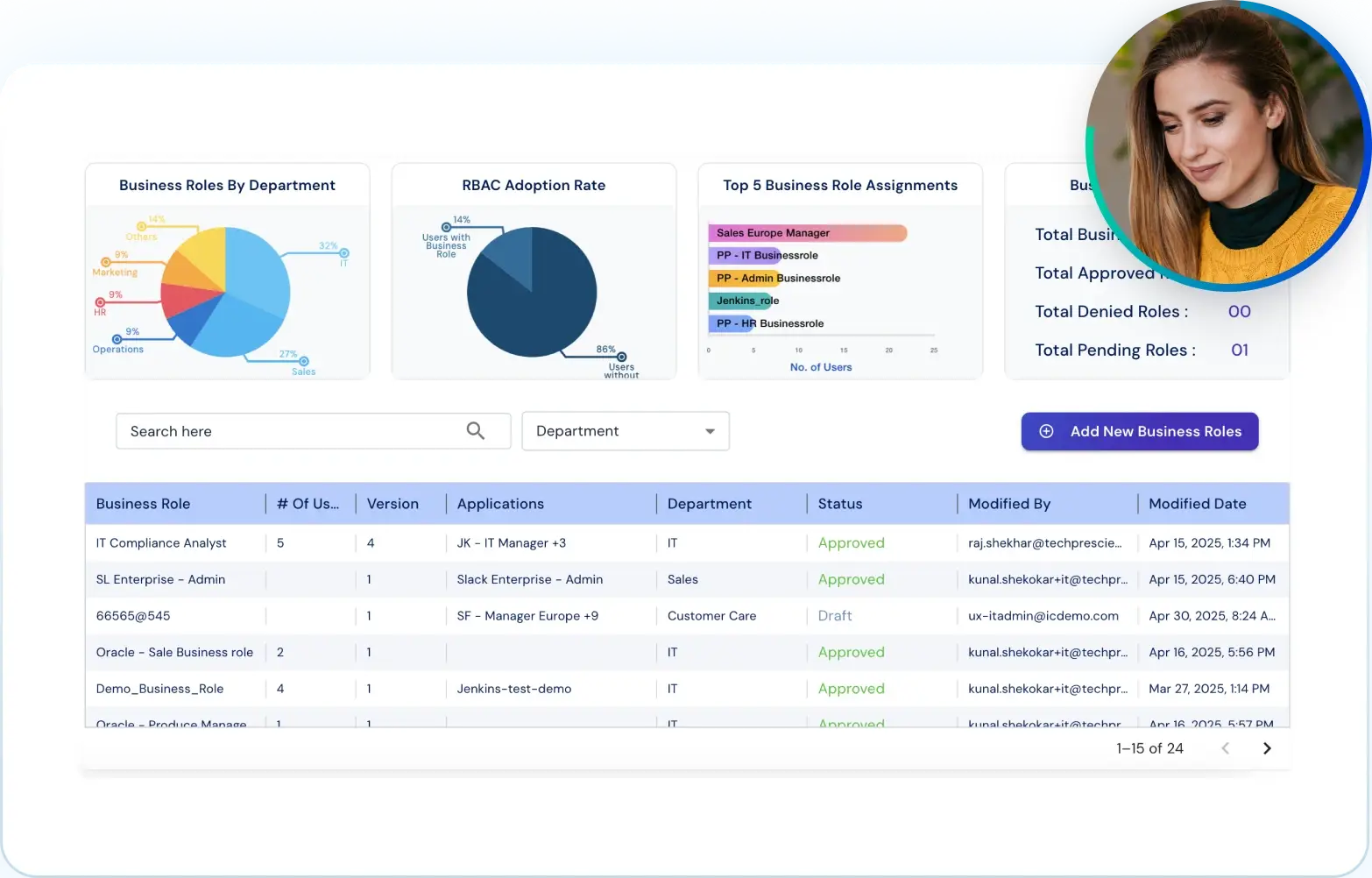
GET A PERSONALIZED DEMO
See Identity Confluence in Action
“One platform to govern identities, automate access decisions, and prove compliance; across every app, user, and system in your environment.”



Murli Ramsunder
Senior Architect, Vonage