
Ownership Mapping for Service Accounts Explained
Last Updated date: November 26, 2026
On this page
See Tech Prescient in Action
Automate access, reduce risk, and stay audit-ready
Service accounts power your critical infrastructure. Deployment pipelines depend on them. Data integration tools rely on them. Monitoring and alerting systems run on them. Yet most organizations treat them as secondary infrastructure components, often created ad hoc and not consistently governed.
The problem isn't discovery. Modern identity governance tools can find these accounts. The problem is ownership. Service accounts remain orphaned. Credentials often lack consistent rotation. Nobody knows why they exist. When auditors ask who manages each account, teams often lack clear answers.
This is the ownership gap, and it costs enterprises in three ways: compliance risk, security exposure, and operational chaos.
Ownership mapping closes that gap. It assigns explicit responsibility for every service account. It automates rotation reminders based on defined policies. It creates verifiable audit trails. It turns a discovered list of unmanaged accounts into a governed, auditable inventory.
This guide shows how Identity Confluence, our next-gen IGA platform, implements ownership governance for service accounts. Assign responsibility. Define rotation policy. Automate with Jira and Zoho via webhook integrations. This is how discovery becomes governance.
TL;DR:
- Explicit ownership assigns one accountable person per service account, closing governance gaps
- Reminder-driven rotation with configurable intervals keeps credentials fresh without forced revocation
- Every creation, approval, rotation, and deprovisioning request generates a compliance-ready audit trail via webhooks
- Risk-based rotation intervals scale without vault infrastructure
- Result: Service accounts move from invisible and unmanaged to governed and auditable
The Ownership Problem
You've completed account discovery. You have a comprehensive inventory of service accounts. You know their types, locations, and purposes. But once you ask the accountability question, gaps begin to appear.
- Who owns Automation Bot? Ownership is unclear.
- When was the sync service last rotated? No consistent record exists.
- Why does deployment-credential still have write access to production? Nobody has reviewed it in three years.
This happens because service accounts are created for immediate operational needs, not documented governance. A developer creates an API key to integrate two systems. The integration works perfectly. The developer moves teams. The manager leaves. The integration runs silently in the background. Ownership is often not documented. Nobody sets a rotation schedule. The account is now orphaned, still authenticating, still active, still permissioned, but lacking defined accountability.
Over time, this compounds. Accounts accumulate. Credentials age without rotation. Permissions grow through exception requests never cleaned up. Auditors ask for proof of control and organizations often struggle to provide evidence.
Ownership mapping bridges this gap. It assigns explicit responsibility to a real person or team. That owner becomes the single point of accountability for the account's security, necessity, and lifecycle management.
Why Ownership Matters: Three Failure Modes
Compliance Risk
Auditors require proof of ownership, rotation frequency, and deprovisioning decisions. Without ownership, organizations may not be able to provide it consistently. Compliance teams fail SOX, GDPR, HIPAA, or industry-specific audits not because controls are missing but because accountability is missing. An auditor cannot approve a control that they cannot verify is owned and maintained.
Security Exposure
In some cases, compromised service accounts go undetected because nobody monitors them. A stolen API key to your data warehouse can run undetected for extended periods. A leaked deployment credential deploys malicious code to production. Ownership means someone verifies account activity, confirms credentials are still needed, and alerts security teams to suspicious usage.
Operational Inefficiencies
Without ownership, rotation may not happen consistently. Credentials age. Systems can fail when credentials finally expire because nobody planned renewal. Deprovisioning is haphazard; accounts are removed from some systems but left running in others. Access becomes unpredictable and unreliable.
Ownership solves all three by making one person explicitly responsible for the entire account lifecycle.
What Ownership Mapping Actually Is
Ownership mapping assigns each non-human identity to a person or team responsible for it. That owner answers three critical questions throughout the account's lifecycle:
Is it still needed?
During quarterly access reviews, the owner confirms the service account serves an active business purpose. Does the system it authenticated to still exist? Is the integration still running? Do we still support this automation?
If the answer is no, the owner requests deprovisioning. If yes, the access review passes, and the account remains active until the next review cycle.
When does it rotate?
Credentials age. The longer a credential remains unchanged, the more vulnerable it becomes to compromise. The system sends rotation reminders based on a defined policy (typically 30, 60, or 90 days). The owner manually rotates on their schedule: tomorrow, next week, whenever operations permit.
If timing is tight, they can defer. If the account is imminent for rotation but not yet urgent, they can override the reminder. This flexibility prevents forced rotation from breaking deployments or automations.
Who requests changes?
When an account needs new permissions, modifications, or deprovisioning, the owner submits a formal request through Identity Confluence. That request generates a ticket in your change management system (Jira, Zoho, or other ticketing systems). The ticket becomes the permanent audit record.
The owner isn't just a passive approver; they act as an active decision-maker. Every change requires their explicit action and accountability.
Key Capabilities of Identity Confluence
Domain-Based Ownership Assignment
Each account gets assigned a primary owner, and optionally a secondary owner, with domain knowledge of what the account does and why it exists. Data sync credentials go to data engineering. Deployment credentials go to DevOps. Monitoring credentials go to SRE. The owner must understand the account's purpose; without that knowledge, they can't make informed decisions during reviews or rotations.
Risk-Based Rotation Policies
Your organization defines default rotation intervals (30, 60, or 90 days). But defaults don't account for risk variation. A read-only API key to a non-critical system uses 90 days. A deployment credential with write access to production uses 30 days. Identity Confluence sends reminders at the configured interval. The owner manually rotates on their schedule, and rotation confirmation or attestation is captured in audit logs. No forced auto-deletion. Works without requiring vault dependency; can integrate if present.
Webhook-Automated Audit Trails
When someone requests a new service account, they specify the purpose, scope, exact permissions, and proposed owner. Identity Confluence auto-creates a ticket in Jira or Zoho via webhook. This ticket serves as the permanent audit trail visible to managers and owners, from ticket creation through approval to provisioning triggered. Every creation request, approval, and rotation generates an auditable record.
Continuous Lifecycle Governance
Once ownership is assigned, the account enters a continuous governance cycle: rotation reminders at policy intervals, quarterly necessity reviews, audit trail logging for every action, and formal deprovisioning requests when accounts are no longer needed. No quarterly checkboxes or auto-deletion, just clear accountability and documented decisions.
Building Ownership Map: Four Steps
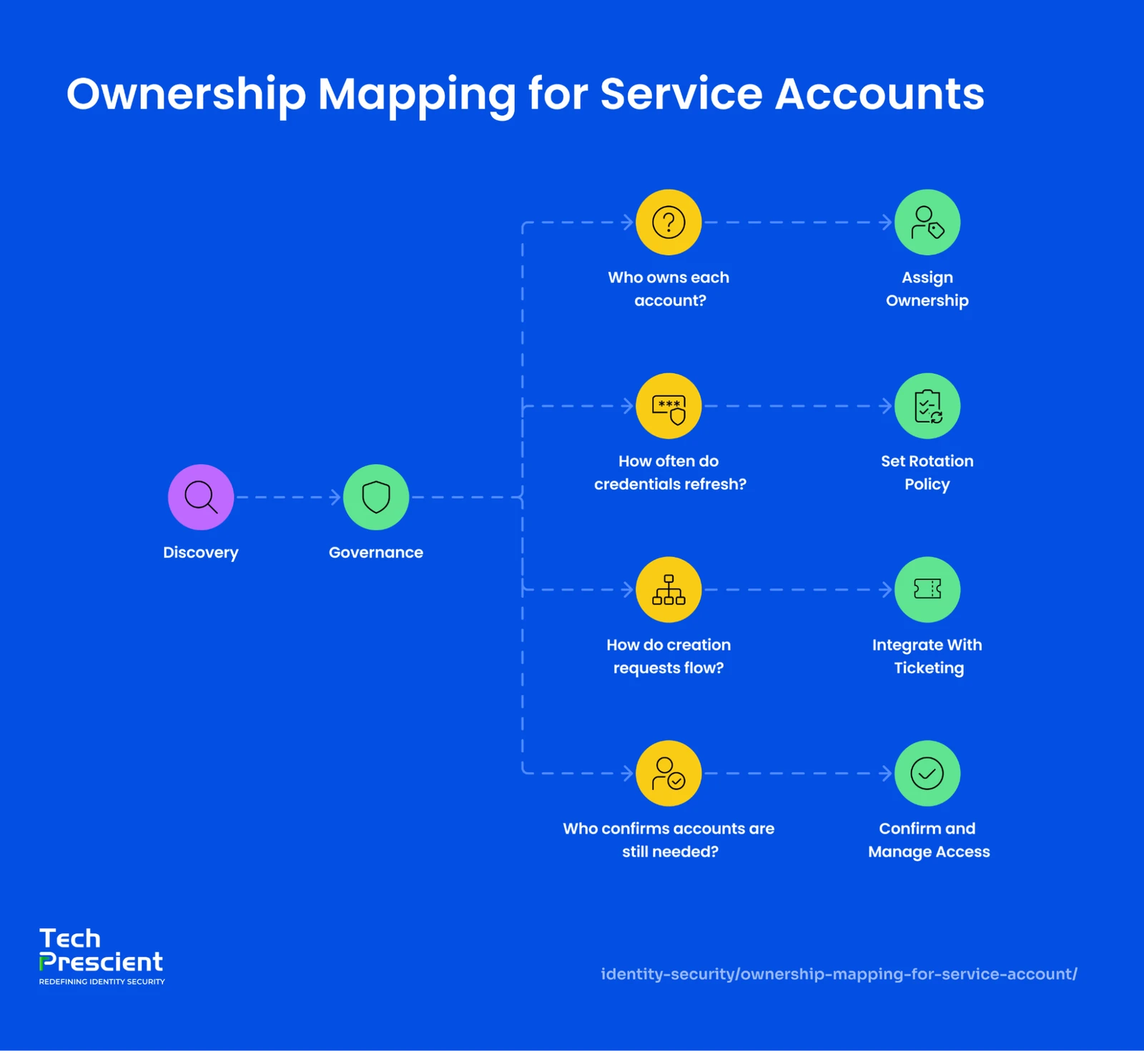
The shift from discovered accounts to governed assets requires four deliberate decisions:
- Who owns each account? Not just a name, but a person or team with domain knowledge
- How often do credentials refresh? Risk-based intervals balancing security and operational stability
- How do creation requests flow? Formal process, not ad hoc approvals
- Who confirms accounts are still needed? Scheduled reviews that prove necessity
Step 1: Assign Ownership
Each service account gets assigned to a person or team responsible for managing its full lifecycle. Assignment follows organizational domain lines:
- Data sync credentials → Data Engineering team
- Deployment credentials → DevOps team
- Monitoring credentials → SRE/Platform team
- Cloud infrastructure credentials → Platform Engineering team
The owner must understand what the account does and why it exists. Without that domain knowledge, they can't make informed decisions during rotation reviews or access changes. A DevOps engineer can explain why a deployment credential needs write access to production. A data engineer can justify why a sync service needs read access to your data warehouse. An owner without domain knowledge is accountable in name only.
Step 2: Set Rotation Policy
Your organization defines default rotation intervals: typically 30, 60, or 90 days. But defaults don't account for risk variation.
Customize per account based on risk exposure:
| Credential Type | Permission Scope | System Criticality | Rotation Interval |
|---|---|---|---|
| API key | Read-only | Non-production | 90 days |
| API key | Read-only | Production | 60 days |
| Deployment credential | Write | Non-production | 60 days |
| Deployment credential | Write | Production | 30 days |
When rotation is due, Identity Confluence sends a reminder to the owner. The owner manually performs the rotation on their schedule: tomorrow, next week, whenever operations permit. If a rotation is imminent but timing is not ideal, they override the reminder and set a custom deferral date. Override actions are logged with justification, maintaining a complete audit trail. If the account is no longer needed, they submit a deletion request for manager approval.
Why manual rotation instead of auto-deletion? Most service accounts are integrated into systems where a sudden credential change causes failures. A deployment credential gets revoked, but the new one isn't deployed yet; production breaks. Manual rotation with reminders prevents outages while maintaining security through scheduled updates.
Application Insight:
Creation, approval, rotation history, and deprovisioning.
This is governance without quarterly checkboxes that auto-approve without confirmation. This is governance without forced auto-deletion that breaks systems. This is governance where owner accountability, combined with reminder-driven rotation and manager approval, creates a complete, tamper-resistant audit trail.
Step 3: Integrate with Ticketing Systems
When someone needs a new service account, they request it formally in Identity Confluence, specifying:
- Purpose: What business function does this account serve?
- Scope: Which systems does it need to access?
- Permissions: Exactly what access is required? (Not "admin access," but specific roles, API scopes, or system-level permissions)
- Proposed owner: Who will be accountable for rotation and lifecycle management?
Identity Confluence auto-creates a ticket in Jira or Zoho via webhook. This ticket serves as the permanent audit record visible to managers, owners, and compliance teams. It shows:
- Exactly what was requested
- Who approved it
- When the account was provisioned
- Every subsequent rotation
- Any deprovisioning decision with justification
This is where governance becomes auditable. Every creation request generates a ticket. Every approval is timestamped. Auditors can pull the complete paper trail for any service account.
Step 4: Confirm and Manage Access
Managers review the creation request and approve or deny it in Identity Confluence. Once approved:
- An account is created in the target system via integration/API/connector.
- Owner is assigned
- Rotation policy goes into effect immediately
- Rotation reminders begin on schedule
Quarterly access reviews: The owner confirms the account is still needed. If yes, review passes. If no, they submit a deprovisioning request. Managers approve. System triggers or tracks revocation via integration/manual confirmation.
Throughout this lifecycle; creation, approval, rotation reminders, access review, deprovisioning, every action generates a log entry. Every decision is documented. Every approval is timestamped.
That's how Identity Confluence enforces real governance, not through rigid automation that risks disruption but through clear accountability with documented decisions.
Risk-Based Rotation Without Vault Infrastructure
A common misconception: rigorous credential management requires a secrets vault. Not necessarily.
A vault secures and rotates credentials automatically. It adds complexity. Vaults typically require integration with systems that need the credentials. They add latency. They require high availability to avoid service disruption. They're necessary for truly temporary, short-lived credentials (minutes or seconds). But service accounts that rotate quarterly may not require vault-level automation in many environments. Identity Confluence takes a pragmatic approach:
- Rotation reminders are sent to the owner at configurable intervals (30, 60, or 90 days). The owner manually rotates the credentials in the target system. They verify that the new credential works. Then they update it in Identity Confluence. Typically, this takes a few minutes per credential.
- Risk assessment determines the rotation interval. High-permission accounts rotate faster. Low-risk read-only credentials rotate more slowly. This is practical risk management, not blind policy enforcement.
- No forced revocation. The old credential doesn't expire until the new one is confirmed to work. This prevents the common vault failure mode: old credentials revoked, new ones not yet deployed, and the system goes down.
For organizations without vault infrastructure, this is governance-grade credential management at a fraction of the cost and complexity. For organizations with vaults, this complements vault-managed temporary credentials by governing long-lived service accounts that are often less efficiently managed in vault-centric models.
Is your identity ownership audit-ready or just documented?
Score your ownership governance and find out exactly where accountability breaks down.
The Visibility-to-Control Transformation
Before ownership mapping:
Service accounts exist in the shadows. You don't know who manages them. Credential rotation is occasional or sometimes nonexistent. You can't prove they're still needed. When auditors ask questions, you lack answers. Your security team manages them reactively, fixing connectivity issues when credentials expire, discovering breaches only after they've happened for weeks.
After ownership mapping:
Service accounts become fully governed assets with clear accountability. Every account is mapped to its owner. Credentials rotate on a defined schedule. Deprovisioning is documented. Access reviews confirm the necessity. Auditors get the complete audit trail: creation date, approval, rotation history, last rotation date, and deprovisioning decision if applicable.
You can tell an auditor:
- This account was created on [date] by [person]
- It's managed by [owner] on the [team]
- It rotates every [30/60/90 days]
- Last rotation was on [date]
- Last access review confirmed it's still needed
The shift is fundamental: From uncontrolled to controlled. From invisible to visible. From risky to auditable. From audit failure to compliance-ready.
Next Steps
Ownership mapping is where governance starts-where discovered accounts become managed assets. Once ownership is assigned and rotation policies are in effect, the next phase expands governance further:
- Automated access reviews: Confirm necessity quarterly without manual processes
- Risk scoring for unused entitlements: Identify and revoke excess permissions
- Policy-driven access changes: Automatically adjust permissions based on role or department transitions
Identity Confluence handles all of this. Start with ownership. Build from there.


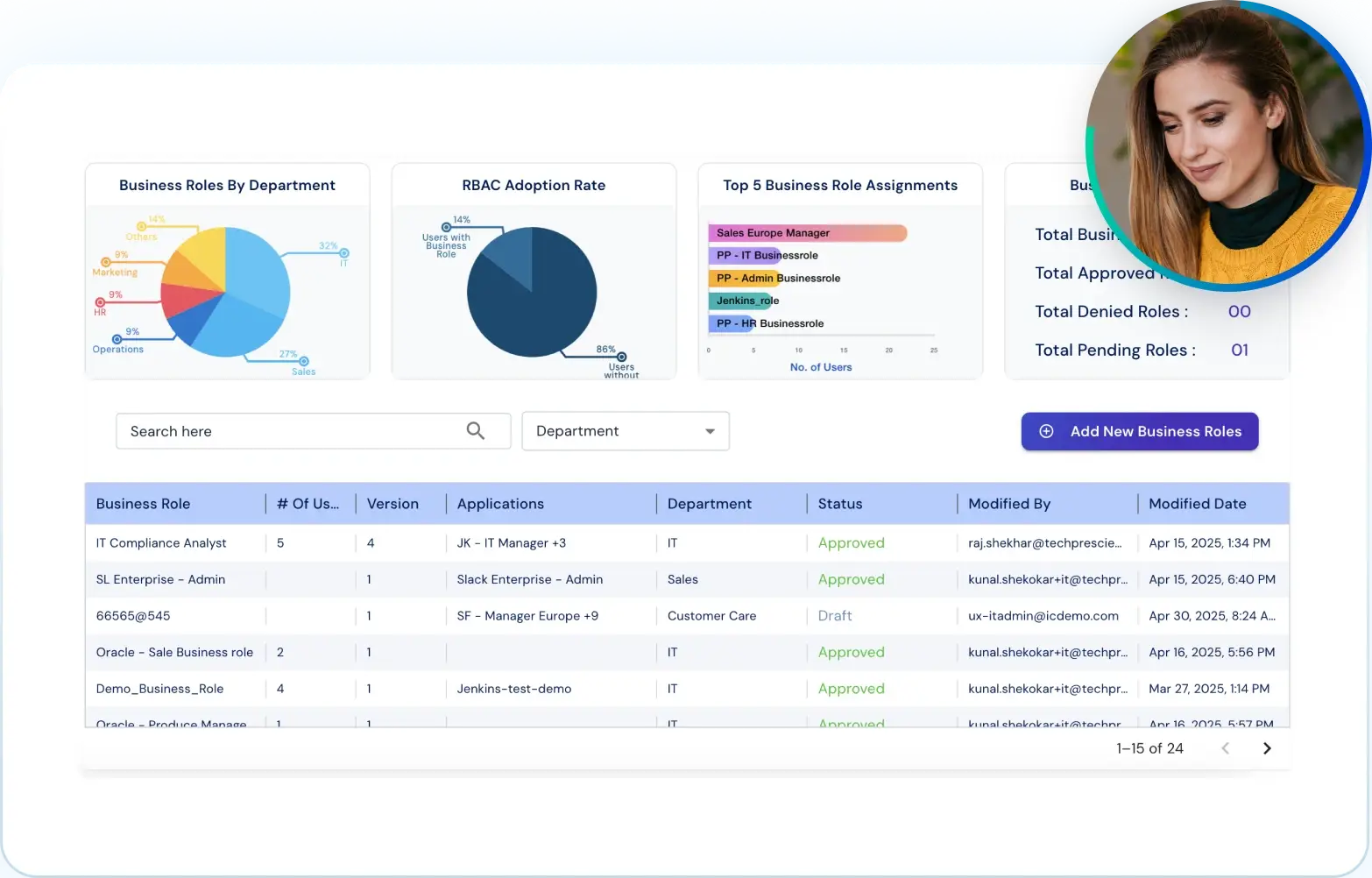
GET A PERSONALIZED DEMO
See Identity Confluence in Action
“One platform to govern identities, automate access decisions, and prove compliance; across every app, user, and system in your environment.”



Murli Ramsunder
Senior Architect, Vonage