




On this page
See Tech Prescient in Action
Automate access, reduce risk, and stay audit-ready
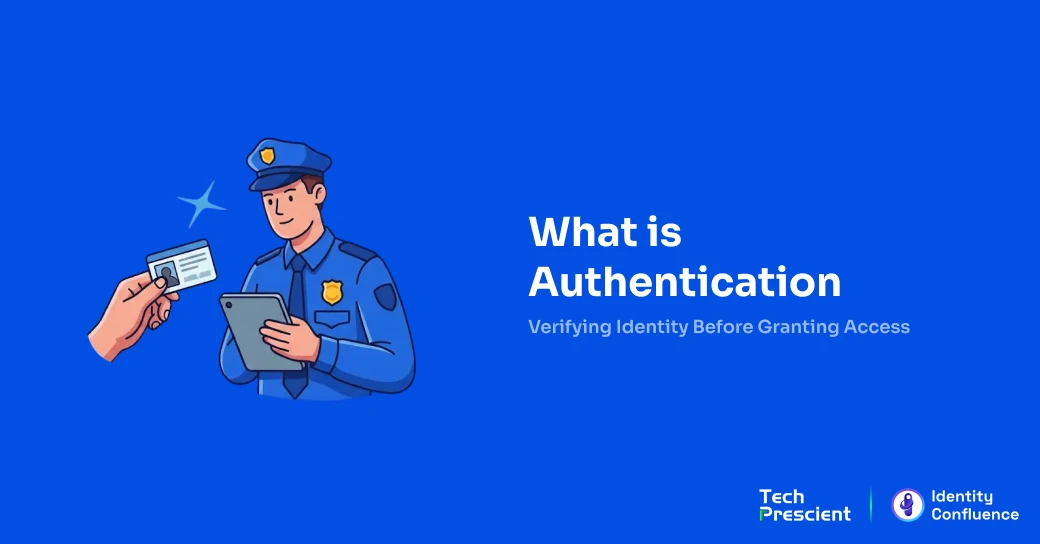
Authentication is the process of verifying the identity of a user, device, application, or system before granting access to digital resources. It ensures that only authorized entities can access protected systems using credentials such as passwords, biometrics, cryptographic keys, or security tokens.
In cybersecurity, authentication is a foundational control. It reduces exposure to unauthorized access, credential misuse, and identity-based attacks.
Credential compromise remains one of the most common breach vectors. Industry reporting indicates that attackers attempt to breach systems approximately every 39 seconds, frequently using stolen passwords. According to IBM's latest Cost of a Data Breach Report, 74% of data breaches involve compromised credentials, with an average organizational cost of $4.88 million.
In distributed and hybrid environments, authentication occurs continuously. Employees access cloud applications remotely. Partners connect to shared portals across regions. APIs exchange data between systems. Each interaction requires identity verification. The strength of the authentication mechanism directly influences enterprise security posture.
Key takeaways:
- Authentication verifies identity before access is granted.
- Credential compromise remains a primary breach driver.
- Multiple verification methods exist, including passwords, biometrics, and hardware-backed factors.
- Authentication differs from authorization, which determines what an authenticated identity can access.
- Strong, centralized identity controls reduce risk across cloud and hybrid environments.
What is Authentication?
Authentication verifies identity before access is granted. It confirms that a user, device, application, or system is legitimate using credentials such as passwords, tokens, cryptographic keys, or biometrics.
Authentication determines whether an entity is who or what it claims to be by validating submitted credentials against trusted identity stores or authentication servers. Access is permitted only after successful verification.
In modern enterprises, authentication applies to multiple identity types:
- Workforce users accessing applications and infrastructure
- APIs requesting service-to-service communication
- IoT devices transmitting operational data
- Service accounts running automated workflows
Each identity requires appropriate verification controls, including:
- Rotating API keys and secrets
- Device-bound certificates with defined expiration
- Hardware-backed or phishing-resistant factors
- Strictly governed privileged credentials
Under a Zero Trust security model, authentication is continuous and context-aware. Every request must be explicitly verified regardless of network location. No identity is implicitly trusted.
Authentication is most effective when integrated with identity governance. Lifecycle events such as onboarding, role changes, and termination should automatically adjust access. Behavioral risk signals can trigger step-up verification when anomalies are detected. When authentication and governance operate together, access decisions reflect both verified identity and real-time risk context.
How Authentication Works
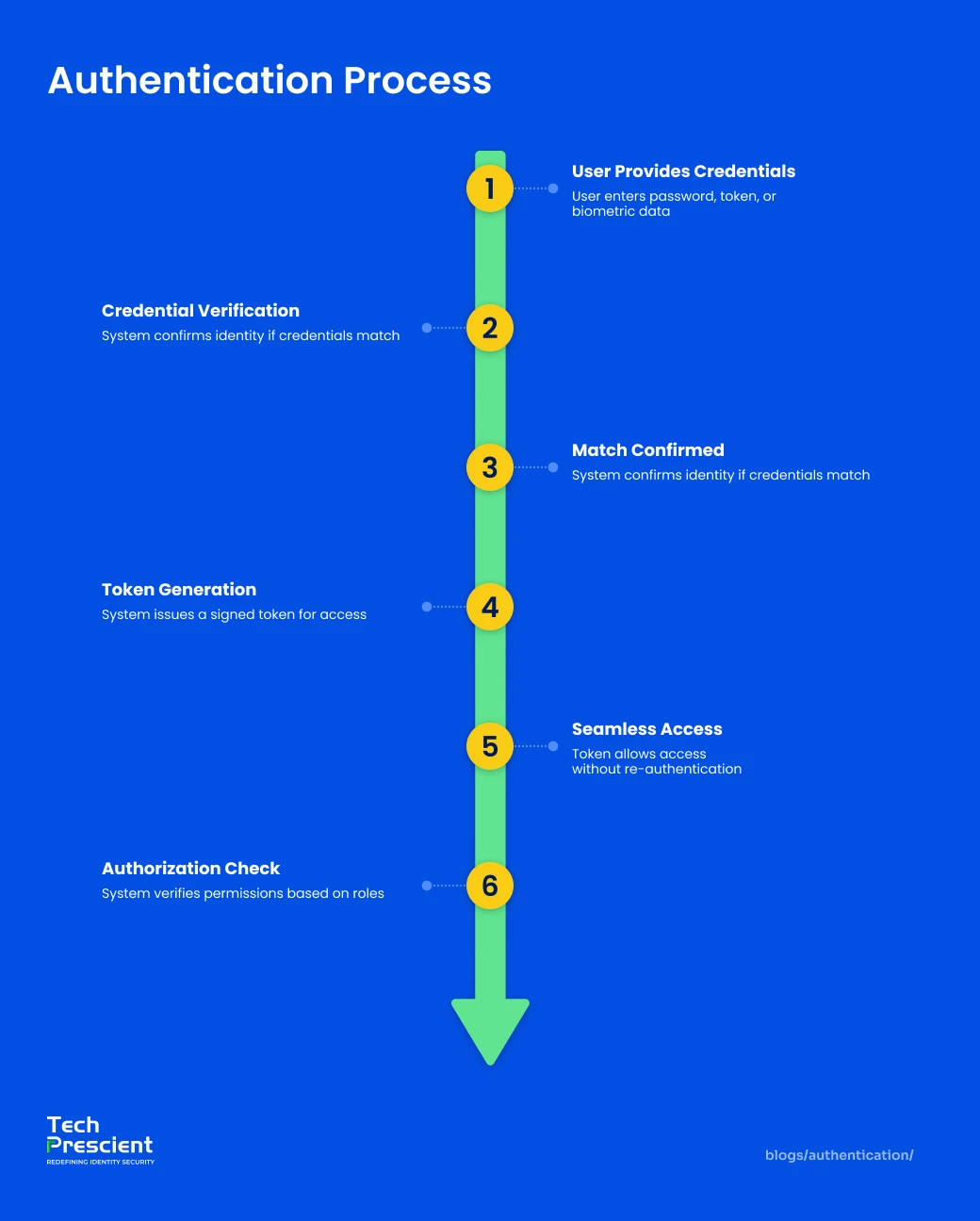
Authentication works by validating submitted credentials against stored identity data. If the credentials match trusted records, the system confirms identity and issues a time-bound access token.
The process follows a structured sequence.
Step 1: Identity Claim
An entity initiates access to a system, application, device, or data resource. The entity submits credentials to assert identity. These credentials typically fall into one or more categories:
- Something you know (password or PIN)
- Something you have (hardware token or mobile authenticator)
- Something you are (biometric factor such as fingerprint or facial recognition)
Step 2: Credential Verification
Your credentials travel securely over encrypted channels to an authentication service. This service compares what you provided against stored information. That storage might be local (like your phone's face unlock) or centralized (Microsoft Entra ID, Okta, Active Directory). Here's the clever part - passwords never get stored as plain text. They're transformed through one-way hashing plus salting, creating mathematical fingerprints. Even if hackers steal the database, they can't reverse-engineer your actual password.
Step 3: Authentication Decision
If the provided credentials match stored records, authentication succeeds. If they do not match, access is denied, and additional controls such as rate limiting or account lockout may be enforced.
Authentication confirms identity. It does not determine access permissions.
Step 4: Token Issuance
After successful authentication, the system issues a signed, time-bound token. This token allows the authenticated entity to access authorized resources without re-entering credentials for each request.
Common token formats include:
- JSON Web Tokens (JWT) for modern web and API-based applications
- SAML assertions for enterprise federation
- Session cookies for browser-based sessions
- Kerberos tickets for internal network authentication
Tokens are cryptographically signed, have defined expiration periods, and can be revoked when risk conditions are detected.

Pro Tip:
Review token expiration policies regularly; short-lived tokens reduce replay risk significantly. If tokens don't expire quickly or support revocation, your session security is weaker than you think.
Step 5: Seamless Access
Applications attach the issued token to subsequent requests. Resource servers validate the token signature and expiration before granting access. This model enables secure session continuity while maintaining stateless communication protocols such as HTTP and HTTPS.
Step 6: Authorization Enforcement
Once identity is verified, authorization controls determine what actions are permitted. Authorization decisions may rely on:
- Role-based access control (RBAC)
- Attribute-based policies (department, device posture, location)
- Contextual risk signals
Authentication answers "Who are you?" Authorization determines "What are you allowed to access?"
This sequence typically completes in milliseconds and operates continuously across enterprise environments. Understanding this workflow enables organizations to design authentication controls that align with risk tolerance, regulatory requirements, and operational scale.
Types of Authentication
There are three primary authentication factors: something you know (passwords), something you have (tokens or devices), and something you are (biometrics). Modern systems combine these factors to improve security.
Single-Factor Authentication (SFA) - Password only - Simple and weak
Single-factor authentication relies on one credential type, most commonly a password.
Password-only authentication presents elevated risk due to phishing, credential stuffing, brute-force attacks, and password reuse. While some legacy systems still depend on SFA, it is generally insufficient for protecting sensitive systems without compensating controls such as network restrictions or additional monitoring.
Myth vs. Fact:
Myth: "A strong password is enough." Fact: Even complex passwords fail against phishing and credential stuffing without MFA.
Two-Factor Authentication (2FA) - Password + OTP or device code
When you add a second factor of authentication, you have substantially increased the security. 2FA is when you need BOTH your password AND your phone. Simply put, the attacker would need both factors of authentication to gain access to your account. SMS codes work everywhere, but have the risk of being vulnerable to SIM-swap attacks. App-based codes are more secure but require more management, as you have to manage the device you are using.
Multi-Factor Authentication (MFA) - 2+ factors for stronger access control
Smart MFA is flexible and adapts to the context of the risk assessment. Checking email? Maybe a password will suffice. Accessing payroll? You may want to trigger some biometric authentication. Microsoft has reported that, using an MFA protocol, enterprises block 99.9% of automated attacks, and thus an MFA approach is reasonable for any enterprise security strategy.
Biometric Authentication - Fingerprint, face, voice ID
Biometric authentication verifies identity using inherent physical or behavioral characteristics such as fingerprints, facial recognition, or voice patterns.
Biometrics reduce reliance on memorized credentials but introduce operational considerations, including sensor accuracy, environmental conditions, spoof resistance, and data protection requirements. Mature implementations support multi-modal verification and fallback mechanisms to maintain availability.
Token-Based Authentication - Uses OAuth, API keys, or session tokens
Modern applications use cryptographic tokens. Hardware keys offer unphishable verification. JWT tokens support stateless authentication for microservices. At the crux of any token scheme is effective lifecycle management - expiration occurs quickly, it is easy to refresh for user sessions, and it is also easy to revoke when compromised.
Location-Based Authentication - Geographic verification as a supplemental factor
Your physical location becomes an additional security layer in location-based authentication. Systems determine your position through GPS on mobile devices or by analyzing network addresses and routing patterns. While not precise enough as a standalone method, location verification excels at flagging suspicious activity.
Consider this scenario: if you normally log in from New York but suddenly an access attempt comes from Russia minutes later, the system blocks it - you physically couldn't travel that fast. Organizations often combine location with other factors, creating geographic boundaries where certain resources are only accessible from specific offices or countries. This helps prevent attackers in remote locations from impersonating legitimate users.
Time-Based Authentication - Temporal patterns strengthen security
Time-based verification adds another contextual layer to access control. Systems track when users typically authenticate and flag unusual temporal patterns. This factor often works hand-in-hand with location verification.
For instance, if you authenticated at noon in California, an attempt from Tokyo an hour later would fail - the time-location combination is impossible. Some organizations restrict sensitive system access to business hours only, automatically denying authentication attempts at 3 AM when no legitimate work should occur. Like location, time factors supplement primary authentication methods rather than replacing them, but they're remarkably effective at detecting compromised credentials being used by attackers in different time zones.
Real-World Examples of Authentication
Authentication operates across both physical and digital environments. Mature organizations apply graduated verification controls based on transaction sensitivity and regulatory requirements.
Financial Services
Banks commonly implement layered authentication controls. Employees use physical badges for facility access, biometric verification for workstation login, and single sign-on (SSO) for internal systems. High-risk actions, such as wire transfers, typically require hardware-backed authentication and dual approval workflows. This tiered approach aligns verification strength with transaction value and fraud risk.
Healthcare
Healthcare environments must balance rapid access with regulatory compliance. Clinicians may authenticate to workstations using proximity badges or biometric login mechanisms. Prescribing controlled substances typically requires additional identity verification, including federally mandated identifiers and multi-factor authentication. All access events are logged and audited to meet compliance requirements while maintaining clinical efficiency.
Retail and E-Commerce
Retail platforms process high transaction volumes, particularly during peak periods. Consumer authentication may incorporate device recognition, adaptive risk scoring, and step-up verification for anomalous behavior. Internally, employee access controls restrict sensitive functions. High-value refunds or overrides often require secondary authentication or managerial approval to mitigate fraud and internal misuse.
B2B and Partner Portals
External users accessing B2B systems are commonly subject to risk-based authentication policies. Low-risk actions may require standard login credentials, while sensitive changes, such as payment updates, trigger step-up verification through hardware tokens or out-of-band confirmation. Periodic access reviews ensure third-party permissions remain aligned with contractual obligations.
In each scenario, authentication strength increases in proportion to risk exposure.
Authentication vs Authorization
Authentication verifies identity, while authorization determines permissions. Authentication answers "Who are you?" Authorization answers "What are you allowed to do?"
For example, an enterprise identity provider may authenticate a user through cryptographic verification. After identity is confirmed, authorization policies evaluate role membership, attributes, and contextual signals to determine resource access. A verified identity does not imply unrestricted access.
From a technical standpoint:
- Protocols such as SAML and OpenID Connect support identity verification.
- OAuth frameworks and role-based access control (RBAC) models govern permission enforcement.
In Zero Trust architectures, both authentication and authorization operate continuously. Identity may be re-evaluated based on behavioral anomalies, and permissions may adjust dynamically according to risk signals. Continuous verification and policy enforcement reduce the impact of credential compromise and limit lateral movement.
Zero Trust makes both continuous. Systems constantly re-verify identity while dynamically adjusting permissions and downloading one file? Normal. Downloading thousands? Trigger re-verification and alerts. Identity Confluence orchestrates this dance, adapting both verification and permissions in real time to risk.
Quick Comparison:
- Authentication happens first and confirms identity.
- Authorization happens after and controls access levels.
- You cannot have authorization without authentication.
| Aspect | Authentication | Authorization |
|---|---|---|
| Purpose | Verifies identity | Controls access permissions |
| Question Answered | "Who are you?" | "What can you do?" |
| When It Occurs | Before accessing the system | After identity verification |
| Failure Result | Access denied entirely | Limited or no permissions |
| Common Methods | Passwords, MFA, biometrics | RBAC, ABAC, ACLs |
| Management Tools | Identity providers, SSO | Identity governance, PAM |
| Audit Focus | Login attempts and methods | Access usage and changes |
| Compliance Relevance | Proves user verification | Demonstrates least privilege |
Why Authentication Matters in Cybersecurity
Strong authentication protects organizations from breaches, identity theft, and insider threats.
Weak verification isn't just a technical problem - it's a business crisis. With enterprises using 1,000+ cloud services, each represents a potential breach point. One compromised account cascades through single sign-on connections, turning minor incidents into major disasters.
Beyond breach costs, poor identity verification drains budgets silently. Password resets. Lost productivity. Customer abandonment. Yet modern approaches like passwordless authentication actually improve both security and satisfaction simultaneously.
Compliance adds urgency. HIPAA, PCI DSS, SOX, and GDPR all mandate strong verification with serious penalties. Failures trigger not just breaches but massive fines and reputation damage. Identity governance platforms automate compliance reporting, but only if the underlying verification meets standards.
The magic happens when verification integrates with identity analytics. Modern platforms detect compromised accounts through behavioral analysis. Unusual patterns trigger alerts. Machine learning identifies threats humans miss. This transforms basic login checks into intelligent security systems.
Common Challenges in Authentication
Authentication strategies must balance security, usability, and technical feasibility. Organizations commonly encounter the following challenges.
Credential Overload
Workforce users often manage a large number of credentials across enterprise systems. Password reuse, weak password selection, and reset fatigue increase exposure to phishing and credential stuffing attacks. While password managers reduce reuse, they introduce dependency on a single master credential and require appropriate governance controls.
User Friction
Excessive verification steps can reduce productivity and encourage policy bypass through shadow IT. Insufficient verification increases breach risk. Adaptive or risk-based authentication models help balance these pressures by applying stronger controls only when contextual risk signals warrant additional verification.
Legacy System Constraints
Older infrastructure frequently lacks support for modern authentication protocols. Some systems enforce limited password length, do not support federation standards, or cannot integrate natively with multi-factor authentication frameworks. In regulated industries, device modification may be restricted. Organizations often rely on compensating controls such as network segmentation or privileged access management to mitigate these limitations.
Social Engineering and MFA Fatigue
Attack techniques continue to evolve. Tactics such as repeated push notification prompts ("MFA fatigue") or impersonation of IT personnel can lead users to approve fraudulent requests. Technical controls must be complemented by phishing-resistant factors, clear user prompts, and security awareness programs.
Authentication effectiveness depends not only on factor strength, but also on implementation design and operational discipline.
Future of Authentication - Passwordless and Beyond
Authentication is shifting toward cryptographic and risk-adaptive models that reduce reliance on shared secrets.
Passwordless Authentication
Passwordless approaches use public-key cryptography, biometrics, or hardware-backed authenticators to verify identity without transmitting or storing reusable passwords. Standards such as FIDO2 enable device-bound credentials that are resistant to phishing and credential replay attacks. Adoption continues to increase as organizations seek stronger protection with reduced password management overhead.
Continuous and Behavioral Verification
Modern systems incorporate behavioral signals such as device posture, navigation patterns, and usage anomalies to evaluate session risk dynamically. When deviations occur, step-up authentication can be triggered without disrupting low-risk activity. This model supports continuous verification aligned with Zero Trust principles.
Decentralized and Attribute-Based Identity
Emerging identity models explore user-controlled credentials and selective attribute disclosure. These approaches aim to reduce the overexposure of personal data by allowing individuals to share only necessary claims rather than full identity records. Adoption remains early-stage and subject to interoperability and regulatory considerations.
If a privileged account were compromised today, how quickly could you detect and revoke access? Your answer reveals the maturity of your authentication and identity governance strategy.
AI-Driven Risk Analysis
Advanced authentication platforms increasingly rely on machine learning models to evaluate large volumes of contextual signals in real time. Risk scoring enables dynamic adjustment of verification requirements while maintaining operational efficiency. Effectiveness depends on data quality, governance controls, and continuous monitoring.
The future of authentication will be defined by phishing-resistant credentials, adaptive policy enforcement, and tighter integration between identity verification and risk analytics.
Final Thoughts
Authentication has evolved from simple password checks into the cornerstone of organizational security. As digital operations expand and threats grow more sophisticated, the stakes have never been higher. Yet this challenge presents an unprecedented opportunity. Organizations can finally achieve both ironclad protection and frictionless user experiences through passwordless technologies, continuous verification, and AI-powered risk assessment. The convergence of authentication with identity governance and Zero Trust principles transforms what was once a compliance burden into a competitive advantage.
The path forward is clear:
Start with MFA for privileged accounts, implement SSO to eliminate password chaos, and begin piloting passwordless solutions with technical teams. But success requires more than just technology; it demands a platform that understands the complete identity lifecycle.
Tech Prescient's Identity Confluence orchestrates this transformation, reducing support costs by 60% while strengthening your security posture.
FAQs
Authentication is the process of verifying a user's identity before granting access to systems or data. It uses credentials like passwords, biometrics, or security tokens to confirm legitimacy and prevent unauthorized access.
Three categories: something you know (passwords), have (phones/tokens), and are (fingerprints). Combining factors improves security - why banks use passwords plus SMS codes.
Authentication proves identity (who you are). Authorization manages permissions (what you can do). First comes identity verification, then resource access determination.
Passwords (universal but weak), SMS codes (convenient, hackable), authenticator apps (secure, growing), hardware tokens (strongest), and biometrics (user-friendly). Most organizations combine methods based on risk.
Password overload (200+ per user), legacy limitations, social engineering attacks, and balancing security with user experience while managing costs and compliance.
Share



Brinda Bhatt
Digital Marketing Strategist
Primarily works to help leverage complex ideas, especially around identity governance, to business and technical audiences. She is led by a logical, data-driven approach to content creation and explores optimal and constructive storytelling.
Most Popular Blogs
Identity Security· 21 min read
Data Access Governance Solutions: How to Secure Sensitive Data at Scale
Compare data access governance solutions for 2026: how DAG platforms discover sensitive data, run access reviews, automate remediation, and prove compliance.
Brinda Bhatt· September 7, 2026
Identity Security· 24 min read
What Is Zero Trust Network Access (ZTNA)?
Learn what Zero Trust Network Access (ZTNA) is, how it works, and why it’s replacing VPNs for secure, identity-based access control.
Yatin Laygude· August 14, 2026
Identity Security· 24 min read
Cyber Essentials Certification: Complete Guide
Learn Cyber Essentials certification, cost, requirements, and steps. Compare Cyber Essentials vs Plus and get certified faster.
Yatin Laygude· August 10, 2026