




On this page
See Tech Prescient in Action
Automate access, reduce risk, and stay audit-ready
Cyber Essentials certification is a UK government-backed cybersecurity standard that helps organizations defend against the most common cyber threats using five essential security controls. Whether you're a small business, SaaS provider, or enterprise, achieving certification demonstrates your commitment to security, strengthens customer trust, and helps meet compliance requirements.
With certification costs starting from approximately £300 for Cyber Essentials and increasing for Cyber Essentials Plus, understanding the requirements, certification process, and ongoing costs is essential before getting started. This guide covers everything you need to know, from eligibility and pricing to certification steps and renewal.
Research from the UK's National Cyber Security Centre (NCSC) shows that organizations implementing Cyber Essentials controls are 92% less likely to make a cyber insurance claim than those without the certification, highlighting its measurable impact on reducing cyber risk. Let's explore everything you need to know about Cyber Essentials certification, including its requirements, costs, certification levels, and the step-by-step process to get certified with confidence.
Key Takeaways
- Understand what Cyber Essentials certification is and why organizations need it.
- Learn the five core security controls required for Cyber Essentials compliance.
- Compare Cyber Essentials and Cyber Essentials Plus to choose the right certification level.
- Discover the certification process, requirements, costs, and annual renewal timeline.
- Explore how Identity Governance (IGA) simplifies compliance, strengthens access control, and accelerates certification.
What Is Cyber Essentials Certification?
Cyber Essentials certification is a UK government-backed cybersecurity certification that validates an organization's ability to defend against common cyber threats using five essential security controls.
Cyber threats continue to evolve, making it critical for organizations to establish a strong security foundation. If you're wondering what Cyber Essentials certification is, it is a UK government-backed assurance scheme that helps businesses demonstrate they have implemented baseline cybersecurity controls to protect their systems, users, and data. Recognized across industries, the certification improves security, builds customer trust, and supports regulatory and contractual compliance.
Let's take a closer look at what Cyber Essentials certification is, why it matters, and which organizations benefit the most.
UK Government-Backed Security Standard
Cyber Essentials was introduced by the UK Government and is backed by the National Cyber Security Centre (NCSC) to help organizations defend against the most common cyber attacks. Rather than requiring complex security programs, it focuses on implementing five practical security controls that significantly reduce cyber risk and establish a strong cybersecurity baseline.
Why Is Cyber Essentials Certification Important?
Cyber Essentials certification demonstrates that an organization has adopted fundamental security best practices to safeguard its IT environment. Beyond strengthening cyber resilience, it helps organizations improve customer confidence, meet compliance requirements, qualify for many UK government contracts, and showcase their commitment to protecting sensitive information.
Who Should Get Cyber Essentials Certification?
Cyber Essentials certification is suitable for organizations of all sizes, especially SMBs, SaaS companies, technology vendors, managed service providers (MSPs), and businesses handling sensitive customer or business data. It is particularly valuable for organizations that work with UK government agencies or need to demonstrate cybersecurity assurance to customers and partners.
Cyber Essentials vs. Cyber Essentials Plus
Organizations can choose between two certification levels based on the assurance they want to demonstrate. Cyber Essentials involves a verified self-assessment questionnaire, while Cyber Essentials Plus includes an independent technical audit to validate that the required security controls have been implemented effectively. The Plus certification offers a higher level of assurance for organizations with stricter security or compliance requirements.
5 Core Security Controls Explained
Cyber Essentials certification is built around five technical security controls that help organizations prevent the majority of common cyber attacks by reducing exploitable vulnerabilities across users, devices, and networks.
Each control addresses a specific area of cybersecurity, working together to reduce risk and improve an organization's overall security posture.
Firewalls & Internet Gateways
Firewalls act as the first line of defense by monitoring and controlling incoming and outgoing network traffic. They block unauthorized access while allowing legitimate users and applications to communicate securely.
Example: A company firewall automatically blocks connection attempts from suspicious IP addresses, preventing attackers from reaching internal servers.
Secure Configuration
Secure configuration ensures that devices, applications, and cloud services are deployed with security in mind. Removing unnecessary software, disabling unused services, and replacing default settings minimizes opportunities for attackers to exploit vulnerabilities.
Example: Before issuing a laptop to a new employee, the IT team removes unnecessary applications, disables default administrator accounts, and applies approved security policies.
User Access Control
User access control limits access to systems and data based on business needs. Applying the principle of least privilege, enforcing strong authentication, and regularly reviewing permissions helps reduce insider threats and unauthorized access.
Example: When an employee changes departments, their previous application access is automatically removed and replaced with role-specific permissions. Identity Governance (IGA) solutions streamline this process through automated provisioning, access reviews, and policy-driven access controls.
Malware Protection
Malware protection safeguards business systems from viruses, ransomware, spyware, and other malicious software. Organizations should deploy endpoint protection, antivirus solutions, email filtering, and safe browsing controls to detect and stop threats before they spread.
Example: Endpoint security detects a malicious email attachment and quarantines it before it can encrypt files on an employee's device.
Security Update Management
Keeping software, operating systems, and firmware up to date helps eliminate known vulnerabilities that attackers commonly exploit. Applying security patches promptly significantly reduces an organization's exposure to cyber threats.
Example: After a critical vulnerability is disclosed, the IT team deploys the latest security update across all company devices within the recommended timeframe.
Cyber Essentials vs Cyber Essentials Plus
Cyber Essentials is a self-assessed certification, while Cyber Essentials Plus includes an independent technical assessment that validates your security controls.
Organizations pursuing Cyber Essentials certification can choose between two levels of assurance based on their security objectives and customer requirements. While both certifications evaluate the same five security controls, they differ in how compliance is assessed and the level of confidence they provide to customers, partners, and regulators.
Understanding the differences between these certification levels can help you determine which option best aligns with your organization's security and compliance goals.
Cyber Essentials (Basic)
Cyber Essentials is the entry-level certification designed for organizations looking to establish a baseline level of cybersecurity. The certification is based on a self-assessment questionnaire (SAQ), where organizations confirm that they have implemented the required security controls. The submitted responses are then reviewed and verified by an accredited certification body before certification is awarded.
This certification is ideal for organizations seeking an affordable way to demonstrate cybersecurity best practices, improve customer trust, and meet basic contractual or regulatory requirements.
Cyber Essentials Plus
Cyber Essentials Plus certification builds upon the Basic certification by adding an independent technical assessment. Instead of relying solely on a questionnaire, qualified assessors validate that the required security controls are functioning effectively through hands-on testing of systems and devices.
The assessment typically includes vulnerability checks, configuration reviews, malware protection verification, and controlled testing of user devices to confirm that security measures work as intended in real-world environments. Because of this additional validation, Cyber Essentials Plus provides a higher level of assurance and is often preferred by organizations handling sensitive information or supplying services to government agencies and regulated industries.
| Feature | Cyber Essentials | Cyber Essentials Plus |
|---|---|---|
| Assessment | Self-assessment questionnaire | Independent technical assessment |
| Verification | Reviewed by an accredited certification body | Verified through hands-on testing |
| Security Testing | No live technical testing | Includes vulnerability and device testing |
| Assurance Level | Baseline cybersecurity assurance | Higher level of security assurance |
| Best For | Organizations starting their security journey | Organizations with advanced security requirements |
| Government Contracts | Meets many baseline contract requirements | Provides stronger assurance for regulated sectors |
| Cost | Lower certification cost | Higher due to independent testing |
| Time to Complete | Faster certification process | Longer due to technical validation |
| Renewal | Valid for 12 months | Valid for 12 months |
Regardless of the certification level you choose, both demonstrate a commitment to implementing the five Cyber Essentials security controls and improving your organization's overall cybersecurity posture. Many organizations begin with Cyber Essentials and later upgrade to Cyber Essentials Plus as their security maturity and compliance requirements evolve.
Quick Insight
Not every organization needs Cyber Essentials Plus. For many businesses, the standard Cyber Essentials certification provides enough assurance to meet customer and contract requirements.
Cyber Essentials Plus Controls Matrix
Map every control to practical security and governance actions.
Cyber Essentials Certification Requirements
Organizations must implement secure configurations, strong access controls, timely patch management, and supported software to meet Cyber Essentials certification requirements.
Meeting these requirements before beginning the assessment can significantly improve your chances of achieving certification on the first attempt.
1. Device Scope Requirements
Only devices that store, process, or access organizational data are included within the Cyber Essentials assessment scope. This typically covers laptops, desktops, servers, virtual machines, mobile devices, cloud-hosted workloads, and networking equipment used for business operations.
Example: If employees access company applications from managed laptops and corporate smartphones, both device types should be included in the certification scope.
2. Password and Authentication Policies
Organizations must enforce strong authentication practices to prevent unauthorized access. This includes using unique passwords, avoiding default credentials, enabling multi-factor authentication (MFA) wherever possible, and restricting administrative privileges to authorized users only.
Example: Employees sign in using strong passwords and MFA, while administrator accounts are limited to IT personnel responsible for managing business systems.
3. Security Patch Management
Keeping systems up to date is a key Cyber Essentials requirement. Critical and high-risk security updates should be applied within 14 days of release to minimize exposure to known vulnerabilities that attackers commonly exploit.
Example: When a software vendor releases a critical security patch, the IT team deploys it across all affected devices within two weeks to maintain compliance and reduce cyber risk.
4. Supported Software Requirement
All operating systems, applications, and security software must be actively supported by their vendors and continue receiving security updates. Unsupported or end-of-life software increases security risks and may prevent an organization from achieving certification.
Example: Replacing an unsupported operating system with a currently supported version ensures that future security patches continue to protect business devices from newly discovered threats.
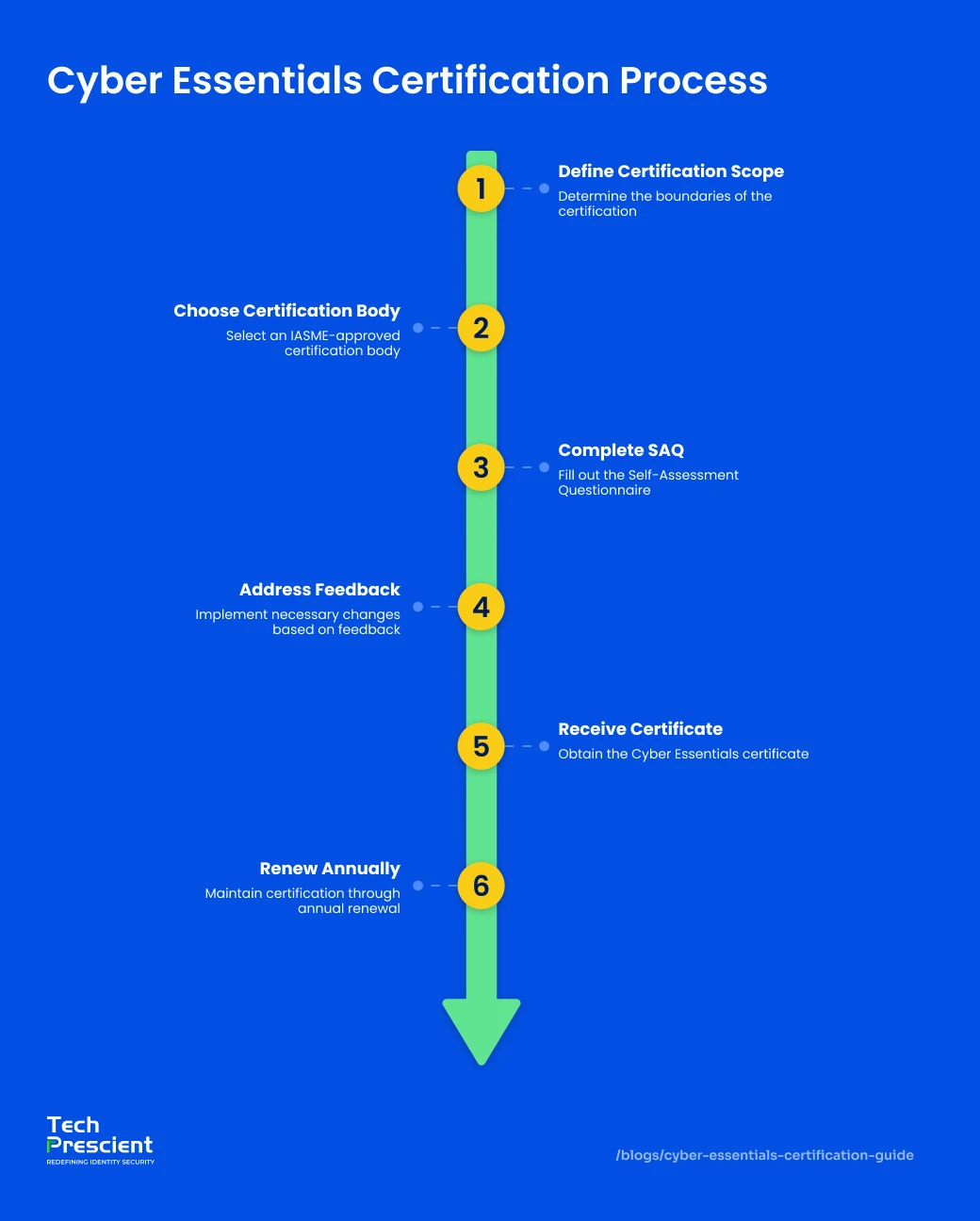
How to Get Cyber Essentials Certification (Step-by-Step)
Achieving Cyber Essentials certification involves defining your assessment scope, addressing security gaps, implementing the required controls, and completing the certification review process.
Following these five steps can help streamline the certification process and improve your chances of passing the assessment successfully.
Step 1: Define the Certification Scope
Start by identifying which parts of your organization will be covered under the certification. This includes the users, devices, cloud environments, applications, and networks that store, process, or access business data. Clearly defining the scope ensures the assessment accurately reflects your operating environment and prevents unnecessary delays later in the process.
Step 2: Conduct a Gap Analysis
Review your existing security posture against the Cyber Essentials requirements to identify areas that need improvement. Evaluate firewall configurations, device settings, user access controls, malware protection, and patch management to determine whether they meet the certification criteria.
A gap analysis helps prioritize remediation efforts before you begin the formal assessment.
Step 3: Implement the Required Security Controls
Address the gaps identified during your assessment by implementing the five Cyber Essentials security controls. This may involve strengthening password policies, enabling multi-factor authentication, applying pending security updates, securing device configurations, and restricting unnecessary user privileges.
Organizations managing large or hybrid IT environments can simplify this phase using automation tools such as Identity Governance and Administration (IGA) platforms. Automated user provisioning, access reviews, and policy-based access controls help enforce least privilege, reduce manual effort, and maintain compliance throughout the certification process.
Step 4: Complete the Self-Assessment Questionnaire (SAQ)
Once the required controls are in place, complete the Cyber Essentials Self-Assessment Questionnaire (SAQ). The questionnaire asks organizations to confirm how security controls have been implemented across the certification scope. Providing accurate and well-documented responses helps avoid delays during the review process.
Step 5: Certification Review and Approval
After the questionnaire is submitted, an accredited certification body reviews the responses to verify that the Cyber Essentials requirements have been met. If additional clarification or supporting information is needed, the assessor may request further details before issuing the certification.
Upon successful review, your organization receives Cyber Essentials certification, demonstrating that it has implemented recognized baseline cybersecurity controls to defend against common cyber threats.

Pro Tip
Preparing evidence, documenting security policies, and automating access management before starting the assessment can significantly reduce the time and effort required for certification. Organizations that continuously manage user access, device security, and policy compliance are often better positioned to maintain certification year after year.
Cyber Essentials Certification Cost
The Cyber Essentials certification cost typically ranges from £320 to £600 + VAT for the Basic certification, while the Cyber Essentials Plus certification cost generally starts at around £1,500 + VAT, depending on the size and complexity of the organization.
The cost of Cyber Essentials certification varies based on several factors, including your organization's size, the certification level you choose, and the readiness of your existing security controls. While the certification fee is relatively affordable, organizations should also account for implementation, remediation, and ongoing compliance costs when planning their budget.
Cyber Essentials Certification Cost by Organization Size
The cost of the Basic Cyber Essentials certification follows a tiered pricing model based on the number of employees, making it accessible for organizations of all sizes.
| Organization Size | Estimated Cost* |
|---|---|
| Micro (0–9 employees) | £320 + VAT |
| Small (10–49 employees) | £440 + VAT |
| Medium (50–249 employees) | £500 + VAT |
| Large (250+ employees) | £600 + VAT |
Cyber Essentials Plus Certification Cost
Unlike the Basic certification, the Cyber Essentials Plus certification cost is not fixed because it includes an independent technical assessment. Pricing varies depending on factors such as the organization's size, IT environment, number of devices, and assessment complexity. In most cases, organizations can expect costs to start at approximately £1,500 + VAT, with larger environments requiring higher investment.
Additional Costs to Consider
The certification fee is only one part of the overall investment. Organizations may also incur additional expenses while preparing for certification, such as:
- Security improvements to address identified gaps.
- Cybersecurity consulting or readiness assessments.
- Security and compliance tools for monitoring and evidence collection.
- Employee cybersecurity awareness and training.
- Annual renewal to maintain certification.
Is Cyber Essentials Worth the Investment?
For many organizations, the return on investment extends well beyond the certification itself. Achieving Cyber Essentials helps reduce exposure to common cyber threats, strengthens customer confidence, improves eligibility for UK government and enterprise contracts, and demonstrates a proactive commitment to cybersecurity. When supported by automation tools such as Identity Governance and Administration (IGA) platforms, organizations can further reduce compliance effort, streamline access management, and lower the ongoing cost of maintaining certification.
How Long Does Cyber Essentials Certification Last?
Cyber Essentials and Cyber Essentials Plus certifications remain valid for 12 months and must be renewed annually to maintain certified status.
Cyber Essentials certification is not a one-time achievement. As cyber threats, technologies, and business environments continue to evolve, organizations are required to renew their certification every year to demonstrate that they still meet the latest security requirements. Annual recertification also encourages organizations to regularly review and strengthen their cybersecurity practices.
Certification Validity
Both Cyber Essentials and Cyber Essentials Plus certificates are valid for 12 months from the date they are issued. Once the certification expires, organizations must complete the renewal process to retain their certified status and continue demonstrating compliance with the Cyber Essentials standard.
How the Renewal Process Works
Renewing Cyber Essentials involves completing a new assessment based on the latest certification requirements. Organizations must review their security controls, update the Self-Assessment Questionnaire (SAQ), and submit it for verification by an accredited certification body. Since the assessment criteria may change over time, it's important to prepare using the most current Cyber Essentials guidance before submitting for renewal.
Tips for Maintaining Continuous Compliance
Keeping your security controls up to date throughout the year makes the renewal process significantly easier. Consider adopting these best practices:
- Apply critical security patches promptly.
- Review user access and administrative privileges regularly.
- Remove unsupported software and inactive accounts.
- Keep security policies aligned with current Cyber Essentials requirements.
- Monitor devices and cloud environments for configuration changes.
Organizations that automate activities such as user provisioning, access reviews, and policy enforcement through Identity Governance and Administration (IGA) platforms can reduce manual effort while maintaining continuous compliance. This proactive approach not only simplifies annual renewal but also strengthens the organization's overall security posture.
Is Cyber Essentials Certification Worth It?
Yes. Cyber Essentials certification helps organizations reduce cyber risk, strengthen customer trust, improve compliance, and unlock new business opportunities, making it a valuable investment for businesses of all sizes.
Beyond meeting compliance requirements, Cyber Essentials offers measurable benefits that strengthen an organization's long-term cybersecurity strategy.
Reduces the Risk of Common Cyber Attacks
Implementing the five Cyber Essentials controls helps organizations defend against the most common attack techniques, including phishing, malware, ransomware, and unauthorized access. By addressing common vulnerabilities proactively, businesses can significantly reduce their overall cyber risk and improve operational resilience.
Improves Eligibility for Government and Enterprise Contracts
Many UK government contracts require suppliers to hold Cyber Essentials certification, particularly when handling sensitive information. Increasingly, private sector organizations also view the certification as evidence that vendors follow recognized cybersecurity best practices during procurement and third-party risk assessments.
Strengthens Customer Trust and Business Reputation
Cyber Essentials certification demonstrates that your organization takes cybersecurity seriously. Displaying a recognized certification gives customers, partners, and stakeholders greater confidence that their information is protected, helping strengthen business relationships and differentiate your organization from competitors.
Potential Insurance Benefits
Many cyber insurance providers recognize Cyber Essentials as a positive indicator of cybersecurity maturity. Organizations with certified security controls may find it easier to meet underwriting requirements and, in some cases, qualify for more favorable insurance terms, depending on the insurer and policy.
Delivers Long-Term Business Value
The benefits of Cyber Essentials extend beyond certification. Organizations often experience improved security governance, stronger compliance readiness, better access management, and greater operational efficiency. When supported by Identity Governance and Administration (IGA) solutions, tasks such as user provisioning, access reviews, and policy enforcement become more automated, helping maintain compliance while reducing administrative effort.
Cyber Essentials Plus Controls Matrix
Map every control to practical security and governance actions.
Common Mistakes to Avoid
Organizations commonly struggle with Cyber Essentials certification due to incomplete asset visibility, weak authentication practices, delayed patching, and ineffective access management.
Avoiding these common mistakes can help simplify the certification process and reduce the likelihood of delays or unsuccessful assessments.
1. Incomplete Asset Inventory
One of the most common mistakes is failing to identify every device, application, and system that falls within the certification scope. Missing assets can leave security gaps and result in an inaccurate assessment.
Pro Tip
Maintain an up-to-date inventory of all endpoints, servers, cloud resources, and business applications before beginning the certification process.
2. Using Default or Weak Credentials
Default usernames, factory passwords, and weak authentication practices remain a common entry point for cyber attackers. Organizations should replace default credentials immediately and enforce strong password policies alongside multi-factor authentication wherever possible.
3. Delaying Security Updates
Organizations often postpone software updates because of operational concerns, leaving systems exposed to known vulnerabilities. Applying critical security patches promptly is essential for meeting Cyber Essentials requirements and reducing cyber risk.
4. Overlooking User Access Control
Granting excessive permissions or failing to remove unnecessary access increases the risk of insider threats and unauthorized access. User permissions should be reviewed regularly to ensure employees have access only to the systems required for their roles.
Identity Governance and Administration (IGA) solutions help address this challenge by automating user provisioning, enforcing least privilege access, conducting periodic access reviews, and removing unnecessary permissions as users change roles or leave the organization.
5. Treating Certification as an Ongoing Commitment
Many organizations focus only on passing the assessment and neglect ongoing security maintenance. Cybersecurity is a continuous process that requires regular monitoring, policy updates, vulnerability management, and access reviews throughout the year.
Organizations that embed Cyber Essentials best practices into their day-to-day security operations are better positioned to maintain compliance, strengthen cyber resilience, and achieve a smoother annual renewal process.
How Identity Governance (IGA) Helps You Pass Faster
Identity Governance and Administration (IGA) simplifies Cyber Essentials certification by automating access controls, strengthening compliance, and reducing the manual effort required to prepare for assessments.
By combining automation with centralized identity management, IGA enables organizations to strengthen security controls and simplify every stage of the Cyber Essentials certification process.
Simplifies User Access Reviews
Regularly reviewing user access is essential for ensuring employees have only the permissions they need. An IGA platform automates access review campaigns, highlights excessive privileges, and helps organizations quickly remove unnecessary access before certification.
Enforces the Principle of Least Privilege
Cyber Essentials emphasizes restricting access to authorized users. IGA solutions enforce the principle of least privilege by assigning role-based permissions, preventing privilege creep, and automatically updating access rights when employees join, change roles, or leave the organization.
Improves Audit Readiness
Preparing for certification often involves gathering evidence to demonstrate that security controls are consistently enforced. An IGA platform centralizes access records, approval workflows, policy changes, and review history, making it easier to provide the documentation required during assessments and future audits.
Provides Visibility Across SaaS and Hybrid Environments
Modern organizations rely on hundreds of cloud applications, on-premises systems, and hybrid environments. IGA solutions provide a centralized view of user identities and permissions across these environments, helping security teams identify orphaned accounts, excessive privileges, and access risks that could affect Cyber Essentials compliance.
Accelerates Compliance with Identity Confluence
Managing identity governance manually can slow down certification efforts and increase the risk of human error. Identity Confluence, Tech Prescient's AI-driven Identity Governance and Administration platform, helps organizations automate user lifecycle management, policy-based provisioning, access reviews, and compliance reporting from a single platform.
Final Thoughts
Cyber Essentials certification provides organizations with a practical, government-backed approach to strengthening cybersecurity, reducing common cyber risks, and demonstrating compliance with recognized security standards. By implementing its five core security controls and maintaining continuous security practices, businesses can improve resilience, build stakeholder trust, and create a strong foundation for long-term security and compliance.
Tech Prescient helps organizations simplify Cyber Essentials readiness by strengthening identity governance, automating user access management, enforcing least privilege, and streamlining compliance reporting. With AI-driven Identity Confluence, enterprises can maintain continuous visibility and control across hybrid and multi-cloud environments while accelerating their path to certification.
FAQs
Cyber Essentials certification is a UK government-backed cybersecurity certification that helps organizations protect themselves against common cyber threats using five essential security controls. It demonstrates that your business has implemented baseline security measures to safeguard systems, users, and sensitive data. The certification also helps build trust with customers, partners, and regulators.
The Cyber Essentials certification cost typically ranges from £320 to £600 + VAT, depending on your organization's size. If you choose Cyber Essentials Plus, which includes an independent technical assessment, costs generally start at around £1,500 + VAT. Additional expenses may include security improvements, consulting, or compliance tools.
Cyber Essentials certification is valid for 12 months from the date it is issued. To remain certified, organizations must renew their certification annually by demonstrating that they continue to meet the required security standards. Maintaining good security practices throughout the year makes the renewal process much easier.
Yes, Cyber Essentials certification is a worthwhile investment for organizations looking to strengthen their cybersecurity and demonstrate security best practices. It helps reduce cyber risk, improve customer confidence, and supports eligibility for many UK government and enterprise contracts. It can also contribute to better compliance and strengthen your overall security posture.
To get Cyber Essentials certification, start by defining the scope of your assessment and reviewing your current security controls. Next, address any security gaps, complete the Self-Assessment Questionnaire (SAQ), and submit it to an accredited certification body for review. Once your submission is successfully verified, your organization will be awarded Cyber Essentials certification.
Share



Yatin Laygude
Content Writer
A content writer with 6 years of experience turning complex topics into clear, engaging, and meaningful content. From blogs and web pages to whitepapers and thought pieces, he creates content that not only explains but also connects with both the audience and business goals.
Most Popular Blogs
Identity Security· 21 min read
Data Access Governance Solutions: How to Secure Sensitive Data at Scale
Compare data access governance solutions for 2026: how DAG platforms discover sensitive data, run access reviews, automate remediation, and prove compliance.
Brinda Bhatt· September 7, 2026
Identity Security· 24 min read
What Is Zero Trust Network Access (ZTNA)?
Learn what Zero Trust Network Access (ZTNA) is, how it works, and why it’s replacing VPNs for secure, identity-based access control.
Yatin Laygude· August 14, 2026
Identity Security· 23 min read
Time-Based Access Control (TBAC): How It Works, Benefits & Enterprise Use Cases
How Time-Based Access Control (TBAC) works, where enterprises use it, and how it enforces least privilege across the joiner-mover-leaver lifecycle.
Brinda Bhatt· August 5, 2026