




On this page
See Tech Prescient in Action
Automate access, reduce risk, and stay audit-ready
Zero Trust Network Access (ZTNA) is a modern security approach that enables secure, identity-based access to applications without exposing the entire corporate network. Instead of trusting users or devices based on their location, ZTNA continuously verifies identity, device posture, and access context before granting application-specific access. This "never trust, always verify" model helps organizations reduce security risks while supporting today's cloud-first and hybrid work environments.
Unlike traditional VPNs that provide broad network access after a single authentication, ZTNA follows the principle of least privilege by connecting users only to the applications they are authorized to access. Built on concepts such as continuous authentication, software-defined perimeter (SDP), and application-level access, ZTNA minimizes the attack surface, prevents lateral movement, and delivers a more secure and seamless remote access experience.
The shift toward ZTNA is accelerating across enterprises. According to the Zscaler ThreatLabz 2025 VPN Risk Report, 65% of organizations plan to replace their existing VPN within the next 12 months, while 96% have already implemented, are planning to implement, or have bought into a Zero Trust strategy, reflecting the growing demand for identity-centric security over traditional perimeter-based models.
Let's explore how Zero Trust Network Access works, why it is replacing VPNs, and how organizations can successfully implement ZTNA to strengthen modern network security.
Key Takeaways
- Learn what Zero Trust Network Access (ZTNA) is and why it is essential for modern security.
- Understand how ZTNA verifies users and devices before granting application-level access.
- Compare ZTNA vs VPN to see why enterprises are moving beyond traditional remote access.
- Explore ZTNA architecture, deployment models, benefits, and real-world use cases.
- Discover how ZTNA integrates with IAM and IGA to strengthen Zero Trust security.
What Is Zero Trust Network Access? (Definition)
Zero Trust Network Access (ZTNA) is an identity-driven security framework that grants users secure access only to the specific applications and resources they are authorized to use. Instead of relying on network location or implicit trust, ZTNA evaluates every access request using identity, device posture, security policies, and contextual risk before allowing access. This zero trust network access definition reflects a fundamental shift from network-centric security to identity-centric security.
To better understand what is Zero Trust Network Access, it's important to explore the principles that differentiate it from traditional network security models.
From Network Perimeters to Identity-Based Security
Conventional security models were designed around a trusted network perimeter, where users inside the network were often granted broad access after authentication. ZTNA replaces this approach by making identity the new security perimeter. Every access request is evaluated individually based on who the user is, the health of their device, and the context of the request, ensuring access is granted only when security requirements are met.
Application-Level Access with Least Privilege
Unlike traditional remote access solutions that expose large portions of the network, ZTNA connects users only to the applications they are explicitly authorized to access. By enforcing least privilege access, organizations reduce unnecessary permissions, minimize the attack surface, and prevent attackers from moving laterally across connected systems.
Software-Defined Perimeter: The Technology Behind ZTNA
ZTNA is commonly implemented using a Software-Defined Perimeter (SDP), which hides applications and services from unauthorized users. Instead of exposing internal resources to the network, SDP establishes secure, encrypted, one-to-one connections only after identity and policy checks are successfully completed, making applications effectively invisible to potential attackers.
The Modern Zero Trust Network Model
The zero trust network model replaces one-time authentication with continuous verification throughout the user's session. Access decisions adapt dynamically to changes in user behavior, device security, and risk levels, allowing organizations to secure applications consistently across cloud, on-premises, and hybrid environments.
How Zero Trust Network Access Works
Zero Trust Network Access (ZTNA) secures application access by continuously validating every access request instead of relying on a one-time login. It evaluates user identity, device security, and contextual factors before establishing a secure connection to a specific application. By granting only application-level access and continuously reassessing trust throughout the session, ZTNA minimizes security risks while supporting modern cloud and hybrid environments.
Understanding how Zero Trust Network Access works is easier when you break it down into the stages involved in every access request.
Step 1: User Requests Access
The process begins when a user attempts to access a business application, whether hosted on-premises, in the cloud, or across hybrid environments. Unlike traditional VPNs, the request is directed only toward the required application rather than the entire corporate network.
Step 2: Identity Authentication
ZTNA verifies the user's identity using an identity provider (IdP) and authentication mechanisms such as Single Sign-On (SSO) and Multi-Factor Authentication (MFA). This confirms that the user is who they claim to be before any access decision is made.
Step 3: Device Posture Validation
Before granting access, ZTNA evaluates the security posture of the connecting device. It checks whether the device complies with organizational security requirements, such as operating system updates, endpoint protection, security patches, encryption status, and overall device health.
Step 4: Policy Engine Evaluation
Once the user and device are validated, a policy engine analyzes additional contextual factors, including user roles, requested application, location, time of access, device type, and risk level. Access decisions are based on predefined policies that enforce least privilege and organizational security requirements.
Step 5: Secure Application Connection
If all policy conditions are satisfied, ZTNA establishes an encrypted, one-to-one connection between the authenticated user and the authorized application. The rest of the corporate network remains hidden, ensuring users can access only the resources they have permission to use.
Step 6: Continuous Monitoring
Unlike traditional security models that trust users after login, ZTNA continuously monitors user activity, device posture, and session behavior throughout the connection. If suspicious activity or policy violations are detected, access can be restricted, re-authenticated, or terminated immediately.
Key Technologies Behind ZTNA
Several technologies work together to enable secure and intelligent access decisions within a zero trust network architecture.
Identity Providers (IdPs)
Identity providers authenticate users and provide verified identity information through services such as SSO, MFA, and federated identity, ensuring access requests originate from legitimate users.
Device Security Validation
Endpoint management and security tools assess device compliance before access is granted. Only devices that meet defined security standards are allowed to connect to enterprise applications.
Policy Engines
The policy engine serves as the decision-making component of ZTNA. It evaluates identity, device posture, user roles, contextual risk, and organizational policies to determine whether access should be granted, denied, or limited.
Secure Encrypted Connections
ZTNA establishes encrypted application-level tunnels instead of exposing the corporate network. These secure connections protect data in transit while isolating applications from unauthorized users and reducing the organization's attack surface.
Core Principles of Zero Trust Network Security
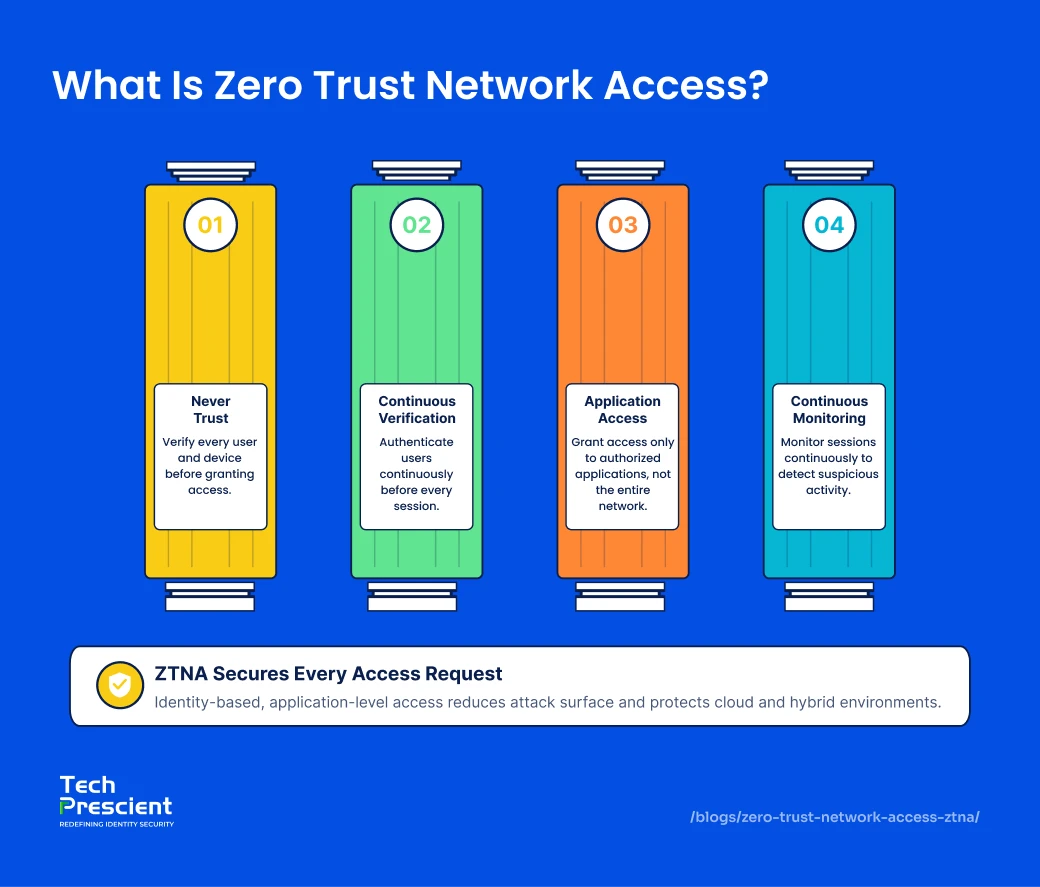
Zero Trust Network Security is based on the principle that no user, device, or application should be trusted by default. Instead of relying on network boundaries, it continuously verifies identity, device posture, and contextual risk before granting or maintaining access. This zero trust network model minimizes the attack surface and strengthens security across modern IT environments.
The following core principles define how Zero Trust Network Access enforces secure, identity-driven access.
Never Trust, Always Verify
The foundation of Zero Trust is the assumption that every access request should be treated as untrusted until it is verified. Instead of granting access based on network location, ZTNA evaluates user identity, device posture, login behavior, location, and other contextual signals before allowing access. This continuous validation helps organizations prevent unauthorized access and reduce identity-based threats.
Least Privilege Access
Zero Trust follows the principle of least privilege, ensuring users, devices, and applications receive only the minimum level of access required to perform their tasks. By limiting permissions to specific resources, organizations reduce the attack surface, prevent excessive privileges, and minimize the impact of compromised accounts or insider threats.
Continuous Authentication and Monitoring
Authentication is not a one-time event in a Zero Trust environment. ZTNA continuously monitors user activity, device compliance, and session behavior to identify changes in risk. If suspicious activity, policy violations, or device health issues are detected, the system can require re-authentication, restrict access, or terminate the session immediately.
Application Invisibility Through Microsegmentation
Unlike traditional network security, ZTNA hides applications from unauthorized users instead of exposing them to the network. Combined with microsegmentation, applications and workloads are divided into smaller security zones, ensuring users can access only the resources they are explicitly authorized to use. This limits lateral movement, contains potential breaches, and strengthens the overall Zero Trust architecture.
Did You Know?
Most successful cyberattacks today begin with compromised identities rather than network breaches. That's why modern Zero Trust strategies focus on continuously verifying users and devices instead of simply protecting the network perimeter.
Evaluate Access Reviews Function as a Zero Trust Control
Identify where approvals fail, gaps persist, or excessive access remains across systems.
ZTNA vs VPN: What's the Difference?
While both Zero Trust Network Access (ZTNA) and Virtual Private Networks (VPNs) enable remote access to enterprise resources, they operate on fundamentally different security models. VPNs connect users to the corporate network after a single authentication, whereas ZTNA grants access only to specific applications after continuously verifying user identity, device health, and contextual risk. As organizations embrace cloud services and hybrid work, zero trust network access vs VPN has become a critical comparison for building secure and scalable remote access strategies.
The table below highlights the key differences between VPN and ZTNA.
| Feature | VPN | ZTNA |
|---|---|---|
| Access Scope | Grants access to the corporate network | Connects users only to authorized applications |
| Trust Model | Trusts users after initial authentication | Continuously verifies every access request |
| Security Risk | Greater exposure to lateral movement | Limits access and reduces attack surface |
| Performance | Routes traffic through centralized VPN gateways, which can affect speed | Connects users directly to applications for improved performance |
Why ZTNA Replaces VPNs
As enterprise environments become more distributed, traditional VPNs struggle to meet modern security and scalability requirements. ZTNA addresses these limitations by delivering secure, identity-driven access without exposing the internal network.
Reduced Attack Surface
VPNs often provide broad network visibility once a user is connected, increasing the risk of lateral movement if credentials are compromised. ZTNA eliminates this exposure by granting access only to the applications users are explicitly authorized to access, keeping the rest of the network hidden.
Better Support for Remote and Hybrid Work
Today's workforce accesses applications from multiple locations, devices, and networks. ZTNA is designed for this reality, enabling secure access based on identity and device trust rather than requiring users to connect through a centralized corporate network.
Improved User Experience
Traditional VPNs can introduce connection delays, network congestion, and unnecessary routing of traffic. ZTNA establishes direct, secure application-level connections, reducing latency while allowing users to access business applications without exposing the entire network.
Stronger Security Through Continuous Verification
Unlike VPNs that primarily authenticate users during login, ZTNA continuously evaluates identity, device posture, and session risk throughout the connection. This enables organizations to detect suspicious activity in real time and automatically enforce security policies when risk levels change.
Which One Should Organizations Choose?
For organizations operating in cloud, SaaS, and hybrid environments, ZTNA offers a more secure and scalable approach than traditional VPNs. By replacing implicit trust with continuous verification and application-level access, ZTNA strengthens security while delivering a seamless remote access experience for employees, contractors, and third-party users.

Pro Tip
If your VPN still gives users access to the entire corporate network after login, it may be time to reassess your remote access strategy. Start by protecting your most critical applications with ZTNA before expanding it across the organization.
Benefits of Zero Trust Network Access
Zero Trust Network Access (ZTNA) helps organizations secure application access without exposing the underlying network. By combining identity-based access, continuous verification, and least privilege principles, it enables enterprises to reduce cyber risks while supporting modern cloud-first and hybrid work environments. These benefits of Zero Trust Network Access extend beyond security, improving operational efficiency, user experience, and regulatory compliance.
Here's how organizations benefit from adopting Zero Trust Network Access.
1. Reduced Attack Surface
ZTNA grants access only to approved applications instead of the entire corporate network. Since internal resources remain hidden from unauthorized users, attackers have fewer opportunities to discover vulnerable systems or exploit exposed network services.
2. Prevents Lateral Movement
If a user account or device is compromised, ZTNA limits the attacker's ability to move across the environment. Application-specific access and microsegmentation ensure that users cannot access systems beyond their authorized permissions, helping contain potential security incidents.
3. Supports Hybrid and Remote Workforces
Employees today work from offices, homes, and remote locations using various devices. ZTNA enables secure access regardless of where users connect from, allowing organizations to provide a consistent security experience without relying on traditional VPN infrastructure.
4. Improves Visibility and Compliance
ZTNA continuously monitors user activity and records every access decision, creating detailed audit trails for security and compliance teams. This visibility helps organizations demonstrate adherence to regulatory frameworks while quickly identifying unauthorized access attempts or policy violations.
5. Enhances User Experience
By connecting users directly to authorized applications, ZTNA eliminates the need for full-network VPN connections. Employees can securely access the resources they need with fewer authentication delays, reduced network congestion, and improved application performance.
Common Use Cases of ZTNA
ZTNA provides secure, identity-driven access across a wide range of enterprise environments. Whether supporting remote employees, external partners, or cloud-native applications, organizations use ZTNA to protect sensitive resources while maintaining productivity. These Zero Trust Network Access use cases demonstrate how the technology addresses modern access challenges without exposing the corporate network.
The following are some of the most common scenarios where organizations implement ZTNA.
1. Remote Workforce Access
Remote employees require secure access to business applications from multiple locations and devices. ZTNA verifies user identity, device posture, and contextual risk before granting application-specific access, ensuring employees can work securely without connecting to the entire corporate network.
2. Third-Party and Vendor Access
Contractors, consultants, and business partners often need temporary access to internal applications. ZTNA allows organizations to provide limited, policy-based access to only the required resources, reducing the risks associated with excessive permissions and shared network access.
3. BYOD (Bring Your Own Device) Security
Organizations increasingly support employees using personal laptops, tablets, and mobile devices. ZTNA evaluates device health and security compliance before granting access, helping organizations protect sensitive applications even when unmanaged or employee-owned devices are used.
4. Multi-Cloud Application Access
Modern enterprises operate applications across public clouds, private clouds, SaaS platforms, and on-premises data centers. ZTNA provides a consistent access model across these environments, allowing users to securely connect to authorized applications regardless of where they are hosted.
5. Securing Privileged and Sensitive Applications
Critical business applications containing financial records, customer data, or intellectual property require stronger protection. ZTNA applies granular access policies and continuous verification to ensure only authorized users can access high-value assets, reducing the risk of unauthorized access and data breaches.
ZTNA Architecture & Deployment Models
Zero Trust Network Access (ZTNA) can be deployed in multiple ways to meet different business and security requirements. Whether organizations choose agent-based, agentless, cloud, or on-premises deployments, each model follows the same core principle of providing secure, identity-driven access without exposing the network. The right zero trust network architecture depends on the organization's infrastructure, workforce, and compliance needs.
Agent-Based ZTNA
An agent-based ZTNA deployment requires a lightweight software agent to be installed on managed devices. The agent continuously collects information about device health, security posture, and compliance before communicating with the ZTNA platform. This enables organizations to enforce granular access policies, monitor sessions in real time, and respond quickly if a device becomes non-compliant. Agent-based deployments are ideal for employees using corporate-managed devices and accessing sensitive applications.
Agentless ZTNA
Agentless ZTNA allows users to securely access applications through a web browser without installing additional software. After verifying user identity and evaluating access policies, the platform establishes a secure connection to the authorized application. This model simplifies access for contractors, vendors, and temporary users while reducing deployment and maintenance efforts. It is particularly effective for browser-based applications and external collaboration.
Cloud vs. On-Premises Deployment
Organizations can deploy ZTNA as a cloud-delivered service or within their own infrastructure.
- Cloud-based ZTNA offers centralized management, rapid scalability, and secure access for distributed users across cloud, SaaS, and hybrid environments.
- On-premises ZTNA provides greater control over infrastructure, data residency, and regulatory requirements, making it suitable for organizations with strict compliance needs.
- Many enterprises also adopt a hybrid deployment model, combining cloud and on-premises capabilities to secure applications regardless of where they are hosted.
How ZTNA Fits Into Zero Trust & IGA Strategy
ZTNA is a key component of Zero Trust architecture, but it delivers the greatest value when integrated with Identity and Access Management (IAM) and Identity Governance and Administration (IGA). Together, these technologies ensure that only the right users receive the right level of access while maintaining security, governance, and compliance across the enterprise.
Identity Becomes the Security Perimeter
ZTNA relies on identity information from IAM solutions to verify users before granting access to applications. By integrating with technologies such as Single Sign-On (SSO), Multi-Factor Authentication (MFA), and identity providers (IdPs), it ensures access decisions are based on verified identities instead of trusted network locations.
IGA Strengthens Access Governance
While IAM authenticates users, Identity Governance and Administration (IGA) determines who should have access, what level of access they need, and when those permissions should change or be revoked. Automated provisioning, role management, and periodic access reviews help organizations maintain least privilege while reducing excessive or outdated permissions.
Policy-Driven Access and Compliance
ZTNA enforces access decisions based on policies that evaluate user identity, device posture, location, application sensitivity, and contextual risk. When combined with governance policies from IGA, organizations can consistently enforce security controls, simplify regulatory compliance, and generate detailed audit trails for reviews and certifications.
Building a Complete Zero Trust Architecture
ZTNA, IAM, and IGA each play a distinct role in a Zero Trust strategy. IAM verifies identities, IGA governs access throughout the identity lifecycle, and ZTNA securely connects users only to the applications they are authorized to use. Together, they create a unified, identity-centric security framework that reduces cyber risk, limits lateral movement, and supports secure access across cloud, hybrid, and on-premises environments.
How to Implement Zero Trust Network Access
Implementing Zero Trust Network Access (ZTNA) goes beyond replacing a VPN. It requires organizations to adopt an identity-first security approach where every access request is evaluated based on user identity, device trust, and predefined security policies. A well-planned implementation helps strengthen security while ensuring seamless access for authorized users.
Follow these key steps to successfully implement a Zero Trust Network Access strategy.
Define Access Policies
Start by identifying users, roles, applications, and business requirements. Create granular access policies based on the principle of least privilege, ensuring users can access only the applications and resources necessary for their job responsibilities.
Integrate an Identity Provider
Connect your ZTNA solution with an Identity Provider (IdP) to centralize user authentication and identity verification. Integrating Single Sign-On (SSO), directory services, and identity repositories helps provide consistent and secure access across all enterprise applications.
Enable Multi-Factor Authentication and Device Validation
Strengthen security by requiring Multi-Factor Authentication (MFA) and validating device posture before granting access. Checking endpoint compliance, operating system updates, encryption status, and security configurations ensures that only trusted users on trusted devices can connect.
Segment Applications
Organize applications into logical security segments instead of exposing the entire network. Application-level segmentation ensures users can access only authorized resources, reducing the attack surface and limiting lateral movement in the event of a security breach.
Continuously Monitor and Optimize
ZTNA is an ongoing security strategy rather than a one-time deployment. Continuously monitor user activity, device health, and access patterns to detect risks, enforce policies, and refine access controls as business and security requirements evolve.
Key Considerations for Successful Deployment
A successful ZTNA implementation should balance security with operational efficiency. Keep these factors in mind:
- Scalability: Choose a solution that can support organizational growth, cloud adoption, and an expanding remote workforce.
- Integration with IAM and IGA: Ensure the platform integrates seamlessly with Identity and Access Management (IAM) and Identity Governance and Administration (IGA) solutions for centralized identity lifecycle management and governance.
- User Experience: Provide secure access with minimal friction through capabilities such as Single Sign-On (SSO), adaptive authentication, and streamlined access workflows.
Best Practice
Treat ZTNA as an ongoing security strategy, not a one-time deployment. Regularly review access policies, remove unnecessary permissions, and monitor user activity to keep your Zero Trust environment effective as your business evolves.
Top ZTNA Solutions & Vendors
Selecting the right ZTNA solution is critical for building a secure, scalable, and identity-driven access strategy. Organizations should look for platforms that not only provide secure application access but also integrate identity governance, policy enforcement, and compliance to support a complete Zero Trust architecture.
Identity Confluence by Tech Prescient is designed to help organizations strengthen Zero Trust initiatives by combining Identity Governance and Administration (IGA) with intelligent access management. Instead of relying solely on network-based controls, the platform enables organizations to govern identities, automate access decisions, and enforce policy-driven security across cloud, on-premises, and hybrid environments.
Why Identity Confluence for Zero Trust?
- Automates identity lifecycle management with Joiner, Mover, and Leaver (JML) workflows.
- Enforces least privilege access through policy-driven provisioning and role-based access controls.
- Supports continuous access governance with automated user access reviews and certification campaigns.
- Integrates with 200+ enterprise applications and existing IAM, HRMS, ITSM, and directory services.
- Provides real-time visibility into identities, entitlements, and access risks across hybrid environments.
- Simplifies compliance with centralized audit trails and support for frameworks such as ISO 27001, SOC 2, HIPAA, SOX, and GDPR.
- Scales with enterprise needs, enabling organizations to secure users, applications, and non-human identities from a single governance platform.
By combining identity governance with policy-based access controls, Identity Confluence helps organizations implement Zero Trust more effectively, ensuring users receive the right access at the right time while maintaining security, compliance, and operational efficiency across the enterprise.
Final Thoughts
Zero Trust Network Access (ZTNA) is transforming how organizations secure access in cloud-first and hybrid environments. By replacing broad network access with identity-based, application-level access and continuous verification, ZTNA reduces cyber risk, limits lateral movement, and strengthens an organization's Zero Trust security strategy.
At Tech Prescient, we help organizations strengthen Zero Trust with Identity Confluence, our AI-driven Identity Governance and Administration (IGA) platform. By automating identity lifecycle management, enforcing least privilege access, and enabling continuous access governance across cloud, SaaS, and on-premises environments, Identity Confluence helps enterprises build a secure, compliant, and identity-first access ecosystem.
FAQs
A Zero Trust access network is a security approach that verifies every user, device, and access request before allowing access to an application. Instead of trusting users because they are inside the corporate network, it grants access only after validating identity, device posture, and security policies. This helps organizations reduce unauthorized access and strengthen overall security.
The main difference between ZTNA and VPN is how they grant access. A VPN provides users with broad network access after a one-time login, while ZTNA connects users only to the specific applications they are authorized to access and continuously verifies trust throughout the session. This makes ZTNA a more secure and scalable choice for modern enterprises.
A Zero Trust approach limits users to only the applications and resources they need instead of exposing the entire network. By enforcing least privilege access and continuously validating every request, it reduces the attack surface and helps prevent lateral movement if an account or device is compromised.
Organizations commonly use traditional VPNs, Zero Trust Network Access (ZTNA), Software-Defined Perimeter (SDP), and direct network access to connect users to enterprise resources. While each serves different business needs, ZTNA and SDP provide stronger security by enforcing identity-based access instead of relying on trusted network boundaries.
Yes. Zero Trust Network Access (ZTNA) is a core component of a Zero Trust architecture because it enforces secure, identity-based access to applications. It works alongside technologies such as IAM, IGA, and Multi-Factor Authentication (MFA) to ensure only authorized users can access the right resources at the right time.
Share



Yatin Laygude
Content Writer
A content writer with 6 years of experience turning complex topics into clear, engaging, and meaningful content. From blogs and web pages to whitepapers and thought pieces, he creates content that not only explains but also connects with both the audience and business goals.
Most Popular Blogs
Identity Security· 21 min read
Data Access Governance Solutions: How to Secure Sensitive Data at Scale
Compare data access governance solutions for 2026: how DAG platforms discover sensitive data, run access reviews, automate remediation, and prove compliance.
Brinda Bhatt· September 7, 2026
Identity Security· 24 min read
Cyber Essentials Certification: Complete Guide
Learn Cyber Essentials certification, cost, requirements, and steps. Compare Cyber Essentials vs Plus and get certified faster.
Yatin Laygude· August 10, 2026
Identity Security· 23 min read
Time-Based Access Control (TBAC): How It Works, Benefits & Enterprise Use Cases
How Time-Based Access Control (TBAC) works, where enterprises use it, and how it enforces least privilege across the joiner-mover-leaver lifecycle.
Brinda Bhatt· August 5, 2026