




On this page
See Tech Prescient in Action
Automate access, reduce risk, and stay audit-ready
Data access governance solutions answer a question most enterprises cannot: who can open sensitive files, why that access was granted, and whether it still holds up. Identity and access management (IAM) confirms identity at the door; data access governance governs what that verified user reaches once inside.
The gap shows up during routine audits. A financial services firm audits its file shares and finds folders containing customer records accessible to team members who have no business reason to access those files. No one gave these team members access with malicious intent, but the records have been accessed through a series of grants that nobody revoked.
Data access governance solutions exist to close that gap. They give security and compliance teams visibility into where sensitive data lives, who can access it, and whether that access still makes sense, then automate the cleanup when it does not.
This guide covers how data access governance platforms work, what features separate them from permissions scanners, how to evaluate the vendors in the space, and where they fit in the context of identity governance and administration (IGA) and data security posture management (DSPM).
Key Takeaways:
- What data access governance means and how it differs from traditional access control
- How data access governance solutions discover, analyze, monitor, and remediate access risk
- The core features that separate a mature platform from a basic permissions scanner
- How to evaluate vendors against consistent, business-relevant criteria
- Where data access governance fits next to identity and access management (IAM) and identity governance and administration (IGA)
- How to choose the right solution for your data environment and compliance obligations
What Is Data Access Governance?
Data access governance is the discipline of controlling who can access enterprise data, why they need that access, and whether it remains appropriate over time.
By blending data governance workflow with data security functions, what was once an audit process for data governance has evolved into a continuous program. Thus, the access control system for data governance also becomes a cycle, requiring each permission to be reviewed for its business purpose at regular intervals.
The "why" carries as much weight as the "who" here. Recording that a user can open a folder tells a reviewer almost nothing on its own. Tying that access back to a documented business reason is what lets a reviewer separate access someone needs from access someone simply still has, a distinction that becomes the foundation for everything covered in user access reviews.
Why Does Data Access Governance Matter?
Three pressures have pushed data security governance from a nice-to-have into a baseline requirement for most regulated enterprises.
Insider risk is the first. The Verizon 2026 Data Breach Investigations Report traced credential abuse across the full attack chain and found it present in 39% of breaches. The same dataset shows 83% of incidents involving privilege escalation used no vulnerability exploit at all, attackers moved up through access that had already been granted. A user sitting on excessive standing access does not need to break in, and orphaned accounts left behind after role changes widen that exposure further.
Compliance pressure compounds the problem, and the cost of missing it is measurable: the IBM Cost of a Data Breach Report 2025 puts the average time to identify and contain a breach at 241 days, with breaches running past 200 days costing roughly 52% more. GDPR compliance, HIPAA compliance, and SOX compliance all require organizations to show that access to regulated data is controlled and reviewed on a defined cadence, and restrictable on paper alone does not satisfy an auditor.
Data sprawl is the third and, arguably, the fastest-growing. Organizations today have sensitive data stored across the cloud, SaaS, and file systems. The permissions model set up for accessing data on an on-prem file server is not necessarily the same as what is required within a complex multi-cloud environment that runs dozens of SaaS connectors.
Data Access Governance vs. Traditional Access Control
Traditional access control is largely static. A user gets granted access, and that access persists until someone manually revokes it. Data access governance treats access as something that needs continuous validation instead of a one-time decision.
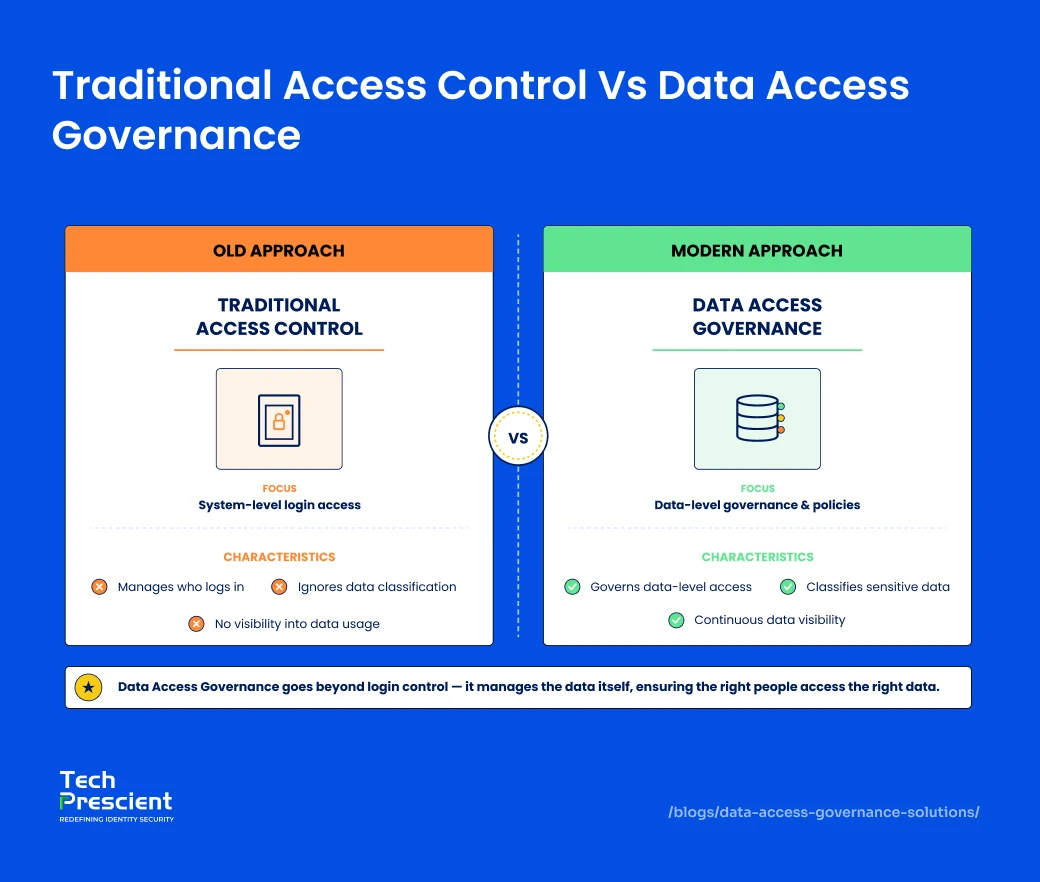
The difference shows up in three places. Traditional models grant permissions once and assume they stay correct indefinitely. Governance models monitor entitlements on an ongoing basis and flag drift as it happens. Traditional access control reacts to a support ticket. Governance surfaces risk before it turns into an incident, which is the same principle that underpins access certification programs more broadly.
Data Access Governance vs IAM, IGA, and DSPM
Identity and access management manages user identities and authentication. Data access governance determines whether users should access specific data and continuously governs whether that access remains appropriate.
| Layer | Question it answers | Primary output |
|---|---|---|
| IAM | Is this user who they claim to be? | An authenticated session |
| IGA | Which identity holds this entitlement, and how did they get it? | Entitlement lifecycle across joiner, mover, leaver |
| DAG | Who can reach this sensitive data, and should they still? | Certified access decisions and revocations |
| DSPM | Where does sensitive data sit, and how exposed is it? | A risk-scored data inventory |
The distinction matters because IAM answers whether this is really the user they claim to be, while DAG answers whether this verified user should actually be able to open this file. Identity governance and administration sits between the two, governing the entitlement lifecycle across joiner, mover, and leaver events. The strongest enterprise programs connect IGA and DAG so identity-level decisions and data-level access stay in sync.
Data Access Governance vs DSPM
Data security posture management finds sensitive data and scores the risk around it: misconfigurations, exposure paths, unencrypted stores, and public buckets. Data access governance governs the entitlements themselves — running the review, capturing the approval, and revoking what fails. Most enterprise data governance programs run both. DSPM supplies the data risk picture, DAG supplies the access decision and the audit trail behind it, and IGA connects both back to the identity holding the entitlement.
How Do Data Access Governance Solutions Work?
Modern data access governance platforms follow a consistent operational pattern. They discover sensitive data, analyze who can reach it, monitor how that access actually gets used, and automatically remediate what no longer makes sense.
Discover and Classify Sensitive Data
Discovery starts with locating where regulated and sensitive data actually lives, across structured databases and unstructured sources like file shares, SharePoint sites, and cloud storage buckets. Unstructured data is typically the harder problem to solve, since it lacks the predictable schema that makes structured data easier to scan automatically. Unstructured data governance is the capability most vendor evaluations turn on.
Classification engines use pattern matching, and increasingly AI-assisted detection, to identify PII, financial records, health information, and other regulated categories. The output feeds a risk score that tells governance teams which repositories deserve attention first, rather than treating every data store as equally urgent.
Analyze Permissions and Access Risks
Once sensitive data is mapped, the platform analyzes who can actually reach it. That means effective permissions after accounting for group memberships, inherited folder structures, and nested access chains, not just who is nominally assigned a role on paper.
This step surfaces overprivileged users and toxic access: entitlement pairs that look harmless on their own and create a segregation of duties violation when a single identity holds both. Data permissions management depends on catching those combinations before an auditor does.
Data Access Monitoring
Static analysis tells you what someone could access. Behavioral monitoring tells you what they are actually doing with it. Data access governance platforms track access patterns to flag anomalies, like a service account suddenly pulling bulk records or a user reaching far outside their normal pattern, that point to insider risk or a compromised credential already in active use.
Automated Access Remediation
Discovery and monitoring only create value if something acts on the findings. Automated remediation handles permission cleanup, access revocation, and policy enforcement at a pace manual review processes cannot match, turning a quarterly audit finding into a near real-time correction instead of a problem that sits open for months.
Want a working checklist for your next access audit?
Use the checklist for the capabilities that matter most for your environment.
Core Features Every Data Access Governance Solution Should Include
Sensitive data access management rests on four capability areas, and the strongest data access governance solutions combine all four: visibility into sensitive data, automated governance workflows, compliance-ready reporting, and least-privilege enforcement that holds over time rather than only at the moment access is first granted.
Data Discovery and Classification
This is the foundation on which everything else depends. Without an accurate, current map of where sensitive data lives, every downstream control, from access reviews to remediation, is working from an incomplete picture.
Access Reviews and Certifications
Mature platforms support structured, recurring reviews where data and resource owners confirm whether existing access still makes sense. This stands in contrast to the rubber-stamp approach many organizations fall into, where a list gets approved once a year without real scrutiny, a pattern automated user access reviews are built to break.
Least Privilege Enforcement
Strong platforms trim entitlements down to what is operationally necessary, using role-based access control and attribute-based access control models to set the baseline and just-in-time access to grant elevated permissions temporarily. Least privilege access holds only when the platform re-tests it on a cycle, well after the moment access is first approved.
Compliance Reporting
Audit-ready documentation maps access controls directly to specific regulatory requirements, the approach behind automated compliance reporting. It cuts down the manual evidence-gathering that otherwise consumes weeks before every audit cycle.
Automated Remediation
The platform needs the ability to act on findings, not just surface them. Revoking stale access, correcting misconfigured permissions, and flagging policy violations should happen without waiting for a human to action every single line item by hand.
Risk-Based Access Analytics
Scoring and prioritization direct effort at the access combinations and data repositories carrying the most real exposure, which is what turns a findings list into data risk management.
Evaluation Criteria Buyers Should Consider
Before comparing specific vendors, test any data access governance software against a consistent set of criteria. Vendors differ sharply in where their platform's real strength lies, and a feature list alone rarely makes that clear.
| Evaluation Criteria | Why It Matters |
|---|---|
| Sensitive Data Discovery | Identifies regulated and high-risk data across structured and unstructured sources |
| Permission Visibility | Reveals excessive, orphaned, or inherited access not obvious from role assignments alone |
| Access Certification | Supports recurring governance and compliance reviews |
| Automated Remediation | Removes risky permissions without manual ticket-by-ticket cleanup |
| Compliance Reporting | Simplifies audit preparation and regulatory evidence collection |
| Cloud and SaaS Coverage | Secures hybrid environments spanning on-prem, cloud, and SaaS platforms |
| Identity Governance Integration | Connects data-level access decisions back to the identities that hold them |
| Risk Analytics | Detects insider threats and unusual behavior, not just static misconfigurations |
| Scalability | Supports enterprise data volumes and user populations as the organization grows |
Top Data Access Governance Solutions in 2026
Organizations typically evaluate data access governance tools along five dimensions: discovery capabilities, automation depth, cloud and SaaS coverage, compliance feature sets, and how well the platform integrates with existing identity infrastructure.
- Saviynt approaches data access governance as an extension of its identity governance platform, connecting file repositories like Microsoft 365, Box, and Google Drive into the same certification workflow that covers application entitlements.
- Concentric AI uses deep-learning classification to map sensitive data and permissions without rule-writing, aimed at teams that want coverage across unstructured repositories quickly.
- Cyera approaches the problem from the data security posture side, with strong discovery and classification across cloud data stores that feeds access risk decisions downstream.
- SailPoint File Access Manager approaches data access governance from an identity-centric angle, tying file and data permissions back to a broader identity governance program. This is a natural fit for organizations already running SailPoint for IGA that want data access reviews inside the same workflow.
- Varonis built its reputation specifically on unstructured data, including file shares, SharePoint, and email archives, with deep permissions visibility into environments that are notoriously difficult to map by hand.
- BigID centers on data discovery and classification, with particular strength in identifying sensitive data across a wide range of structured and unstructured sources, then feeding that intelligence into downstream governance processes.
- Securiti combines data governance with privacy management, using AI-assisted controls to connect data discovery directly to privacy regulation requirements such as GDPR and CCPA.
- Immuta focuses on data platforms and policy automation, letting governance teams define access policies once and enforce them consistently across multiple data warehouses and analytics environments.
- Microsoft Purview extends data governance and compliance visibility natively across the Microsoft ecosystem, which makes it a practical entry point for organizations heavily invested in Microsoft 365 and Azure.
- Forcepoint brings risk detection into the mix and integrates data access governance with broader data security posture management, giving security teams a more unified view of data risk alongside access risk.
| Vendor | Best For | Key Strength |
|---|---|---|
| Saviynt | IGA-led data governance | Unified certification |
| Concentric AI | Rules-free classification | Deep-learning discovery |
| Cyera | Cloud data estates | DSPM-led risk |
| SailPoint | Identity-centric governance | Access reviews |
| Varonis | Unstructured data | Permissions visibility |
| BigID | Data discovery | Sensitive data intelligence |
| Securiti | Privacy and governance | AI-powered controls |
| Immuta | Data platforms | Policy automation |
| Microsoft Purview | Microsoft ecosystem | Compliance visibility |
| Forcepoint | Risk detection | DSPM integration |
No single vendor dominates every criterion above. The right fit generally depends on which data environments matter most to your organization and whether data access governance needs to plug into an existing identity governance program like Identity Confluence or operate largely on its own.
Why Tech Prescient?
Data access governance fails at the identity layer more often than the data layer. A platform can classify every sensitive file in the estate and still get the access decision wrong if it cannot see which accounts exist, who owns them, and what each one is entitled to. Identity Confluence governs that layer. The platform builds a complete identity inventory across cloud, on-premises, and SaaS systems on day one, including the service accounts, API keys, and bots that read production data on a schedule and rarely appear in a manual review. Non-human identity governance assigns each one an accountable human owner and enforces credential rotation at 30, 60, or 90-day intervals, closing the category most data access reviews skip.
On the review side, user access reviews run on schedule with a risk score, the access source, and the last-usage date in front of every reviewer, which is what separates a real certification from a rubber stamp. SoD enforcement catches entitlement pairs that pass individually and violate policy together. Excessive permissions get flagged and trimmed against least privilege, with RBAC and ABAC support and file-and-folder governance down to three-tier hierarchical structures in Google Drive and file servers.
For audit, the Evidence Center collects proof continuously across SOC 2, ISO 27001, SOX, HIPAA, GDPR, DPDPA, and NIST CSF, so automated compliance reporting stops being a two-week reconstruction before every cycle. 250+ prebuilt connectors and a custom connector framework bring new applications under governance in days.
Identity Confluence coexists with SailPoint, SAP GRC, Okta, Entra ID, and existing PAM tooling. Teams already running a DAG or DSPM product keep it and connect the identity layer underneath, with no rip-and-replace.

Pro Tip:
Weigh the evaluation criteria before you start vendor calls. Decide upfront whether discovery, automation, or compliance reporting matters most for your environment. It keeps demos focused and comparable.
Data Access Governance Use Cases
Data access governance solutions show up most clearly in four practical scenarios: regulatory compliance, insider threat prevention, cloud data governance, and the access cleanup that follows a merger or acquisition.
Regulatory Compliance
Frameworks including GDPR, HIPAA, SOX, and PCI DSS all require organizations to demonstrate controlled, reviewed access to regulated data. Data access governance platforms generate the audit trail and evidence that compliance teams need without manual reconstruction, a workflow covered step by step in our user access review audit guide.
Insider Threat Prevention
Continuous monitoring and access analytics help surface risky entitlements and unusual behavior before they turn into an actual incident, rather than getting discovered during a post-breach investigation after the damage is done.
Cloud Data Governance
As data spreads across SaaS applications and cloud storage, data access governance extends consistent oversight to environments that traditional, on-premises-focused access controls were never designed to cover in the first place.
Mergers and Acquisitions
Combining two organizations means combining two access models, usually inherited from different platforms and different levels of governance maturity. Data access governance accelerates the discovery and cleanup work needed to bring a merged environment up to a single, consistent standard.
How to Choose the Right Data Access Governance Solution?
The right data access governance solution depends less on vendor reputation and more on your specific data environment, regulatory obligations, and how mature your existing governance processes already are.
Evaluate Your Data Landscape
Map where sensitive data actually lives across structured databases, unstructured file shares, and SaaS applications before evaluating tools. Vendor strengths vary sharply across these categories, and a platform strong in one is rarely strong in all three.
Assess Compliance Requirements
Identify which frameworks apply, whether that is GDPR, HIPAA, SOX, PCI DSS, or industry-specific regulations, and confirm the platform generates reporting that maps directly to those requirements rather than generic, unmapped logs.
Prioritize Automation
Manual access reviews stop scaling past a certain organizational size. Favor platforms with genuine automated remediation over those that simply surface findings for someone else to act on manually.
Consider Identity Governance Integration
If an IGA program is already in place, evaluate how well a data access governance solution connects to it. Disconnected systems create duplicate work and inconsistent access decisions between the two layers.
Measure Scalability and Cloud Support
Confirm the platform can handle current data volumes and the specific cloud and SaaS environments already in use, not just the on-premises footprint it may have originally been designed around.
Make Data Access Governance Work for You
Data access governance solutions exist because identity verification and data protection are two different problems, and traditional IAM was never built to solve both at once. Knowing who someone is does not tell you what they should still be able to see, and that gap widens every time an organization adds another cloud platform or SaaS connector to its environment.
Closing that gap properly changes three things. Audits stop requiring weeks of manual reconstruction, insider risk gets caught while it is still a finding rather than after it becomes an incident, and identity governance and data access governance start operating as one connected system instead of two separate efforts pointed at the same problem.
See who can reach your sensitive data, before your auditors ask
Identity Confluence maps every human and non-human identity, shows the effective access behind each one, and generates the evidence trail an audit needs. You get a full inventory on day one, without a multi-month implementation.
FAQs
Data access governance is the process of managing, monitoring, and controlling who can access sensitive organizational data and ensuring that access remains appropriate over time. It extends beyond identity verification into the actual data layer.
IAM manages user identities and authentication. Data access governance focuses on governing access to sensitive data and reviewing whether existing permissions still make sense for that user's current role.
DSPM finds sensitive data and scores its exposure. Data access governance governs who can reach that data, runs the certification, and revokes access that no longer holds up. Most programs run both, since neither answers the other's question.
Data governance covers the full stewardship of data assets: quality, lineage, ownership, retention, and shared definitions. Data access governance is the access control and certification layer inside it, concerned with who can reach regulated data and whether that permission is still justified.
Ownership usually sits with the security or identity team, with data and application owners acting as reviewers and compliance signing off on the evidence. Programs assigned to IT alone tend to stall, because IT can see the permissions but rarely knows the business reason behind them.
They improve compliance readiness, reduce insider threat exposure, enforce least privilege, and automate access reviews that would otherwise consume weeks of manual effort from IT and compliance teams.
Core features include sensitive data discovery, access reviews and certifications, compliance reporting, automated remediation, activity monitoring, and risk-based access analytics.
Yes. Data access governance supports Zero Trust security by continuously validating and governing access to sensitive data and by treating every permission as provisional until it is reconfirmed.
Share



Brinda Bhatt
Digital Marketing Strategist
A Digital Marketing Strategist who makes complex identity governance accessible to security and technology leaders through clear, data-driven content. Her insight-led, audience-focused approach supports Tech Prescient's mission of redefining identity security for modern enterprises.
Most Popular Blogs
Identity Security· 24 min read
What Is Zero Trust Network Access (ZTNA)?
Learn what Zero Trust Network Access (ZTNA) is, how it works, and why it’s replacing VPNs for secure, identity-based access control.
Yatin Laygude· August 14, 2026
Identity Security· 24 min read
Cyber Essentials Certification: Complete Guide
Learn Cyber Essentials certification, cost, requirements, and steps. Compare Cyber Essentials vs Plus and get certified faster.
Yatin Laygude· August 10, 2026
Identity Security· 23 min read
Time-Based Access Control (TBAC): How It Works, Benefits & Enterprise Use Cases
How Time-Based Access Control (TBAC) works, where enterprises use it, and how it enforces least privilege across the joiner-mover-leaver lifecycle.
Brinda Bhatt· August 5, 2026