




On this page
See Tech Prescient in Action
Automate access, reduce risk, and stay audit-ready
Data Security Posture Management (DSPM) is a cybersecurity framework that continuously discovers, classifies, monitors, and protects sensitive data across cloud, SaaS, and on-prem environments. Its goal is to reduce data exposure risks, enforce least privilege access, and support regulatory compliance.
DSPM shifts the focus of security from infrastructure to the data itself. Rather than relying solely on perimeter controls, it provides continuous visibility into where sensitive data resides, who can access it, how it is used, and where protection gaps exist. This includes automated data classification, encryption validation, access governance analysis, monitoring, and remediation workflows.
Unlike traditional security tools that primarily defend networks or endpoints, DSPM follows data across hybrid and multi-cloud ecosystems. It evaluates real data exposure, not just configuration posture, to identify excessive permissions, misconfigurations, shadow data stores, and compliance risks.
By centering security strategy on data, organizations can reduce breach likelihood, limit blast radius, and strengthen audit readiness in dynamic cloud environments.
Key Takeaways:
- Learn why DSPM is becoming essential as data breaches cost $4.88M on average
- Discover how DSPM differs from DLP, [CSPM](/blogs/cloud-security-posture-management/), and CASB in protecting your data
- Explore measurable business benefits, including faster incident response
- See real-world use cases across healthcare, finance, and AI implementations
- Get practical guidance on selecting the right DSPM solution for your organization
How DSPM Works
Data Security Posture Management (DSPM) operates through continuous data discovery, contextual classification, risk analysis, and automated remediation. Together, these functions create a control layer that aligns data sensitivity with access and configuration posture.
At a functional level, DSPM follows four stages: discover → classify → assess risk → remediate.
Automated Data Discovery
DSPM continuously scans structured and unstructured data across cloud storage, databases, SaaS applications, backups, and on-premises systems.
It identifies sensitive data types, including personally identifiable information (PII), protected health information (PHI), financial records, and intellectual property.

Pro Tip
Don’t try to classify everything on Day 1. Begin with high-risk datasets like PII, financial records, and IP to drive faster risk reduction and executive buy-in.
Risk-Based Classification
DSPM applies rule-based and machine learning classification methods to label data according to sensitivity, regulatory obligations, and business impact.
Classification establishes the context required to prioritize security controls and remediation actions.
Exposure and Access Risk Analysis
DSPM correlates data sensitivity with identity permissions, configuration states, and account privilege levels.
This analysis surfaces conditions such as over-permissioned accounts, public exposure, and misconfigurations that increase breach likelihood.
Automated Remediation and Policy Enforcement
DSPM integrates with identity and cloud control planes to initiate corrective actions, including:
- Removing excessive access
- Encrypting exposed data
- Alerting security teams
- Enforcing least privilege policies
By continuously aligning data sensitivity with access controls, DSPM reduces exposure risk before exploitation occurs.
Why Is DSPM Important in 2026?
Data Security Posture Management (DSPM) uses automated discovery and classification to identify sensitive data, assess exposure, and enforce policy controls across distributed environments. The urgency is structural, not temporary.
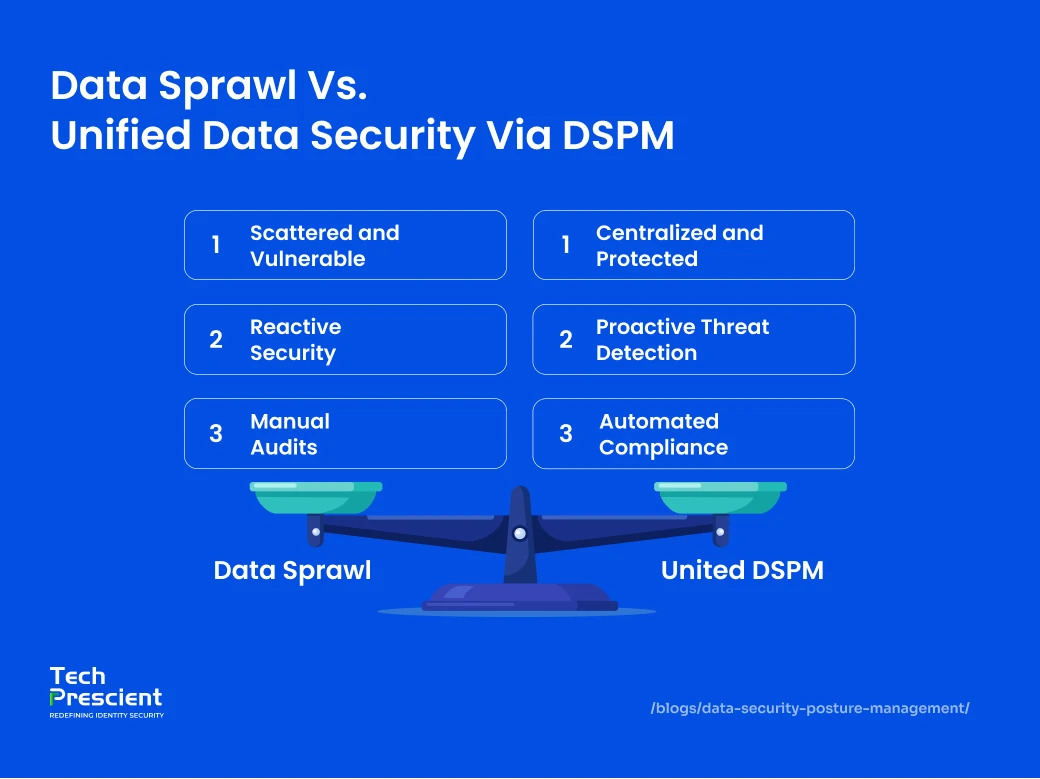
Traditional security architectures were designed to protect networks, endpoints, and user activity. They remain effective for perimeter defense and threat detection across users, APIs, devices, and applications. However, they were not built to control the scale, duplication, and distribution of data introduced by cloud adoption, SaaS expansion, AI workloads, and cloud-native development.
As infrastructure evolved, data governance did not keep pace. The result is measurable visibility and control gaps.
Today’s data risk is defined by:
- Data sprawl across cloud, SaaS, development, backup, and analytics environments
- Unmanaged replicas of sensitive data outside formal governance controls
- Excessive permissions that do not reflect current job roles
- Misconfigurations in storage platforms and cloud services
- Limited visibility into where regulated or high-value data resides
One of the most persistent challenges is “shadow data”: unauthorized copies, backups, exports, or replicas of sensitive information that exist outside enforced governance policies. These copies often emerge through routine operational workflows rather than malicious intent.
For example, a team may export customer records from a CRM system to support a campaign and store the file in shared cloud storage for collaboration. Without enforced access controls, encryption, or retention policies, regulated data becomes exposed. This pattern is common in distributed operating models.
DSPM addresses these risks through three core capabilities:
Automated Data Discovery
Continuously scans databases, file systems, object storage, SaaS platforms, and structured and unstructured repositories to create a living inventory of sensitive data across environments.
Risk-Based Classification
Classifies data by sensitivity and correlates exposure factors such as excessive permissions, public accessibility, and misconfigurations, enabling prioritized remediation.
Policy Validation and Enforcement
Validates configurations against internal policies and regulatory standards, identifies weak access controls, and supports automated remediation to reduce exposure.
The financial impact reinforces the operational necessity. According to the 2024 Cost of a Data Breach Report by IBM, the global average cost of a data breach reached $4.88 million, reflecting continued year-over-year growth. Exposure is measurable and material.
DSPM becomes materially stronger when aligned with identity governance. Data classification defines what is sensitive. Identity governance enforces who should have access. When integrated with platforms such as Tech Prescient’s Identity Confluence, organizations align data sensitivity with entitlement control, reducing unnecessary access and limiting lateral movement risk.
DSPM vs. Traditional Security Tools
Data Security Posture Management (DSPM) differs from legacy and adjacent security tools because it centers on the data itself. Other platforms primarily secure infrastructure configurations, user access pathways, or data movement channels. DSPM continuously evaluates where sensitive data exists, how it is classified, and whether exposure conditions are present.
The distinction is structural:
- CSPM secures cloud configurations.
- DLP monitors and restricts data movement.
- CASB governs SaaS access.
- CNAPP unifies cloud workload protections.
- DSPM identifies, classifies, and reduces exposure of the data itself.
The tools are complementary, but they solve different risk layers.
| Sr No | Tool | Primary Focus | What It Protects | Limitation |
|---|---|---|---|---|
| 1 | DSPM | Data visibility & exposure risk | Sensitive data | Requires integration with IAM |
| 2 | CSPM | Cloud configuration | Infrastructure | Does not classify data |
| 3 | DLP | Data movement | Data in motion | Reactive, not proactive |
| 4 | CASB | SaaS access control | User-cloud access | Limited data context |
DSPM vs. CSPM
Cloud Security Posture Management (CSPM) focuses on identifying and remediating misconfigurations in cloud environments. It continuously evaluates infrastructure across IaaS, PaaS, and SaaS environments against benchmarks such as CIS controls and regulatory frameworks including NIST, GDPR, and HIPAA. CSPM integrates with cloud platforms through APIs to assess virtual machines, storage accounts, networks, and application configurations.
CSPM answers: Is the cloud environment configured securely?
Data Security Posture Management answers a different question: Where is sensitive data located, and is it exposed?
DSPM discovers and classifies structured and unstructured data across cloud storage, databases, backups, SaaS platforms, and development environments. It evaluates access permissions, encryption status, duplication, and exposure pathways. Its focus is not infrastructure posture alone, but the sensitivity and accessibility of the information residing within that infrastructure.
Key distinction: CSPM secures infrastructure configurations. DSPM secures the data within those environments.
DSPM vs. DLP
Data Loss Prevention (DLP) monitors data in motion. It inspects outbound traffic such as email, file transfers, web uploads, and network transmissions to prevent unauthorized data exfiltration. DLP solutions enforce policies at the point of transmission, blocking or quarantining content that violates predefined rules.
DLP answers: Is sensitive data leaving the organization inappropriately?
DSPM operates earlier in the lifecycle. It identifies sensitive data at rest, in use, and across distributed repositories before movement occurs. It evaluates whether access controls, encryption, and configuration settings create exposure risk, even if no transfer attempt has been made.
DLP is primarily reactive to data movement events. DSPM is proactive in identifying exposure conditions.
Key distinction: DLP blocks unauthorized movement. DSPM reduces the underlying exposure that makes data loss possible.
DSPM vs. CASB & CNAPP
Cloud Access Security Broker (CASB) governs user access to SaaS applications. It acts as a policy enforcement layer between users and cloud services, monitoring activity, detecting shadow IT, and applying controls to reduce misuse or risky behavior.
CASB answers: Are users accessing SaaS applications appropriately?
Cloud-Native Application Protection Platform (CNAPP) provides consolidated protection for cloud-native workloads across the development and runtime lifecycle. It typically integrates CSPM, cloud workload protection, and related controls into a unified architecture.
CNAPP answers: Are cloud-native applications and workloads secure across their lifecycle?
DSPM answers a narrower and more precise question: Where is sensitive data stored across all environments, and is it properly governed?
DSPM provides visibility into data location, duplication, sensitivity classification, access exposure, and compliance alignment. It complements CASB and CNAPP by ensuring that the information being accessed or processed is continuously evaluated for risk, not only the users or the infrastructure surrounding it.
Key distinction: CASB manages access to cloud services. CNAPP secures cloud-native workloads. DSPM governs the data those systems store and process.
Top Business Benefits of DSPM
Data Security Posture Management (DSPM) delivers measurable business value by improving data visibility, reducing compliance overhead, strengthening access governance, and accelerating incident response. Its impact is operational, financial, and strategic.
The primary business outcomes include:
Full Visibility into Sensitive Data
Here's a startling reality: Most businesses do not know where sensitive data actually resides. During DSPM implementations, organizations consistently find 40-60% more sensitive data repositories than they realized were present.
Seriously, think about it, when was the last time you took a hard look at every place you had customer social security numbers within your environment? Most organizations believe they are only in their CRM and HR systems. However, DSPM regularly discovers the same sensitive information lurking in:
- Backup and archive systems from years past
- Development and testing environments
- Application logs and error files
- Shadow IT deployments
- Third-party integrations and data exports
This in-depth transparency of data changes the way you will manage risk. You can't defend what you can't see, and you can't make a smart security decision based on partial insight. When combined with Identity Confluence, this visibility allows for accurate access decisions. Instead of providing access through broad role-based permissions, we automatically give users access to only the data they need based on real-time sensitivity labels.
Proactive Risk Detection
By consistently monitoring data stores and data flows for vulnerabilities and threats, DSPM provides organizations with enhanced security. By automating the management and identification of misconfigurations, stale access controls, and over-permissioning, this solution mitigates data breach risk while increasing data protection by regularly applying and updating cloud data security controls, all while enforcing least privilege.
DSPM shifts security from reactive to proactive by identifying conditions that could lead to data exposure before incidents happen. Organizations implementing proactive risk detection report 51% lower incident response costs, according to IBM's Cost of Data Breach Report.
Common scenarios DSPM catches before they become headlines:
- Shadow Data Repositories: Employees create "helpful" copies of customer lists for marketing campaigns or duplicate financial data for analysis. These well-intentioned actions often create unprotected sensitive data repositories.
- Configuration Drift: Systems that start with appropriate security controls gradually lose protection through routine changes, updates, or administrative errors. DSPM continuously monitors the protection status.
- Access Creep: Users accumulate permissions over time that exceed their current needs, or sensitive data becomes accessible to broader groups than intended. Traditional security tools miss these gradual changes.
When DSPM identifies these risks, Identity Confluence can automatically adjust access permissions to minimize exposure while remediation occurs, without waiting for manual intervention.
Compliance Automation (GDPR, CCPA, HIPAA)
Manual compliance processes are resource-intensive, error-prone, and cannot keep pace with modern data environments. DSPM transforms compliance from a periodic scramble into continuous, automated adherence.
- GDPR Automation: DSPM automatically maintains Article 30 records by discovering personal data across your environment and mapping processing activities. When individuals request access to their data, DSPM instantly locates every instance for complete responses.
- HIPAA Automation: Healthcare organizations benefit from automatic PHI discovery across clinical systems, research databases, and communication platforms. DSPM ensures all Protected Health Information receives appropriate protection regardless of location.
- CCPA Automation: DSPM tracks personal information collection and monitors third-party sharing to support transparency requirements and enable rapid consumer request responses.
The time savings are substantial. Organizations achieve significant reductions in audit preparation time and compliance program costs through workflow automation.
Stronger Access Governance
Traditional access governance uses static role definitions that can become obsolete quickly. Data Security Posture Management (DSPM) gives you the data context that allows you to make intelligent, adaptive access decisions.
Instead of broad permissions for every user, DSPM grants protection by the risk associated with the data. For example, a user reading publicly available information may only need single-factor authentication, while a user reading customer financial data requires multi-factor authentication, session recording, and limited-time access.
Identity Confluence uses the DSPM classifications to implement access governance based on changes in the data sensitivity. When it discovers (through policies) that previously unrestricted data has sensitive information, it will automatically adjust the access permissions.
Faster Incident Response
When security incidents occur, security teams need immediate answers about potential data impact. DSPM accelerates incident response by providing instant data context and impact assessment capabilities.
- Immediate Impact Assessment: DSPM instantly identifies what sensitive data exists within affected systems, enabling security teams to quickly determine whether incidents involve public information or critical assets like customer PII, financial records, or intellectual property. This immediate classification allows for appropriate response prioritization.
- Targeted Response Strategies: Understanding data impact enables precise containment approaches. DSPM helps teams decide whether incidents require immediate system isolation (for sensitive data exposure) or can allow continued operations during remediation (for non-sensitive data incidents).
- Regulatory Notification Support: Many data protection regulations require breach notifications within specific timeframes. DSPM provides the data impact information necessary to determine whether regulatory notification requirements apply and what specific data types were affected.
Organizations with comprehensive data context reduce average incident response time by 42%, and every day of faster response saves an average of $1.2 million in business disruption costs.
Expert Insight
Mature programs track exposure risk scores, not just how much sensitive data exists. This shifts security from inventory reporting to actionable risk reduction.
Common Use Cases for DSPM
DSPM adapts to multi-cloud, healthcare, finance, SaaS, and more industries by addressing specific data security challenges unique to each sector.
Protecting PHI in Healthcare
Healthcare organizations face a perfect storm: Vast amounts of Protected Health Information (PHI) spread across increasingly complex systems, strict HIPAA requirements, and significant financial penalties for violations.
DSPM typically discovers PHI in unexpected places beyond primary clinical systems:
- Communication Platforms: PHI appears in email attachments when clinicians consult on cases, instant messages coordinating patient care, and collaboration tools sharing medical images.
- Research and Analytics: De-identification processes often leave residual PHI in research datasets, creating compliance risks and requiring re-anonymization.
- Legacy Systems: Backup and archive systems may contain PHI from patients treated years ago, potentially violating data retention policies.
The results speak for themselves: healthcare organizations implementing comprehensive PHI discovery and protection report 89% reduction in HIPAA compliance audit findings. This improvement translates directly to reduced regulatory risk and lower compliance program costs.
Identity Confluence integration becomes particularly powerful in healthcare, enabling automated access decisions based on clinical roles, department assignments, and specific patient relationships.
Reducing SoD Risks in Finance
Financial services organizations navigate complex Segregation of Duties (SoD) requirements designed to prevent fraud and ensure regulatory compliance. Traditional SoD monitoring relies on static role reviews that can't detect subtle violations spanning multiple systems.
DSPM enhances SoD compliance through granular visibility into actual financial data access rather than theoretical permissions. It tracks specific transaction data interactions, identifies cross-system access patterns that create conflicts, and enables time-based policies that adapt to business cycles.
The automation potential is significant. A regional bank discovered that 12% of users had accumulated permissions creating potential SoD violations across multiple systems. Automated remediation workflows reduced these violations by 94% within 60 days while maintaining operational requirements.
Enabling Responsible AI Data Use
Organizations adopting AI capabilities face a new challenge: Ensuring AI systems access only appropriate training data while maintaining privacy protections and preventing bias.
DSPM provides the foundation for responsible AI implementation by automatically identifying sensitive information in potential training datasets, tracking data lineage through AI development processes, and monitoring AI model outputs for potential privacy violations.
This becomes critical as 67% of executives consider AI governance a top priority for 2025, according to IBM's AI Governance Report. Organizations implementing robust AI data governance reduce regulatory risk by 67% while enabling faster AI deployment.
Meeting Regulatory Deadlines
DSPM transforms regulatory compliance from reactive scrambles to proactive readiness. When new regulations emerge or deadlines approach, DSPM provides comprehensive data inventory, automated gap analysis, and real-time compliance tracking.
A healthcare organization recently faced a state privacy law implementation deadline of 180 days. Using DSPM, they completed comprehensive personal data discovery across 847 systems within 21 days and achieved full compliance 30 days ahead of schedule. Manual approaches would have required 18-24 months for the same scope.
How to Choose the Right DSPM Solution
Focus on scale, speed, AI-native capabilities, and contextual intelligence when evaluating DSPM solutions. The right platform should integrate seamlessly with your existing security stack while providing flexibility for changing business requirements.
When selecting a DSPM solution, evaluate these five essential criteria:
- Deployment Speed: Select platforms that enable rapid implementation and deliver immediate value through agentless integration approaches. Quick deployment minimizes disruption while accelerating time-to-insight for data discovery and risk assessment.
- Environmental Scale: Ensure your chosen DSPM solution handles extensive, complex infrastructures effortlessly. The platform should scale seamlessly across multicloud, on-premises, and hybrid environments without performance degradation as data volumes grow.
- Classification Precision: Choose solutions that deliver accurate data classification through sophisticated AI-based methodologies rather than basic pattern matching. Advanced machine learning algorithms reduce false positives while identifying sensitive data variations that rule-based systems miss.
- AI-Native Architecture: Prioritize DSPM platforms built for the modern era, leveraging advanced AI and machine learning capabilities to discover and classify information that traditional security tools overlook. AI-native solutions adapt and improve classification accuracy over time.
- Contextual Intelligence: Select platforms that provide comprehensive data insights including origin tracking, applicable regulatory requirements, and risk level assessments. Rich context enables informed decision-making about protection priorities and compliance strategies.
- Real-time Compliance Reporting: Look for solutions that maintain continuous compliance posture and generate audit-ready documentation for GDPR, HIPAA, CCPA, and other frameworks automatically rather than requiring manual report generation during audit periods.
- Identity Governance Integration: DSPM solutions deliver maximum value when integrated with comprehensive identity governance platforms like Identity Confluence. This enables automated access decisions based on data sensitivity rather than static role assignments.
Organizations implementing AI-native DSPM solutions achieve strategic advantages by reducing security risks while enabling innovation, ensuring sensitive data remains protected throughout digital transformation initiatives.
How DSPM Integrates with Identity Governance
Data Security Posture Management (DSPM) identifies where sensitive data resides and evaluates its exposure risk. Identity Governance and Administration (IGA) ensures that only authorized users have appropriate access to that data.
Independently, each capability addresses a different control layer. Together, they align data sensitivity with access enforcement.
This integration enables:
- Risk-Based Access Control: Access decisions are informed by data classification and exposure context, not solely by role membership or static policies.
- Automated Access Reviews Based on Data Sensitivity: Certification campaigns prioritize high-risk datasets, focusing review effort where regulatory or business impact is greatest.
- Dynamic Least-Privilege Enforcement: Excessive entitlements are identified in relation to sensitive data holdings, allowing access reduction based on measurable risk.
- Improved Audit Readiness: Organizations can demonstrate not only who has access, but why that access is justified relative to data sensitivity and policy requirements.
When DSPM insights are integrated into identity governance platforms, access control becomes data-driven rather than role-centric. Instead of relying solely on predefined access models, organizations continuously align entitlements with the sensitivity of the information being protected.
The result is tighter exposure control, reduced entitlement drift, and defensible governance decisions grounded in real data context.
Implementation Tip
DSPM delivers the most value when linked to identity governance. Mapping data sensitivity to entitlements enables real-time least-privilege enforcement.
Final Thoughts: Why DSPM Is a Must in 2026
Data Security Posture Management (DSPM) defines the modern security baseline. As cloud adoption, SaaS expansion, and AI initiatives accelerate, sensitive data becomes more distributed and more difficult to govern through infrastructure controls alone. At the same time, regulatory obligations continue to expand and threat actors increasingly target data repositories directly. DSPM delivers continuous visibility into where sensitive data resides, how it is exposed, and whether controls align to measurable risk.
In 2026, DSPM is not optional, it is foundational. When integrated with identity governance, data classification informs access decisions in real time, reducing excessive entitlements and strengthening audit defensibility. Organizations that operationalize data-centric security reduce exposure while enabling secure growth.
Tech Prescient's Identity Confluence platform exemplifies this integration by leveraging data classification and sensitivity information to make intelligent access decisions automatically. Rather than relying on static role assignments, it adapts permissions based on real-time risk assessment.
FAQs
DSPM (Data Security Posture Management) is a data-centric cybersecurity framework that continuously discovers, classifies, and protects sensitive information across cloud, SaaS, and on-prem environments to reduce exposure risk and ensure compliance.
DLP blocks data movement; DSPM focuses on data visibility, risk detection, and prevention before breaches happen. DSPM maintains continuous awareness of data location and exposure risks across your entire environment.
DSPM maps sensitive data to regulatory requirements, flags violations, and automates compliance reports for GDPR, HIPAA, CCPA, and more through continuous monitoring and policy enforcement.
Yes, DSPM supports cloud, on-premises, SaaS, and multicloud infrastructures through agentless deployment and API-based integration that provides unified visibility across diverse environments.
Yes, DSPM complements those tools by focusing on the security of the data itself, not just infrastructure or identity management. DSPM provides the data context that makes other security tools more effective.
CSPM secures cloud configurations, DLP prevents data leaks during transmission, and DSPM focuses on discovering and protecting sensitive data wherever it resides. DSPM provides continuous visibility into data exposure risks rather than reacting to data movement events.
Share



Brinda Bhatt
Digital Marketing Strategist
A Digital Marketing Strategist who makes complex identity governance accessible to security and technology leaders through clear, data-driven content. Her insight-led, audience-focused approach supports Tech Prescient's mission of redefining identity security for modern enterprises.
Most Popular Blogs
Identity Security· 21 min read
Data Access Governance Solutions: How to Secure Sensitive Data at Scale
Compare data access governance solutions for 2026: how DAG platforms discover sensitive data, run access reviews, automate remediation, and prove compliance.
Brinda Bhatt· September 7, 2026
Identity Security· 24 min read
What Is Zero Trust Network Access (ZTNA)?
Learn what Zero Trust Network Access (ZTNA) is, how it works, and why it’s replacing VPNs for secure, identity-based access control.
Yatin Laygude· August 14, 2026
Identity Security· 24 min read
Cyber Essentials Certification: Complete Guide
Learn Cyber Essentials certification, cost, requirements, and steps. Compare Cyber Essentials vs Plus and get certified faster.
Yatin Laygude· August 10, 2026