




On this page
See Tech Prescient in Action
Automate access, reduce risk, and stay audit-ready
Modern cyberattacks rarely rely on complex exploits; most begin with stolen credentials or compromised identities. Attackers steal a password, log in, and appear to be legitimate employees. Because the login appears legitimate, traditional network security tools often fail to detect the attack.
In 2026, the most effective cybersecurity strategies focus on identity security and access governance rather than traditional network perimeters. This shift toward identity-centric security is redefining how organizations implement cybersecurity best practices for organizations.
Cybersecurity Best Practices in 2026:
Businesses must implement cybersecurity best practices and broader cyber risk management practices to protect systems, data, and networks from unauthorized access.
These best practices combine security technologies with organizational policies and procedures that guide how employees access systems, handle sensitive data, and respond to potential threats.
When implemented consistently, cybersecurity best practices help organizations reduce security risks, safeguard sensitive information, and maintain operational resilience.
Key Takeaways:
- MFA significantly reduces automated credential-based attacks.
- Identity governance and access control are now central components of modern cybersecurity strategies.
- Automate access reviews and deprovisioning; manual processes are where most organizations fail.
- Compliance frameworks (GDPR, HIPAA, SOX) require continuous access control; IGA makes this routine, not annual.
- Zero trust only works when you can enforce policy-driven access automatically.
What Are Cybersecurity Best Practices?
Cybersecurity best practices are a collection of policies, technologies, and operational controls designed to protect systems, data, and digital identities from cyber threats.
These practices help organizations reduce the risk of unauthorized access, data breaches, and operational disruptions by establishing consistent security measures across their environments.
Common cybersecurity best practices include:
- Multi-factor authentication (MFA)
- Least privilege access control
- Zero Trust architecture
- Data encryption
- Regular patch management
- Employee security awareness training
- Automated identity governance
Organizations adopt these practices as part of broader cybersecurity framework best practices to strengthen their security posture, meet regulatory requirements, and maintain reliable business operations.
Why Cybersecurity Best Practices Matter More in 2026
Modern cyberattacks increasingly target user identities rather than system vulnerabilities, making identity security a central pillar of cybersecurity best practices.
Many modern cyberattacks begin with stolen credentials rather than software vulnerabilities. Attackers obtain these credentials through phishing campaigns, previous data breaches, or malware and then use them to log in as legitimate users and move through systems without immediately raising security alerts.
Once attackers obtain valid credentials, they can often access systems without triggering traditional perimeter defenses. The CrowdStrike 2026 Global Threat Report notes that 82% of detections in 2025 were malware-free, with adversaries frequently abusing valid accounts and trusted identity flows to move through environments while blending into normal activity.
Regulatory frameworks such as GDPR, HIPAA, and SOX increasingly require proof of controlled identity access. These frameworks require organizations to demonstrate intentional control over identity access. Audit gaps can lead to regulatory penalties. Regulatory compliance continues to expand across industries in 2026.
As organizations modernize their infrastructure, enterprise cybersecurity practices increasingly focus on identity protection, access governance, and continuous verification.
Core Cybersecurity Best Practices Every Business Must Follow
The following cybersecurity best practices help reduce breach risk, protect identities, and strengthen enterprise security programs.
Don't Reuse Passwords Across Accounts
Don't reuse the same or similar passwords across multiple websites and applications. When you do, if a hacker compromises one of your accounts, all of your other accounts using that same password could be vulnerable. Password reuse remains one of the most common and easily exploited entry points that attackers rely on.
Use a Password Manager
Consider using a password manager, which will create unique, lengthy, and complex passwords for you and store them in an encrypted state. This eliminates credential reuse and ensures every account has a strong, distinct password that attackers cannot easily guess or crack.
Protect Identities with MFA and Least Privilege
Passwords alone don't protect modern systems. A layered approach combining multi-factor authentication (MFA) and least privilege access significantly reduces breach risk.
What to implement:
- Enforce MFA across all accounts: Even with a compromised password, attackers cannot log in without the second verification factor - one-time codes, app approvals, or biometrics.
- Apply role-based access so users only have what their role requires. When roles change, access updates automatically.
- Review and remove unused access quarterly to prevent dormant permissions from becoming an attacker's entry point.
See our RBAC best practices guide for implementation details.
Implement Strong Governance and Security Policies
Security breaks down without clear ownership and policy. Governance, especially Identity Governance and Administration (IGA), ensures access decisions are controlled, documented, and auditable across systems.
Without it, access becomes inconsistent and difficult to track, creating risk and compliance gaps.
What to implement:
- Define clear policies for data access, ownership, and lifecycle
- Run regular risk assessments to validate controls
- Assign accountability through a CISO or security leadership
Keep Systems, Software, and Devices Updated
Unpatched systems leave known vulnerabilities exposed. Attackers actively target these gaps because they are easy to exploit and widely documented. Agencies like CISA regularly publish lists of vulnerabilities that are actively being exploited in real-world attacks.
Timely patching reduces exposure to known vulnerabilities actively targeted by attackers.
What to implement:
- Enable automatic updates across all systems and devices
- Deploy EDR to detect suspicious behavior beyond antivirus
- Encrypt endpoints to protect data on lost or stolen devices
Secure Networks and Remote Access
Modern environments extend beyond a fixed perimeter. Users, devices, and applications operate across cloud and remote environments, making implicit trust ineffective.
Zero Trust shifts security from location to identity and context.
What to implement:
- Segment networks to limit lateral movement
- Prioritize WPA3; use transition mode and phase out WPA2
- Replace legacy VPNs with Zero Trust Network Access (ZTNA)
Zero Trust only works when organizations can enforce policy-driven access continuously across users, devices, and systems.
Encrypt and Back Up Business Data
Ransomware and data breaches often lead to data loss or exposure. Encryption protects data confidentiality, while backups ensure recovery when systems are compromised.
Both are required to ensure data availability and recovery after an incident.
What to implement:
- Encrypt data at rest (AES-256) and in transit (TLS 1.2+)
- Follow the 3-2-1 backup model for resilience
- Test backup recovery regularly to validate readiness
Train Employees to Be a Human Firewall
Phishing remains the most common initial attack vector, and employees are often the first line of defense. Most attacks still rely on phishing or human error, not technical exploits.
Consistent training helps reduce risk and improve detection.
What to implement:
- Run phishing simulations and provide immediate feedback
- Conduct short, regular security training sessions
- Provide simple ways to report suspicious activity
Cybersecurity Best Practices for Small Businesses
Small businesses face the same credential-based threats as enterprises, but often with fewer security resources.
Prioritized Approach:
- Phase 1 (Months 1-3): MFA on all accounts. Automatic OS patching. Cloud backup with one off-site copy.
- Phase 2 (Months 4-6): Identify sensitive data. Document who has access. Remove unused permissions, and deactivate inactive or orphaned accounts.
- Phase 3 (Months 7-12): One annual awareness training. Test backup recovery once. Document the incident response plan.
Quick Tip:
Small businesses can reduce cyber risk by focusing on enabling MFA for all users, using automated patching, and maintaining secure cloud backups. Free authenticator apps, affordable hardware keys, and cloud storage services make these controls easy to implement.
Identity-Centric Security: The Foundation of Modern Cyber Defense
Identity-centric security ensures that every user, device, and access request is verified before granting system access. Traditional network perimeters no longer define enterprise environments as employees work remotely, applications run across cloud platforms, and third parties access systems from multiple locations.
The CrowdStrike Global Threat Report highlights that many modern attacks rely on stolen credentials and legitimate tools rather than malware, making identity a primary attack surface. As a result, organizations are shifting from perimeter-based security to identity verification and access governance. Identity Governance and Administration (IGA) helps enforce identity security policies and automate access control at scale.
Expert Insight:
Identity governance is a foundational control in modern cybersecurity frameworks and Zero Trust architectures.
Identity governance automates provisioning, role-based access updates, and timely deprovisioning across systems.
This approach aligns with compliance frameworks such as GDPR, HIPAA, SOX, and ISO 27001. They require organizations to demonstrate intentional control over user access. IGA provides documented policies, audit logs of every grant and revocation, manager sign-offs, and compliance reports. With IGA, audits become routine operations rather than annual crises.
Without strong identity governance, enforcing least-privilege access at scale becomes nearly impossible in a Zero Trust architecture.
Common Cybersecurity Mistakes Businesses Still Make
Over-permissioned Users: Someone gets broad access to make their job easier. They change roles. Access doesn't get removed. Two years later, they still have keys to systems they've never used. When their account gets compromised, the attacker has maximum reach. Fix: Enforce least privilege. Audit quarterly. Remove unused access immediately.
Over-permissioned accounts significantly increase the impact of credential compromise and are a common cause of data breaches.
Skipped Access Reviews
Organizations review access once a year. By then, significant portions of the workforce have likely changed roles or responsibilities. Access accumulates unreviewed. Dormant accounts sit forgotten, ripe for compromise. Fix: Quarterly reviews with automatic reminders. Automate deprovisioning on role changes.
Weak Third-Party Controls
You set up vendor access, then forget about it. They stay on your systems long after the contract ends. Third parties often use weaker passwords and skip training. Fix: Treat third-party access identically to employee access. MFA. Least privilege. Expiration dates. Quarterly reviews.
Untested Incident Response Plans
The document exists. It's probably outdated. Nobody has practiced. When an incident happens, teams panic. Recovery takes weeks. Fix: Test your plan quarterly. Practice isolating systems, preserving evidence, and communicating with leadership.
Backups That Never Get Tested
Backups run nightly and log success. But nobody has actually restored one to verify it works. When ransomware hits, backups are corrupted or incomplete. Recovery fails. Fix: Test restores monthly. Document your RTO and RPO. Know how long real recovery takes.
MFA Everywhere Except Email
Organizations deploy MFA for VPN and cloud apps, but skip email because it's inconvenient. Email accounts often function as central identity recovery channels across enterprise systems. If an attacker controls email, they reset all passwords and disable MFA on everything else. Fix: Enforce MFA on email and identity systems first.
Benchmark Your Cybersecurity Posture for 2026
See how your organization's identity security maturity compares against real-world threat exposure and Zero Trust readiness.
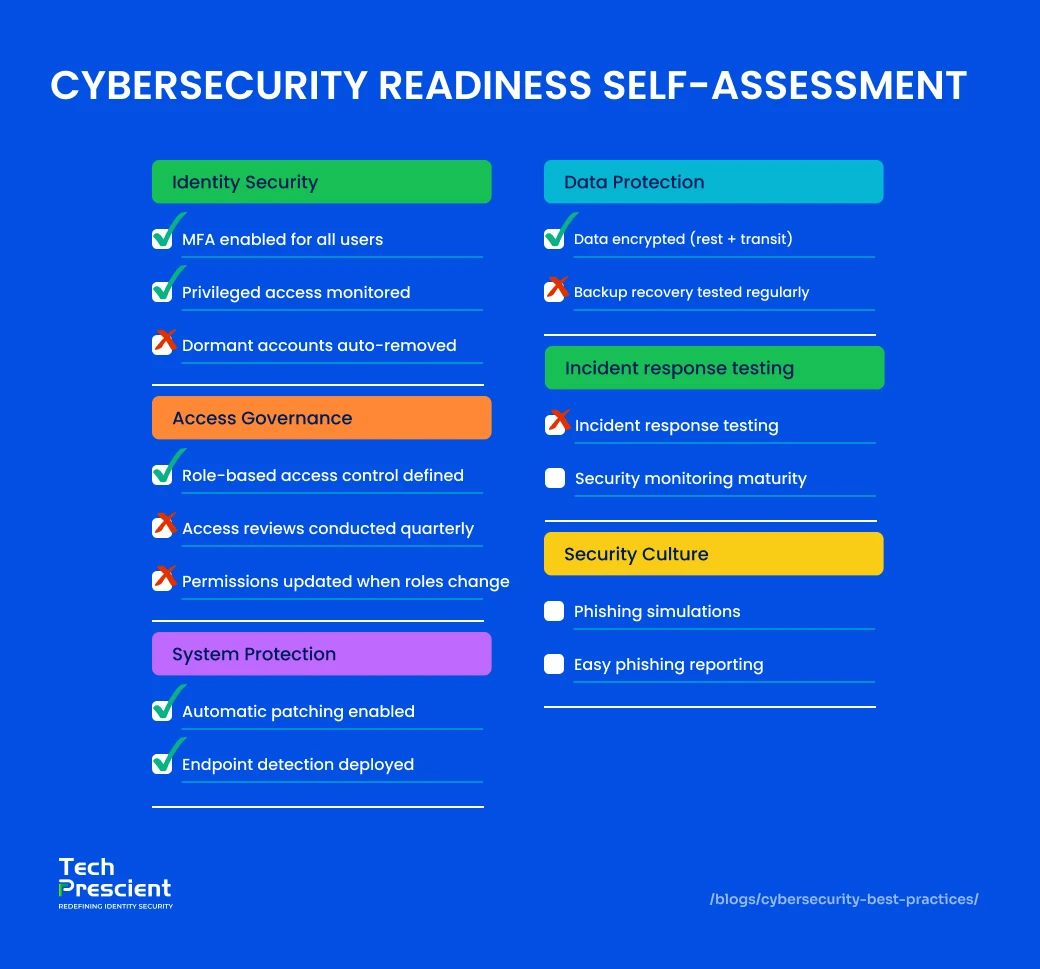
Cyber Risk Management Checklist for 2026
Use the checklist below to evaluate whether your organization has implemented the core cyber risk management practices required to reduce breach risk and maintain compliance.
Detailed Control Implementation Guide
Review each category below. Bullet points represent minimum control requirements aligned to NIST Cybersecurity Framework, CIS Controls v8.1, and 2026 threat landscape realities.
Identity and Access
Identity and access controls ensure that only authorized users can access business systems and sensitive data.
- MFA is enforced for all users, especially admins and privileged accounts.
- Least privilege is defined by role. Users don't have broad access.
- Access reviews occur at least quarterly. Managers decide who should keep access.
- Deprovisioning happens within 24 hours of a role change or exit (automated and logged).
- A centralized system tracks all user access across cloud, on-premise, and hybrid environments.
Data Protection
Data protection controls ensure sensitive information remains secure even if systems are compromised.
- Data at rest is encrypted (AES-256 or equivalent).
- Data in transit is encrypted (TLS 1.2 or higher).
- Backups follow the 3-2-1 strategy: 3 copies, 2 media types, 1 offsite.
- Backup restoration is tested monthly to verify integrity.
- Data protection policy identifies sensitive data and enforces controls.
Systems and Infrastructure
Infrastructure security controls protect operating systems, endpoints, and networks from known vulnerabilities and exploitation.
- Operating systems and critical software are patched within 30 days of release (automated, not manual).
- EDR is deployed on all endpoints.
- Firewalls and network segmentation isolate critical assets.
- Device encryption (BitLocker, FileVault, LUKS) is enabled on all endpoints.
- Wireless networks use WPA3 or WPA2 with strong passwords.
Governance and Compliance
Governance controls ensure that cybersecurity policies are documented, enforced, and aligned with regulatory compliance requirements.
- Written cybersecurity policies exist and are reviewed annually.
- A CISO or security committee owns the security program (not IT ops alone).
- Risk assessments occur annually or when systems change.
- Incident response plan is documented and tested semi-annually.
- Compliance audits are scheduled and tracked for applicable frameworks (SOX, GDPR, HIPAA, ISO 27001).
People and Awareness
Human-focused security controls help employees recognize cyber threats and reduce the risk of phishing and social engineering attacks.
- All employees complete security awareness training annually.
- Phishing simulations run quarterly.
- Implement a simple system for employees to report suspicious activity, with responses within 24 hours.
- Third-party and contractor access are treated with the same rigor as employee access.
Measurement and Improvement
Continuous monitoring and security metrics help organizations measure cyber risk and improve their security posture over time.
- Security metrics are tracked and reported to leadership monthly.
- A process exists for acting on findings (issues are logged, assigned, and tracked to closure).
- External security assessments (vulnerability scans, penetration tests) occur annually.
Next Steps
Managing identity governance processes often faces significant scalability challenges. Access reviews frequently get overlooked, leading to potential security risks, while the deprovisioning of user accounts can be an excessively time-consuming task. Additionally, compliance audits can become a tedious and stressful experience for organizations, often resulting in delays and inefficiencies.
To address these issues, it is essential to implement streamlined processes and automated solutions that enhance efficiency and ensure compliance without sacrificing security.
Platforms like Tech Prescient's Identity Confluence (IC) simplify identity management, ensure users have only the access they need, and help organizations stay compliant in mixed IT environments.
FAQs
The core six: (1) MFA + least privilege (identity security). (2) Written governance with executive ownership. (3) Automatic patching. (4) Zero-trust network access. (5) Encryption and 3-2-1 backups. (6) Security awareness training. Consistent implementation of these practices significantly reduces organizational breach risk.
Prioritize: Phase 1 (Months 1-3): Deploy MFA, enable automatic patching, and implement cloud backup. Phase 2 (Months 4-6): Identify sensitive data, audit access, and remove dormant accounts. Phase 3 (Months 7-12): Train staff, test backup recovery, and document incident response. Tools are cheap (free authenticator apps, $40-60 hardware keys, affordable cloud backup).
Stolen credentials are the most common entry point for modern cyberattacks. MFA reduces the effectiveness of stolen passwords, while least-privilege access limits potential damage. Continuous deprovisioning prevents dormant accounts from sitting around. Identity governance is as critical as network defense now.
Quarterly minimum for regular users. Monthly for admins. When someone changes roles or leaves, access must be revoked within 24 hours (automate this). Automation saves time. Set up automatic manager reminders. Automate deprovisioning on HR changes.
IAM governs authentication and access enforcement, while IGA governs lifecycle access control, policy enforcement, and access review processes.
Regulators want proof of intentional access control. GDPR, HIPAA, and SOX all require the same: documented policies, audit logs of every grant/removal, manager sign-offs, and timestamps. IGA provides this daily. Audits become routine. You're always ready.
Share



Brinda Bhatt
Digital Marketing Strategist
A Digital Marketing Strategist who makes complex identity governance accessible to security and technology leaders through clear, data-driven content. Her insight-led, audience-focused approach supports Tech Prescient's mission of redefining identity security for modern enterprises.
Most Popular Blogs
Identity Security· 21 min read
Data Access Governance Solutions: How to Secure Sensitive Data at Scale
Compare data access governance solutions for 2026: how DAG platforms discover sensitive data, run access reviews, automate remediation, and prove compliance.
Brinda Bhatt· September 7, 2026
Identity Security· 24 min read
What Is Zero Trust Network Access (ZTNA)?
Learn what Zero Trust Network Access (ZTNA) is, how it works, and why it’s replacing VPNs for secure, identity-based access control.
Yatin Laygude· August 14, 2026
Identity Security· 24 min read
Cyber Essentials Certification: Complete Guide
Learn Cyber Essentials certification, cost, requirements, and steps. Compare Cyber Essentials vs Plus and get certified faster.
Yatin Laygude· August 10, 2026