




On this page
See Tech Prescient in Action
Automate access, reduce risk, and stay audit-ready
GDPR compliance checklist implementation starts with understanding how your organization collects, stores, and processes personal data from individuals in the EU or UK. GDPR introduces strict requirements around privacy, transparency, security, and data subject rights, making compliance essential for SaaS companies, enterprises, websites, and US businesses handling EU data.
GDPR compliance checklist frameworks provide a structured way to manage these obligations without overlooking critical requirements. From data mapping and lawful basis documentation to DSAR handling, consent management, breach response, and governance, a practical checklist helps organizations reduce compliance risk and maintain audit readiness.
GDPR enforcement carries significant financial and operational consequences for non-compliance. According to the European Commission, serious GDPR violations can result in fines of up to €20 million or 4% of an organization's global annual turnover, whichever is higher. Beyond penalties, organizations may face reputational damage, regulatory scrutiny, and business disruption. In this guide, we'll explore what GDPR covers, who needs to comply, and the essential steps to build a practical GDPR compliance checklist for 2026.
Key Takeaways
- Learn what a GDPR compliance checklist is, who needs it, and why GDPR compliance matters.
- Explore the 14 key GDPR compliance steps, from data mapping and consent to DSARs and security.
- Understand GDPR website and email compliance requirements, including cookies, privacy notices, and consent rules.
- See how SaaS and identity security teams support GDPR readiness through access control and audit visibility.
- Identify common compliance mistakes and access practical GDPR checklist resources and templates.
What Is a GDPR Compliance Checklist?
A GDPR compliance checklist is a structured set of actions organizations use to meet GDPR requirements for data privacy, security, and governance. It helps businesses translate complex regulatory obligations into practical steps for managing personal data responsibly and maintaining ongoing compliance.
A well-defined checklist answers three key questions: why it exists, who needs it, and why it matters.
1. Purpose of a GDPR Compliance Checklist
The purpose of a GDPR compliance checklist is to help organizations systematically manage compliance activities instead of approaching GDPR as a one-time legal exercise. It provides a practical framework for areas such as data mapping, lawful basis documentation, consent management, privacy notices, DSAR handling, breach response, and governance.
2. Who Needs a GDPR Compliance Checklist?
GDPR applies to more than just organizations located in Europe. Any business that processes the personal data of EU residents, offers services to EU users, or tracks their behavior may need to comply. This includes EU businesses, SaaS companies, eCommerce brands, marketing platforms, and US companies handling EU personal data.
3. Why Does a GDPR Compliance Checklist Matter?
A GDPR compliance checklist helps organizations reduce compliance gaps, improve accountability, and maintain stronger data protection practices. It also supports audit readiness, customer trust, and regulatory compliance. Without a structured approach, businesses risk missing key obligations that can lead to operational issues, reputational damage, or regulatory penalties.
Who Needs GDPR Compliance? (Especially US Companies)
GDPR compliance is not limited to businesses operating within Europe. The regulation applies to any organization that collects, processes, stores, or monitors the personal data of individuals in the EU, regardless of where the company is headquartered.
Understanding who falls under GDPR scope becomes easier when you look at the common business categories affected.
1. US Companies Serving EU Users
A major misconception is that GDPR only applies to EU-based organizations. In reality, US companies offering products, services, subscriptions, or digital experiences to EU residents may also need to comply. This is why a GDPR compliance checklist for US companies is increasingly relevant for organizations with international customers, remote users, or global digital operations.
2. SaaS, eCommerce, and Marketing Businesses
Industries that rely heavily on personal data often have broader GDPR exposure. SaaS providers, eCommerce brands, marketing platforms, adtech companies, and online service providers frequently process customer information such as names, email addresses, payment details, behavioral data, or analytics data. If EU resident data is involved, GDPR obligations may apply.
3. Organizations Monitoring EU User Behavior
GDPR can also apply to businesses that track or analyze user behavior within the EU. Activities such as website analytics, personalized advertising, location tracking, behavioral profiling, or cookie-based monitoring may trigger compliance requirements, even when the organization has no physical presence in Europe.
4. Do You Need an EU Representative?
Some non-EU organizations subject to GDPR may be required to appoint an EU representative. This representative acts as a local point of contact for regulators and data subjects when a business does not have an established presence in the EU. The requirement depends on factors such as the nature, scale, and risk level of the data processing activities.
For organizations operating across borders, understanding whether GDPR applies is the first step toward building a practical and defensible compliance strategy.
Quick Reality Check
If your website tracks EU visitors through analytics, cookies, forms, or marketing campaigns, GDPR may already apply, even without an EU office.
Lead Magnet
Are you confident your GDPR controls will stand up to an audit?
GDPR Compliance Checklist: 14 Essential Steps
A strong GDPR compliance checklist combines legal, operational, and technical controls to help organizations manage personal data responsibly. The following steps cover the core practices businesses should establish to support GDPR compliance and ongoing audit readiness.
Data Mapping & Inventory
Start by identifying what personal data you collect, where it comes from, where it is stored, who can access it, and how it moves across systems. Maintaining a clear data inventory and Records of Processing Activities (RoPA) creates visibility into your data environment and supports better compliance decisions.
Define Lawful Basis for Processing
Every data processing activity must have a valid legal justification under GDPR. This could include consent, contractual necessity, legal obligations, legitimate interests, or vital interests. Organizations should clearly document the lawful basis tied to each processing activity.
Consent Management
Where consent is required, businesses should implement clear and verifiable consent practices. This includes explicit opt-in methods, easy withdrawal mechanisms, and consent tracking records. Strong consent management is especially important for email communications and marketing activities.
Privacy Notices & Transparency
Individuals should understand how their data is collected and used. Organizations need clear privacy notices, accessible privacy policies, and transparent explanations of data usage, retention, and sharing practices. This is a foundational element of any GDPR website compliance checklist.
Enable Data Subject Rights (DSAR)
GDPR grants individuals rights over their personal data, including the right to access, correct, delete, restrict, or transfer their information. Businesses should establish repeatable workflows to manage Data Subject Access Requests (DSARs) and respond within required timelines.
Implement Data Security Controls
Protecting personal data requires layered security measures. Common controls include encryption, role-based access control (RBAC), monitoring, secure authentication, and privacy-by-design practices to reduce unauthorized access and data exposure risks.
Create a Data Breach Response Plan
Organizations should be prepared to detect, investigate, contain, and report security incidents involving personal data. GDPR requires certain breaches to be reported within 72 hours, making documented response plans and incident logs essential.
Manage Vendors & Third Parties
Third-party providers that process personal data can introduce compliance risk. Businesses should evaluate vendors, establish Data Processing Agreements (DPAs), and periodically review third-party security and privacy practices.
Review International Data Transfers
If personal data moves across borders, organizations must ensure transfers comply with GDPR requirements. Mechanisms such as Standard Contractual Clauses (SCCs) or recognized adequacy arrangements may be necessary depending on the destination and processing model.
Determine Whether You Need a DPO
Some organizations may need to appoint a Data Protection Officer (DPO), particularly when handling large-scale or sensitive data processing activities. A DPO typically oversees privacy governance, compliance monitoring, and regulatory coordination.
Conduct Data Protection Impact Assessments (DPIAs)
High-risk processing activities should undergo a Data Protection Impact Assessment (DPIA). These assessments help organizations evaluate privacy risks, identify mitigation measures, and support responsible decision-making before processing begins.
Define Data Retention & Deletion Practices
Personal data should not be stored indefinitely. Organizations should establish data retention schedules, deletion rules, and disposal procedures that align with business, legal, and regulatory requirements. Automation can help enforce these policies consistently.
Train Employees on GDPR Responsibilities
Employees play a direct role in protecting personal data. Regular training programs can improve awareness around data handling, privacy obligations, access controls, phishing risks, and role-based responsibilities across teams.
Strengthen Governance & Documentation
GDPR compliance is an ongoing process, not a one-time exercise. Maintaining policies, audit records, monitoring practices, documentation, and continuous reviews helps organizations demonstrate accountability and sustain long-term compliance maturity.

Pro Tip
Start your GDPR checklist with data mapping and access reviews. You can't secure, govern, or justify personal data processing if you don't know where your data lives.
GDPR Website Compliance Checklist
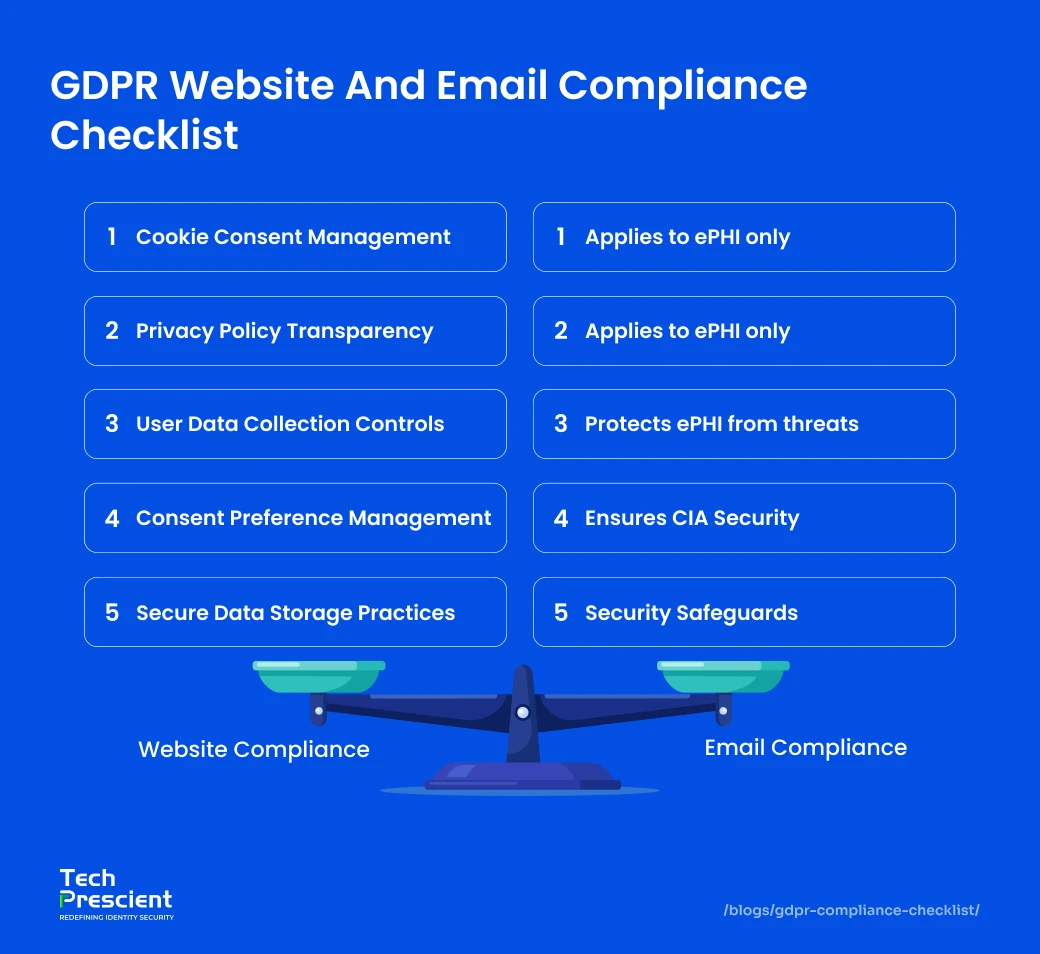
A GDPR website compliance checklist helps organizations ensure their websites handle visitor data in a compliant and transparent manner. From cookies and analytics tools to privacy notices and consent collection, websites must clearly communicate how personal data is collected, used, and managed.
Below are some core areas every website should review for GDPR readiness.
1. Cookie Consent Management
Websites using cookies or tracking technologies should implement clear consent mechanisms before non-essential cookies are activated. Cookie banners should allow users to make informed choices, reject optional tracking, or update their preferences later. Consent requests should be specific, easy to understand, and avoid practices such as pre-selected consent boxes.
2. Tracking Scripts & Analytics Compliance
Many websites rely on tools for analytics, advertising, personalization, or behavioral monitoring. Organizations should review tracking scripts, pixels, third-party embeds, analytics tools, and marketing tags to ensure data collection aligns with GDPR requirements and user consent preferences.
3. Privacy Policy & Transparency
A compliant website should provide an easy-to-find privacy policy that explains what data is collected, why it is collected, how long it is retained, who it is shared with, and how users can exercise their privacy rights. Transparency around data practices is a core GDPR expectation.
4. User Rights & Contact Options
Website visitors should have a clear way to exercise their GDPR rights, such as requesting access to their data, correcting information, or requesting deletion. Providing accessible contact details, request forms, or privacy support channels can help streamline these interactions.
5. Forms, Sign-Ups & Data Collection Points
Any point where users submit personal information, including contact forms, account registrations, newsletter sign-ups, or checkout pages, should follow GDPR principles. Businesses should collect only necessary information, explain its intended use, and obtain consent where required.
A practical website GDPR compliance checklist helps organizations manage website privacy requirements more consistently while reducing compliance gaps related to consent, tracking, and user transparency.
GDPR Email Compliance Checklist
A GDPR email compliance checklist helps organizations align email communications with GDPR requirements around consent, transparency, and user control. Whether sending newsletters, promotional campaigns, or product updates, businesses must ensure personal data used for email communication is collected and managed appropriately.
Compliant email practices typically revolve around consent handling, subscriber choice, and responsible data management.
1. Consent & Double Opt-In
Email marketing should be built on a clear legal basis, especially when consent is required. Organizations should use clear opt-in methods and avoid vague or bundled permissions. Many businesses strengthen compliance through double opt-in workflows, where users confirm their subscription through a follow-up email before being added to mailing lists.
2. Unsubscribe & Preference Management
Recipients should be able to withdraw consent easily and at any time. Marketing emails should include visible unsubscribe options and, where applicable, preference centers that allow users to manage communication choices instead of opting out entirely.
3. Consent Records & Audit Trails
Maintaining proof of consent is an important part of GDPR readiness. Organizations should keep consent logs showing when consent was collected, what users agreed to, and how permission was obtained. These records can help support compliance reviews, audits, or regulatory inquiries.
4. Data Collection & Transparency
Businesses should clearly explain why email addresses are being collected, how they will be used, and whether data will be shared with third-party marketing tools or platforms. Sign-up forms, landing pages, and subscription workflows should reflect these privacy expectations.
5. Email List Hygiene & Data Management
Organizations should regularly review email databases to remove outdated, inactive, or improperly collected contacts. Good email data practices support data minimization, retention management, and cleaner compliance operations while reducing unnecessary privacy risk.
A practical GDPR email compliance checklist helps businesses maintain compliant email programs while improving transparency, consent governance, and subscriber trust.
GDPR Checklist for SaaS & Identity Security Teams
For SaaS companies and identity security teams, GDPR compliance extends beyond privacy notices and consent management. It also involves controlling who can access personal data, how access is granted, and how organizations demonstrate accountability during audits or compliance reviews.
Identity governance and access controls play a central role in strengthening GDPR readiness across modern SaaS environments.
1. Identity Governance & GDPR Compliance
Identity Governance and Administration (IGA) helps organizations manage the lifecycle of user identities and access permissions. In a GDPR context, this supports stronger control over who can access personal data, what systems they can use, and whether access aligns with business responsibilities.
2. Access Reviews & Least Privilege
Regular access reviews help organizations validate that employees, contractors, and third parties only retain access that is necessary for their roles. Applying the principle of least privilege reduces unnecessary permissions, limits insider risk, and helps minimize unnecessary exposure of personal data.
3. Audit Logs & Compliance Visibility
Maintaining detailed audit records is essential for demonstrating compliance. Access logs, activity monitoring, permission changes, and authentication events can provide visibility into how sensitive data is accessed and managed across SaaS systems. These records also support investigations, audits, and regulatory reporting requirements.
4. User Lifecycle & Access Management
SaaS environments often involve frequent onboarding, role changes, and offboarding activities. Strong identity processes should ensure that user access is provisioned appropriately, updated when responsibilities change, and removed promptly when users leave the organization.
5. Continuous Monitoring & Governance
GDPR compliance is an ongoing effort, making continuous monitoring important for identity security teams. Regular reviews of access patterns, policy adherence, privileged accounts, and governance controls can help organizations detect gaps early and maintain stronger compliance posture over time.
A practical GDPR approach for SaaS organizations combines identity governance, access control, and audit readiness to support both regulatory compliance and stronger data protection practices.
Lead Magnet
Do you know if your access controls truly align with GDPR principles?
Common GDPR Compliance Mistakes to Avoid
GDPR compliance challenges often arise not from a lack of policies, but from gaps in execution and oversight. Identifying common mistakes can help organizations strengthen their compliance programs, reduce operational risk, and improve audit preparedness.
Several recurring issues continue to create compliance gaps across organizations of different sizes and industries.
1. Skipping Data Mapping & Visibility
Many organizations struggle with GDPR because they lack a clear understanding of what personal data they collect, where it is stored, how it moves across systems, and who can access it. Without proper data mapping and inventory practices, it becomes difficult to support DSARs, retention policies, or risk assessments.
2. Weak Consent Practices
Consent management remains a common compliance challenge, especially for websites and marketing operations. Using unclear consent language, bundled permissions, pre-selected choices, or difficult opt-out experiences can create GDPR exposure and weaken user trust.
3. Overlooking Vendor & Third-Party Risk
Organizations often rely on cloud providers, SaaS tools, payment processors, and marketing platforms to process personal data. Failing to assess vendors, establish Data Processing Agreements (DPAs), or review third-party security practices can introduce avoidable compliance and data protection risks.
4. Operating Without a Breach Response Plan
Security incidents can happen even in mature environments. Organizations that lack a defined process for detecting, investigating, documenting, and reporting personal data breaches may struggle to meet GDPR notification timelines and regulatory expectations.
5. Treating GDPR as a One-Time Project
Another common mistake is viewing GDPR as a one-off compliance exercise instead of an ongoing governance effort. Regulations, business operations, vendors, and data flows evolve over time, making continuous reviews, documentation updates, and monitoring essential for sustained compliance.
Avoiding these pitfalls can help organizations build a more practical, resilient, and audit-ready GDPR compliance strategy.
Practical Takeaway
GDPR compliance is easier to maintain when treated as an ongoing operational process, not a one-time legal project or annual audit task.
Final Thoughts
A GDPR compliance checklist provides a practical framework for managing data privacy obligations through governance, security, transparency, and accountability. By translating regulatory requirements into structured actions, it helps organizations reduce compliance gaps, strengthen data protection practices, and maintain ongoing audit readiness.
Tech Prescient helps organizations implement identity governance, enforce least-privilege access, and operationalize GDPR compliance across complex digital environments.
FAQs
The seven GDPR requirements are built around key data protection principles: lawfulness, fairness, transparency, purpose limitation, data minimization, accuracy, storage limitation, integrity and confidentiality, and accountability. Together, they define how organizations should collect, process, secure, and manage personal data responsibly.
Yes, GDPR can apply to US companies if they process the personal data of EU residents, offer services to EU users, or monitor their behavior online. In other words, your business location matters less than the data you handle and who you handle it for.
Five widely referenced GDPR principles include lawfulness, purpose limitation, data minimization, accuracy, and storage limitation. These principles help organizations ensure personal data is collected for valid reasons, kept accurate, and not retained longer than necessary.
GDPR compliance in the US refers to US organizations following GDPR requirements when handling EU personal data. This often involves implementing privacy controls, consent management, security measures, and governance practices aligned with GDPR expectations.
Creating a GDPR compliance checklist usually starts with data mapping to understand what personal data you collect and process. From there, define your lawful basis, implement security and consent controls, and document processes to support ongoing compliance and audit readiness.
Share



Yatin Laygude
Content Writer
A content writer with 6 years of experience turning complex topics into clear, engaging, and meaningful content. From blogs and web pages to whitepapers and thought pieces, he creates content that not only explains but also connects with both the audience and business goals.
Most Popular Blogs
Identity Security· 21 min read
Data Access Governance Solutions: How to Secure Sensitive Data at Scale
Compare data access governance solutions for 2026: how DAG platforms discover sensitive data, run access reviews, automate remediation, and prove compliance.
Brinda Bhatt· September 7, 2026
Identity Security· 24 min read
What Is Zero Trust Network Access (ZTNA)?
Learn what Zero Trust Network Access (ZTNA) is, how it works, and why it’s replacing VPNs for secure, identity-based access control.
Yatin Laygude· August 14, 2026
Identity Security· 24 min read
Cyber Essentials Certification: Complete Guide
Learn Cyber Essentials certification, cost, requirements, and steps. Compare Cyber Essentials vs Plus and get certified faster.
Yatin Laygude· August 10, 2026