




On this page
See Tech Prescient in Action
Automate access, reduce risk, and stay audit-ready
Identity management best practices outline how organizations securely manage user access, mitigate identity-based risks, and maintain compliance in an increasingly digital world. As identities become the new security perimeter, Identity and Access Management (IAM) is no longer just an IT function; it is a core cybersecurity control.
In 2026, evolving threats, hybrid workforces, cloud adoption, and stricter regulations make IAM best practices a baseline requirement for effective cybersecurity. Simply deploying IAM tools is not enough. Organizations must apply the right principles, controls, and governance processes to ensure access is secure, auditable, and aligned with business needs. This guide breaks down proven identity management best practices, from foundational IAM principles to practical implementation strategies, to help security and IT teams strengthen access security, reduce compliance risk, and build resilient identity programs.
Key Takeaways:
- Identity management best practices provide a structured approach to securing user access across applications, systems, and data.
- In 2026, IAM best practices must address cloud adoption, remote work, identity sprawl, and evolving compliance requirements.
- Core IAM principles such as least privilege, centralized identity control, and policy-based access form the foundation of secure identity management.
- Effective IAM programs combine automation, access reviews, privileged access management, and continuous monitoring.
- Avoiding common mistakes like over-permissioning, static policies, and poor system integrations is critical to reducing identity-based risk.
What Is Identity Management?
Identity and Access Management (IAM) is a framework of policies, processes, and technologies used to manage digital identities and control access to organizational resources. It ensures that the right users have the right access to the right systems, and only for as long as needed.
A strong identity management strategy actively reduces risk while enabling efficient user access. It enables organizations to manage user accounts efficiently, grant or revoke access as needed, and maintain continuous visibility into who can access what. Beyond just protecting sensitive data, identity management supports compliance requirements and lays the groundwork for best practices like user access management, automated provisioning, and least privilege enforcement. When done right, it becomes a critical pillar of any organization's overall cybersecurity IAM efforts.
Core IAM Principles for Cybersecurity and Compliance
Strong identity management starts with a clear set of core IAM principles. These principles guide how access is granted, reviewed, and governed to ensure security, compliance, and scalability across the organization. The following principles form the foundation of modern IAM best practices.
Principle of Least Privilege (PoLP)
The Principle of Least Privilege (PoLP) requires granting users only the access they need, and nothing more. Whether it’s an employee, contractor, or third-party vendor, limiting access rights reduces the chance of unauthorized access to sensitive systems or data.
Implementing PoLP means conducting regular access reviews, analyzing each user’s responsibilities, and tightening permissions accordingly. This approach not only supports cybersecurity identity and access management but also aligns with compliance frameworks that demand strict access control policies. It’s one of the most effective IAM best practices for minimizing the impact of insider threats or compromised accounts.

Pro Tip:
Least privilege fails most often not at onboarding, but over time. Regular access reviews and lifecycle-driven automation are essential to prevent permission creep as users change roles, projects, or teams.
Role-Based Access Control (RBAC) vs. Attribute-Based Access Control (ABAC)
RBAC and ABAC both support structured access control, but they operate in different ways.
-
Role-Based Access Control (RBAC) assigns access rights based on predefined roles, like “HR Manager” or “Finance Analyst.” It’s easy to manage and works well in most structured environments.
-
Attribute-Based Access Control (ABAC) takes it a step further. It uses dynamic attributes such as department, location, device type, or time of day to grant access. This makes it more flexible, especially in complex or hybrid environments.
For many organizations, combining RBAC for standard roles and ABAC for context-aware controls forms a powerful access management strategy. Together, they help enforce user account management best practices while ensuring policy-driven, risk-aware access decisions.
Centralized IAM
A centralized IAM system acts as a single source of truth for managing identities and permissions across the entire organization. Instead of juggling multiple tools or departments handling access separately, a unified IAM platform ensures consistent policy enforcement, better visibility, and stronger governance.
With centralized control, IT teams can implement automated provisioning, detect anomalies faster, and apply security access management policies organization-wide. It’s a must-have for organizations looking to scale securely while meeting regulatory and operational demands.
Why IAM Best Practices Matter in 2026
The digital landscape is changing fast. With remote work, cloud-first operations, and rising threats like credential theft and insider attacks, following IAM best practices is more critical than ever. Organizations can no longer rely on traditional perimeter-based security. Instead, they need strong IAM security controls that manage user identities, enforce least privilege principles, and secure access in real time. From defending against account takeovers to adopting Zero Trust strategies, Identity and Access Management best practices help build a resilient defense against today’s complex threats.
There’s growing pressure around compliance with global regulations like GDPR, HIPAA, and others. Robust identity governance frameworks, audit trails, and automated provisioning not only reduce risk but also simplify compliance reporting. At the same time, users demand seamless experiences. Features like Single Sign-On (SSO), adaptive authentication, and user access management best practices make security smarter without making it harder. Following the right IAM security best practices in 2026 enables organizations to move efficiently while maintaining strong security and compliance.
Expert Insight:
In 2026, most breaches don’t occur because access controls are missing, but because they’re outdated. Identity risk grows silently when access decisions don’t evolve with business, cloud adoption, and workforce changes.
6 Must-follow IAM Best Practices (With Tools & Examples)
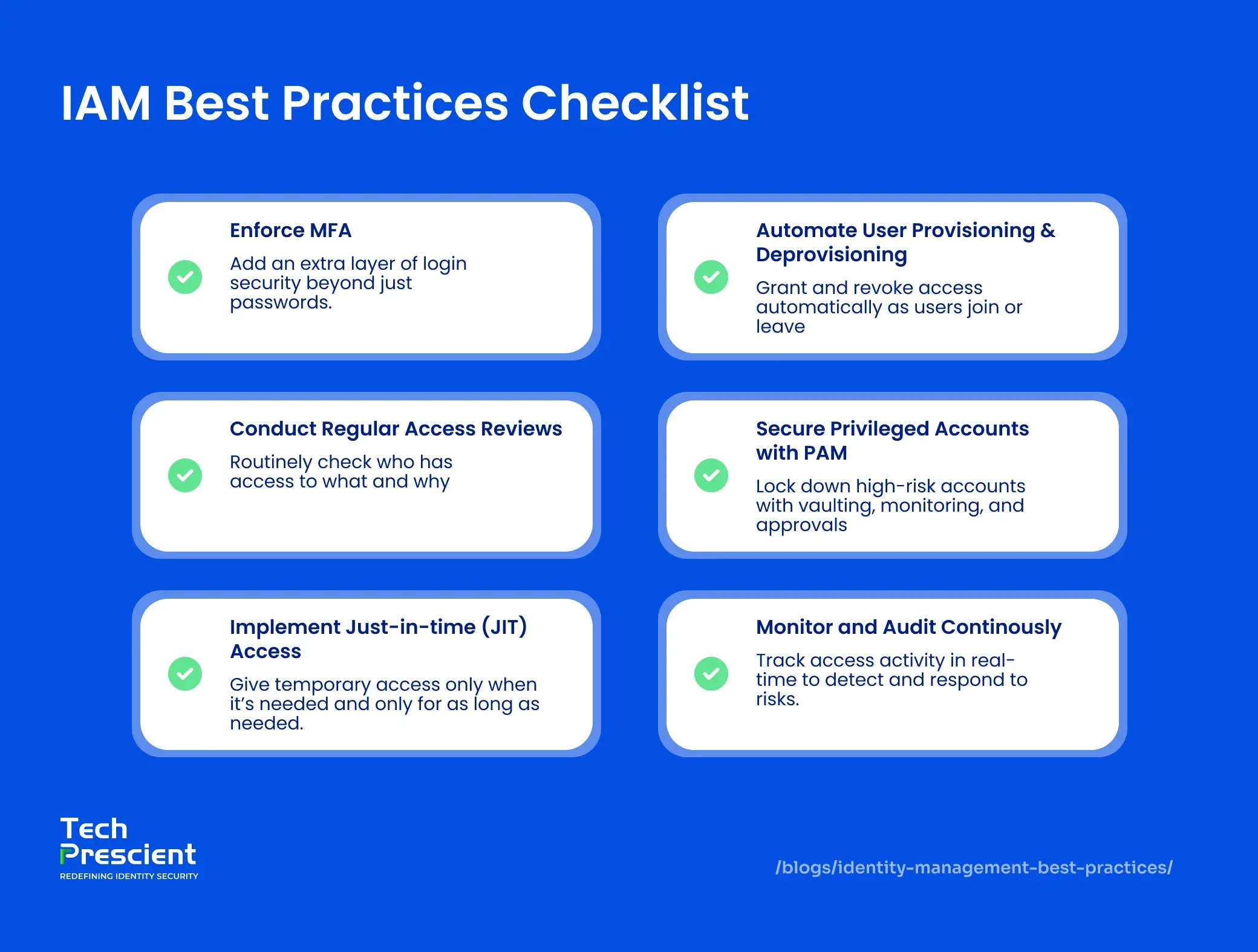
Implementing IAM best practices requires more than isolated controls; it demands a coordinated strategy that combines identity governance, automation, and continuous oversight. The following IAM best practices represent the most effective ways organizations can strengthen identity security, reduce access risk, and stay compliant in 2026:
1. Enforce Multi-Factor Authentication (MFA)
MFA adds a second layer of verification, ensuring that even if a password is compromised, the attacker still can’t access the system. It typically combines something the user knows (password), has (token), or is (biometric).
For example, combining a password with a fingerprint scan or an OTP sent to a registered device significantly strengthens authentication. Adaptive MFA takes this further by evaluating contextual risk factors like location or device type before deciding how strict the login flow should be.
2. Automate User Provisioning and Deprovisioning
Manual access management is time-consuming and error-prone. Automating user provisioning ensures that new hires get the right access from day one, while automated deprovisioning removes access as soon as someone exits or changes their role in the organization.
Tools that integrate with HR systems (like Workday or SAP) and identity platform-based directories can streamline the process and enforce user account management best practices at scale.
3. Conduct Regular Access Reviews
Access creep is a silent risk. Users often retain access they no longer need, which violates the principle of least privilege. That’s why regular access reviews - monthly, quarterly, or after role changes are essential.
Dashboards from leading identity governance tools can help visualize permissions, flag anomalies, and streamline the access certification process, making it easier to stay both secure and compliant.
4. Secure Privileged Accounts with PAM
Privileged accounts like admin or root users are goldmines for attackers. Privileged Access Management (PAM) helps lock down these high-risk accounts by storing credentials in secure vaults, monitoring session activity, and requiring approval for access elevation.
Whether it’s IT administrators, machine identities, cloud engineers, or third-party vendors, PAM ensures that access is tightly controlled and traceable, supporting both cybersecurity IAM and compliance needs.
5. Implement Just-in-Time Access Controls
Instead of giving standing privileges, grant temporary, context-based access through Just-in-Time (JIT) access controls. This means users only get elevated permissions when needed, for a limited time.
JIT access is ideal for short-term use cases - like helpdesk agents or vendors - who occasionally require elevated permissions. It ensures granular control without compromising productivity or violating your access management strategy.
6. Monitor and Audit Continuously
Security doesn’t stop at provisioning. Continuous monitoring and audit trails are key to spotting unusual behavior, revoking stale access, and proving compliance during audits.
Real-time alerts, activity logs, and compliance dashboards provided by IAM security platforms offer the visibility needed to respond quickly and stay aligned with regulatory expectations. This is central to strong identity management and cybersecurity.
Knowing best practices is only half the equation. The real risk lies in assuming your IAM controls are working as intended without ever validating them.
Examine your operational IAM control framework
Use this checklist to check whether your identity management solution is truly secure, scalable, and auditable.
Common IAM Mistakes That Undermine Security
Even the most well-intentioned IAM security strategies can fall short if they’re not executed thoughtfully. Many organizations unknowingly introduce risk by overlooking key areas of their Identity and Access Management (IAM) setup. Avoiding these pitfalls is as important as implementing IAM best practices correctly.
Over-permissioning Users
Granting users more access than they need is one of the most common identity-related mistakes. Over time, these unnecessary permissions pile up, often referred to as "permission creep," and significantly widen the attack surface. Without strict enforcement of the least privilege principle, even non-admin users can end up with access to sensitive systems or data. This not only violates access management best practices but also creates a compliance risk.
Treating IAM as a One-Time Setup
IAM isn’t a one-and-done configuration. It’s an ongoing strategy that must evolve with your workforce, technologies, and threat landscape. Organizations often make the mistake of setting up IAM policies and never revisiting them. Without regular access reviews, audits, and updates, you're left with stale data, outdated roles, and potentially dangerous blind spots. IAM must be treated as an ongoing component of the organization’s cybersecurity strategy.
Weak Integration with HR or Cloud Systems
IAM can’t operate in silos. If it isn’t tightly integrated with your HRIS or cloud infrastructure, you're inviting delays, misconfigurations, and security gaps. Lack of automated provisioning and deprovisioning is a red flag. It often means former employees still retain access to critical systems. Integrating IAM with tools like Workday, Okta, or Azure AD ensures smooth, real-time user access management and supports your access management strategy at scale.
Final Thoughts: Future-Proof Your IAM
Identity management best practices are evolving strategies that must adapt to changing threats, technologies, and regulatory demands. In 2026, organizations that treat IAM as a continuous security discipline, rather than a one-time implementation, will be better positioned to reduce risk and scale securely.
But IAM doesn’t exist in a vacuum. It intersects with broader concepts like identity governance, provisioning automation, and Zero Trust. If you’re ready to take the next step, check out our related blog: [IGA vs IAM: What’s the Difference?] to learn how governance fits into your identity roadmap.
Next Steps
Tech Prescient helps you simplify and secure identity and access management across your entire IT ecosystem, from cloud platforms to HR systems and beyond. Whether you're an IT leader, security analyst, or compliance officer, our solutions are built to scale with your business.
FAQs
Enforcing the principle of least privilege is foundational to effective identity governance. Users should be granted only the access required to perform their job functions, and that access should be continuously evaluated. This limits exposure from compromised credentials, insider misuse, and role drift over time.
At a minimum, access reviews should be conducted quarterly. Organizations operating in highly regulated or high-risk environments may require monthly or continuous reviews. Review frequency should be determined by risk tolerance, regulatory obligations, and the sensitivity of accessed systems and data.
Yes, small businesses can adopt IGA best practices using cloud-based solutions that offer scalable features, automation, and compliance tools without the high upfront costs of traditional enterprise systems.
IAM (Identity and Access Management) best practices focus on managing user identities and access controls, like authentication and authorization. IGA framework best practices go further, adding oversight, compliance, role management, and access certification to ensure governance and reduce audit risk.
Automation enhances IGA by streamlining user provisioning, access reviews, policy enforcement, and audit reporting. It reduces human error, accelerates response times, and ensures consistent compliance across systems.
Share



Yatin Laygude
Content Writer
Senior Content Strategist creating IAM-focused security content.
Most Popular Blogs
Identity Security· 21 min read
Data Access Governance Solutions: How to Secure Sensitive Data at Scale
Compare data access governance solutions for 2026: how DAG platforms discover sensitive data, run access reviews, automate remediation, and prove compliance.
Brinda Bhatt· September 7, 2026
Identity Security· 24 min read
What Is Zero Trust Network Access (ZTNA)?
Learn what Zero Trust Network Access (ZTNA) is, how it works, and why it’s replacing VPNs for secure, identity-based access control.
Yatin Laygude· August 14, 2026
Identity Security· 24 min read
Cyber Essentials Certification: Complete Guide
Learn Cyber Essentials certification, cost, requirements, and steps. Compare Cyber Essentials vs Plus and get certified faster.
Yatin Laygude· August 10, 2026