




On this page
See Tech Prescient in Action
Automate access, reduce risk, and stay audit-ready
Identity and access management (IAM) risk assessment evaluates how effectively an organization protects access to its systems, data, and cloud environments. It examines access controls, identity policies, and permission structures to identify weaknesses that could be exploited by internal or external threats. The goal is to surface and remediate risk before it results in security incidents or compliance failures.
IAM risk reporting is the operational output of a mature IAM risk assessment program. While assessments uncover gaps and vulnerabilities, reporting translates those findings into structured insights, dashboards, and audit-ready documentation. These outputs support security leaders, auditors, and compliance teams in decision-making, governance, and regulatory validation. This guide addresses both assessment and reporting as complementary components of effective IAM risk management.
According to research by Augusta University, the cost per data breach in 2023 was around $5 million. Taking preventative measures, such as doing IAM evaluations, is crucial because that is a significant investment. Being HIPAA or GDPR compliant shows strong security and builds client trust. Regularly reviewing and updating your IAM practices keeps your company credible and more attractive to partners.
Let's explore the blog to uncover more: from the core benefits of IAM risk assessments to actionable insights on how they strengthen your security strategy.
Key Takeaways:
- Understand what IAM risk assessment is and why it is critical to security and compliance
- Identify common IAM risks, including excessive privileges and third-party access exposure
- Apply a structured, step-by-step approach to identify, prioritize, and remediate IAM risks
- Implement best practices such as multi-factor authentication, least privilege, automation, and regular access reviews
- Recognize how consistent IAM risk assessments improve security, compliance, and operational efficiency while reducing user friction
What is IAM Risk Assessment?
IAM risk assessment evaluates access controls, permissions, and identity policies to identify security gaps, compliance risks, and over-privileged accounts before they lead to breaches.
An IAM assessment examines the effectiveness of access control and authorization processes, taking into account governance, security, and identity management components. Its purpose is to identify gaps or weaknesses within the current framework and provide a clear roadmap for strengthening IAM practices moving forward.
These assessments are critical in mitigating persistent data security threats. Many data breaches stem from credential compromise or unauthorized access, and poorly defined access management policies create exploitable vulnerabilities for attackers.
To prevent such risks, regular or periodic IAM assessments are essential. They help ensure that security controls remain robust, potential threats are addressed proactively, and IAM systems stay aligned with evolving cybersecurity challenges.
Choosing the right identity and access management risk assessment is a vital step in strengthening your company's security. The assessment you choose should align with your organization's specific needs, and there are several factors to keep in mind:
- Compliance requirements: IAM assessments should be designed to support applicable regulatory frameworks and audit expectations, ensuring consistent protection of sensitive data and demonstrable control effectiveness.
- Internal security expertise: Organizations with limited IAM or security specialization should prioritize assessments that provide structured guidance or external expertise to support accurate risk identification and remediation planning.
- Budget considerations: Cost-effective solutions that lack depth often fail to identify systemic IAM weaknesses. IAM assessment should be treated as a risk-reduction investment, not a cost-minimization exercise.
- Long-term security goals: A good IAM risk assessment doesn't just patch today's vulnerabilities. It should also support your future security roadmap and evolving digital environment.
By weighing these factors, you'll ensure your IAM risk assessment isn't just a one-time exercise but a strategic tool for building stronger defenses over time.
Common IAM Risks to Watch For
Common IAM risks include excessive privileges, orphaned accounts, weak authentication, compliance gaps, and unmanaged third-party access that increase breach and audit risk.
Identity and access management risks aren't always driven by highly advanced cyberattacks. In many cases, they originate from overlooked basics, like mismanaged permissions or poorly secured credentials. When these gaps go unaddressed, they can quickly evolve into critical vulnerabilities. Here are some of the most common challenges organizations run into:
Excessive Privileges
Excessive privileges occur when users, service accounts, or applications are granted access beyond what is required for their role or function. This condition often results from role changes, incomplete deprovisioning, or automation configured with overly broad permissions.
Over-privileged accounts significantly increase blast radius. If compromised, they enable lateral movement, privilege escalation, and access to sensitive systems or data. Enforcing the principle of least privilege and conducting regular access reviews are essential controls for reducing this risk.
Orphaned & Dormant Accounts
Orphaned or dormant accounts, those belonging to former employees, inactive systems, or unused applications, pose a hidden IAM risk. Even though they may no longer be actively used, these accounts often retain access privileges, creating an easy target for attackers. If left unchecked, they can serve as a backdoor into critical systems, allowing unauthorized access or data breaches. Regularly identifying and deactivating unused accounts is essential to maintaining a secure IAM environment.
Weak Authentication Practices
Weak or poorly managed authentication remains one of the most frequent IAM vulnerabilities. Simple passwords, reused across multiple accounts or shared among users, can be easily exploited by attackers. Such practices leave systems open to credential-stuffing attacks, brute-force attempts, and unauthorized access. The risk increases when credentials aren't stored securely or when multi-factor authentication (MFA) isn't enforced. Strengthening authentication practices, through strong, unique passwords, MFA, and secure credential storage, is essential to safeguarding critical systems and sensitive data.
Compliance Gaps
Compliance gaps arise when IAM policies and practices fail to meet regulatory or industry standards, such as GDPR, HIPAA, or PCI DSS. These gaps not only increase the risk of security incidents but can also lead to hefty fines and reputational damage. Common issues include incomplete access reviews, lack of proper audit trails, and failure to enforce role-based permissions consistently. Regular IAM assessments help identify and close these gaps, ensuring both regulatory compliance and a stronger overall security posture.
Shadow IT & Third-Party Risks
Shadow IT occurs when employees use apps or software that haven't been approved or managed by the IT team, often to make work faster or easier. These tools may improve productivity but often lack proper security controls, leaving sensitive data exposed and creating blind spots for IT teams. Similarly, third-party vendors, contractors, or partners frequently require access to internal systems. If this external access isn't properly managed, monitored, and de-provisioned when no longer needed, it can become a critical vulnerability. Maintaining strict visibility, enforcing access policies, and regularly auditing third-party permissions are essential steps to mitigate these risks.
Analyze User Activity
Monitoring user activity is crucial for detecting suspicious or unauthorized behavior before it escalates into a security incident. Unusual patterns, such as logins from unexpected locations, access to sensitive data outside normal working hours, or large-scale file downloads, can indicate compromised accounts or insider threats. Implementing continuous user activity monitoring and leveraging analytics helps organizations quickly identify anomalies and respond proactively to potential risks.
Do You Actually Have These IAM Risks?
Score privilege, lifecycle, and audit exposure in minutes
What Is IAM Risk Reporting (and How It Differs from Risk Assessment)?
IAM risk reporting is the structured communication of identity-related risk based on the outputs of IAM risk assessments. It converts technical findings into clear, decision-oriented artifacts such as dashboards, formal reports, metrics, and audit evidence that can be consumed by security leadership, compliance teams, and auditors.
While IAM risk assessment focuses on identifying vulnerabilities, control gaps, and exposure within identity and access environments, IAM risk reporting focuses on visibility, accountability, and governance. The two functions are closely related but serve distinct operational purposes.
IAM Risk Assessment vs IAM Risk Reporting
| Sr No | Aspect | IAM Risk Assessment | IAM Risk Reporting |
|---|---|---|---|
| 1 | Focus | Identifying risks and gaps | Communicating risk posture and trends |
| 2 | Audience | Security & IAM teams | CISOs, auditors, compliance leaders |
| 3 | Output | Findings and control weaknesses | Reports, metrics, dashboards, evidence |
| 4 | Frequency | Periodic or event-driven | Continuous or scheduled |
IAM risk assessment answers what is wrong and where risk exists. IAM risk reporting answers how much risk remains, how it is changing, and whether controls are effective over time.
What IAM Risk Reports Typically Include
Effective IAM risk reports consolidate technical findings into consistent, measurable indicators, including:
- Excessive privilege metrics across users, roles, and service accounts
- Counts and trends for dormant and orphaned accounts
- Multi-factor authentication coverage and enforcement gaps
- Access review exceptions and policy violations
- Alignment with regulatory and standards-based requirements
- Remediation status, ownership, and risk reduction trends
By presenting IAM risk in a structured and repeatable format, reporting enables informed decision-making, supports audit readiness, and provides defensible evidence of identity control maturity.
Steps in an IAM Risk Assessment
A comprehensive IAM risk assessment follows a structured process designed to identify, evaluate, and mitigate potential security vulnerabilities across your organization's identity and access management environment.
These steps not only identify IAM risks but also form the foundation for consistent IAM risk reporting and audit readiness.
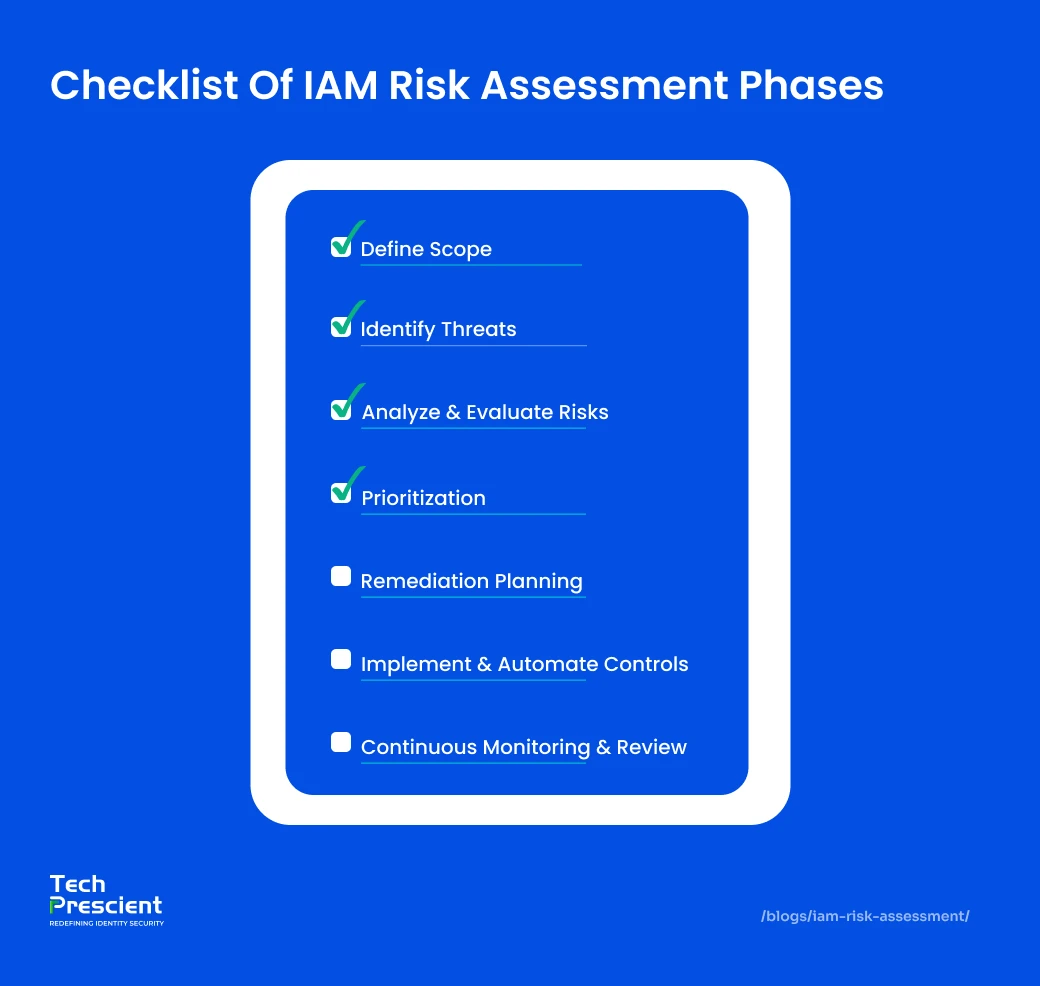
Define Scope
An IAM risk assessment begins with clearly defining scope and objectives. This includes identifying critical assets such as systems, applications, and sensitive data, along with the identities and roles that access them.
Assessment objectives should be explicitly documented, whether the focus is risk reduction, regulatory compliance, control validation, or overall security posture improvement. Clear boundaries must also be established, including which departments, user populations, systems, and access processes are in scope.
A well-defined scope ensures the assessment remains focused, produces actionable results, and aligns with organizational risk priorities.
Identify Threats & Vulnerabilities
The next step in an IAM risk assessment is to pinpoint potential threats and vulnerabilities that could compromise your organization's security. This includes detecting access violations, where users gain unauthorized access or deviate from established access policies. It also involves identifying excessive privileges, such as accounts with permissions beyond what is required for their roles, which can be exploited if compromised.
Dormant or inactive accounts must be flagged, as they can serve as hidden entry points for attackers. Additionally, compliance gaps should be assessed to ensure that IAM practices meet relevant regulatory standards and industry requirements. By thoroughly identifying these risks, organizations can gain a clear understanding of where their IAM system may be exposed and prioritize areas that require immediate attention.
Analyze & Evaluate Risks
Once threats and vulnerabilities have been identified, the next step is to analyze and evaluate their potential impact. This involves categorizing each risk based on its severity, whether high, medium, or low, and understanding the possible consequences for your systems, data, and overall security posture. It's also important to identify which applications, systems, or resources require the highest level of protection, as this helps in aligning security measures with business priorities.
Additionally, performing a root cause analysis helps uncover the underlying factors that led to each vulnerability, such as misconfigured permissions, weak authentication practices, or gaps in policy enforcement. By thoroughly analyzing and evaluating risks, organizations can prioritize remediation efforts effectively and address the most critical vulnerabilities first, ensuring a stronger and more resilient IAM framework.
Prioritize Risks
Risks should be prioritized based on severity, business impact, and exploitability. High-risk issues, such as excessive privileges on critical systems or unresolved compliance violations, require immediate attention.
Lower-risk findings can be addressed through planned remediation cycles aligned with operational capacity. A structured prioritization approach ensures resources are applied where they reduce risk most effectively.
Remediation Planning
After prioritization, remediation strategies should be defined to address identified weaknesses and reduce exposure. Common remediation controls include:
- Just-In-Time (JIT) Access: Instead of granting permanent elevated permissions, assign access temporarily based on specific tasks or user behavior, with automatic revocation when no longer needed.
- Multi-Factor Authentication (MFA): Add extra layers of verification to ensure only authorized users can access critical systems, reducing the risk of unauthorized access from stolen or weak credentials.
- Role-Based Access Control (RBAC): Assign permissions according to user roles rather than individuals, enforcing the principle of least privilege and simplifying access management.
Implementing these strategies ensures that access is tightly controlled, vulnerabilities are addressed proactively, and sensitive systems and data remain protected.
Implement & Automate Controls
After planning remediation strategies, the next step is to implement and automate IAM controls to ensure consistent enforcement and continuous protection. Leveraging IAM platforms with automated, real-time assessment capabilities allows organizations to identify vulnerabilities as they arise, rather than waiting for periodic manual audits. Automation can streamline access provisioning and de-provisioning, enforce policies consistently, and provide alerts for unusual activity or policy violations. By integrating automated controls, organizations reduce the risk of human error, maintain tighter security over critical systems and data, and ensure that their IAM processes remain effective and up to date.
Continuous Monitoring & Review
The final step in an IAM risk assessment is to establish ongoing monitoring and periodic reviews to ensure sustained security and compliance. Continuous monitoring involves tracking user activity, access patterns, and system behavior in real time to detect and respond to anomalies or potential threats quickly.
Complementing this, periodic reviews of IAM policies, access rights, and control mechanisms help verify that they remain effective, up to date, and aligned with organizational goals and regulatory requirements. By combining real-time monitoring with regular audits, organizations can maintain a proactive security posture, quickly address emerging risks, and ensure their identity and access management framework continues to protect critical systems and data effectively. This continuous monitoring feeds directly into IAM risk reporting by generating real-time insights, trend analysis, and executive-level security reports.
Get Expert Support
Organizations should assess internal IAM and security expertise when planning assessments. Where internal capability is limited, structured assessment methodologies or external expertise may be required to ensure accurate risk identification and effective remediation planning. And if that still doesn't meet your needs, consider leveraging platforms like Tech Prescient's Identity Confluence, which provides the expertise and advanced tools you need to strengthen your IAM framework and move in the right direction with confidence.
Best Practices for IAM Risk Management
Effective IAM risk management requires consistent enforcement of identity controls, ongoing visibility into access activity, and alignment with regulatory and business requirements. The following best practices support a resilient, measurable IAM program.
Enforce MFA Across All Accounts
Implement multi-factor authentication for every account, especially for users with elevated privileges. MFA adds an extra layer of verification, making it much harder for attackers to gain unauthorized access. Regularly review and update MFA settings to ensure they cover all potential access points.
Apply the Principle of Least Privilege (PoLP)
Access should be limited to the minimum permissions required for each role or function. The principle of least privilege reduces the potential impact of compromised accounts and limits lateral movement within the environment.
Permissions should be reviewed periodically to ensure they remain aligned with current job responsibilities, application usage, and business needs.
Automate User Provisioning & De-Provisioning
Use automated tools to manage onboarding, role changes, and offboarding. This ensures accounts are created and removed promptly, reducing the risk posed by orphaned or inactive accounts. Automation also enforces consistency and prevents manual errors.
Conduct Regular Access Reviews
Schedule frequent audits to verify that user access aligns with business roles and responsibilities. These reviews help detect over-privileged accounts, dormant users, and policy violations. Corrective actions can then be taken proactively to maintain security.
Integrate IAM with Compliance Frameworks
Align IAM policies with regulatory requirements such as GDPR, HIPAA, or ISO standards. Integration ensures that access management practices meet compliance obligations and are auditable. This also reduces the risk of penalties and enhances trust with stakeholders.
Use Anomaly Detection & Logging
Continuously monitor user activity and system behavior to detect unusual patterns that could indicate a security breach. Maintain detailed logs of all access events to enable forensic analysis and incident response. AI-driven monitoring can enhance detection and reduce response times.
Standardize IAM Risk Reporting
IAM risk reporting should be standardized through consistent dashboards and metrics that track risk exposure, remediation progress, and compliance posture over time. Clear reporting enables stakeholders to assess trends, measure control effectiveness, and make informed risk decisions.
Benefits of Conducting IAM Risk Assessments
Conducting regular IAM risk assessments delivers valuable insights that strengthen security, streamline operations, and enhance compliance across the organization. Key benefits include:
Enhanced Security Posture
Risk assessments help identify vulnerabilities, over-privileged accounts, and weak access controls before attackers can exploit them. This proactive approach strengthens the overall security posture. By addressing gaps promptly, organizations can protect sensitive systems and data more effectively.
Compliance Readiness
Regular assessments ensure that IAM practices align with regulatory requirements such as GDPR, HIPAA, or SOX. Maintaining compliance reduces the risk of penalties and audits. It also demonstrates to stakeholders that security policies are robust and well-managed.
Data Protection
An IAM audit reviews how well your organization safeguards sensitive data. It involves analyzing who has access to critical information and verifying whether those access rights are properly assigned and aligned with security policies.
Reduced Costs from Breach Prevention
By identifying high-risk accounts and potential vulnerabilities early, organizations can prevent costly security incidents. Investing in proactive IAM assessments reduces the financial and operational impact of breaches. This approach also avoids expenses related to emergency remediation and regulatory fines.
Incident Response
A thoroughly audited IAM system plays a critical role during a security incident. It allows IT teams to quickly detect compromised accounts, revoke access, and contain the breach, minimizing its overall impact and reducing potential damage.
Improved Operational Efficiency
IAM risk assessments uncover redundant or misaligned access rights, helping organizations streamline user provisioning and de-provisioning. Optimizing access management processes reduces administrative overhead and prevents errors. Teams can operate more efficiently while maintaining secure access controls.
Better User Experience with Right-Sized Access
Assessments ensure that employees and systems receive access aligned with their roles and responsibilities. This reduces frustration from unnecessary restrictions while maintaining security. Providing the right level of access enhances productivity and supports a smoother workflow across the organization.
Improved Risk Visibility Through Reporting
IAM risk reporting translates assessment findings into clear metrics and dashboards for executives, auditors, and compliance teams. This visibility supports informed decision-making and ongoing oversight without requiring deep technical interpretation.
Measure Your Identity Risk Before Auditors Do
Evaluate maturity across access, reviews, and compliance
Final Thoughts
IAM risk assessments are a foundational component of effective security governance. When conducted regularly, they help organizations identify identity-related weaknesses, maintain compliance, and remain audit-ready as environments evolve.
IAM risk assessments identify vulnerabilities. IAM risk reporting ensures those risks are visible, measurable, and actionable. Together, they form the backbone of a strong identity governance strategy.
At Tech Prescient, we help enterprises automate IAM risk assessments and generate continuous IAM risk reports that support compliance, audits, and executive decision-making.
FAQs
IAM risk reporting presents access-related risks, policy violations, and compliance gaps in structured reports or dashboards so security teams, auditors, and executives can track and act on identity risks.
An effective IAM risk report typically includes excessive privilege metrics, dormant and orphaned account counts, multi-factor authentication coverage gaps, access review findings and exceptions, compliance alignment status, and remediation ownership, progress, and trends.
The four pillars of IAM are Authentication (verifying the identity of users and systems), Authorization (granting access based on defined permissions and policies), Administration (managing identity lifecycle events such as onboarding and offboarding), and Audit and compliance (monitoring, logging, and validating access against policies and regulations). Together, these pillars support secure, governed, and auditable access management.
Ideally, IAM risk assessments should happen at least once a year. However, if your organization is in a highly regulated industry or is going through big changes like mergers, new technology rollouts, or system upgrades, more frequent reviews are crucial. Regular assessments reduce gaps and help you stay compliant.
Some of the biggest IAM risks include excessive privileges, orphaned accounts left active after employees leave, weak authentication methods without MFA, and shadow IT. Add in poor access reviews and compliance gaps, and you're looking at real threats like unauthorized access, data breaches, and even regulatory penalties.
Share



Yatin Laygude
Content Writer
A content writer with 6 years of experience turning complex topics into clear, engaging, and meaningful content. From blogs and web pages to whitepapers and thought pieces, he creates content that not only explains but also connects with both the audience and business goals.
Most Popular Blogs

Identity Security· 21 min read
Data Access Governance Solutions: How to Secure Sensitive Data at Scale
Compare data access governance solutions for 2026: how DAG platforms discover sensitive data, run access reviews, automate remediation, and prove compliance.
Brinda Bhatt· September 7, 2026
Identity Security· 24 min read
What Is Zero Trust Network Access (ZTNA)?
Learn what Zero Trust Network Access (ZTNA) is, how it works, and why it’s replacing VPNs for secure, identity-based access control.
Yatin Laygude· August 14, 2026
Identity Security· 24 min read
Cyber Essentials Certification: Complete Guide
Learn Cyber Essentials certification, cost, requirements, and steps. Compare Cyber Essentials vs Plus and get certified faster.
Yatin Laygude· August 10, 2026