
Top 10 IAM Best Practices for Secure Access in 2026
Last Updated date: September 9, 2025
On this page
See Tech Prescient in Action
Automate access, reduce risk, and stay audit-ready
Identity and Access Management (IAM) best practices are security principles that ensure users get the right access at the right time, no more, no less. In 2026, IAM must combine strong authentication, least privilege, automation, and governance to reduce breach risk and maintain compliance.
IAM defines the policies and technologies that manage access to an organization's digital resources. It determines who can access specific applications, systems, and data, and under what conditions.
IAM consists of two primary components:
- Identity Management: Verifies user identities through credentialing and authentication before access is granted.
- Access Management: Enforces authorization policies that define what authenticated users can access based on role, responsibility, and context.
For modern enterprises operating in dynamic threat environments, IAM is foundational infrastructure. A defined IAM strategy strengthens control over sensitive resources, supports regulatory requirements, and enables secure digital transformation. According to the latest Verizon Data Breach Investigations Report (DBIR), identity-related incidents account for 84% of security breaches.
Key takeaways:
- Understand IAM fundamentals, implementation approaches, and common mistakes
- Discover essential authentication methods that protect against credential compromise
- Learn access control strategies that minimize your organization's attack surface
- Implement automated user lifecycle management across your technology ecosystem
- Adopt Zero Trust principles for a more resilient security architecture
- Integrate governance capabilities to maintain continuous compliance
- Explore emerging technologies, reshaping identity security
- See real-world applications across different industry sectors
The ten core IAM best practices include:
- Enforce multi-factor authentication (MFA)
- Apply least privilege and just-in-time (JIT) access
- Automate user provisioning and deprovisioning
- Implement role-based and attribute-based access control (RBAC and ABAC)
- Centralize authentication through single sign-on (SSO)
- Adopt passwordless authentication mechanisms
- Continuously monitor, audit, and conduct access reviews
- Apply Zero Trust architecture principles
- Integrate identity governance and administration (IGA) capabilities
- Establish ongoing security awareness and identity training programs
What Is Identity and Access Management (IAM)?
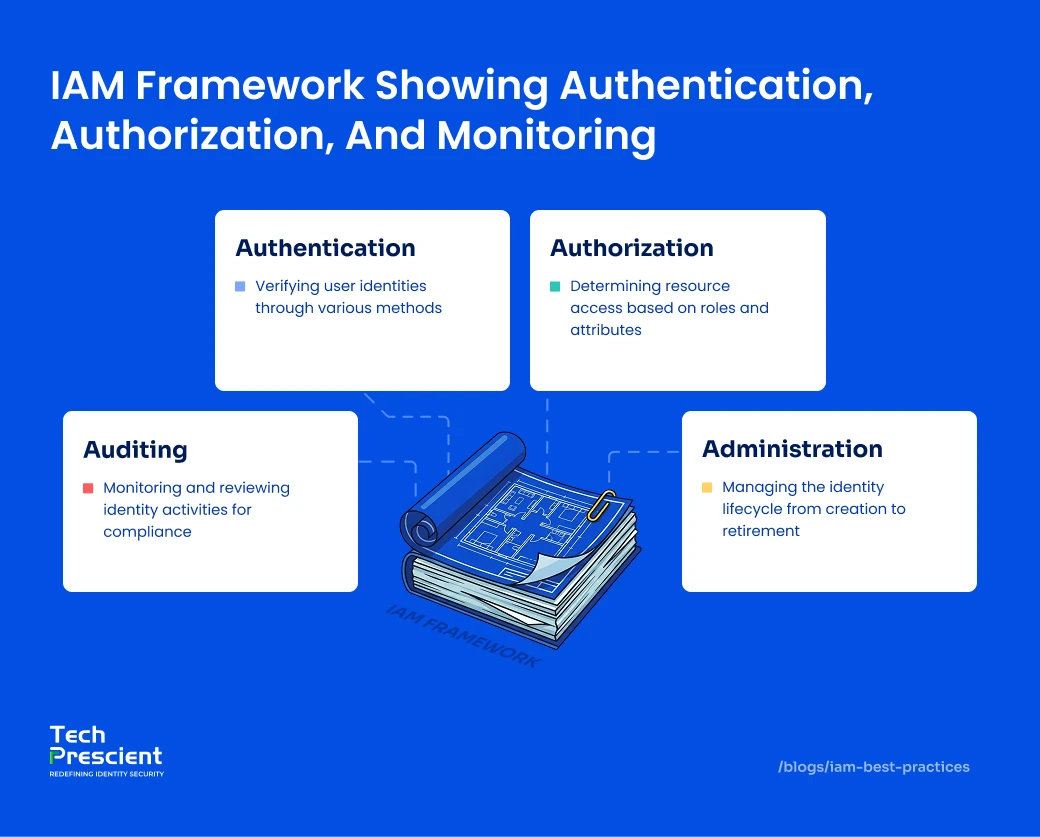
Identity and Access Management (IAM) is a comprehensive framework of policies, processes, and technologies that enables organizations to manage digital identities and control user access to critical systems and resources. IAM systems verify who users are (authentication), determine what they can access (authorization), manage their identities throughout their lifecycle, and monitor their activities for security and compliance purposes.
A robust IAM framework sits at the intersection of security, operational efficiency, and user experience—protecting sensitive assets while ensuring seamless access for legitimate users. As digital environments grow more complex with cloud migrations, remote work, and third-party integrations, IAM best practices have evolved from simple password policies to sophisticated, context-aware security systems.
For example, in a SaaS application like an HR system (such as Workday) or a finance tool (like QuickBooks), IAM prevents users from accessing the entire application. For example, a recruiter may only be able to access an employee's record. Meanwhile, a finance executive may be allowed to only view the budget items, which allows the company to manage access properly and leave sensitive information restricted. IAM guarantees that the user has the appropriate permissions based on their roles, responsibilities, or job requirements, and makes sure they do not allow free access to sensitive areas they do not have permission to access.
10 Core IAM Best Practices for Identity Security
IAM best practices are designed to reduce credential-based attacks, eliminate excessive permissions, and ensure continuous compliance. Below are the ten most critical practices organizations should implement in 2026.
Organizations seeking to strengthen their identity management best practices must address multiple dimensions of access security. The following ten practices represent the industry consensus on establishing a resilient identity security posture that balances protection with productivity.
1. Enforce Multi-Factor Authentication (MFA)
Multi-factor authentication (MFA) prompts users to provide two or more verification factors to access resources, applications, or accounts. MFA security requires either something the user knows (an account's password), something the user has (a security token or a mobile device), and/or something the user is (biometric verification).
Multi-factor authentication (MFA) strengthens protection against credential-based attacks by requiring verification beyond a password. If an attacker compromises a password through phishing, data exposure, or other methods, access is still restricted until additional authentication factors are validated. This control significantly reduces the likelihood of unauthorized access and strengthens an organization's overall security posture.
Implementing MFA helps organizations:
- Prevent unauthorized access even when passwords are compromised
- Meet regulatory compliance requirements across various industries
- Protect sensitive data from credential-based attacks
- Secure remote access to corporate resources
- Create a foundation for more advanced security models
Enabling MFA in your organization:
- Offers enhanced security with more layers than 2FA
- Ensures the identity of consumers is safeguarded against attacks
- Aligns with regulatory compliance standards
- Boasts straightforward implementation
- Integrates seamlessly with Single Sign-On (SSO) solutions
- Enhances security measures, even in remote work environments
As per research by Microsoft, published in August 2019, MFA stops over 99.9% of account compromise attempts.
Tech Prescient's Identity Confluence platform is building out its own native MFA tool while providing support for risk-based authentication, which adjusts security requirements based on contextual factors like location, device, and behavior.
2. Apply Least Privilege & Just-in-Time Access
Least Privilege Access
The principle of least privilege (PoLP) restricts user access to the minimum permissions required to perform assigned job functions. Access rights are defined according to role, responsibility, and business need, limiting exposure to sensitive systems and data.
Organizations operationalize least privilege through:
- Scheduled access and entitlement reviews
- Fine-grained role and permission design
- Removal or revocation of unused or unnecessary access rights
- Continuous monitoring of privileged accounts
Excessive permissions increase the potential impact of credential compromise. By minimizing standing access, organizations reduce lateral movement risk and constrain the blast radius of an incident.
Just-in-Time Access
Just-in-Time (JIT) access eliminates standing privileged access by granting elevated permissions only when required and only for a defined duration. Users request temporary access to perform a specific task. Upon approval, privileges are activated for a time-bound window and automatically expire once the task is complete.
A JIT model includes:
- Time-bound privileged access
- Automated approval workflows
- Automated access expiration
- Context-aware authorization controls
By replacing permanent privileged accounts with temporary elevation, organizations reduce persistent risk exposure while preserving operational efficiency.
Industry research indicates that a significant percentage of privileged credentials remain unused for extended periods, underscoring the risk associated with standing access. Reducing unused privileges directly limits the attack surface and strengthens overall identity governance.

Pro Tip
Run a quarterly "unused privilege sweep." Automatically downgrade or revoke elevated access that hasn't been used in 30–60 days. This prevents silent privilege accumulation.
Tech Prescient's Identity Confluence platform offers built-in risk scoring that automatically identifies excessive permissions and recommends right-sizing options while providing temporary elevated access with automated workflows.
3. Automate User Provisioning and De-Provisioning
Manual identity lifecycle management causes inefficiencies, mistakes, and security gaps that can be eliminated through automated processes, an important IAM best practice, especially critical for scaling organizations.
Provisioning encompasses creating user accounts and granting users the required level of system access permissions. Appropriately provisioning access means creating user identities in directories, assigning application licenses, and role-based permissions to multiple systems for an employee coming on board or moving to a different role within the organization.
De-provisioning means removing all access and accounts once employment is terminated at some level with the organization. This means disabling authentication credentials in some form, removing application licenses, and removing system access to prevent unauthorized use after the employee no longer works with the organization.
Automated provisioning enables employees to receive appropriate access as soon as they are hired or change roles. Automated de-provisioning instantly removes all access for employees during the offboarding process.
The benefits extend beyond security to operational efficiency:
- Reduction in onboarding time from days to minutes
- Elimination of orphaned accounts
- Consistent application of access policies
- Decreased helpdesk burden
- Comprehensive audit trails for compliance
Organizations that implement automated provisioning report an average 85% decrease in provisioning time, allowing new employees to be productive from day one. Identity Confluence's User Lifecycle Management module integrates with HR systems like Workday and SAP SuccessFactors to transform HR events into automated access workflows, creating a single source of truth for identity governance across the enterprise.
4. Implement Role-Based & Attribute-Based Access Control
Role-Based Access Control (RBAC) and Attribute-Based Access Control (ABAC) provide complementary approaches to authorization management.
RBAC assigns permissions based on defined job functions. Users receive access through standardized role groupings aligned to business responsibilities. This model supports consistent administration and is effective in structured organizational environments.
ABAC evaluates contextual attributes at the time of access. Authorization decisions may consider:

User attributes
Department, clearance level, certifications.
Resource attributes
Data classification, sensitivity level.
Environmental attributes
Location, device posture, time of access.
Organizational policies
Segregation of duties, regulatory constraints.
ABAC enables dynamic, context-aware enforcement beyond static role assignments.
Modern IAM programs increasingly adopt a hybrid model:
- RBAC for baseline access standardization
- ABAC for fine-grained and conditional access decisions
- Dynamic policy evaluation based on real-time conditions
- Continuous validation of authorization states
A hybrid approach strengthens access precision while maintaining administrative scalability. Properly implemented, it reduces excessive permissions and supports adaptive security requirements without increasing operational complexity.
5. Centralize IAM with Single Sign-On (SSO)
Single Sign-On (SSO) has evolved from a convenience feature to a security imperative. Centralizing authentication through SSO provides:
- Consistent security policy enforcement
- Reduced password fatigue and unsafe practices
- Comprehensive visibility into access patterns
- Streamlined user experience
- Simplified compliance reporting
Implementing SSO as an identity and access management best practice requires careful planning:
- Federation with cloud applications via SAML, OIDC, or WS-Fed
- Integration with on-premises applications
- Session management and timeout policies
- Risk-based authentication triggers
- Centralized monitoring and analytics
Identity Confluence's integration-ready architecture supports all major federation protocols and offers pre-built connectors for 250+ cloud and on-premise applications, enabling rapid deployment while maintaining security integrity.
How Many IAM Best Practices Do You Meet?
Score your implementation across lifecycle and governance
6. Adopt Passwordless Authentication
Passwordless authentication represents the convergence of enhanced security and improved user experience—eliminating the primary vulnerability of traditional systems while reducing friction. Modern implementations leverage:
- FIDO2 WebAuthn standards
- Biometric factors (fingerprint, facial recognition)
- Hardware security keys
- Certificate-based authentication
- Mobile device verification
Organizations implementing passwordless solutions report up to a 50% reduction in authentication-related support tickets and significant improvements in both security posture and user satisfaction. This emerging IAM best practice directly addresses the limitations of password-based systems that remain vulnerable to credential stuffing, phishing, and brute force attacks.
Tech Prescient's Identity Confluence platform supports multiple passwordless authentication methods while providing adaptive policies that can require additional verification based on contextual risk factors.
7. Monitor, Audit & Conduct Regular Reviews
Continuous monitoring and periodic reviews transform IAM from a static security control into a dynamic, responsive system, a critical IAM security best practice for maintaining alignment between configured access and actual business requirements.
Effective monitoring and auditing practices include:
- Real-time activity logging and alerting
- Behavioral analytics to detect anomalies
- Scheduled access certification campaigns
- Separation of duties (SoD) validation
- Comprehensive audit trails for regulatory compliance
Identity Confluence's Identity Analytics & Risk Insights module leverages machine learning to score user risk, highlight anomalies, and proactively surface potential security issues before they escalate into breaches. The upcoming Access Reviews & Certifications feature will offer one-click attestation workflows and pre-configured compliance reports tailored to frameworks like SOX, GDPR, and HIPAA.
8. Embrace Zero Trust Security Model
The Zero Trust security model emphasizes a few guiding principles that redefine the identity management best practices: don't trust, always verify, assume breach, and least-privilege access. Instead of relying on implicit trust based on the location of a user on a network or the ownership of an asset, Zero Trust requires strict verification of identity regardless of where access attempts are originating from.
By implementing Zero Trust principles, organizations ensure that users are who they say they are before giving them access to resources, which adds layers of continuous authentication and authorization, ultimately reducing the threats of unauthorized access and extending lateral movement in the event a network's perimeter is bypassed.
Zero Trust principles move IAM from a perimeter-based approach to an all-encompassing, holistic security framework where:
- Identity becomes the new perimeter
- Authentication and authorization occur continuously
- Context informs access decisions
- Lateral movement is constrained
- Micro-segmentation limits breach impact
Implementing Zero Trust requires:
- Strong identity verification for all users
- Device health validation
- Least privilege access enforcement
- Microsegmentation of networks
- Continuous monitoring and validation
Tech Prescient's Identity Confluence platform was architected with Zero Trust principles at its core, providing the continuous verification, least privilege enforcement, and contextual access decisions essential for modern security postures.
9. Educate and Train Employees
While technical controls form the foundation of IAM security, the human element remains critical. Regular security awareness training strengthens the effectiveness of IAM best practices by ensuring users understand:
- The importance of identity security protocols
- How to recognize phishing and social engineering attempts
- Proper handling of credentials and authentication factors
- Procedures for requesting and reviewing access
- Responsibility for reporting suspicious activities
Companies with formal security awareness training programs experience, on average, 70% fewer successful attacks as compared to companies with no formal education initiatives. Identity Confluence contributes to this compelling statistic by providing intuitive interfaces and clear workflows to build security best practices into daily activities.
10. Integrate Identity Governance and Administration (IGA)
IAM assists organizations with many security activities, but Identity Governance and Administration (IGA) offers additional required certification campaigns, policy enforcement, and separation of duties controls to help organizations manage regulatory obligations and reduce risk.
Tech Prescient's Identity Confluence platform provides IAM and IGA capabilities within a single solution, reducing complexity while ensuring security policy is systematically enforced across environments.
Common IAM Mistakes to Avoid
Even mature organizations undermine IAM effectiveness through preventable implementation mistakes. The following issues frequently lead to identity-related breaches.
Over-permissioning users
Granting excessive access rights creates unnecessary risk exposure. Identity Confluence's risk scoring automatically identifies and flags over-privileged accounts.
Ignoring de-provisioning
Delays in revoking access for departing employees or contractors create orphaned accounts that can be exploited. Access removal must be automated and triggered by authoritative source changes.
Treating MFA as optional
Allowing exceptions undermines security posture. According to Okta, organizations that treat MFA as an optional experience have 3-4 times more security incidents than those with universal enforcement. Identity Confluence enables phased MFA rollouts with comprehensive exception tracking.
Poor integration with HR systems
Relying on manual processes creates delays and errors. Identity Confluence's pre-built connectors establish reliable, automated synchronization with authoritative sources.
Neglecting regular access reviews
Allowing entitlement drift compromises least privilege principles. Tech Prescient's upcoming certification campaigns automate the review process with intelligent recommendations.
Warning Signs Your IAM Strategy Is Weak
- IT creates accounts manually via email requests
- Privileged access never expires
- Audit preparation takes weeks instead of hours
- Third-party access is not centrally tracked
- MFA exceptions exist for senior leadership
If any of these apply, your IAM controls may exist on paper but not in practice.
IAM in Action: Industry Use Cases
Financial Services
A leading financial institution implemented IAM best practices to address regulatory requirements and protect sensitive financial applications. By deploying Identity Confluence's User Lifecycle Management and Just-in-Time access, they achieved:
- 99.9% reduction in standing privileges
- 85% decrease in provisioning time
- Comprehensive audit evidence for regulatory examinations
- Elimination of old orphaned accounts from contractor access
Healthcare
A multi-facility healthcare system was able to enhance HIPAA compliance and protect patient information by advancing its identity and access management processes. The organization implemented Identity Confluence and offered role-based access control to align functional roles with specific clinical functions so that providers only accessed patient records in relation to their treatment of the patient. Access rights were automatically synchronized with the credentialing of practitioners, and access was revoked immediately when a person left employment, addressing lapses in security that normally took a few days to close. Detailed audit logs provided the compliance auditors with evidence, and preparation time for regulatory review was reduced significantly. Their implementation of Identity Confluence delivered:
- Role-based access control aligned with clinical functions
- Automated provisioning synchronized with credentialing
- Real-time access revocation for departing practitioners
- Continuous monitoring for unusual PHI access patterns
- Comprehensive audit logs for compliance verification
SaaS/Technology
A technology company enjoying rapid growth adopted identity management best practices to grow with speed and security. Identity Confluence provided an SSO integration across its cloud applications ecosystem to reduce login friction while also increasing security. The company automated its onboarding workflows with its HRIS, reducing provisioning time from days to minutes and ultimately removing access errors during its rapid hiring process. For the company, this automation also helped manage their 300% year-over-year growth without increasing security costs or compromising their security posture. Identity Confluence provided:
- SSO integration across their cloud application ecosystem
- Automated onboarding aligned with their HRIS system
- Developer-friendly APIs for custom application integration
- Risk-based authentication for sensitive operations
- Scalable identity infrastructure supporting 300% annual growth
Future of IAM: AI, Automation & Quantum-Resistant Security
The identity security landscape continues to evolve as organizations adapt to cloud expansion, distributed workforces, and increasingly sophisticated threat activity. Several developments are influencing the direction of IAM strategy.
AI-Driven Identity Intelligence
Machine learning algorithms are transforming IAM from static rule sets to dynamic, intelligent systems capable of:
- Detecting anomalous access patterns in real-time
- Predicting potential security incidents before they occur
- Optimizing role definitions through behavioral analysis
- Automating routine access decisions
- Providing contextual, risk-based authentication
Quantum-Resistant Authentication
Advances in quantum computing present long-term considerations for cryptographic resilience. While large-scale quantum threats to current encryption standards are not immediate, organizations should monitor the development of post-quantum cryptographic standards.
IAM architectures should be designed with:
- Cryptographic agility to support evolving standards
- Modular authentication components
- Upgrade paths for post-quantum algorithms
- Vendor alignment with recognized standards bodies
Forward-compatible authentication design reduces future migration risk and preserves long-term security investments.
Decentralized Identity
Decentralized identity models, including verifiable credentials and distributed identity frameworks, aim to reduce reliance on centralized identity providers. These approaches may support:
- Cross-organizational identity verification
- Selective disclosure of user attributes
- Privacy-preserving authentication models
- Tamper-evident credential validation
Adoption remains dependent on interoperability standards, governance frameworks, and regulatory alignment. Organizations should evaluate decentralized identity models within the context of risk, compliance, and operational feasibility.
IAM vs IGA: Why Governance Completes the Picture
Identity and Access Management (IAM) establishes authentication and authorization controls that enable users to access systems and data. Identity Governance and Administration (IGA) extends these capabilities by introducing oversight, policy enforcement, certification, and compliance validation mechanisms.
While IAM determines who can access what, IGA validates whether that access remains appropriate over time.
| Sr No | Capability | IAM | IGA |
|---|---|---|---|
| 1 | Authentication | ✅ | ❌ |
| 2 | Authorization | ✅ | ❌ |
| 3 | Access Reviews | Limited | ✅ |
| 4 | Segregation of Duties | Limited | ✅ |
| 5 | Compliance Reporting | Basic | Advanced |
IAM systems primarily enforce access decisions at the point of authentication and authorization. IGA platforms provide structured review workflows, policy-based risk analysis, segregation of duties enforcement, and audit-ready reporting.
IAM enables access execution. IGA ensures sustained appropriateness, accountability, and regulatory alignment.
Conclusion: Building a Secure IAM Framework
In 2026 and beyond, identity access management best practices are no longer optional safeguards, they are strategic business enablers. As organizations operate across cloud, SaaS, hybrid, and remote environments, securing identities has become the new security perimeter. Implementing strong MFA, enforcing least privilege, automating provisioning and de-provisioning, adopting Zero Trust principles, and integrating governance controls ensures that users receive the right access at the right time, no more, no less.
As identity-based attacks continue to grow, IAM must evolve into an intelligent, adaptive framework powered by automation, contextual risk analysis, and continuous monitoring. The future of identity access management best practices lies in unified platforms that combine access control with governance, delivering real-time visibility, reduced operational friction, and stronger compliance outcomes.
Don't Assume You're Secure, Validate It
Measure maturity across MFA, lifecycle, and governance
FAQs
Authentication, authorization, administration, and auditing form the four fundamental pillars of IAM. Authentication verifies identity claims, authorization determines access rights, administration manages the identity lifecycle, and auditing provides visibility and compliance evidence.
Enforcing least privilege access, implementing phishing-resistant MFA, automating provisioning and de-provisioning processes, and conducting regular access reviews represent the core best practices for effective identity management in today's threat landscape.
Authentication, authorization, administration, and audit comprise the 4 A's of IAM, representing a critical function within the identity security framework. Modern implementations integrate these functions within a cohesive governance structure.
The three foundational principles of IAM are to verify identity through strong authentication, enforce least privilege access, and continuously monitor all identity and access activities. These principles form the cornerstone of effective identity security programs.
No—IAM (Identity and Access Management) focuses on managing digital identities and controlling access, while IGA (Identity Governance and Administration) extends these capabilities with governance, compliance, and lifecycle management functions. IGA encompasses IAM while adding policy enforcement, access certification, role management, and comprehensive audit capabilities.
A centralized IAM approach provides uniform user provisioning, consistent security policies, streamlined administration, comprehensive visibility, and simplified compliance reporting across all systems and applications, reducing security gaps and administrative overhead.
Organizations should conduct access reviews at least quarterly for sensitive systems and annually for standard access, with additional reviews triggered by significant organizational changes, as recommended by both Okta and StrongDM.
Automation is critical for scalable IAM, eliminating manual errors in provisioning/deprovisioning, ensuring consistent policy application, reducing administrative overhead, providing comprehensive audit trails, and enabling rapid response to security incidents.


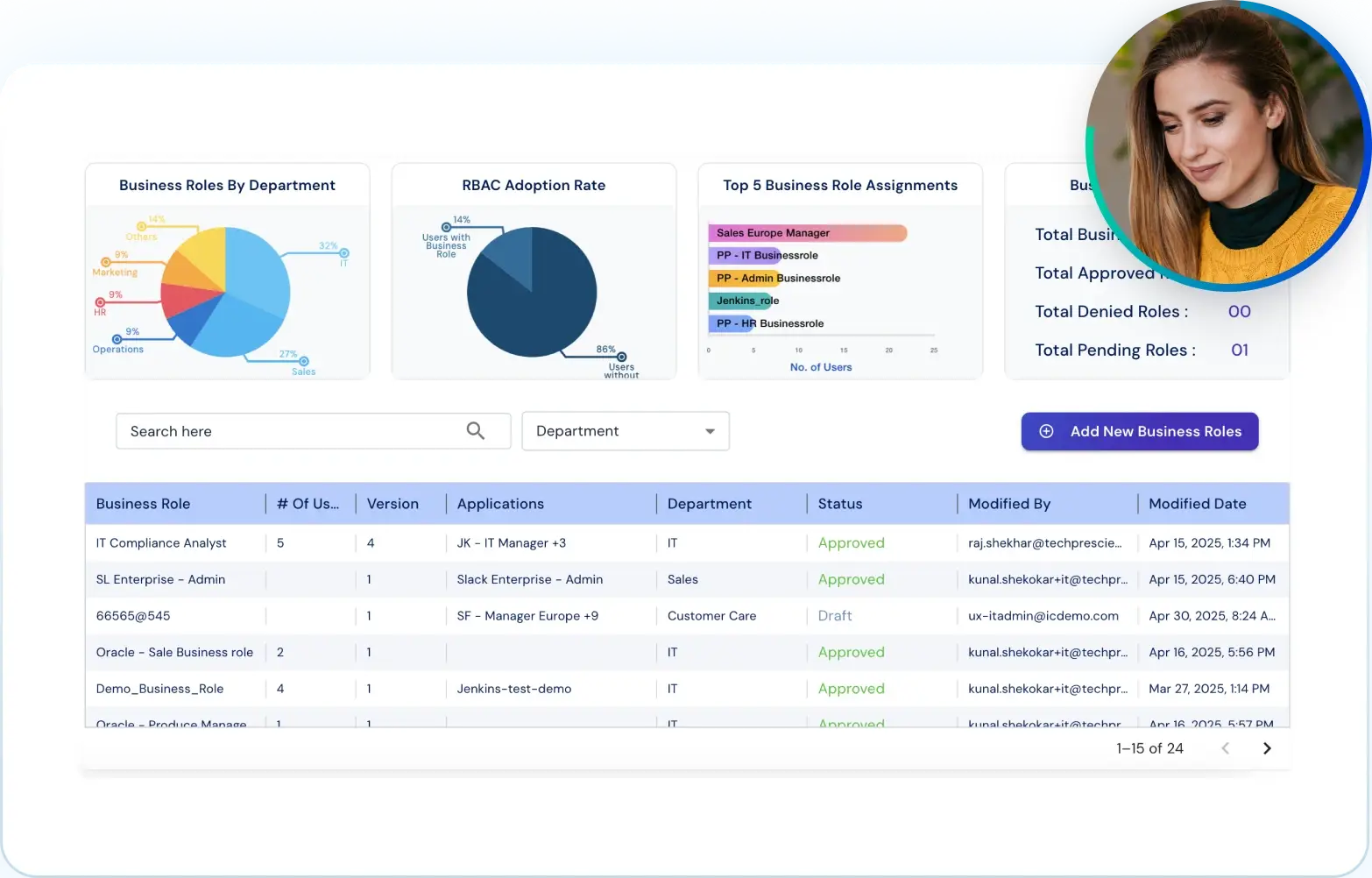
GET A PERSONALIZED DEMO
See Identity Confluence in Action
“One platform to govern identities, automate access decisions, and prove compliance; across every app, user, and system in your environment.”



Murli Ramsunder
Senior Architect, Vonage