
User Access Review Audit: Process, Steps & Compliance Tips
Last Updated date: September 1, 2025
On this page
See Tech Prescient in Action
Automate access, reduce risk, and stay audit-ready
A user access review audit (UAR), also referred to as access certification, is a recurring governance process used to confirm that employee access rights align with current job responsibilities. Its primary purpose is to enforce the principle of least privilege, ensuring users retain only the access required to perform their roles. When executed consistently, UAR audits support compliance with regulatory frameworks such as SOX, HIPAA, and GDPR while reducing exposure to insider risk.
A standard UAR audit follows a structured workflow. Organizations define the scope of in-scope systems and users, collect entitlement data, validate permissions against role expectations, remediate excessive or inappropriate access, and document outcomes to support audit readiness. This disciplined approach helps maintain accurate access controls and reduces the likelihood of privilege accumulation over time.
Regular user access review audits are an important protection for any firm, as they contribute to the prevention of data breaches and reputational harm. Checking and validating user access privileges on a regular basis improves data security, defensive mechanisms, and demonstrates a strong commitment to fulfilling essential industry compliance standards.
A recent report by Secureframe found that 86% of data breaches happen because of stolen or misused login details. That's a huge number. One of the best ways to lower this risk is through regular user access reviews, as they make sure employees only have the access they actually need. With that in mind, let's break down why UAR audits matter, how to run them step by step, and some best practices to keep the whole process simple and compliant.
Key Takeaways:
- What a UAR audit is and its role in enforcing the principle of least privilege
- Why UAR audits are essential for security, compliance, and efficiency
- The main types of user access reviews and their use cases
- Step-by-step process to conduct a successful UAR audit
- Best practices and automation tips to streamline audits
What is a User Access Review Audit?
A user access review audit is a structured, periodic assessment of user permissions across an organization's information systems. Its objective is to verify that access rights align with current job responsibilities and adhere to the principle of least privilege, ensuring users retain only the access necessary to perform their functions.
User access reviews are commonly performed as part of recurring compliance cycles or in preparation for external audits. Through this process, organizations identify and remediate excessive, unauthorized, or outdated access, reducing the risk of privilege creep and limiting exposure associated with compromised credentials. Consistent execution of UAR audits also supports regulatory compliance requirements, including those related to SOX, HIPAA, and GDPR.
In practice, a UAR audit provides centralized visibility into who has access to which systems and why. For example, in a large financial institution managing sensitive data across multiple applications and databases, a UAR audit enables security and IT teams to systematically validate employee access against defined role expectations. By removing unnecessary privileges and documenting review decisions, the organization strengthens its security posture while maintaining clear, auditable evidence of compliance.
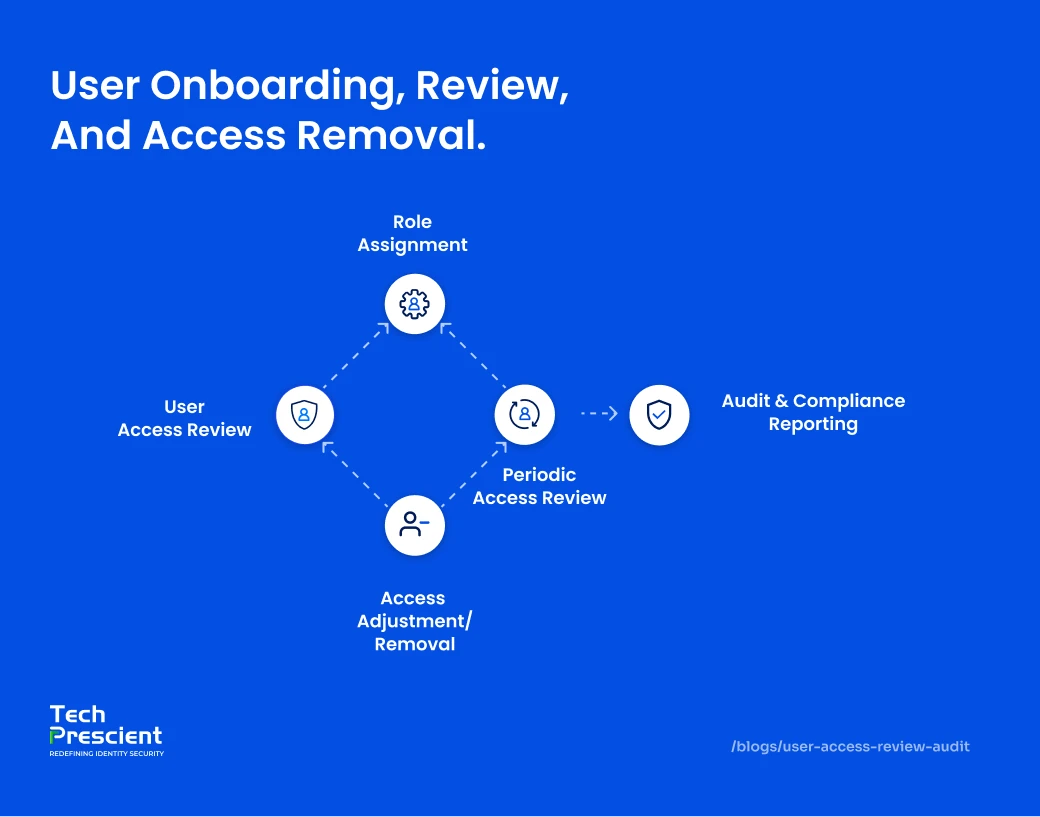
Why Are User Access Review Audits Critical for Security and Compliance?
User access review audits are a foundational control for protecting sensitive systems and meeting regulatory obligations. As organizations grow and environments become more complex, unmanaged access introduces measurable security, compliance, and operational risk. UAR audits address this risk across several critical dimensions.
Data Security Assurance
As employees transition between roles, they often retain access privileges that no longer align with their responsibilities. This leftover access increases the organization's attack surface and exposes it to risks of unauthorized use. User Access Reviews (UARs) address this by detecting and removing unnecessary permissions, ensuring only the minimum required rights are active. By enforcing the principle of least privilege, UARs reduce opportunities for misuse, exploitation, or accidental exposure of sensitive data.
Mitigation of Insider Threats
Unchecked access often creates conditions for insider risks. UARs help prevent three common scenarios:
- Privilege Creep: The gradual accumulation of excessive permissions as employees change roles without revoking outdated access rights.
- Privilege Abuse: Intentional exploitation of legitimate access for malicious purposes such as data theft, IT system sabotage, or fraud.
- Privilege Misuse: Inappropriate use of legitimate access without malicious intent, such as accessing sensitive data out of curiosity, potentially leading to compliance violations or accidental data leaks.
By addressing these risks systematically, organizations strengthen their security posture and reduce the likelihood of internal threats.
Adaptability to Organizational Changes
Organizations are constantly evolving, employees change roles, departments restructure, and new applications are introduced. Without regular reviews, access rights can quickly become outdated or excessive. UARs ensure that permissions remain aligned with current job functions and organizational needs, maintaining agility without compromising security.
Regulatory Compliance
Many industries operate under strict frameworks like GDPR for data protection, HIPAA for healthcare privacy, and SOX for financial reporting. These standards often mandate periodic access reviews to protect sensitive data and prevent unauthorized use. UARs provide a clear, auditable record of who has access to which systems and when changes occurred, evidence that is invaluable during compliance audits. Neglecting this process can lead to regulatory violations, fines, and reputational damage.
Efficient Resource Utilization
Access sprawl often leads to unnecessary licensing and infrastructure costs. Dormant accounts and excessive permissions inflate software usage metrics and complicate vendor management. UAR audits provide visibility into actual access requirements, enabling more accurate license allocation and cost control without disrupting business operations.
Proactive Risk Management
Instead of waiting for access issues to escalate into security incidents or compliance failures, UARs enable a proactive approach. By continuously monitoring and adjusting access rights, organizations identify vulnerabilities before they are exploited, ensuring stronger resilience against evolving threats.
See Where Your Access Reviews Break
When audit pressure rises, weak controls surface fast. Test yours now.
Types of User Access Reviews
Organizations use different types of user access reviews to address specific risk scenarios, operational changes, and compliance requirements. Each review type serves a distinct purpose within an access governance program and is often used in combination to maintain consistent control.
1. Periodic access reviews
Periodic access reviews are conducted at predefined intervals, commonly quarterly or annually, to validate that user access remains appropriate over time. These reviews typically apply to all in-scope users and systems and are a core requirement in regulated environments.
The procedure typically includes:
- Generating access reports for all users and systems
- Reviewing permissions with managers or system owners
- Approving, modifying, or revoking access as needed
- Documenting outcomes and maintaining audit evidence
Periodic reviews are especially critical for regulated industries where auditors require proof of consistent access governance.
2. Event-driven access reviews
Event-driven access reviews occur whenever significant changes happen in the organization, like onboarding, offboarding, promotions, or department restructuring. These reviews aim to address immediate access risks that come with such transitions. The main goal is to make sure users whose roles have changed have their permissions updated quickly. They can also be triggered after policy updates or security incidents.
3. Continuous access reviews
Continuous access reviews involve real-time monitoring and evaluation of user activities and access rights using automated tools and systems. This approach aligns with the concept of continuous adaptive trust, where user permissions are regularly adjusted based on contextual behavior analysis. Advanced technologies like AI, machine learning, and behavioral monitoring play a key role in detecting unusual access patterns and reducing risks as they occur. By adopting different types of user access reviews tailored to your cybersecurity strategy, organizations can effectively minimize the risk of inappropriate access.
How to Carry Out a User Access Review (5-Step Procedure)
A user access review follows a repeatable, structured process designed to ensure access rights remain aligned with business roles, security policies, and compliance requirements. This five-step procedure establishes consistency, accountability, and audit readiness across review cycles. The core steps of a user access review include:
Define the review scope
Identify in-scope systems, applications, data sets, and user populations based on risk, regulatory requirements, and business criticality.
Collect access and entitlement data
Aggregate current user access information from identity systems, applications, and infrastructure to establish a complete view of existing permissions.
Validate access against role requirements
Compare assigned permissions to defined job functions and least privilege standards to identify excessive, outdated, or inappropriate access.
Remediate identified access issues
Modify or revoke permissions that are no longer justified, ensuring changes are implemented and tracked in accordance with policy.
Document outcomes and obtain approvals
Record review decisions, remediation actions, and sign-offs to create an auditable record that supports internal governance and external audit requirements.
This procedure applies to both periodic and event-driven user access reviews and forms the foundation of a defensible access governance and audit readiness program.
Step-by-Step User Access Review Audit Process (Detailed Breakdown)
A structured user access review process plays a vital role in reducing cybersecurity risks to your organization's critical assets. To assist you, we've developed a user access review template that can serve as a comprehensive checklist during your audits.
A UAR audit follows five steps: define scope, collect data, compare against roles, remediate issues, and document findings. This ensures access stays compliant and secure.
Step 1. Define the Scope
Start by creating a complete inventory of all systems, applications, and data repositories, covering both on-premises and cloud environments, to ensure no asset is missed. Prioritize these systems based on data sensitivity and potential business impact if compromised. High-risk areas such as financial applications, HR databases, and customer information systems should receive the most attention during the user access review.
Next, identify all relevant regulatory requirements, such as GDPR for EU personal data or HIPAA for PHI in healthcare, to ensure compliance. Include any third-party or vendor systems that have access to your network, as external access points can introduce additional risks and must be part of the review scope.
Step 2. Collect Access Data
Start by compiling a comprehensive list of all organizational assets where sensitive data is stored or processed, including servers, workstations, network devices, cloud services, and databases. For each system, identify how access logs and reports can be generated to track user activity effectively. When extracting access data, you can use automated tools or manual methods:
- Automated Tools/Scripts: Leverage automation to pull access data, such as usernames, roles, permissions, and last login timestamps, directly from systems. This minimizes manual errors and saves time.
- Manual Processes: For systems without automation capability, system administrators must manually gather access lists, including user accounts, group memberships, and any special access rights.
Insight:
Step 3. Compare Against Roles
Access must be evaluated against defined job functions and the principle of least privilege. The objective is to confirm that users, applications, and processes retain only the access necessary to perform approved responsibilities.
Validation should include:
- Reviewing standard user accounts to confirm permissions align with role expectations
- Restricting administrative and privileged access to approved personnel only
- Ensuring temporary or elevated access is time-bound and revoked when no longer required
During this step, reviewers identify excessive, outdated, or inappropriate permissions and determine whether adjustments are required to restore alignment with least privilege standards.
Step 4. Remediate Issues
Once discrepancies or unauthorized access instances are identified, take immediate corrective measures. Develop a structured process to revoke any outdated, excessive, or unnecessary access rights. Prioritize these actions based on the associated risk level to minimize exposure to potential threats.
Collaborate with the IT security team to ensure revocations are executed without disrupting critical operations. This may involve scheduling changes during non-peak hours or granting temporary supervised access when immediate removal could impact business continuity. Additionally, establish a clear notification protocol for affected users and their managers, outlining the reason for revocation and the correct process for requesting reinstatement if needed.
Step 5. Document Findings
Creating an audit report is critical for maintaining compliance and improving access control processes. This document should provide a complete record of the review, covering the scope, methodologies, findings, and corrective actions taken. It must also clearly document every instance of unauthorized or inappropriate access and the rationale for each corrective step.
Include the following details within the report:
- Scope & Approach: Outline what systems, applications, and data sets were included, and how the review was conducted.
- Issues & Fixes: Document each discrepancy, how it was detected, and the corrective measures implemented.
- Decisions & Challenges: Explain decisions behind access revocations and note any issues encountered during implementation.
Once findings are documented, the report should also define an action plan to prevent similar issues in the future. This plan can include policy improvements, new tools or automation for access reviews, and employee training initiatives. Assign responsibilities, set deadlines, and establish metrics for measuring the effectiveness of these actions.
Best Practices for Effective Access Audits
Conducting effective access reviews demands the right tools and a well-defined strategy. Below are key best practices organizations should follow to ensure a complete and accurate access review process:
Implement RBAC
Role-Based Access Control (RBAC) provides a structured approach to aligning access rights with job responsibilities. By assigning permissions to roles rather than individual users, RBAC simplifies access management and reduces the risk of over-provisioning.
- Define Roles and Permissions: Identify all roles within the organization and determine the set of permissions required for each role to perform its functions.
- Map Users to Roles: Assign users to appropriate roles based on their job descriptions and responsibilities, ensuring they inherit the correct permissions.
- Verify Role Alignment: Regularly review job functions against assigned roles to confirm that access remains appropriate and aligned with security policies.
This structured approach reduces complexity, prevents over-provisioning, and ensures that access rights remain consistent with organizational needs.
Automate reviews with IAM/IGA tools
Automation is essential for streamlining user access reviews and ensuring accuracy. Leverage Identity and Access Management (IAM) or Identity Governance and Administration (IGA) solutions that can automate data collection and review workflows. These tools help reduce manual errors and improve compliance. Key considerations when implementing automation:
- Seamless Integration: Choose tools that integrate with existing systems such as HR applications, Active Directory/LDAP, and cloud platforms to update roles automatically based on HR events like onboarding, promotions, or terminations.
- Full Lifecycle Management: Ensure the solution supports end-to-end access governance, including user provisioning, periodic reviews, modifications, and detailed documentation.
- Scalability: Opt for platforms that can scale with organizational growth and manage complex access structures across multiple systems and environments.
Insight:
Involve multiple stakeholders
Include department heads and line managers in the access review process to validate whether each user's permissions are truly necessary. These stakeholders have a clear understanding of operational requirements and can accurately determine the level of access needed for each role. Engaging multiple stakeholders improves decision accuracy, reinforces least privilege principles, and reduces the likelihood of over-privileged accounts persisting across review cycles.
Regularly audit logs
A documented access review procedure is essential for consistency and accountability. Organizations should clearly define how reviews are conducted, who is responsible, review frequency, and how outcomes are documented and approved.
Procedures should be reviewed periodically to confirm they remain effective and aligned with evolving security and compliance requirements. Where possible, standardized review templates can be used to ensure consistency across systems, roles, and regulatory scopes. A well-defined process strengthens governance, supports repeatability, and improves overall access control maturity.
Automating User Access Review Audits
Automation is a critical enabler for scaling user access review audits across modern, distributed environments. As organizations adopt cloud services and increase system complexity, manual access reviews become difficult to sustain without introducing risk.
Manual vs Automated User Access Reviews
Manual user access reviews typically rely on spreadsheets, static reports, and email-based approvals. While workable in small environments, these methods are time-consuming, prone to human error, and difficult to scale across multiple systems.
Automated user access reviews leverage Identity and Access Management (IAM) or Identity Governance and Administration (IGA) platforms to continuously collect access data, apply policy controls, and surface violations in near real time.
Key differences include:
- Manual reviews operate on fixed schedules, while automated reviews support continuous or high-frequency validation
- Manual processes increase administrative burden and audit fatigue; automation reduces operational effort
- Automated reviews improve consistency, accuracy, and audit readiness
By pulling access data directly from applications, directories, and cloud platforms, automation reduces reliance on manual reconciliation and improves visibility into current entitlements. Automated workflows provide a clear view of who has access to which resources and whether that access remains justified under least privilege standards.
Modern IAM and IGA platforms extend these capabilities by integrating with authoritative systems, applying policy-based controls, and supporting structured approval workflows. Automated alerts, approval routing, and remediation actions help organizations address access issues promptly while maintaining a documented audit trail. The result is shorter review cycles, reduced risk exposure, and stronger alignment between access governance and compliance requirements.
User Access Review Audit Report & Templates
A well-structured user access review audit report is essential for demonstrating compliance and maintaining audit defensibility. These reports document the full review lifecycle, including scope definition, access data evaluated, risks identified, remediation actions taken, and final approvals.
Clear and consistent documentation supports regulatory requirements such as SOX, HIPAA, GDPR, and ISO 27001 while providing auditors and executive stakeholders with transparent visibility into access governance practices. Inadequate reporting increases the risk of audit findings, compliance gaps, and unmanaged insider access.
To standardize reporting and reduce administrative overhead, many organizations use predefined audit report templates. These templates ensure reviews consistently capture key elements, including:
- Systems and applications reviewed
- Users and roles evaluated
- Access changes approved or revoked
- Review outcomes and compliance status
Standardized templates also serve as ready evidence during external audits and internal assessments. By enforcing consistency and completeness, they strengthen governance, improve repeatability, and reduce the effort required to demonstrate effective access control oversight.
Final Thoughts
User access review (UAR) audits are a core component of effective identity and access governance. Beyond meeting compliance requirements, they help organizations protect sensitive data, limit insider risk, and maintain operational integrity. When embedded as a structured, recurring control, access reviews reinforce accountability, transparency, and consistency across the enterprise.
At Tech Prescient, we help enterprises modernize and automate their user access review processes to reduce risk and stay audit-ready. From aligning with regulatory standards like SOX, HIPAA, and GDPR to leveraging automation with tools such as Okta, our team ensures that the right people always have the right access at the right time.
Don't wait for an audit finding or a security incident to highlight gaps in your access governance. Take the next step with Tech Prescient today. Book a personalized Demo.
FAQs
The main goal is to confirm that every user only has the permissions they need for their current role, nothing more, nothing less. This helps maintain the principle of least privilege and reduces the risk of unauthorized access.
Annual reviews are the bare minimum, but for organizations handling sensitive data, quarterly reviews are a best practice. The more frequent the review, the quicker you can catch and fix access creep.
An audit report should document the scope of the review, access evaluated, findings identified, remediation actions taken, and approval records. These elements provide evidence that the review was completed in accordance with policy and regulatory expectations.
Yes. Identity and access governance solutions can automate data collection, review workflows, policy enforcement, and documentation. Automation improves consistency, reduces manual error, and supports scalable access governance.
Ignoring these reviews opens the door to insider threats, compliance violations, and costly data breaches. It's like leaving your office doors unlocked, you may not notice a problem until it's too late.


GET A PERSONALIZED DEMO
See Identity Confluence in Action
“One platform to govern identities, automate access decisions, and prove compliance; across every app, user, and system in your environment.”



Murli Ramsunder
Senior Architect, Vonage