




On this page
See Tech Prescient in Action
Automate access, reduce risk, and stay audit-ready
Authorization in cybersecurity is the process of determining what actions an authenticated user, application, or device is permitted to perform within a system. It governs access to data, applications, and infrastructure based on predefined policies, roles, or attributes. In simple terms, authentication verifies identity, while authorization determines permitted actions. Policies define and enforce what is allowed or denied.
Authorization grants an authenticated user the right to access specific resources under defined conditions. Once identity is confirmed, authorization evaluates policy logic to determine which data, applications, or processes can be accessed and what actions can be performed. Permissions are enforced through structured roles, rules, or attribute-based controls. This ensures that every identity operates within approved boundaries, maintaining security and operational integrity.
Consider a physical office building. Individuals may enter after identity verification, but access to specific rooms depends on their role. A manager may have access across departments, while an employee may be restricted to a single floor. Authorization operates the same way in digital environments by controlling who can view, modify, or administer specific resources.
Improperly defined authorization policies increase organizational risk. Overprivileged access, misconfigured permissions, and privilege accumulation create exploitable conditions. According to Infosec Institute, 74% of data breaches involve a human element, including privilege misuse, stolen credentials, or social engineering. Effective authorization directly mitigates this exposure by enforcing least-privilege access and limiting unnecessary permissions.
In this article, we examine how authorization works, the models that structure permission management, and the operational practices organizations use to enforce least privilege while maintaining system efficiency.
Key Takeaways:
- Authorization defines what users can do after authentication, controlling access based on roles, rules, or attributes.
- The authorization process verifies user privileges through defined policies before granting or denying access.
- Key authorization models like RBAC, ABAC, DAC, and MAC determine how permissions are managed across systems.
- Organizations face challenges like privilege creep, policy complexity, and lack of visibility in authorization management.
- Modern IAM and IGA solutions integrate authorization to ensure least privilege, compliance, and secure access control.
What Is Authorization in Cybersecurity?
Authorization is the process that determines what an authenticated identity is permitted to do within a system. After authentication verifies identity, authorization defines the actions, access levels, and privileges granted to a user, application, or device. It establishes the boundaries within which an identity can operate.
Within Identity and Access Management (IAM) frameworks, authentication and authorization function together to control access to digital resources. Authentication confirms identity, while authorization enforces access decisions through defined policies. Permissions are assigned and evaluated based on structured controls rather than discretionary decisions, ensuring consistent enforcement across systems.
In cybersecurity, authorization works as a rule-based control layer that ensures users interact only with the data and resources they are allowed to access. It operates through well-defined policies, rules, and contextual attributes such as a user's department, device type, location, or time of access to enforce permissions dynamically. This ensures that every action taken within a system adheres to security and compliance standards.
To put it simply, authentication answers the question "Who are you?", while authorization answers "What can you do?" Think of it like air travel: your passport confirms your identity (authentication), while your boarding pass defines where you are allowed to go and the flight you are permitted to board (authorization).
At its core, every secure system uses authorization mechanisms that constantly check and validate permissions. These mechanisms rely on three main components:
- Rules (Policies): Define who can do what, under which conditions. For instance, only "admins" can modify user data.
- Contextual Details: Include information like device type, network, or location to make access decisions more precise.
- Policy Decision Point (Checker): Evaluates the request based on the above rules and context, then grants or denies access.
In essence, authorization in cybersecurity acts as a continuous gatekeeper, ensuring that users, systems, or applications can only perform approved actions.
Authentication vs Authorization: What's the Difference?
Authentication confirms identity, while authorization determines permissions. Both are essential for secure access control.
| Sr No | Feature | Authentication | Authorization |
|---|---|---|---|
| 1 | Purpose | Verify identity | Grant permissions |
| 2 | Question Answered | Who are you? | What can you do? |
| 3 | Occurs When | First step | After authentication |
| 4 | Example | Login with password | Access admin dashboard |
Without authentication, a system cannot reliably establish identity. Without authorization, authenticated identities may receive permissions beyond what is required.
Together, authentication and authorization form the core enforcement mechanisms within Identity and Access Management (IAM), ensuring that access decisions are both verified and controlled according to defined policy.
Expert Insight
In modern cybersecurity architecture, authorization must be dynamic, contextual, and continuously evaluated, not static. Organizations that centralize policy enforcement and automate access reviews significantly reduce breach risk and audit failures.
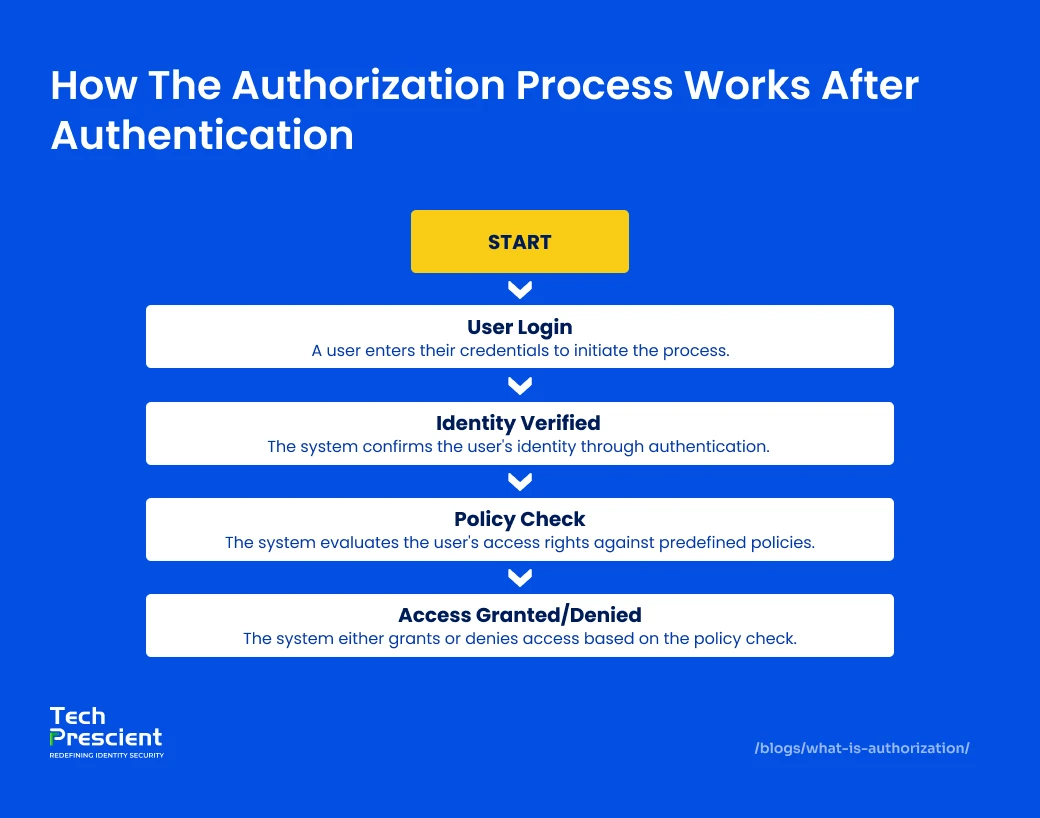
How the Authorization Process Works
Authorization determines whether an authenticated user can access specific data, applications, or actions within a system. It evaluates user privileges against predefined rules and contextual conditions to ensure only approved operations are performed.
At its foundation, authorization relies on three core elements: permissions, roles, and policies. Permissions define the exact actions a user or system can perform, such as read, write, or delete. Roles group permissions into logical sets that map to job responsibilities, which makes access management scalable. Policies contain the rules and logic that determine when and how roles and permissions apply, specifying the conditions under which access is allowed or denied. These elements work together so the authorization engine can make consistent, auditable access decisions.
Here's how the authorization process unfolds step by step:
User authentication
The process begins when a user proves their identity by signing in with credentials, a one-time code, or multi-factor authentication. Successful authentication establishes a trusted identity and often produces a token or session identifier that represents that identity for subsequent requests.
Authorization request
The authenticated user attempts to access a resource or perform an action. The request contains the user identity or token, the target resource, and the desired action, for example, reading a file, calling an API, or modifying a record.
Policy retrieval and context collection
The access control engine gathers the relevant policy definitions and any contextual attributes needed to evaluate the request. Context can include the user's roles and attributes, resource metadata (such as sensitivity or owner), and environmental details like device type, IP address, geolocation, and time of day.
Access control evaluation (decision stage)
The Policy Decision Point evaluates the request by applying policy logic to the collected attributes, roles, and permissions. This may involve validating tokens (for example, checking JWT claims or OAuth scopes), consulting an attribute store or policy information point for additional facts, and executing policy rules from the policy administration point. The result is a clear allow or deny decision and, where applicable, any obligations or constraints, such as requiring approval or elevated verification.
Enforcement (policy enforcement point)
The policy enforcement point enforces the decision returned by the decision stage. If the decision is allowed, the system permits the requested action within the defined scope. If the decision is to deny, the system blocks the action and returns a suitable error or status. Enforcement can occur in the application itself, at an API gateway, or via a dedicated authorization service.
Token handling and session management
When applicable, the authorization system issues, refreshes, or updates tokens to reflect the granted scopes and permissions. Session state is tracked so subsequent requests can reuse validated tokens without repeating the full evaluation, while still honoring time-limited or revocable permissions.
Activity logging and audit
Every access attempt and decision is recorded, including identity details, the requested resource, the decision outcome, timestamp, origin, and justification. These logs support auditing, compliance reporting, and forensic investigations.
Continuous review and policy feedback
Authorization is iterative. Periodic access reviews, automated analytics to detect privilege creep, and feedback from audits lead to role adjustments and policy updates. This continuous cycle keeps permissions aligned with business needs and reduces long-term risk.
In modern Identity and Access Management systems, these steps execute in near real time and are integrated with identity stores, token services, and identity governance tools. Centralized policy management, policy-as-code, and consistent enforcement across applications and cloud environments enable organizations to maintain the principle of least privilege, preserve auditability, and deliver secure, frictionless access.
Types of Authorization Models
Organizations rely on different authorization models to control who can access which resources. The choice of model depends on how structured the organization is, how dynamic the environment is, and the level of security required.
Role-Based Access Control (RBAC)
Role-Based Access Control assigns permissions based on the roles defined within an organization. Instead of granting access directly to each user, permissions are grouped into roles such as Admin, Manager, or Employee. A user receives access by being assigned one or more roles. This makes management easier because changes to job responsibilities only require role updates, not individual permission changes. RBAC works best in environments where job functions are clearly defined and do not change frequently.
Attribute-Based Access Control (ABAC)
Attribute-Based Access Control uses attributes to determine access permissions. These attributes may be related to the user (department, clearance level), the resource (file classification, owner), or the environment (time of day, device, location). Access decisions are made dynamically by evaluating policies that consider these attributes. This model provides very fine-grained control and aligns well with modern security approaches that require continuous evaluation of trust.
Discretionary Access Control (DAC)
Discretionary Access Control allows the owner or creator of a resource to decide who can access it and what actions are permitted. This model is common in personal computing and shared workspaces where individuals frequently create and share files. The flexibility of DAC makes it easy to collaborate, but it also means that organizations must rely on users to assign permissions responsibly. DAC is best suited to smaller environments or systems where individual ownership of data is clear.
Mandatory Access Control (MAC)
Mandatory Access Control is enforced by a central authority that assigns security classifications to data and clearance levels to users. Access is only granted when the user's clearance level matches or exceeds the required classification of the resource. Individual users do not have the ability to override or modify permissions. MAC is typically used in highly secure environments where confidentiality is more important than flexibility, such as government, defense, and classified data systems.
Comparison Table of Advantages and Limitations
| Sr No. | Authorization Model | Advantages | Limitations |
|---|---|---|---|
| 1 | Role-Based Access Control (RBAC) | Easy to manage because permissions are grouped into roles. | Can become difficult to maintain when many roles or exceptions are required. |
| 2 | Attribute-Based Access Control (ABAC) | Provides flexible and fine-grained access control based on multiple attributes. | Policy creation, attribute management, and auditing can be complex. |
| 3 | Discretionary Access Control (DAC) | Resource owners have direct control and the system is simple to understand. | Risk of accidental overexposure of sensitive data if permissions are not carefully managed. |
| 4 | Mandatory Access Control (MAC) | Strong, centralized security ideal for sensitive information environments. | Rigid structure makes it less adaptable to changing roles or requirements. |
Real-World Examples of Authorization
Authorization controls who can access information and perform actions across the tools and systems we use every day. Whether at work, in healthcare, or in cloud applications, authorization ensures that users only access what they are permitted to.
Employees With Different System Privileges
In most organizations, employees access internal systems based on their job responsibilities. Role-Based Access Control (RBAC) is commonly used here. For example, an HR manager may be able to view and update all employee records, while a regular employee can only view their own information. By assigning permissions to roles instead of individuals, organizations maintain consistency and reduce administrative effort.
Healthcare Providers Accessing Patient Data
Healthcare systems must balance accessibility with strict privacy regulations. Attribute-Based Access Control (ABAC) helps achieve this by considering multiple conditions before allowing access. A doctor may access a patient's data only if they are assigned to that patient, are using a secure hospital device, and are accessing the data during working hours. This ensures that sensitive medical information is protected while still being available when needed for treatment.
Cloud Storage and File Sharing (View Only vs. Edit Access)
Collaboration tools like Google Drive or Microsoft OneDrive often rely on Discretionary Access Control (DAC). The person who creates a file is the resource owner and chooses who can view, comment, or edit. For example, a document owner may grant one teammate edit rights and another teammate view-only access. This allows flexible and user-driven sharing, especially in collaborative work environments.
Common Authorization Challenges
Even with the right access control model, organizations often face difficulties in maintaining secure and efficient authorization. As systems scale and users change roles, managing permissions and policies can become increasingly complex.
Privilege Creep and Overprovisioning
Privilege creep occurs when users gradually accumulate more permissions than they actually need. This usually happens when employees switch departments or take on temporary responsibilities but continue to retain old access rights. Over time, this creates unnecessary risk because users may access sensitive systems or data they no longer require.
To address this, organizations should enforce the principle of least privilege, conduct regular access reviews, and remove outdated permissions promptly. Automated deprovisioning can also help ensure access is revoked when roles or employment status change.
Managing Policies Across Multiple Clouds
Modern organizations often operate across hybrid or multi-cloud environments. Each cloud platform may use different authorization models, identity frameworks, and policy formats. This makes it challenging to maintain consistent access rules across systems.
Centralizing authorization with a unified policy management layer helps ensure consistent enforcement. Platforms that support centralized policy enforcement and continuous authorization can evaluate access in real time, regardless of where resources reside.
Lack of Automation or Visibility
Manual provisioning and deprovisioning of access is slow, error-prone, and difficult to scale. Without automation, teams struggle to maintain an accurate record of who can access what. This lack of visibility increases the risk of misconfigurations and unauthorized access.
Integrating authorization workflows with HR systems and identity platforms enables Just-in-Time (JIT) access, automatic permission updates, and clear tracking of access changes.
Compliance and Audit Gaps
Regulated industries require verifiable records of access activity, including who accessed specific data, when access occurred, and what actions were performed. Fragmented logging and decentralized controls create audit gaps.
Centralized logging, tamper-resistant audit trails, and consistent policy enforcement strengthen compliance posture and improve incident response readiness.
Strengthen Your Authorization Strategy
Struggling with privilege creep, policy complexity, or multi-cloud authorization management? Tech Prescient helps enterprises implement policy-driven authorization integrated with IAM and IGA frameworks, ensuring least privilege, audit readiness, and Zero Trust alignment.
Best Practices for Modern Authorization
Modern authorization extends beyond granting access. It requires structured, adaptive controls that scale with organizational complexity while minimizing risk exposure. Effective authorization practices balance enforcement, operational scalability, and auditability.
Principle of Least Privilege (PoLP)
The principle of least privilege ensures that users are granted only the access needed to perform their responsibilities. By restricting permissions to the minimum necessary, organizations limit the potential impact if an account is compromised. This helps contain security risks and supports operational efficiency.
Learn more about how the principle of least privilege strengthens identity security in modern enterprises.
Just-in-Time (JIT) Access
Instead of providing ongoing, broad access levels, Just-in-Time access delivers temporary permissions only when required. Once the task is complete, access is automatically revoked. This minimizes long-term exposure of sensitive systems and reduces the chance of privilege abuse.
Role Mining and Access Reviews
Over time, roles and responsibilities change, which can lead to unnecessary or outdated permissions. Regularly reviewing access, along with role mining to identify overlapping or unused privileges, allows organizations to stay aligned with the Principle of Least Privilege and prevent privilege creep.
Continuous Authorization and Auditing
Rather than relying on static, one-time approvals, continuous authorization evaluates access based on real-time context such as location, behavior, and activity. Combined with ongoing audits, this helps detect anomalies, enforce compliance requirements, and maintain visibility into who accessed what and when.
Centralized Policy Enforcement
Authorization policies should be defined and managed in one place, even if applications and environments are distributed. A centralized and decoupled policy enforcement approach ensures consistency, reduces configuration errors, and simplifies the management of access rules across cloud, on-premises, and hybrid infrastructures.
Authorization in Action: IAM and IGA Context
Authorization is at the heart of any modern identity and access management (IAM) architecture. While IAM frameworks define who can access which resources and what actions they are permitted to perform, authorization is the mechanism that enforces those rules in real time. When integrated properly, it ensures that every access request aligns with the user's identity, role, and context. This operational layer enables organizations to control access at scale, across applications, services, and environments, and serves as a key pillar of a comprehensive IAM strategy.
Beyond simply granting or denying access, identity governance and administration (IGA) provides the oversight needed to ensure access policies stay aligned with business goals, compliance standards, and risk control. IGA manages the review, certification, and adjustment of user entitlements throughout the entire user lifecycle including onboarding, role changes, and offboarding. In this way, authorization becomes not just a technical enforcement step in IAM but also a governed and auditable process through IGA. Together, IAM addresses the mechanics of access, while IGA ensures the access remains appropriate, traceable, and compliant.
To understand how authorization fits within broader identity strategies, explore our detailed guide on Identity Governance vs Identity and Access Management (IGA vs IAM).
Final Thoughts
Authorization is the backbone of secure digital access, defining who gets to do what once identity is verified. It transforms authentication into meaningful trust by ensuring users only access what they are permitted to, maintaining data integrity, compliance, and security across every interaction.
As organizations scale across hybrid and multi-cloud environments, managing authorization efficiently becomes critical. By adopting modern models like RBAC and ABAC, enforcing the principle of least privilege, and integrating authorization within IAM and IGA frameworks, businesses can achieve both agility and control.
FAQs
Authorization is the process that decides what actions a verified user can perform within a system. Once authentication confirms who you are, authorization sets the boundaries of what you can access or do based on your role or permissions. It is essentially the gatekeeper for your digital privileges.
Authentication is about proving your identity, like logging in with a username and password. Authorization comes next as it decides what you are allowed to do once you are inside. In short, authentication asks "Who are you?" and authorization asks "What can you do?"
There are four key access control models: RBAC (Role-Based Access Control), ABAC (Attribute-Based Access Control), DAC (Discretionary Access Control), and MAC (Mandatory Access Control). Each model defines permissions differently based on roles, attributes, ownership, or central policies.
Think of an HR system where a manager can view all employee records, but staff members can only see their own details. That is authorization in action where permissions based on job roles ensure everyone accesses only what they need.
Authorization is critical in cybersecurity because it limits access to sensitive systems, reduces insider threats, and enforces the principle of least privilege. By ensuring users only perform approved actions, it minimizes breach risk and supports regulatory compliance.
Share



Yatin Laygude
Content Writer
A content writer with 6 years of experience turning complex topics into clear, engaging, and meaningful content. From blogs and web pages to whitepapers and thought pieces, he creates content that not only explains but also connects with both the audience and business goals.
Most Popular Blogs
Identity Security· 21 min read
Data Access Governance Solutions: How to Secure Sensitive Data at Scale
Compare data access governance solutions for 2026: how DAG platforms discover sensitive data, run access reviews, automate remediation, and prove compliance.
Brinda Bhatt· September 7, 2026
Identity Security· 24 min read
What Is Zero Trust Network Access (ZTNA)?
Learn what Zero Trust Network Access (ZTNA) is, how it works, and why it’s replacing VPNs for secure, identity-based access control.
Yatin Laygude· August 14, 2026
Identity Security· 24 min read
Cyber Essentials Certification: Complete Guide
Learn Cyber Essentials certification, cost, requirements, and steps. Compare Cyber Essentials vs Plus and get certified faster.
Yatin Laygude· August 10, 2026