
Ownership Succession: What Happens to Governance When an Owner Leaves?
Last Updated date: September 8, 2026
On this page
See Tech Prescient in Action
Automate access, reduce risk, and stay audit-ready
Every business role, policy, and non-human identity is meant to have a named owner, someone who certifies access, approves changes, and acts as the single accountable voice for everything tied to that asset. In practice, ownership lapses quietly, and the asset keeps governing access with nobody accountable for it.
Ownership succession in Identity Confluence solves this at the configuration level. Administrators define a transfer policy per asset type before any gap occurs. When the original owner is removed, the handoff runs off that policy: no ticket, no phone call, and no break in the access governance continuity your compliance program depends on. Configure a manager or a fallback user for each asset type, and the transfer needs nobody's attention. Unclear ownership is the most-cited failure in this space, not an edge case. In the Cloud Security Alliance's 2026 State of Non-Human Identity and AI Security survey of 383 IT and security professionals, 51% named no clear ownership or accountability as their single biggest NHI pain point, tied with over-permissioned access.
TL;DR
- Ownership succession prevents identity governance ownership gaps when owners are deprovisioned, disabled, or deleted
- Applies independently to three asset types: NHIs, Policies, and Business Roles
- Two configurable controls per section: manager escalation and a designated fallback user
- For NHIs, NHI owner management ensures ownership always lands somewhere, even when both controls are off
- Policies and Business Roles transfer automatically when a manager or fallback user is set; otherwise IT admins are notified to reassign
- Transfer activates after identity provider sync, not at the exact moment of deprovisioning
Governance Disruption Upon Owner Deprovisioning
When a bank account's sole signatory resigns without naming a replacement, every transaction freezes. The account is intact. The money is there. But nobody has the authority to act on it. That single missing name brings everything to a halt.
The same thing happens in identity governance ownership when an owner is deprovisioned without a predefined transfer rule. The business role still governs access. The policy still enforces rules. The NHI still authenticates. But the person authorized to certify and manage each one is gone, with no replacement on record. Certifications go unfinished, access decisions stall, and the compliance evidence behind them stops holding together.
Tech Prescient's Identity Confluence closes that gap with ownership succession.
What Is Ownership Succession in Identity Confluence
Ownership succession is a pre-configured transfer policy that activates the moment an owner becomes unavailable. It does not wait for an administrator to notice the gap. It fires automatically after the identity provider syncs and confirms that an owner has been deprovisioned, disabled, or deleted.
Think of it as a relay race. The baton does not stop when the first runner steps aside. The next runner is already positioned and ready. IGA ownership automation makes sure someone is always in a position before the gap appears, not after someone notices it.
Application Insight:
The sync window is a feature, not a delay. Succession occurs only after the identity provider confirms that the owner is truly gone, not temporarily disabled. That verification step is what makes each transfer reliable.
An Asset that Ownership Succession Protects
Ownership succession covers three independently configured asset types, each with its own governance weight and risk when ownership goes unassigned.
Why Do Non-Human Identities Need a Dedicated Succession Plan?
NHI owner management covers service accounts, API keys, bots, AI agents, and automation credentials. These assets actively authenticate, execute tasks, and access sensitive systems around the clock. An unowned NHI is not just a governance gap. It is an open, unmonitored channel into your environment with no one accountable for what it does.
What Happens to Governance Policies When the Owner Leaves?
Policy owner succession covers access and governance policies. Without an active owner, no one can approve exceptions, authorize updates, or take accountability when something looks wrong. The policy keeps enforcing rules that nobody is responsible for anymore, and that is a problem that compounds quietly over time.
Who Takes Over a Business Role When Its Owner Is Deprovisioned?
Business role ownership transfer covers business role definitions. A single business role can govern hundreds of users. When the owner leaves without a successor, certifications go unreviewed, modifications go unapproved, and every person assigned to that role inherits the governance gap left behind.
Each asset type is configured independently. A policy owner succession rule does not carry over to NHIs or business roles automatically.
How Does Ownership Succession Decide the New Owner
Every section under ownership succession has the same two controls that determine exactly how ownership transfers when an owner leaves.
Assigning a Manager as Owner
This control automatically promotes the departed owner's direct manager as the new owner. If a manager is found in the org hierarchy, they inherit ownership immediately and receive an email notification confirming the transfer. No manual action. No gap in accountability.
Configure a Fallback User
This control designates a specific named person as the last-resort owner, chosen in advance rather than in reaction to a gap. When ownership transfers to them, they receive an email notification as well. When both controls are ON, the handoff is sequential. The manager takes ownership first. The fallback user only steps in if that manager later leaves.
Four Ownership Succession Outcomes
| Configuration | Who Gets Ownership | What to Know |
|---|---|---|
| Both ON | Manager first. Fallback user if manager also leaves. | Most resilient. Full sequential coverage. |
| Manager ON, Fallback OFF | Manager takes over. | If no manager exists, NHIs fall to the application owner. Policies and business roles go to IT admins manually. |
| Manager OFF, Fallback ON | Fallback user takes over directly. | Best when the manager lacks domain knowledge of the asset. |
| Both OFF | NHIs fall to the application owner automatically. | Policies and business roles: mapping cleared, IT admins notified manually. |
How Does NHI Ownership Transfer Work
For NHIs, NHI owner management runs in a defined sequence once the identity provider sync confirms the owner is gone. The system checks the manager toggle first. If ON, the manager inherits ownership. If OFF, it checks for a fallback user. If configured, ownership transfers directly to that named person. If both toggles are OFF, ownership automatically goes to the application owner of the parent application until a dedicated owner is assigned.
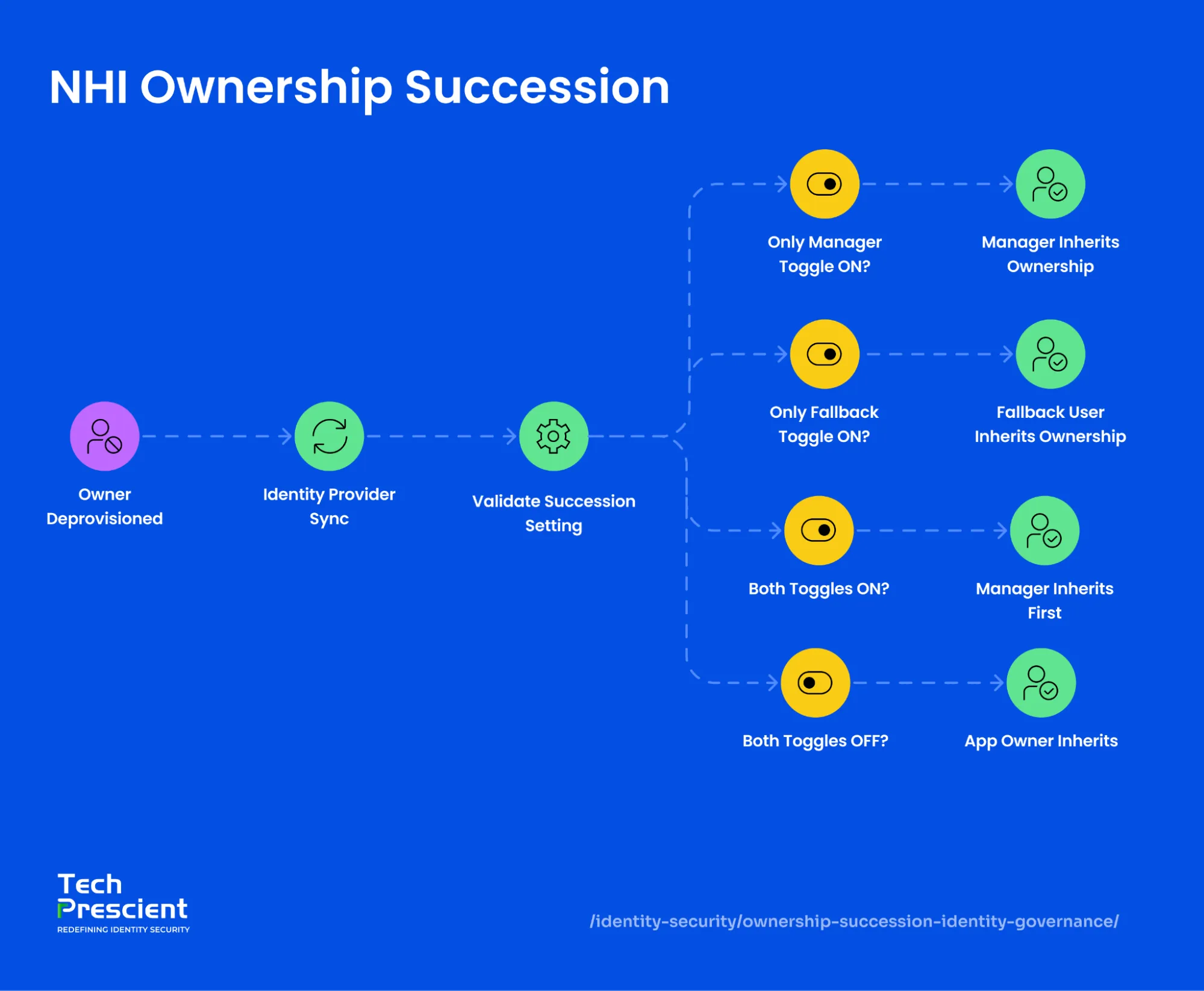
NHI ownership continuity is a structural guarantee in Identity Confluence. Every NHI always has an accountable owner, regardless of how the controls are configured.
How Is Ownership Transferred for Business Roles and Policies?
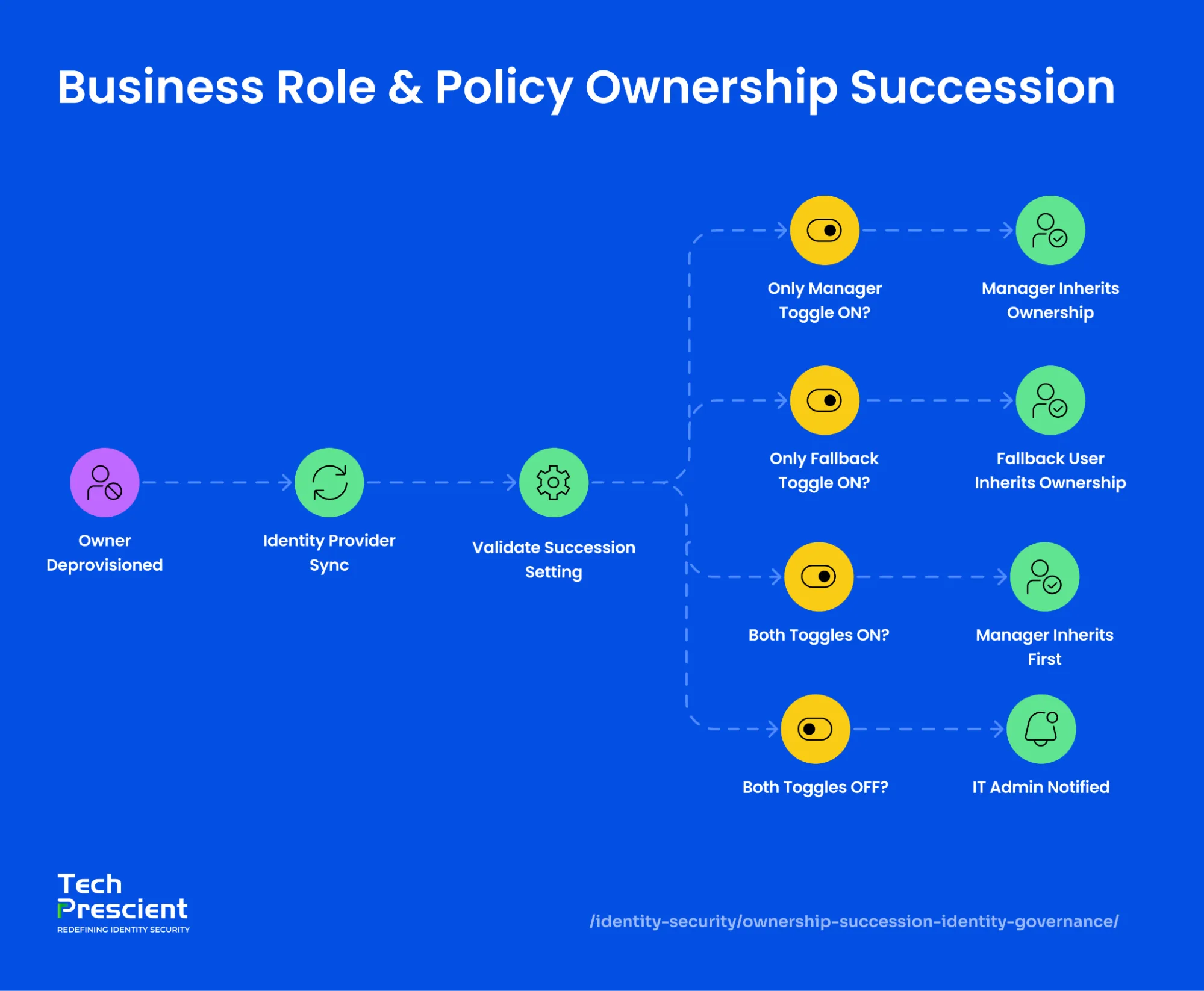
Business role ownership transfer and policy owner succession follow the same two-control logic as NHIs. The one scenario still in development is when both toggles are OFF. Until that fallback is live, Identity Confluence clears the ownership mapping and notifies IT admins for manual reassignment. Ensuring at least one toggle is configured for every Business Role and Policy section removes any dependency on manual intervention.
Ownership succession works as the foundation of that chain. Initiate certification builds on top of it by ensuring the owner now in place formally reviews what they govern on a defined schedule. Policy and business role accessibility ensure that every record has the right visibility and approval structure behind it, so ownership is never just a name on a record but an active, governed responsibility.
The accountability chain should never break because someone changed jobs. Ownership succession is not a convenience feature. It is a compliance control.
What Ownership Succession Actually Changes
Most identity governance ownership failures do not announce themselves. They open quietly the moment someone is deprovisioned, and nobody has a plan for what comes next.
For identity and security teams, certification campaigns no longer stall because an owner left. Audit trails stay clean because every transfer is verified, timestamped, and logged. For compliance teams, the answer to "who owns this" is always current and always traceable. For the business, a personnel change stays a personnel change instead of becoming a governance incident.
Ownership succession does not fill the gap after it opens. It keeps the gap from opening at all.
Want to find where accountability breaks down first?
Evaluate the effectiveness and impact of your ownership governance practices to ensure robust accountability and efficient transitions.
What Comes Next
Ownership succession keeps access governance continuity intact through every personnel change. Once every business role, policy, and NHI has a verified, active owner at all times, governance stays complete through scheduled reviews and structured approval workflows at every stage.
See how Tech Prescient's Identity Confluence keeps ownership continuous, certifications uninterrupted, and audit evidence complete across every departure, every transfer, and every personnel change.
Is your ownership governance audit-ready, or just documented?
See ownership, succession, transfer, and accountability the moment the sync confirms an owner is gone; no ticket, no gap.
FAQs
It is a pre-configured transfer policy that moves ownership of a business role, policy, or non-human identity to a new accountable person the moment the current owner is deprovisioned, disabled, or deleted; automatically, without a ticket.
Identity Confluence checks the manager control first; if it's on, the manager inherits ownership. If off, it checks for a designated fallback user. If both are off, ownership defaults to the owner of the parent application, so an NHI always has an accountable owner.
Transfer activates after the identity provider sync confirms the owner is genuinely gone rather than temporarily disabled. That verification step is what makes each transfer reliable instead of firing on a false signal.
The two-control logic is identical: manager first, then fallback user. The difference appears only when both controls are off. NHIs default to the owner of the parent application, so they always land somewhere. Policies and business roles have their ownership mapping cleared, and IT admins are notified for manual reassignment. Setting at least one control on every section removes the difference entirely.


GET A PERSONALIZED DEMO
See Identity Confluence in Action
“One platform to govern identities, automate access decisions, and prove compliance; across every app, user, and system in your environment.”



Murli Ramsunder
Senior Architect, Vonage