
Centralized Management: Definition, Benefits, and Cybersecurity Role
Last Updated date: September 30, 2025
On this page
See Tech Prescient in Action
Automate access, reduce risk, and stay audit-ready
Centralized management is an operational model where decision-making authority, security controls, and policy enforcement are governed from a single unified system. In cybersecurity, it refers to managing identity, access, network security, and compliance through one consolidated administrative framework.
Within security operations, centralized management brings tools, policies, and workflows into a single control plane. Rather than distributing responsibility across disconnected teams or platforms, this model establishes defined governance and consistent enforcement across networks, endpoints, cloud environments, and applications. The result is improved visibility, measurable oversight, and standardized control execution.
Key advantages include uniform policy enforcement, quicker detection and response to threats, optimized use of resources, and easier compliance with regulations. By breaking down silos, centralized management offers a complete view of an organization's security posture and enables more coordinated, effective actions when responding to incidents.
According to IBM's Cost of a Data Breach Report 2025, organizations with fully centralized identity management cut breach lifecycle costs by 28% compared to fragmented systems. This shows why centralized management is essential for both strong cybersecurity and efficient operations. Let's explore more in this blog.
Key Takeaways:
- Centralized management consolidates decision authority to ensure consistent policy enforcement and oversight.
- It improves efficiency and accountability but may reduce local autonomy and adaptability.
- Common implementations include centralized identity and access management (IAM) architectures and unified security control platforms.
- Compared to decentralized models, it prioritizes control and standardization over flexibility.
- In cybersecurity, centralized management strengthens visibility, compliance alignment, and enterprise-wide risk reduction.
What Is Centralized Management?
Centralized management is the practice of overseeing security operations, access controls, and infrastructure policies through a single governing authority or platform, ensuring consistency and visibility across the organization.
In practice, centralized management consolidates security tools, procedures, and monitoring systems into a unified administrative framework. This approach eliminates fragmented ownership across departments and replaces it with defined governance and coordinated execution. Within a centralized management system (CMS), administrators plan, assess, implement, authorize, and continuously monitor security controls across the organization from a single operational layer.
Quick Check
Can you view identity, access, and security logs from one console, and revoke access instantly when someone leaves? If not, your centralized management may still be fragmented.
Why Centralized Management Is Necessary
Centralized management has become essential for modern organizations because it consolidates security oversight into a single framework. By unifying visibility, documentation, and compliance, it reduces miscommunication and eliminates unnecessary redundancies. At the same time, it lightens the burden on critical infrastructure like firewalls, making security operations more efficient and reliable. Key benefits include:

Gain more visibility
Centralized management provides all teams with a unified view of network operations, allowing them to monitor the impact of their work and respond effectively to issues.
Comprehensive activity logging
A CMS maintains structured logs of system events and anomalies, supporting root cause analysis, forensic investigation, and continuous control validation.
Reduced firewall and infrastructure overhead
Managing policies and security functions through a centralized server reduces configuration sprawl, streamlines rule management, and minimizes unnecessary processing load on perimeter controls.
Ensure compliance
Centralized management streamlines adherence to compliance standards, controls data access, enforces uniform security policies, and makes audits faster and more efficient.
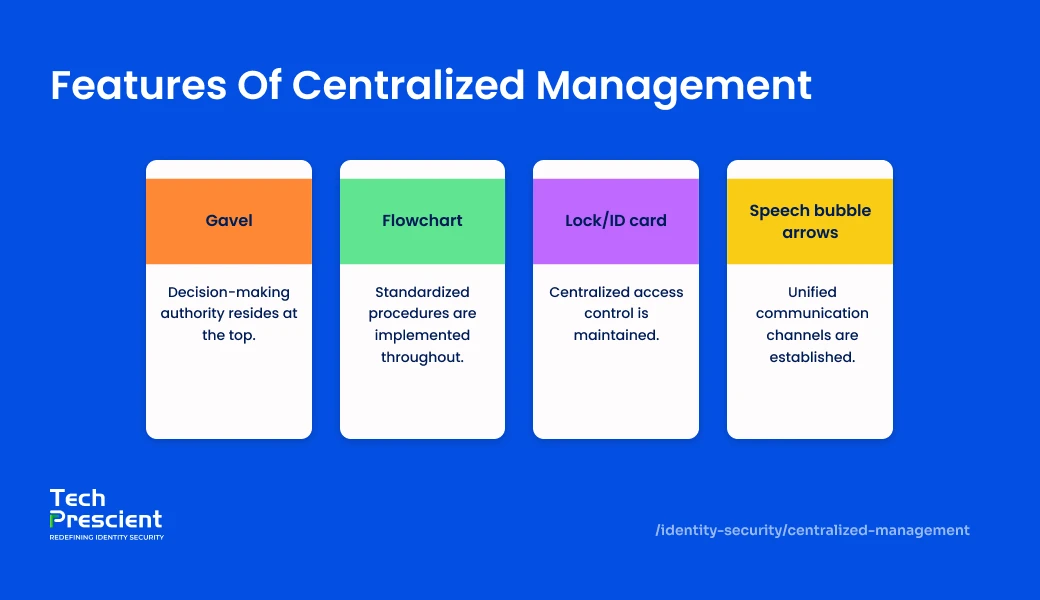
Key Features of Centralized Management
Centralized management is defined by unified authority, standardized execution, and consolidated identity governance. It prioritizes control, consistency, and measurable oversight across the enterprise.
Top-down decision-making
All strategic and critical decisions are made by top management, while lower-level managers and employees execute these decisions according to directives. This ensures organizational goals are aligned, responses to issues are swift, and accountability is clear at every level.
Standardized procedures across the organization
Policies, processes, and workflows are uniform across departments, locations, and teams. Employees are expected to follow these standardized procedures, and changes or deviations require approval from upper management, reducing operational inconsistencies and security risks.
Centralized identity & access administration
A core aspect of centralized management is centralized identity and access administration. With this approach, identity management systems, access controls, and user permissions are governed from a central point, ensuring that all users follow strict role-based access policies. By implementing centralized access control, organizations can prevent unauthorized access, protect sensitive data, and streamline security operations. Centralized security management also simplifies compliance audits, giving teams a clear view of who has access to what and helping maintain regulatory adherence across the enterprise.
Unified communication flow
Centralized management also relies on a unified communication flow, where updates, directives, and security protocols are communicated from the executive level down to all teams. This structured top-down approach ensures everyone receives the same information, reducing misunderstandings and supporting consistent policy implementation. In cybersecurity, this unified flow reinforces centralized security management by keeping employees informed about organizational updates, security guidelines, and compliance requirements. By combining centralized communication with centralized identity management, organizations can maintain a cohesive, secure, and well-informed workforce.
Advantages of Centralized Management
The primary advantage of centralized management is enforceable control. It enables consistent policy execution, coordinated oversight, and strategic alignment across business and security operations.
Consistency in decision-making
Centralized governance ensures that policies, security standards, and operational objectives are uniformly applied. This consistency reduces ambiguity and clarifies roles, responsibilities, and expected outcomes.
Strong oversight & accountability
Centralized management enables senior leadership to monitor operations, policies, and compliance effectively. By maintaining control over critical processes, management can quickly identify issues, enforce standards, and ensure accountability at every level, improving overall performance and operational quality.
Efficient resource allocation
A centralized operational view enables leadership to allocate personnel, budget, and technology based on enterprise-wide priorities. This reduces redundant tooling, limits overlap, and improves cost efficiency.
Clear strategic direction
By concentrating authority at the top, centralized management provides a unified vision and clearly defined organizational goals. This ensures that all departments work toward the same objectives, enabling coordinated efforts, faster decision-making, and improved long-term results.
Disadvantages of Centralized Management
While centralized management strengthens oversight and policy consistency, it can constrain adaptability if governance is not supported by automation and clearly defined delegation models.
Understanding these limitations is critical to implementing centralized control without introducing operational friction.
Slower response times
Centralized decision-making can delay reactions to changing market conditions or urgent operational issues because most decisions require approval from top management. This slower responsiveness can impact customer satisfaction, operational efficiency, and the organization's ability to adapt quickly.
Risk of delays
Concentrating critical decisions with a few leaders creates potential slowdowns in workflow and project execution. When approvals or instructions are delayed, productivity can suffer, and teams may be unable to act promptly on important tasks.
Limited employee autonomy
Employees in centralized organizations generally have minimal decision-making authority, which can reduce motivation and limit opportunities for innovation. Lack of empowerment may prevent staff from contributing creative solutions or responding independently to local challenges.
Overload on leadership
Senior management is responsible for most strategic planning, approvals, and policy enforcement, which can lead to excessive workload and burnout. This strain can reduce leadership effectiveness, slow decision-making, and increase the risk of errors in critical organizational processes. Even centralized models fail when access sprawl goes unchecked.
Are Your Access Reviews Defensible During an Audit?
Centralized visibility improves control, but without structured UARs, compliance gaps increase.
Examples of Centralized Management in Action
Centralized management models operate across business structures and cybersecurity architectures. The common denominator is consolidated authority paired with standardized execution.
Small businesses (owner-led decisions)
In many small businesses, the owner or founder retains full control over strategic and operational decisions. This centralized approach ensures that policies, procedures, and business strategies are consistently applied, enabling quick alignment across staffing, service delivery, and customer experience while maintaining accountability.
Tech companies (Apple's historic model)
Apple has historically operated with a centralized management structure, where all major product, design, and strategic decisions are made by top leadership at the headquarters. This model guarantees uniform quality standards, cohesive product development, and consistent global implementation of business strategies, maintaining brand integrity and operational efficiency.
Cybersecurity: centralized identity & access management systems
Global enterprises often deploy centralized identity and access management (IAM) systems to handle thousands of employees, contractors, and partners across multiple regions. From a single hub, IT teams can assign user permissions, enforce authentication, and monitor activity consistently across all platforms. For instance, financial institutions use IAM to meet strict compliance requirements, reduce insider threats, and quickly revoke access when employees leave. This demonstrates how centralized management strengthens both security and operational control.
Centralized vs. Decentralized Management
Centralized and decentralized management differ in decision-making, authority distribution, and team operations. Knowing their differences helps choose the structure best suited for an organization's goals and size.
Centralized management prioritizes control, compliance, and consistency, while decentralized management emphasizes flexibility and localized decision-making. The table below highlights their structural and operational differences.
| Sr No | Feature | Centralized Management | Decentralized Management |
|---|---|---|---|
| 1 | Decision Authority | Authority and strategic decisions are concentrated at the top leadership levels, ensuring consistency and control. | Decision-making is distributed across departments and managerial levels, allowing teams to act independently. |
| 2 | Decision Speed | Decisions may take longer due to multiple layers of approval and top-level oversight. | Decisions are typically faster as local managers or teams can respond immediately without waiting for top-level approval. |
| 3 | Organizational Flexibility | Limited flexibility since most decisions must be approved by senior leadership, reducing adaptability. | Highly flexible as decision-making occurs at multiple levels, enabling quicker adjustments to changing circumstances. |
| 4 | Responsibility & Accountability | Transparent accountability, as a few leaders are responsible for key organizational decisions. | Accountability can be more diffuse because decision-making authority is spread across various managers and departments. |
| 5 | Employee Empowerment | Employees have limited authority and decision-making power, following directives from higher management. | Employees enjoy greater autonomy, making decisions and taking action based on their expertise, role, and seniority. |
| 6 | Ideal Organization Size | Best suited for small to medium-sized organizations where top management can maintain control and oversight. | Works well in larger organizations that need agility and local decision-making to respond quickly to changes and operational needs. |
Cybersecurity & Centralized Security Management
Centralized security management consolidates firewalls, identity systems, access governance tools, and monitoring platforms into a single administrative console. This unified approach reduces misconfigurations, improves policy enforcement, and strengthens identity security across hybrid and cloud environments.
Role in Cybersecurity
Centralized security management relies on unified consoles that integrate firewalls, Identity & Access Management (IAM) systems, and Identity Governance & Administration (IGA) platforms. This approach enables administrators to plan, implement, and monitor all security controls from a single interface, reducing the risk of misconfigurations and improving response times to security incidents.
Benefits
Centralized security management improves how organizations monitor, enforce, and respond to cybersecurity challenges, offering advantages such as:
Enhanced visibility
A centralized security framework provides a unified view across the entire network, including endpoints and user activities. This visibility enables security teams to detect anomalies, identify potential threats early, and consistently monitor compliance across all systems.
Regulatory compliance
By consolidating security controls into a single console, organizations can more easily comply with regulations such as GDPR, HIPAA, and PCI DSS. Centralized management supports unified policy enforcement, maintains comprehensive audit trails, and simplifies the generation of compliance reports.
Reduced complexity
Centralized management brings together critical security functions such as firewalls, Identity and Access Management (IAM), and Identity Governance and Administration (IGA) into one cohesive framework. This reduces tool redundancy, streamlines operational processes, and accelerates incident response.

Pro Tip
Centralize policy definition, not operational control. Use automation and delegated administration to prevent leadership bottlenecks while maintaining unified governance.
Identity-Centric Security Architecture Perspective
From an identity security standpoint, centralized management becomes a structural requirement as organizations scale across SaaS platforms, multi-cloud environments, and distributed workforces. Without centralized identity governance, access controls fragment across systems, increasing the likelihood of privilege accumulation, orphaned accounts, inconsistent policy enforcement, and audit exposure.
Centralized identity architecture consolidates visibility across authentication systems, entitlement stores, and policy engines. By integrating identity and access management (IAM) for authentication and access provisioning with identity governance and administration (IGA) for lifecycle control, entitlement review, and policy enforcement, organizations establish continuous oversight rather than point-in-time access approval.
In this model, access is not only provisioned efficiently but continuously validated against role definitions, risk signals, and compliance requirements. Governance becomes enforceable, measurable, and auditable across cloud and on-premises systems.
When Should Organizations Use Centralized Management?
Organizations should adopt centralized management when regulatory compliance, identity governance, and risk reduction are strategic priorities. It is particularly effective in environments where access control, audit readiness, and consistent policy enforcement are non-negotiable.
Where centralized management fits best:
Regulated industries
Sectors such as finance, healthcare, and government must follow strict compliance rules. A centralized model makes it easier to enforce the same policies everywhere and stay audit-ready.
Scaling cybersecurity programs
As companies grow, having multiple disconnected systems can create security gaps. Centralized management works with IAM and IGA tools to standardize access, improve visibility, and reduce complexity.
Organizations handling sensitive data
Businesses in areas like banking, insurance, and defense deal with highly confidential information. Centralized control allows faster incident response and tighter protection of critical assets.
Global and distributed teams
Companies with offices or employees in different locations often face inconsistent local practices. Centralization ensures a single framework for access, communication, and compliance across all regions.
Is Centralized Management Still Relevant in Cloud-First and Zero Trust Environments?
Centralized management remains essential in cloud-first and Zero Trust architectures, but its function has shifted from infrastructure control to identity-centric governance.
As organizations adopt SaaS applications, multi-cloud infrastructure, and distributed workforce models, traditional perimeter-based control models become insufficient. Governance must move closer to identity, access policy, and continuous verification mechanisms.
Within a Zero Trust framework:
- Access decisions are continuously evaluated based on identity, context, and risk signals.
- Identity functions as the primary control plane rather than network location.
- Policies must be enforced uniformly across distributed systems, endpoints, and cloud services.
In this model, centralized management does not mean centralized infrastructure. It means centralized visibility, policy definition, and governance enforcement across decentralized environments.
Centralized identity and access governance platforms provide:
- Consolidated entitlement visibility across cloud and on-premises systems
- Automated provisioning and deprovisioning workflows
- Continuous policy validation and enforcement
- Auditable control evidence for regulatory alignment
This structure enables Zero Trust enforcement without introducing operational friction.
Centralized governance supports:
- Just-in-Time (JIT) access provisioning
- Continuous access certification and review cycles
- Segregation of duties (SoD) enforcement
- Real-time compliance monitoring and reporting
Zero Trust does not eliminate centralized management. It redefines it. Control shifts from network boundaries to identity governance layers, where policy consistency, automation, and continuous validation determine security effectiveness.
Final Thoughts
Centralized management is a strategic approach that drives consistency, efficiency, and strong oversight across the organization. By concentrating decision-making at the top, businesses can align processes, streamline resources, and maintain control. While it may limit flexibility, it's ideal for industries where compliance, accountability, and security matter most.
In cybersecurity, centralized management strengthens identity and access governance, ensures consistent policy enforcement, and reduces risk. Tech Prescient helps businesses leverage these frameworks with expert guidance and automation-driven solutions.
FAQs
Centralized management is an organizational model where decision-making authority and operational control are concentrated at the top level or within a single governing system. It ensures consistent policies, clear oversight, and structured execution across all departments or security platforms.
Centralized management provides consistent policies, stronger oversight, and clear strategic direction. It also helps allocate resources efficiently and maintain alignment across departments. Overall, it brings structure and predictability to organizational operations.
While it strengthens control, centralized management can slow adaptability and create potential bottlenecks. It may also limit employee autonomy and overburden leadership with decision-making. These trade-offs need to be considered for fast-moving environments.
In cybersecurity, centralized management means handling identity systems, access controls, firewalls, and compliance monitoring through a unified console. This improves visibility, strengthens governance, and reduces the risk of misconfigured or excessive user access.
Centralized management keeps authority at the top, while decentralized management spreads decision-making across multiple levels. Centralization prioritizes control and consistency, whereas decentralization favors flexibility and faster responses. Both have unique advantages depending on business needs.


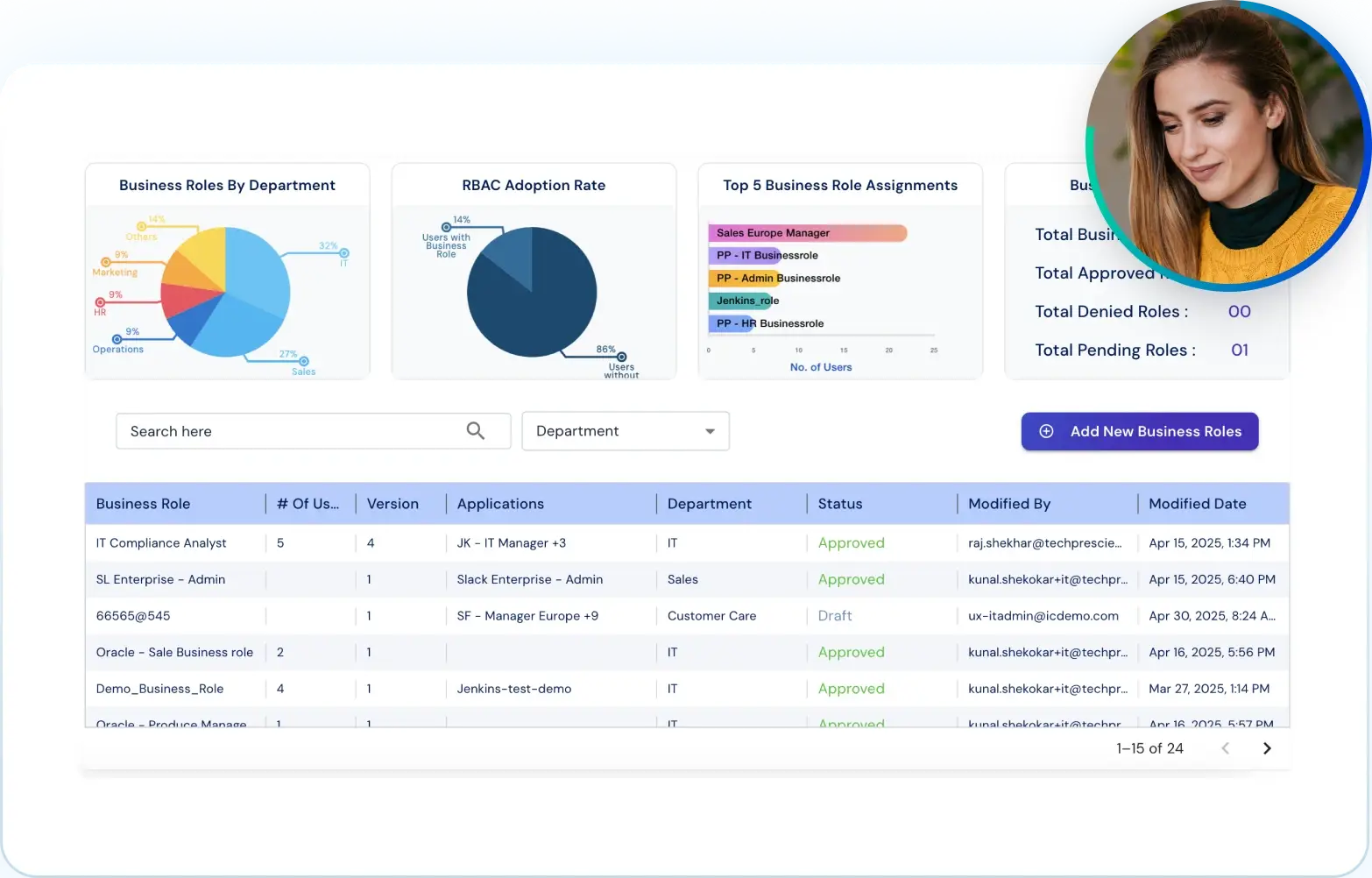
GET A PERSONALIZED DEMO
See Identity Confluence in Action
“One platform to govern identities, automate access decisions, and prove compliance; across every app, user, and system in your environment.”



Murli Ramsunder
Senior Architect, Vonage