
Use Cases of Identity Governance and Administration (IGA)
Last Updated date: July 13, 2026
On this page
See Tech Prescient in Action
Automate access, reduce risk, and stay audit-ready
Identity governance use cases define how organizations automate access control, enforce segregation of duties, and maintain audit-ready compliance across hybrid IT environments. Modern IGA platforms help enterprises manage identity lifecycle visibility, access reviews, and least-privilege policies at scale.
Managing who can access what across an organization should not depend on manual effort, fragmented tools, or prolonged spreadsheet-based reviews. Yet many enterprises still rely on disconnected processes and reactive audits to govern access.
Identity Governance and Administration (IGA) helps organizations automate access decisions, enforce least-privilege policies, and stay continuously audit-ready across hybrid IT environments. In 2026, modern IGA platforms go beyond basic identity management, adding intelligence, policy enforcement, and real-time visibility into who has access, why they have it, and whether that access is still appropriate.
This guide covers the most critical identity governance use cases enterprises rely on today, and explains how these use cases map to the capabilities you should expect from a modern IGA platform.
Key Takeaways:
- IGA transforms reactive identity management into proactive governance
- Ten proven use cases solve your most pressing operational challenges
- Strategic implementation beats big-bang deployment
- Different stakeholders solve different problems with IGA
What Are IGA Use Cases and Why Do They Matter?
Identity governance use cases explain how organizations apply IGA platforms to automate user provisioning, enforce segregation of duties (SoD), manage access certifications, and generate audit-ready compliance reports. These use cases reveal whether a platform can truly support hybrid, multi-cloud, and regulated environments.
For buyers evaluating identity governance solutions, use cases provide a practical lens to assess platforms: Can they automate access reviews at scale? Do they enforce segregation of duties? Can they produce audit-ready reports on demand?
Organizations with mature IGA programs consistently reduce audit effort, improve onboarding speed, and lower access-related risk, making use cases a critical input when selecting the right IGA platform.
Expert Insight:
Start with a baseline access risk assessment before selecting use cases. Quantifying orphaned accounts, excessive privileges, and audit findings helps prioritize high-impact governance controls first.
In practical terms, these capabilities directly affect how different teams operate day to day.
For Compliance Teams: Auditors ask who accessed financial systems last quarter. Instead of spending weeks pulling logs from different systems and reconciling spreadsheets, teams can generate standardized audit reports on demand with complete supporting evidence.
For IT Directors: A new marketing manager joins on Monday morning. Without IGA, your team spends the day creating accounts, assigning permissions, and handling access tickets. With IGA, the HRIS entry triggers automatic provisioning workflows, allowing the manager to begin work with the appropriate access in place from day one.
For Security Teams: An employee leaves on Friday afternoon. Without IGA, their accounts might sit dormant for weeks until someone remembers to disable them. With IGA, HRIS-driven termination events trigger automated deprovisioning workflows across connected systems, significantly reducing exposure from dormant accounts.
For HR Operations: Role changes don't require email chains coordinating with IT to update permissions. The HRIS update automatically adjusts access to match the new position.
By 2026, many modern IGA platforms began incorporating AI-assisted capabilities to identify access risk, suggest role optimizations, and flag anomalous access patterns earlier in the lifecycle.
Top Use Cases of Identity Governance and Administration
Identity Governance and Administration is not a single feature. It's a collection of tightly connected use cases that together control who gets access, when they get it, and why. Below are the most common and high-impact IGA use cases organizations rely on to improve security, reduce manual work, and stay audit-ready.
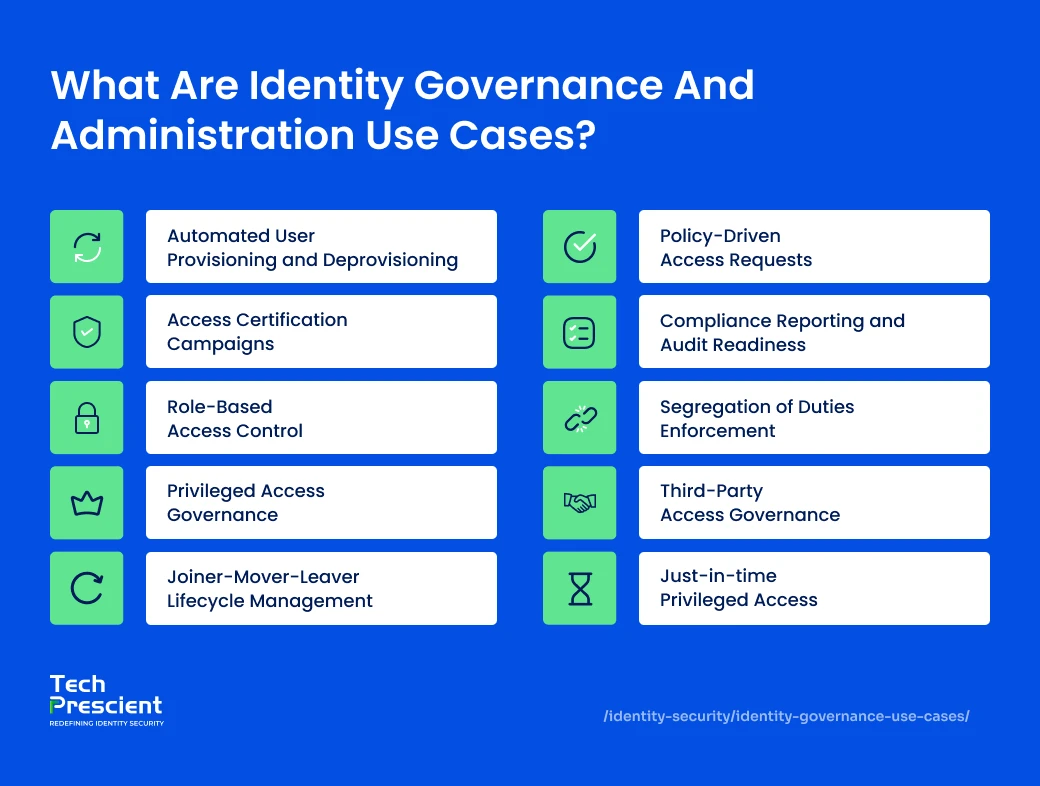
Automated User Provisioning and Deprovisioning
The Problem: New employees wait days for system access because IT manually processes each account creation. When employees leave, their accounts often remain active for weeks, creating security vulnerabilities.
How IGA Solves It: The IGA platform connects to your HRIS (like Workday or BambooHR). When HR adds a new employee, the system automatically creates accounts across all connected applications. When HR marks someone as terminated, access is removed across connected systems in a controlled, automated manner aligned with organizational policy.
Benefit: Secure onboarding and offboarding without manual coordination.
Example: Your HR team adds a new sales representative to Workday on Friday. By Monday morning, they have email, CRM access, document storage permissions, and accounts for collaboration tools ready to go. No IT tickets required.
When they leave six months later, the HRIS status change triggers instant deprovisioning. Their email forwards to their manager, files are transferred to the team, and all system access terminates within minutes.
What Identity Confluence Provides: Pre-built connectors to 250+ applications, including cloud and on-premises systems. HRIS integration with major platforms. Automated workflows for both provisioning and deprovisioning.
Access Certification Campaigns
The Problem: Compliance frameworks like SOX and HIPAA require quarterly access reviews. Managers receive spreadsheets with hundreds of user permissions they don't understand. Reviews take weeks. Evidence collection for auditors is a nightmare.
How IGA Solves It: Access certification campaigns automate the entire process. The system shows managers their team members with current access across all systems. Managers click to approve or revoke. The platform documents everything with timestamps and creates audit-ready reports.
Benefit: Audit readiness plus compliance without the spreadsheet chaos.
Example: Every quarter, your finance system requires access review. The IGA platform sends each manager a simple review showing their direct reports' financial system access. Managers see who has access, when they last used it, and whether it's appropriate for their role. They approve or deny with one click. The system automatically revokes denied access and generates the compliance report auditors need.
What Identity Confluence Provides: Automated certification campaigns with customizable schedules. Manager-friendly review interfaces that translate technical permissions into plain language. Complete audit trails with evidence packaging.
Role-Based Access Control (RBAC)
The Problem: Managing individual permissions across multiple applications is administrative chaos. Users accumulate permissions over time. New hires require extensive manual configuration. IT can't keep up.
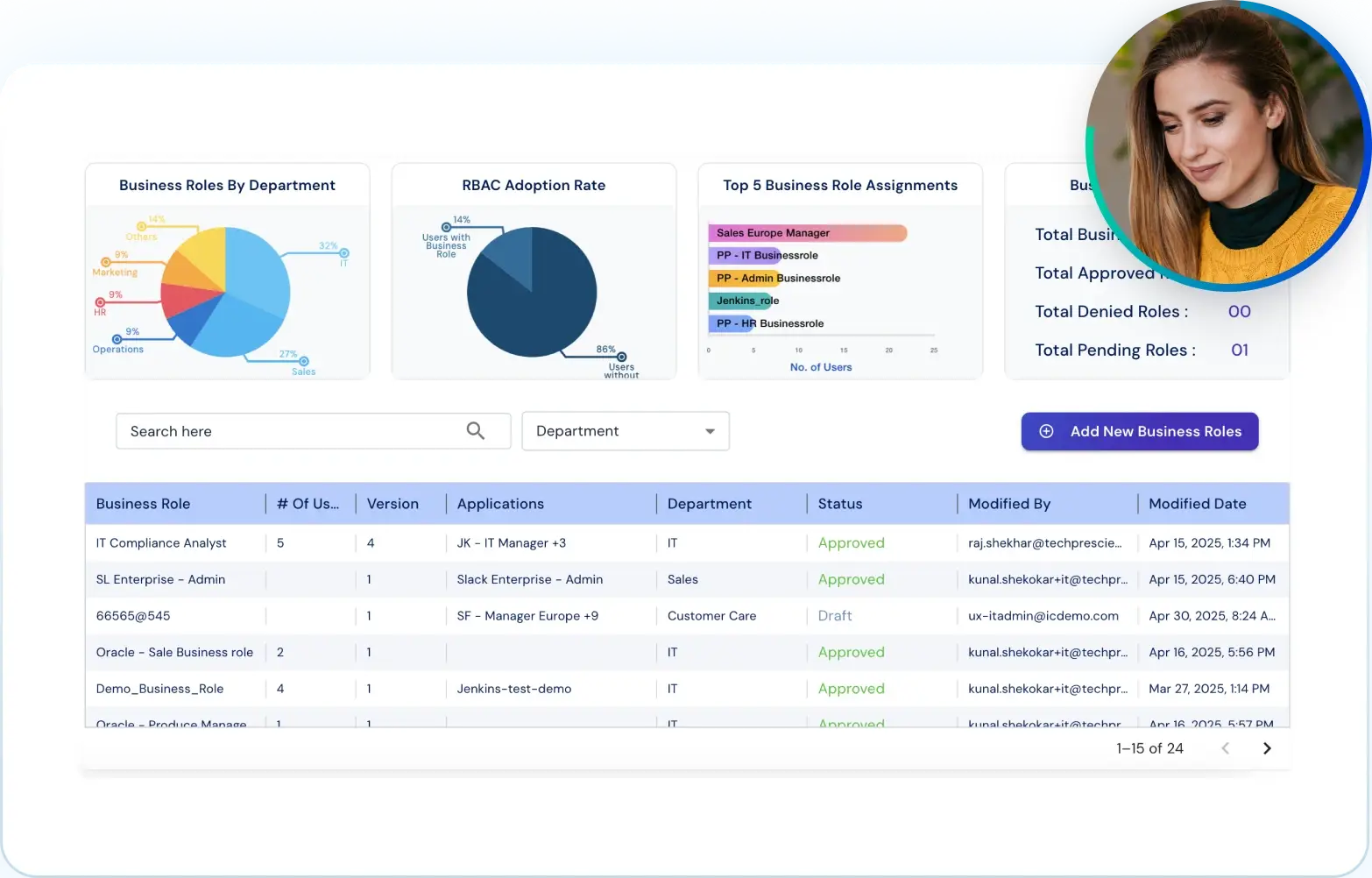
How IGA Solves It: RBAC defines standard roles based on job function. "Sales Representative" gets a specific set of permissions across all systems. Assign someone the role, and they automatically receive all necessary access. Change roles, and permissions update automatically.
Benefit: Consistent access per department and role with minimal IT involvement.
Example: Your company has 50 sales representatives. Instead of manually configuring CRM access, document permissions, and tool access for each person, you create a "Sales Representative" role once. Assign new sales hires to this role, and they instantly receive all necessary permissions. If someone moves to sales management, you change their role, and the system adjusts their access automatically.
What Identity Confluence Provides: Visual role designer for creating and managing roles. Role mining that analyzes existing access patterns to suggest optimal role structures. Automated permission assignment based on role membership.
Privileged Access Governance
The Problem: Administrative accounts with elevated privileges are prime targets for attackers. Permanent admin rights create persistent security risks. But you need admin access for legitimate operational tasks.
How IGA Solves It: Privileged access governance enforces approval requirements and time limits on elevated access. Users request admin rights with business justification. If approved, they receive temporary credentials that automatically expire after the task completes.
Benefit: Control and monitor admin-level access without blocking legitimate work.
Example: A database administrator needs elevated access to troubleshoot a production issue. They submit a request explaining the problem. Their manager approves. The system grants 4-hour database admin access. All actions are logged. At the 4-hour mark, credentials automatically expire. The audit log shows exactly what they did during that window.
What Identity Confluence Provides:
- Structured request and approval flows for privileged access
- Temporary credential access with automatic expiry controls
- Privileged session tracking and recording, natively or through integrations
- End-to-end audit logs with compliance-ready evidence
Joiner-Mover-Leaver (JML) Lifecycle Management
The Problem: Employee lifecycle events trigger complex access changes. New hires need onboarding. Role changes require permission adjustments. Departures need immediate access revocation. Coordinating this across HR, IT, and managers is error-prone.
How IGA Solves It: JML automation synchronizes your HRIS with all connected systems. The identity lifecycle adjusts automatically as employees join, change roles, or leave. HR makes one change in their system, and access updates everywhere.
Benefit: Automatically adapts access as users change roles without manual coordination.
What Identity Confluence Provides: Real-time HRIS synchronization. Automated access recalculation for role changes. Intelligent access suggestions based on peer analysis. Complete lifecycle documentation.
Example: An IT Manager is promoted to Operations Director. HR updates their role in Workday. Identity Confluence automatically:
- Detects the role change in real time
- Compares access with peers in the same role
- Recommends what to add (operations dashboards, facilities systems)
- Recommends what to remove (legacy IT admin tools)
- Sends a fast-track approval to the new manager
- Applies approved changes across all systems within minutes
What Identity Confluence Delivers:
- Real-time HRIS sync with platforms like Workday and BambooHR
- Automatic access recalculation for every joiner, mover, and leaver event
- AI-driven peer-based access recommendations
- Complete, tamper-proof JML records and audit trails
By this stage, most organizations realize they support some IGA use cases, but not all of them consistently or at scale.
Assess which identity governance use cases you support today, where enforcement gaps exist, and which areas create the highest compliance or security risk.
See how your IGA use cases perform in the real world.
Our 5-minute scorecard reveals enforcement gaps, governance weaknesses, and the highest-priority risks to address first.
Policy-Driven Access Requests and Approvals
The Problem: Every access request becomes an IT ticket. Users don't know what to request. IT doesn't know what's appropriate. Managers lack context to approve intelligently. Request fulfillment becomes inconsistent and difficult to scale.
How IGA Solves It: Self-service access catalog shows users what they can request based on their role. Low-risk requests auto-approve based on policies. Higher-risk requests route to appropriate approvers with context. Users get access faster, and IT handles fewer tickets.
Benefit: Faster access with fewer IT tickets.
Example: A sales team member needs CRM access. They log into the self-service portal and see "Sales CRM" as an available request. The system knows this is appropriate for their role and auto-approves instantly. The CRM access provisions automatically. No IT ticket or manager approval needed. But when they request financial system access, the system recognizes this as unusual for their role and routes it to their manager for review.
What Identity Confluence Provides:
- User-role-specific self-service access catalog
- For auto-approval rules (birthright, SoD, compliance), an intelligent policy engine
- Workflows for multi-level approval of sensitive or unusual requests
- Complete records and audit trails for each request and choice
Compliance Reporting and Audit Readiness
The Problem: Preparing for audits takes months. You pull logs from dozens of systems, correlate access data with approval records, and format everything for auditors. It's manual, time-consuming, and error-prone.
How IGA Solves It: Compliance reporting collects evidence continuously from all connected systems. Pre-built templates map to compliance frameworks like SOX, HIPAA, and GDPR. Click to generate audit reports showing who has access to what, when it was granted, who approved it, and when it was last reviewed.
Benefit: Generate real-time reports for SOX, GDPR, HIPAA, and other frameworks.
Example: Your external auditors arrive for the annual SOX audit. They ask for evidence of financial system access controls. Instead of scrambling to collect data, you log into the IGA platform and generate the SOX compliance report. It shows all users with financial system access, their roles, when access was granted, quarterly certification records with manager attestations, and automatic deprovisioning of terminated employees. The report is generated on demand with complete supporting documentation.
What Identity Confluence Provides:
- Pre-configured templates for SOX, HIPAA, GDPR, PCI-DSS, and ISO 27001
- Real-time compliance dashboards for ongoing monitoring
- One-click audit report generation
- Complete evidence packages with timestamps, approvals, and export-ready formats

Pro Tip
Auditors evaluate evidence, not intent. Platforms that cannot show who approved access, why it was granted, and when it was last reviewed introduce audit risk, even when controls exist.
Segregation of Duties (SoD) Enforcement
The Problem: Certain access combinations enable fraud. Someone who can both create vendors and approve payments could create fake vendors and authorize fraudulent payments. Manually detecting these toxic combinations across multiple systems is nearly impossible.
How IGA Solves It: SoD enforcement uses predefined rules to detect conflicting permissions. When someone's access would create a conflict, the system blocks it and requires a security review. Continuous monitoring identifies existing violations for remediation.
Benefit: Enforces policy-level access boundaries, reduces risk of internal fraud, and simplifies audits with automatic SoD violation reports.
Example: In your finance department, the system includes an SoD rule stating that users cannot have both "Vendor Creation" and "Payment Approval" permissions in the ERP system. When you try to assign the Accounts Payable role to someone who already has the Vendor Management role, the system blocks the assignment and alerts security. This prevents the toxic combination before it creates an audit finding or enables fraud.
What Identity Confluence Provides: Pre-built SoD rule library for common scenarios. Cross-system conflict detection. Preventive controls that block dangerous combinations. Exception management with business justification tracking.
Third-Party Vendor Access Governance
The Problem: Contractors, consultants, and vendors need temporary access to your systems. Their accounts often remain active long after contracts end. You lack visibility into what external users are accessing.
How IGA Solves It: Third-party access governance ties vendor access to contract dates. Access provisions when contracts start and automatically revoke when they end. You track exactly what external users access and for how long.
Benefit: Ensures time-bound, least-privilege access, prevents long-term orphan accounts, and tracks usage for accountability.
Example: A marketing agency contractor needs access to your analytics platform for a 30-day campaign project. You grant access when the contract starts, setting the expiration date to match the contract end. The contractor accesses only the analytics tool, nothing else. After 30 days, access automatically revokes. The system generates a report showing exactly what they accessed during those 30 days for your records.
What Identity Confluence Provides: Contract-based access expiration. Time-bound access grants with automatic revocation. Vendor activity monitoring and reporting. Integration with contract management systems.
Just-In-Time (JIT) Privileged Access
The Problem: Permanent admin rights create 24/7 security risks. But you need admin access for legitimate operational tasks like troubleshooting, maintenance, and emergency response.
How IGA Solves It: Just-in-time privileged access eliminates permanent admin accounts. Users request elevated access when needed. If approved, they receive temporary admin credentials that automatically expire after task completion. Every privileged session is monitored and recorded.
Benefit: Eliminates standing admin rights, reduces attack surface, and enables session monitoring and recording.
Example: A DevOps engineer needs root access to a production server to apply a critical security patch. They submit a request explaining the need. Their manager approves. The system grants 2-hour root access. The engineer applies the patch. All commands are logged. At the 2-hour mark, the credentials automatically expire. The security team has a complete record of what happened during that privileged session.
What Identity Confluence Provides: Approval workflows for JIT access requests. Temporary credential provisioning with automatic expiration. Session recording and command logging. Risk-based access decisions with policy enforcement.
By this stage, most organizations realize they support some IGA use cases, but not all of them consistently or at scale.
Assess which identity governance use cases you support today, where enforcement gaps exist, and which areas create the highest compliance or security risk.
See how your IGA use cases perform in the real world.
Our 5-minute scorecard reveals enforcement gaps, governance weaknesses, and the highest-priority risks to address first.
Key Features of Modern IGA Platforms (2026)
Modern Identity Governance and Administration (IGA) platforms extend beyond foundational identity management. They integrate automation, policy enforcement, analytics, and compliance reporting into a unified governance framework.
Core Capabilities to Look For
- Automated provisioning and deprovisioning
- Access certification automation
- Segregation of Duties (SoD) rule engine
- Role-Based Access Control (RBAC) with role mining
- Policy-based access request workflows
- Just-in-Time (JIT) privileged access
- Risk-based analytics
- Pre-built compliance reporting templates
These capabilities provide end-to-end identity lifecycle governance, enforce least-privilege access models, and improve control consistency across hybrid IT environments.
Real-World Application: Use Case in Action
A regional healthcare provider with 3,500 employees faced mounting HIPAA compliance challenges. Manual provisioning delayed new clinical staff from accessing patient systems for 3 days. Access reviews consumed 6 weeks every quarter, with managers struggling with spreadsheets. Auditors consistently flagged incomplete documentation of who accessed protected health information.
They implemented IGA, focusing on three priorities: automated provisioning, access certification, and compliance reporting.
Phase 1: Automated Provisioning (Weeks 1-4)
Connected the IGA platform to their HRIS and clinical systems. Defined birthright access for each role (nurses, physicians, and administrative staff). Created automated workflows for onboarding and offboarding.
Result: New hire access provisioning dropped from 3 days to 2 hours. Terminated employee access is now revoked within minutes of the HRIS status change.
Phase 2: Access Certification (Weeks 5-8)
Launched quarterly certification campaigns for all systems containing protected health information. Managers review their team's access through a simple web interface showing who has access to what and when they last used it.
Result: Quarterly certification now completes in 9 days instead of 6 weeks. The system identified and remediated 284 instances of inappropriate access to patient data. All certification decisions are documented with timestamps for HIPAA audit requirements.
Phase 3: Compliance Reporting (Weeks 9-12)
Configured pre-built HIPAA report templates. Set up real-time compliance dashboards showing access patterns, certification status, and policy violations.
Result: Audit preparation time dropped from 6 weeks to 3 days. External auditors received complete evidence packages documenting access controls. No access-related audit findings were identified in the first post-implementation review.
Measurable Outcomes After 90 Days:
- New hire productivity gained: 2.5 days per employee
- IT ticket volume: Reduced 68%
- Audit preparation time: 96% reduction
- Compliance confidence: Zero HIPAA findings
Mapping IGA Use Cases to the Right IGA Platform Capabilities
Not all identity governance platforms support every use case equally. Understanding how use cases align with platform capabilities helps organizations choose solutions that fit their compliance needs, security posture, and scale.
Compliance-Driven Organizations (SOX, HIPAA, GDPR) look for platforms strong in:
- Access certification automation
- Segregation of duties enforcement
- Pre-built compliance reporting templates
Large Enterprises & Hybrid IT Environments prioritize:
- Scalable provisioning and deprovisioning
- Role-based access control with role mining
- Hybrid cloud and on-prem integration support
Security-Focused Teams evaluate support for:
- Privileged access governance
- Just-in-time access workflows
- Continuous access risk monitoring
Fast-Growing Organizations focus on:
- HRIS-driven joiner-mover-leaver automation
- Policy-based access approvals
- Minimal setup time and pre-built connectors
This mapping is often where organizations identify gaps between basic identity management tools and full-featured IGA platforms.
How to Identify the Right IGA Use Cases for Your Organization
Don't try to implement all ten use cases at once. Start with your biggest pain point, prove value, then expand.
Audit Current Access Challenges
Ask your teams these questions:
- IT Operations: How many hours per week do you spend processing access requests? How long does new hire provisioning take? How many orphaned accounts exist from former employees?
- Compliance: How long does audit preparation take? How many audit findings relate to access controls? Can you prove who accessed sensitive data last quarter?
- Security: How many accounts have permanent admin rights? Can you identify all users with access to your most sensitive systems? How quickly can you revoke access in an emergency?
- Business Units: How often do users complain about access delays? How long after a promotion do permissions actually update?
The answers reveal where IGA delivers immediate value.
Prioritize High-Risk Areas
Match use cases to your organization's profile:
- Regulated Industries (Healthcare, Finance): Start with access certification, compliance reporting, and SoD enforcement. Audit requirements make these mandatory.
- Rapidly Growing Companies: Focus on automated provisioning, RBAC, and JML lifecycle management. Manual processes break as headcount increases.
- Security-Focused Organizations: Implement privileged access governance, JIT access, and vendor access governance to reduce attack surface.
- Complex IT Environments: Deploy RBAC, policy-driven access requests, and SoD enforcement to manage permission sprawl across many applications.
Align Use Cases to Roles (HR, IT, Compliance)
Different stakeholders care about different outcomes:
- CISOs: Want privileged access governance, SoD enforcement, and JIT access to reduce security risk.
- IT Directors: Need automated provisioning, RBAC, and JML lifecycle management to reduce operational burden.
- Compliance Managers: Require access certification, compliance reporting, and policy-driven approvals for audit readiness.
- HRIS Leads: Benefit from JML automation, automated provisioning, and vendor access governance for seamless employee lifecycle management.
Choose Tools That Support Automation and SoD
Organizations comparing vendors should also review the best identity governance platforms for compliance and audit readiness to understand how leading solutions differ in capabilities and scale. Evaluate IGA platforms on these capabilities:
Integration: Does it connect to your HRIS (Workday, SAP, BambooHR)? Can it manage both cloud and on-premises applications? Does it support your critical systems?
Automation: Can workflows run without manual intervention? Does deprovisioning happen automatically? Can certification campaigns schedule themselves?
SoD Support: Does it include pre-built SoD rules? Can it detect conflicts across multiple systems? Does it prevent toxic combinations proactively?
Scalability: Can it handle your current user count and application portfolio? Will it scale as you grow?
Usability: Is the self-service portal intuitive? Can managers certify access without technical training?
Not sure where to begin? Start with your most painful problem. Quick wins build momentum for broader implementation.
Implementing Use Cases with Identity Confluence
Organizations evaluating IGA solutions often start with use cases, then assess which platforms can support them with automation, policy enforcement, and audit-ready reporting. Identity Confluence addresses all ten use cases through a unified platform designed for rapid deployment and measurable results.
Core Capabilities:
Pre-built connectors for 250+ applications spanning cloud, on-premises, and hybrid environments. HRIS integration with Workday, SAP SuccessFactors, BambooHR, and ADP. Support for SCIM, SAML, and OAuth standards. Bidirectional synchronization maintains identity consistency across systems.
Automated provisioning and deprovisioning are synchronized with your HRIS. Role-based access control with visual role designer and role mining. Access certification campaigns with automated workflows and audit-ready evidence. Policy-driven access requests with self-service catalog and approval routing.
Compliance reporting with pre-configured templates for SOX, HIPAA, GDPR, PCI-DSS, and ISO 27001. Segregation of duties enforcement with pre-built conflict rules. Privileged access governance with time-limited credentials and session monitoring. Just-in-time access with approval workflows and automatic expiration.
Understanding IGA use cases is the first step. Seeing how they apply inside your own environment is where real value begins.
Final Thoughts
Identity governance use cases define how organizations move from reactive access management to structured, policy-driven control. By automating provisioning, enforcing segregation of duties, and continuously certifying access, modern IGA platforms reduce operational friction while strengthening compliance and security.
As enterprises scale across hybrid and multi-cloud environments, access complexity increases faster than manual processes can handle. IGA must go beyond basic identity administration by embedding automation, risk intelligence, and audit-ready reporting directly into the identity lifecycle to ensure access remains appropriate over time.
By aligning high-impact use cases with the right platform capabilities, organizations can reduce audit effort, eliminate privilege sprawl, and maintain least-privilege access at scale. To see how Tech Prescient helps operationalize these use cases with automation, policy enforcement, and real-time visibility across hybrid environments, book a demo.
FAQs
IAM (Identity and Access Management) covers authentication (proving who you are) and authorization (what you can access). IGA is the governance layer ensuring access is appropriate, auditable, and compliant. IAM handles login mechanics; IGA ensures those logins should exist.
Quick wins with a single use case take 6-8 weeks. Standard enterprise implementation with multiple use cases typically requires 4-6 months. Complex global deployments need 9-12 months. Phased approaches deliver value faster than attempting everything at once.
Modern IGA platforms support standard protocols (SCIM, SAML, LDAP) and include pre-built connectors for common systems. Custom integrations handle proprietary applications. Most enterprises integrate their critical systems within the first 4-6 weeks.
Three main challenges: integration complexity with hundreds of applications, change management as users and managers adopt new processes, and role design that balances granularity with manageability. Phased rollouts, executive sponsorship, and role mining tools address these challenges.
IGA automates the evidence collection that auditors require. Instead of manually gathering access data across systems, you generate compliance reports showing who has access, when it was granted, who approved it, and when it was last reviewed. Audit preparation drops from months to days.
Start by identifying your highest-impact use cases, such as access certification, privileged access governance, or compliance reporting. Then evaluate platforms based on automation depth, integration with your HRIS and applications, support for segregation of duties, scalability, and audit reporting capabilities.
No. Enterprise-grade IGA platforms must support complex role models, thousands of applications, hybrid IT environments, and regulatory requirements. Smaller tools may work for limited use cases, but often struggle at enterprise scale.
Modern IGA platforms include automated provisioning, access certification campaigns, segregation of duties enforcement, role-based access control, policy-driven approvals, and real-time compliance reporting. Advanced platforms also include AI-based risk analytics and just-in-time privileged access.
Evaluate integration breadth (cloud + on-prem), HRIS synchronization, support for SCIM/SAML, SoD rule engines, automated deprovisioning, and compliance reporting depth. Hybrid-ready IGA platforms must provide centralized visibility across distributed systems.


GET A PERSONALIZED DEMO
See Identity Confluence in Action
“One platform to govern identities, automate access decisions, and prove compliance; across every app, user, and system in your environment.”



Murli Ramsunder
Senior Architect, Vonage