
What Is an IT Governance Framework?
Last Updated date: July 22, 2026
On this page
See Tech Prescient in Action
Automate access, reduce risk, and stay audit-ready
An IT governance framework helps organizations ensure that their IT systems, processes, and decisions support overall business goals. As businesses expand and adopt more cloud services, SaaS tools, and digital platforms, it becomes harder to maintain control, visibility, and consistency across IT environments.
IT governance frameworks bring structure to this complexity by establishing clear policies, responsibilities, and control mechanisms. They guide how IT decisions are made, how risks are managed, and how compliance is maintained, while ensuring technology investments deliver real value. In this blog, we'll break down what an IT governance framework is, why it's important, the core governance domains, popular frameworks like COBIT and ITIL, and the role identity security plays in effective IT governance.
Key Takeaways:
- An IT governance framework connects IT decisions to business priorities and value creation.
- Governance focuses on oversight and decision-making, not day-to-day IT management or operations.
- Strong IT governance reduces risk, improves compliance, and increases transparency at the leadership level.
- Identity and access governance is a foundational component of modern IT governance frameworks.
What is an IT Governance Framework (Definition)
An IT governance framework is a structured way for organizations to manage and control how technology is used. It sets clear guidelines for IT decision-making, accountability, and oversight, ensuring that technology supports business goals, follows regulations, and manages risk effectively. By defining who is responsible for IT decisions and how outcomes are measured, the framework helps organizations use their IT investments securely, efficiently, and in line with business priorities.
Many IT governance frameworks are created by well-known standards bodies and industry organizations such as ISACA and ISO. Each framework takes a slightly different approach, using its own set of principles, processes, and standards, so organizations can choose what best fits their size, industry, and regulatory needs.
- Framework vs Policy: A policy defines specific rules (for example, access controls or data handling), while an IT governance framework defines ownership, enforcement, and how compliance and performance are measured across all policies.
- Governance vs Operations: IT governance is also not the same as day-to-day IT operations. While IT governance sets direction and oversight, what should happen and why, IT management handles day-to-day execution, such as system maintenance and service delivery.
Core Domains of an IT Governance Framework
Most IT governance frameworks are structured around five foundational domains that ensure alignment, accountability, and measurable value from IT investments.
Strategic Alignment
Strategic alignment ensures that IT initiatives directly support enterprise objectives rather than operating independently. Governance mechanisms help prioritize projects, approve investments, and stop initiatives that do not deliver business value.
- Aligns IT strategy with business goals and growth plans
- Ensures technology decisions support measurable business outcomes
- Prevents misaligned or redundant IT initiatives
Value Delivery
Value delivery focuses on ensuring that IT investments deliver expected benefits at an acceptable cost. Governance frameworks define how value is measured, tracked, and reported over time.
- Tracks return on investment (ROI) and total cost of ownership
- Ensures benefits are realized, not just planned
- Improves cost control and resource efficiency
Risk Management
Risk management addresses the identification, assessment, and mitigation of IT-related risks, including cybersecurity, compliance, and operational failures. This domain ensures risks are understood, owned, and managed at the appropriate level.
- Manages cybersecurity, data protection, and compliance risks
- Defines risk tolerance and escalation mechanisms
- Reduces exposure to outages, breaches, and regulatory penalties
Resource Management
Resource management ensures that people, applications, data, and infrastructure are used efficiently and responsibly. Governance helps avoid waste, skills gaps, and overprovisioning.
- Optimizes use of IT staff, systems, and infrastructure
- Prevents underutilized or redundant applications and tools
- Improves capacity planning and vendor management
Performance Measurement
Performance measurement provides visibility into how well IT is delivering against defined goals. Governance frameworks rely on metrics and reporting to support informed decision-making.
- Uses KPIs, metrics, and dashboards to track performance
- Monitors service quality, risk levels, and investment outcomes
- Enables continuous improvement through data-driven reviews
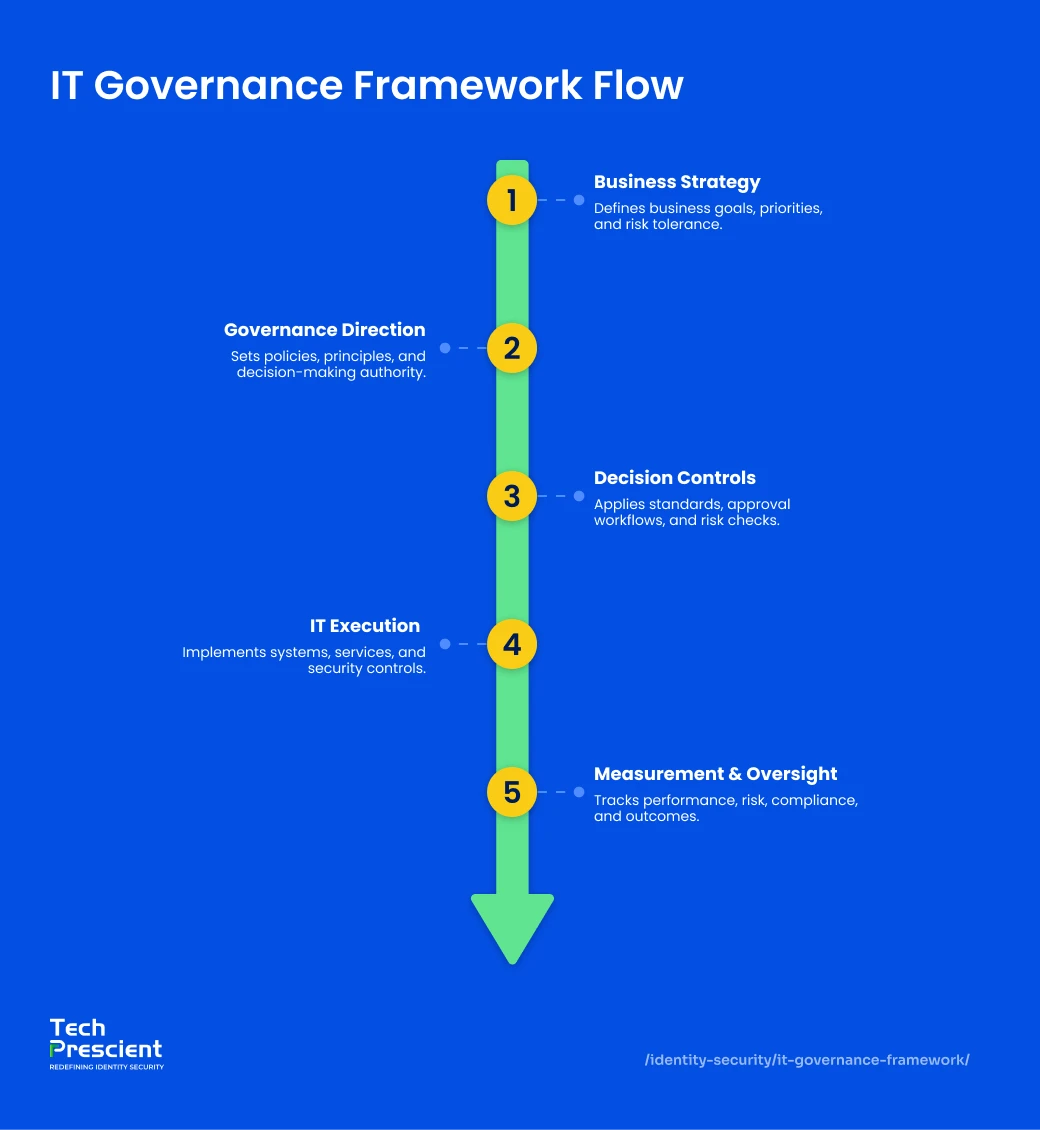
Why IT Governance Frameworks Matter
Organizations use IT governance frameworks to prevent misalignment between IT and business goals, reduce operational and regulatory risk, and ensure technology investments deliver measurable value.
Business Alignment
Without governance, IT decisions are often made in silos. This leads to duplicated tools, wasted spending, and technology initiatives that do not support business goals. An IT governance framework ensures that technology decisions are deliberate and aligned with business priorities. It helps organizations invest in the right tools and initiatives, ensuring that digital investments deliver clear business value and measurable returns.
Risk Management and Compliance
IT governance frameworks enable organizations to manage technology risk and consistently meet regulatory requirements. By defining clear controls, ownership, and review processes, governance reduces compliance gaps and audit issues. It supports alignment with regulations and industry standards, such as SOX, GDPR, RBI, SAMA, and SBP, while ensuring that controls are applied and regularly reviewed across IT systems.
Accountability and Transparency
Effective governance makes it clear who is responsible for IT decisions and how results are measured. This transparency improves oversight for leadership and boards, giving them better visibility into IT risks, performance, and compliance status. With defined ownership and clear decision structures, organizations can manage issues faster and maintain better control over their IT environment.
Common IT Governance Frameworks Explained
Different IT governance frameworks address different aspects of control, accountability, service delivery, and risk. Organizations often adopt one primary framework and complement it with others based on their size, industry, and regulatory exposure.
Popular IT Governance Frameworks Compared
| Framework | Focus Area | Best For | Governance Level |
|---|---|---|---|
| COBIT | Enterprise IT governance & controls | Regulated enterprises | Strategic & Control-focused |
| ITIL | IT service management | Operational efficiency | Operational |
| ISO/IEC 38500 | Board-level governance principles | Executive oversight | Strategic |
| NIST CSF | Cybersecurity risk management | Risk-heavy environments | Security-focused |
| CMMI | Process maturity & improvement | Development-driven orgs | Process-focused |
Organizations often combine multiple frameworks to balance strategic governance, operational control, and cybersecurity oversight.
COBIT
COBIT (Control Objectives for Information Technology) is an IT Governance Framework created by ISACA. It addresses the governance of all levels of an organization's IT, with an emphasis on controls, auditability, and compliance.
Beyond controls, COBIT helps organizations align IT activities with business goals. It ensures that IT objectives directly support enterprise strategy, focuses on maximizing value from IT investments, and promotes efficient use of resources such as people, processes, and technology. COBIT also offers a structured approach to identifying, assessing, and managing IT-related risks, helping protect critical assets and the organization's reputation.
Example: A bank uses COBIT to define the roles and responsibilities associated with access approval; to define how IT risk is reported to its board(s); and to measure compliance with SOX and internal audit requirements. COBIT provides an auditor with the ability to ensure that the institution's IT decisions are traceable, controlled, and auditable across the entire organization.
COBIT is best for: Enterprise organizations, financial institutions, and highly regulated organizations.
ITIL
ITIL (Information Technology Infrastructure Library) is a framework that defines best practices for IT Service Management (ITSM), helping organizations deliver reliable, high-quality IT services aligned with business needs. It focuses on how IT services are planned, delivered, supported, and continuously improved.
ITIL covers the full service lifecycle, from service strategy and design to transition, operation, and continual improvement, and establishes operational controls through incident, problem, and change management. While ITIL does not govern IT at the board level, it complements governance frameworks like COBIT by ensuring IT services are delivered efficiently, consistently, and with minimal risk.
Example: An enterprise IT team uses ITIL in incident response management, change approval, and service availability. While ITIL enhances operational efficiency (i.e. faster ticket resolution), it does so while using a governance framework (COBIT) to define oversight and accountability.
ITIL is best for: Organizations looking to improve IT operations, service quality, and efficiency.
ISO/IEC 38500
ISO/IEC 38500 is a board-level IT governance standard that provides guiding principles for how organizations should direct, evaluate, and monitor the use of IT. Rather than prescribing detailed processes, it helps senior leadership ensure that IT supports business strategy, delivers value, manages risk, and complies with legal and regulatory obligations.
The standard is designed for executives and board members, clarifying their responsibility for IT decisions and outcomes. It emphasizes accountability, transparency, and ethical use of technology, making it especially useful for organizations that want clear oversight of IT without adopting a highly operational or control-heavy framework.
Example: A company's board uses ISO/IEC 38500 to guide decisions on major technology investments, ensuring IT initiatives align with business strategy, comply with regulations, and clearly assign responsibility, without prescribing operational details.
ISO/IEC 38500 is best for: Executive leadership and boards seeking strategic IT oversight.
NIST Cybersecurity Framework
The NIST Cybersecurity Framework (NIST CSF) provides a clear and practical way for organizations to manage cybersecurity risk. It structures security activities around five core functions: Identify, Protect, Detect, Respond, and Recover, which together cover the full lifecycle of handling cyber threats.
Rather than being prescriptive, NIST CSF helps organizations understand what security controls they have, where gaps exist, and how to improve over time. It is widely used across regulated and non-regulated industries because it is flexible, easy to adapt, and works well alongside other governance and compliance frameworks.
Example: A healthcare organization uses NIST CSF to structure its cybersecurity program, assess risk exposure, and demonstrate compliance readiness. Governance teams use the framework to prioritize security investments and track risk reduction over time.
NIST is best for: Organizations with strong cybersecurity and regulatory requirements.
CMMI
CMMI (Capability Maturity Model Integration) focuses on process improvement, helping organizations adapt efficient behaviors that decrease risks in software, product, and service development.
It provides a structured approach to measuring process maturity and identifying gaps that impact quality and performance. By improving consistency in areas such as project management and engineering, CMMI enables organizations to deliver outcomes more reliably and at scale.
Example: A software development firm adopts CMMI to improve governance over development and delivery processes. By advancing to higher maturity levels, the organization reduces project overruns, improves quality, and achieves better predictability in outcomes.
CMMI is best for: Organizations aiming to mature and standardize their IT and operational processes.
IT Governance Framework Examples
Real-world examples help clarify how an IT governance framework influences everyday IT decisions, who approves access, how risks are reviewed, and how technology choices stay aligned with business and compliance requirements.
Bank: Access Approvals and Audit Reviews
In a banking environment, IT governance frameworks are used to tightly control who can access what systems and data. Access requests for core banking platforms or financial systems must follow predefined approval workflows, often involving managers, application owners, and compliance teams.
Regular audit reviews ensure that access aligns with job roles, segregation-of-duties rules are enforced, and inactive or excessive permissions are removed. This governance model reduces fraud risk, supports regulatory audits, and provides clear accountability for access decisions.
Healthcare: Data Access Governance for HIPAA
In healthcare organizations, IT governance frameworks guide the access, monitoring, and protection of patient data. Governance policies define which roles (doctors, nurses, billing staff) can access specific types of patient information and under what conditions.
Audit logs, periodic access reviews, and clear ownership of data systems help ensure compliance with healthcare regulations, reduce unauthorized access, and maintain patient trust, all while allowing clinicians to access the information they need to deliver care.
Enterprise: Software Procurement Controls
In large enterprises, IT governance frameworks play a key role in software procurement and technology adoption. Instead of teams purchasing tools independently, governance processes require business justification, security review, cost analysis, and approval before new software is introduced.
This prevents tool sprawl, reduces security and licensing risks, and ensures that technology investments align with enterprise architecture standards and business priorities.
IT Governance vs IT Management (Key Differences)
IT governance defines what should happen and why, while IT management focuses on how it happens and who does it. Both are essential, but they serve very different purposes within an organization.
| Aspect | IT Governance | IT Management |
|---|---|---|
| Primary Focus | Direction, oversight, and control | Execution and day-to-day operations |
| Core Question | What should happen and why? | How do we make it happen? |
| Level | Strategic | Tactical and operational |
| Ownership | Board, executive leadership, senior stakeholders | IT managers, administrators, operations teams |
| Responsibilities | Defining policies, frameworks, decision rights, and accountability | Running systems, delivering services, managing teams and projects |
| Scope | Business alignment, risk, compliance, value delivery | Infrastructure, applications, service delivery, support |
| Decision-Making | Sets decision-making authority and escalation paths | Implements and executes approved decisions |
| Time Horizon | Long-term and outcome-focused | Short-term and execution-focused |
| Examples | Approving cloud strategy, defining access governance, setting risk tolerance | Configuring systems, deploying software, resolving incidents |
How to Choose the Right IT Governance Framework
The right IT governance framework depends on your organization's size, industry regulations, and governance maturity. The goal isn't to adopt every framework, but to choose (or combine) ones that fit your risk profile, compliance needs, and operational scale.
Organization Size
- SMBs: Frameworks like ISO/IEC 38500 and the NIST Cybersecurity Framework work well because they are principle-based, flexible, and easier to implement with limited resources.
- Enterprises: Larger organizations often require more structured and detailed governance models such as COBIT or TOGAF, which support complex environments, multiple business units, and formal audit requirements.
Industry & Compliance Requirements
- Financial Services: Highly regulated environments typically combine COBIT (for governance and controls) with NIST (for security and risk management) to meet regulatory, audit, and cybersecurity expectations.
- Government & Public Sector: Organizations often rely on NIST for security governance and CMMI for process maturity, standardization, and continuous improvement.
Governance Maturity Level
- Early-stage governance: Start with a lightweight framework that establishes accountability, basic controls, and oversight without slowing execution.
- Mature organizations: As governance capabilities evolve, frameworks can be layered, adding more controls, metrics, and formal decision models over time.
Note:
Choose a framework that matches where your organization is today, not where you think it should be. Effective IT governance is iterative, designed to scale as complexity, risk, and regulatory exposure grow.
IT Governance Framework and Identity Security
Modern IT governance frameworks depend heavily on identity security to enforce policy-driven access, reduce insider risk, and maintain continuous compliance across hybrid environments.
At the core of this connection is Identity Governance and Administration (IGA). While IT governance defines who should have access, under what conditions, and why, IGA is the mechanism that enforces those decisions consistently across the organization. It ensures that access policies are not just documented, but actively applied and monitored.
Role of Identity Governance & Administration (IGA)
IGA acts as the control layer between governance intent and operational access. It helps organizations:
- Define and enforce access policies based on roles, responsibilities, and risk.
- Ensure that access aligns with business needs rather than ad hoc IT decisions.
- Maintain a single source of truth for who has access to what, and why.
This makes identity a foundational pillar of effective IT governance, especially in environments with complex applications, cloud services, and third-party access.
Access Reviews and Segregation of Duties
Two of the most common governance failures uncovered during audits are excessive access and conflicting permissions. IGA directly addresses these risks by:
- Enabling periodic access reviews to validate that users still need their assigned permissions.
- Enforcing segregation of duties (SoD) to prevent toxic access combinations that could lead to fraud or misuse
- Highlighting dormant, orphaned, or over-privileged accounts before they become audit findings or security incidents.
Audit-Ready Identity Controls
Strong IT governance requires controls that can stand up to regulatory and internal audits. Identity governance supports this by:
- Maintaining detailed audit trails of access approvals, changes, and removals.
- Automating joiner–mover–leaver processes to eliminate access gaps.
- Providing clear evidence that access decisions are intentional, reviewed, and policy-driven.
IT Governance Maturity Levels
Organizations typically progress through governance maturity stages:
- Ad Hoc - Informal IT decisions with limited documentation
- Defined - Basic policies and accountability structures established
- Managed - Performance metrics and compliance controls implemented
- Optimized - Continuous monitoring, automation, and board-level reporting
Advancing governance maturity improves transparency, reduces risk, and strengthens regulatory readiness.
Best Practices for Implementing IT Governance Frameworks
Successful IT governance is not achieved through documentation alone. It requires strong executive backing, clearly defined ownership, practical enforcement mechanisms, and continuous oversight to remain effective as the organization evolves.
Executive Sponsorship
IT governance must be driven from the top. Board-level and executive sponsorship ensures that governance decisions carry authority across business units and are treated as strategic priorities, not IT-side initiatives. When leadership is involved, governance frameworks are more likely to influence funding decisions, risk tolerance, and enterprise-wide behavior.
Clearly Defined Roles and RACI
Ambiguity is one of the fastest ways governance efforts fail. Clearly defining roles, responsibilities, and decision ownership through a RACI model (Responsible, Accountable, Consulted, Informed) ensures that everyone understands:
- Who sets policies
- Who enforces them
- Who approves exceptions
- Who is accountable for outcomes
This clarity prevents overlap, delays, and "shadow IT" decision-making.
Policy-Driven Automation
Manual governance does not scale. Policies should be enforced through automation wherever possible, especially for access management, approvals, and reviews. Automating governance controls reduces human error, ensures consistency, and makes governance measurable and auditable rather than subjective or informal.
Regular Audits and Reviews
IT governance is an ongoing process, not a one-time exercise. Regular audits and governance reviews help organizations:
- Validate that controls are working as intended
- Identify gaps caused by business or technology changes
- Adjust policies to new risks, regulations, or operating models
Continuous measurement and periodic review keep governance aligned with real-world operations instead of becoming outdated or theoretical.
Common Mistakes to Avoid
IT governance often breaks down not because frameworks are flawed, but because they are poorly implemented, overcomplicated, or not enforced in day-to-day operations.
Treating Governance as Documentation Only
One of the most common mistakes is reducing IT governance to policies, charts, and slide decks that exist only on paper. Governance must actively guide decisions and behavior. If policies are written but never applied to real IT processes, such as access approvals, procurement, or risk acceptance, they quickly lose relevance and impact.
Lack of Enforcement and Metrics
Governance without enforcement is optional by default. When there are no controls, KPIs, or accountability mechanisms, teams revert to ad hoc decisions. Effective governance requires measurable outcomes, such as compliance rates, risk reduction metrics, and audit findings, to ensure policies are actually followed and are producing results.
Ignoring Identity and Access Governance
Many governance programs overlook identity and access controls, even though access-related issues are among the most common audit and security failures. Over-permissioned users, inactive accounts, and missing access reviews undermine governance efforts and increase risk. Without strong identity governance, broader IT governance frameworks remain incomplete.
FAQs
The five core domains are strategic alignment, value delivery, risk management, resource management, and performance measurement. Together, they ensure IT initiatives support business goals, deliver measurable value, manage risk, use resources efficiently, and are tracked through clear metrics and KPIs.
A common example is COBIT, which provides a structured set of governance objectives, controls, and performance measures. It is widely used by enterprises to align IT with business needs while meeting audit and compliance requirements.
Not exactly. ITIL focuses on IT service management, how services are designed, delivered, and improved. It complements governance frameworks like COBIT by supporting execution, but it does not define enterprise-level governance on its own.
IT governance defines what should be done and why, setting direction, policies, and oversight at a leadership or board level. IT management focuses on how things are done, handling daily operations such as system maintenance, service delivery, and incident response.
Yes. Small and mid-sized organizations can benefit from lightweight governance frameworks to control risk, manage IT costs, and meet basic compliance needs. Governance does not have to be complex, starting simple and scaling over time is often the most effective approach.
The best IT governance framework depends on organizational size, regulatory exposure, and risk profile. Many enterprises use COBIT for governance, ITIL for operations, and NIST for cybersecurity risk management.
Yes. Organizations often combine frameworks such as COBIT and ITIL to address both strategic oversight and operational efficiency.
Identity governance enforces access policies, automates reviews, and ensures compliance evidence is available for audits, making it a critical execution layer of IT governance.


GET A PERSONALIZED DEMO
See Identity Confluence in Action
“One platform to govern identities, automate access decisions, and prove compliance; across every app, user, and system in your environment.”



Murli Ramsunder
Senior Architect, Vonage