




On this page
See Tech Prescient in Action
Automate access, reduce risk, and stay audit-ready
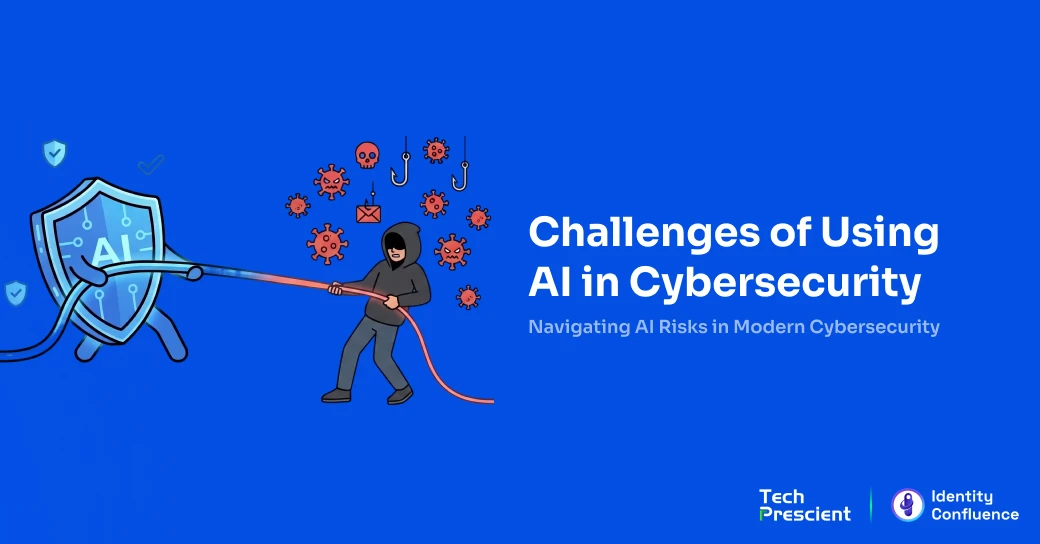
AI is transforming how organizations detect and respond to cyber threats, but it also introduces risks that require active control. While AI enables faster detection, automation, and real-time response, it also introduces new attack surfaces, operational complexity, and trust challenges.
From adversarial attacks to data bias impacting decision accuracy, organizations must balance capability with control. As AI becomes deeply embedded in security systems, understanding its limitations is just as important as understanding its benefits.
In this blog, we'll explore how AI is used in cybersecurity, the key challenges it introduces, and how organizations can address them effectively.
Key Takeaways
- AI improves threat detection speed but introduces new security risks
- Poor data quality and bias can directly impact AI accuracy
- False positives and alert fatigue remain major operational challenges
- AI is used by both attackers and defenders
- Human oversight and governance are critical for effective AI security
What Is AI in Cybersecurity?
AI in cybersecurity uses machine learning, behavioral analytics, and automation to detect, prevent, and respond to threats in real time.
AI in cybersecurity refers to the use of artificial intelligence technologies, such as machine learning (ML), pattern recognition, and behavioral analytics, to improve how security systems identify and respond to threats. Instead of relying only on predefined rules, AI systems learn from data and adapt to new attack patterns.
Traditional security tools typically operate on rule-based logic, for example, blocking known malicious IPs or signatures. While effective for known threats, they struggle with new or evolving attacks. AI changes this by analyzing behavior and identifying anomalies, even when the threat has never been seen before.
For example, if a user who normally logs in from one location suddenly attempts access from multiple countries within minutes, an AI system can detect this unusual behavior and flag it as a potential compromise. This ability to detect patterns and deviations makes AI effective in dynamic environments.
How AI Fits into the Modern Security Stack
AI is now integrated across multiple layers of cybersecurity systems:
- Threat detection systems use AI to identify suspicious activity in real time
- Endpoint security tools analyze device behavior to detect malware or anomalies
- Identity and access systems use AI to evaluate login risk and user behavior
- Security operations centers (SOC) rely on AI to prioritize alerts and reduce noise
By automating analysis, AI reduces manual effort and allows teams to focus on high-risk threats.
AI vs Traditional Security Approaches
The key difference between AI-driven and traditional security lies in how threats are identified:
- Traditional systems rely on known signatures and static rules
- AI systems rely on behavioral analysis and continuous learning
This allows AI to detect unknown threats but introduces dependencies on data quality and model accuracy.

Expert Insight:
AI models are only as reliable as the data and assumptions they are built on. In cybersecurity, this means an AI system can confidently make the wrong decision if it learns from incomplete, outdated, or biased data, making governance and validation just as critical as detection accuracy.
How AI Is Used in Cybersecurity
AI is embedded across multiple cybersecurity functions to improve detection speed, automate response, and analyze large volumes of data that humans cannot process efficiently. However, these same use cases also highlight why challenges like data quality, false positives, and model reliability become critical.
1. Threat Detection & Anomaly Detection
AI is widely used to detect threats by analyzing patterns in network traffic, user behavior, and system activity. Instead of relying only on known attack signatures, AI systems establish a baseline of "normal" behavior and flag deviations.
For example, if a user suddenly accesses sensitive data at unusual hours or from an unfamiliar location, AI can detect this anomaly and raise an alert. This makes AI effective against unknown or evolving threats. These use cases also highlight why data quality, false positives, and model reliability are critical.
2. Automated Incident Response
AI enables faster response to security incidents by automating routine actions. Once a threat is detected, AI systems can trigger predefined responses such as isolating a device, blocking access, or flagging high-risk users.
This reduces response time and helps contain threats before they spread. In high-volume environments, automation is essential to manage the scale of alerts and incidents. However, over-reliance on automation introduces risk when decisions are made without validation.
3. Phishing & Malware Detection
AI is increasingly used to detect phishing emails and malware by analyzing content, behavior, and patterns. It can identify suspicious language in emails, detect malicious links, and recognize unusual file behavior.
For example, AI models can flag emails that mimic trusted domains or contain subtle indicators of phishing attempts. Similarly, malware detection tools use AI to identify previously unseen threats based on behavior rather than known signatures.
While this improves detection rates, attackers are also using AI to create more convincing phishing attacks and evade detection, making this a constantly evolving challenge.
Why These Use Cases Matter
These use cases highlight AI's core strengths: speed, scale, and adaptability. However, they also expose their limitations.
AI systems rely on data, models, and assumptions, which means errors can occur at scale. A false positive can overwhelm teams, while a missed anomaly can lead to a breach. These use cases also explain why data bias, adversarial attacks, and lack of explainability must be addressed.
Real-World Challenges of AI in Cybersecurity
While AI offers strong capabilities, organizations often face practical challenges when deploying it in real environments:
- Difficulty integrating AI with existing security tools
- Lack of visibility into AI decision-making
- High operational costs and infrastructure requirements
- Managing large volumes of alerts generated by AI systems
- Ensuring compliance with data protection regulations
These challenges show that adopting AI is not just a technical decision but an operational and governance challenge.
Key Challenges of AI in Cybersecurity
AI in cybersecurity faces challenges such as poor data quality, adversarial attacks, false positives, lack of transparency, and operational complexity, each of which can directly impact security outcomes. While AI improves detection and response, it introduces a new layer of risk. These challenges directly affect detection accuracy, response speed, and trust in AI-driven decisions.
Data Quality and Bias
AI systems depend heavily on the quality of data they are trained on. In cybersecurity, this includes logs, user activity, network traffic, and historical threat data. If this data is incomplete, outdated, or poorly labeled, the AI model may learn incorrect patterns. For example, if certain attack behaviors are underrepresented in the dataset, the system may fail to detect them in real-world scenarios. Bias in data can also lead to uneven detection, where some threats are identified accurately while others are consistently missed. Data quality is foundational, as the effectiveness of the system depends on it.
Adversarial Attacks on AI Models
AI systems themselves can become targets. Adversarial attacks are designed to manipulate how AI models interpret data. One example is data poisoning, where attackers inject malicious or misleading data into the training dataset, causing the model to learn incorrect behavior. Another is adversarial inputs, where small, carefully crafted changes in data can trick AI into misclassifying threats. Attackers can also use evasion techniques to bypass AI detection entirely. These risks make adversarial attacks a growing concern, as the same intelligence used for defense can be exploited.
High False Positives & Alert Fatigue
AI systems often generate a large number of alerts, many of which may not represent real threats. These false positives create noise within security operations. Security teams, especially in SOC environments, may struggle to investigate every alert. Over time, this leads to alert fatigue, where analysts become overwhelmed and may start ignoring or deprioritizing alerts. This increases the risk of missing real threats within the noise and reduces overall effectiveness.
Lack of Explainability (Black Box AI)
Many AI models operate as "black boxes," meaning their decision-making process is not easily understandable. When an AI system flags a threat or blocks access, security teams may not know exactly why the decision was made. This lack of transparency reduces trust and makes validation difficult. It also poses compliance challenges, especially in regulated industries where decisions must be explainable and auditable. This is where explainable AI (XAI) in security becomes critical.
Integration with Legacy Systems
Many organizations still rely on legacy infrastructure that was not designed to support AI-driven systems. Integrating AI into these environments can be complex and costly. Compatibility issues, lack of standardized data formats, and infrastructure limitations often slow down implementation. In some cases, organizations must upgrade or replace existing systems, which increases the cost and effort of adoption.
AI-Powered Cyberattacks (AI vs AI)
Attackers are increasingly using AI to enhance their capabilities. This includes generating highly convincing phishing emails, creating deepfake content, and automating attack processes. AI enables attackers to scale operations, personalize attacks, and adapt quickly to defenses. This creates an AI vs AI environment, where both attackers and defenders are leveraging advanced technologies. This makes the threat landscape more dynamic and harder to predict.
Privacy & Data Security Risks
AI systems often rely on large volumes of user and behavioral data to function effectively. This raises concerns around privacy, especially when monitoring user activity or analyzing sensitive information. Organizations must ensure compliance with regulations such as GDPR and other data protection laws. Improper data handling can expose sensitive information and create additional security and legal risks.
Resource & Skill Constraints
Implementing and managing AI systems requires specialized expertise in both cybersecurity and machine learning. There is a shortage of professionals with this combined skill set, making it difficult for organizations to deploy and maintain AI solutions effectively. In addition, AI systems require significant computational resources, increasing costs related to infrastructure, maintenance, and ongoing optimization.
Model Drift & Continuous Learning Issues
Cyber threats evolve constantly, which means AI models must also adapt. Over time, models may experience model drift, where their accuracy declines because the data they were trained on no longer reflects current threat patterns. To maintain effectiveness, models must be continuously updated and retrained. This requires continuous monitoring and access to high-quality data.
Over-Reliance on Automation
While automation improves efficiency, relying too heavily on AI can create blind spots. AI systems may miss complex or context-specific threats that require human judgment. In some cases, automated responses may also take incorrect actions if the underlying model is flawed. A balanced approach is required; combining AI with human expertise improves decision-making and reduces risk.
Advantages vs Disadvantages of AI in Cybersecurity
AI in cybersecurity improves detection speed, automation, and scalability, but it also introduces risks such as data bias, false positives, high costs, and adversarial vulnerabilities.
While AI in cybersecurity brings significant benefits, it is not without trade-offs. Understanding both sides helps organizations adopt AI more effectively and avoid over-reliance on it.
AI in Cybersecurity: Pros vs Cons
The following table summarizes the advantages and limitations of AI in cybersecurity.
| Advantages | Disadvantages |
|---|---|
| Faster Detection: Identifies threats in real time | Data Bias: Poor data leads to wrong decisions |
| Automation: Reduces manual effort in security ops | False Positives: Too many alerts create noise |
| Unknown Threat Detection: Finds new attack patterns | Lack of Explainability: Hard to justify decisions |
| Scalability: Handles large data volumes easily | Integration Issues: Difficult with legacy systems |
| Faster Response: Automates containment actions | AI-Powered Attacks: Attackers use AI too |
| Continuous Learning: Adapts to new data | Model Drift: Accuracy drops over time |
| Behavior Monitoring: Detects unusual activity | Privacy Risks: Requires sensitive data tracking |
| Team Support: Reduces analyst workload | Skill Gaps: Needs specialized expertise |
| Better Insights: Correlates multiple data sources | Over-Reliance: Less human oversight |
How to Overcome AI Cybersecurity Challenges
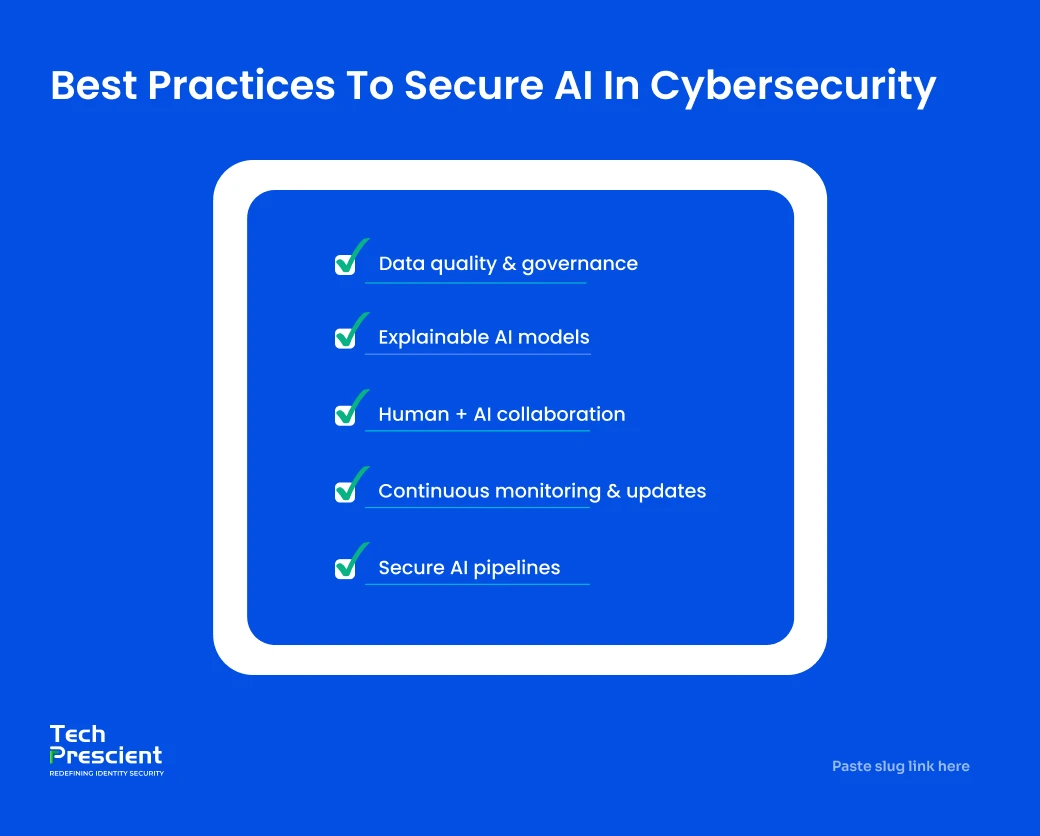
Organizations can reduce AI cybersecurity challenges by improving data quality, maintaining human oversight, and implementing strong governance and security controls. Addressing AI risks requires a structured approach. It requires ensuring AI systems are reliable, secure, and aligned with real-world threats. The following best practices in AI cybersecurity help organizations minimize risk while maximizing value.
1. Improve Data Quality & Governance
AI systems are only as effective as the data they rely on. Organizations must ensure that training and operational data are accurate, complete, and up to date. This includes establishing clear data governance practices, such as validating data sources, removing duplicates or corrupted entries, and ensuring datasets reflect real-world scenarios. Regular audits of data pipelines help prevent bias and improve detection accuracy. Without strong data quality controls, even advanced AI models can produce unreliable outcomes.
2. Adopt Explainable AI Models
To build trust and meet compliance requirements, organizations should prioritize explainable AI (XAI) models that provide transparency into how decisions are made. Explainable models help security teams understand why a threat was flagged or an action was taken. This is critical for incident investigation, regulatory audits, and validating AI-driven decisions. Without explainability, organizations risk relying on systems they cannot fully interpret or justify.
3. Combine AI with Human Expertise
AI should support, not replace, security teams. Human expertise is essential for interpreting complex threats, validating AI decisions, and handling edge cases that automation may miss. A hybrid approach ensures AI handles scale and speed while humans provide context and judgment. This balance reduces the risk of over-automation and improves overall security effectiveness.
4. Continuous Monitoring & Model Updates
Cyber threats evolve constantly, and AI models must adapt to remain effective. Continuous monitoring helps identify performance issues such as declining accuracy or unusual behavior. Regular retraining with updated datasets ensures models stay relevant. This also helps address model drift, where AI performance degrades over time due to changes in threat patterns. Ongoing evaluation and tuning are essential to maintain accuracy and reliability.
5. Secure AI Pipelines
AI systems introduce new attack surfaces, especially in data pipelines and model training processes. Securing these pipelines is critical to prevent manipulation or unauthorized access. Organizations should implement controls such as access restrictions, data integrity checks, and monitoring for unusual changes in training data. Protecting against risks like data poisoning ensures that AI models are not compromised at their source.
Future of AI in Cybersecurity
AI will drive more automated and predictive systems, but governance and human oversight will remain critical. The future of AI in cybersecurity is moving toward faster, more automated, and increasingly predictive systems. As threats evolve, organizations will rely more on AI to detect, respond, and even prevent attacks before they occur. However, this shift also brings new challenges around control, trust, and accountability.
AI vs AI: The Cyber Arms Race
Cybersecurity is entering an era where both attackers and defenders are powered by AI.
Attackers are using AI to generate realistic phishing campaigns, automate reconnaissance, and identify vulnerabilities at scale. At the same time, defenders are using AI to detect anomalies, respond to threats, and strengthen defenses.
This creates an ongoing AI vs AI arms race, where the speed and sophistication of both attacks and defenses continue to increase.
Rise of Autonomous Security Operations
Security operations are gradually shifting toward autonomous SOC (Security Operations Centers), where AI handles large parts of detection, triage, and response without human intervention. These systems can analyze massive volumes of data, prioritize threats, and take immediate action. This reduces response time and helps organizations manage the growing scale of cyber threats. However, full autonomy is not without risk. Organizations will still need human oversight to validate decisions, handle complex scenarios, and ensure accountability.
Integration with Identity Security
As identity becomes the primary attack surface, AI will increasingly integrate with identity and access management systems. AI can analyze user behavior, detect anomalies in access patterns, and assign risk scores to identities in real time. When combined with identity governance, this enables more precise control over who has access to what and under what conditions. This integration helps enforce least privilege, reduce identity-related risks, and improve overall security posture. You can explore more about this in our guide on identity governance in AI security.
What This Means for Organizations
The future of AI in cybersecurity is not just about adopting new technologies, it's about building systems that are secure, transparent, and well-governed.
Organizations that succeed will:
- Combine AI capabilities with strong governance frameworks
- Maintain human oversight for critical decisions
- Integrate AI with identity-first security strategies
Final Thoughts
AI is powerful, but it is not a complete solution. Its effectiveness depends on how well it is governed, monitored, and combined with human expertise. While AI improves detection speed and automation, it also introduces risks that organizations must actively manage. Organizations that succeed will control AI, govern it, and integrate it into an identity-first security strategy.
FAQs
The key challenges of AI in cybersecurity include poor data quality, bias in training datasets, adversarial attacks on AI models, high false positives, and a lack of explainability. These issues can reduce detection accuracy, overwhelm security teams, and create trust and compliance challenges if not properly managed.
The main disadvantages of AI in cybersecurity include high implementation costs, privacy concerns due to data usage, integration challenges with legacy systems, and over-reliance on automation. Without proper governance, these limitations can create new risks instead of reducing them.
AI in cybersecurity is used for threat detection, anomaly detection, automated incident response, phishing detection, and malware analysis. It helps security teams analyze large volumes of data, identify unusual behavior, and respond to threats faster than traditional methods.
Yes, AI systems can be targeted through techniques like adversarial attacks and data poisoning, where attackers manipulate inputs or training data to mislead the model. This makes it important to secure AI pipelines and continuously validate model performance.
AI is not replacing cybersecurity professionals but augmenting their capabilities. It automates repetitive tasks and improves detection speed, allowing security teams to focus on strategy, complex threats, and governance. Human expertise remains essential for decision-making and oversight.
Share



Rashmi Ogennavar
Content Strategist
A content strategist translating complex Tech and SaaS concepts into compelling narratives for business and technical audiences. With a strategic, data-informed approach, the work bridges content and product storytelling, crafting messaging that resonates and drives decisions across the buyer journey.
Most Popular Blogs
Identity Security· 21 min read
Data Access Governance Solutions: How to Secure Sensitive Data at Scale
Compare data access governance solutions for 2026: how DAG platforms discover sensitive data, run access reviews, automate remediation, and prove compliance.
Brinda Bhatt· September 7, 2026
Identity Security· 24 min read
What Is Zero Trust Network Access (ZTNA)?
Learn what Zero Trust Network Access (ZTNA) is, how it works, and why it’s replacing VPNs for secure, identity-based access control.
Yatin Laygude· August 14, 2026

Identity Security· 24 min read
Cyber Essentials Certification: Complete Guide
Learn Cyber Essentials certification, cost, requirements, and steps. Compare Cyber Essentials vs Plus and get certified faster.
Yatin Laygude· August 10, 2026