




On this page
See Tech Prescient in Action
Automate access, reduce risk, and stay audit-ready
Managing user access across dozens of systems is challenging without effective automation. Organizations relying on manual processes often face issues such as overprivileged users, orphaned accounts, delayed updates, and compliance visibility gaps. Identity Governance and Administration (IGA) ensures the right access is granted on day one, updated as roles change, and fully revoked at exit across every system, transforming identity governance from an operational task to a core security control in today's cloud-first, SaaS-heavy environments.
Selecting an IGA platform in 2026 requires careful evaluation. The market includes a wide range of vendors with differing architectural models, deployment timelines, and governance capabilities. Platform selection directly impacts security posture, operational efficiency, and audit readiness.
This analysis reviews 10 established IGA platforms using publicly available data from G2, Gartner reports, and verified customer feedback. Evaluation criteria include implementation complexity, automation capabilities, user and administrator experience, integration breadth, and governance maturity.
Below, you'll find a structured comparison of the top IGA platforms in 2026, including deployment timelines, ideal organization size, automation depth, and governance maturity.
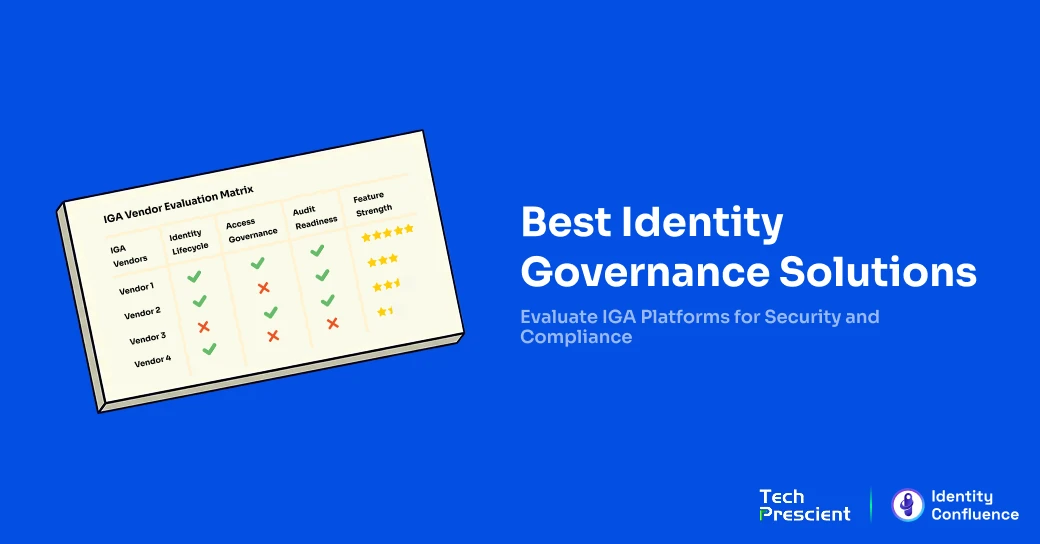
10 Best Identity Governance Solutions and IGA Platforms
The best identity governance solutions in 2026 include Tech Prescient's Identity Confluence, SailPoint, Saviynt, Microsoft Entra ID Governance, Omada, One Identity, IBM Verify, Oracle Identity Governance, Broadcom, and RSA. Each platform varies in automation depth, deployment speed, and ability to handle enterprise-scale complexity.
Each excels in different scenarios; pick based on your organization's priorities and constraints.
Identity Confluence – Best For Rapid Deployment And Non-Human Identity Governance
Identity Confluence is a modern Identity Governance and Administration (IGA) solution for enterprises that need governance speed. Unlike many IGA providers that require 12-18 month deployments, Identity Confluence delivers policy-based governance in 2-4 weeks, a critical advantage for organizations under audit pressure or managing rapid growth.
Identity Confluence automates joiner, mover, and leaver workflows for human and machine identities across 250+ applications. It governs the entire access lifecycle through policy enforcement, approval workflows, and continuous compliance monitoring. Built-in intelligence powers access certifications and automated compliance evidence, delivering faster onboarding, reduced access risk, and audit-ready governance without replacing existing IAM systems.
Key Features
- Real-time, event-triggered access updates enabling provisioning in minutes rather than days
- Native integrations with Okta, Entra ID, Azure AD, and pre-built connectors for immediate connectivity
- Intelligent User Access Reviews (UARs) using machine learning to surface high-risk access patterns
- Automated compliance evidence collection aligned to SOX, GDPR, HIPAA, ISO 27001, SOC 2, and PCI-DSS
- Unified workflow management for access requests, approvals, and lifecycle transitions across all systems
- Scalable policy engine that adapts to complex organizational structures and role hierarchies
Pros
- Delivers implementation value in 2-4 weeks with minimal organizational disruption
- Achieves onboarding in 30 minutes vs. traditional multi-day manual processes
- An intuitive user interface enables business users and managers to participate without IT dependency
- AI-assisted reviews reduce certification effort up to 60-80% compared to manual processes
- Handles both human and non-human identity (NHI) governance in a single platform
- Scales consistently across global, hybrid, and multi-cloud environments
Cons
- Requires initial effort to define lifecycle rules, roles, and access policies for optimal outcomes
- Mostly adopted by mid-market and upper mid-market organizations
- Certain complex ERP integrations (e.g., SAP or Oracle) may involve additional configuration
Best For:
- Mid-to-large enterprises with complex joiner-mover-leaver requirements
- Organizations looking to centralize lifecycle governance without rebuilding their entire IAM stack
- Companies where implementation speed is a strategic priority
- Teams managing service accounts and Non-human identities (NHI) alongside human access governance
Timeline: 2-4 weeks for full implementation
Customer Feedback:
Organizations across financial services report measurable improvements in access governance and operational efficiency after adopting Identity Confluence. A security leader noted the platform's impact on team productivity and access accuracy, highlighting how it reduces manual review cycles and provides the consistent audit trails needed for regulatory compliance.
— Senior Security Leader, Financial ServicesSailpoint – Best For Enterprise Complexity And Heterogeneous Environments
SailPoint IdentityNow is a cloud-based identity governance platform adopted primarily by enterprise organizations. It delivers policy-driven lifecycle management, access certifications, and least-privilege controls across environments. The platform performs well in organizations managing complex identity ecosystems with stringent compliance and regulatory obligations. Within SailPoint, lifecycle and access governance are interconnected, making it well-positioned for organizations requiring consistent access validation and formal governance workflows.
Pros
- Handles identity governance in large-scale organizational settings
- Integrates with a broad spectrum of cloud and on-premises applications
- Offers structured access certification procedures with multiple approval tiers
- Well-regarded by enterprise users according to customer review sites
- Used by organizations with large user bases
Cons
- Implementation cycles typically last 6-12 months due to platform depth and configuration requirements
- Total cost of ownership is significant; entry pricing is $75,000+
- Operational complexity increases as governance rules and exceptions grow
- According to a couple of G2 reviews, "High cost, lack in customization, issues resolution so slow," and "Certain customizations require deep technical knowledge"
- Requires specialized Java expertise for advanced customization
Best For
- Large organizations managing complex identity environments
- Organizations in regulated industries require structured compliance controls
- Teams with dedicated identity governance resources
Timeline: 12-18 months
SailPoint Competitors and Alternatives
Saviynt – Best For Cloud-Native Compliance And Regulated Industries
Saviynt Enterprise Identity Cloud is an identity governance platform designed to manage complex identity environments across workforce, vendor, and non-human identities. User lifecycle management is integrated with risk-based access controls and segregation-of-duties policies.
Pros
- Cloud-native architecture with support for AWS, Azure, and GCP
- Integrates cloud security and identity governance in one platform
- 100+ pre-built integrations with a cloud platform focus
- Provides structured access certification workflows
- Listed as Gartner Peer Insights Customers' Choice for multiple consecutive years
Cons
- Implementation cycles typically last 6-12 months due to platform depth
- Total cost of ownership is significant for large or multi-year deployments
- Requires specialized implementation expertise and governance knowledge
- According to G2, "When issues arise, it is difficult to get agents who can get to the root cause. Tickets stay open far too long before resolution"
- Support quality varies by region and plan; a few reviews mention this
Best For
- Large organizations with cloud-first infrastructure managing AWS, Azure, or GCP
- Heavily regulated industries require compliance and access governance controls
Timeline: 6-12 months
Saviynt Competitors and Alternatives
Microsoft Entra Id Governance – Best For Microsoft Ecosystem Integration
Microsoft Entra ID Governance automates lifecycle management and access certifications within Microsoft environments, with integration to Conditional Access policies and Zero Trust frameworks. It enables organizations standardized on Microsoft to automate joiner–mover–leaver processes using directory and HR-driven events.
Pros
- Native integration with Microsoft 365, Azure, and Entra ID
- Lowest total cost of ownership compared to standalone IGA platforms
- Fast deployment cycles (4-8 weeks typical)
- Strong support for hybrid Active Directory environments
- Seamless integration with Microsoft Conditional Access policies
Cons
- Identity governance capabilities are limited to the Microsoft ecosystem
- Non-Microsoft applications lack deep visibility and control
- Organizations with multi-vendor infrastructure may require supplementary tools
- Advanced governance features require higher licensing tiers, reflecting Microsoft's modular approach
- According to one of the G2 reviews, "The interface and terminology can be confusing, especially for users who aren't deeply familiar with Microsoft environments"
Best For
- Organizations standardized on Microsoft 365 and Azure
- Mid-to-large organizations (1,000-10,000 employees) seeking native Microsoft access governance
Timeline: 4-8 weeks
Microsoft Entra ID Governance Competitors and Alternatives
Omada Identity – Best For Compliance Speed And Mid-Market Organizations
Omada Identity is a mid-market identity governance platform designed for organizations seeking rapid compliance readiness through process-driven governance workflows. It emphasizes structured, repeatable governance processes rather than extensive configuration.
Pros
- A process-driven framework reduces implementation complexity
- Rapid path to compliance readiness (12-16 weeks typical)
- User-friendly interface accessible to business users
- Pre-built workflows for SOX, GDPR, HIPAA, and PCI-DSS
- Strong customer success support for mid-market organizations
Cons
- Feature set narrower than enterprise-grade platforms
- Limited connector ecosystem compared to larger solutions
- Best suited for mid-market organizations; may not scale to enterprise complexity
- According to a review in G2, "The initial setup is lengthy and somewhat difficult"
- The UI is described as "dated" despite strong security functionality
Best For
- Mid-market enterprises (1,000-10,000 employees) seeking rapid compliance readiness
- Organizations in regulated industries seeking quick compliance enablement
Timeline: 12-16 weeks
Omada Identity Competitors and Alternatives
One Identity Manager – Best For Complex Hybrid And Legacy Environments
One Identity Manager is an enterprise identity governance platform designed for organizations with complex hybrid and on-premises infrastructure. It supports mission-critical identity scenarios across cloud, on-premises, and hybrid environments with strength in managing legacy systems alongside modern cloud infrastructure.
Pros
- Comprehensive lifecycle management for complex scenarios
- Deep governance controls and segregation-of-duties enforcement
- Flexible deployment options (on-prem, cloud, hybrid)
- Extreme customization flexibility for complex identity scenarios
- Provides support for on-premises and hybrid deployment models
Cons
- Steep learning curve and complex user interface
- Long implementation cycles (8-12 months typical)
- Dated user interface compared to modern cloud-native platforms
- Higher total cost of ownership than mid-market alternatives
- According to G2 and PeerSpot, users report varying response times depending on the support tier
- Support quality is inconsistent; premium-tier support is strong, standard support is mixed
Best For
- Large enterprises (5,000+) with complex hybrid infrastructure
- Enterprises requiring extreme customization for legacy systems
Timeline: 8-12 months
One Identity Manager Competitors and Alternatives
IBM Security Verify Governance – Best For Risk-Driven Access And Analytics
IBM Security Verify Governance combines identity governance, access management, and risk-based controls within IBM's broader security portfolio. Its lifecycle management capabilities emphasize adaptive access decisions based on user context and risk signals.
Pros
- Advanced machine learning and AI capabilities for risk-based access decisions
- Behavioral analytics and anomaly detection identify unusual patterns
- Proactive risk identification versus reactive incident response
- Zero Trust architecture alignment for modern security frameworks
- Strong integration with the enterprise security ecosystem
Cons
- High implementation complexity requires specialized expertise
- Requires skilled data analysts and data scientists to tune and optimize
- Implementation cycles typically 6-9 months
- According to G2, "Complexity and oftentimes requiring customization. Tends to force organization to fit into its way of governance"
- Slow initial setup; admin dashboard reported as slow, documentation too technical
- Pricing is described as "considerable, especially for large-scale implementations."
Best For
- Large enterprises (5,000+) with sophisticated IT operations
- Heavily regulated industries requiring anomaly detection and risk scoring
Timeline: 6-9 months
IBM Security Verify Governance Competitors and Alternatives
Oracle Identity Governance – Best For Oracle ERP-Centric Governance
Oracle Identity Governance is an enterprise platform designed for organizations with substantial Oracle infrastructure investments, including ERP systems and cloud services. It leverages Oracle ERP as the authoritative source for business context and access decisions in lifecycle workflows.
Pros
- Native Oracle ERP integration (E-Business Suite, Fusion) eliminates connector development
- Deep governance capabilities designed for Oracle applications
- Supports Oracle-centric cloud migration strategies
- Mature platform with extensive enterprise deployments
Cons
- Governance capabilities are limited to the Oracle ecosystem
- Limited value for organizations without a significant Oracle infrastructure
- High implementation complexity and longer deployment cycles (9-18 months typical)
- Ease of Setup reported as complex by users; limited analyst coverage
- According to G2 and SelectHub, "Customization is difficult. Understanding the event flow is difficult"
- PeerSpot reviewers note limited recent updates in December 2024. Platform innovation focuses on stability over UI modernization
Best For
- Large organizations (5,000+) with mature Oracle deployments
- Enterprises where Oracle ERP forms the core of the identity infrastructure
Timeline: 9-18 months
Oracle Identity Governance Competitors and Alternatives
Broadcom Identity Governance – Best For On-Premises Stability And Control
Broadcom Identity Governance is an enterprise platform for organizations with on-premises identity infrastructure requiring deep governance controls and stability. It is designed for large enterprises where identity system reliability is critical.
Pros
- Proven stability and reliability from decades of enterprise deployments
- Comprehensive policy engines supporting role-based, attribute-based, and rule-based access
- Strong on-premises infrastructure support and optimization
- Highly customizable to support complex governance scenarios
- Backward compatibility ensures minimal disruption from platform updates
Cons
- Dated user interface compared to modern cloud-native platforms
- Long implementation cycles (12-18 months typical)
- Cloud integration and capabilities are secondary priorities
- Higher total cost of ownership for cloud-heavy environments
- According to PeerSpot, "The community that works around this particular technical issue is shrinking"
- Limited analyst coverage; traditional on-premises focus means innovation prioritizes stability
Best For
- Large enterprises (5,000+) with on-premises-heavy infrastructure
- Organizations prioritizing governance maturity and stability
Timeline: 12-18 months
Broadcom Identity Governance Competitors and Alternatives
Rsa Identity Governance And Lifecycle – Best For Mid-Market Balance And Speed
RSA Identity Governance and Lifecycle is an identity governance platform designed for organizations balancing provisioning automation with analytics-driven access governance. It emphasizes phased deployment approaches for faster time-to-value.
Pros
- Balanced capabilities combining lifecycle automation and access governance
- Analytics-driven access reviews reduce manual certification workload
- Proven mid-market track record with strong customer success support
- Faster implementation cycles (4-6 months typical)
- Flexible policy engine supporting role-based and rule-based governance
Cons
- The feature set is less comprehensive than market-leading enterprise platforms
- No advanced capabilities for cloud infrastructure entitlement management (CIEM)
- Privileged access management (PAM) integration is limited
- May require supplementary tools for complex compliance scenarios
Best For
- Mid-market enterprises (3,000-15,000 employees) balancing features and speed
- Organizations seeking rapid value without extensive configuration
Timeline: 4-6 months
RSA Identity Governance and Lifecycle Competitors and Alternatives
Quick Comparison Table
| Platform | Best For | Organization Size | Timeline |
|---|---|---|---|
| Identity Confluence | Rapid Deployment | 500-5K | 2-4 weeks |
| SailPoint | Enterprise Complexity | 5K+ | 12-18 mo |
| Saviynt | Cloud-Native | 5K+ | 6-12 mo |
| Microsoft Entra | Microsoft Ecosystem | 1K-10K | 4-8 weeks |
| Omada | Compliance Speed | 1K-10K | 12-16 weeks |
| One Identity | Hybrid Complexity | 5K+ | 8-12 mo |
| IBM Verify | Analytics & Risk | 5K+ | 6-9 mo |
| Oracle | Oracle Ecosystem | 5K+ | 9-18 mo |
| Broadcom | On-Premise | 5K+ | 12-18 mo |
| RSA | Mid-Market Balance | 3K-15K | 4-6 mo |
How We Evaluated These Identity Governance Platforms
We analyzed IGA solutions based on the following criteria: core IGA capability depth (lifecycle management, certifications, compliance automation); automation versus manual intervention (how much is truly automated); integration breadth (number of pre-built connectors across HR, identity providers, and applications); deployment speed and time to full implementation; customer feedback and actual outcomes from G2, Gartner Peer Insights, and industry analyst reports.
This analysis does not reflect vendor sponsorship or financial arrangements.
How To Choose The Right Identity Governance Platform
Choosing the right identity governance platform depends on system complexity, regulatory exposure, infrastructure type, and internal implementation capacity. Organizations with highly distributed SaaS environments require stronger automation and lifecycle orchestration.
Identity governance selection depends on three critical factors: your organization's system complexity, regulatory requirements, and implementation timeline. Platforms like Omada offer rapid deployment (12-16 weeks), while enterprise solutions like SailPoint require 12-18 months but handle extreme complexity.
Key Evaluation Criteria
System Complexity
How many applications need access coordination?
Compliance Requirements
Which regulations apply (SOX, HIPAA, GDPR)?
Implementation Timeline
Do you need rapid deployment or deep customization?
Infrastructure Type
Is your environment cloud-first, hybrid, or legacy-heavy?
Budget & Resources
What's your budget and team capability?

Mukesh Rathod
CTO, Tech Prescient
Key Capabilities To Look For In An IGA Solution
Modern identity governance platforms must automate lifecycle management, enforce least privilege, and provide continuous compliance visibility. Advanced solutions also support AI-assisted reviews and non-human identity governance.
Must-Have Capabilities:
- Automated joiner–mover–leaver workflows
- Access certification and review frameworks
- Integration with HR systems and identity providers
- Access revocation on employee exit
- Audit trails and change history
- Visibility into user access assignments
Nice-To-Have Capabilities:
- AI-assisted access recommendations
- Governance for non-human identities
- Segregation of duties enforcement
- Custom workflow support
- Advanced reporting and dashboards
- Temporary or just-in-time access options
Red Flags To Watch For:
When assessing IGA solutions, consider whether the platform exhibits any of these characteristics:
- Manual intervention is required for common role changes
- Limited visibility into access updates after onboarding
- Weak or inconsistent deprovisioning workflows
- Audit evidence spread across multiple tools or systems
- Critical governance features are available only in premium tiers
Final Thoughts
Identity governance has become essential for modern organizations. With cloud adoption and SaaS proliferation, manual access management creates risk and inconsistency.
Organizations that want to quickly implement a governance program but want to continue using the IAM products they already have can automate their governance using Identity Confluence. Using identity infrastructure that has already been put in place, organizations can automate the governance for standard identity lifecycles and core applications within 2 to 4 weeks using a policy-based approach.
FAQs
Identity Governance and Administration (IGA) is a framework that ensures users have the right access to the right systems at the right time. It automates joiner–mover–leaver processes, access reviews, and compliance reporting to reduce risk and audit overhead.
IAM (Identity and Access Management) answers "Who are you?" and provides authentication, SSO, MFA, and credential management. IGA (Identity Governance and Administration) answers "What should you access based on policy?" and automates lifecycle decisions, onboarding, role changes, and offboarding, while enforcing organizational policy across systems. PAM (Privileged Access Management) answers "Who can have admin privileges and when?" and specializes in high-risk administrative access with session recording and approval workflows.
IAM handles authentication (who you are). IGA handles governance (what you access and whether that access is still appropriate). You need both; IAM proves identity, while IGA ensures that identity has only the access required.
IGA implementation timelines vary by complexity. Cloud-native solutions may deploy within 2-8 weeks, mid-market platforms typically require 3-6 months, and enterprise-grade or on-premises systems may take 9-18+ months.
SOX, GDPR, HIPAA, and PCI-DSS require access controls and continuous evidence that access is appropriate. ISO 27001 and SOC 2 recommend IGA implementations. Even organizations not facing strict regulatory requirements benefit from automated access governance for insider threat reduction.
Typical ROI comes from reduced audit preparation time, faster provisioning, lower helpdesk workload, and reduced access-related risk. Results vary based on governance maturity and automation depth.
No. IAM and IGA are complementary. Most enterprises use both; IAM provides the foundation (authentication and basic access control), while IGA adds the governance layer, ensuring access stays aligned with policy over time.
Calculate current audit preparation time (often $100-300K annually in IT/compliance team hours), IT provisioning overhead, or potential insider threat risk. Compare it to the IGA implementation cost. Most mid-market organizations see measurable operational improvements within 18-24 months.
There is no universal best; only the best fit for your organization. SailPoint leads for enterprise complexity, Saviynt for cloud-native compliance, Microsoft Entra for Microsoft-standardized organizations, and Identity Confluence for rapid deployment without rip-and-replace.
Share



Brinda Bhatt
Digital Marketing Strategist
A Digital Marketing Strategist who makes complex identity governance accessible to security and technology leaders through clear, data-driven content. Her insight-led, audience-focused approach supports Tech Prescient's mission of redefining identity security for modern enterprises.
Most Popular Blogs
Identity Security· 21 min read
Data Access Governance Solutions: How to Secure Sensitive Data at Scale
Compare data access governance solutions for 2026: how DAG platforms discover sensitive data, run access reviews, automate remediation, and prove compliance.
Brinda Bhatt· September 7, 2026
Identity Security· 24 min read
What Is Zero Trust Network Access (ZTNA)?
Learn what Zero Trust Network Access (ZTNA) is, how it works, and why it’s replacing VPNs for secure, identity-based access control.
Yatin Laygude· August 14, 2026
Identity Security· 24 min read
Cyber Essentials Certification: Complete Guide
Learn Cyber Essentials certification, cost, requirements, and steps. Compare Cyber Essentials vs Plus and get certified faster.
Yatin Laygude· August 10, 2026