




On this page
See Tech Prescient in Action
Automate access, reduce risk, and stay audit-ready
Most enterprises today run firewalls, deploy endpoint protection, and enforce multi-factor authentication, and breaches still happen. Not because the tools failed, but because a person clicked something, shared something, or approved something they should not have. That is not a technology problem. It is a cybersecurity awareness and identity governance problem, where human behavior and access control gaps intersect. Recent data from CrowdStrike's 2026 Global Threat Report shows that over 80% of modern cyberattacks are now malware-free, relying on valid credentials and trusted access pathways - no malware to flag, just legitimate-looking access followed by silent lateral movement.
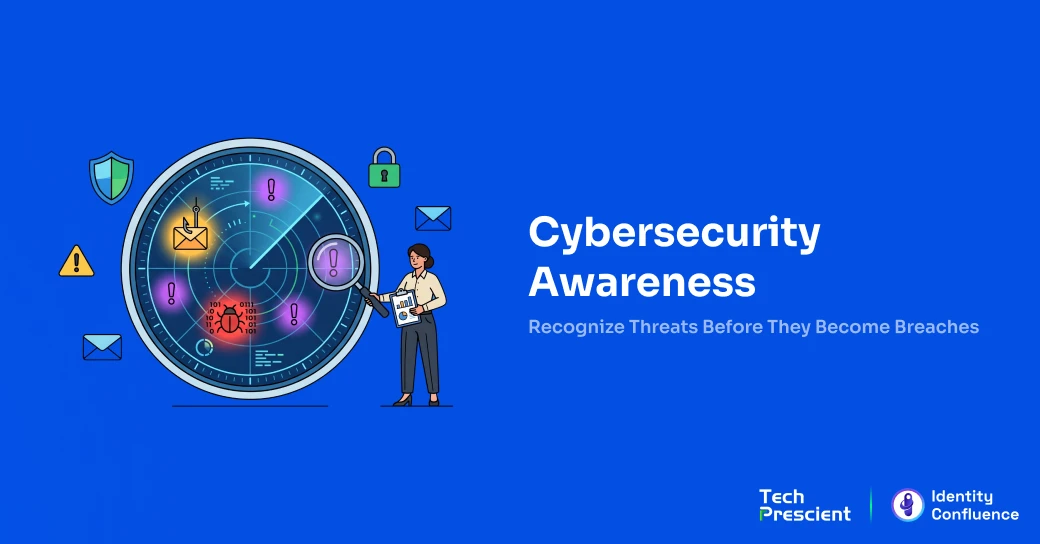
In 2026, cybersecurity awareness is no longer about teaching employees to spot a poorly worded email. Attackers now use AI to generate personalized phishing messages in minutes, clone executive voices, and impersonate colleagues on live video calls. Security awareness has become a frontline security control, not a training checkbox, and this blog breaks down what a practical, measurable awareness program built for 2026 threats actually looks like.
Key Takeaways:
- Cybersecurity awareness is a continuous behavioral discipline, not a one-time training activity
- Human behavior and credential misuse are now the primary attack surface, not software vulnerabilities
- AI-powered phishing, deepfakes, and voice cloning have redefined the threat landscape
- Effective awareness must integrate with identity security controls like MFA, access governance, and least privilege
- Programs that measure behavior reduce risk; programs that track completion do not
Cybersecurity awareness is no longer optional; it is a core security control. But awareness alone is not enough. Without identity governance to control access and enforce least privilege, even a well-trained employee's mistake can escalate into a major breach.
What Is Cybersecurity Awareness in 2026?
Cybersecurity awareness is the ongoing state of vigilance and secure behavior that individuals maintain in daily digital interactions. It enables them to recognize cyber threats, avoid risky actions, and protect the systems, data, and identities they work with every day.
This distinction is critical. Awareness is not the same as completing a training module. It is the result of consistent education, reinforced behavior, and practical experience. It shows up in how people actually act when they receive a suspicious email, an unusual access request, or an unexpected video call from a senior leader.
In 2026, cyber awareness must cover a much wider threat landscape than it did three years ago. Social engineering awareness now requires employees to question AI-generated voice calls, deepfake video conferences, and hyper-personalized email threads referencing real colleagues by name. The playbook has changed. Awareness programs have to change with it.
At an organizational level, cybersecurity awareness is the foundation that makes every other security investment work. Your organization can deploy the best identity governance platform available, but if an employee approves MFA push notifications without verifying the actual login request, that control is compromised.
Cybersecurity Awareness vs Cybersecurity Knowledge
Cybersecurity knowledge represents the cognitive layer: understanding what threats exist and how they work. Cybersecurity awareness is the operational layer: translating that knowledge into consistent secure behavior in practice. Both matter, but they serve entirely different functions.
The gap between knowing and doing is well-documented. Most employees are aware of cybersecurity risks yet still take actions like reusing passwords or sharing credentials. The challenge is not knowledge; it is behavior. The problem is not missing cybersecurity knowledge. The problem is that knowledge has not become behavior.
Why Cybersecurity Awareness Is More Important Than Ever
The case for cybersecurity awareness in 2026 rests on a straightforward observation: attackers have shifted focus from technical vulnerabilities to human vulnerabilities because humans are faster and more reliable to exploit than most security controls.
Technical defenses have genuinely improved over the past decade. Attackers adapted in response. Social engineering, phishing, credential theft, and identity exploitation became the dominant initial access vectors across industries. The human is now the primary attack surface.
AI-Driven Threats and Deepfakes
AI-driven threats are cyberattacks that use artificial intelligence to generate, personalize, or scale deceptive content, including phishing emails, synthetic voices, and deepfake video, to deceive individuals into taking harmful actions.
AI has dramatically increased the scale and sophistication of cyberattacks. Phishing emails are now highly personalized, created in minutes, and often indistinguishable from legitimate communication. Voice-based attacks and impersonation attempts are also rising rapidly due to AI-driven automation.
Deepfake attacks are increasing rapidly, with organizations reporting real incidents involving the impersonation of executives during financial approvals. These attacks bypass traditional verification methods and require new awareness protocols.
Human Error Remains the Weakest Link
Human error in cybersecurity refers to unintentional actions by employees that create security vulnerabilities: clicking phishing links, reusing passwords, sharing credentials, or approving unverified requests.
Credential-based intrusions remain the dominant entry path because they consistently succeed. The access broker market, where stolen valid credentials are bought and sold, has grown substantially year over year. Remote and hybrid work expands the risk further: employees access enterprise systems from personal devices and home networks, where verification habits are more casual. Most breaches remain undetected for extended periods, and delays in reporting significantly increase both impact and recovery cost. Fast incident reporting directly compresses that timeline and reduces cost.
Other persistent human risk patterns that awareness programs must address:
- Password reuse across work and personal accounts, enabling credential stuffing at scale
- Shadow IT using unapproved apps to share or store sensitive data, bypassing access governance entirely
- Privilege misuse; accessing systems beyond what a role requires due to insufficient identity lifecycle management
- Slow or absent incident reporting, which extends attacker dwell time and widens breach scope
Employees with excessive access permissions dramatically increase the blast radius of any security incident when credentials are compromised. Most enterprises discover this only after an incident, not before. Regular access certifications and least-privilege enforcement are the controls that close this gap before it becomes a breach.
Financial, Reputational, and Compliance Impact
The financial impact of poor cybersecurity awareness refers to the direct and indirect costs an organization incurs when human-enabled incidents lead to data breaches, regulatory penalties, or operational disruption.
The IBM 2025 Cost of a Data Breach Report puts the global average cost of a data breach at USD $4.44 million, with phishing consistently among the costliest breach vectors. Regulatory pressure compounds this: GDPR, HIPAA, SOX, and ISO 27001 enforcement actions consistently cite insufficient employee security awareness and inadequate access controls as contributing factors. Regulators are increasingly treating awareness program maturity as a direct indicator of organizational security responsibility, not just a compliance checkbox.
How does your organization's cybersecurity posture actually compare?
See where your identity risk, Zero Trust maturity, and ransomware resilience stand against 2026 benchmarks.
Cybersecurity Awareness vs Security Awareness Training
Cybersecurity awareness is the sustained state of informed, secure behavior individuals maintain in their daily work. Security awareness training is the structured program designed to develop and reinforce that state. Training is an input. Awareness is the outcome.
Most enterprises invest in training, but far fewer achieve true cybersecurity awareness. Annual compliance modules transfer knowledge. They do not reliably change behavior. Research consistently shows that training improves knowledge, but without continuous reinforcement, it does not reliably change behavior.
| Dimension | Cybersecurity Awareness | Security Awareness Training |
|---|---|---|
| What it is | A sustained behavioral state | A structured educational program |
| Duration | Continuous, always-on | Periodic: monthly, quarterly, or annual |
| Goal | Long-term secure behavior | Knowledge transfer |
| Measurement | Click rates, report rates, incident behavior | Quiz scores, module completions |
| Delivery | Simulations, nudges, real-time feedback | Courses, videos, workshops |
| Risk it addresses | Habitual, everyday behavior | Knowledge gaps |
Key Cyber Threats Driving Awareness Programs in 2026
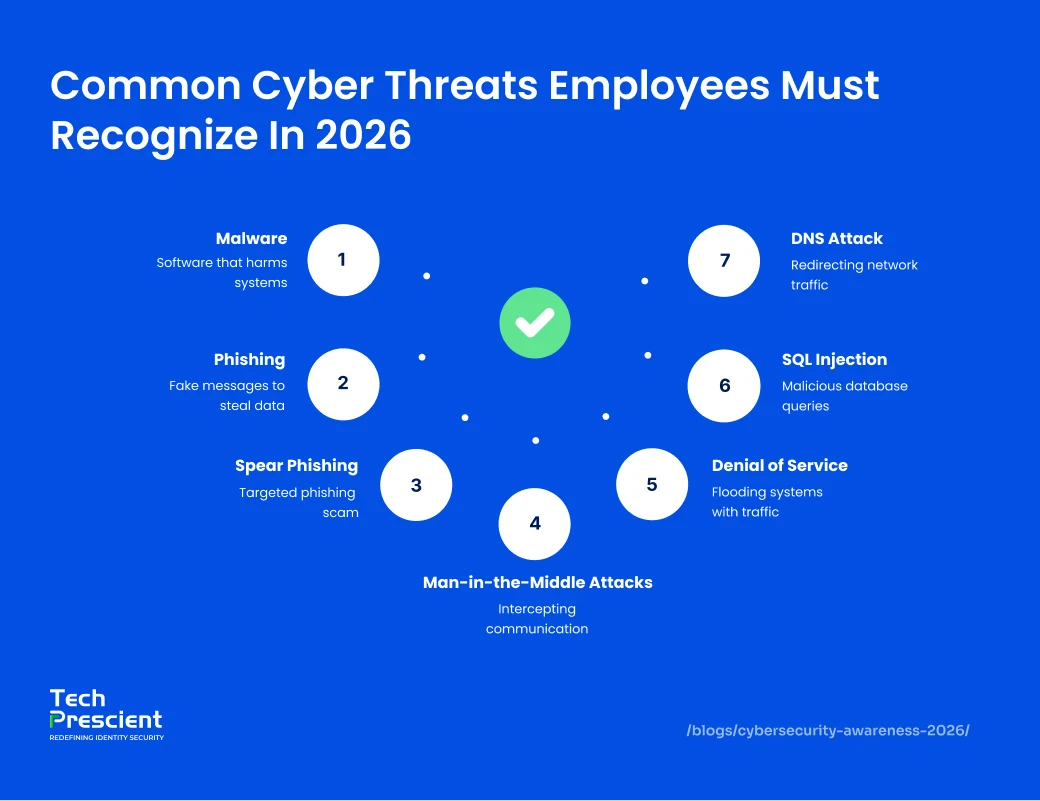
The threats that security awareness training must address in 2026 have shifted significantly. Programs designed around traditional email phishing recognition are now structurally incomplete given the convergence of AI-generated attacks, expanded cloud environments, remote work, and sophisticated identity targeting.
AI-Powered Phishing and Social Engineering
AI-powered phishing refers to attacks where generative AI is used to research targets, craft personalized messages, and scale social engineering at near-zero cost, fundamentally changing the economics of social engineering.
AI-generated phishing emails achieve significantly higher engagement rates than traditional attacks, making them more effective and harder to detect. The FBI IC3 2024 Annual Report recorded $16.6 billion in total cybercrime losses in 2024, with business email compromise alone accounting for $2.77 billion across more than 21,000 incidents. Awareness programs must train employees to recognize AI-generated patterns: highly personalized language, unusual urgency around financial approvals, and requests to bypass standard verification.
Deepfake Identity Impersonation
Deepfake identity impersonation uses AI-generated synthetic video or audio to create convincing false representations of real people, typically for fraud or unauthorized approval of financial or access-related decisions.
Employees are trained to verify email senders and URLs, but rarely trained to question whether a person on a video call is real. Security teams are increasingly encountering deepfake-related threats, especially in high-risk roles such as finance and executive leadership. Awareness programs must include training on deepfake video indicators and must establish a clear cultural expectation: verifying a senior leader's identity before approving a large transaction is required protocol, not an inconvenience.

Security Insight
Most insider threat damage, accidental or malicious, is amplified by over-provisioned access that was never revoked. Integrating awareness program outcomes, such as repeat simulation failures, with automated access review triggers allows security teams to act before an incident occurs rather than after.
Cloud, SaaS, and Remote Work Risks
Cloud and SaaS security risks in a cybersecurity awareness context refer to vulnerabilities created when employees use cloud applications or SaaS platforms without adequate security practices: misconfigured permissions, credential reuse, and unsanctioned application use.
Cloud-based attacks are increasing rapidly, with many incidents involving valid account access rather than system vulnerabilities. In most cases, attackers are not exploiting software vulnerabilities, they are logging in using credentials employees have already exposed. This is where identity lifecycle management and cyber awareness must work in tandem: automated deprovisioning, just-in-time provisioning, and regular access certifications reduce the blast radius when awareness fails.
Insider Threats: Accidental and Malicious
An insider threat is a security risk originating from within the organization, from employees or partners with legitimate access who either misuse it intentionally or create vulnerabilities through careless behavior.
Proofpoint's 2025 phishing simulation research found that only 18.3% of simulated phishing emails were properly reported by employees, meaning over 80% of suspicious communications were clicked or silently ignored. Security awareness training reduces accidental insider risk. Identity governance controls, particularly least privilege access and automated access certifications, limit what any single employee can reach, which constrains damage, whether the insider threat is accidental or deliberate.
What Effective Cybersecurity Awareness Looks Like in 2026
Effective cybersecurity awareness is a measurable, continuous security discipline that combines role-based education, continuous behavioral reinforcement, simulated attack scenarios, and integration with identity security controls. The goal is a security culture where employees actively reduce risk rather than unknowingly introduce it.
Role-based training that reflects actual threat exposure is the foundation. Finance teams face BEC and wire transfer fraud. IT and helpdesk staff face social engineering targeting privileged access. Executives face deepfake impersonation. HRIS leads managing joiner-mover-leaver workflows need to understand that access provisioning decisions carry direct security consequences. Effective programs segment training by threat exposure so each role gets content calibrated to the attacks they are most likely to face.
Phishing simulations with behavioral feedback are the core engine of behavioral change. Phishing simulations show that untrained employees are highly vulnerable to attacks, but continuous training significantly reduces risk over time. The behavioral feedback element is critical: employees who click a simulated phishing link must receive immediate, specific feedback explaining what the indicators were and what to do next time.
Integration with identity governance and access controls is the connection most awareness programs miss. When an employee consistently fails phishing simulations, that behavioral signal should feed into the identity governance layer: temporarily reducing access privileges, increasing MFA verification frequency, or restricting sensitive system access until the risk is addressed. Platforms like Tech Prescient's Identity Confluence connect awareness outcomes with identity governance by automating user provisioning, enforcing least privilege, and running continuous access certifications across systems.
The Business Impact of Strong Cybersecurity Awareness
The business impact of strong cybersecurity awareness is reflected in measurable risk reduction, compliance improvement, and breach cost avoidance, all directly attributable to changes in employee behavior over time.
Reduced phishing success rates. Sustained security awareness training reduces phish-prone rates from one-third of the workforce to under 5% over 12 months, per KnowBe4's benchmarking data above. That directly translates to fewer credential theft incidents, fewer ransomware deployments, and fewer BEC events reaching the organization.
Faster incident reporting and lower breach costs. Enterprises with strong security cultures see employees report suspicious activity faster, compressing attacker dwell time. Organizations that combine human awareness with automation detect and respond to threats faster, reducing overall breach impact.
Stronger compliance posture. SOX, HIPAA, GDPR, and ISO 27001 all require documented security awareness programs. Enterprises with mature programs have cleaner training records, better access review trails, and faster incident response timelines, all of which carry real weight during regulatory audits.
Reduced insider risk. When employees understand the access they hold, the data they are responsible for, and the consequences of misuse, they make fewer accidental errors. Combined with identity governance controls enforcing least privilege and automated access certifications, awareness reduces both the probability and blast radius of insider incidents.
Best Practices to Build Cybersecurity Awareness in 2026
Building effective cybersecurity awareness requires a program that is continuous, measurable, role-specific, and integrated with the organization's identity security and access governance strategy. A standalone annual training exercise is not enough.
Move from annual training to a continuous cadence
Monthly simulations, quarterly topic-specific modules, and just-in-time learning triggered by real or simulated incidents produce lasting behavior change. Map frequency to role risk level.
Track behavioral metrics, not completion rates
Replace module completions with: phishing simulation click and report rates by department, MFA challenge failure rates, time-to-report on incidents, and access anomaly rates flagged by identity governance systems.
Segment training by threat profile and role
Finance, IT, HR, executive, and general employee roles face distinct threat landscapes. Role-based cybersecurity awareness training is more relevant, more engaging, and more measurably effective than a uniform program.
Add deepfake and voice phishing to simulations
Standard phishing simulations are the minimum. Effective programs in 2026 add vishing drills, deepfake video recognition exercises for executives and finance teams, and social engineering attempts via internal messaging platforms. Each must include immediate behavioral feedback.
Write security policies in plain language
Every security policy should answer three questions: What should I do? What should I not do? Who do I contact when unsure? Policies that require legal interpretation do not change behavior.
Connect awareness outcomes to identity governance controls
Treat human risk data as a governance input. Employees flagged for high-risk behavior should trigger access reviews. Privilege escalation requests from high-risk users should require additional verification.
Align with Zero Trust architecture
Zero trust security trusts no user or device by default. Awareness training ensures employees understand why verification requests occur and recognize when an unexpected verification step is itself a social engineering attack.
Secure visible leadership participation
CISOs, CTOs, and business unit heads must participate in the same simulations as the rest of the workforce. Acknowledging when senior leaders fail simulations removes the cultural exemption that quietly undermines most security awareness programs.
Final Thoughts
Running awareness programs in isolation from your identity governance controls does not scale. Employees get trained, but access reviews get skipped. Simulations run, but overprivileged accounts remain untouched. And when a breach occurs, the blast radius is far larger than it needed to be.
Tech Prescient's Identity Confluence connects cybersecurity awareness with identity governance by controlling access, enforcing least privilege, and continuously monitoring user risk, ensuring that human errors do not escalate into enterprise-wide breaches.
FAQs
Cybersecurity awareness is the ability to recognize cyber threats and follow safe digital practices to protect systems, data, and identities. It is the behavioral state that results from consistent training, experience, and reinforcement, not just knowing what threats exist.
The CrowdStrike 2026 Global Threat Report found that 82% of cyberattack detections in 2025 were malware-free, with adversaries relying on valid credentials, identity exploitation, and social engineering. Technical controls cannot fully prevent threats that abuse legitimate access and human trust. Awareness is the control that addresses the human layer directly.
Security awareness training is the structured program that transfers knowledge and provides simulated experience. Cybersecurity awareness is the behavioral outcome that results from training, reinforcement, and practice over time. Awareness only develops when knowledge becomes consistent daily behavior.
Responsibility is shared. Organizations provide structured training programs, role-specific threat education, regular simulations, and clear security policies. Employees are responsible for applying that training: reporting suspicious activity, verifying unusual requests, and following access and data security policies.
For most enterprise roles, security awareness training should be continuous: monthly phishing simulations, quarterly topic-specific modules, and real-time feedback on any incident. High-exposure roles including finance, IT administration, and executives warrant higher-frequency touchpoints given their disproportionate targeting.
Identity security controls including MFA, least privilege access, and automated access certifications are most effective when employees understand why those controls exist and cooperate with them. When awareness failures occur, those behavioral signals should feed into identity governance systems to trigger access reviews, increase verification requirements, or restrict sensitive system access until the risk is resolved.
The most common human risk pathways include clicking phishing links, credential reuse across work and personal accounts, approving MFA push notifications without verifying the login source, failing to report suspicious activity, and misconfiguring access permissions in cloud and SaaS environments. These are not edge cases; they are the primary initial access vectors across most documented enterprise breaches.
Human risk in cybersecurity refers to the aggregate probability that employee behavior, through error, deception, or intentional misuse, results in a security incident. It is measured using phishing simulation rates, incident reporting frequencies, and behavioral anomaly data from identity and access management systems. Managing it requires both security awareness programs and identity governance controls that limit damage when behavior fails.
Share



Brinda Bhatt
Digital Marketing Strategist
A Digital Marketing Strategist who makes complex identity governance accessible to security and technology leaders through clear, data-driven content. Her insight-led, audience-focused approach supports Tech Prescient's mission of redefining identity security for modern enterprises.
Most Popular Blogs
Identity Security· 21 min read
Data Access Governance Solutions: How to Secure Sensitive Data at Scale
Compare data access governance solutions for 2026: how DAG platforms discover sensitive data, run access reviews, automate remediation, and prove compliance.
Brinda Bhatt· September 7, 2026
Identity Security· 24 min read
What Is Zero Trust Network Access (ZTNA)?
Learn what Zero Trust Network Access (ZTNA) is, how it works, and why it’s replacing VPNs for secure, identity-based access control.
Yatin Laygude· August 14, 2026
Identity Security· 24 min read
Cyber Essentials Certification: Complete Guide
Learn Cyber Essentials certification, cost, requirements, and steps. Compare Cyber Essentials vs Plus and get certified faster.
Yatin Laygude· August 10, 2026