




On this page
See Tech Prescient in Action
Automate access, reduce risk, and stay audit-ready
RBAC works best for organizations with stable roles and predictable access needs.
ABAC is ideal for dynamic, context-aware access decisions based on user, resource, and environmental attributes.
PBAC is best suited for compliance-driven environments where business policies directly govern access.
Modern enterprises must balance strong security controls with flexible access across cloud, SaaS, and hybrid environments. As businesses transition to more advanced IT infrastructures, where 89% of companies have multi-cloud plans, selecting an appropriate access control model directly impacts security posture, compliance obligations, and operational efficiency.
This article compares three widely adopted access control models:
- Role-Based Access Control (RBAC) - Access is granted based on predefined organizational roles.
- Attribute-Based Access Control (ABAC) - Access is granted based on several user, resource, and environmental attributes.
- Policy-Based Access Control (PBAC) - Dynamic business policies and rules-based access.
The access control model an organization adopts influences its security posture, compliance readiness, and administrative overhead. Although RBAC, ABAC, PBAC, and other access control models share the same overall objective of enabling safe authorization and restricting access to computer resources, the underlying mechanisms do make a significant difference to both enterprise-scale cybersecurity resilience as well as to cost of ownership.
Key Takeaways:
- What each model does - RBAC uses predefined roles, ABAC evaluates multiple attributes, PBAC applies business policies
- Pros and cons comparison - Implementation complexity, flexibility levels, and management overhead for each approach
- Best fit scenarios - When to choose RBAC (stable hierarchies), ABAC (dynamic environments), or PBAC (compliance-heavy)
- Real-world examples - DevOps teams using RBAC, healthcare with ABAC geolocation controls, financial services emergency access via PBAC
- Decision framework - Evaluation checklist covering security needs, organizational complexity, and regulatory requirements
- Hybrid approaches - How to combine multiple models for layered security and balanced complexity
- Implementation guidance - Practical steps for choosing and deploying the right access control strategy
- Tools and platforms - Modern IGA solutions that support multiple access control models
What Is Role-Based Access Control (RBAC)?
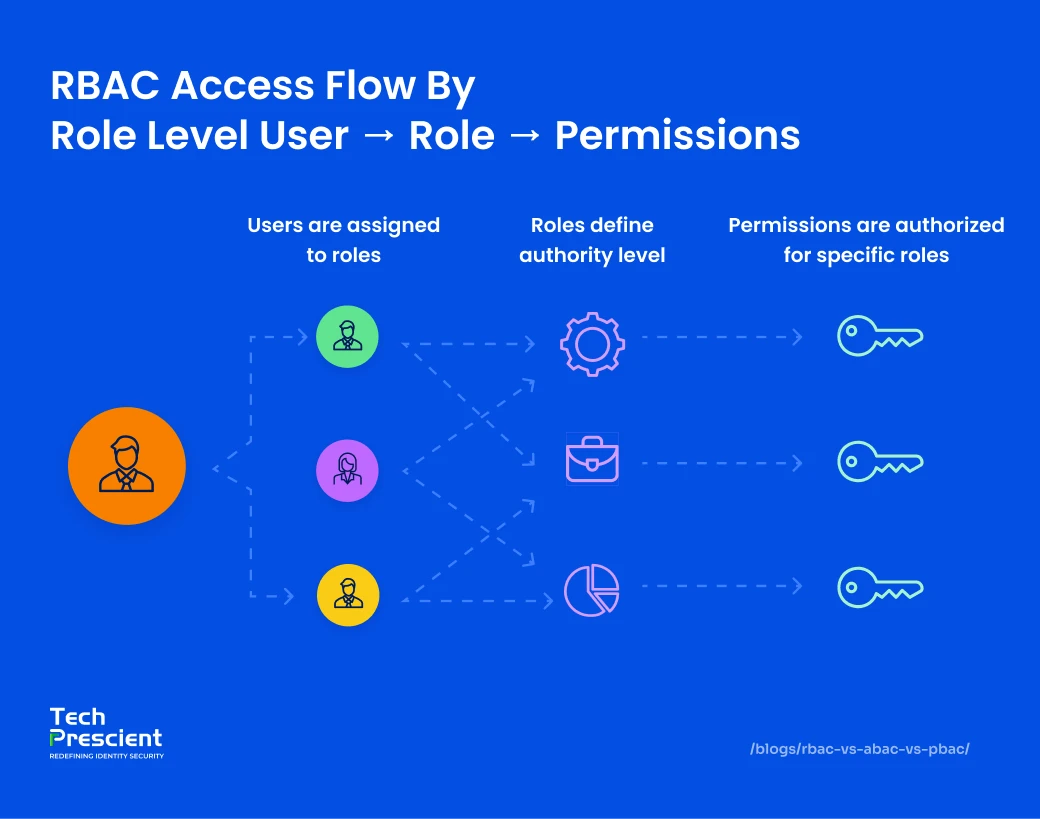
Role-Based Access Control (RBAC) grants access permissions based on predefined organizational roles rather than individual user attributes. RBAC answers the question: "What can someone access based on their job role?" RBAC depends on predefined roles, each with a unique set of permissions, where any employee designated to a particular role will have the same level of access to resources as any other person who shares that designation. Rather than managing permissions for individual users, RBAC groups users into roles that correspond to job functions, with each role carrying a specific set of permissions that align with organizational responsibilities.
RBAC is an example of coarse-grained authorization, meaning that specific attributes of the authorization request, such as time and location, cannot be taken into account within an RBAC framework. As organizations scale, RBAC can introduce administrative complexity, as even minor access variations may require the creation of additional roles. Additionally, RBAC introduces scalability issues as new roles and positions are added to the company structure, potentially leading to role proliferation and administrative complexity.
Definition and RBAC Basics
RBAC is widely used in businesses because of its simplicity and ease of use, operating on three fundamental elements that create a structured access control system.
Core RBAC Components:
- Users: Individual accounts within the organization requiring system access
- Roles: Functional categories that reflect job responsibilities and organizational hierarchy
- Permissions: Specific actions users can perform on resources (read, write, execute, delete)
How RBAC Works: The power of RBAC lies in its abstraction layer, where roles act as a set of entitlements or permissions, significantly simplifying access management and enabling organizations to assign one role to hundreds of users. This approach becomes particularly valuable for scaling organizations, as adding new employees requires simply assigning appropriate roles rather than configuring individual permissions.
Real-World RBAC Example: Consider a financial services organization implementing RBAC across its trading platform:
- "Senior Financial Analyst" role: Access to market data feeds, execute trade recommendations within specific limits, and generate client portfolio reports
- "Compliance Officer" role: Access to audit logs, regulatory reporting systems, and trade monitoring tools, but restricted from direct trading capabilities
- This clear delineation ensures that each user can perform their job functions while maintaining appropriate security boundaries.
Pros: Easy to Manage, Predictable
RBAC is widely adopted due to its relatively simple administrative model, offering organizations straightforward access management with clear accountability and minimal administrative overhead.
- Predictable Security Posture: RBAC creates a predictable security environment where access patterns follow organizational structure. Security teams can easily understand and verify that users have appropriate access levels based on their roles, making security assessments and risk management more straightforward.
- Administrative Efficiency and Scalability: RBAC simplifies administration and increases operational efficiency by providing a streamlined approach to assigning and managing access permissions. Organizations can quickly onboard new team members by assigning existing roles, and role changes automatically propagate appropriate permissions across all connected systems. This approach is especially effective in large organizations with stable role definitions, where manual permission management would be prohibitively complex.
- Compliance and Audit Readiness: RBAC facilitates regulatory compliance by providing clear, role-based audit trails that demonstrate how access permissions align with job responsibilities. RBAC helps organizations adhere to data protection and privacy requirements set forth in myriad regulations by restricting access to resources. The automation of access based on roles also supports compliance by reducing human errors that could inadvertently expose sensitive data to unauthorized users.
Cons: Role Explosion, Lacks Context-Awareness
While RBAC offers simplicity, it struggles with organizational complexity and cannot adapt to dynamic business environments or contextual security requirements.
- Role Explosion Challenges: Some teams attempt to sidestep problems by defining increasingly fine-grained roles, creating ad hoc roles as new needs emerge, or assigning too many roles to individual users. This role explosion occurs when real-world job functions differ from policy documents, even in minor ways, leading organizations to create numerous overlapping roles that become difficult to manage and maintain.
- Limited Environmental Awareness: RBAC depends on predefined roles and cannot take into account specific attributes of the authorization request, such as time and location. This limitation becomes problematic in modern work environments where context matters significantly for security decisions. For instance, RBAC cannot automatically restrict access when users work from untrusted networks or during unusual hours, potentially creating security vulnerabilities.
- Rigidity in Dynamic Environments: RBAC can become restrictive in environments where access requirements change frequently, and organizations grow, teams expand, and access needs shift. Roles defined early in an RBAC implementation may become misaligned with evolving business needs. Modern organizations with cross-functional teams, project-based work, and rapidly changing business requirements often find RBAC too inflexible to accommodate their evolving needs without constant administrative overhead.
What Is Attribute-Based Access Control (ABAC)?
The difference between RBAC and ABAC stems from the way each method manages access. Unlike RBAC, which grants access according to predefined roles, ABAC is a security policy that relies on a combination of attributes to match users with the resources they need to do a job. Rather than relying solely on roles, ABAC evaluates multiple attributes related to the user, resource, and environment. This approach enables organizations to define access policies that adapt to contextual and environmental conditions.
Key Components
- Subject Attributes and User Characteristics: Subject attributes encompass all characteristics of the requesting entity, including traditional role information but extending far beyond to include department affiliation, security clearance levels, employment status, geographic location, and even dynamic factors like current project assignments or temporary access grants.
- Attributes are the characteristics of the subject, object, or the environment parameters. For example: department = "Finance", job_title = "Manager", employment_status = "Full-Time".
- Resource and Object Attributes: Resources possess their own attributes that influence access decisions, such as data classification levels (public, internal, confidential, restricted), creation timestamps, owner information, geographic storage location, and sensitivity markers.
- These attributes enable fine-grained control over data access based on the nature and classification of the information being requested.
- Environmental Context and Conditions: ABAC allows admins to implement smart access restrictions that account for context, for instance, HR employees may only have access to sensitive information at certain times or only for staff in the relevant branch office. Environmental attributes include time of access, network location, device security posture, current threat intelligence levels, and even business context like whether emergency procedures are in effect.
- Action Types and Operation Scope: Actions in ABAC go beyond simple read/write permissions to include specific operations like share, export, modify, delete, or execute, along with scope limitations such as duration of access, number of records that can be accessed, or whether data can be downloaded versus only viewed online.
Example: HR Staff Accessing Data Only from Secure Networks
Consider a multinational corporation implementing ABAC for human resources data access. An HR specialist in the European office requests access to employee salary information for annual review purposes. The ABAC system evaluates multiple attributes simultaneously: the user's role as "HR Specialist," their geographic assignment to "Europe Region," the resource classification as "Salary Data - Confidential," the requested action of "Read with Limited Export," and environmental factors including access from a "Corporate Network" during "Business Hours" using a "Managed Device."
The policy might state: "Grant access to salary data IF user department equals HR AND user region matches data region AND network classification equals corporate AND device compliance status equals verified AND current time falls within business hours." This multifaceted evaluation ensures that access is granted only when all contextual factors align with security requirements.
Pros
ABAC delivers superior flexibility and security by evaluating multiple attributes to make intelligent, context-sensitive access decisions that adapt automatically to changing business conditions.
- Fine-Grained Access Control: ABAC offers a robust solution for controlling data access with unprecedented granular control by enabling organizations to create highly specific policies that consider multiple contextual factors simultaneously. This granularity extends beyond traditional role-based limitations to encompass real-world scenarios where access needs vary based on circumstances rather than just job titles.
- Flexibility and Easy Adaptation: ABAC policies can be adapted as users, resources, and contextual requirements change, provided attribute models are well maintained. Rather than modifying complex rules or creating new roles, administrators need only assign the relevant attributes to new users or resources. This flexibility means that when a new employee joins or when business requirements evolve, access control adapts automatically without requiring policy rewrites or system reconfigurations.
- Security with Context-Sensitive Rules: ABAC allows administrators to create context-sensitive security rules as needs arise, enabling them to protect user privacy and adhere to compliance requirements without requiring a high degree of technical knowledge. Attribute-based policies can align more closely with business context, though effective management typically requires governance and technical oversight, as they can work with familiar business concepts like department, location, and job function rather than complex technical configurations.
- Dynamic and Adaptive Decision Making: ABAC enables organizations to create dynamic, context-aware access control policies that automatically adapt to changing conditions without manual intervention. For example, the system can automatically restrict access when users travel to high-risk countries or enhance security requirements during incident response procedures, providing real-time protection based on current circumstances.
Cons
- Policy Development and Management Complexity: Developing and maintaining ABAC policies can be complex due to the multitude of attributes and conditions that need to be considered. Organizations must carefully design policies to avoid conflicts while ensuring that access decisions remain both accurate and efficient, requiring specialized expertise and ongoing maintenance efforts.
- Implementation and Resource Requirements: ABAC often requires significant upfront design effort and coordination across teams. Admins need to manually define attributes, assign them to every component, and create a central policy engine that determines what attributes are allowed to do, based on various conditions. The initial setup requires significant investment in infrastructure, training, and policy design, which may present challenges for organizations with limited security or engineering resources.
- Performance and Scalability Considerations: The complexity of evaluating multiple attributes in real-time can introduce latency and performance challenges, particularly in high-transaction environments. Organizations must invest in robust infrastructure to ensure that the benefits of fine-grained control don't come at the cost of system responsiveness and user experience.
What Is Policy-Based Access Control (PBAC)?
Policy-Based Access Control (PBAC) enforces access decisions based on centralized business policies rather than static roles or attributes alone. PBAC evaluates access requests in real time against centrally defined business and security policies. Unlike static role assignments (RBAC) or purely attribute-driven models (ABAC), PBAC evaluates access requests in real time against predefined policies that reflect business logic, security requirements, and regulatory obligations. This approach allows organizations to translate business requirements directly into technical enforcement rules, while maintaining both flexibility and compliance alignment.
Role of Policy Languages (e.g., Rego, XACML)
- XACML (eXtensible Access Control Markup Language): XACML defines an architecture, a policy language, and a request/response scheme that has become the industry standard for enterprise policy-based access control implementations. XACML enables organizations to create complex, hierarchical policies that can be shared across different systems and applications, providing a standardized approach to policy definition and enforcement.
- Rego and Open Policy Agent Integration: Modern cloud-native environments often leverage Rego, the declarative language used by Open Policy Agent (OPA), which allows organizations to write policies as code that can be version-controlled, tested, and deployed alongside applications. This approach enables DevOps teams to integrate security policies directly into their continuous integration and deployment pipelines.
- Policy as Code Methodology: The PBAC model uses a methodology called policy as code (PaC), meaning that policy can be written directly into code. It reduces manual enforcement effort by embedding access policies directly into governance and deployment workflows and merging into the code, automating its processes along the way. This methodology ensures that policies are consistently applied, easily auditable, and can evolve alongside business requirements without manual intervention.
Example: MFA Required + Network Check Before Allowing Access
A financial services organization creates a PBAC policy that states, "Any financial transaction requires multi-factor authentication AND must originate from a secure network location."
What makes this PBAC: Instead of creating separate roles for different scenarios, the organization writes one business policy that automatically adapts to different situations:
Policy in Plain Language:
IF user attempts financial transaction
AND transaction value > $10,000
AND time = outside business hours
THEN require enhanced MFA + supervisor approval + secure network verification
ELSE IF transaction value < $10,000
THEN require standard MFA + network verification
Why This Shows PBAC Benefits:
- Business-driven: Policy reflects actual business risk management, not technical roles
- Adaptive: Same policy handles different transaction values and times automatically
- Centralized: One policy rule governs all financial transactions across all systems
- Auditable: Clear business logic for compliance teams to understand and verify
This demonstrates how PBAC translates business requirements directly into technical access controls, unlike RBAC (which would need separate roles for each scenario) or ABAC (which would require complex attribute combinations).
Pros: Centralized Control, Adaptable
- Granular Control and Flexibility: PBAC allows administrators to define policies by which access may be coarse-grained or fine-grained based on the specific business requirements. Companies may have highly granular policies for high-risk assets but less granular access policies for day-to-day operations, providing the exact level of control needed for specific situations without adding undue complexity.
- Agility and Velocity in Policy Management: PBAC makes it simple to add, remove, or change permissions by centralizing policy updates. As business conditions change or new compliance requirements emerge, admins can make quick changes without needing to change specific applications or systems, reducing deployment time by several orders of magnitude compared to manual access control changes.
- Environmental and Contextual Flexibility: Environmental and contextual controls like time-limited access (restricting access to working hours) or location-bound access (requiring corporate network access for sensitive data) can be supported by policy mapping. This offers flexibility where the access decision-making is based on true business context and security requirements that are not possible for static role-based models.
- Observability and Policy Clarity: Readable policies improve visibility into how identities, resources, and access decisions are related. Transparency enables more efficient governance and simpler auditing, and enables organizations to easily locate and remediate access issues.
- Dynamic Compliance Alignment: PBAC allows organizations to dynamically align internal policies with access controls to ensure ongoing compliance with regulatory standards like HIPAA, GDPR, and NIST. The policy-based methodology inherently enforces compliance mandates, consistency, and creates comprehensive audit trails showing how access choices correlate to business regulations and regulatory frameworks.
Cons: Complex Initial Setup, Policy Management
- Implementation Planning and Resource Requirements: Given that PBAC allows for such granular access controls, creating the policies to govern this model can be a complex task. Especially as the organization grows and access policies become more sophisticated, updating and managing them can become more resource-intensive. Organizations must invest significant effort in translating business requirements into technical policy structures.
- Technical Expertise and Tooling Needs: Implementing a PBAC system requires specialized tools and cybersecurity personnel with expertise in policy creation and enforcement. The complexity of policy languages and the need for ongoing policy maintenance requires dedicated resources and specialized training that may be challenging for smaller organizations to justify.
- System Integration and Legacy Compatibility: Updating current systems that rely on other access control models is another challenge for organizations. The process of externalizing access control logic from apps and systems and centralizing management to one policy engine is a complex task that requires diligent planning and sufficient resources.
In-Depth Comparison: How RBAC, ABAC, and PBAC Differ in Practice
Understanding the fundamental differences between these access control models enables organizations to make informed decisions based on their specific security requirements, operational constraints, and strategic objectives. Each model addresses different aspects of the access control challenge, and the optimal choice depends on organizational maturity, technical capabilities, and business context.
Expert Insight:
Access control failures rarely come from choosing the "wrong" model. They come from poor enforcement, missing lifecycle governance, and unmanaged policy sprawl. The best model is the one you can automate, monitor, and audit continuously.
Use This Table to See How Each Model Compares
| Feature | RBAC | ABAC | PBAC |
|---|---|---|---|
| Access Basis | Predefined organizational roles | Checks user, resource, and contextual attributes | Business policies and rules |
| Flexibility | Low to Moderate | High | Very High |
| Type of Access Control | Coarse-grained | Fine-grained | Fine-grained with business context |
| Implementation Complexity | Simple | Complex | Moderate to Complex |
| Administrative Overhead | Low | High | Moderate |
| Context Awareness | Handled through predefined roles | Evaluated dynamically using attributes | Context enforced through policy logic |
| Best for Organization Type | Stable hierarchies with defined roles | Dynamic environments require contextual decisions | Compliance-driven organizations with complex business rules |
| Scalability | Moderate (role explosion risk) | High | High |
| Real-time Adaptation | Limited | Excellent | Good to Excellent |
| Audit Complexity | Simple | Complex | Moderate |
| Business Logic Integration | Limited | Moderate | Excellent |
| Cost of Implementation | Low | High | Moderate |
| Ease of Modification | Low (role changes required) | Moderate to High (attribute updates) | High (policy updates) |
How to Interpret This Comparison:
- Choose RBAC for simplicity, predictability, and clear role ownership.
- Choose ABAC when access decisions must adapt to user context and environment.
- Choose PBAC when business policies and regulatory controls drive authorization.
Quick Explainer: When to Use Which Model
- RBAC Implementation Scenarios: Organizations should consider RBAC when they have clearly defined, stable hierarchical structures where job functions align well with traditional departmental boundaries. If your organization has a clearly defined hierarchy, or utilizes company roles to determine data access without too much consideration outside of those roles, then RBAC is suitable. This model works particularly well for established enterprises with predictable access patterns and limited need for contextual decision-making.
- ABAC Implementation Scenarios: If your organization needs to manage access across several contexts that cannot be put under a simple policy or role, especially if you also need those controls to function dynamically, then ABAC is an appropriate approach. ABAC excels in environments where access decisions must consider multiple factors such as user location, time of access, device security posture, and data sensitivity levels.
- PBAC Implementation Scenarios: If regulatory requirements or other security demands primarily determine your access controls, and you need maximum flexibility to apply those controls over different business contexts, then PBAC is a good choice. PBAC particularly benefits organizations where business policies drive security decisions and where compliance requirements necessitate sophisticated access control logic.
Real-World Use Cases: When to Use Each Model
RBAC: Role Assignment for DevOps Teams
- In a technology company managing complex software development and deployment pipelines, RBAC provides the structural foundation for organizing access across development, testing, and production environments. The organization implements distinct roles that reflect the natural hierarchy and responsibilities within their DevOps practices.
- Junior Developers receive access to development repositories with read and write permissions, limited deployment capabilities to staging environments, and access to development-specific monitoring tools. Their role restrictions prevent accidental modifications to production systems while enabling full productivity within appropriate boundaries.
- Senior Developers inherit all junior developer permissions while gaining additional capabilities including production code review authority, limited production deployment rights for emergency patches, and access to production logging systems for debugging purposes. This progressive permission structure reflects increased responsibility and experience levels.
- DevOps Engineers operate with comprehensive infrastructure management capabilities, including full access to deployment pipelines, monitoring and alerting systems, container orchestration platforms, and infrastructure-as-code repositories. Their role enables complete system management while maintaining clear accountability through role-based audit trails.
ABAC: Patient Data Access with Geolocation
A multi-location healthcare network implements ABAC to ensure patient data access complies with both HIPAA requirements and operational needs across different facilities and specialties. The system evaluates multiple attributes simultaneously to make sophisticated access decisions that reflect the complex nature of healthcare data protection.
- Physician Access Scenarios: When a cardiologist at the downtown facility requests access to a patient's medical records, the ABAC system evaluates the physician's specialty credentials, current patient assignments, facility location, time of access, and the patient's current treatment status. Access is granted only when the physician is treating the patient and the request occurs during appropriate clinical hours from an authorized medical facility.
- Emergency Access Provisions: During emergency situations, ABAC policies adapt to provide necessary access while maintaining security controls. Emergency room physicians gain temporary access to patient records regardless of their typical specialty restrictions, but these access grants are automatically logged, time-limited, and subject to post-incident review to ensure appropriate use.
- Geographic and Temporal Restrictions: The system automatically restricts access when healthcare providers attempt to view patient data from unauthorized locations or during unusual hours, while providing mechanisms for legitimate after-hours access through additional authentication and approval workflows.
PBAC: Emergency Access with Multiple Policy Checks
- A global financial services firm implements PBAC to manage emergency access procedures during critical system incidents, market disruptions, or regulatory events. The organization's business policies translate directly into technical access controls that adapt to different emergency scenarios while maintaining comprehensive oversight and compliance.
- Emergency Declaration and Escalation: When system emergencies are declared through formal incident management procedures, PBAC policies automatically adjust access permissions for designated incident response personnel. The policy framework evaluates incident severity levels, required response capabilities, and individual qualifications to grant appropriate elevated access while maintaining security boundaries.
- Multi-Factor Policy Evaluation: Emergency access requires satisfaction of multiple concurrent policies including verified identity through enhanced multi-factor authentication, supervisor approval through automated workflow systems, confirmed incident response role assignment, and real-time verification of the ongoing emergency status. Access is automatically revoked when emergency conditions no longer exist.
- Comprehensive Audit and Compliance: PBAC enables detailed logging of all emergency access activities, including justification documentation, approval chains, actions performed during elevated access periods, and automatic compliance reporting for regulatory review. This comprehensive audit capability ensures that emergency procedures meet both operational needs and regulatory requirements.
Choosing the Right Access Control for Your Organization
Selecting an appropriate access control model requires a comprehensive evaluation of organizational characteristics, security requirements, compliance obligations, and operational constraints. The decision process must extend beyond technical considerations to encompass business strategy, risk tolerance, and long-term organizational objectives.
Key Factors: Regulatory Environment, User Complexity, Audit Requirements
Regulatory Environment Assessment:
- Healthcare organizations that are HIPAA-compliant may need the high-level controls of ABAC to show that access is justified
- Financial service companies that are SOX compliant may favor RBAC's unambiguous role-based audit trails for easier reporting of compliance
- Sophisticated regulatory situations are aided by PBAC's policy-oriented system that is immediately conducive to compliance necessities
- Different industries have distinct regulatory frameworks that influence the decision of access control models
User Complexity and Organizational Structure:
- Large, complex organizations typically require more sophisticated security models like ABAC or PBAC
- Organizations with diverse user populations need flexible access control approaches
- Multiple locations and complex reporting structures favor dynamic access models
- Frequent organizational changes require adaptable access control frameworks
- Simple, stable hierarchies work well with traditional RBAC implementations
Audit Requirements and Oversight Needs:
- Organizations requiring detailed access justification benefit from ABAC's attribute-based logging capabilities
- Companies needing clear, role-based accountability prefer RBAC's straightforward audit approach
- Comprehensive audit trails and detailed reporting favor more sophisticated access control models
- Regulatory compliance requirements often dictate the level of audit granularity needed
Evaluation Checklist
Security and Risk Assessment:
- Do you need real-time access decisions based on user location?
- Is device security posture critical for your access control?
- Do network conditions affect your security requirements?
- Are time-based access restrictions necessary for your operations?
- Does your threat landscape require fine-grained permission management?
- Do different data classification levels need separate access approaches?
Operational Capability Analysis:
- What is your organization's tolerance for implementation complexity?
- Do you have technical expertise for sophisticated policy engines?
- How frequently do your access requirements change?
- What are your administrative overhead constraints?
- Can your team manage ongoing policy maintenance?
- Do you have a budget for specialized access control tools?
Future-Proofing and Scalability:
- How will business growth impact your access control needs?
- Are cloud migration initiatives planned that affect access models?
- Will digital transformation change your security requirements?
- Are regulatory requirements expected to become more stringent?
- Do you anticipate increased third-party system integrations?
- Can your chosen model accommodate future needs without complete reimplementation?
Not Sure Which Access Control Model Fits Your Organization?
Assess which access control model best fits your security, compliance, and operational needs.
Pro Tip: Modern IGA Platforms
Modern Identity Governance & Administration (IGA) platforms provide sophisticated capabilities for implementing and managing multiple access control models within unified frameworks. Combining RBAC and ABAC can provide some of the advantages of both models, enabling simple administration and assignment of permissions while also permitting increased flexibility and granularity pertaining to authorization decisions.
These platforms enable organizations to start with simpler RBAC implementations for basic access management while gradually incorporating ABAC or PBAC capabilities for sensitive resources requiring more sophisticated controls. This evolutionary approach allows organizations to build access control maturity over time without disrupting existing operations or requiring massive upfront investments.
Can You Combine RBAC, ABAC, and PBAC?
Hybrid access control models offer organizations the strategic flexibility to leverage the strengths of multiple approaches while minimizing individual weaknesses. Using both models enables simple administration and assignment of permissions while also permitting increased flexibility and granularity pertaining to authorization decisions. Rather than viewing these models as mutually exclusive, forward-thinking enterprises implement layered security architectures that apply different access control methods based on specific use cases, risk profiles, and resource sensitivity levels.
Reality Check:
Most enterprises don't fail because they lack RBAC, ABAC, or PBAC — they fail because access decisions are reviewed only after incidents. Continuous evaluation and enforcement matter more than the model itself.
Layered or Nested Models (e.g., RBAC + ABAC Conditions)
- Foundation and Enhancement Architecture: A typical hybrid approach uses RBAC as the foundational layer for basic access management based on job roles, then applies ABAC policies for sensitive resources requiring contextual evaluation. This architecture enables organizations to maintain the administrative simplicity of role-based access management while adding sophisticated attribute-based controls where business requirements demand greater precision and context awareness.
- Progressive Control Implementation: Organizations can implement progressive access controls where basic resource access follows RBAC principles, but sensitive operations require additional ABAC or PBAC policy evaluation. For example, a financial analyst might access standard reporting tools through their RBAC role assignment, but accessing personally identifiable information or executing high-value transactions triggers additional attribute-based evaluations considering factors like network location, time of access, and recent security training completion.
- Conditional Access Integration: Modern hybrid implementations often feature conditional access logic where RBAC provides baseline permissions that can be enhanced or restricted through ABAC conditions. This approach enables dynamic security postures that adapt to changing risk conditions while maintaining the predictability and manageability of role-based access structures.
Benefits of Modular Access Policies
- Administrative Efficiency with Granular Control: Hybrid approaches combine the ease of RBAC role management with the precision of attribute-based controls, reducing administrative complexity while maintaining security effectiveness. A hybrid approach following both RBAC and ABAC allows the IAM system to combine the IT and Business structures together, enabling organizations to align technical access controls with business processes and organizational structures.
- Risk-Adaptive Security Postures: Organizations can apply stricter ABAC or PBAC policies to high-risk resources while using simpler RBAC for routine access, optimizing both security and user experience. This risk-based approach ensures that security controls are proportionate to the sensitivity and value of protected resources without creating unnecessary friction for standard business operations.
- Compliance Flexibility and Audit Readiness: Different regulatory requirements can be addressed through appropriate model selection within the same overall framework. Organizations can use RBAC for clear audit trails in standard operations, ABAC for detailed attribute-based compliance in data protection scenarios, and PBAC for sophisticated policy-driven compliance in regulated industries.
Tools That Support Hybrid Frameworks
- Enterprise Identity Platforms: EmpowerID supports RBAC relational modeling that provides the backbone or structure for defining an organization and its overall policies while leveraging the flexibility and real-time contextual nature of ABAC and PBAC. These platforms enable sophisticated role and relationship modeling alongside flexible attribute-based policies, providing comprehensive hybrid implementation capabilities.
- Cloud-Native Access Control: Major cloud providers offer built-in support for hybrid access control through integrated identity and access management services. Azure ABAC builds on Azure RBAC by adding role assignment conditions based on attributes in the context of specific actions, demonstrating how cloud platforms enable progressive enhancement of role-based controls with attribute-based conditions.
- Open Source and Standards-Based Solutions: Tools like Open Policy Agent (OPA) and XACML-based policy engines enable organizations to implement unified policy frameworks supporting multiple access control paradigms through declarative policy languages, providing flexibility for custom implementations and integration with existing infrastructure.
Organizations evaluating access control maturity often assess whether existing models support scale, compliance, and risk management requirements.
Identity Confluence helps enterprises operationalize RBAC, ABAC, and PBAC through centralized policy enforcement, lifecycle-driven access, and audit-ready governance without forcing a single model across all systems.
FAQs
RBAC assigns permissions based on predefined organizational roles, while ABAC uses various attributes related to users, resources, and environment to make dynamic access decisions. The main difference between RBAC and ABAC is the way each method grants access. RBAC techniques allow you to grant access by roles. ABAC techniques let you determine access by user characteristics, object characteristics, action types, and more. RBAC simplifies access management by grouping users according to job functions but offers limited flexibility, while ABAC provides fine-grained control through multiple contextual factors but requires more complex policy management.
PBAC can provide enhanced security compared to RBAC when implemented properly because it allows for dynamic, context-aware access decisions based on business policies rather than static role assignments. PBAC's dynamic policy enforcement provides a business with the ability to adjust on the fly and stay current with changing business or legal dynamics. However, security effectiveness depends on proper implementation and policy design rather than the model choice alone, and organizations must consider their specific risk profiles and operational capabilities.
Yes, many organizations successfully combine RBAC and ABAC to leverage the advantages of both models. Many times neither RBAC or ABAC will be the perfect solution to cover all the use cases you need. That's why most organizations use a hybrid system, where high-level access is accomplished through RBAC and then fine-grained controls within that structure are accomplished through ABAC. This combination provides RBAC's administrative simplicity with ABAC's fine-grained control capabilities, enabling organizations to apply appropriate security measures based on resource sensitivity and risk levels.
Real-world PBAC implementations demonstrate the model's versatility across industries and use cases. Healthcare systems secure access to patient records based on doctor's specialty, patient location, and the type of data accessed, while financial institutions grant access to transactions based on employee role, account type, and transaction amount. Cloud computing platforms implement access control for resources based on user identity, resource type, and API calls, while zero trust security frameworks integrate PBAC to implement the principle of least privilege with continuous verification.
The choice depends on your organization's size, complexity, security needs, and operational requirements. The appropriate access control model depends on organizational structure, regulatory requirements, and the level of contextual control required. The decision must be made based on a careful analysis of the organization's specific needs and requirements. Choose RBAC for clearly defined hierarchies and stable job roles requiring simple implementation, select ABAC for fine-grained, context-aware access control with dynamic decision-making capabilities, and consider PBAC when regulatory requirements or business policies primarily drive access controls with maximum flexibility needs across different business contexts.
Share



Brinda Bhatt
Digital Marketing Strategist
A Digital Marketing Strategist who makes complex identity governance accessible to security and technology leaders through clear, data-driven content. Her insight-led, audience-focused approach supports Tech Prescient's mission of redefining identity security for modern enterprises.
Most Popular Blogs

Identity Security· 21 min read
Data Access Governance Solutions: How to Secure Sensitive Data at Scale
Compare data access governance solutions for 2026: how DAG platforms discover sensitive data, run access reviews, automate remediation, and prove compliance.
Brinda Bhatt· September 7, 2026
Identity Security· 24 min read
What Is Zero Trust Network Access (ZTNA)?
Learn what Zero Trust Network Access (ZTNA) is, how it works, and why it’s replacing VPNs for secure, identity-based access control.
Yatin Laygude· August 14, 2026
Identity Security· 24 min read
Cyber Essentials Certification: Complete Guide
Learn Cyber Essentials certification, cost, requirements, and steps. Compare Cyber Essentials vs Plus and get certified faster.
Yatin Laygude· August 10, 2026