




On this page
See Tech Prescient in Action
Automate access, reduce risk, and stay audit-ready
Introduction
Role-Based Access Control (RBAC) and PBAC (Policy-Based Access Control) are both models of access control that form the backbone of enterprise identity security, but differ greatly in how they go about doing so. RBAC provides access based on predefined roles of users in an organization, whereas PBAC relies on dynamic policies with multiple attributes and conditions to decide on access. RBAC is easier to deploy and maintain in organizations with well-defined roles, but PBAC is more flexible and provides higher granularity, so it is best suited for complicated environments.
However, most organizations are faced with a crucial decision that hinges on everything from breach mitigation to audit compliance: should you deploy Role-Based Access Control (RBAC) or Policy-Based Access Control (PBAC)?
The operational and security implications are material:
- $4.88 million – average cost to an organization for a data breach in 2024
- 72% of breaches involve privilege misuse or credentials stolen from trusted users and insiders
- 3-5 months - average time organizations take to detect unauthorized access resulting from credential abuse
While RBAC appears simple to use because it relies on role-based permissions, and PBAC is somewhat difficult because it depends on intelligent, context-based security, the discussion is often framed too narrowly:
Choosing between RBAC and PBAC is a false dilemma. Many mature enterprises combine both models strategically: they will be using RBAC for operational efficiencies and PBAC for decisions based on the risk of loss to the organization, without entering an overly complex process.
In this guide, you will learn the essential times to leverage each access control model and combine these two forms, and how platforms such as Identity Confluence are making hybrid access control attainable to organizations of any size.
RBAC assigns access based on predefined user roles, while PBAC evaluates real-time context such as location, device, time, and risk using policies. RBAC is simpler and scalable for stable environments; PBAC is more flexible and suited for dynamic, zero-trust architectures.
Key Takeaways:
- RBAC assigns access based on predefined roles: Users inherit standardized permissions through organizational roles, simplifying administration but limiting flexibility
- PBAC uses contextual, policy-driven logic: Access decisions evaluate real-time attributes like location, time, and risk scores for adaptive security
- PBAC offers flexibility, and RBAC provides simplicity: Each model's greatest strength becomes its weakness at enterprise scale
- Use both for layered identity governance: Modern IGA platforms like Identity Confluence orchestrate hybrid models for optimal security and efficiency
What Is Role-Based Access Control (RBAC)?
Role-Based Access Control (RBAC) is a method of access control that decides what a user can or cannot do according to the role that the user has been assigned. RBAC is straightforward.
You first define a role. You then allocate a set of privileges to that role. Last, you allocate the role to one or more users. For instance, you can define a role named "Finance Manager," authorize it to approve expense reports, view accounting software such as QuickBooks, and generate financial reports, and assign it to Emma, David, and Jennifer, who are all finance managers at your company. When Emma departs and Michael arrives as the new finance manager, you just delete Emma from the role and insert Michael – he automatically picks up all the correct permissions.
The fundamental concept is scalability by abstraction: RBAC minimizes administrative overhead. In a non-RBAC enterprise, permissions have to be handled one by one – in a 10,000-user, 50-application organization, there are 500,000 individual user-to-permission assignments. With RBAC, the organization deals with user-to-role assignments for about 100 roles. This is a 97% decrease in administrative overhead.
But RBAC presumes that access requirements are stable, predictable, and static. The contemporary workforce introduces structural challenges to this assumption. Contractors come and go for discrete projects with limited lifespans, employees rotate between teams within, and remote workers use multiple systems from different devices and locations. These mobile situations tend to create "role sprawl," as organizations implement exception-based roles to support shifting access demands, ultimately eroding RBAC's simplicity.
Identity Confluence insight: Organizations have begun to realize there is no longer an either/or discussion between RBAC and PBAC. Rather, organizations are beginning to understand that RBAC and PBAC are more complementary than they are adversaries, and using both strategically is ultimately for the best. RBAC is the foundation of permissioning, to ensure people have access tied to their job functions at an organizational scale, while PBAC is the complement to provide the context: checking the device, the location, the time, or the risk level before providing access.
By using RBAC and PBAC together, organizations can avoid the need to create an excessive number of exception-based roles to accommodate edge cases. With proper policies, many exceptions can be handled automatically. It's also about not having fewer roles, but rather healthier roles that serve a clear, organizational purpose through automated lifecycle management.
Smart organizations are beginning to track "role health": how often are roles required to have exceptions, how quickly does access get removed from unused or excessive usage, and how much access does everyone have that is dormant? RBAC handles the structure of access, while PBAC gets to the "why" of every access decision.
Identity Confluence makes this practical because it allows users to attach policies directly to the roles, set clear examination of temporary access with auto-expiry, and retain clear audit trails. Stronger security with less confusion.
How It Works: Role definitions and permission assignments
How RBAC Works: A 4-Step Process
Implementing RBAC is a step-by-step process that converts cumbersome permission management into efficient access control:
Define Roles
Determine the various job functions in your organization. For instance, in a hospital, you may have roles such as doctor, nurse, and receptionist, each with different responsibilities and access requirements.
Grant Permissions to Roles
Define the precise permissions for each role. A Doctor may have permission to view and modify patient records, prescribe medication, and view lab results, while a nurse may only be granted permission to view patient records and modify vital signs.
Map Users to Roles
Map users to their respective roles depending on job functions. As Emma becomes a new nurse, she gets mapped to the "Nurse" role and consequently gains all related permissions.
Access Control
When a user tries to access a resource, the system verifies the roles assigned to the user and their related permissions to decide whether to give access.
This 3-tier architecture (permissions → roles → users) insulates the administrator from the burden of dealing with direct permissions. Roles are the "heavy lift", but once defined, placing roles on users is a quick one-step task. Contemporary IGA solutions build on this foundation with analytics, detection of duplicate roles, role optimization recommendations, and detection of anomalous permission combinations that are security threats.
RBAC Use Case Example: Managers editing files; users with view-only rights
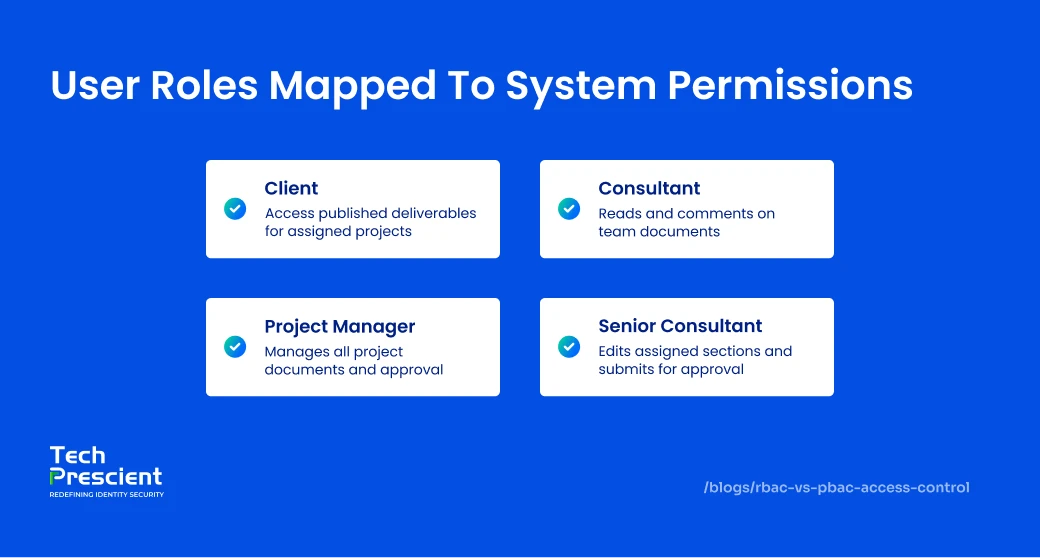
Imagine a global consulting company dealing with thousands of project deliverables between teams distributed around the world. Project managers need overall control of project documentation, creating proposals, drafting Statements of Work, altering project plans, and archiving closed project deliverables. Team members need read access so they can keep current and write their sections but should not have the power to change formal documents without assent. External collaborative clients need access to selected deliverables relevant to their project without accessing internal planning documents or other clients' materials.
RBAC elegantly models this hierarchical access structure:
- Project Manager Role: Create, read, update, and delete all project documents; approve team submissions; grant temporary edit access
- Senior Consultant Role: Read all project documents; edit assigned sections; submit documents for approval
- Consultant Role: Read team documents; edit personal assignments; comment on shared documents
- Client Role: Read published deliverables for assigned projects only; download approved documents
Imagine a person named Emma moves from Consultant to Senior Consultant to Project Manager; her permissions will automatically change across all systems that are connected. The only thing the IT team needs to do is simply edit her role within Identity Confluence; the changes will be made for them through automated provisioning workflows. No manual permission updates, no access request tickets, no delays that impact her productivity. With the platform's Business Role Management module, various roles and hierarchies are visible, making it easy to show an auditor what each person has access to and ensure that the right levels of access are in place.
Advantages of RBAC
The main advantage of RBAC is its transparency, predictability, and simplicity. By clustering access rights under roles, auditors and administrators can quickly prove why a user is granted specific permissions. This access entitlement clarity is important in regulated applications where an audit team requires clear and logical entitlement reasons without delving into permission clutter.
- Enhances Security: RBAC limits the access of users to the minimal levels necessary to carry out a task. This assists organizations in implementing security best practices such as the principle of least privilege (PoLP), which reduces the risk of data breach and data leakage. In the case of a breach, RBAC will reduce the blow by minimizing the attack surface—protection of information will be restricted to the role that has been used by the hacker as the point of entry. Thus, for instance, an HR staffer who is the victim of a phishing attack cannot leak privileged data from the finance division. Destructive attacks on any single account are suppressed prior to the moment when they can damage other systems. The RBAC separation of duties (SoD) principle makes security even stronger by preventing any staffer from having exclusive authority to process a task. With SoD, even malicious actors in the organization are restricted in the harm they can inflict.
- Administrative effectiveness at scale: RBAC demonstrates a reduced operational burden involved in managing permissions. In a user-to-permission context, every joiner, mover, and leaver scenario can require dozens of changes across the systems. With RBAC, onboarding an end-user involves allocating a role (or roles) that opens up access into an immediate context of (possible) correct entitlement across the applicable systems. Offboarding an end-user provides comparable efficiency; deleting a role will deprivilege the associated permissions. This efficiency will scale proportionally – bringing on the 5,000th employee no more administrative effort than bringing on the 5th.
- Audit and compliance transparency: Compliance frameworks that increasingly require organizations to demonstrate minimal privilege and proper access for every user (SOX, HIPAA, GDPR, ISO 27001, etc.). With RBAC, each role can be characterized in simple business terms, such as "Only finance managers may approve transactions above $10,000" or "Only licensed clinicians may modify patients." This enables evidence to be generated during audits with far less work, meaning less time is wasted in back-and-forth exchanges with auditors, and represents an efficient means of demonstrating that controls are automatically enforceable enterprise-wide.
- Consistent, predictable access control: Because roles are defined in advance and centrally administered, all users performing the same job function will have the same set of access permissions. This prevents the issues associated with ad hoc permission granting and ensuing privilege creep over time. Predictability is also good for security; if a user complains about access, administrators can immediately review the roles assigned to that user without having to review permissions each time.
- Batch change efficiency: When a company requires a change, for instance, deploying a new analytics dashboard to all managers, changes to the manager role happen automatically, providing hundreds or thousands of users with instant access. Likewise, when a dangerous permission is revoked from a role, all users in that role immediately reduce risk; no account cleanup is required.
- Solid basis for layered styles: RBAC is a great basis for hybrid or advanced access control models. Numerous organizations apply RBAC to address baseline accessibility and subsequently add contextual controls (through PBAC or ABAC) for risky actions. Since RBAC maintains an adequate baseline, creating more complicated multi-factor authentication policies becomes easier, as there are context-relevant, more authorized and secure policies that can be designed and suitably controlled and then add complexity as required.
Identity Confluence perspective: Tech Prescient's AI-driven platform leverages RBAC benefits, incorporating features such as automated role mining to eliminate redundancy, role certification campaigns to maintain current roles, and anomaly detection to identify unusual combinations of permissions. These capabilities allow RBAC to remain a lean, organized approach that is governed properly rather than a disparate number of difficult-to-manage definitions.
Limitations of RBAC
RBAC works best for predictable access patterns but breaks down in dynamic, cloud-first, or contractor-heavy environments.
1. Lack of Context-Aware Capabilities
RBAC's decision-providing process is static: if a user is assigned a role, then RBAC grants the corresponding permissions without determining the context of the access request. Essentially, RBAC is incapable of distinguishing between normal, permitted activity and anomalous or risky activity.
For example, a financial analyst may have the role assigned to be able to access quarterly revenue reports. If the financial analyst requested access from their corporate laptop at 2 PM in New York, RBAC would grant that access. Likewise, if the same request was made from an unrecognized device at 3 AM from an IP address in Eastern Europe, RBAC would grant that access. To RBAC, both situations are identical because the only consideration is a role-permission mapping.
The lack of context-awareness results in a blind spot that sophisticated attackers exploit. If an attacker obtains valid credentials, RBAC would grant the permissions as long as the role assignment exists, even if the behavior greatly diverges from what the user would normally do.
While Role-Based Access Control (RBAC) is a static model and does not consider risk in and of itself, Identity Confluence has risk scoring, anomaly detection, and ongoing authentication that build on top of RBAC. In other words, if something suspicious occurs – accessing systems from strange locations, accessing from unusual devices, accessing systems at odd hours, etc., that may result in additional verification, a temporary block on access, and notification of the situation without sacrificing the simplicity of an RBAC modality.
Expert Insight
RBAC failures rarely happen at onboarding. They happen quietly over time when roles stay static while users, devices, and risk continuously change. Without contextual policy enforcement, valid credentials become the easiest attack path.
2. Role Explosion in Large Organizations
Today's workforce is dynamic and operates under strict security regulations, making access control scalability critical. RBAC authorizes access based on user roles, but this seemingly simple approach can quickly become unmanageable. If one employee accesses five applications with two roles in each, you need to define and maintain 10 roles just for that single employee. With hundreds of employees, organizations can end up with thousands of roles rapidly. The RBAC model can easily lead to role explosion a chaotic overload of roles and permissions that becomes increasingly difficult to maintain and scale.
Let's examine how this unfolds in a technology organization. An engineering department starts with three clean roles: Developer, Senior Developer, and Lead Developer. As business complexity grows, these roles multiply:
- Senior Backend Developer - Payments Team
- Senior Backend Developer - Payments Team - AWS Production
- Senior Backend Developer - Payments Team - AWS Production - Python Stack - Level 3 - Temp Contractor
Each variation addresses legitimate access needs, but collectively they destroy RBAC's intended simplicity and create:
- Administrative burden: IT teams manage hundreds of increasingly granular roles
- Entitlement ambiguity: Role purposes become unclear, making reviews and audits difficult while increasing the risk of excessive privileges
- Security overlap: Users accumulate multiple conflicting roles without understanding their total access, leading to privilege creep
Role explosion in today's complex digital environment requires proactive management through role consolidation analytics to identify redundant, overly specific, or inappropriate roles before they become unmanageable.
3. Static Nature in Dynamic Environments
RBAC roles are static; while they allow for an RBAC role to be updated under the requests of an administrator, they do not update automatically. This could be acceptable in a stable organization, but in people-driven environments and continually dynamic situations where people change projects, locations, or responsibilities, these static roles become a negative. It opens a risk opportunity without automation or contextual overlays for RBAC, due to the lack of automation or contextual overlays for RBAC, which might:
- Leave users with access they no longer need (privilege creep).
- Delay access to newly required systems until manual updates are made.
- Create compliance risks if outdated roles remain assigned.
Identity Confluence integrates RBAC with automated joiner–mover–leaver workflows and triggers HR systems. This aligns the role assignments with the current department, location, or employment status of a user (and possibly reduces the window of unnecessary or risky access).
What Is Policy-Based Access Control (PBAC)?
Policy-Based Access Control (PBAC) is an access control model that grants or denies access based on policies evaluating user attributes, environmental context, and real-time risk instead of static roles.
Imagine PBAC as an intelligent security guard who doesn't merely verify your ID badge but who also looks at the context. For instance, suppose Sarah is a finance manager who would typically approve expense reports. Under RBAC, she always possesses this right. But under PBAC, the system defines smart policies such as:
- "Finance managers can approve expenses up to $10,000 between office hours from corporate devices."
- "Expenses exceeding $25,000 must get secondary manager approval irrespective of position."
- "No expense approvals should be done outside of the country without first notifying for travel."
When attempting to approve an expense for $50,000 at 2 AM from a cafe in another country, PBAC policy would reject the attempt despite her having the appropriate role, since the situation implies fraud.
The main distinction: RBAC inquires, "What is your job?" whereas PBAC inquires, "What is your job AND does this particular request make sense in light of our security policies and present context?"
PBAC is merely a model, i.e., it is not tied to a specific technology implementation organizations can utilize policy-based thinking on diverse systems and situations.
How It Works: Rules combining user attributes, environment, and policies
PBAC architectures use a layered decision-making process:
Policy Enforcement Point (PEP)
The PEP is "in-line" in the application or gateway and intercepts the user's requests (e.g., "download file", "view record") before the request reaches the resource.
Policy Decision Point (PDP)
The PDP is the "brain" of PBAC. It verifies the request against current policies, utilizing information about who the user is, what they're requesting, and the context or environment they're in.
Policy Information Points (PIPs)
The PDP pulls this information from different systems: HR systems → user details (e.g., department, training status), Configuration databases (CMDB) → resource details (e.g., type, sensitivity), Security tools (SIEM) → current threat level or alerts, and Device management tools → whether the device is compliant.
Decision Evaluation
The system evaluates all the information collected, enforces security policies in priority order, and responds with a decision: Allow, Deny, or Allow with additional steps (like requiring multi-factor authentication or logging the event for inspection).
Since PBAC relies on real-time context, it is able to respond immediately to dynamic conditions. For instance, it could block a highly sensitive financial transaction when initiated from an unmanaged personal device but pass the same transaction from a secure corporate laptop. This contextual sensitivity allows organizations to have security without hindering legitimate business processes unnecessarily.
PBAC Use Case Example: Access allowed only during office hours from a secure location
An Example of PBAC Use Case: Pharmaceutical Research Security
A large global pharmaceutical organization leverages PBAC to secure clinical trial data, which is under stringent regulations:
- Graded access: Researchers may only access the trial data during their registered laboratory working hours (from the Workforce Management System).
- Positional restrictions: Access can only be from approved lab workstations (verified in asset management), located in the same facility as the researcher's assignment (validated through badge reader logs).
- Training compliance: Must have their current annual HIPAA certification (checked against the Learning Management System) before accessing sensitive records.
- Atypical behavioral baseline checks: every request is evaluated against the researcher's previous access; when accesses deviate from their baseline, they can result in warnings or additional approval.
- Project status awareness: Once the trial has been declared "Complete" in the Trial Management System, access to the data is de-exclusive.
This one PBAC policy encompasses many manual approvals, eliminates dozens of static roles, and ensures every access request is compliant by design.
Advantages of PBAC
1. Granular, Attribute-Based Access
PBAC allows for access controls that line up exactly with business logic. For example:
- Allow reading of salary ranges, but not individual salaries.
- Allow fund transfer of less than $10,000 automatically, but require dual approval for transfers of $10,000 and above.
- Allow edits to projects in a "design" phase, but not after a project is in "production".
Because PBAC refers to many user, resource, and environmental attributes from across the IT ecosystem, PBAC removes the inherent trade-offs that can be necessary with RBAC. Identity Confluence augments this with attribute governance, automatically synchronizing attributes and resolving conflicts, and detecting stale data, so policies can be based on current inputs.
2. Dynamic, Contextual Enforcement
With PBAC, access decisions can adjust automatically and seamlessly based on risk factors luck reducing the wait for an administrator to respond to incidents. Examples include:
- Automatically removing privileged access when credentials are similarly in the dark web.
- Stopping contractors' access immediately after their contract engagement has expired at midnight.
- Implementing emergency lockdown policies in less than 30 seconds when detecting lateral movement during an incident.
Identity Confluence also incorporates real-time risk analytics to PBAC, continuously recalculating risk scores from both users and resources and actively providing this score to the policy engine, so policy decisions can be made faster than a threat could escalate to a crisis, while maintaining the integrity of legitimate workflows.
PBAC doesn't reduce risk by being complex; it reduces risk by being precise. Poorly governed policies can be just as dangerous as over-permissioned roles. Governance, not flexibility, determines success.
Limitations of PBAC
1. The Complexity of Policy Design and Management
The flexible nature of PBAC policies can quickly turn into a disadvantage if not properly managed. Writing good policies requires:
- Understanding Boolean logic and attribute relationships.
- Managing the precedence of policies and combining algorithms.
- Preventing unexpected interplay among policies that are all correct in principle and isolation.
Even relatively innocuous syntax errors (for example, mismatched AND statements or incorrect references to attributes) are capable of over-permissioning or denying access that prevents legitimate work.
Identity Confluence's guided policy wizards, conflict detection, and the simulation option of testing policies against real access logs to gauge their results before they go live – reduce the likelihood of logic errors and maximize predictable outcomes in complex situations.
2. Ongoing Maintenance Overhead
PBAC is not a "set and forget" process. Business rules change, and therefore, policies need to be updated often:
- New applications add attributes and policy requirements.
- Organizational changes make relevant attributes useless.
- Regulatory changes (GDPR introduced new conditions) require new conditional controls.
- Mergers and acquisitions bring a new set of policy regimes.
Without governance, PBAC can decay into thousands of poorly understood rules, the ownership of which is not well defined.
Note
Tech Prescient's Identity Confluence Policy Lifecycle management tracks ownership, imposes review cycles, identifies obsolete policies through usage analytics, and manages versioning from development to production. This ensures that policies are up-to-date, accurate, and enforceable over time.
Difference Between RBAC and PBAC (Side-by-Side Comparison)
RBAC is static and role-based; PBAC is dynamic and policy-driven. Here's a side-by-side breakdown showing how each model operates and how Identity Confluence leverages its respective strengths:
| Feature | RBAC | PBAC |
|---|---|---|
| Access Decision Basis | User's assigned role(s) | Multiple attributes and policies |
| Context Awareness | None - static permissions | High - evaluates time, location, device, behavior |
| Setup Complexity | Low – define roles and permissions | High - write and test policy rules |
| Scalability Pattern | Scales with role standardization | Scales with policy reuse |
| Flexibility | Limited - requires role changes | Extensive - policies adapt dynamically |
| Management Overhead | Low for stable organizations | Higher - continuous policy refinement |
| Audit Trail | Simple - "User X has Role Y" | Detailed - full decision context logged |
| Performance Impact | Minimal - cached role checks | Higher - real-time policy evaluation |
| Compliance Reporting | Basic role reports | Rich contextual reports |
| Best For | Stable enterprises with clear job roles (RBAC) | Dynamic, cloud-native, zero-trust environments (PBAC) |
Real-World Scenarios
PBAC in Healthcare - Controlling Access as people enter and leave shifts
A major healthcare organization introduced PBAC to fairly and accurately secure patient information with minimal disruption. The PBAC engine, from the provider's risk services, collects a few hundred data points in real time for each access request. The factors considered included:
- Shift schedules from the WFM system to identify whether the user was on shift.
- Terminal and network location from the network access controls to assess where the access originated and ensure that it was an authorized device in a permitted facility.
- Patient assignments from the EMR to ensure that staff only viewed records for patients assigned to them.
- Historical access patterns to identify if the user has abnormal access that may represent a compromised user credential.
If a nurse is assigned to a different unit through demand, the PBAC engine will dynamically change the patients they can see to the patients assigned to them based on their current physical location. In times of emergencies, there is a "break-glass" workflow to allow for immediate overrides, and it is fully logged for later review.
Outcome: Implementation was effective in eliminating patient data access delay while being equally stringent regarding HIPAA compliance guidelines. Automated policy deployment overcame approval procedures, shortening implementation times by orders of magnitude relative to conventional RBAC solutions.
RBAC for Finance – Role and Title-Based Access
A large global bank with more than 15,000 staff at trading desks standardized access with RBAC directly against organizational job codes. Centrally defined and automatically allocated roles like "Equity Derivatives Trader", "Risk Manager", and "Compliance Officer" exist.
When workers shift between workstations, role changes in HR cause instantaneous access adjustments across scores of linked trading systems. A segregation-of-duties structure prevents anyone from having inconsistent jobs that would facilitate fraud – i.e., simultaneously having trade-execution and trade-settlement authority.
Result: Provisioning time for access was decreased from three days to less than 30 minutes. Direct mapping of job roles to permissions made it easy to audit, leading to zero SOX findings in recent audits. Quarter-by-quarter automated review of roles ensured perpetual entitlement appropriateness without undue administrative burden.
Is your access control model holding you back?
Evaluate your access control model with Zero Trust requirements.
When to Use RBAC, PBAC, or Both
Neither model is a one-size-fits-all solution. Master when to apply each, or both together. Knowing the strengths and weaknesses of each model allows architects to design access control plans that meet your needs for security, usability, and maintainability. Identity Confluence's flexible architecture accommodates pure RBAC, pure PBAC, or hybrid configurations, fitting you instead of forcing you into a preconceived model.
When RBAC Works Best: Stable orgs with clear roles
RBAC excels in organizations with well-defined hierarchies and predictable access patterns. Manufacturing companies with distinct operator/supervisor/manager levels, government agencies with formal clearance classifications, traditional banks with rigid departmental structures, and healthcare organizations with licensed role requirements find RBAC sufficient for the majority of their access control needs. These institutions typically have stable workforces, clear reporting structures, and access requirements that align naturally with job titles.
Signs that RBAC fits your primary needs:
- Job titles remain consistent across departments and locations
- Access requirements align closely with organizational hierarchy
- Compliance frameworks specifically mandate role-based controls
- User populations are relatively static with low turnover
- Business processes are well-defined and stable
- Exception requests are rare and can be handled manually
- Audit requirements focus on demonstrating role appropriateness
Tech Prescient's Identity Confluence streamlines RBAC deployment by automatically examining your current access patterns to recommend ideal role structures. The system dispenses with tedious role design speculation by determining natural groupings of users, trying new roles beforehand to avoid interruptions, and regularly cleaning up duplicate roles to maintain your system in order. This provides a tractable RBAC structure within weeks instead of months, marrying role-based simplicity with policy-based flexibility when your business dictates it.
When PBAC Is Better: Cloud-Native, Dynamic Environments
PBAC thrives in dynamic, distributed environments where context determines appropriate access. Technology companies with DevOps cultures need policies that adapt to continuous deployment cycles. Healthcare providers with complex shift patterns require time-based access controls. Financial services firms with real-time risk requirements need policies that respond to market conditions and threat intelligence. These organizations operate in environments where static roles can't keep pace with business needs.
PBAC indicators that suggest you need policy-based controls:
- Distributed, remote, or contractor-heavy workforce requiring location-based access
- Frequent organizational restructuring would require constant role updates
- Multi-cloud or microservices architecture with API-level access control needs
- Zero-trust security initiatives require continuous verification
- Regulatory requirements for contextual controls (time, location, purpose)
- High-value targets attracting sophisticated threats requiring adaptive security
- Business processes that vary significantly based on context
- Access requirements that change faster than IT can update roles
Identity Confluence transforms PBAC from a complex beast into a manageable solution. Natural language policy builders let business users define rules without coding; they simply describe the access requirement in plain English, and the platform generates the appropriate policy logic. Policy simulation validates changes before production deployment by running them against recorded access patterns. The platform's Policy Intelligence continuously analyzes policy effectiveness, identifying unused policies, suggesting optimizations that improve both security and user experience, and alerting on policies that might be causing excessive denials or allowing risky access.
Hybrid Models: Combine RBAC's Simplicity with PBAC's Adaptability
Most enterprises benefit from layered approaches that leverage each model's strengths. Use RBAC for broad categorization and baseline permissions; employees get foundational access through departmental roles that rarely change. Layer PBAC for sensitive operations, exceptions, and contextual requirements. Production deployments require approval workflows, time windows, and validated change tickets. This hybrid model minimizes complexity while maximizing security effectiveness.
A typical Identity Confluence hybrid implementation follows this pattern:
RBAC Foundation
Assign users to coarse-grained department and seniority roles (Developer, Senior Developer, Lead Developer)
PBAC Overlay
Apply policies for sensitive actions (production access requires on-call status, incident ticket, and manager approval)
Risk-Based Adjustment
Dynamically adjust both roles and policies based on Identity Analytics risk scores
Contextual Enhancement
Add location, time, and device policies where regulations or security requirements demand
Exception Handling
Use temporary policy overrides for legitimate exceptions rather than permanent role changes
This solution accommodates the most common access with RBAC, leaving fine-grained control using PBAC on your most critical assets. Identity Confluence's single management console displays both models in a cohesive manner, concealing complexity from administrators while retaining complete visibility for auditors. Access Intelligence from the platform indicates which model is controlling each access decision, so troubleshooting remains simple even with hybrid sophistication.
The Role of RBAC and PBAC in Zero Trust
Zero Trust demands strict access control; PBAC supports it dynamically, and RBAC enforces least privilege. Modern security architectures assume breach and verify every access request regardless of source. Both RBAC and PBAC play crucial roles in implementing Zero Trust, though they contribute differently to the "never trust, always verify" principle that defines this security model.
Principles of Zero Trust: Never Trust, Always Verify
Zero Trust eliminates implicit trust based on network location or user identity alone. Every access request requires verification against the current security posture, regardless of where it originates or who makes it. This continuous verification demands access control models that can evaluate multiple factors in real-time: user identity confidence, device health status, behavioral patterns, environmental context, and resource sensitivity. While RBAC provides the foundation through least-privilege role design, PBAC enables the dynamic evaluation that Zero Trust truly requires.
The Zero Trust equation becomes Identity (who) + Device (what) + Location (where) + Time (when) + Behavior (how) + Risk (context) = Access Decision. RBAC handles the "who" through role assignment but struggles with the other factors. PBAC evaluates the complete equation, denying access when any factor raises risk above acceptable thresholds. Identity Confluence unifies both models in a Zero Trust framework, using RBAC for efficient baseline decisions while applying PBAC for risk-based adjustments.
How PBAC Enhances Zero Trust: Real-Time Access Decisions
PBAC's policy engine becomes the Zero Trust policy decision point, evaluating each request against current threat intelligence and environmental factors. When a user's risk score increases due to anomalous behavior, like accessing systems from a new location or downloading unusual data volumes, PBAC policies immediately restrict access to sensitive resources. If a device fails compliance checks for missing patches or detected malware, PBAC denies access regardless of user privileges. This real-time adaptation embodies Zero Trust's continuous verification principle.
Identity Confluence supercharges PBAC for Zero Trust through its Continuous Adaptive Trust engine. Every access request triggers a multi-factor evaluation that goes beyond traditional policy attributes. The platform integrates with your entire security stack, SIEM, EDR, threat intelligence, and user behavior analytics to build comprehensive risk profiles. These risk scores feed directly into PBAC policies, creating access control that adapts faster than threats evolve. A typical Identity Confluence Zero Trust policy might evaluate user authentication strength versus resource sensitivity, device trust score from endpoint protection, user risk score from behavior analytics, geographic feasibility (is the location possible given last access?), time-based patterns (is this normal for this user?), and peer group analysis (are similar users accessing this resource?).
How RBAC Supports Least Privilege: Predefined Roles Limit Exposure
Zero Trust RBAC through Identity Confluence implements true least privilege through temporal and contextual constraints that traditional RBAC can't provide. Base roles provide minimal steady-state access, just enough for routine tasks. When users need elevated privileges for specific operations, they request just-in-time (JIT) access that automatically expires after a defined period or task completion. This approach maintains least privilege as the default while enabling legitimate operations without permanent over-provisioning.
Identity Confluence's Privileged Access Management extends RBAC with Zero Trust principles that prevent standing privileges from becoming attack vectors. Time-bound roles ensure administrator access expires after 4 hours, forcing re-authentication and re-authorization for extended work. Approval workflows require manager and security team authorization for sensitive roles, creating human verification layers. Break-glass access enables emergency overrides with full audit trails and immediate security alerts. Continuous certification requires regular attestation for continued role membership or automatic revocation. Segregation of duties prevents toxic role combinations that could enable fraud or data exfiltration. This Zero Trust RBAC reduces attack surface by 90% compared to traditional standing privileges while maintaining operational efficiency through intelligent automation.
Final Thoughts
RBAC and PBAC aren't alternative solutions; rather, they're technologies that address distinct challenges. Begin with RBAC for core access management since it's straightforward and quick to implement, and introduce PBAC policies for high-value resources and high-risk situations as your requirements expand.
Solution: Identity Confluence from Tech Prescient takes the either-or problem out of the equation by enabling both models within a single platform, allowing you to ramp your access control strategy without having to rebuild your infrastructure.
Ready to modernize your identity governance?
Tech Prescient's Identity Confluence is the IGA platform that seamlessly orchestrates RBAC and PBAC, delivering enterprise-grade access control without enterprise-grade complexity.
FAQs
RBAC assigns access based on predefined roles, while PBAC makes access decisions using real-time context such as location, device, time, and risk. RBAC is simpler and static; PBAC is dynamic and adaptive.
Yes. PBAC is better suited for cloud environments because it adapts access decisions based on real-time context like APIs, devices, and risk signals. RBAC alone is often too static for cloud-native systems.
Yes. Most organizations use RBAC for baseline access and PBAC for contextual, high-risk decisions. This hybrid approach balances simplicity with security.
An example of PBAC is allowing access only if a user is on a secure device, in an approved location, during working hours, and within acceptable risk limits.
PBAC is more complex because it evaluates multiple attributes and conditions in real time, requiring careful policy design and ongoing management. RBAC relies on simpler role-permission mappings.
Share



Brinda Bhatt
Digital Marketing Strategist
Primarily works to help leverage complex ideas, especially around identity governance, to business and technical audiences. She is led by a logical, data-driven approach to content creation and explores optimal and constructive storytelling.
Most Popular Blogs

Identity Security· 21 min read
Data Access Governance Solutions: How to Secure Sensitive Data at Scale
Compare data access governance solutions for 2026: how DAG platforms discover sensitive data, run access reviews, automate remediation, and prove compliance.
Brinda Bhatt· September 7, 2026
Identity Security· 24 min read
What Is Zero Trust Network Access (ZTNA)?
Learn what Zero Trust Network Access (ZTNA) is, how it works, and why it’s replacing VPNs for secure, identity-based access control.
Yatin Laygude· August 14, 2026

Identity Security· 24 min read
Cyber Essentials Certification: Complete Guide
Learn Cyber Essentials certification, cost, requirements, and steps. Compare Cyber Essentials vs Plus and get certified faster.
Yatin Laygude· August 10, 2026