
Who Owns This Service Account? Ownership Attribution Explained
Last Updated date: November 25, 2026
On this page
See Tech Prescient in Action
Automate access, reduce risk, and stay audit-ready
Ownership attribution is the process of tying a service account or API credential to a real, accountable person, either at the time it is created or later by reconstructing it from the platform's own records.
A service account does not fill out an onboarding form. An API key does not introduce itself to HR. Both get created the moment someone needs them, often with a name like "sync-service" or "automation-bot," and nothing in the system says whose job it is to watch them unless that gets decided on purpose.
In the Cloud Security Alliance's 2026 State of Non-Human Identity and AI Security survey of 383 IT and security professionals, 51% named no clear ownership or accountability as their single most significant NHI pain point, tied with over-permissioned access.
Identity Confluence decides it, for every service account and API credential, by attributing ownership at creation or recovering it from the audit trail.
TL;DR
- Service accounts and API keys have no owner by default. There is no HR record or manager link behind them.
- Ownership attribution ties every non-human credential to a real, accountable person, either at creation or after the fact.
- The cleanest way: capture the owner in the request itself, so the account is born with an owner already in place.
- For accounts that already exist, ownership is pieced together from the audit trail of creation, approval, and rotation entries.
- Attribution has to come first. Rotation reminders, access reviews, and ownership succession all need a named owner to act on.
- In an audit, this gives you evidence that an auditor can check directly, not just a name on a spreadsheet.
Why Service Accounts and API Keys Have No Owner by Default?
A human employee comes with attribution built in. HR records the hire, the identity provider links them to a manager, and every account they touch carries that context forward automatically.
Non-human identities skip that step entirely. A developer creates an API key to connect two systems, gives it a functional name instead of a personal one, and moves on once it works. Nobody writes down who asked for it or who is responsible for it now. Service account ownership has to be set up on purpose. Nothing about how these accounts are built does it for you.
How Ownership Gets Attributed?
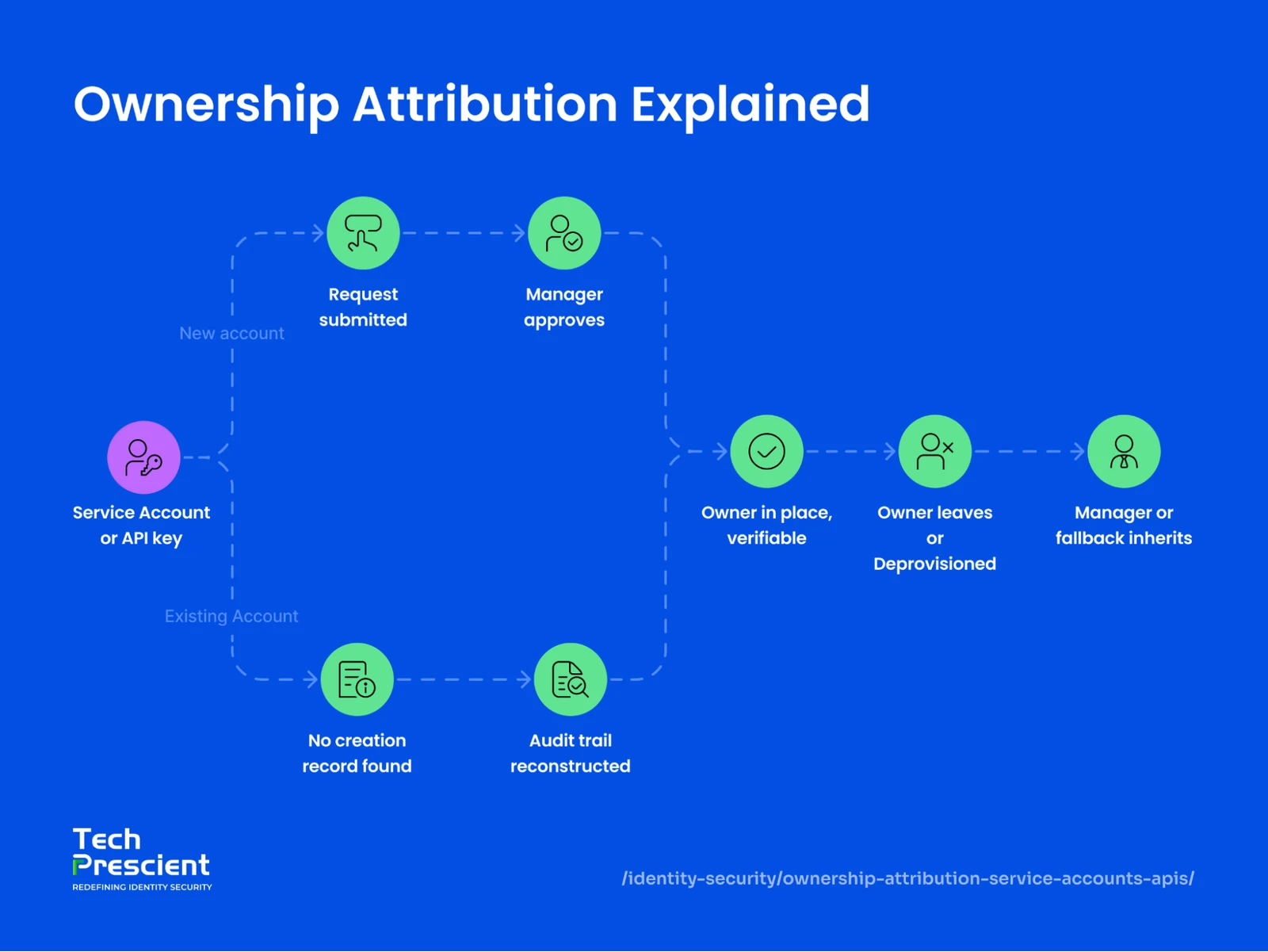
The cleanest moment to attach ownership is before the account exists. When someone requests a new service account or API credential in Tech Prescient's Identity Confluence, that request asks for the purpose, the systems it needs to reach, the exact permissions, and a proposed owner. Once a manager approves it, the account is provisioned with that owner already in place.
API key ownership assigned this way needs no guessing later. The record exists from the moment the credential does, because the request itself creates it.
Attribution is one piece of a larger governance picture.
See where your broader non-human identity program stands, covering ownership, rotation, least privilege, and monitoring across your environment.
How Ownership Is Traced for Accounts That Already Exist?
Plenty of service accounts and API keys already exist, created long before any attribution process was in place.
Reconstruction matters because so few of these credentials are governed on the way out either. The same CSA research found only 20% of organizations have a formal process for offboarding and revoking API keys, which is how ownerless accounts accumulate in the first place.
For these, ownership has to be worked out the other way: not captured up front but pieced together from what the system already recorded.
Every action on a service account or API credential generates a logged, timestamped entry: creation, approval, rotation, and deprovisioning. That logged history answers who approved this key's access months later, even when nobody remembers the conversation. The chain exists because each action was logged the moment it happened.
A service account with no attributed owner and no audit trail has no path back to accountability. Attribution at creation and the audit trail are the only two ways this gap gets closed.
What Proves Ownership During an Audit?
Ownership evidence has to answer more than a name on a spreadsheet can. Ownership evidence answers a direct question:
- Who requested this account?
- Who approved it? Who owns it now?
- And when did that last change?
Identity Confluence ties every service account and API credential to that exact chain, which is what makes an account genuinely accountable rather than accountable on paper. The answer is something an auditor can check directly, not something a team has to reconstruct under pressure. For the broader practice this supports, see access transparency.
Why Does Ownership Have to Be Established First?
Rotation reminders and access reviews both run on the same assumption: the account already has a clearly attributed owner to act on. Without attribution, neither process has anyone to reach.
Attribution is also what ownership succession builds on. Succession can only transfer an owner that attribution established first; it cannot create one from nothing. That is why attribution has to come before every other control, not alongside them.
Attribution at creation, and reconstruction from the audit trail when it was missed, is what puts a real person behind every later governance action instead of a guess. This is the same principle identity governance runs on more broadly: a control holds up only as well as the record behind it, and that same standard applies across machine identity management as a whole, not just service accounts and APIs in isolation.
Smart identity governance can help you get rid of excess access before it turns into a huge breach. You can prevent permission creep from expanding your attack surface. Find and fix over-provisioned roles, users, and entitlements immediately. You can also detect high-risk access with context-aware, real-time intelligence. You'll be able to control every identity type, including service accounts, workforce, and APIs.
Risk-based reviews will help you validate access and you can detect emerging risks with Tech Prescient's Policy Intelligence. Eliminating excessive permissions is one of the fastest and best ways to take full control of ownership attribution. Since Identity Confluence continuously validates permissions, you don't have to worry about entitlement drift quietly becoming a breach vector.
See how Tech Prescient's Identity Confluence attributes ownership for every service account and API credential, at creation and after the fact, with a record behind each one that holds up when someone asks. Book a demo.
FAQs
It is the process of tying a service account or API credential to a named, accountable person, either at the moment it is created or by reconstructing it later from the platform's logged history of creation, approval, and rotation.
Human identities inherit ownership from HR and the identity provider, which link every account to a person and a manager. Non-human identities have no HR record. A developer creates an API key during integration work, gives it a functional name, and moves on, so ownership only exists if a process captures it deliberately.
When no owner was recorded up front, ownership was reconstructed from the audit trail. Every action on the credential - creation, approval, rotation, and deprovisioning, left a timestamped entry, and that chain of entries identifies who requested and approved it.
Rotation reminders, access reviews, and ownership succession all need a named owner to act on. Succession in particular can only transfer an owner that is already established. Without attribution, none of these controls has anyone to reach.


GET A PERSONALIZED DEMO
See Identity Confluence in Action
“One platform to govern identities, automate access decisions, and prove compliance; across every app, user, and system in your environment.”



Murli Ramsunder
Senior Architect, Vonage