
What Is SIEM? Security Information and Event Management Explained
Last Updated date: July 12, 2026
On this page
See Tech Prescient in Action
Automate access, reduce risk, and stay audit-ready
SIEM (Security Information and Event Management) is a centralized cybersecurity platform that collects, correlates, and analyzes log and event data across an organization's IT environment to detect threats, support compliance, and improve SOC efficiency in real time.
Security Information and Event Management (SIEM) is a core cybersecurity solution that enables organizations to identify and respond to threats before they disrupt operations. It centralizes security logs and event data from across the IT environment, including networks, endpoints, cloud services, and applications. This consolidated visibility provides security teams with real-time insight into anomalous activity and potential indicators of compromise. Modern SIEM platforms extend beyond the original combination of long-term log management (SIM) and real-time event monitoring (SEM) by incorporating advanced analytics, machine learning, and behavioral analysis to detect complex threats at scale.
SIEM solutions automate portions of threat detection, alert triage, and reporting workflows while strengthening compliance reporting, historical investigations, and SOC performance. As enterprise environments become more distributed and adversary techniques more sophisticated, SIEM remains a central component of Security Operations Centers (SOCs) and formal incident response programs. SIEM platforms do not directly monitor systems; they ingest and analyze log data generated by other technologies to determine when a security-relevant event has occurred and whether investigation is required.
According to a 2021 industry report by Core Security, 74% of organizations consider SIEM very to extremely important to their security posture, and 68% use SIEM platforms to reduce breach risk and strengthen defensive controls, underscoring its role in modern security strategies. The sections below examine how SIEM works, the features that matter, and how to evaluate the right SIEM solution for your organization.
Key Takeaways:
- What SIEM is, how it evolved from SIM and SEM, and why it is critical to modern cybersecurity.
- How SIEM works step by step, from log collection and correlation to alerting and incident response.
- The core SIEM features, benefits, and real-world use cases that strengthen threat detection and compliance.
- How SIEM compares to SOAR, XDR, and log management within a modern security operations stack.
- The challenges of traditional SIEM, what modern SIEM solves, and how to choose a future-ready SIEM tool.
What Is SIEM?
SIEM combines log management and real-time event monitoring to give security teams centralized visibility, faster threat detection, and compliance-ready reporting.
Security Information and Event Management (SIEM) is a cybersecurity platform that collects, correlates, and analyzes log and event data from across an organization's IT environment, including servers, endpoints, applications, and network devices. By continuously monitoring security activity in real time, SIEM helps security teams detect threats early, investigate incidents efficiently, and respond by identifying malicious activities and generating prioritized alerts and automated actions based on predefined policies and analytics.
At its core, SIEM brings together multiple security functions to provide visibility, control, and faster threat response across the SOC.
Quick Reality Check
Can your security team trace a suspicious login across endpoints, cloud apps, and network logs in minutes? If not, centralized SIEM visibility may be a gap, not just a tool upgrade.
SIEM = SIM + SEM
SIEM is built on the combination of Security Information Management (SIM) and Security Event Management (SEM). SIM focuses on long-term log collection, retention, and analysis to support compliance and forensic investigations, while SEM enables real-time event monitoring, correlation, and alerting. Together, they form the backbone of modern security operations.
Role in Threat Detection and Incident Response
SIEM correlates events across disparate systems to identify suspicious behavior that may go unnoticed in isolated logs. Using correlation rules, behavioral analytics, and automation, SIEM platforms support Threat Detection, Investigation, and Response (TDIR) by generating prioritized alerts and accelerating incident resolution.
SOC Visibility and Operational Efficiency
By consolidating security data into a centralized view, SIEM improves SOC visibility across complex and hybrid IT environments. Security teams gain context-rich insights that reduce alert fatigue, streamline investigations, and improve coordination during security incidents.
SIEM, Compliance, and Threat Intelligence
SIEM also plays a critical role in compliance by maintaining audit-ready logs and generating regulatory reports. When integrated with threat intelligence, SIEM enriches events with external context, helping teams quickly identify high-risk activity, prioritize incidents, and strengthen the organization's overall security posture.
How SIEM Works (Step-by-Step)
SIEM works by collecting security data, normalizing it, correlating related events, generating prioritized alerts, and supporting investigation and response through centralized dashboards and automation.
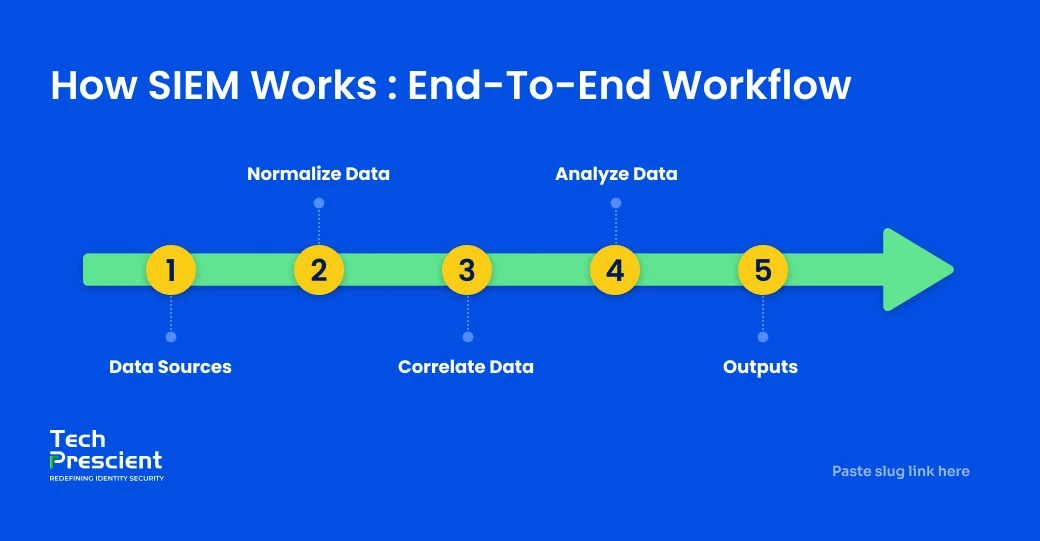
It ingests log and event data from systems and security tools, standardizes the data into a consistent format, applies correlation rules and analytics to identify security-relevant activity, and produces alerts based on defined thresholds and risk context to guide investigation within the SOC.
Data Collection
SIEM continuously gathers log and event data from a wide range of sources across the organization's IT infrastructure. These sources include firewalls, endpoints, servers, applications, databases, cloud workloads, SaaS platforms, and security tools such as IPS, IDS, antivirus software, and content filters. Data is collected from both on-premises and cloud environments to ensure complete visibility.
Aggregation and Normalization
Once collected, SIEM aggregates and normalizes data from disparate systems into a consistent format. This standardization allows logs generated by different devices and platforms to be analyzed together, making it easier to categorize events such as failed logins, account changes, or unusual system activity.
Correlation and Analytics
SIEM applies correlation rules and analytics to identify relationships between events that may appear harmless in isolation. By analyzing attributes such as users, IP addresses, event types, processes, and memory usage, SIEM detects attack patterns, behavioral anomalies, and deviations from baseline activity. Many SIEM platforms also integrate with threat intelligence feeds to match internal data against known threat signatures.
Alerting and Prioritization
When correlated events indicate potential risk, SIEM generates alerts and assigns severity based on predefined rules and risk scoring. Common alerts may include malware activity or failed login attempts, which are prioritized so security teams can focus on high-impact incidents and reduce noise from low-risk events.
Field Insight
Alert volume isn't the problem, alert quality is. Mature SIEM deployments focus on risk scoring and context enrichment to reduce analyst fatigue.
Investigation and Response
SIEM provides a centralized dashboard for monitoring activity, reviewing timelines, and investigating incidents. Stored logs support forensic analysis and compliance validation, while integration with SOAR tools enables automated responses such as account suspension or traffic blocking. This approach helps reduce mean time to detect (MTTD) and mean time to respond (MTTR) across the SOC.
Key SIEM Features
Modern SIEM platforms integrate log management, analytics, UEBA, threat intelligence, and automation to reduce alert fatigue and improve detection accuracy.
They combine centralized log collection, real-time event analysis, user and entity behavior analytics (UEBA), threat intelligence enrichment, and workflow automation to identify security-relevant activity, contextualize alerts, and standardize investigation processes within the SOC.
Dashboards for SOC Analysts
SIEM dashboards provide centralized visibility into security events, alerts, and incidents. Real-time visualizations, customizable views, and risk-based alerting help SOC analysts quickly triage alerts, investigate threats, and focus on high-priority incidents.
Log Management and Retention
SIEM solutions collect, aggregate, normalize, and store log data from across the IT environment, including servers, endpoints, applications, databases, cloud workloads, and security devices such as firewalls, IDS, IPS, and antivirus tools. Long-term log retention supports forensic investigations, historical analysis, and regulatory compliance requirements.
Real-Time Security Monitoring
SIEM continuously monitors security events across on-premises and cloud environments, providing a real-time view of activity related to users, devices, and applications. Correlation rules and analytics help identify suspicious behavior, detect emerging threats, and surface security incidents as they occur.
Threat Intelligence Integrations
Many SIEM platforms integrate with built-in or third-party threat intelligence feeds to enrich internal event data with external context. This enables correlation against known indicators of compromise, threat signatures, and adversary tactics, techniques, and procedures, improving detection accuracy and prioritization.
UEBA for Detecting Anomalous Behavior
User and Entity Behavior Analytics (UEBA) enhances SIEM capabilities by establishing baselines for normal user and system behavior. By analyzing authentication patterns, access activity, and privilege usage, UEBA helps detect insider threats, compromised accounts, and subtle anomalies such as low-and-slow attacks.
SOAR and Automated Response
Advanced SIEM solutions integrate with Security Orchestration, Automation, and Response (SOAR) tools to automate workflows and response playbooks. Automation enables faster containment actions such as account suspension, traffic blocking, or ticket creation, helping reduce mean time to respond (MTTR).
Compliance Reporting
SIEM platforms support regulatory compliance by automating log collection, monitoring, and reporting for standards such as PCI DSS, GDPR, HIPAA, and SOX. Prebuilt dashboards and compliance reports simplify audits and help identify policy violations early.
Benefits of SIEM for Cybersecurity
SIEM supports cybersecurity operations by enabling structured threat detection, consistent investigation workflows, impact containment, and audit-aligned reporting.
By centralizing log data, applying correlation and analytics, and standardizing alert handling through automation, SIEM provides unified visibility across the enterprise while supporting incident response processes and regulatory compliance requirements.
Real-Time Threat Detection
SIEM continuously monitors log and event data from across on-premises, cloud, and hybrid environments to identify suspicious activity as it happens. By correlating security events in real time, SIEM enables faster detection of known and unknown threats, including insider threats, phishing, ransomware, DDoS attacks, and data exfiltration.
Centralized Visibility Across the IT Environment
SIEM provides a single, centralized view of security activity across users, devices, applications, and networks. This "single pane of glass" improves situational awareness for SOC teams by consolidating alerts, context, and event data into one dashboard, making it easier to identify attack paths and prioritize response efforts.
When integrated with identity governance and access management (IGA) systems, SIEM becomes even more powerful by correlating user access behavior with real-time threat signals.
Faster Investigations and Root-Cause Analysis
By aggregating and retaining security logs in a centralized platform, SIEM supports rapid investigation and forensic analysis. Security teams can reconstruct timelines, correlate related events, and identify root causes of incidents more efficiently, reducing mean time to detect (MTTD) and mean time to respond (MTTR).
Reduced Breach Impact Through Automation
Modern SIEM platforms integrate with AI-driven analytics and Security Orchestration, Automation, and Response (SOAR) tools to automate repetitive investigation tasks and response actions. Automated workflows help contain incidents earlier, limit lateral movement, and reduce the overall impact of security breaches on business operations.
Automated Compliance Reporting
SIEM simplifies regulatory compliance by automating log collection, monitoring, and reporting for standards such as PCI DSS, GDPR, HIPAA, and SOX. Real-time audits, long-term data retention, and on-demand compliance reports reduce operational overhead and help organizations demonstrate compliance during audits.
Improve SOC Efficiency with Identity-Aware SIEM
See how Tech Prescient's SIEM-driven identity analytics reduces alert fatigue, improves threat detection, and strengthens compliance.
Common SIEM Use Cases
Organizations use SIEM to detect credential misuse, insider activity, ransomware behavior, lateral movement, and compliance violations across hybrid environments.
SIEM supports threat hunting, monitors cloud and on-premises infrastructure, correlates authentication and network activity, and generates alerts based on defined policies and behavioral analytics to support structured investigation and response.
Detecting Brute-Force and Credential-Based Attacks
SIEM correlates authentication events across identity systems, endpoints, and network devices to identify patterns such as repeated failed login attempts, unusual login locations, or abnormal access timing. These correlations help detect brute-force attacks and credential stuffing attempts early, before attackers gain persistent access.
Insider Threat Detection Using UEBA
Insider threats are difficult to detect because they often involve legitimate credentials and authorized access. SIEM platforms with User and Entity Behavior Analytics (UEBA) establish baselines for normal user behavior and flag deviations such as unusual data access, abnormal privilege usage, or suspicious login patterns. This allows security teams to identify potential insider threats that traditional perimeter-focused tools may miss.
Malware and Ransomware Detection
By continuously analyzing log and event data from endpoints, servers, and security tools, SIEM helps identify indicators of malware and ransomware activity. Correlated events such as suspicious file execution, lateral movement, and anomalous network traffic can surface threats earlier in the attack lifecycle, enabling faster containment and reduced impact.
Tracking Lateral Movement and Advanced Threats
SIEM is particularly effective at detecting advanced persistent threats (APTs) by correlating low-level signals across multiple systems over time. Activities such as credential reuse, abnormal process behavior, and cross-system access attempts can indicate lateral movement, helping security teams uncover stealthy adversary activity that might otherwise go unnoticed.
Monitoring Privileged Accounts
SIEM enables continuous monitoring of privileged users, including administrators and service accounts, which are frequent targets for attackers. By tracking access patterns, configuration changes, and high-risk actions, SIEM helps reduce the risk of privilege abuse and supports compliance requirements in regulated environments.
Cloud and Hybrid Environment Monitoring
Modern SIEM solutions ingest logs from cloud platforms, SaaS applications, and on-premises infrastructure to provide unified visibility across hybrid IT environments. This helps security teams detect misconfigurations, unauthorized access, and suspicious activity within cloud workloads and services.
Meeting Regulatory Compliance Requirements
SIEM supports compliance efforts by collecting and retaining logs required for standards such as PCI DSS, HIPAA, and SOX. Automated reporting and audit-ready dashboards help organizations demonstrate compliance, detect violations early, and respond to audit requests efficiently.
SIEM vs. Other Cybersecurity Solutions
SIEM focuses on detection and visibility, while SOAR, XDR, and log management tools address automation, telemetry correlation, and data storage in different ways.
SIEM is often compared with SOAR, XDR, and log management tools because these technologies support overlapping parts of security operations. However, each solves a different problem. Understanding how they differ helps organizations design an effective, layered security strategy rather than relying on a single tool to do everything.
SIEM vs. SOAR
SIEM and SOAR are closely related but serve different purposes within the Security Operations Center (SOC). SIEM focuses on detecting and analyzing security events by collecting and correlating data across the IT environment. It acts as the central system of record, helping teams gain visibility, investigate incidents, and meet compliance requirements.
A SIEM platform supports these needs by providing:
- Centralized collection of logs from applications, infrastructure, and security tools
- Correlation and analysis to identify suspicious activity and raise alerts
- Dashboards, reports, and audit trails for compliance and investigations
- Historical data for root cause analysis and threat hunting
SOAR is designed to act on what SIEM detects. It takes alerts generated by SIEM and other security tools and automates response actions through predefined workflows. This helps security teams respond faster, reduce manual effort, and ensure consistent incident handling.
A SOAR platform strengthens response by offering:
- Automation of incident response tasks using playbooks
- Orchestration across multiple security and IT tools
- Guided workflows for incident responders and SOC teams
- Faster containment and remediation with reduced analyst fatigue
The differences between SIEM and SOAR are most visible across focus, workflow, data usage, and users. SIEM emphasizes detection and analysis, while SOAR emphasizes action and automation. SIEM raises the alarm, while SOAR acts on the alarm. SIEM collects and analyzes large volumes of log data, while SOAR consumes SIEM alerts and integrates with other tools to execute responses. SIEM is primarily used by security analysts and compliance teams, while SOAR is used by SOC teams and incident responders.
In practice, SIEM and SOAR are commonly deployed together. SIEM provides visibility and context, while SOAR ensures alerts are handled quickly and consistently, helping organizations reduce mean time to respond (MTTR) and improve overall SOC efficiency.
SIEM vs. XDR
SIEM and XDR address different security challenges and are often used together to strengthen SOC operations. SIEM centers on log aggregation and analysis, which makes it effective for governance, compliance, and long-term visibility. It is well suited for environments where audit readiness and historical investigations are important.
A SIEM platform supports these needs by providing:
- Organization-wide ingestion of log data from infrastructure, applications, and security tools
- Capabilities for compliance reporting, audits, and forensic investigations
- Detection based on correlation rules that require ongoing tuning
- Long-term retention of log data for retrospective analysis
XDR takes a real-time, telemetry-driven approach by correlating signals across multiple security layers to accelerate detection and response.
An XDR platform strengthens response by offering:
- Unified visibility across endpoints, networks, cloud workloads, and email
- Correlation of live telemetry from multiple security domains
- Automated investigation and response workflows
- Faster remediation and support for proactive threat hunting
The differences between SIEM and XDR are most visible across focus, detection, and response. SIEM emphasizes visibility and compliance, while XDR emphasizes real-time response. SIEM analyzes centralized logs, while XDR correlates live telemetry. SIEM supports investigation and reporting, while XDR enables automated action.
In practice, many organizations deploy XDR alongside SIEM to combine long-term visibility and compliance with rapid detection and automated response.
SIEM vs. Log Management
Although both SIEM and log management work with log data, they serve very different operational and security objectives. Log management solutions are designed to store and retrieve logs for operational visibility rather than proactive threat detection. They are commonly used for troubleshooting, audits, and reviewing system behavior.
A log management platform supports these use cases by providing:
- Centralized collection, storage, and indexing of log data
- Long-term retention and archiving for audit purposes
- Search, filtering, and basic dashboards
- Reporting for audits and operational review
- Analyst-driven, reactive investigation workflows
SIEM builds on log management by adding continuous security analysis and contextual intelligence that supports detection and response.
A SIEM platform extends log management capabilities by enabling:
- Correlation of events across multiple data sources
- Continuous analysis to surface high-risk security incidents
- Real-time alerts prioritized by risk and context
- Advanced analytics using AI and machine learning
- Automated or guided response actions
The distinction between the two becomes clear when comparing purpose and outcomes. Log management focuses on access to log data, while SIEM focuses on security detection and response. Log management relies on manual review, while SIEM operates continuously and automatically. Log management supports review and troubleshooting, while SIEM drives security action.
In summary, log management helps teams understand what happened, while SIEM continuously analyzes activity to detect threats and guide timely response.
SIEM vs SOAR vs XDR vs Log Management (Quick Comparison)
| Sr No | Feature | SIEM | SOAR | XDR | Log Management |
|---|---|---|---|---|---|
| 1 | Primary Focus | Detection & analysis | Response automation | Real-time telemetry correlation | Log storage & search |
| 2 | Data Source | Aggregated logs | SIEM alerts + tools | Native security telemetry | System logs |
| 3 | Automation | Limited (via integration) | High | Moderate to High | Minimal |
| 4 | Compliance | Strong | Limited | Limited | Basic |
| 5 | Best For | SOC visibility & audits | Incident response automation | Rapid cross-domain detection | Operational troubleshooting |
Challenges of Traditional SIEM (and How Modern SIEM Solves Them)
Traditional SIEMs struggle with alert overload, manual rule tuning, scalability limits, and limited visibility in cloud and hybrid environments. These challenges slow detection and increase operational effort. Modern SIEMs overcome them with cloud-native design, AI-driven analytics, and automation, delivering scalable ingestion, fewer false positives, and unified visibility across identity, endpoint, network, and cloud systems.
Alert Overload and High Noise Levels
Traditional SIEM systems can generate an enormous number of alerts because they rely heavily on static correlation rules and simple threshold-based detection. Without contextual intelligence, this often results in a flood of low-value alerts that overwhelm analysts and increase mean time to detect (MTTD).
Modern SIEMs incorporate machine learning and advanced analytics to automatically identify patterns and behaviors that indicate real threats. These capabilities help reduce false positives and surface only the most relevant alerts, enabling security teams to focus on incidents that truly matter.
Improvements with modern SIEM:
- Adaptive learning models reduce noisy alerts
- Risk scoring prioritizes high-impact incidents
- Fewer false positives improve SOC efficiency
Complex Rule Tuning and Manual Configuration
Legacy SIEM tools depend on manually defined rules that require continuous tuning to adapt to new applications and evolving threats. This labor-intensive process demands deep expertise and constant upkeep, making it costly and slow to maintain.
Next-generation SIEMs use behavioral models and AI to automatically detect anomalies relative to baseline behavior, without requiring exhaustive rule writing. This helps security teams detect subtle threats such as lateral movement or insider anomalies more effectively.
How modern SIEM simplifies tuning:
- Behavioral analytics reduce reliance on static correlation rules
- Contextual enrichment improves detection accuracy
- Prebuilt models accelerate deployment and reduce manual adjustments
Scalability and Storage Challenges
Traditional on-premises SIEMs can struggle to ingest, process, and store the massive volumes of log and event data generated by modern enterprise environments. Scaling up typically requires purchasing and maintaining more hardware, which increases costs and complexity.
Cloud-native SIEM architectures address this by separating compute and storage layers, allowing organizations to scale elastically with data growth. Cloud SIEMs reduce capital expenditures and remove the need for on-site infrastructure, making long-term retention more affordable and manageable.
Benefits of modern architectures:
- Elastic storage for large data volumes
- Reduced infrastructure management overhead
- More cost-effective long-term retention
Limited Visibility in Hybrid and Cloud Environments
Legacy SIEM platforms were often designed for predominantly on-prem ecosystems, limiting their ability to ingest and correlate data from cloud workloads, SaaS applications, and distributed services. This can lead to blind spots and missed context during investigations.
Modern SIEM solutions provide broad, API-based ingestion and deep integrations with cloud platforms, identity systems, and third-party threat intelligence feeds. This delivers unified visibility across both on-premises and cloud environments, helping SOC teams detect threats wherever they occur.
Enhanced visibility features:
- API-driven connectors for cloud and hybrid sources
- Third-party threat intelligence integration
- Correlation across diverse telemetry types
How to Choose the Right SIEM Tool
Choosing the right SIEM requires balancing security goals, operational efficiency, and future scalability. The right platform should improve threat visibility, support compliance, and integrate easily with your existing security stack.
Ask the Right Questions When Evaluating Vendors
A SIEM must integrate smoothly with your current security tools, cloud platforms, and SOC workflows. Just as important is vendor reliability, including platform stability, support quality, and roadmap maturity. Reviewing customer case studies and analyst insights helps validate real-world performance beyond feature lists.

Pro Tip
Look for a SIEM that goes beyond basic log collection and alerting. Solutions like Tech Prescient's Identity Confluence are built to integrate across modern IT environments while combining advanced analytics, automation, and strong vendor-backed support. This helps security teams reduce alert noise, improve detection accuracy, and scale with confidence.
Define Your Security and Compliance Objectives
Clearly define what you want the SIEM to achieve before evaluating tools. Some organizations focus on compliance reporting, while others prioritize real-time threat detection or faster incident response. These priorities directly determine which capabilities matter most.
Assess Compatibility with Existing Infrastructure
The SIEM should ingest data from all critical systems, including on-prem infrastructure, cloud workloads, SaaS applications, and security tools. Limited compatibility reduces visibility and weakens detection accuracy. Native integrations and API support simplify deployment and future expansion.
Evaluate Core SIEM Capabilities
Core capabilities determine how effectively the SIEM detects and investigates threats. Centralized log management, real-time correlation, and contextual investigation are essential foundations. Advanced analytics and automation help reduce false positives and analyst workload.
Consider Scalability and Performance
SIEM data volumes grow quickly as organizations expand users, applications, and cloud services. The platform must scale without impacting performance or alert timeliness. Poor scalability can lead to delayed detection and operational bottlenecks.
Choose the Right Deployment and Management Model
Deployment should align with data sensitivity, compliance needs, and internal expertise. On-prem, cloud, and hybrid SIEMs each offer different trade-offs in control and operational overhead. Managed or co-managed models can accelerate adoption for lean teams.
Analyze Total Cost of Ownership (TCO)
SIEM costs extend beyond licensing to include infrastructure, storage, tuning, and staffing. Ignoring these factors can reduce ROI over time. Transparent pricing and predictable scaling are essential for long-term sustainability.
Validate with a Proof of Concept (POC)
A proof of concept helps evaluate the SIEM using real data and workflows. It exposes integration challenges, alert noise levels, and usability gaps early. This reduces deployment risk and sets realistic expectations for the SOC.
Evaluate Vendor Reputation and Long-Term Support
A SIEM is a long-term investment that depends on ongoing vendor support and innovation. Regular updates, responsive support, and a clear roadmap are critical as threats evolve. Customer references and analyst recognition help assess long-term viability.
Future of SIEM: AI, Automation & Cloud-First Security
The future of SIEM is shifting toward unified, cloud-first security analytics rather than standalone monitoring. Modern SIEM platforms combine AI-driven analytics, automation, and scalable cloud architectures to improve detection speed, prioritize real threats, and streamline response across hybrid environments. By correlating identity, endpoint, network, and cloud signals in real time, next-generation SIEMs reduce alert noise, support continuous compliance, and align with Zero Trust security models. As security operations evolve, SIEM is becoming the intelligence backbone of the SOC, enabling proactive defense through integrated analytics and automation.
Final Thoughts
SIEM has become a core pillar of modern cybersecurity because it delivers visibility, context, and intelligence across massive volumes of security data. By correlating events from endpoints, networks, cloud platforms, and applications, SIEM enables security teams to detect threats faster and respond with clarity.
As organizations scale across hybrid and cloud environments, security data becomes more complex and harder to manage. SIEM must go beyond log collection by reducing noise, prioritizing risk, and integrating with identity, endpoint, and automation tools to surface what truly matters.
By unifying visibility, analytics, and response, SIEM helps organizations strengthen their security posture, streamline SOC operations, and stay ahead of evolving threats.
FAQs
SIEM is a centralized security platform that collects, normalizes, and analyzes security events from across your IT environment. It helps teams detect threats early and gain real-time visibility into suspicious activity. SIEM also supports faster incident response and security decision-making.
A SIEM system brings together logs from endpoints, networks, cloud, and applications into one place. It correlates events, triggers risk-based alerts, and supports investigations with timelines and context. It also simplifies compliance through centralized reporting.
Well-known SIEM tools include Splunk, IBM QRadar, Microsoft Sentinel, and CrowdStrike Falcon LogScale. These platforms offer log management, threat detection, and analytics at scale. Each varies in deployment model, analytics depth, and integrations.
SIEM detects threats by correlating patterns across large volumes of log data. It applies correlation rules, behavioral analytics, and UEBA to identify anomalies. Threat intelligence enrichment adds context to prioritize real risks.
Organizations with regulatory requirements, large user bases, or sensitive data benefit most from SIEM. It is especially critical for teams running a SOC or managing hybrid and cloud environments. SIEM helps maintain visibility as security complexity grows.


GET A PERSONALIZED DEMO
See Identity Confluence in Action
“One platform to govern identities, automate access decisions, and prove compliance; across every app, user, and system in your environment.”



Murli Ramsunder
Senior Architect, Vonage