




On this page
See Tech Prescient in Action
Automate access, reduce risk, and stay audit-ready
The ISO 27001 certification cost varies significantly based on company size, security maturity, implementation approach, and audit scope. For some organizations, certification may cost a few lakhs, while larger enterprises can spend substantially more due to operational complexity and compliance requirements.
Understanding the real cost of ISO 27001 is important because certification involves more than just audit fees. Organizations must account for implementation efforts, internal audits, compliance tools, consulting, employee training, and ongoing maintenance.
In this guide, we'll break down the cost of ISO 27001 certification, India-specific pricing, major cost drivers, and practical ways organizations can reduce compliance expenses.
Key Takeaways:
- Total ISO 27001 certification cost can range from $10K–$50K+ globally
- SMBs in India typically spend around ₹5L–₹10L depending on scope and readiness
- Major cost drivers include audits, consulting, implementation, and compliance tools
- Automation platforms can reduce operational effort and compliance costs significantly
- Certification also includes recurring costs such as surveillance audits and recertification
How Much Does ISO 27001 Certification Cost?
The ISO 27001 certification cost typically ranges from $10,000 to $50,000+ globally, depending on company size, operational complexity, implementation readiness, and the certification approach used.
The total cost of ISO 27001 certification is influenced by several factors, including the scope of the Information Security Management System (ISMS), the number of employees and locations, existing security maturity, consulting requirements, and audit fees.
For smaller organizations with simpler environments, certification costs are generally lower. Larger enterprises with multiple business units, cloud environments, vendors, and compliance requirements usually face significantly higher implementation and operational expenses.
Global ISO 27001 Certification Cost Ranges
Globally, organizations commonly spend:
- Small businesses and startups: approximately $10K–$25K
- Mid-sized organizations: around $25K–$50K
- Large enterprises: $50K+ depending on complexity and audit scope
These costs usually include implementation activities, internal preparation, audit fees, documentation, and ongoing compliance efforts.
ISO 27001 Certification Cost in India
The ISO 27001 certification cost in India is generally lower than in North America or Europe due to differences in consulting rates, audit costs, and operational expenses.
Typical India-based cost ranges are:
- Startups and small businesses: ₹2.5L–₹6L
- Mid-sized companies: ₹5L–₹10L
- Large enterprises: ₹10L+ depending on scope and locations
Organizations with strong existing security practices and compliance programs often reduce implementation costs significantly.
SMB vs Enterprise Cost Differences
One of the biggest factors affecting ISO 27001 certification price is organizational complexity.
Smaller businesses usually have:
- Fewer systems and applications
- Simpler access management structures
- Limited compliance scope
- Smaller audit requirements
Enterprises, however, often require:
- Multi-location audits
- Larger ISMS scopes
- Third-party risk management
- More extensive documentation and monitoring processes
As a result, enterprise certification projects are typically more resource-intensive and operationally complex.
What the Cost Usually Includes
The overall ISO 27001 cost breakdown generally includes:
- ISMS implementation
- Risk assessments and documentation
- Certification audits
- Internal audits
- Compliance tools and automation
- Employee awareness and training
- Ongoing surveillance audits
Many organizations underestimate the operational and maintenance costs that continue after certification.
ISO 27001 Certification Cost Comparison
| Organization Type | Global Cost Range | India Cost Range |
|---|---|---|
| Startup / Small Business | $10K–$25K | ₹2.5L–₹6L |
| Mid-Sized Company | $25K–$50K | ₹5L–₹10L |
| Enterprise | $50K+ | ₹10L+ |

Pro Tip
Organizations with existing controls for SOC 2, GDPR, or cloud security frameworks often reduce ISO 27001 implementation costs because many governance and security processes can be reused.
ISO 27001 Certification Cost Breakdown
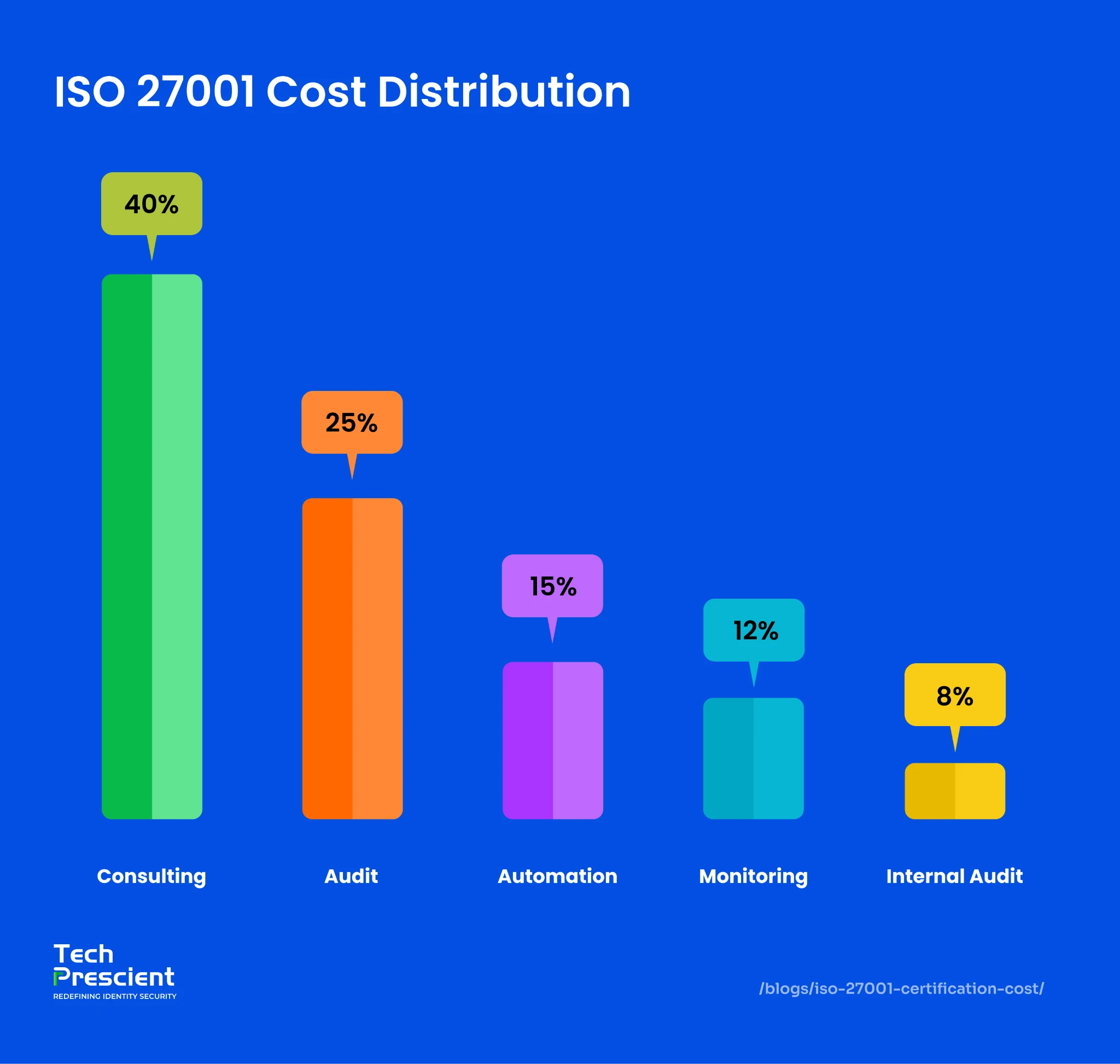
The total ISO 27001 certification cost is distributed across implementation activities, audits, compliance tools, and ongoing operational efforts.
Many organizations initially focus only on the certification audit fee, but the overall ISO 27001 cost breakdown includes multiple stages of implementation, governance, monitoring, and maintenance. The final cost depends on how much work is handled internally versus outsourced to consultants or automation platforms.
1. Consulting & Implementation Costs
Typical Cost: $15K–$40K globally, ₹3L–₹13L in India
The largest portion of the implementation cost often comes from consulting, planning, and ISMS development activities.
This stage typically includes:
- Gap assessments
- Risk assessments
- ISMS scope definition
- Policy and documentation creation
- Control implementation guidance
- Employee awareness and training
Organizations with mature security practices may require less consulting support, while companies starting from scratch often spend more on implementation assistance.
2. Certification Audit Costs
Typical Cost: $10K–$20K globally, ₹2L–₹5L in India
Certification audits are conducted by accredited certification bodies and usually occur in two stages.
- Stage 1 Audit: Reviews documentation, ISMS structure, and readiness
- Stage 2 Audit: Evaluates operational effectiveness and control implementation
Audit pricing depends on factors such as company size, number of employees, operational locations, ISMS scope, and audit duration.
3. Internal Audit Costs
Typical Cost: $4K–$5K+
ISO 27001 requires organizations to perform internal audits before the certification audit. Some companies use internal compliance or security teams, while others hire external auditors for independent assessments. Internal audits help identify gaps, validate controls, and improve readiness before formal certification. Organizations with limited in-house expertise may face higher costs for external audit support.
4. Compliance Tools & Automation
Typical Cost: $5K–$15K per year
Many organizations invest in compliance automation and governance platforms to reduce manual work associated with ISO 27001.
These tools help automate:
- Evidence collection
- Policy management
- Access reviews
- Risk tracking
- Audit preparation
- Continuous monitoring
For SaaS companies and cloud-first organizations, automation platforms often reduce operational overhead and improve long-term compliance efficiency.
Simplify ISO 27001 Control Mapping
Understand clauses, controls, evidence, and governance workflows
Hidden Operational Costs
Beyond direct certification expenses, organizations should also account for:
- Employee training time
- Internal security resources
- Policy maintenance
- Vendor assessments
- Continuous monitoring activities
- Surveillance audits and recertification
These ongoing operational costs are often overlooked during early budgeting discussions.
ISO 27001 Certification Cost in India
The ISO 27001 certification cost in India typically ranges from ₹2.5L to ₹10L for most organizations, depending on company size, implementation maturity, audit scope, and compliance approach.
Compared to North America and Europe, certification costs in India are generally lower due to reduced consulting rates, audit costs, and operational expenses. However, the final investment still varies significantly based on how prepared the organization is before starting the certification process.
Organizations with existing cybersecurity controls, documented processes, and compliance programs often complete certification faster and at a lower cost.
1. Startup and Small Business Costs
For startups and smaller organizations, certification costs are usually lower because environments are less complex and audit scopes are smaller.
Most startups spend between ₹2.5L and ₹6L covering:
- ISMS implementation
- Basic consulting support
- Internal audits
- Certification audits
- Initial compliance tooling
Cloud-native SaaS startups that already follow structured security practices may reduce costs further through automation.
2. Mid-Sized Company Costs
Mid-sized organizations typically spend between ₹5L and ₹10L due to:
- Larger user bases
- More systems and applications
- Multiple departments or locations
- Expanded compliance requirements
- Additional documentation and governance processes
At this stage, organizations often invest more heavily in compliance automation and operational monitoring.
3. Enterprise Certification Costs
Large enterprises may spend ₹10L–₹13L+ or significantly more depending on:
- Multi-location audits
- International operations
- Complex cloud infrastructure
- Vendor and supply chain security requirements
- Larger internal compliance teams
Enterprise implementations also tend to require longer timelines, larger audit scopes, and more mature governance processes.
India Cost Snapshot
| Sr. No | Company Size | Typical Cost Range |
|---|---|---|
| 1 | Small Business / Startup | ₹2L–₹6L |
| 2 | Mid-Sized Company | ₹5L–₹10L |
| 3 | Enterprise | ₹13L+ |
What Influences Pricing in India
The certification cost Indian organizations pay depends on several operational factors, including:
- Number of employees
- Number of offices or operational locations
- Existing security maturity
- Scope of the ISMS
- Use of consultants vs automation tools
- Internal compliance expertise
Organizations that start with strong access controls, documented processes, and cloud security practices generally reduce implementation effort and audit preparation costs.
Factors That Affect ISO 27001 Certification Cost
The ISO 27001 certification cost depends on several factors, including organizational complexity, security maturity, audit scope, infrastructure size, and the implementation approach used. No two ISO 27001 projects cost the same. A startup with a small cloud environment and strong existing controls may complete certification relatively quickly, while a large enterprise with multiple offices, vendors, and legacy systems may require significantly more time, resources, and audit effort.
Understanding these cost drivers helps organizations estimate budgets more accurately and identify areas where expenses can be reduced.
Number of Employees
The number of employees directly impacts audit scope, access management complexity, documentation requirements, and operational governance.
Larger organizations typically require:
- More user access reviews
- Additional security policies and procedures
- Broader employee awareness training
- More extensive audit sampling
As workforce size increases, both implementation effort and certification audit costs generally increase as well.
Number of Locations
Organizations operating across multiple offices, regions, or countries often face higher certification costs due to expanded audit requirements and operational complexity.
Multi-location environments usually require:
- Additional audit time
- Broader infrastructure reviews
- Distributed security governance
- More complex asset and access management
Global organizations may also need to account for regional compliance requirements and third-party risk considerations.
Existing Security Controls and Maturity
Organizations with mature cybersecurity programs usually reduce ISO 27001 implementation effort significantly.
Existing investments in areas such as:
- Access management
- Security monitoring
- Incident response
- Cloud security
- Vendor risk management
- Documentation and policies
can accelerate implementation timelines and reduce consulting requirements.
Organizations starting from scratch often spend more on remediation, governance development, and operational process creation.
Scope of Certification
One of the biggest cost factors is the scope of the Information Security Management System (ISMS).
A narrowly defined scope covering a single product, department, or business unit is generally faster and less expensive to certify. Broader enterprise-wide scopes require:
- More controls
- Larger audit coverage
- Additional documentation
- Expanded operational governance
Many organizations initially limit scope strategically to reduce cost and implementation complexity.
Consultant-Led vs Automation-Based Approach
The implementation approach also impacts total certification cost. Consultant-led projects usually reduce internal workload and accelerate timelines, but often increase upfront spending. Automation platforms, on the other hand, help reduce manual effort by streamlining evidence collection, monitoring, risk tracking, and audit preparation. Organizations increasingly combine both approaches by using automation tools alongside targeted consulting support to improve efficiency and reduce long-term operational costs.
Internal Compliance Resources
Organizations with dedicated security, compliance, or GRC teams often spend less on external consulting and audit preparation.
Companies without internal expertise may require additional support for:
- ISMS design
- Risk assessments
- Policy management
- Internal audits
- Compliance monitoring
This can increase both implementation cost and certification timelines.
Certification Approaches & Their Costs
The approach an organization chooses for ISO 27001 implementation has a major impact on total certification cost, internal workload, and implementation speed. Some organizations handle certification internally using existing teams, while others rely heavily on consultants or compliance automation platforms. Each approach has different trade-offs between cost, operational effort, scalability, and long-term maintenance. The right approach usually depends on the organization's internal expertise, timeline, security maturity, and available resources.
1. DIY Approach
The DIY approach is typically the lowest-cost option, with many organizations spending around ₹2.5L–₹5L depending on audit scope and tooling requirements.
In this model, internal teams handle:
- ISMS creation
- Risk assessments
- Policy development
- Control implementation
- Audit preparation
While this reduces consulting expenses, it requires significant internal effort and strong knowledge of ISO 27001 requirements. Organizations without dedicated compliance or security expertise may face longer timelines and increased operational overhead.
DIY implementations are often more suitable for smaller startups or technically mature teams already familiar with security governance frameworks.
2. Consultant-Led Approach
A consultant-led implementation is usually the most expensive approach, often ranging from ₹5L–₹15L+ depending on company size and complexity.
Consultants typically assist with:
- Gap assessments
- Risk management processes
- Documentation and policies
- ISMS implementation
- Audit readiness
- Compliance guidance
This approach helps organizations accelerate certification timelines and reduce internal learning curves. However, long-term dependency on external consultants can increase operational costs over time.
Large enterprises and organizations operating in regulated industries often choose this model because of the complexity involved.
3. Compliance Automation Platforms
Compliance automation platforms fall into the mid-range cost category and are increasingly popular among SaaS and cloud-first organizations.
These platforms help automate:
- Evidence collection
- Policy management
- Risk tracking
- Access reviews
- Continuous monitoring
- Audit preparation
Automation reduces manual compliance effort and improves long-term operational efficiency. For many SaaS companies, this approach delivers the best balance between implementation speed, scalability, and cost management.
Organizations often combine automation platforms with limited consulting support to reduce overall implementation expenses while maintaining operational flexibility.
Comparison Table: ISO 27001 Certification Approaches
| Approach | Typical Cost | Internal Effort | Implementation Speed | Best For |
|---|---|---|---|---|
| DIY | ₹2.5L–₹5L | High | Slower | Small startups, mature technical teams |
| Consultant-Led | ₹5L–₹15L+ | Low–Medium | Faster | Enterprises, regulated industries |
| Automation Platforms | Mid-range | Medium | Fast | SaaS and cloud-first companies |
Hidden & Ongoing ISO 27001 Costs
ISO 27001 certification is not a one-time expense. Beyond the initial implementation and audit costs, organizations must budget for ongoing monitoring, audits, maintenance, and compliance operations. Many companies underestimate the long-term operational effort required to maintain an effective Information Security Management System (ISMS). While certification may be achieved within a few months, maintaining compliance requires continuous governance and periodic reassessment.
1. Surveillance Audits
After certification, organizations must undergo annual surveillance audits to verify that security controls and ISMS processes are still functioning effectively.
These audits typically cost between ₹50K and ₹1.5L per year depending on:
- Company size
- Scope of certification
- Number of locations
- Audit duration
Organizations that fail to maintain controls or documentation may face additional remediation costs during these reviews.
2. Recertification Costs
ISO 27001 certification is valid for three years. After that, organizations must complete a full recertification audit to retain certification status. Recertification audits are usually more extensive than annual surveillance audits and may involve:
- Updated risk assessments
- Policy reviews
- Evidence validation
- Expanded operational checks
As organizations grow, recertification costs can increase due to broader infrastructure and operational complexity.
3. Internal Compliance Team Costs
Maintaining ISO 27001 often requires dedicated internal resources for:
- Policy management
- Access reviews
- Audit preparation
- Risk tracking
- Vendor assessments
- Continuous monitoring
For many organizations, the ongoing operational cost of maintaining compliance internally becomes a significant long-term investment.
4. Compliance Tool Subscriptions
Organizations using GRC or compliance automation platforms must also account for recurring subscription costs. These tools help streamline evidence collection, monitoring, reporting, and audit preparation, but they add annual operational expenses. However, many companies find that automation reduces manual workload enough to offset a large portion of these recurring costs.
5. The Cost of Maintaining Compliance
The real long-term cost of ISO 27001 is often operational rather than audit-related. Organizations that lack automation, ownership, or continuous monitoring processes frequently spend more time and resources preparing for audits manually every year. In contrast, organizations with mature governance and automation practices usually maintain compliance more efficiently over time.
How to Reduce ISO 27001 Certification Cost
Organizations can significantly reduce ISO 27001 certification cost by improving implementation readiness, limiting unnecessary scope, and using automation to reduce manual compliance effort. Many companies assume ISO 27001 certification is inherently expensive, but a large portion of the cost comes from operational inefficiencies, poor preparation, and excessive manual work. Organizations that plan strategically often reduce both implementation timelines and audit expenses considerably.
1. Start with a Gap Analysis
One of the most effective ways to reduce cost is conducting a gap analysis before beginning implementation.
A gap assessment helps organizations identify:
- Existing security controls
- Missing documentation
- Operational weaknesses
- Areas already aligned with ISO 27001 requirements
This prevents unnecessary remediation work and helps prioritize the most important compliance activities first. Organizations with mature access controls, monitoring practices, and security policies usually require less consulting and implementation effort.
2. Use Automation Tools
Compliance automation platforms can reduce a substantial amount of manual work associated with ISO 27001.
These tools help streamline:
- Evidence collection
- Access reviews
- Policy management
- Risk tracking
- Audit preparation
- Continuous monitoring
For SaaS and cloud-first organizations, automation often improves both implementation speed and long-term operational efficiency. Many organizations reduce ongoing compliance workload significantly by integrating automation early rather than managing evidence and audits manually through spreadsheets.
3. Limit Certification Scope Initially
Trying to certify the entire organization at once often increases implementation complexity and audit costs unnecessarily.
Many companies reduce expenses by initially limiting certification scope to:
- A single product
- One business unit
- Core production systems
- Critical customer-facing environments
Once the ISMS matures, organizations can gradually expand scope over time. This phased approach is especially common among startups and fast-growing SaaS companies.
4. Reuse Existing Security Controls
Organizations already following frameworks such as SOC 2, GDPR, PCI DSS, or internal security standards can often reuse many existing controls and governance processes.
Areas such as:
- Access management
- Incident response
- Risk assessments
- Monitoring practices
- Vendor management
- Security policies
may already partially align with ISO 27001 requirements, reducing implementation effort significantly.
5. Build Operational Readiness Early
One of the biggest hidden cost drivers is poor operational preparation before audits.
Organizations that establish:
- Clear ownership
- Documented processes
- Continuous monitoring
- Consistent evidence collection
typically spend far less time and money during certification and surveillance audits.
6. Real-World Cost Optimization Insight
Many SaaS companies reduce ISO 27001 implementation and maintenance costs by 30–50% through compliance automation platforms and standardized cloud security practices. Automation becomes especially valuable as environments scale and compliance operations become more complex.
Is ISO 27001 Certification Worth the Cost?
Although ISO 27001 certification requires upfront investment, many organizations see long-term ROI through stronger customer trust, improved compliance, reduced security risk, and faster enterprise sales cycles. For many businesses, the value of ISO 27001 goes far beyond compliance. The framework helps organizations build operational security maturity while also improving credibility with customers, partners, auditors, and regulators. Whether ISO 27001 is "worth it" often depends on the organization's growth stage, industry, customer expectations, and risk exposure.
1. Enterprise Trust and Deal Enablement
One of the biggest business advantages of ISO 27001 certification is the trust it creates during vendor evaluations and procurement processes. Enterprise customers increasingly require vendors to demonstrate mature security governance before sharing sensitive data or approving contracts. ISO 27001 certification acts as a recognized trust signal that shows the organization follows structured security and risk management practices.
For SaaS companies and service providers, certification often helps:
- Accelerate security reviews
- Improve vendor assessment outcomes
- Shorten enterprise sales cycles
- Increase competitiveness in regulated industries
In many cases, certification directly supports revenue growth by enabling access to larger enterprise opportunities.
2. Regulatory and Compliance Benefits
ISO 27001 also helps organizations strengthen broader compliance initiatives. Because the framework aligns with many security and privacy requirements, organizations can use it to support GDPR compliance, HIPAA readiness, SOC 2 governance, vendor security assessments, and internal audit requirements. Rather than managing security processes separately for each framework, ISO 27001 helps establish a centralized and repeatable governance structure.
3. Reduced Cybersecurity Risk
The framework improves visibility into security gaps and helps organizations implement stronger operational controls. By formalizing areas such as access management, risk assessments, incident response, monitoring, vendor governance, and employee awareness, organizations reduce the likelihood of costly breaches, operational disruptions, and compliance failures. While certification cannot eliminate cyber risk, it significantly improves security maturity and resilience.
4. Long-Term Operational Value
Organizations often initially pursue ISO 27001 for compliance reasons, but many ultimately gain value through improved operational discipline and governance consistency.
Over time, ISO 27001 helps organizations:
- Standardize security processes
- Improve accountability
- Strengthen audit readiness
- Build scalable governance practices
- Improve customer confidence
This long-term operational maturity is often where the biggest ROI is realized.
Final Thoughts
ISO 27001 certification cost varies based on company size, implementation complexity, and the approach you choose. Organizations that invest in automation, operational readiness, and structured governance often reduce both compliance effort and long-term maintenance costs significantly.
Reduce ISO Compliance Operational Cost
Automate reviews, lifecycle governance, and audit readiness
FAQs
No. ISO 27001 certification involves costs related to ISMS implementation, certification audits, internal audits, compliance tools, and ongoing monitoring activities.
It can be, but costs vary widely depending on organizational size, scope, and implementation maturity. Most SMBs typically spend between ₹5L and ₹10L for implementation and certification.
The ISO 27001 certification cost in India usually ranges from ₹2.5L to ₹10L for small and mid-sized organizations, while large enterprises may spend significantly more depending on audit scope and operational complexity.
Yes. ISO 27001 helps organizations improve cybersecurity governance, reduce risk, strengthen compliance readiness, and build trust with customers and enterprise buyers.
Most organizations complete ISO 27001 certification within 6–12 months depending on existing security maturity, resource availability, implementation scope, and audit readiness.
Share



Rashmi Ogennavar
Content Strategist
A content strategist translating complex Tech and SaaS concepts into compelling narratives for business and technical audiences. With a strategic, data-informed approach, the work bridges content and product storytelling, crafting messaging that resonates and drives decisions across the buyer journey.
Most Popular Blogs
Identity Security· 21 min read
Data Access Governance Solutions: How to Secure Sensitive Data at Scale
Compare data access governance solutions for 2026: how DAG platforms discover sensitive data, run access reviews, automate remediation, and prove compliance.
Brinda Bhatt· September 7, 2026
Identity Security· 24 min read
What Is Zero Trust Network Access (ZTNA)?
Learn what Zero Trust Network Access (ZTNA) is, how it works, and why it’s replacing VPNs for secure, identity-based access control.
Yatin Laygude· August 14, 2026
Identity Security· 24 min read
Cyber Essentials Certification: Complete Guide
Learn Cyber Essentials certification, cost, requirements, and steps. Compare Cyber Essentials vs Plus and get certified faster.
Yatin Laygude· August 10, 2026