




On this page
See Tech Prescient in Action
Automate access, reduce risk, and stay audit-ready
A user access review policy defines how organizations periodically review, approve, and revoke user access to systems, applications, and data to enforce the principle of least privilege and maintain audit readiness across compliance frameworks.
This policy serves as a core identity governance control, not a one-time compliance task. It establishes a repeatable method for evaluating access based on current roles and business needs. By validating who has access and adjusting permissions when responsibilities change or employment ends, organizations reduce unnecessary exposure while meeting regulatory expectations.
Access environments naturally change over time. Role transitions, organizational shifts, and employee departures often leave outdated or excessive permissions in place if reviews are not enforced. This access drift increases the likelihood of security incidents, data exposure, and audit findings by allowing privileges to persist beyond their intended scope.
According to Secureframe, attacks involving stolen or compromised credentials increased by 71% in a single year, and 74% of breaches involved human interaction. These trends highlight the impact of unmanaged access and unreviewed entitlements. User access reviews directly address this exposure. Regular certification, modification, and removal of access reduces a common attack vector while demonstrating effective governance to auditors. A well-defined review process strengthens security posture, supports compliance requirements, and provides a scalable foundation for managing identity risk.
Key Takeaways
- Understand what a user access review policy is and why it is critical for security and compliance.
- Learn how access reviews enforce the principle of least privilege and RBAC.
- Follow a step-by-step user access review process that stays audit-ready.
- See how structured access reviews support SOX, GDPR, HIPAA, ISO 27001, and SOC 2 audits.
- Apply best practices to scale access reviews using automation and identity governance.
What Is a User Access Review Policy?
A user access review policy defines the standards and procedures for regularly reviewing, validating, and managing user access across an organization's digital environment. It ensures that employee and third-party access to systems, applications, and data is reviewed regularly to prevent unauthorized or inappropriate access.
As part of a broader identity and access management strategy, the policy focuses on verifying who has access to critical resources and whether that access aligns with current job responsibilities. Based on review outcomes, organizations adjust permissions to ensure users retain only the access required to perform their roles securely and effectively.
A structured access review policy enables organizations to continuously validate entitlements as roles change or users exit the organization. This reduces the risk of excessive or lingering access, which is a common contributor to insider threats, data exposure, and security incidents.
Additionally, the policy provides a framework to address discrepancies uncovered during access audits. For instance, if an audit identifies that a former employee still retains active access to critical systems, immediate remediation is required to revoke access and investigate the oversight, thereby preventing recurrence of similar risks.
User Access Review Policy Template (Audit-Ready Example)
An audit-ready user access review policy must formally define purpose, scope, roles, review cadence, and evidence requirements. The following template provides a clear, compliance-aligned structure that organizations can adapt to meet audit and regulatory expectations.
1. Policy Purpose
This policy ensures that all user access rights are reviewed regularly and formally approved, modified, or revoked as appropriate. The objective is to reduce unauthorized access, prevent privilege accumulation, and maintain compliance with applicable regulatory and security standards.
2. Scope
This policy applies to all employees, contractors, third-party users, and service accounts with access to organizational systems, applications, infrastructure, or data.
3. Review Frequency
- Privileged users: Quarterly
- Critical systems: Quarterly
- Non-critical systems: Annually
- Event-based reviews: Role change, termination, or security incident
4. Roles & Responsibilities
- Managers: Confirm ongoing business justification for user access
- IT / Security: Enforce least-privilege principles and implement approved access changes
- Human Resources: Initiate access reviews based on employee lifecycle events
- Audit / Compliance: Validate review evidence and assess control effectiveness
5. Documentation & Audit Trails
All access review activities must be formally documented, approved, time-stamped, and retained in accordance with audit and regulatory requirements. Documentation must be sufficient to demonstrate control operation and reviewer accountability.
Why User Access Reviews Matter for Compliance & Security?
User access reviews enable organizations to periodically verify that users have only the access required for their current roles. By identifying excessive, outdated, or unauthorized permissions, access reviews reduce security risks, support compliance audits, and prevent privilege misuse across systems.
1. Unauthorized Access
As employees' roles evolve, they often retain unnecessary access rights, creating risks such as privilege creep. User Access Reviews (UARs) help identify and revoke such excess privileges, thereby reducing the organization's overall attack surface. This proactive approach strengthens security by preventing unauthorized access and mitigating insider threats like privilege misuse, abuse, and escalation.

Privilege Creep
Happens when employees accumulate more access rights to critical systems and sensitive data than their job roles require. This usually occurs as they take on new responsibilities or projects, while outdated permissions are left in place instead of being revoked.
Privilege Misuse
Occurs when individuals use their granted privileges in ways that differ from the intended purpose. Such misuse may be accidental, careless, or deliberate, but regardless of intent, it often results in cybersecurity breaches.
Privilege Abuse
Refers to the deliberate exploitation of privileges to steal, compromise, or damage an organization's sensitive information. Both malicious insiders and external attackers who compromise privileged accounts may engage in such abuse.
Privilege Escalation
Arises when users unlawfully obtain higher levels of access than authorized, typically through malicious techniques. Once elevated, these privileges can be exploited to move laterally across systems, access confidential resources, and target critical infrastructure.
2. Strengthens insider threat detection
As employees transition into new roles or take on different responsibilities, they often retain access rights that are no longer relevant to their current positions. User access reviews (UARs) help detect these discrepancies and remove unnecessary privileges, thereby reducing the overall attack surface available to malicious actors. By revoking redundant access, organizations can prevent unauthorized activity and mitigate risks associated with insider threats.
3. Supports regulatory compliance
Many industries operate under strict regulatory standards such as Europe's GDPR for data protection, HIPAA for healthcare, and SOX for financial reporting. These frameworks often require organizations to perform regular user access reviews to ensure sensitive information is protected against misuse or unauthorized access.
Conducting these reviews creates a detailed audit trail, documenting who has access to specific systems, when changes occurred, and how access rights are managed. Such documentation becomes essential during compliance audits, for example, SOX assessments demand a thorough review of access to financial systems to verify that only authorized personnel can handle sensitive financial data. Failure to maintain this level of oversight can result in regulatory violations, which may carry heavy fines, legal liabilities, and severe reputational harm.
Core Elements of a User Access Review Policy
An effective user access review policy is built on clearly defined scope, review cadence, stakeholder accountability, and documentation requirements. These elements ensure that access reviews are consistent, repeatable, and defensible under audit. When implemented together, they help organizations maintain accurate access controls while meeting security and compliance obligations.
The sections below outline the core components that should be explicitly defined in any user access review policy.
Scope of Access Reviews – What systems and users are included?
A robust User Access Review (UAR) policy depends on having a clear objective and scope, as these elements together determine the effectiveness of the review process. For IT managers, defining them well ensures that reviews are purposeful, aligned with organizational security goals, and capable of addressing real risks. The objective gives the policy its direction by establishing why reviews are necessary, while the scope sets the boundaries of who and what will be included in those reviews. A strong objective should be concise, easy to understand, and directly relevant to the security and compliance challenges faced by the organization.
For example, one could state: "To regularly review and assess user access rights to sensitive data, minimizing the risk of unauthorized data exposure and ensuring compliance with industry regulations."
The scope defines the boundaries of the review process by identifying:
- User populations included in reviews, such as employees, contractors, external users, and service accounts
- Systems and applications covered, including business-critical platforms, infrastructure, and data repositories
- Data classifications in scope, such as confidential or regulated information
- Any role-based exceptions or system-specific considerations
A clearly defined scope ensures reviews are comprehensive without becoming impractical.
Example scope statement: "This policy applies to all employees and contractors with access to sensitive customer data within the CRM platform. Access reviews are conducted quarterly, with separate review criteria for privileged administrative accounts."
Review Frequency – Monthly, quarterly, annually
The review frequency in a user access review policy defines how often user access rights are assessed and validated. Finding the right balance is essential; reviews conducted too rarely may leave obsolete or unauthorized access undetected, while overly frequent reviews can overwhelm IT teams with unnecessary administrative work. Ideally, the frequency should reflect the pace of organizational changes, such as employee onboarding, role transitions, or project-specific needs. This approach ensures an accurate, up-to-date view of user privileges and helps confirm that only authorized individuals maintain access to critical systems and data.
In addition to scheduled reviews, policies should define event-driven triggers that require immediate reassessment of access. Common triggers include:
- Employee role changes or promotions
- Employment termination or contract expiration
- Security incidents or control failures
- Changes to regulatory or compliance requirements
Incorporating both periodic and event-based reviews ensures access remains aligned with current business and security conditions.
Stakeholder Roles – HR, managers, IT, auditors
Defining stakeholder roles is central to an effective user access review policy. When responsibilities are allocated across teams, reviews become more structured, risks are reduced, and accountability is strengthened. Each group, HR, managers, IT, and auditors, plays a unique part in ensuring that access privileges remain accurate, relevant, and compliant.
- HR Teams: HR serves as the starting point for provisioning and deprovisioning users. By maintaining accurate employee records and promptly notifying IT of new hires, role changes, or departures, HR ensures that access rights stay aligned with an individual's employment status. Their involvement minimizes the risk of lingering or unnecessary accounts.
- Managers: Line managers or business unit leaders act as access reviewers and approvers. Since they best understand the operational needs of their teams, they are responsible for verifying whether employees still require certain permissions. This oversight ensures that access aligns with business needs and helps prevent privilege creep.
- IT Administrators: IT is responsible for implementing approved access changes, enforcing least-privilege principles, and maintaining secure system configurations. Their role ensures policy decisions are accurately reflected in technical controls.
- Auditors and Compliance Officers: Audit and compliance teams provide independent oversight by reviewing evidence, validating control execution, and assessing alignment with regulatory requirements. Their findings help identify gaps and strengthen governance.
When these roles operate in coordination, the access review process functions as a controlled loop: lifecycle events trigger reviews, managers validate necessity, IT executes changes, and auditors verify effectiveness.
Documentation Protocols – Audit trail, certifications
Robust documentation protocols are the backbone of a strong user access review policy. They establish a clear audit trail, capturing who had access, what changes were made, when they occurred, and why they were approved. This not only enforces accountability but also provides solid evidence during audits and certification reviews.
A reliable audit trail should cover:
- User Profiles and Roles: Detailed records of user responsibilities and associated access permissions, creating a structured view of access levels.
- Access Change Logs: A comprehensive log of all modifications, including who initiated the change, the time of change, and the justification behind it.
- Access Approval Workflow: Documentation of the entire process for granting access, from request to authorization, ensuring clarity and transparency.
- Access Removal Process: A defined protocol for revoking access promptly when employees leave or transition to new roles, preventing privilege creep.
Beyond tracking, documentation also supports certifications and compliance. This is where reporting frequency becomes critical. Specifying how often reports are generated and reviewed ensures continuous oversight of access patterns, highlights unusual activity, and provides proof of proactive governance.
Together, audit trails and certification protocols elevate documentation from simple recordkeeping to an active safeguard, strengthening security, ensuring regulatory alignment, and reinforcing organizational trust.
Step-by-Step User Access Review Process
An effective user access review requires a structured approach. The following steps outline how to gather access data, involve the right stakeholders, flag anomalies, and take corrective action, while keeping documentation audit-ready.
Generate access reports/Extract access data
The first step in reviewing user access is to generate accurate and comprehensive access reports. This process involves compiling information from all organizational assets, servers, workstations, network devices, cloud platforms, databases, and other systems where sensitive data is stored or processed. These reports form the foundation for assessing whether access rights are appropriate and compliant.
There are two primary approaches to extracting access data:
- Automated Tools and Scripts: Whenever possible, rely on automation to pull access information directly from systems. Automated extraction reduces manual effort, eliminates human error, and ensures consistency. Key details to capture include user names, assigned roles, access levels, and last access timestamps.
- Manual Processes: In environments where automation is not feasible, due to system limitations or tool incompatibility, manual collection is required. Here, system administrators compile access rights lists from applications and platforms to provide the necessary visibility into user privileges.
By combining both automated and manual methods, organizations can generate access reports that are complete, accurate, and tailored to their unique IT landscape.
Review with department heads
Involving department heads is a critical component of the user access review process. Since managers and business leaders have direct visibility into their teams' responsibilities, they are best positioned to verify whether access rights align with actual job requirements. Their involvement not only reinforces accountability but also ensures that access reviews are rooted in the operational context rather than being a purely technical exercise.
Department heads should:
- Validate User Permissions: Confirm that employees under their supervision retain only the access necessary for their roles, preventing privilege creep.
- Review Documentation: Cross-check access records against job functions to ensure accuracy during onboarding, role changes, or offboarding.
- Identify Outliers: Flag unnecessary or outdated permissions that IT teams may overlook without business context.
- Collaborate with IT: Work alongside administrators to approve, modify, or revoke access rights, ensuring changes are both technically feasible and business-relevant.
By integrating department heads into the review process, organizations strengthen accountability and create a closed feedback loop where access decisions are informed by both technical oversight and business needs.
Flag anomalies or unnecessary privileges
One of the primary objectives of an access review is to detect anomalies, instances where users, applications, or processes hold permissions that exceed what is truly required. Left unchecked, these unnecessary privileges can create opportunities for insider threats, privilege misuse, or accidental data exposure.
At the core of this process lies the Principle of Least Privilege (PoLP). It dictates that every user, system, or application should have only the minimum level of access required to perform its function, no more, no less. By limiting access rights in this way, organizations reduce their attack surface and ensure that if an account is compromised, the potential damage is restricted.
For example:
- User Accounts: Regular employees operate with standard access, while elevated or administrative privileges are tightly controlled.
- Applications and Systems: System processes run with narrowly defined permissions, preventing them from interacting with unrelated data or networks.
- Temporary Privileges: Elevated access is granted only for specific tasks and automatically revoked once the activity is complete.
Steps to Flag and Address Excess Privileges:
- Identify Anomalies: Scrutinize access reports to spot accounts with privileges beyond role requirements, such as admin rights for non-IT staff.
- Reduce Unnecessary Access: Downgrade or revoke excess permissions promptly, aligning them with principle of least privilege.
- Cross-Check with Departments: Collaborate with department heads to validate complex or cross-functional access needs that may appear excessive at first glance.
- Document and Approve Exceptions: Any deviation from the principle of least privilege should be justified, recorded, and approved by the relevant stakeholders.
By embedding the principle of least privilege into access reviews, organizations turn it into a practical filter: any access beyond the principle's limits is flagged as an anomaly. This makes it easier to spot unnecessary privileges, close gaps proactively, and maintain stronger security and compliance.
Revoke, adjust, or approve access
Once anomalies are flagged, corrective action must follow swiftly to maintain security and compliance. The goal is to ensure only legitimate and necessary access rights remain active, minimizing risks from outdated or unauthorized privileges.
- Revoke Unauthorized Access: Establish a systematic process to immediately remove outdated, unnecessary, or suspicious privileges. Coordinate with IT security to prevent disruption, scheduling revocations carefully, or granting supervised temporary access when critical operations are at stake.
- Adjust Roles and Permissions: Review and refine user roles to align with actual responsibilities. This may involve redefining job functions, updating group memberships, or creating new role profiles to reflect business needs accurately.
- Approve and Document Exceptions: For cases requiring special or cross-functional access, formally approve them through department heads, with clear documentation to ensure accountability and transparency.
By revoking excess rights, adjusting roles appropriately, and approving only justified exceptions, organizations maintain a strong balance between security and operational efficiency.
Document all changes
Accurate documentation is critical to ensure accountability, compliance, and audit readiness. Every step of the user access review, including findings, corrective actions, and follow-up measures, should be captured in detail.
- Report the Review Process: Maintain a comprehensive record of the review's scope, data collection methods, identified discrepancies, corrective actions, and rationale behind revocations or adjustments. Specific instances of unauthorized or inappropriate access must be logged.
- Create an Action Plan: Outline recommendations for strengthening access control policies and procedures. Include follow-up tasks, assigned responsibilities, deadlines, and measurable outcomes to track effectiveness.
- Communicate with Stakeholders: Share reports with management, IT security, department heads, and auditors to ensure transparency. Gather feedback to improve future reviews.
- Maintain Compliance Records: Securely store reports, supporting documents, and logs for regulatory or audit purposes, ensuring they are well-organized and easily retrievable.
By thoroughly documenting every change, organizations not only strengthen accountability but also demonstrate compliance with security and regulatory requirements.
Best Practices for Efficient & Scalable Access Reviews
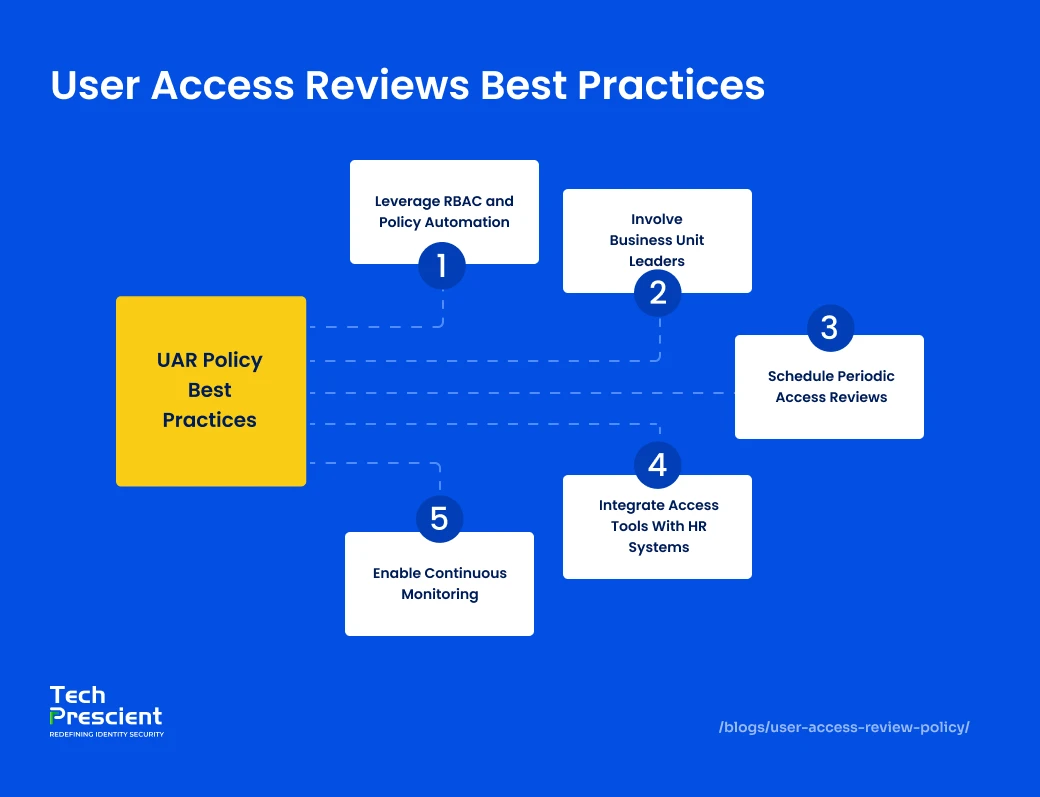
A user access review becomes more efficient and less burdensome when supported by well-defined access control policies and adherence to recognized security standards. To help strengthen your process, we've outlined four best practices that can significantly enhance your organization's user access reviews.
1. Leverage RBAC and policy automation
Role-Based Access Control (RBAC) streamlines access management by assigning permissions to roles rather than to individual user accounts. Each role represents the access required for specific job functions, and users inherit permissions based on their assigned role. This not only reduces complexity but also accelerates user access reviews, allowing organizations to validate roles instead of checking individual profiles.
To implement effectively:
- Map user access rights to job functions by reviewing job descriptions and responsibilities.
- Define roles that reflect these functions and assign appropriate permissions.
- Use policy automation tools to ensure roles remain updated as responsibilities evolve.
2. Involve business unit leaders
Department heads and business unit leaders play a critical role in validating employee access rights. Since they have direct insight into daily operations and job requirements, they are best positioned to assess what level of access is truly necessary. Their involvement not only enforces the Principle of Least Privilege (PoLP) but also helps prevent unnecessary or excessive access that could introduce security risks. Collaborating with these leaders ensures access rights are aligned with actual responsibilities, strengthening both operational efficiency and security.
3. Schedule periodic access reviews
Keeping access reviews consistent and timely is essential for maintaining strong security standards. As part of your access management policy, establish a formalized user access review (UAR) procedure that:
- Defines a clear review schedule
- Assigns security officers responsible for conducting reviews
- Outlines how and when employees will be notified
- Specifies reporting timelines and required report details
In addition, align UARs with your organization's operational calendar. For example, reviews can be scheduled after major business cycles (such as year-end financial closures) when systems are more stable and staff availability is higher. At the same time, avoid peak activity periods, like end-of-quarter sales or holiday seasons, to minimize disruption. Formalizing both the schedule and timing ensures UARs remain efficient, consistent, and non-intrusive.
4. Integrate access tools with HR systems
To streamline user access reviews, organizations should adopt automation tools that not only collect and analyze access data but also integrate seamlessly with existing infrastructure, such as HR systems, Active Directory/LDAP, and cloud services. These integrations allow user roles and permissions to be automatically updated in response to HR events like onboarding, promotions, role changes, or terminations.
An effective platform should:
- Support end-to-end management of the user access lifecycle, covering provisioning, review, modification, and documentation.
- Scale with organizational growth and adapt to increasing complexity in access rights.
- Ensure accuracy by minimizing manual intervention and reducing the risk of outdated or unnecessary privileges.
This alignment between HR systems and access management tools ensures that access rights remain consistent with real-time organizational changes, enhancing both efficiency and security.
Overcoming Common Access Review Challenges
User access reviews often stumble on hidden roadblocks, manual delays, complex IT environments, and weak HR integrations. Tackling these challenges head-on is essential to keep reviews accurate, efficient, and audit-ready.
Manual review delays
Conducting user access reviews manually is often time-consuming and resource-intensive. The process typically starts with gathering and consolidating access data from multiple systems and applications, each with its tools, interfaces, and complexities. Beyond data collection, reviewers must also have a deep understanding of organizational workflows and the security implications tied to each permission. This makes verifying whether access rights are appropriate for every user a painstaking and error-prone task.
How to address this challenge:
- Leverage automation tools to accelerate data collection, analysis, and reporting
- Adopt access management platforms that provide real-time visibility into permissions across systems
- Implement role-based access control (RBAC) to align access rights with job roles and reduce complexity
- Automate policy enforcement to eliminate bottlenecks and minimize human error
By reducing reliance on manual checks, organizations can shorten review cycles, improve accuracy, and strengthen overall security posture.
Complex IT environments
Most organizations today operate across a hybrid landscape of cloud services, on-premise infrastructure, and third-party applications. While this flexibility supports business needs, it creates major challenges for user access reviews. Each platform comes with its management interface, security protocol, and integration requirements, making it difficult to maintain a single, consistent view of user access rights. The situation becomes even more complex when dealing with custom-built applications, which often require specialized expertise to manage permissions effectively.
How to overcome these challenges:
- Adopt a centralized access management platform that unifies visibility across cloud, on-premise, and third-party systems
- Implement Identity and Access Management (IAM) solutions with automation to streamline user identity and permission management
- Leverage Security Information and Event Management (SIEM) tools to monitor access patterns, detect anomalies, and strengthen oversight
By consolidating access oversight in complex IT environments, organizations can reduce blind spots, simplify reviews, and enhance overall security posture.
Poor integration with HR systems
Access reviews depend on accurate and timely identity data. When access management tools are not integrated with HR systems, user lifecycle changes such as onboarding, role transitions, and terminations are often delayed or missed.
Manual handoffs between HR and IT introduce dependency on spreadsheets and ad hoc processes, increasing the risk of outdated access persisting beyond its business justification.
To address this challenge, organizations should integrate access review workflows directly with HR systems to ensure:
- Identity lifecycle events automatically trigger access updates and reviews
- Access remains aligned with current employment status and role assignments
- Manual reconciliation is minimized, reducing delays and errors
Strong HR integration ensures access reviews reflect real-time organizational changes and supports continuous compliance.
Compliance Frameworks That Require Access Reviews
User access reviews are not only a cybersecurity best practice but also a mandatory requirement under several international compliance frameworks. These standards emphasize periodic reviews to enforce the principle of least privilege, protect sensitive data, and maintain audit readiness. Failure to comply can lead to heavy penalties, reputational damage, or loss of customer trust.
Here are the major frameworks that mandate access reviews:
NIST (SP 800-53, AC-1 & AC-2)
Requires organizations to perform periodic reviews of access rights and policies. Companies may define their review schedules, but must ensure access aligns with organizational policies.
PCI DSS (Requirement 7)
Applies to all entities that store, process, or transmit cardholder data, Requirement 7 mandates that access to cardholder data and related systems be restricted strictly to individuals whose job responsibilities require it. It further calls for granular access control, enforcement of the principle of least privilege, and periodic review of user roles. To meet this requirement effectively, organizations handling cardholder data must also adopt compliance tools that ensure ongoing monitoring and enforcement.
HIPAA (§164.308)
In the United States, this requirement applies to covered entities and business associates in the healthcare sector that handle citizens' healthcare data. It mandates that access be granted only to authorized individuals or software programs with approved rights. Healthcare organizations must also periodically review, document, and update access rights, supported by regular audits of access records to ensure compliance with the HIPAA Privacy Rule, which safeguards medical records and other personal health information. Non-compliance may result in violations and audits by the US Department of Health and Human Services (HHS).
GDPR (Article 32)
The regulation applies to all organizations processing the personal data of EU residents, regardless of the organization's location. It obligates such entities to regularly audit data access, covering both employees and third-party vendors. Access to personal data must also be limited to authorized personnel whose job responsibilities require it, in line with the principle of least privilege. Failure to comply with these requirements can expose organizations to significant penalties and steep fines.
ISO/IEC 27001 (Annex A.5)
Calls for scheduled access reviews as part of an ISMS framework, with privileged accounts requiring more frequent reviews than standard users.
SOX (Section 404)
The Sarbanes-Oxley Act (SOX) applies to all public companies in the United States, as well as international companies with registered equity or debt securities under the Securities and Exchange Commission (SEC). It requires financial organizations to enforce strict access control procedures and undergo annual audits by independent auditors. SOX further mandates that both management and auditors establish and verify controls over access to financial systems and data privacy. To support the integrity of financial reporting, organizations rely on regular User Access Reviews (UARs) to ensure that only authorized individuals can access sensitive financial information. Specialized compliance software is often adopted to help meet these standards effectively.
SOC 2 (CC 6)
SOC 2 (Common Criteria 6) is designed to protect the confidentiality and integrity of data handled by service organizations, particularly those managing sensitive customer information. It applies broadly to organizations across the globe that provide cloud-based services, IT systems, or data processing for clients. The framework mandates strong access control mechanisms, regular monitoring, and periodic user access reviews (UARs) to ensure that only authorized personnel can access critical systems. By enforcing the principle of least privilege and strict accountability measures, SOC 2 (CC 6) helps organizations maintain compliance and build trust with clients worldwide.
The table below summarizes how major compliance frameworks mandate user access reviews:
Compliance Access Review Requirements
| Sr No | Framework | Access Review Requirement | Typical Frequency |
|---|---|---|---|
| 1 | SOX | Review access to financial systems | Quarterly |
| 2 | ISO 27001 | Review user and privileged access | Periodic |
| 3 | PCI DSS | Restrict and review cardholder data access | Regular |
| 4 | SOC 2 (CC6) | Logical access controls and monitoring | Ongoing |
| 5 | HIPAA | Authorized access to PHI | Periodic |
| 6 | GDPR | Access limited to authorized personnel | Ongoing |
By aligning with these frameworks, organizations strengthen security, streamline compliance efforts, and reduce exposure to financial and reputational risk.
If your UAR policy were tested today, would it survive an audit?
Many companies have policies; few can have audit-proof execution.
Final Thoughts
A user access review policy is no longer optional; it's a critical safeguard against privilege creep, insider threats, and compliance failures. By embedding structured reviews into your identity governance strategy, you not only reduce risks but also build a culture of accountability, audit readiness, and proactive security.
At Tech Prescient, we partner with organizations to design and implement scalable access review processes that align with regulatory frameworks, business operations, and Zero Trust principles. From automating review cycles to integrating with HR and IAM systems, we help ensure that only the right people have the right access, at the right time.
FAQs
The user access review process is a structured procedure that verifies whether each user's access rights align with their current job responsibilities. By comparing permissions against role requirements, organizations can spot excessive or outdated privileges and adjust them accordingly. This ensures both security and compliance remain intact.
The frequency of reviews often depends on the sensitivity of systems. Critical systems are usually reviewed quarterly to minimize risk, while less sensitive applications may be reviewed annually. Regular scheduling helps maintain least privilege and prevents privilege creep over time.
Several compliance frameworks mandate user access reviews to safeguard sensitive data. Regulations such as GDPR, HIPAA, SOX, ISO 27001, and PCI DSS all require organizations to periodically verify access rights. Meeting these requirements not only protects data but also helps ensure audit readiness.
Automation is typically achieved through Identity Governance and Administration (IGA) or Identity and Access Management (IAM) tools. These platforms streamline reporting, automate certification workflows, and provide dashboards to track approvals and revocations. This reduces manual effort and makes reviews more scalable.
The principle of least privilege means granting users only the minimum level of access required to perform their job functions. By limiting permissions in this way, organizations reduce the attack surface and minimize the risk of insider threats or accidental misuse of data.
Privileged access activity reviews are typically the responsibility of IT security teams and system owners, with oversight from compliance or audit teams. Line managers validate business justification, while auditors verify that reviews are completed within required timelines.
Non-critical system user IDs should generally be reviewed at least annually. However, organizations may choose quarterly or bi-annual reviews based on internal risk assessments or compliance requirements.
Complete audit trails are ensured by logging access decisions, reviewer approvals, timestamps, justification for exceptions, and evidence of remediation. Automated IGA tools significantly improve audit trail accuracy and consistency.
Share



Yatin Laygude
Content Writer
A content writer with 6 years of experience turning complex topics into clear, engaging, and meaningful content. From blogs and web pages to whitepapers and thought pieces, he creates content that not only explains but also connects with both the audience and business goals.
Most Popular Blogs

Identity Security· 21 min read
Data Access Governance Solutions: How to Secure Sensitive Data at Scale
Compare data access governance solutions for 2026: how DAG platforms discover sensitive data, run access reviews, automate remediation, and prove compliance.
Brinda Bhatt· September 7, 2026
Identity Security· 24 min read
What Is Zero Trust Network Access (ZTNA)?
Learn what Zero Trust Network Access (ZTNA) is, how it works, and why it’s replacing VPNs for secure, identity-based access control.
Yatin Laygude· August 14, 2026
Identity Security· 24 min read
Cyber Essentials Certification: Complete Guide
Learn Cyber Essentials certification, cost, requirements, and steps. Compare Cyber Essentials vs Plus and get certified faster.
Yatin Laygude· August 10, 2026