
Cyber Essentials: Complete Guide to Certification, Controls & Compliance
Last Updated date: July 17, 2026
On this page
See Tech Prescient in Action
Automate access, reduce risk, and stay audit-ready
Cyber Essentials is a UK government-backed cybersecurity certification that helps organizations defend against common cyber threats by implementing five essential security controls. Designed for organizations of all sizes, it establishes a strong security baseline, protects critical systems and data, and demonstrates a commitment to cybersecurity best practices.
Whether you're looking to strengthen your security posture, meet supply chain requirements, or qualify for UK government contracts, Cyber Essentials offers a practical and cost-effective path to better cyber resilience. Organizations can choose between the self-assessed Cyber Essentials certification and the independently verified Cyber Essentials Plus certification based on their security needs.
According to the UK National Cyber Security Centre (NCSC), organizations with Cyber Essentials controls in place make 92% fewer cyber insurance claims than those without them, highlighting the framework's effectiveness in reducing common cyber risks. In this guide, we'll explore what Cyber Essentials is, how certification works, its five security controls, certification costs, benefits, and the steps to prepare your organization for compliance.
Key Takeaways:
- Learn what Cyber Essentials is and why it is a trusted UK cybersecurity certification.
- Explore the five core security controls that form the foundation of Cyber Essentials.
- Understand the differences between Cyber Essentials and Cyber Essentials Plus certification.
- Follow a step-by-step checklist, certification process, costs, and audit requirements.
- Discover the benefits of Cyber Essentials and how Identity Governance (IGA) strengthens compliance.
What Is Cyber Essentials?
Cyber Essentials is a government-backed cybersecurity certification developed by the UK government and supported by the National Cyber Security Centre (NCSC). It provides organizations with a practical framework of essential technical controls that reduce exposure to common cyber attacks while improving overall security hygiene. Suitable for businesses of all sizes and industries, Cyber Essentials serves as a foundation for stronger cybersecurity, regulatory readiness, and customer trust.
To better understand what makes Cyber Essentials effective, let's explore its purpose, the organizations behind it, and why it is considered the first step toward stronger cyber resilience.
1. UK Government-Backed Cybersecurity Standard
The UK government introduced Cyber Essentials and is technically overseen by the National Cyber Security Centre (NCSC). The certification provides organizations with a recognized and trusted security standard that helps demonstrate they have implemented fundamental cybersecurity measures to defend against everyday threats.
2. A Baseline for Stronger Cybersecurity
Rather than requiring advanced security technologies, Cyber Essentials focuses on the core controls every organization should have in place. It establishes a practical security baseline that helps reduce vulnerabilities, protect business-critical systems, and improve an organization's overall cybersecurity posture.
3. Think of It as Cyber Hygiene
Cyber Essentials can be compared to everyday hygiene practices. Just as routine habits like washing your hands help prevent illness, regularly applying security updates, restricting unnecessary access, and securing devices helps prevent many common cyber attacks before they can cause damage. These simple but consistent practices form the foundation of good cyber hygiene.
Why Cyber Essentials Matters for Organizations
As cyber threats continue to evolve, organizations need a practical way to strengthen their security without adding unnecessary complexity. Cyber Essentials provides that foundation by focusing on the security controls that prevent many common attacks. Beyond improving cybersecurity, the certification also helps organizations meet contractual requirements, demonstrate security maturity, and gain a competitive edge.
Here's why Cyber Essentials has become an important security standard for organizations.
1. Risk Reduction & Security Posture
Cyber Essentials focuses on five core security controls that address the most common attack methods used by cybercriminals. According to the UK National Cyber Security Centre (NCSC), implementing these controls helps protect organizations from the vast majority of common cyber attacks.
By adopting these controls, organizations can:
- Minimize common security vulnerabilities.
- Improve protection across users, devices, and networks.
- Build a stronger foundation for long-term cyber resilience.
2. Compliance & Regulatory Requirements
For many organizations, Cyber Essentials is more than a security best practice. It is a prerequisite for bidding on certain UK government contracts that involve handling sensitive or personal information.
The certification also supports broader compliance initiatives by demonstrating that essential cybersecurity controls are in place, making it easier to satisfy customer, supplier, and regulatory security expectations.
3. Business & Customer Trust
Cyber Essentials acts as an independent validation of your organization's commitment to cybersecurity. Displaying the certification reassures customers, partners, and suppliers that you follow recognized security practices and take data protection seriously.
It can also provide additional business advantages, including:
- Greater credibility during vendor assessments.
- Stronger supply chain relationships.
- Access to Cyber Essentials-backed cyber insurance for eligible UK businesses.
The 5 Cyber Essentials Security Controls
At the core of the Cyber Essentials framework are five technical controls that address the most common security risks faced by organizations today. Together, these controls protect networks, devices, user accounts, and software from everyday cyber threats. They also serve as the foundation of the Cyber Essentials checklist, helping organizations prepare for certification and strengthen their overall security posture.
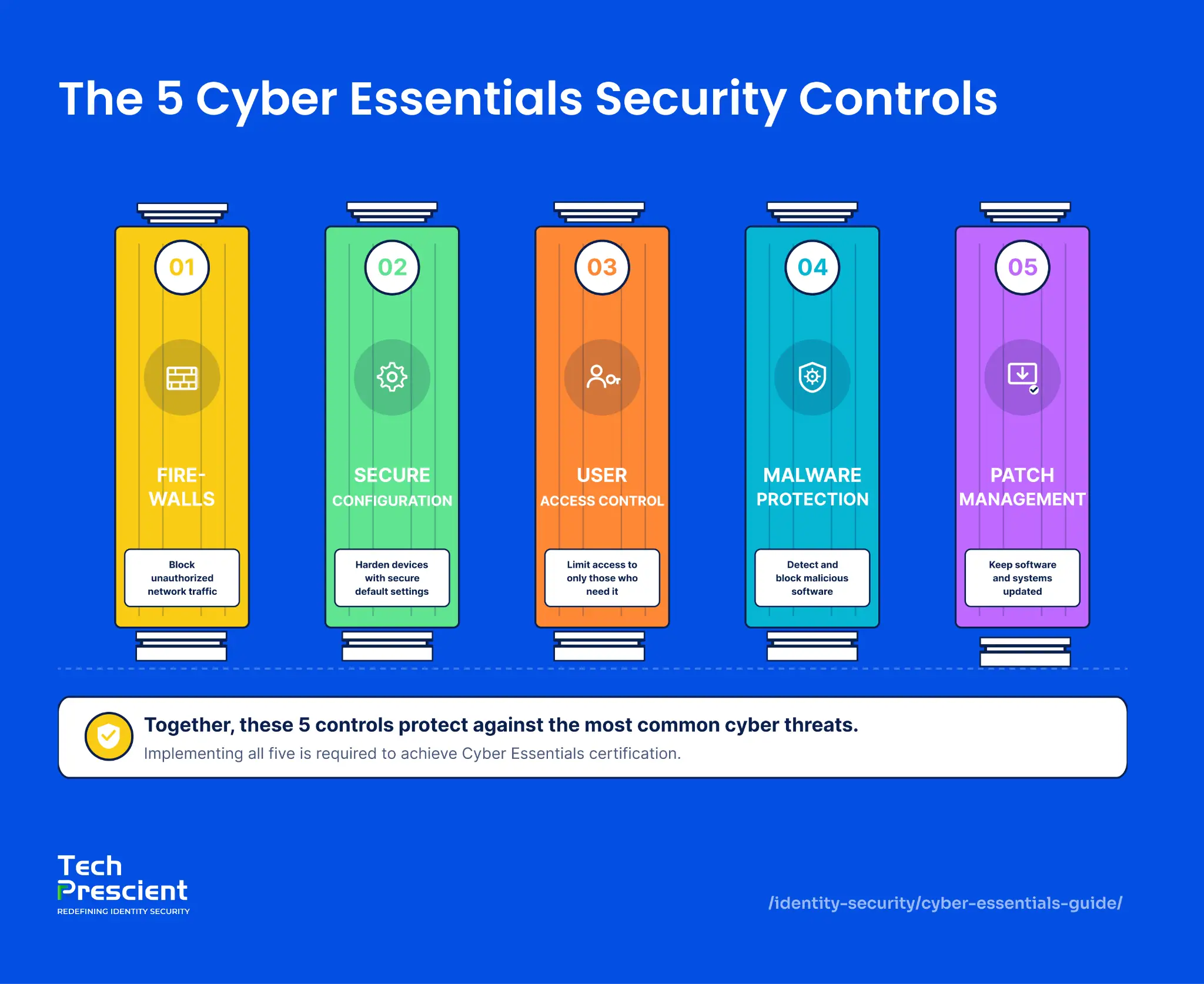
Let's explore each of the five controls and how they contribute to a more secure IT environment.
1. Firewalls
Firewalls act as the first layer of network security by monitoring and filtering traffic entering or leaving an organization's systems. They help prevent unauthorized access while allowing approved users and applications to communicate safely. Properly configured firewalls significantly reduce the risk of external attacks targeting business networks.
Example: A firewall blocks an attacker from accessing an organization's internal database while allowing employees to securely connect to cloud applications.
2. Secure Configuration
Many cyber incidents occur because systems are deployed with default settings or unnecessary services enabled. Secure configuration focuses on hardening devices, applications, and operating systems by removing unnecessary features, changing default credentials, and applying recommended security settings before they are put into use.
Example: Before issuing laptops to employees, the IT team disables unused services, changes default administrator credentials, and enables disk encryption.
3. User Access Control
User access control ensures employees have access only to the systems and data required for their roles. By following the principle of least privilege and regularly reviewing permissions, organizations reduce the risk of accidental data exposure, insider threats, and compromised accounts.
Example: An HR executive can access employee records, while finance systems remain accessible only to authorized finance personnel.
4. Malware Protection
Malware protection safeguards systems against threats such as ransomware, spyware, viruses, and trojans. This control involves deploying reliable endpoint protection, keeping security tools updated, and educating users to recognize suspicious files and links before they cause harm.
Example: Endpoint security software detects and quarantines a malicious email attachment before it can infect an employee's device.
5. Patch Management
Software vulnerabilities are one of the most common entry points for cyber attackers. Patch management ensures operating systems, applications, and firmware are updated with the latest security fixes as soon as practical, reducing the opportunity for attackers to exploit known weaknesses.
Example: After a critical vulnerability is disclosed, the IT team deploys the latest security update across all company devices, preventing attackers from exploiting the flaw.

Pro Tip
Cyber Essentials is most effective when treated as an ongoing security practice rather than a one-time certification. Regularly reviewing your security controls helps you stay compliant and better prepared for evolving cyber threats.
Cyber Essentials Certification Levels Explained
Organizations pursuing Cyber Essentials certification can choose between two certification levels depending on their security objectives and compliance requirements. While both certifications are based on the same five security controls, they differ in how compliance is verified. The standard Cyber Essentials certification relies on a self-assessment questionnaire, whereas Cyber Essentials Plus requires an independent technical assessment to validate that the controls are effectively implemented.
Understanding the differences between these certification levels will help you choose the option that best aligns with your organization's security maturity and business needs.
1. Cyber Essentials (Basic)
Cyber Essentials is the entry-level certification and is achieved by completing a self-assessment questionnaire. Organizations evaluate their own security controls against the certification requirements, and the responses are reviewed by an accredited certification body before the certificate is issued.
This certification is well-suited for organizations looking to establish a cybersecurity baseline, improve their security posture, demonstrate compliance, or meet the eligibility requirements for certain UK government contracts without undergoing technical testing.
2. Cyber Essentials Plus
Cyber Essentials Plus builds on the standard certification by adding an independent technical assessment. Instead of relying solely on self-declared responses, qualified assessors verify that the required security controls are operating effectively through vulnerability checks, device testing, and configuration reviews.
Organizations handling sensitive information, operating in highly regulated industries, or working with customers that require stronger security assurance often choose Cyber Essentials Plus. Meeting the Cyber Essentials Plus requirements demonstrates a higher level of confidence that security controls are functioning as intended.
Cyber Essentials vs Cyber Essentials Plus
| Sr No | Feature | Cyber Essentials | Cyber Essentials Plus |
|---|---|---|---|
| 1 | Assessment method | Completed through a self-assessment questionnaire reviewed by an accredited certification body. | Completed through an independent technical assessment conducted by a qualified assessor. |
| 2 | Verification | Based on the organization's declaration that the required security controls are in place. | Security controls are independently tested and verified before certification is awarded. |
| 3 | Technical Testing | No hands-on testing of systems or devices is required. | Includes technical testing to validate that the implemented controls are working effectively. |
| 4 | Level of Assurance | Provides confidence that baseline security controls have been implemented. | Provides stronger assurance through independent verification of security controls. |
| 5 | Best For | Organizations seeking a cost-effective way to demonstrate baseline cybersecurity practices. | Organizations handling sensitive data or requiring higher levels of security assurance. |
| 6 | Cost & Effort | Lower cost and faster to achieve because it relies on self-assessment. | Higher cost and longer completion time due to technical verification. |
Cyber Essentials Checklist (Step-by-Step)
Preparing for Cyber Essentials certification involves more than completing a questionnaire. Organizations must first ensure that their systems, devices, and user accounts meet the framework's security requirements. Following a Cyber Essentials checklist helps identify security gaps, prioritize remediation efforts, and improve readiness for certification.
Use the following checklist as a practical starting point before applying for Cyber Essentials certification.
Create an Asset Inventory
Identify all devices, servers, applications, cloud services, and network equipment within the certification scope. Maintaining an up-to-date asset inventory ensures every critical system is included in your security efforts.
Apply Secure Configurations
Review operating systems, devices, and applications to remove unnecessary software, disable unused services, and replace default settings with secure configurations. This reduces the organization's attack surface.
Review User Access Controls
Verify that employees have access only to the systems and data required for their roles. Remove inactive accounts, enforce strong authentication, and regularly review user permissions.
Install Security Updates
Ensure operating systems, business applications, firmware, and security tools are updated with the latest patches. Promptly addressing known vulnerabilities helps prevent attackers from exploiting outdated software.
Enable Malware Protection
Deploy trusted endpoint protection across all supported devices and keep malware definitions up to date. Regular scans and real-time protection help detect and block malicious software before it can compromise business systems.
Perform a Final Readiness Review
Before submitting your certification application, verify that all five Cyber Essentials security controls have been implemented consistently across the environment. Address any remaining gaps and ensure supporting documentation is available if required.
Before applying for certification, verify that every device, user account, cloud service, and business application within scope has been reviewed. Overlooking even a single asset can delay the certification process.
Cyber Essentials Certification Process
Cyber Essentials certification follows a structured process that includes preparation, assessment, certification review, and an independent technical audit for Cyber Essentials Plus.
The certification journey typically follows these steps.
Step 1: Perform a Gap Analysis
Start by assessing your current security posture against the Cyber Essentials requirements. Identify any missing controls, misconfigurations, or outdated systems, and address these gaps before beginning the certification process.
Step 2: Complete the Self-Assessment Questionnaire
For Cyber Essentials certification, organizations complete a self-assessment questionnaire covering the five required security controls. The responses should accurately reflect the security measures implemented across the organization's in-scope systems.
Step 3: Certification Body Review
An accredited certification body reviews the submitted questionnaire to verify that the responses meet the Cyber Essentials requirements. If clarification or additional information is needed, the organization may be asked to provide further evidence before certification is issued.
Step 4: Technical Assessment (Cyber Essentials Plus)
Organizations choosing Cyber Essentials Plus undergo an independent technical assessment after successfully meeting the standard certification requirements. This additional verification confirms that the implemented security controls are functioning effectively in the production environment.
Cyber Essentials Audit Explained
A Cyber Essentials audit is part of the Cyber Essentials Plus certification and is carried out by qualified assessors. Unlike the standard certification, which relies on self-declared information, the audit involves technical verification of systems, devices, and security controls to confirm they comply with the framework's requirements. Successfully completing this assessment provides stronger assurance to customers, partners, and regulators that the organization's cybersecurity controls are operating as intended.
Cyber Essentials Certification Cost & Timeline
The Cyber Essentials certification cost and timeline depend on factors such as organization size, certification level, and overall security readiness.
The Cyber Essentials certification cost is not fixed and can vary depending on the size of your organization, the certification level you choose, and the amount of preparation required before assessment. Similarly, the time needed to achieve certification depends on how quickly your organization can implement the required security controls and address any identified gaps.
Before planning your certification journey, it's helpful to understand what influences both the cost and the expected timeline.
1. What Affects the Certification Cost?
Several factors determine how much an organization will spend on Cyber Essentials certification, including:
- The size and complexity of your IT environment.
- Whether you choose Cyber Essentials or Cyber Essentials Plus.
- The number of systems and devices included within the certification scope.
- The effort required to remediate security gaps before assessment.
- The certification body's pricing and assessment services.
2. How Long Does Certification Take?
There is no standard timeline for Cyber Essentials certification. Organizations with well-established security controls can often complete the process within a few weeks, while those requiring significant remediation may take one to three months to become certification-ready.
For Cyber Essentials Plus, the timeline is usually longer because it includes an independent technical assessment after the initial certification requirements have been met.
Typical Timeline
| Stage | Estimated Duration |
|---|---|
| Gap analysis and remediation | 1–4 weeks |
| Self-assessment and submission | 1–3 days |
| Certification body review | A few business days to 2 weeks |
| Cyber Essentials Plus technical assessment | 1–2 weeks |
| Overall certification timeline | Approximately 2–8 weeks, depending on readiness |
Cyber Essentials Plus Controls Matrix
Map every control to practical security and governance actions.
Cyber Essentials vs ISO 27001: What's the Difference?
Cyber Essentials focuses on implementing baseline technical security controls, while ISO 27001 provides a comprehensive framework for managing information security across an organization.
The table below highlights the key differences between the two frameworks.
| Sr No | Criteria | Cyber Essentials | ISO 27001 |
|---|---|---|---|
| 1 | Primary Focus | Protects organizations against common cyber threats through five essential technical controls. | Establishes a comprehensive Information Security Management System (ISMS) for managing security risks. |
| 2 | Scope | Covers baseline technical security measures for IT systems and devices. | Covers people, processes, technology, governance, and continuous risk management. |
| 3 | Certification Approach | Certification is based on a self-assessment or an independent technical assessment for Cyber Essentials Plus. | Certification requires an external audit to verify compliance with ISO 27001 requirements. |
| 4 | Implementation Effort | Generally faster and easier to implement for organizations of any size. | Requires greater planning, documentation, and ongoing management to maintain certification. |
| 5 | Best Suited For | Organizations seeking a practical cybersecurity baseline or meeting UK government contract requirements. | Organizations that need a globally recognized information security management framework or operate in highly regulated industries. |
| 6 | Geographic Recognition | Primarily recognized within the United Kingdom. | Recognized and accepted by organizations worldwide. |
When Should You Choose Cyber Essentials?
Cyber Essentials is a good choice if your organization wants to establish foundational cybersecurity practices, reduce exposure to common cyber attacks, demonstrate security to customers, or meet eligibility requirements for UK government contracts. It is particularly suitable for small and medium-sized businesses or organizations beginning their cybersecurity journey.
When Should You Choose ISO 27001?
ISO 27001 is a better fit for organizations that require a comprehensive information security management framework, operate across multiple regions, handle large volumes of sensitive information, or need to meet international compliance expectations. It is also ideal for businesses seeking continual improvement through structured risk management and governance processes.
Can Organizations Use Both?
Yes. Cyber Essentials and ISO 27001 complement each other rather than compete. Many organizations first implement Cyber Essentials to establish strong technical security controls and later adopt ISO 27001 to build a broader security management program. Using both frameworks provides stronger protection, improves compliance readiness, and demonstrates a mature approach to information security.
Best Practice
If your long-term goal is a mature cybersecurity program, start with Cyber Essentials to establish baseline technical controls, then build on that foundation with ISO 27001 for broader risk management and governance.
Who Needs Cyber Essentials Certification?
Cyber Essentials certification is valuable for organizations of all sizes, especially those handling sensitive data, delivering digital services, or working with the UK public sector.
The following organizations benefit the most from Cyber Essentials certification.
1. Small and Medium-Sized Businesses (SMEs)
SMEs are frequent targets of cyber attacks but often have limited security resources. Cyber Essentials provides an affordable and practical framework for strengthening security, reducing cyber risk, and demonstrating a commitment to protecting customer and business data.
2. Large Enterprises
For larger organizations, Cyber Essentials helps establish consistent baseline security controls across departments, business units, and distributed workforces. It also complements broader cybersecurity and compliance initiatives by reinforcing essential technical safeguards.
3. SaaS and Technology Companies
Organizations delivering cloud-based applications and digital services must protect customer data and maintain trust. Cyber Essentials helps SaaS providers demonstrate that fundamental security controls are in place, supporting customer assurance and supply chain security requirements.
4. Government Contractors and Suppliers
Organizations bidding for or delivering certain UK government contracts that involve handling sensitive or personal information may need Cyber Essentials certification. Holding a valid certificate also strengthens credibility when working with public sector organizations and security-conscious clients.
5. Organizations Handling Sensitive Data
Businesses in sectors such as finance, healthcare, education, legal services, and professional consulting regularly process confidential information. Cyber Essentials helps reduce the risk of data breaches by ensuring essential security controls are consistently applied across the IT environment.
Common Challenges & Mistakes in Cyber Essentials Compliance
Organizations often face challenges with defining certification scope, managing user access, maintaining secure configurations, and keeping security controls up to date.
The following are some of the most common challenges organizations face during Cyber Essentials compliance.
1. Misunderstanding the Certification Scope
One of the most common mistakes is incorrectly defining which systems, devices, users, and cloud services are included within the certification scope. An incomplete or inaccurate scope can leave security gaps unaddressed and delay the certification process.
2. Weak Access Governance
Organizations often grant users more access than they need or fail to remove permissions when employees change roles or leave the company. Regular access reviews and least-privilege policies help reduce unnecessary access and lower the risk of unauthorized activity.
3. Delayed Security Updates
Postponing operating system, application, or firmware updates leaves known vulnerabilities exposed for longer than necessary. A consistent patch management process is essential to maintaining compliance and protecting systems from common exploits.
4. Inconsistent Secure Configurations
Default settings, unused services, and poorly configured devices can create unnecessary security risks. Applying secure configurations consistently across all endpoints helps reduce the organization's attack surface.
5. Lack of Continuous Monitoring
Cyber Essentials is not a one-time exercise. As new devices, users, and applications are introduced, organizations should continuously monitor their environment, review security controls, and address emerging risks to maintain an effective security posture.
How Identity Governance (IGA) Supports Cyber Essentials
Identity Governance and Administration (IGA) helps organizations strengthen access controls, automate governance processes, and simplify Cyber Essentials compliance.
Here's how Identity Governance supports Cyber Essentials compliance.
Strengthens User Access Control
User access control is one of the five core Cyber Essentials security controls. IGA solutions enforce the principle of least privilege by ensuring employees receive only the access they need based on their roles. Automated provisioning, deprovisioning, and periodic access reviews also help prevent excessive or outdated permissions.
Simplifies Audit Readiness
Preparing for Cyber Essentials assessments often requires organizations to demonstrate how user access is managed and controlled. IGA centralizes identity data, maintains detailed audit trails, and generates compliance reports, making it easier to provide evidence during certification and future audits.
Automates Access Reviews
Manually reviewing user access across multiple applications can be time-consuming and error-prone. IGA automates access certification campaigns, highlights high-risk accounts, and helps organizations quickly identify and remediate inappropriate access before it becomes a compliance issue.
Supports Continuous Compliance
Cyber Essentials compliance doesn't end after certification. As employees join, change roles, or leave the organization, access permissions must be updated accordingly. IGA continuously governs identities and access rights, helping organizations maintain compliance, reduce identity-related risks, and stay prepared for future assessments.
Benefits of Cyber Essentials Certification
Cyber Essentials certification helps organizations strengthen cybersecurity, build stakeholder confidence, improve compliance readiness, and gain a competitive business advantage.
The following are key benefits of Cyber Essentials certification.
1. Stronger Cybersecurity
Cyber Essentials helps organizations establish a solid security foundation by reducing vulnerabilities that attackers commonly exploit. Implementing the required controls improves protection for users, devices, applications, and networks against everyday cyber threats.
2. Improved Compliance Readiness
Although Cyber Essentials is not a regulatory framework, it supports broader compliance efforts by encouraging essential security practices. It also helps organizations prepare for customer security assessments, industry requirements, and UK government procurement standards.
3. Greater Business Trust
Holding a Cyber Essentials certification demonstrates that your organization follows recognized cybersecurity practices. This can strengthen confidence among customers, suppliers, business partners, and other stakeholders who expect organizations to safeguard sensitive information.
4. Competitive Advantage
Many organizations consider cybersecurity certifications during vendor evaluations and procurement decisions. Cyber Essentials can help businesses stand out from competitors, strengthen supply chain relationships, and improve eligibility for contracts that require a recognized security standard.
5. Lower Security and Operational Costs
Preventing cyber incidents is often more cost-effective than recovering from them. By reducing the likelihood of common attacks and encouraging proactive security practices, Cyber Essentials can help minimize downtime, incident response costs, and the financial impact of security breaches.
Final Thoughts
Cyber Essentials provides organizations with a practical, government-backed framework for strengthening cybersecurity, reducing exposure to common cyber threats, and demonstrating a commitment to security best practices. By implementing its five core security controls, businesses can improve cyber resilience, build stakeholder confidence, and establish a strong foundation for long-term compliance.
Tech Prescient helps organizations strengthen identity governance, automate user access management, enforce least-privilege policies, and simplify compliance reporting to support Cyber Essentials requirements across complex hybrid and multi-cloud environments.
Cyber Essentials Plus Controls Matrix
Map every control to practical security and governance actions.
FAQs
Cyber Essentials is a UK government-backed cybersecurity certification that helps organizations protect themselves against common cyber threats by implementing five essential security controls. It provides a practical security baseline that improves cyber resilience, supports compliance, and demonstrates a commitment to cybersecurity best practices.
Not necessarily. The standard Cyber Essentials certification is based on a self-assessment questionnaire, making it achievable for most organizations that have implemented the required security controls. Cyber Essentials Plus is more rigorous because it includes an independent technical assessment to verify those controls.
The five Cyber Essentials controls are firewalls, secure configuration, user access control, malware protection, and patch management. Together, these controls help organizations reduce common security vulnerabilities and defend against the majority of everyday cyber attacks.
Cyber Essentials focuses on implementing five baseline technical security controls to reduce common cyber risks, while ISO 27001 is a comprehensive Information Security Management System (ISMS) that covers people, processes, technology, and continuous risk management. Many organizations adopt Cyber Essentials first before progressing to ISO 27001.
Cyber Essentials is not legally mandatory for every organization. However, it is required for many UK government contracts that involve handling sensitive or personal information, and many private-sector organizations also use it to strengthen supply chain security and demonstrate their cybersecurity commitment.


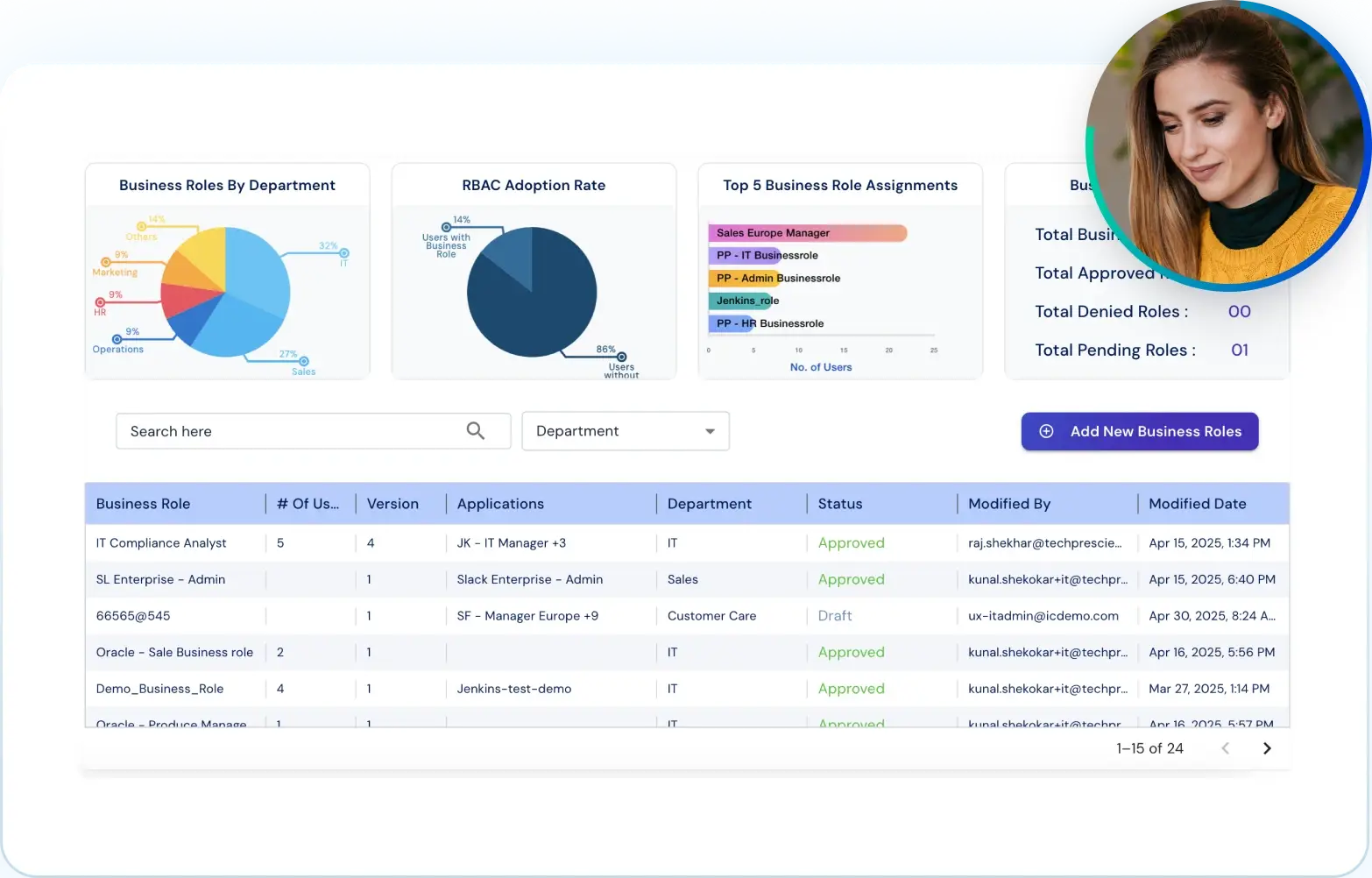
GET A PERSONALIZED DEMO
See Identity Confluence in Action
“One platform to govern identities, automate access decisions, and prove compliance; across every app, user, and system in your environment.”



Murli Ramsunder
Senior Architect, Vonage