
What Is Security Posture? Definition & Why It Matters
Last Updated date: July 15, 2026
On this page
See Tech Prescient in Action
Automate access, reduce risk, and stay audit-ready
Security posture refers to an organization's overall cybersecurity readiness and its ability to prevent, detect, respond to, and recover from threats across people, processes, and technology.
It reflects how effectively security controls, policies, and operational practices function together to protect data, systems, and identities. Security posture is not defined by the presence of individual tools such as firewalls or endpoint protection. It is defined by how well security capabilities are implemented, integrated, and continuously validated against evolving risk.
A strong security posture provides measurable visibility into risk, accelerates incident detection and response, and supports regulatory and compliance requirements. A weak posture introduces exposure through misconfigurations, unpatched vulnerabilities, excessive privileges, and fragmented controls. These gaps expand the attack surface and increase the likelihood of compromise.
This article examines the core components of security posture, why it is critical for modern enterprises, and how organizations can assess and improve it in a structured, repeatable way.
Key Takeaways:
- Security posture is a true measure of your organization's cyber resilience and your ability to defend, detect, and recover from threats.
- A mature posture combines the right set of technologies, policies, monitoring, and awareness of personnel.
- Gaps in posture increase risk exposure, complicate compliance, and erode stakeholder trust.
- Continuous assessment and automation improve visibility, reduce response time, and support informed decision-making.
- Security posture is not a point-in-time outcome. It requires ongoing evaluation and adaptation as threats evolve.
Security Posture Definition
The security posture of an organization is a measure of its cybersecurity preparedness and is an indication of how well an organization can prevent, detect, respond to, and recover from cyber threats. A strong security posture is not just about having the latest tools or software in place, but rather the policies, procedures, employee awareness, and monitoring systems that function together to minimize risk and maintain compliance. It is essentially a snapshot of the organization's preparedness to defend itself against an evolving cyber threat at a point in time.
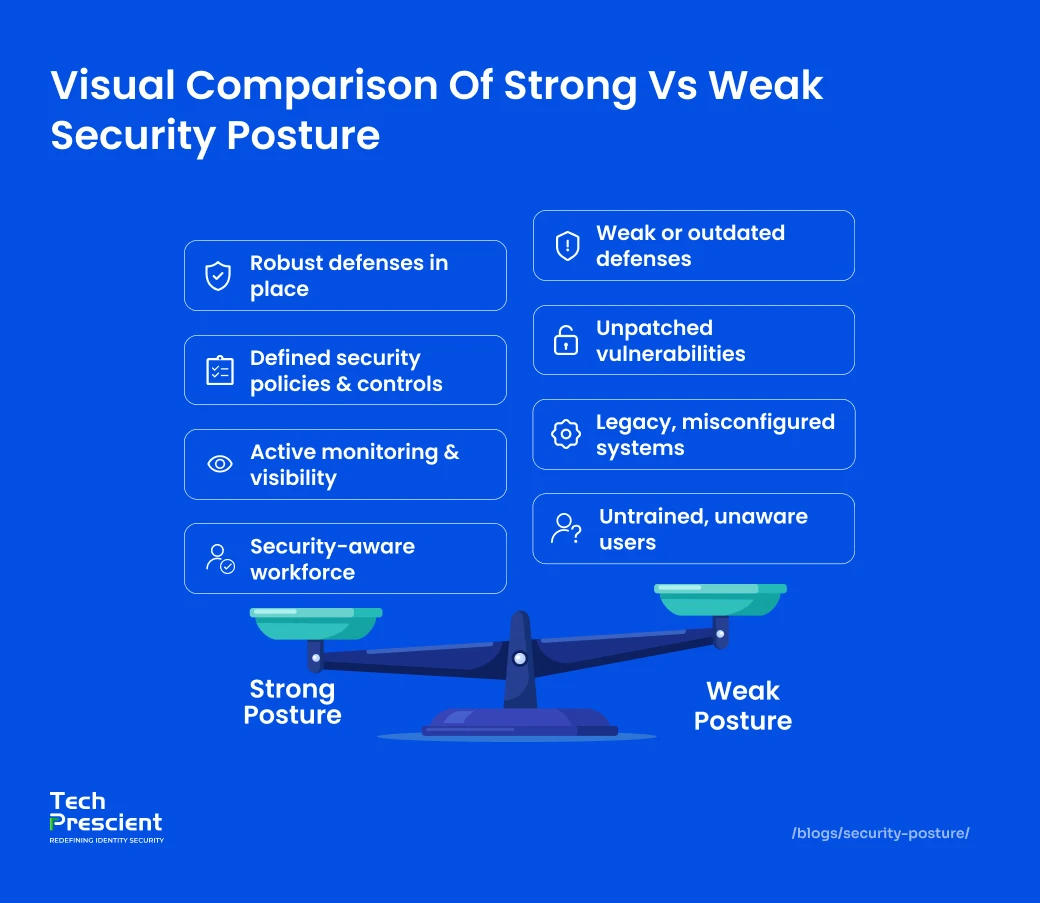
Example of Strong Security Posture vs Weak Security Posture:
| Strong Security Posture | Weak Security Posture |
|---|---|
| Up-to-date security tools that include firewalls, encryption, endpoint protection, identity access controls, etc. | Using outdated and inconsistent security tools, limited integration without meaningful connections to security processes and privileges |
| Policies and incident response plans that are written and updated periodically, and enforced strictly | Policies exist but are mostly disregarded, and little effort is made to enforce and revise those policies. |
| Employees are trained at least periodically on Social engineering attacks, cyber hygiene, and organizational security policies. | Employees are unaware of potential cyber threats or frequently exhibit careless behaviors. |
| Continuous monitoring, vulnerability management, and threat detection tools are employed. | System logging is limited, if even monitored at all (to detect threats being realized), and/or vulnerability management tools perform sub-optimized procedures with delayed detection. |
| Audits and assessments are performed regularly to ensure systems are in place to identify gaps or deficiencies. | There are no regular assessments of resources, leading to gaps in compliance without awareness of the gaps and leaving organizations with an increased exposure to an attack. |
Security Posture Examples (Real-World Scenarios)
Security posture becomes measurable when evaluated against operational controls, governance maturity, and risk exposure. The following scenarios demonstrate how implementation depth directly affects resilience.
Example 1: Financial Services Organization
- Multi-factor authentication (MFA) enforced for all workforce and privileged access
- Quarterly access certification and entitlement reviews
- Strict segregation of duties (SoD) controls implemented
- Continuous threat monitoring and anomaly detection
Outcome: Reduced insider risk, stronger fraud prevention controls, and improved audit readiness through enforced least-privilege access and continuous oversight.
Example 2: Healthcare Organization
- Legacy systems operating without modernization roadmap
- No recurring vulnerability assessments
- Over-permissioned workforce accounts
- No documented or tested incident response plan
Outcome: Expanded attack surface, increased likelihood of unauthorized access, and elevated regulatory exposure due to insufficient control validation and response readiness.
Example 3: SaaS Enterprise with Mature Security Program
- Zero Trust architecture implemented across identity and cloud environments
- Real-time behavioral anomaly detection
- Automated identity lifecycle management
- Continuous compliance monitoring mapped to regulatory frameworks
Outcome: Integrated, identity-centric controls that reduce lateral movement risk, improve response speed, and maintain alignment with regulatory requirements.
Result: Resilient security posture aligned with regulatory frameworks.
Key Components of Security Posture
Security posture is defined by the effectiveness, integration, and governance of multiple control layers working together. These components determine how consistently an organization can manage risk, maintain compliance, and respond to evolving threats. Weakness in any control domain increases exposure and undermines overall resilience.
1. Tools and Controls
Security posture depends on the implementation and integration of preventive, detective, and responsive controls across identity, endpoints, networks, and cloud environments.
Core controls typically include:
- Network security controls such as firewalls and intrusion detection and prevention systems (IDPS)
- Endpoint detection and response (EDR) capabilities
- Data loss prevention (DLP) and encryption controls
- Identity and access management (IAM) to enforce authentication, authorization, and least-privilege access
- Security information and event management (SIEM) and security orchestration, automation, and response (SOAR) platforms for centralized visibility and coordinated response
The effectiveness of these tools is determined not by their presence, but by configuration accuracy, integration depth, and continuous validation.
Example: An EDR solution that automatically isolates a compromised endpoint limits lateral movement and reduces operational disruption.
2. Policies and Procedures
Policies define the rules of engagement for the entire security ecosystem. They outline how data is to be handled, when to take action in the event of an incident, and the IAM system is one way to detail who is enforcing controls. Procedures operationalize those policies by formalizing the actions taken to secure the organization and allowing others to reference whether those actions are compliant and defensible.
Example: A well-documented incident response plan enables the incident response teams to work effectively and collaboratively during a security breach, lowering the potential damage and recovery time.
3. Employee Training
Workforce behavior directly affects identity security and access risk. Structured training programs, phishing simulations, and role-based awareness initiatives reduce human-driven exposure. Security maturity increases when employees understand access hygiene, recognize social engineering attempts, and follow established reporting protocols.
Example: Prompt reporting of a phishing attempt enables credential resets and investigation before unauthorized access occurs.
4. Vulnerability & Risk Management
Security posture requires systematic identification, prioritization, and remediation of vulnerabilities across infrastructure and applications.
This includes:
- Recurring vulnerability assessments
- Penetration testing
- Configuration reviews
- Risk-based patch management
Effective programs prioritize remediation based on exploitability, business impact, and identity exposure, not solely on technical severity scores.
Example: A risk-based dashboard that correlates vulnerabilities with privileged access exposure allows teams to address high-impact weaknesses first.
5. Monitoring & Visibility
Continuous monitoring is essential for validating control effectiveness and detecting anomalous activity across cloud, hybrid, and on-premise environments.
Capabilities typically include:
- Centralized log aggregation and analysis (SIEM)
- Automated response workflows (SOAR)
- Endpoint behavioral monitoring (EDR)
- Identity and access activity monitoring
Sustained visibility supports early detection, faster containment, and informed executive reporting.
Example: Ongoing monitoring in a hybrid cloud environment, for instance, can detect unusual login patterns that might suggest compromised identities.
Note
Learn how a Security Operations Center (SOC) enhances continuous monitoring and threat detection across your environment.
6. Governance & Compliance
Governance provides structure and accountability for the management of security. Governance holds policies, tools, and practices accountable to standards such as ISO 27001, NIST, or GDPR. The goal of compliance processes is to prove that controls are performed as intended and are documented - the basis of trust with customers and regulators alike.
Example: Regular audits and access reviews, for example, would ensure that only authorized users can access sensitive environments, reducing both risk and compliance.
Identity Confluence simplifies governance by automating compliance reporting, enforcing access policies, and ensuring every identity, human or non-human, remains auditable and compliant by design.
Why a Strong Security Posture Matters
A mature security posture reduces operational risk, supports regulatory alignment, protects business continuity, and reinforces stakeholder confidence.
Security posture is not defined solely by the ability to block attacks. It reflects how consistently an organization can detect, contain, and recover from disruption while maintaining control over identity, data, and cloud environments. As threat complexity and regulatory expectations increase, posture maturity determines whether incidents remain contained events or escalate into systemic failures.
1. Threat Mitigation
A mature security posture allows early detection and fast remediation. Continuous monitoring, layered defenses, and proactive patching procedures make it difficult for attackers to exploit vulnerabilities. For example, if an endpoint security system detects ransomware behavior and quickly isolates the device in real time, the attack cannot spread across the network. A strong posture does not eliminate risks, but it allows the organization to respond faster, reducing overall damage.
2. Business Continuity
Cyber incidents destabilize operations, delay projects and revenue impact on businesses. Creating a mature security posture originating from processes and policies, as well as backup systems and a recovery plan, makes it possible for organizations to continue operating amid an attack. For instance, if there is a compromise to a cloud service, organizations with redundant systems or automated failover can use the other system while they contain the issue. In summary, a strong and resilient posture allows the business to carry on, significantly protecting productivity and the customer experience.
3. Regulatory Compliance
Maintaining a robust posture allows you to align your security practices to frameworks such as ISO 27001, NIST, GDPR, or HIPAA. Conducting periodic assessments, enforcing policies, and implementing access controls demonstrates to your clients that their data is protected, which is critical information for any regulated business, so that they are not penalized and maintain their certification.
For example, if a healthcare provider has strict IAM and audit controls, they would not only comply with HIPAA but also mitigate insider threat risks. Regulation is not just a matter of avoiding fines or other penalties; regulation means developing an organized, auditable security practice that regulators and stakeholders easily identify as trustworthy.
4. Customer Trust & Cost Savings
A breach can tarnish trust and reputation much faster than any technical control failure. When a customer sees and trusts your security posture, it reassures them that their data is kept safe and that reasonable care is taken when handling it. Trust can certainly lead to loyalty, market opportunity, and incident cost reductions over time.
For example, companies that engage and monitor their posture proactively and consistently report breach incidents had considerably lower total costs associated with recovery, remediation and increased premiums (or other costs) than companies that waited and reacted to incidents after they happen.
What Is Security Posture Management (SPM)?
Security Posture Management (SPM) is the continuous process of monitoring, assessing, and improving security controls across cloud, identity, data, and infrastructure environments.
Unlike point-in-time assessments, SPM operates as an ongoing governance function. It provides structured visibility into control effectiveness and risk exposure by:
- Identifying configuration drift and misconfigurations
- Detecting excessive privileges and entitlement risks
- Monitoring control gaps against regulatory and internal standards
- Enabling automated or guided remediation workflows
SPM shifts security oversight from periodic review to continuous validation.
Common Types of Security Posture Management
1. Cloud Security Posture Management (CSPM)
Cloud security posture management focuses on identifying and remediating cloud configuration risks across infrastructure-as-a-service (IaaS) and platform-as-a-service (PaaS) environments.
2. Data Security Posture Management (DSPM)
Data security posture management provides visibility into sensitive data location, classification, access exposure, and policy enforcement.
3. Identity Security Posture Management (ISPM)
Evaluates identity risks, entitlement sprawl, privilege misuse, and access governance gaps across workforce and machine identities.
As cloud adoption and identity complexity increase, automated posture management capabilities reduce reliance on manual audits and improve real-time risk awareness. Continuous posture management enables measurable control validation rather than retrospective compliance reporting.
Types of Security Posture
Security posture differs across cloud, data, and identity domains. Each environment introduces distinct risks, and together they define overall cyber resilience.
Security posture is not a single control set. It reflects how effectively controls operate across interconnected environments. Cloud configurations, data protection mechanisms, and identity governance are interdependent. Weakness in one domain increases exposure in the others.
For example, compromised identities can expose sensitive data; poorly classified data complicates compliance enforcement; and misconfigured cloud services expand the attack surface. Understanding how these domains interact enables organizations to identify blind spots and strengthen control alignment across environments.
1. Cloud Security Posture
Cloud security posture focuses on securing your cloud environments, workloads, and configurations. It is the continuous evaluation of misconfigurations, access controls, and compliance across cloud providers.
A mature cloud security posture includes:
- Continuous monitoring of cloud configurations (CSPM)
- Identity and access management to cloud resources
- Encrypting sensitive data in transit and at rest
- Overseeing shadow IT and compliance audits
Its objective is to avoid data exposure, misconfigurations, and unauthorized local access across hybrid or multi-cloud environment infrastructure.
2. Data Security Posture
Data security posture describes how well your organization secures sensitive information and regulated information while it is in use and throughout its lifecycle. The data security posture includes processes for data discovery, classification, encryption and access governance (i.e., ensuring the appropriate person has access at the right time).
A mature data posture includes:
- Data discovery and classification that is automated
- Policy-based access control and masking
- Data loss prevention (DLP) solutions
- Continuous inspection for anomalous access or data leak
The objective is to protect sensitive data wherever it is - on-prem, in the cloud or shared outside the organization.
3. Identity Security Posture
Identity security posture is concerned with managing and protecting human and non-human identities throughout the enterprise. It is an assessment of how strong the governance is around identity systems, privileges, and authentication.
A strong identity posture includes:
- Strong authentication and MFA policies
- Privileged access management (PAM)
- Continuous identity lifecycle management
- Real-time detection of anomalous access behavior
The objective is to mitigate identity-based risk, eliminate standing privileges, and maintain accountability at every access point.
Security Posture Assessment: How to Evaluate It
A structured security posture assessment identifies control gaps, prioritizes risk exposure, and establishes a roadmap for continuous improvement.
An assessment evaluates how effectively an organization prevents, detects, and responds to threats across identity, cloud, data, and infrastructure environments. Rather than reacting to incidents, structured assessments provide measurable insight into control maturity and operational resilience.
The following framework outlines core evaluation steps.
Inventory All Assets
Establish a comprehensive inventory of all assets connected to the environment, including personnel, devices, servers, applications, cloud workloads, APIs, and non-human identities.
Asset management should include:
- Classification by business criticality and data sensitivity
- Documented ownership and accountability
- Continuous updates to reflect configuration and infrastructure changes
Complete and current asset visibility forms the foundation of effective risk management. Untracked assets introduce unmanaged exposure and undermine control validation.
Assess Identities and Access Controls
Examine all human and non-human identities in your environment, including users, service accounts, APIs, and automation scripts.
- Assess for over-permissioned accounts, orphaned identities, and inactive users.
- Verify that least privilege principles are applied consistently.
- Confirm multi-factor authentication (MFA) and single sign-on (SSO) configurations.
- Map identities to business-critical systems and sensitive data.
Purpose: Knowing who or what has access, and if that access is appropriate, is essential to reducing attack surfaces and improving security posture.
Conduct Vulnerability Scans
Perform automated and recurring vulnerability assessments across infrastructure, applications, and network components.
Assessments should identify:
- Unsupported or outdated software
- Configuration weaknesses
- Missing security patches
- Exposed services
Remediation prioritization must consider exploitability, privilege exposure, and business impact rather than severity score alone.
Purpose: Identify and remediate weaknesses before they are operationalized into active threats.
Conduct a Gap Analysis
Assess your current controls and practices against industry standards (NIST CSF, ISO 27001, CIS Controls)
- Identify gaps in technology, policies, and training.
- Map each gap to a remediation plan.
Purpose: Close the current state versus desired security maturity gap.
Analyze and Correlate Data
Use analytic tools to identify trends, anomalies, and indicators of compromise in your environment.
- Use a SIEM (Security Information and Event Management) to correlate logs and identify threats.
- Use SOAR (Security Orchestration, Automation, and Response) to automate workflows.
- Use EDR/XDR (Endpoint Detection and Response, Extended Detection and Response) to get visibility at the endpoint.
Purpose: Get insight into where you are in terms of your security posture, and to detect and respond faster to new threats.
Review and Report Results
Document, summarize, and report the key findings, risky observations, and recommendations in a simple and actionable manner.
- Provide prioritized recommendations for remediation and identify an owner.
- Provide some KPIs to measure improvement over time.
Purpose: Turn findings from the assessment into a roadmap for continuous security improvements.
How Does Your Security Posture Compare in 2026?
See how organizations rank across posture maturity, identity risk exposure, and Zero Trust readiness.
How to Improve Your Security Posture
Improving security posture requires continuous control validation, identity governance enforcement, monitoring maturity, and Zero Trust alignment. Posture improvement is not a one-time initiative; it is an operational discipline that integrates automation, policy enforcement, and measurable oversight.
The following initiatives strengthen posture maturity across identity, cloud, and infrastructure environments.
1. Automate Asset Inventory
Comprehensive and continuously updated asset visibility is foundational to risk management.
Effective asset governance includes:
- Automated discovery of on-premises, cloud, and SaaS assets
- Identification of unmanaged or shadow resources
- Classification of assets by business criticality and data sensitivity
- Integration with configuration management databases (CMDBs) for accountability
Centralized asset visibility reduces blind spots and improves prioritization across vulnerability management and monitoring workflows.
2. Update Policies & Incident Response Plans
Conduct reviews of security policies, procedures, and incident response plans to update based on current threat profiles and compliance changes.
- Standardize access control rules, acceptable use policies, escalation, and incident reporting practices.
- Tabletop exercises, simulated attack scenarios, or red-team exercises would enable systems to assess current readiness for incident response and to complete processes as documented.
- Keep policies aligned with regulatory requirements such as GDPR, HIPAA, or ISO 27001.
This collection, maintenance, tracking, and reporting of policies improves organizational resilience against incidents, reduces incident response time, and ensures continued compliance with agreements and regulations.
3. Train Employees Regularly
Human behavior directly influences identity exposure and credential risk.
Security awareness programs should include:
- Role-based training aligned to access privileges
- Phishing simulations and social engineering testing
- Clear reporting channels for suspicious activity
- Training on credential hygiene, cloud access practices, and data handling standards
Reducing human-driven error lowers the likelihood of credential compromise and unauthorized access.
4. Implement an IGA Solution
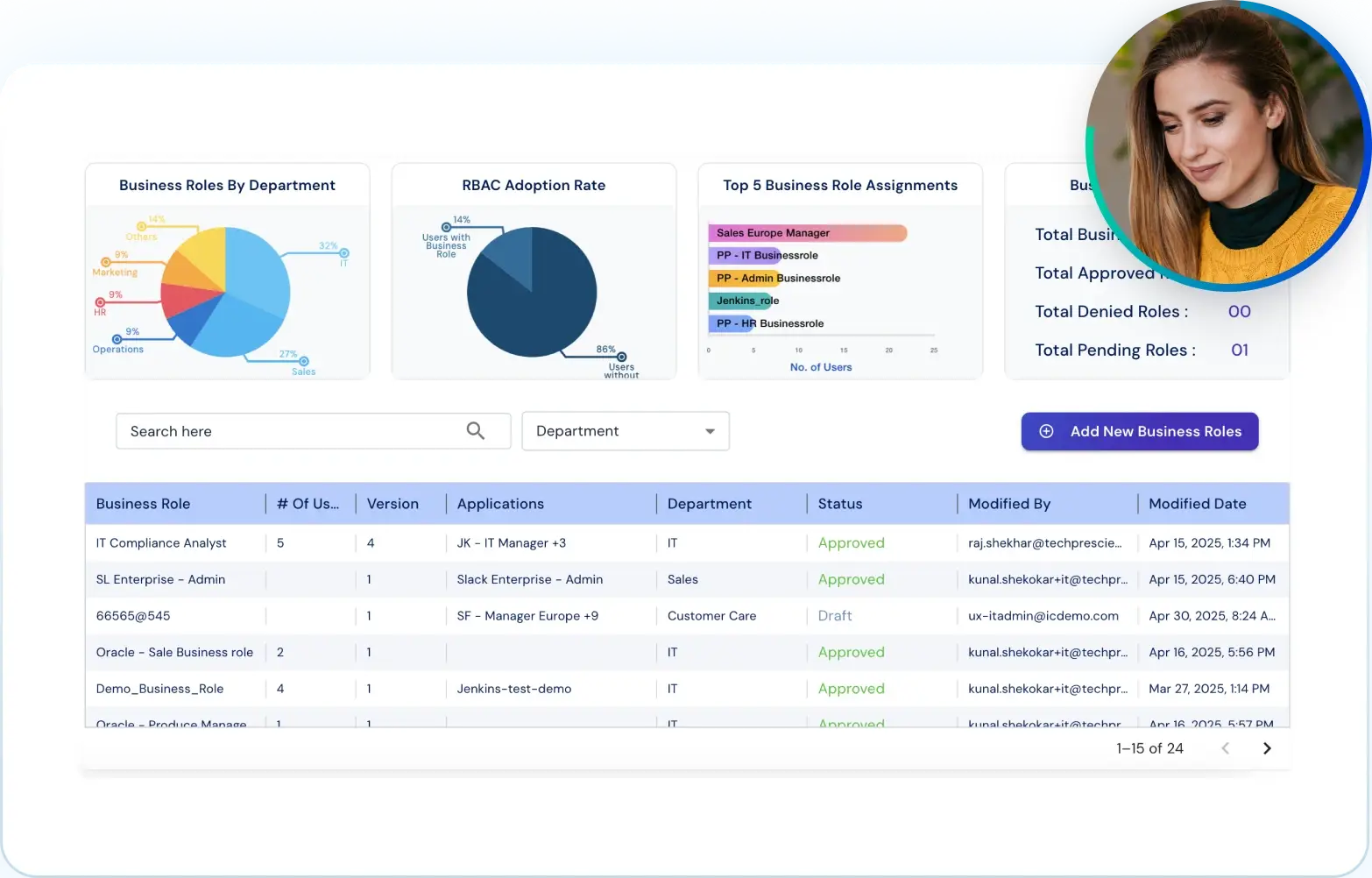
The purpose of Identity Governance & Administration (IGA) solutions, like Tech Prescient's Identity Confluence, is to centralize and automate user access and authorization management across an organization.
- Automatically provision and deprovision accounts, including human and non-human identities.
- Enforce least-privilege access and segregation of duties policies.
- Automated user access reviews and certification of compliance.
- Provide a single source of truth for all identities and their entitlements.
This ensures appropriate access is maintained, reduces the amount of risk from over-permissioned accounts, improves compliance, and adds to your Zero Trust and monitoring efforts.
5. Apply Zero Trust Principles
Zero trust follows the principle of 'never trust, always verify,' which assumes that no user, device, or application should be trusted. It is a process of constant verification. Utilize these zero trust frameworks across networks, systems, or applications.
- Constantly have users, devices, and applications verify identity before allowing them access.
- Utilize least-privilege access, micro-segmentation, and conditional access policies to help limit lateral movement.
- Use Zero Trust to enforce the protection of your cloud, APIs, and even non-human identities, such as automation scripts or service accounts.
This limits the blast radius from a potential breach, contains a compromised system, and enforces access policies that are context-aware, provide access based upon time, and limit access.
6. Use Continuous Monitoring Tools
Implement solutions that monitor your traditional networks, endpoints, cloud resources, and applications in real-time.
- Utilize SIEM (Security Information and Event Management), SOAR (Security Orchestration, Automation, and Response), or EDR/XDR platforms that facilitate alerting or automated response.
- The analysis of logs and the correlation of events can uncover anomalies, unusual access patterns and potential threats.
- Effective monitoring of your environment should also take place across on-prem, cloud, and hybrid environments to ensure consistent monitoring.
This will assist you in detecting considerations early, taking proactive remediation steps, and maintaining a robust overall situational awareness throughout the organization.
7. Conduct Periodic Security Audits
Complete an in-depth review of all systems, configurations, access privileges, and compliance posture periodically.
- Consider auditing permissions, account provisioning, patch levels, and configuration reviews.
- Document your findings, remediation activities, and rule changes in light of the audit outcomes.
- Re-evaluate both internal and external perspectives (or third-party audit) in an objective evaluation of the organization's posture.
This guarantees the security controls are effectively in place and supporting continual improvement, while also producing potential reporting for regulators.
Common Challenges & Risks in Security Posturing
Assuring a strong security posture will always have challenges associated with it. Organizations frequently face persistent gaps, creating vulnerability and lowering the value of the associated cybersecurity program. Here are some of the more common challenges for organizations:
1. Over-Permissioned Users
Challenge: Users often amass excessive access permissions over time, meaning they have more permissions than are necessary for their role. Over-Permissioned users are a result of changes in role, temporary projects, and stale access reviews.
Risk: Over-Permissioned users increase the impact of a compromised account, allowing attackers to move laterally and access sensitive infrastructures and data.
Quick Fix: Implement least privileged access policies, and regularly review entitlements to ensure permissions are in line with the user's current role.
See how identity lifecycle management ensures proper provisioning and deprovisioning of user accounts to reduce risk from over-permissioned identities.
2. Shadow IT
Challenge: Employees may deploy unauthorized applications, devices, or cloud services without IT approval. This "shadow IT" subverts established security controls.
Risk: Shadow IT introduces blind spots and unmonitored data flows that can create vulnerabilities for pervasive attacks, and even potential compliance violations.
Quick Fix: Maintain an up-to-date inventory of approved/purposed-for-use tools, keep usage policies enforced and encourage sanctioned and secure alternatives.
3. Outdated Tools & Technology
Challenge: Many legacy systems, unpatched software, or outdated security tools do not align with today's threat landscape.
Risk: Attackers can easily exploit weaknesses in outdated tools. Unsupported systems may not be compatible today with current monitoring or response technology.
Quick Fix: Create a regular patch management schedule and upgrade programs for systems and tools; ensure critical updates are prioritized; integrate modern security tools and systems that allow for automation and continuous monitoring.
4. Lack of Training & Awareness
Challenge: Employees are often the weakest link in an organization's cybersecurity; however, without security training, they may become victims of phishing, mishandle sensitive data, or bypass security protocols.
Risk: Even with technical controls in place, breaches or compromised data may still happen due to human error, and the risk may ultimately harm the entire organization's security position.
Quick Fix: Implement regular role-based security training programs; simulate phishing attacks; and highlight policies to safely handle sensitive data and secure credentials.
5. Inconsistent Policy Enforcement
Challenge: Policies can be created, but have inconsistent implementation across areas such as departments, networks, or cloud environments.
Risk: The uneven implementation creates areas of opportunity for an attacker and defeats the purpose of compliance with an organization's overall security posture.
Quick Fix: Implement automatic compliance where adequate, implement a central compliance management tool, and periodically audit compliance.
6. Insufficient Visibility & Monitoring
Challenge: Organizations are unable to detect anomalous activity or vulnerabilities in real time without comprehensive monitoring.
Risk: Areas of blind spot allow threats to go unnoticed, increasing breach risks and delaying response to incidents.
Quick Fix
Implement continuous monitoring solutions in on-prem, cloud, and hybrid environments, combine the logs with SIEM/SOAR tools and set alerts for suspicious behavior.
Final Thoughts
An organization's security posture is not the one-time completion of a checklist but rather an ever-changing journey that demonstrates the organization's ability to prevent, detect, and respond to threats. A robust security stance reflects the amalgamation of people, processes, and technology while confidently assuring that risks are known, monitored, managed, compliance is achieved, and business vitality is secured. Regular assessments, policy and procedure modifications, continuous monitoring, and training of staff are crucial components to maintaining and improving an organization's cybersecurity posture over time.
A security posture entrusts responsibility for understanding how to stay secure at every state, level, and team column. Achieving a solid security posture takes commitment and drive from financial sponsors of security, IT and security leadership, and even the front-line teams comprising the organization, engraining security into the organization's DNA. By proactively managing vulnerability to inform patching, enforcing policies and frameworks, and leveraging automation and modern security frameworks, organizations can reduce risk, protect sensitive information, and develop customer and partner trust.
FAQs
Security posture is an organization's overall cybersecurity readiness. It measures how effectively people, processes, and technology prevent, detect, respond to, and recover from cyber threats.
Security posture can also be called a security stance or cybersecurity readiness. All terms describe the organization's overall behavior to secure its digital assets and efficiently respond to possible security threats.
The three core components are: (1) Security controls and policies, (2) Continuous monitoring and detection, and (3) Incident response and recovery processes.
A security posture assessment may include vulnerability scans, access reviews, configuration audits, and gap analysis against frameworks like NIST or ISO 27001.
Organizations can improve security posture by enforcing least privilege, automating access governance, implementing Zero Trust principles, conducting regular audits, and enabling continuous monitoring.


GET A PERSONALIZED DEMO
See Identity Confluence in Action
“One platform to govern identities, automate access decisions, and prove compliance; across every app, user, and system in your environment.”



Murli Ramsunder
Senior Architect, Vonage