
What Is Cyber Essentials? Certification, Checklist & Plus Explained (2026 Guide)
Last Updated date: July 11, 2026
On this page
See Tech Prescient in Action
Automate access, reduce risk, and stay audit-ready
Cyber Essentials is a UK government-backed cybersecurity certification designed to protect organizations from the most common cyber threats. Developed by the National Cyber Security Centre (NCSC), it establishes a strong security baseline through five essential controls. These controls help businesses secure systems, manage access, and reduce vulnerabilities across modern digital environments.
Cyber Essentials is widely seen as the first step toward a secure infrastructure, helping prevent up to 80% of basic cyber attacks. The standard certification builds a foundation through a self-assessment of core security controls, while Cyber Essentials Plus adds independent technical verification for a more comprehensive assessment of an organization’s security posture, making it especially valuable for SaaS and cloud-driven organizations handling sensitive data, as it strengthens trust, supports compliance, and signals a proactive approach to cyber risk.
According to the UK Government’s Cyber Security Breaches Survey 2025, 50% of businesses experienced a cyber attack in the past year, with phishing being the most common threat. The NCSC also highlights that implementing baseline controls like Cyber Essentials can prevent the majority of commodity attacks, making certification a critical first line of defense. Let’s explore Cyber Essentials in detail, including its controls, checklist, certification process, and how Cyber Essentials Plus strengthens your overall security posture.
Key Takeaways:
- Cyber Essentials is a UK government-backed certification based on five core security controls.
- This guide covers what Cyber Essentials is, who needs it, and why it matters in 2026.
- Learn the Cyber Essentials checklist and how to prepare for the self-assessment questionnaire (SAQ).
- Understand the difference between Cyber Essentials and Cyber Essentials Plus, including audit and assurance levels.
- Explore certification steps, cost breakdown, and how it helps prevent up to 80–90% of common cyber attacks.
What Is Cyber Essentials?
Cyber Essentials is a UK government-backed cybersecurity certification that helps organizations implement fundamental security controls to protect systems and networks. It establishes a baseline through five key technical measures, enabling businesses to defend against common cyber threats and reduce vulnerabilities.
1. Who runs it
Cyber Essentials is developed by the National Cyber Security Centre (NCSC), part of the UK government. Launched in 2014, it is administered by IASME and delivered through IASME-accredited certification bodies that assess and validate compliance.
2. Who needs it
Cyber Essentials is suitable for organizations of all sizes but is especially valuable for SMEs, SaaS providers, and third-party vendors handling sensitive data. It is also mandatory for businesses bidding on certain UK government contracts involving critical or personal data.
3. Certification levels
There are two certification levels. Cyber Essentials is an entry-level, self-assessment (SAQ) certification. Cyber Essentials Plus is more advanced, involving independent technical audits, vulnerability testing, and external verification.
4. Why it matters in 2026
With increasing ransomware, phishing, and supply chain attacks, Cyber Essentials provides a standardized baseline to reduce risk and strengthen security posture while supporting compliance needs.
5. Government and business relevance
Certification demonstrates the implementation of essential security controls, building trust with customers and partners. It also supports access to government contracts, improves cyber insurance eligibility, and enhances market credibility.
What Are the 5 Cyber Essentials Controls?
The 5 Cyber Essentials controls form a baseline security framework that protects networks, systems, and data from common cyber threats by securing networks, managing access, preventing malware, and keeping systems up to date.
Firewalls
Firewalls act as the first line of defense by controlling incoming and outgoing network traffic. Proper boundary firewall configuration ensures that only legitimate and necessary connections are allowed, while unauthorized access attempts are blocked.
- Configure boundary firewalls and routers to protect all internet-facing devices
- Replace default credentials and restrict administrative access to authorized users only
- Block unauthenticated inbound connections and allow only required ports and services
- Regularly review firewall rules and remove unnecessary or outdated configurations
- Use host-based or software firewalls for devices operating on untrusted networks
Secure Configuration
Secure configuration focuses on minimizing vulnerabilities by ensuring systems are set up with only essential services and secure settings, with robust password setting Remove or disable unused software, services, and user accounts
- Change default passwords and enforce strong authentication mechanisms
- Disable auto-run features and unnecessary functionalities
- Maintain an inventory of devices and ensure each is securely configured
- Require authentication before granting access to business-critical systems
User Access Control
User access control ensures that only authorized individuals can access systems and data, based on their roles and responsibilities. It limits the risk of misuse, privilege escalation, and unauthorized access.
- Implement role-based access control and restrict admin privileges to essential users
- Enforce multi-factor authentication (MFA) for all critical systems and remote access
- Establish approval processes for account creation and privilege assignment
- Regularly review and remove inactive or unnecessary accounts
- Use separate accounts for administrative tasks to reduce risk exposure
Malware Protection
Malware protection safeguards systems against threats such as viruses, ransomware, and spyware. It involves deploying and maintaining effective detection and prevention mechanisms across all endpoints.
- Install anti-virus and anti-malware software on all devices and endpoints
- Enable real-time scanning of files, emails, and web activity
- Keep malware definitions and detection tools up to date
- Restrict access to malicious or untrusted websites and downloads
- Use application allowlisting and sandboxing to prevent execution of unauthorized code
Patch Management
Patch management ensures that systems, software, and devices are regularly updated to fix known vulnerabilities. Timely updates are critical to reducing exposure to exploits and maintaining compliance.
- Apply security patches and updates for operating systems, applications, and firmware
- Follow defined timelines, such as applying critical patches within 14 days
- Enable automatic updates wherever possible to ensure consistency
- Remove unsupported or end-of-life software that no longer receives updates
- Maintain a vulnerability management policy to track and remediate risks proactively
Cyber Essentials Checklist (Step-by-Step)
The Cyber Essentials checklist ensures your organization meets all required security controls before submitting the self-assessment questionnaire (SAQ). It ensures your systems, users, and processes meet the baseline security standards defined under the certification scheme.
Follow this structured approach to prepare for certification:
1. Review scope (devices, cloud services, remote users)
Identify all assets within scope, including laptops, servers, mobile devices, cloud platforms, and remote access environments. Ensure all internet-facing systems are included and running supported operating systems, applications, and browsers with the latest security patches applied.
2. Implement the 5 controls
Apply firewall protection, secure configuration, user access control, malware protection, and patch management across all systems. This includes changing default passwords, disabling auto-run and unnecessary services, enforcing MFA and role-based access control, restricting macros, and ensuring anti-malware tools are active and updated.

Pro Tip
Focus on high-impact fixes first like MFA enforcement, patch updates, and removing unsupported software. These are the most common reasons organizations fail the SAQ.
3. Document policies
Maintain documentation for security configurations, access control processes (including onboarding and offboarding), patch management timelines, and malware protection practices. Ensure policies reflect real implementations and support audit readiness.
4. Complete SAQ
Accurately complete the self-assessment questionnaire by validating that all controls are in place. Responses should be evidence-backed, covering areas like system updates, secure configurations, and access restrictions.
5. Submit to IASME-approved body
Submit your SAQ to an IASME-accredited certification body for review. Address any identified gaps if required, and upon successful validation, receive your Cyber Essentials certification.
Prepare for Cyber Essentials with Confidence
Download the SAQ Readiness Toolkit with checklists and policy templates to pass your certification faster.
Cyber Essentials Requirements
Cyber Essentials requirements establish baseline security controls that organizations must implement to achieve certification.
To qualify, organizations are required to:
- Implement all five technical control areas: firewalls, secure configuration, access control, malware protection, and patch management
- Use supported operating systems and apply security updates in a timely and consistent manner
- Enforce multi-factor authentication (MFA) for access to critical systems and administrative functions
- Restrict administrative privileges in accordance with least privilege principles
- Configure all internet-facing systems to reduce exposure to unauthorized access
Meeting these requirements demonstrates alignment with recognized baseline security practices and reduces exposure to common, externally exploitable vulnerabilities.
Cyber Essentials vs Cyber Essentials Plus
Cyber Essentials offers two certification levels that differ in how security controls are assessed and validated. While Cyber Essentials is based on a self-assessment questionnaire (SAQ) reviewed by an external certification body, Cyber Essentials Plus builds on this by adding independent technical auditing and vulnerability testing to verify that controls are effectively implemented.
To understand the differences clearly, here’s a side-by-side comparison:
| Sr No | Feature | Cyber Essentials | Cyber Essentials Plus |
|---|---|---|---|
| 1 | Assessment | Self-assessment questionnaire (SAQ) with external review | Independent technical audit conducted by certified assessors |
| 2 | Assurance Level | Basic assurance of security controls | Advanced assurance with verified implementation and effectiveness |
| 3 | On-site Testing | No direct system testing | Yes, includes hands-on testing of systems, devices, and configurations |
| 4 | Best For | SMEs and organizations starting their security journey | Government suppliers and organizations handling sensitive or regulated data |
Cyber Essentials focuses on establishing a foundational security baseline by validating responses provided in the SAQ. It is quicker to complete, cost-effective, and suitable for organizations looking to demonstrate basic cybersecurity hygiene.
Cyber Essentials Plus, on the other hand, requires organizations to first achieve Cyber Essentials certification and then undergo a rigorous technical audit. This includes external and internal vulnerability scans, malware protection testing, configuration reviews, and verification of controls such as MFA and access restrictions.
Choosing between the two depends on your organization’s security maturity, risk exposure, and compliance requirements. While Cyber Essentials is ideal for building a baseline, Cyber Essentials Plus provides a higher level of assurance, making it more suitable for organizations dealing with sensitive data or pursuing government contracts.
Expert Insight
Most organizations don’t fail due to lack of controls, but due to inconsistent implementation and poor documentation during the assessment process.
How to Get Cyber Essentials Certified
Organizations achieve Cyber Essentials certification by implementing the required security controls, completing a self-assessment questionnaire (SAQ), and passing verification by an IASME-accredited certification body. The process typically takes a few weeks, depending on the organization’s size, complexity, and readiness.
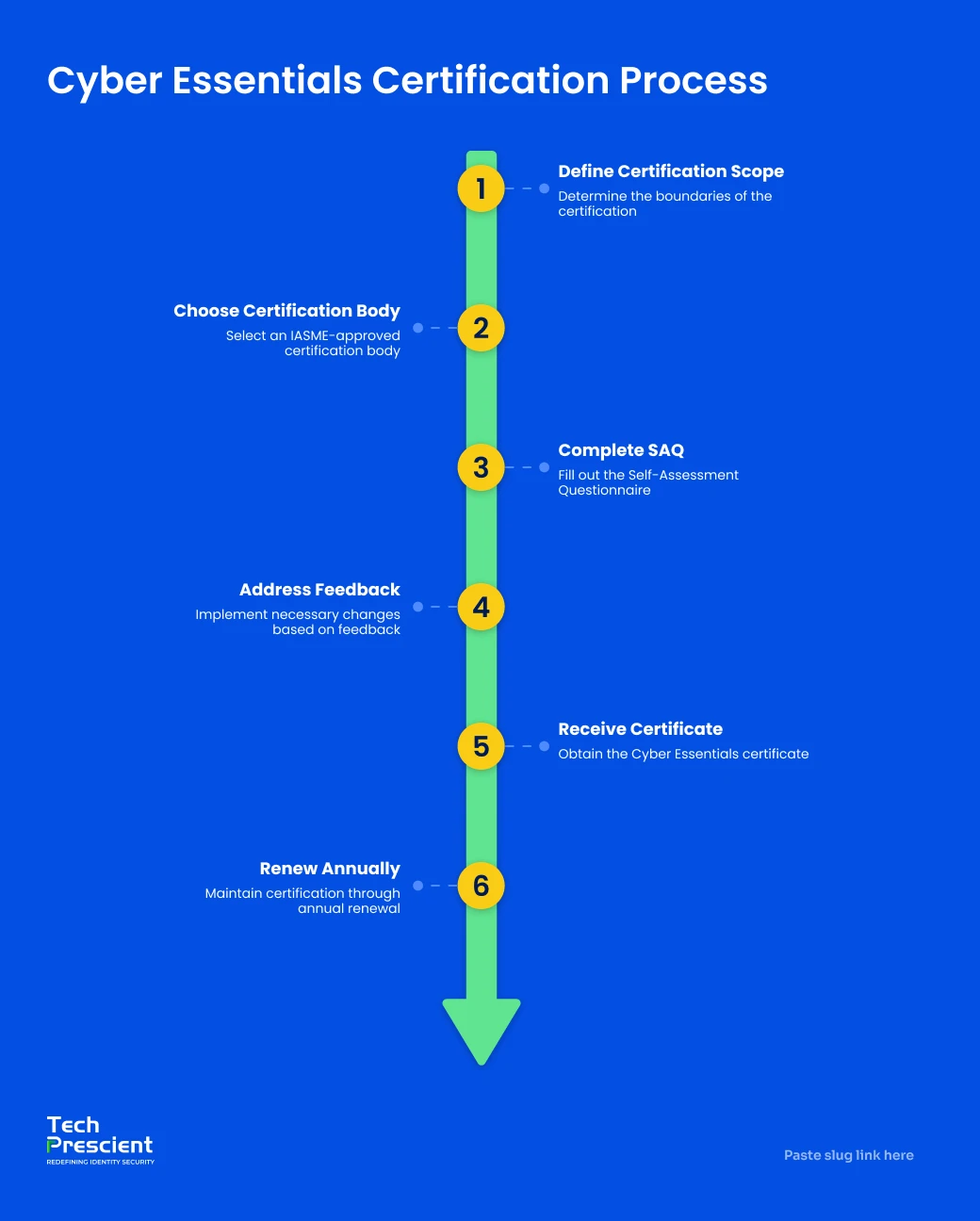
Follow these key steps to get certified:
Define certification scope
Identify all in-scope systems, including devices, servers, cloud services, and remote users. Conduct a gap analysis against the five Cyber Essentials controls to assess your current security posture. Ensure all systems are supported, securely configured, and aligned with requirements such as MFA, patch management, and malware protection.
Choose certification body
Decide whether to pursue Cyber Essentials (self-assessment) or Cyber Essentials Plus (independent technical audit). Then select an IASME-accredited certification body by comparing pricing, support, and service offerings. This body will review and validate your certification.
Complete SAQ (Self-Assessment Questionnaire)
Fill out the SAQ with accurate details about your implementation of firewall configuration, secure configuration, user access control, malware protection, and patch management. Responses should be evidence-backed and typically involve input from IT teams or security stakeholders.
Address feedback
After submission, the certification body reviews your SAQ and may request clarifications or identify gaps. Implement the required remediation actions, such as enforcing MFA, updating unsupported software, or tightening access controls, before resubmitting if needed.
Receive certificate
Once your responses are validated and all requirements are met, you will be awarded the Cyber Essentials certification. For Cyber Essentials Plus, this step includes passing an external technical audit involving vulnerability scans and control verification.
Renew annually
Cyber Essentials certification is valid for 12 months. Organizations must renew annually by reassessing their controls, updating systems, and ensuring continued compliance with evolving security requirements.
How Much Does Cyber Essentials Certification Cost?
Cyber Essentials certification costs start from around £300 + VAT for micro businesses and go up to £500 + VAT for large enterprises. For Cyber Essentials Plus, pricing typically ranges from £1,650 to £4,250 + VAT.
1. Cyber Essentials
The Cyber Essentials certification follows a tiered pricing model based on employee count:
- Micro organizations (0–9 employees): £300 + VAT
- Small organizations (10–49 employees): £400 + VAT
- Medium organizations (50–249 employees): £450 + VAT
- Large organizations (250+ employees): £500 + VAT
2. Cyber Essentials Plus
Cyber Essentials Plus includes an independent technical audit, so pricing is higher and depends on the scope of verification, number of devices, and infrastructure complexity:
- Micro organizations: ~£1,650 + VAT
- Small organizations: ~£2,250 + VAT
- Medium organizations: ~£3,250 + VAT
- Large organizations: ~£4,250 + VAT
In addition to certification fees, organizations should take into account additional cost such as - audit preparation cost, implementing security controls, upgrading unsupported systems, enabling MFA, deploying anti-malware solutions, and meeting patch management requirements costs.
Is Cyber Essentials Worth It?
Cyber Essentials is a cost-effective way to reduce cyber risk, build trust, and meet compliance needs. By implementing its five baseline controls, organizations can prevent up to 80–90% of common cyber attacks, making it a strong first line of defense.
Here’s why Cyber Essentials is worth the investment:
1. Reduced risk of cyber attacks
Cyber Essentials helps organizations defend against common threats such as phishing, ransomware, and malware. By enforcing controls like firewall configuration, access control, and patch management, it significantly lowers the likelihood of breaches and data loss.
2. Improved customer trust and credibility
Certification demonstrates that your organization follows recognized cybersecurity best practices. This reassures customers, partners, and stakeholders that their data is protected, enhancing brand reputation and trust.
3. Access to government contracts and compliance alignment
Cyber Essentials is often a mandatory requirement for UK government contracts involving sensitive data. It also helps align your organization with broader data security and compliance requirements, simplifying regulatory adherence.
4. Cyber insurance and financial benefits
Many insurers recognize Cyber Essentials certification as a benchmark for risk reduction. This can improve eligibility for cyber insurance policies and, in some cases, lead to lower premiums.
5. Stronger supply chain positioning
Certified organizations are listed within the NCSC ecosystem, making them more attractive to partners and vendors. It signals that your business meets baseline security standards, strengthening supply chain trust.
6. Competitive advantage in the market
Cyber Essentials acts as a differentiator, especially for SMEs and SaaS providers. It provides a clear signal that your organization takes cybersecurity seriously, helping you win new business and stand out in competitive markets.
Cyber Essentials vs ISO 27001
Cyber Essentials provides a baseline security framework, while ISO 27001 offers a comprehensive, risk-based security management system.
Cyber Essentials and ISO 27001 both aim to improve an organization’s security posture, but they differ significantly in scope and approach. Cyber Essentials focuses on implementing a defined set of baseline technical controls to prevent common cyber attacks, whereas ISO 27001 is a comprehensive Information Security Management System (ISMS) that covers risk management, governance, and continuous improvement across people, processes, and technology.
| Sr. No. | Feature | Cyber Essentials | ISO 27001 |
|---|---|---|---|
| 1 | Scope | Focused on five technical controls (firewalls, access control, patching, etc.) | Broad ISMS covering risk management, policies, and organizational controls |
| 2 | Approach | Prescriptive checklist-based implementation | Risk-based, flexible framework tailored to the organization |
| 3 | Complexity | Simple and quick to implement | Complex, requires extensive documentation and processes |
| 4 | Certification Process | Self-assessment (and optional technical audit for Plus) | Multi-stage external audit with ongoing compliance requirements |
| 5 | Coverage | Primarily IT systems and common cyber threats | Covers people, processes, physical, and technological security domains |
| 6 | Recognition | UK government-backed baseline certification | Internationally recognized standard |
Cyber Essentials is ideal for organizations looking to establish basic cybersecurity hygiene quickly and cost-effectively, especially SMEs or businesses entering compliance requirements. ISO 27001, on the other hand, is better suited for organizations that need a mature, scalable, and globally recognized security framework with continuous risk management and governance.
In practice, many organizations adopt Cyber Essentials as a starting point and later progress to ISO 27001 to achieve a more comprehensive and strategic security posture.
Common Mistakes to Avoid During Cyber Essentials Certification
Organizations pursuing Cyber Essentials certification are often delayed or unsuccessful due to gaps in implementation and supporting documentation.
Common issues include:
- Use of unsupported or outdated software that no longer receives security updates
- Inconsistent enforcement of multi-factor authentication (MFA) across critical systems and administrative access points
- Excessive user privileges that are not aligned with role-based access control or least privilege principles
- Incomplete or inaccurate responses within the Self-Assessment Questionnaire (SAQ)
- Failure to meet patch management timelines, including the 14-day remediation requirement for critical vulnerabilities
- Insufficient documentation of security policies, controls, and their implementation
Addressing these issues strengthens alignment with certification requirements and reduces the likelihood of assessment delays or failure.
Avoid Certification Delays and SAQ Failures
Get the Cyber Essentials SAQ Readiness Toolkit to fix gaps and validate controls.
Final Thoughts
Cyber Essentials is a practical benchmark for strengthening foundational cybersecurity through five core controls including firewalls, secure configuration, access control, malware protection, and patch management. As organizations expand across cloud, remote, and interconnected environments, these baseline controls become critical to reducing risks like ransomware, phishing, and unauthorized access. By adopting Cyber Essentials and maintaining regular reviews, businesses can improve resilience, build trust, and meet evolving compliance and contract requirements.
Tech Prescient helps organizations strengthen identity security and access governance with scalable, modern solutions.
FAQs
The five Cyber Essentials controls are firewalls, secure configuration, user access control, malware protection, and patch management. These baseline security controls help organizations protect systems and networks from common cyber threats. They are designed to reduce risks such as phishing attacks, ransomware infections, and unauthorized system access.
Cyber Essentials certification is designed to be accessible for small and medium-sized businesses. Most organizations can achieve it by implementing the five required controls and completing the self-assessment questionnaire (SAQ). Preparation usually involves reviewing system configurations, updating security policies, and ensuring access controls are properly enforced.
Organizations can complete the Cyber Essentials self-assessment questionnaire internally as part of the certification process. However, the submission must still be reviewed and verified by an accredited certification body. For Cyber Essentials Plus certification, an independent technical audit and vulnerability testing are required.
Cyber Essentials is based on a self-assessment questionnaire that is reviewed by an external certification body. Cyber Essentials Plus includes additional independent technical testing and vulnerability assessments. This provides a higher level of assurance and is often required for organizations working with government contracts.
Cyber Essentials certification is valid for 12 months from the date it is issued. Organizations must renew the certification each year to remain compliant. Annual renewal confirms that the required security controls are still properly implemented and maintained.
Cyber Essentials is not mandatory for all organizations, but it is required for businesses bidding on certain UK government contracts involving sensitive data. Many organizations also adopt it voluntarily to improve security and credibility.
Cyber Essentials certification typically takes a few days to a few weeks, depending on your organization’s readiness and how quickly you can implement required controls and complete the SAQ.


GET A PERSONALIZED DEMO
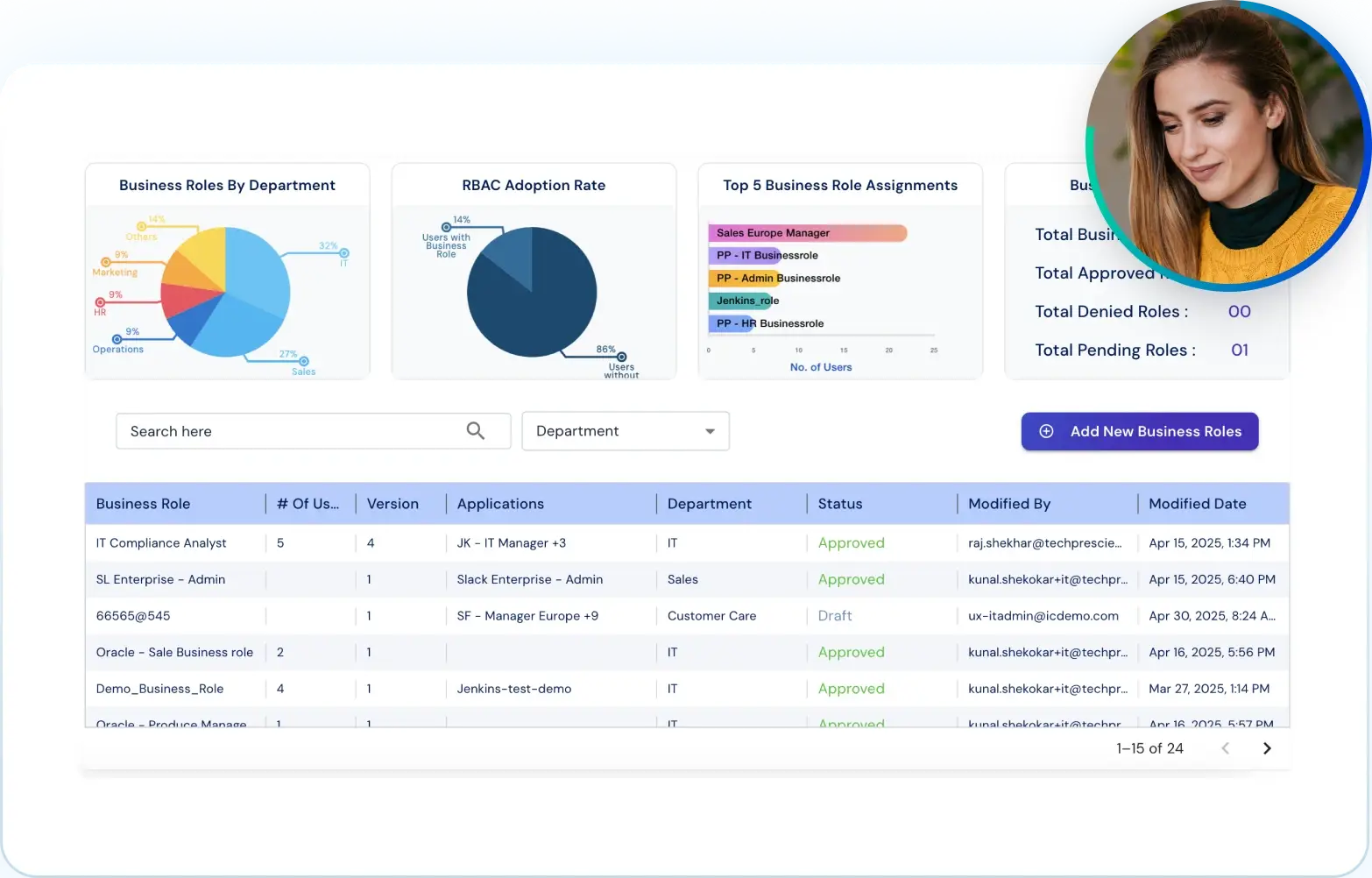
See Identity Confluence in Action
“One platform to govern identities, automate access decisions, and prove compliance; across every app, user, and system in your environment.”



Murli Ramsunder
Senior Architect, Vonage