
What Is ISO/IEC 27001? Complete 2022 Overview
Last Updated date: July 16, 2026
On this page
See Tech Prescient in Action
Automate access, reduce risk, and stay audit-ready
ISO/IEC 27001 is the internationally recognized standard for managing information security through a structured and risk-based approach. Developed by the International Organization for Standardization (ISO) and the International Electrotechnical Commission (IEC), it helps organizations protect sensitive information by establishing an effective Information Security Management System (ISMS).
Applicable to organizations of all sizes and industries, ISO/IEC 27001 provides a framework for identifying risks, implementing security controls, and continuously improving security practices. The latest version, ISO/IEC 27001:2022, reflects modern security challenges and supports stronger governance, compliance, and operational resilience.
The importance of information security continues to grow. According to the ISO Survey of Management System Standard Certifications, more than 44,000 organizations worldwide hold ISO/IEC 27001 certifications, making it one of the most widely adopted information security standards globally and a benchmark for demonstrating security and compliance maturity. In this guide, we'll explore the ISO/IEC 27001 standard, its core principles, the ISMS framework, Annex A controls, and how identity security supports ongoing compliance.
Key Takeaways:
- Learn what ISO/IEC 27001 is and how it helps organizations protect sensitive information through an ISMS.
- Understand the CIA triad and the core security principles that underpin the ISO/IEC 27001 standard.
- Explore the key changes introduced in ISO/IEC 27001:2022, including the updated Annex A controls.
- Follow the ISO/IEC 27001 certification process from risk assessment and control implementation to external audits.
- Discover how identity security, IAM, and IGA support ISO 27001 compliance and governance objectives.
What Is ISO/IEC 27001? (Definition & Meaning)
ISO/IEC 27001 is an international standard that helps organizations protect sensitive information through a risk-based Information Security Management System (ISMS).
As cyber threats, regulatory requirements, and data privacy expectations continue to evolve, organizations need a consistent way to manage information security risks. ISO/IEC 27001 provides that framework by helping businesses establish policies, processes, and controls that protect critical information while supporting compliance and operational resilience.
Let's break down the key components that make ISO/IEC 27001 the world's most widely recognized information security standard.
1. ISO and IEC: The Organizations Behind the Standard
ISO/IEC 27001 was developed jointly by the International Organization for Standardization (ISO) and the International Electrotechnical Commission (IEC). ISO develops international standards across a wide range of industries, while IEC focuses on standards related to electrical and electronic technologies.
Together, these organizations create globally accepted frameworks that help businesses operate more securely, efficiently, and consistently across different markets and regions.
2. The Role of an Information Security Management System (ISMS)
At the core of ISO/IEC 27001 is the Information Security Management System (ISMS). An ISMS is a structured framework of policies, procedures, processes, and controls used to identify, assess, and manage information security risks.
Rather than treating security as a collection of standalone tools, an ISMS takes a holistic approach that combines people, processes, and technology. This enables organizations to continuously monitor risks, implement appropriate controls, and improve their security posture over time.
3. A Risk-Based Approach to Information Security
Unlike prescriptive security frameworks, ISO/IEC 27001 does not require every organization to implement the same controls. Instead, it follows a risk-based approach that allows organizations to evaluate their unique risks and select controls that address their specific security requirements.
This flexibility helps organizations focus resources on the threats that matter most while maintaining alignment with business objectives and compliance obligations.
4. Applicable Across Industries and Organization Sizes
ISO/IEC 27001 is designed to be industry-agnostic, making it suitable for organizations of all sizes and sectors. Whether it's a SaaS startup, healthcare provider, financial institution, government agency, educational institution, or manufacturing company, any organization that handles sensitive information can benefit from implementing the standard.
By adopting ISO/IEC 27001, organizations can demonstrate their commitment to protecting data, strengthening customer trust, and improving overall security governance.
What Does ISO/IEC 27001 Stand For?
ISO/IEC 27001 is a globally recognized information security standard developed through the collaboration of ISO and IEC to help organizations establish consistent security practices and manage information risks effectively.
The name ISO/IEC 27001 reflects the two international standards bodies responsible for developing and maintaining the framework. Their collaboration combines expertise in standardization, technology, and governance to create a security benchmark that organizations can adopt worldwide.
1. ISO: International Organization for Standardization
The International Organization for Standardization (ISO) is an independent global body that develops standards across industries to promote quality, safety, efficiency, and interoperability. Its standards provide organizations with a common framework for improving processes, reducing risk, and meeting stakeholder expectations.
In the context of ISO/IEC 27001, ISO helps establish the management system requirements that organizations use to govern and continuously improve information security.
2. IEC: International Electrotechnical Commission
The International Electrotechnical Commission (IEC) is an international standards organization focused on electrical, electronic, and related technologies. IEC contributes technical expertise that helps ensure standards remain relevant to modern technology environments and evolving digital risks.
Its involvement strengthens ISO/IEC 27001's ability to address information security challenges associated with today's interconnected systems and technologies.
3. Why Do ISO and IEC Collaborate?
Information security extends beyond business processes and governance. It also involves technology, infrastructure, and digital systems. By combining ISO's management system expertise with IEC's technical knowledge, the two organizations create a comprehensive framework that balances security governance with practical implementation.
This collaboration helps organizations adopt a consistent and internationally accepted approach to protecting information assets.
4. The Value of Global Standardization
One of the biggest strengths of ISO/IEC 27001 is its global recognition. Because the standard is accepted across countries and industries, organizations can use a common framework to manage information security regardless of their size, location, or sector.
This standardization simplifies security governance, supports compliance initiatives, improves communication with stakeholders, and provides customers and partners with greater confidence in an organization's security practices.
Struggling to keep ISO 27001 documentation organized and audit-ready?
Get a practical toolkit to structure SoA, risk registers, ISMS scope, and evidence tracking.
Core Principles of ISO/IEC 27001 (CIA Triad)
ISO/IEC 27001 is built on the principles of confidentiality, integrity, and availability to ensure information remains protected, accurate, and accessible when needed.
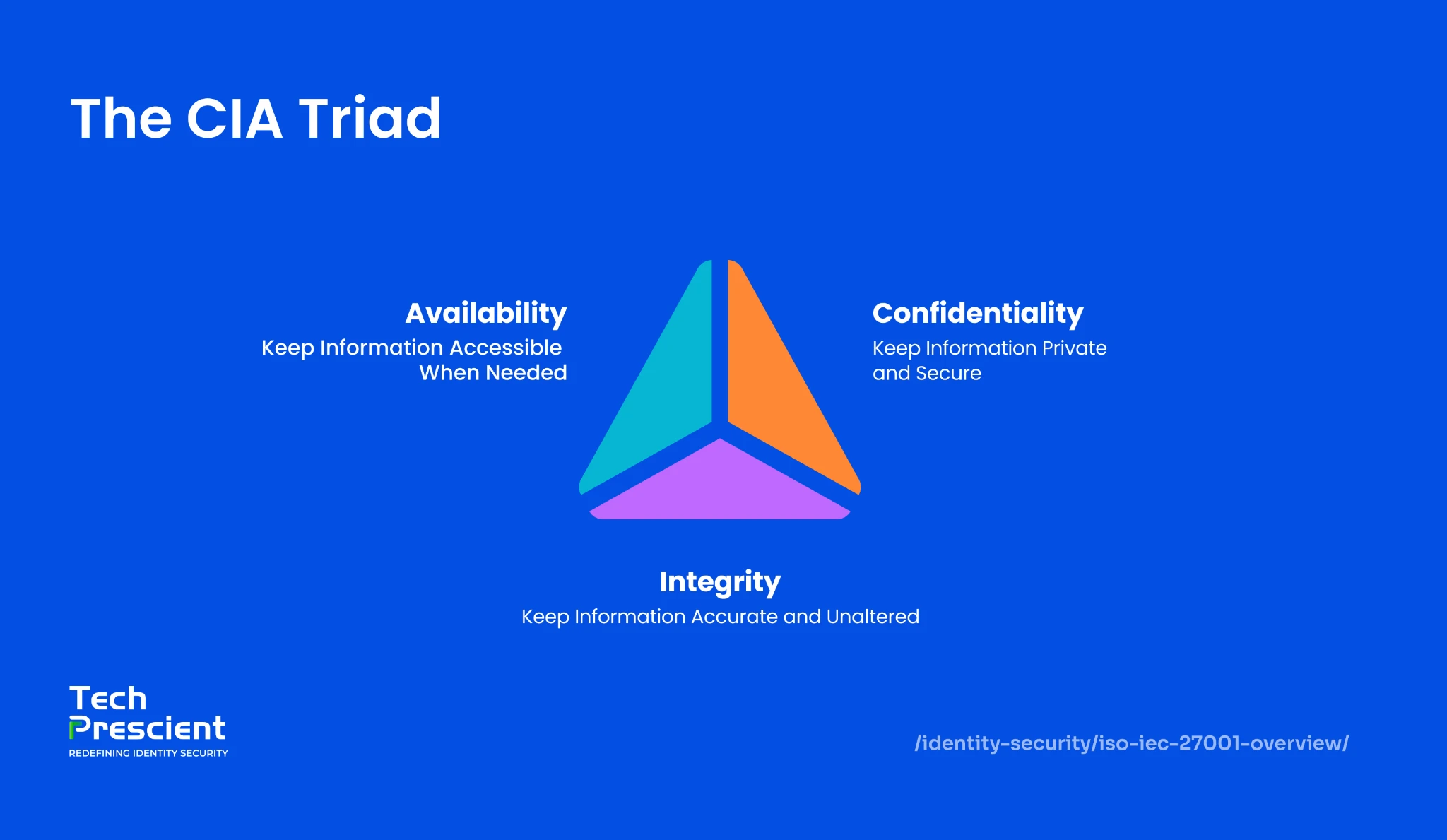
The CIA Triad forms the foundation of ISO/IEC 27001 and guides how organizations secure data, maintain trust, and support business continuity. These three principles influence the selection of security controls within an Information Security Management System (ISMS).
Confidentiality
Confidentiality focuses on preventing unauthorized access to sensitive information. Whether the data belongs to customers, employees, partners, or the organization itself, access should only be granted to individuals with a legitimate business need. To achieve this, organizations implement controls such as role-based access control (RBAC), user authentication, encryption, data classification, and least-privilege policies. Maintaining confidentiality helps reduce the risk of data breaches, insider threats, and unauthorized disclosure of critical information.
Integrity
Integrity ensures that information remains accurate, complete, and protected from unauthorized modification. Businesses rely on trustworthy data to make decisions, maintain records, and support daily operations. If information is altered intentionally or accidentally, it can lead to compliance issues, operational disruptions, and financial losses. Controls such as audit trails, change management processes, version control, data validation, and file integrity monitoring help organizations preserve data accuracy and quickly identify unauthorized changes.
Availability
Availability ensures that authorized users can access information, applications, and systems whenever they are required. Even the most secure environment can create business challenges if critical resources become unavailable during normal operations or unexpected incidents. Organizations support availability through regular backups, disaster recovery planning, business continuity strategies, infrastructure redundancy, and proactive system monitoring. These measures help minimize downtime and ensure that essential services remain operational during outages, cyberattacks, or system failures.
Why the CIA Triad Matters
The confidentiality, integrity, and availability principles are embedded throughout ISO/IEC 27001 and influence how organizations assess risks and select security controls. By maintaining a balance between these three elements, businesses can create a resilient security program that protects information assets, supports compliance objectives, and strengthens stakeholder trust.
What Is an ISMS in ISO/IEC 27001?
An Information Security Management System (ISMS) is the foundation of ISO/IEC 27001. It provides a systematic approach to protecting sensitive information by helping organizations identify risks, implement appropriate controls, and continuously improve their security practices. Rather than focusing on technology alone, an ISMS aligns security with business objectives, governance requirements, and risk management efforts.
1. The Foundation of an Information Security Management System
An ISMS establishes the policies, procedures, and controls needed to protect information assets. It creates a repeatable framework for managing security risks, assigning responsibilities, and ensuring information security is embedded into day-to-day operations.
2. The People, Process, and Technology Approach
An effective ISMS is built on three interconnected elements: people, processes, and technology. Employees and stakeholders follow defined security responsibilities, processes provide governance and consistency, and technology delivers the controls needed to protect systems and data. Together, these elements create a balanced and sustainable security program.
3. How an ISMS Manages Information Security Risks
Risk management is a core component of an ISMS. Organizations identify potential threats and vulnerabilities, evaluate their impact, and implement controls to reduce risk. This risk-based approach ensures security resources are focused on protecting the most critical information assets.
4. Continuous Improvement Through the PDCA Cycle
ISO/IEC 27001 promotes ongoing improvement through the Plan-Do-Check-Act (PDCA) cycle. Organizations plan security objectives, implement controls, measure effectiveness, and make improvements based on audit findings, performance reviews, and changing business requirements.
5. Why an ISMS Matters
An ISMS helps organizations move from reactive security measures to a proactive and structured security strategy. By continuously managing risks and improving controls, businesses can strengthen security, support compliance efforts, and build greater trust with customers and stakeholders.
Expert Insight
Many organizations focus on security tools first, but ISO 27001 starts with processes and governance. A well-defined ISMS often delivers more long-term value than adding another security solution.
ISO/IEC 27001:2022 Overview (Latest Version)
ISO/IEC 27001:2022 modernizes the standard by updating security controls, streamlining control categories, and better addressing today's cloud, digital, and privacy-focused environments.
ISO/IEC 27001:2022 is the latest version of the standard and the first major update since 2013. While the ISMS requirements remain largely unchanged, the revision modernizes Annex A controls to better address evolving cybersecurity risks, cloud adoption, digital transformation, and regulatory expectations.
1. What's New in ISO/IEC 27001:2022?
The 2022 update focuses on making the standard more relevant to today's threat landscape. It introduces new controls, consolidates overlapping ones, and updates control guidance to address areas such as cloud services, threat intelligence, information security for digital environments, and data privacy considerations.
These changes help organizations align their security programs with current business and technology realities while maintaining a risk-based approach to information security management.
2. ISO/IEC 27001:2013 vs. ISO/IEC 27001:2022
One of the biggest changes in the 2022 revision is the restructuring of Annex A. The 2013 version contained 114 controls across 14 domains, whereas ISO/IEC 27001:2022 organizes 93 controls into four simplified categories. The update reduces complexity, removes duplication, and makes controls easier to understand and implement.
Organizations certified under the 2013 version were required to transition to the 2022 standard to maintain certification and align with the latest security requirements.
The Four Annex A Control Categories
To improve usability and organization, ISO/IEC 27001:2022 groups its 93 Annex A controls into four primary categories:
Organizational Controls
These controls focus on governance, risk management, policies, supplier relationships, asset management, and incident response. They establish the strategic and administrative foundation for managing information security across the organization.
People Controls
People controls address the human element of security through activities such as background verification, security awareness training, responsibilities during employment, and disciplinary processes. Their objective is to reduce risks associated with human error and insider threats.
Physical Controls
Physical controls protect facilities, equipment, and information assets from unauthorized access, theft, damage, or environmental threats. Examples include secure work areas, physical entry controls, surveillance measures, and equipment protection.
Technological Controls
Technological controls focus on securing systems, networks, applications, and data. They include areas such as access control, encryption, vulnerability management, monitoring, secure development practices, and protection against cyber threats.
Why the 2022 Update Matters
ISO/IEC 27001:2022 reflects the realities of modern business environments where cloud adoption, remote work, digital transformation, and increasing regulatory scrutiny have reshaped security requirements. By updating its control framework and improving alignment with current risks, the standard enables organizations to build stronger security programs while maintaining compliance and operational resilience.
ISO 27001 certification is not about implementing all 93 Annex A controls. The goal is to identify your organization's risks and apply only the controls that are relevant and justified.
Annex A Controls Explained
Annex A is a control framework within ISO/IEC 27001 that helps organizations manage information security risks. The controls are not mandatory by default; instead, organizations select and implement them based on the outcomes of their risk assessment and treatment processes.
1. Organizational Controls
Organizational controls establish the governance structure for information security. They cover areas such as security policies, risk management, asset management, supplier security, incident response, and business continuity to ensure security is managed consistently across the organization.
2. People Controls
People controls focus on reducing human-related security risks. These controls include employee screening, security awareness training, acceptable use requirements, and clearly defined security responsibilities throughout the employment lifecycle.
3. Physical Controls
Physical controls protect facilities, equipment, and information assets from unauthorized access, theft, damage, or environmental threats. Common examples include secure entry points, visitor management procedures, surveillance systems, and equipment protection measures.
4. Technological Controls
Technological controls safeguard systems, applications, networks, and data through technical security measures. Examples include access controls, cryptography, vulnerability management, malware protection, logging, monitoring, and secure development practices.
5. Risk-Based Control Selection
ISO/IEC 27001 follows a risk-based approach, meaning organizations implement controls based on their specific risk profile rather than a predefined checklist. The selected controls are documented in the Statement of Applicability (SoA), providing justification for which controls have been adopted and how they support the organization's security objectives.
Documentation gaps often surface when audits are already underway.
Strengthen ISO 27001 readiness with structured templates for documentation management and evidence tracking.
ISO/IEC 27001 Certification Process
ISO/IEC 27001 certification involves establishing an ISMS, implementing security controls, conducting audits, and successfully completing an independent certification assessment. While the exact timeline varies based on size and complexity, most organizations follow a series of well-defined steps to prepare for certification and maintain ongoing compliance.
Define the Scope
The certification journey begins by determining the scope of the Information Security Management System (ISMS). Organizations must identify the business units, processes, locations, systems, and information assets that will be covered by the certification.
Conduct a Risk Assessment
Next, organizations evaluate potential threats and vulnerabilities that could impact information assets. This assessment helps determine the level of risk and forms the foundation for selecting appropriate security controls.
Implement Security Controls
Based on the risk assessment findings, organizations implement the necessary policies, procedures, and technical safeguards. These controls are designed to reduce identified risks and align security practices with ISO/IEC 27001 requirements.
Perform an Internal Audit
Before pursuing certification, organizations conduct an internal audit to assess the effectiveness of their ISMS. This step helps identify gaps, validate compliance efforts, and address issues before the formal certification review.
Complete the External Audit
An accredited certification body performs the external audit in two stages. Stage 1 reviews ISMS documentation, policies, and readiness for certification. Stage 2 evaluates how effectively the ISMS and security controls are implemented and operating in practice.
Achieve Certification
Once both audit stages are successfully completed, the organization receives ISO/IEC 27001 certification. The certification is generally valid for three years, with periodic surveillance audits conducted to verify continued compliance and effectiveness of the ISMS.
Maintaining Certification
Certification is not a one-time activity. Organizations must continuously monitor risks, update controls, conduct regular audits, and demonstrate ongoing improvement to maintain compliance and successfully renew certification at the end of the certification cycle.
Benefits of ISO/IEC 27001 Certification
ISO/IEC 27001 certification helps organizations strengthen security, demonstrate compliance, build stakeholder confidence, and better manage information security risks.
By implementing a structured Information Security Management System (ISMS), organizations can improve risk management, enhance operational resilience, and demonstrate their commitment to protecting sensitive information.
1. Strengthens Regulatory and Compliance Readiness
Many regulatory frameworks and industry requirements emphasize strong information security practices. ISO/IEC 27001 provides a structured foundation that helps organizations support compliance efforts related to regulations such as GDPR, SOX, and other data protection and governance requirements.
2. Builds Customer and Stakeholder Trust
Customers, partners, and investors increasingly expect organizations to demonstrate strong security practices. ISO/IEC 27001 certification provides independent validation that information security is being managed through recognized standards and established controls, helping strengthen confidence and credibility.
3. Reduces Security and Business Risks
The standard promotes a proactive approach to identifying, assessing, and treating information security risks. By continuously monitoring threats and implementing appropriate controls, organizations can reduce the likelihood of data breaches, operational disruptions, and other security-related incidents.
4. Creates a Competitive Advantage
ISO/IEC 27001 certification can differentiate an organization in competitive markets where security is a key purchasing consideration. Many customers, partners, and procurement teams view certification as evidence of a mature security program, making it easier to meet vendor requirements and win new business opportunities.
5. Improves Organizational Resilience
Through risk management, incident response planning, and continuous improvement, ISO/IEC 27001 helps organizations become more resilient to evolving cyber threats and business disruptions. This enables them to maintain operations, protect critical information, and respond more effectively to security incidents.
6. Supports Long-Term Security Maturity
ISO/IEC 27001 is designed around continuous improvement rather than one-time compliance. As organizations regularly assess risks, review controls, and refine processes, they develop a stronger and more sustainable information security posture over time.
Is ISO/IEC 27001 Mandatory?
ISO/IEC 27001 is not a legal requirement in most jurisdictions, but it is often expected by customers, regulators, and business partners as proof of strong information security practices.
However, as cybersecurity risks and compliance obligations continue to grow, many businesses adopt the standard to demonstrate that they have a structured and effective approach to managing information security.
1. An Industry-Driven Requirement
In many sectors, ISO/IEC 27001 has become a widely accepted benchmark for information security. Industries such as finance, healthcare, technology, telecommunications, and government contracting often expect organizations to follow recognized security frameworks, making certification a strategic business advantage even when it is not mandatory.
2. Supporting Compliance Objectives
While ISO/IEC 27001 itself is not a regulatory requirement, its controls and risk management practices can help organizations support broader compliance efforts. The framework aligns well with many data protection, privacy, and governance requirements, making it easier to demonstrate due diligence during audits and assessments.
3. Meeting Vendor and Customer Expectations
Many organizations require vendors, suppliers, and service providers to demonstrate strong security practices before sharing sensitive information or entering into contracts. ISO/IEC 27001 certification is often used as evidence that an organization has established security controls, risk management processes, and governance measures that meet industry expectations.
4. Strengthening Business Opportunities
For organizations operating in competitive markets, certification can become a business necessity. Prospective customers increasingly evaluate security maturity during procurement processes, and ISO/IEC 27001 certification can help organizations satisfy security questionnaires, shorten vendor assessments, and improve their ability to win new business.
5. When Should Organizations Consider Certification?
Organizations that handle sensitive customer data, intellectual property, financial information, or regulated data should strongly consider ISO/IEC 27001 implementation. Even when certification is not required, the framework provides a proven foundation for improving security, building trust, and managing information security risks more effectively.
Who Should Implement ISO/IEC 27001?
ISO/IEC 27001 is designed to be flexible and scalable, making it suitable for organizations of all sizes and industries. Whether an organization manages customer records, financial data, intellectual property, or regulated information, the standard provides a structured framework for managing security risks and protecting critical assets.
1. SaaS and Technology Companies
SaaS providers and technology organizations often manage large volumes of customer data and cloud-based applications. Implementing ISO/IEC 27001 helps establish security governance, strengthen access controls, and demonstrate a commitment to protecting customer information, which is increasingly important during vendor evaluations and procurement processes.
2. Financial Institutions
Banks, insurance providers, fintech companies, and other financial organizations handle highly sensitive financial and personal information. ISO/IEC 27001 helps these organizations manage security risks, improve data protection practices, and support compliance with industry regulations and customer expectations.
3. Healthcare Organizations
Hospitals, clinics, healthcare technology providers, and medical research organizations process confidential patient information that requires strong protection. ISO/IEC 27001 provides a framework for securing health records, managing access to sensitive data, and reducing the risk of security incidents that could impact patient privacy.
4. Government and Public Sector Agencies
Government departments and public sector organizations manage large volumes of citizen, operational, and confidential information. Implementing ISO/IEC 27001 helps establish consistent security practices, strengthen risk management, and improve the protection of critical public services and data assets.
5. Other Organizations Handling Sensitive Data
ISO/IEC 27001 is not limited to specific industries. Manufacturing companies, educational institutions, professional services firms, retailers, and nonprofit organizations can also benefit from implementing the standard. Any organization that relies on information to operate can use ISO/IEC 27001 to improve security, enhance trust, and support long-term resilience.
6. Does Organization Size Matter?
No. ISO/IEC 27001 can be implemented by startups, small and medium-sized businesses, and large enterprises alike. The framework is risk-based, allowing organizations to tailor their ISMS and security controls according to their size, complexity, and business requirements.
Common Challenges in ISO 27001 Implementation
While ISO/IEC 27001 provides a structured framework for managing information security, implementation can be a complex process. Organizations must balance business priorities, security requirements, and compliance objectives while building and maintaining an effective Information Security Management System (ISMS).
1. Defining the Right Scope
One of the earliest challenges is determining the scope of the ISMS. Organizations must clearly identify which business units, processes, systems, locations, and information assets will be included. A scope that is too broad can increase complexity, while one that is too narrow may leave critical risks unaddressed.
2. Limited Internal Expertise
Successful implementation requires knowledge of risk management, security controls, compliance requirements, and audit processes. Organizations without dedicated security or compliance teams may struggle to interpret requirements, perform risk assessments, and align controls with business objectives.
3. Resource and Time Constraints
Implementing ISO/IEC 27001 often requires significant investment in people, processes, and governance activities. Balancing implementation efforts alongside day-to-day operations can be difficult, particularly for organizations with limited budgets or small security teams.
4. Tooling and Process Gaps
Many organizations discover that their existing tools and processes do not fully support ISO/IEC 27001 requirements. Gaps in areas such as asset management, access governance, risk tracking, incident management, and compliance reporting can create additional implementation challenges and require process improvements or new technology investments.
5. Documentation and Evidence Management
ISO/IEC 27001 requires organizations to maintain documented policies, procedures, risk assessments, and records that demonstrate compliance. Keeping documentation accurate, current, and aligned with evolving business processes can be a time-consuming task without proper governance and oversight.
6. Audit Readiness and Continuous Compliance
Preparing for internal and external audits is often one of the most demanding stages of implementation. Organizations must demonstrate that controls are not only documented but also operating effectively. Beyond certification, maintaining compliance requires continuous monitoring, periodic reviews, risk reassessments, and ongoing improvement of the ISMS.
7. Overcoming Implementation Challenges
Organizations that establish executive support, define a realistic scope, invest in employee awareness, and adopt the right governance and security tools are better positioned for success. Taking a phased and risk-based approach can simplify implementation while helping ensure long-term compliance and security maturity.
Compliance Tip
Start collecting audit evidence from day one. Waiting until the certification audit is scheduled often creates unnecessary stress and documentation gaps.
ISO 27001 and Identity Security (IGA Angle)
Protecting information is a core objective of ISO/IEC 27001, and identity security is a key enabler of that goal. Since users are one of the primary ways information is accessed, modified, and shared, organizations must establish strong controls around identities, permissions, and access rights. This is where Identity and Access Management (IAM) and Identity Governance and Administration (IGA) become essential components of an effective Information Security Management System (ISMS).
1. The Connection Between ISO 27001, IAM, and IGA
Many ISO 27001 controls focus on ensuring that only authorized individuals can access sensitive information and critical systems. IAM helps organizations manage user authentication and access permissions, while IGA extends these capabilities by providing governance, oversight, and lifecycle management of user access. Together, they help organizations enforce security policies and reduce the risk of unauthorized access.
2. Role-Based Access Control (RBAC) and Least Privilege
ISO 27001 promotes the principle of granting users only the access necessary to perform their job responsibilities. Role-Based Access Control (RBAC) supports this objective by assigning permissions based on predefined roles rather than individual requests. Combined with least-privilege principles, RBAC helps minimize excessive access rights and reduces the organization's attack surface.
3. Access Reviews and User Access Governance
Regular access reviews are an important part of maintaining compliance and reducing security risks. Identity governance solutions enable organizations to periodically review user permissions, identify inappropriate access, and remove unnecessary privileges. These reviews help ensure access rights remain aligned with current job responsibilities and business needs.
4. Supporting Audit and Compliance Reporting
Demonstrating compliance requires visibility into who has access to what resources and why that access was granted. IGA platforms provide reporting, audit trails, certification records, and access governance workflows that help organizations generate evidence for internal reviews and external audits. This simplifies compliance efforts and improves accountability across the enterprise.
5. Why Identity Security Matters for ISO 27001
As organizations grow and user access becomes more complex, managing identities manually becomes increasingly difficult. By integrating IAM and IGA practices into their ISO 27001 strategy, organizations can strengthen access controls, improve governance, support audit readiness, and reduce the risk of unauthorized access to sensitive information.
Documentation gaps often surface when audits are already underway.
Strengthen ISO 27001 readiness with structured templates for documentation management and evidence tracking.
Final Thoughts
ISO/IEC 27001 helps organizations manage security risks, protect sensitive information, and strengthen compliance through a structured, risk-based approach. As security and compliance requirements grow, maintaining effective access controls, governance, and audit readiness can become increasingly challenging.
Tech Prescient helps organizations streamline ISO/IEC 27001 compliance with identity governance, automated access reviews, least-privilege controls, and audit-ready reporting.
FAQs
ISO/IEC 27001 is an internationally recognized standard for managing and protecting sensitive information. It provides organizations with a structured framework, known as an Information Security Management System (ISMS), to identify risks, implement security controls, and continuously improve information security practices.
The three core principles of ISO/IEC 27001 are Confidentiality, Integrity, and Availability (CIA). These principles ensure that information is accessible only to authorized users, remains accurate and reliable, and is available whenever it is needed for business operations.
ISO/IEC 27001 certification requires planning, documentation, risk assessments, and successful audit completion. While the process can be complex, organizations that establish a clear ISMS, implement appropriate controls, and prepare effectively can achieve certification successfully.
No, ISO/IEC 27001 is generally not a legal requirement. However, many organizations adopt it to support regulatory compliance, meet customer expectations, satisfy vendor security requirements, and demonstrate a strong commitment to information security.
ISO/IEC 27001:2022 is the latest version of the standard. It updates Annex A controls, introduces improvements for modern cybersecurity challenges, and aligns the framework more closely with areas such as cloud security, digital operations, and data protection.


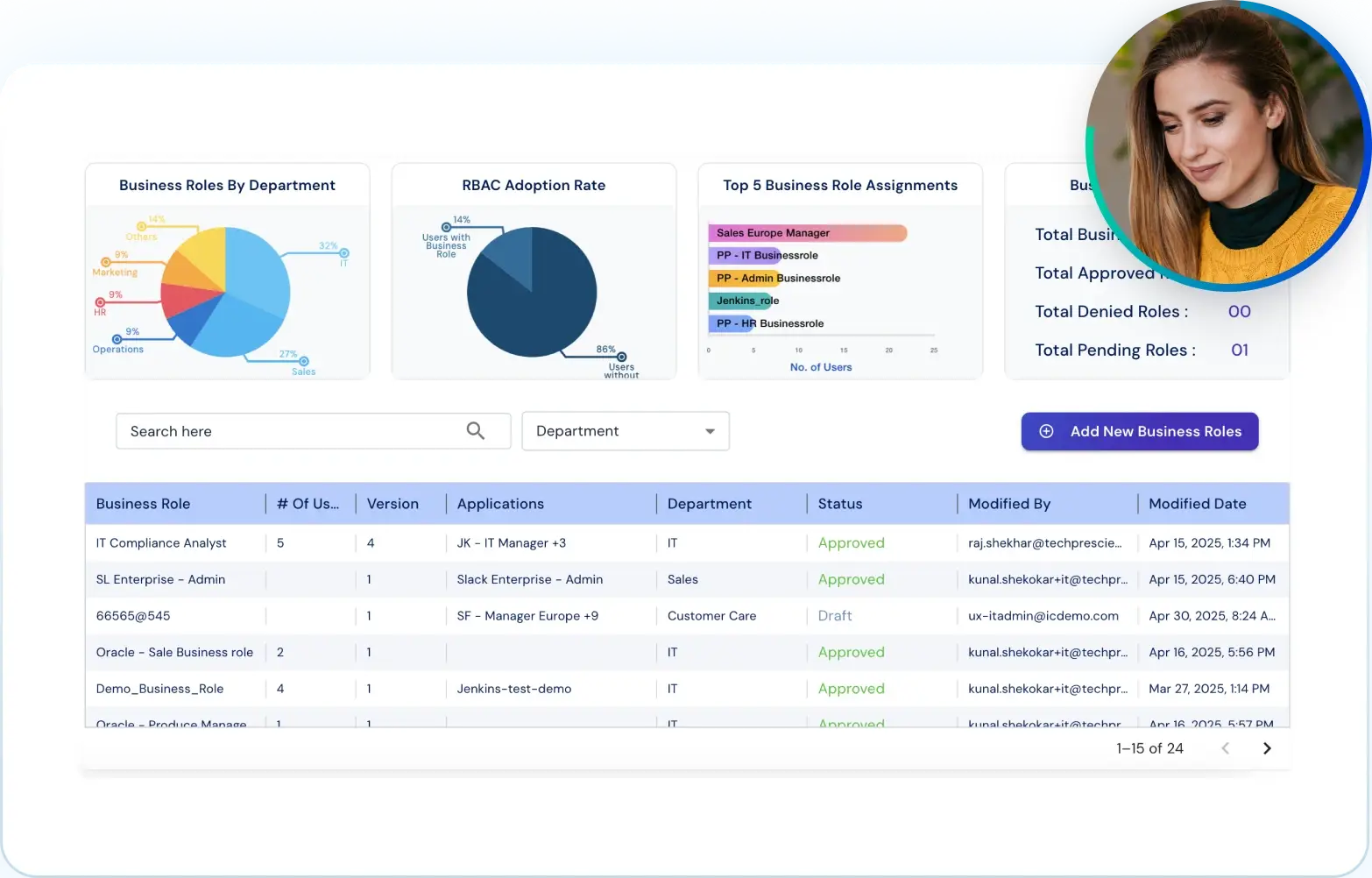
GET A PERSONALIZED DEMO
See Identity Confluence in Action
“One platform to govern identities, automate access decisions, and prove compliance; across every app, user, and system in your environment.”



Murli Ramsunder
Senior Architect, Vonage