
See Every Identity Before You Govern It
Last Updated date: November 27, 2026
On this page
See Tech Prescient in Action
Automate access, reduce risk, and stay audit-ready
A certification campaign goes out every quarter. Managers approve the access they can see. The review closes on time, and the report looks clean. What it does not show is the service account a contractor set up eight months ago, still running with admin rights and no owner attached to it, which nobody will notice until someone goes looking.
Identity governance discovery is what makes that visibility possible before a review ever opens. It is the practice of finding every account, human and non-human, and giving it a place in the inventory governance runs on. Most programs treat discovery as a setup task: something run once during implementation and revisited only when an audit asks for it. And it doesn't leave a small gap.
Orchid Security's Identity Gap: 2026 Snapshot, built on telemetry from enterprise applications across North America and Europe, found that identity sitting outside IAM's view now outweighs identity inside it, 57% to 43%, and that 67% of non-human accounts are created directly inside an application where no IAM program ever sees them.
Identity Confluence treats it as a continuous layer instead, one that every other governance control draws on in real time.
What Full Discovery Gives Identity Governance
Every control in an identity program, access reviews, segregation of duties checks, and lifecycle automation runs on the same input: a complete picture of who and what holds access. An incomplete picture limits every control that reads from it.
This is what makes access certification campaigns genuinely defensible. A campaign can certify with confidence when it is working from a population it actually knows, account by account, rather than whatever happens to surface on its own. That confidence comes directly from discovery running ahead of the review, not alongside it.
Insight:
A governance program is only as strong as the inventory feeding it. Continuous discovery is what keeps every review, policy, and certification working from an accurate, current picture.
Human and Non-Human Identity Discovery, Built for Each One
Human identities come closer to visibility by default, since HR systems and identity providers already track who joined and who left. Visible is not the same as governed. HR and identity provider records sit in systems of their own, and governance only acts on what reaches its inventory. Continuous discovery closes that gap, including for the population that looks straightforward.
Non-human identities call for a different approach. A service account or API key gets created during integration work, has no HR record, and keeps running long after the project that needed it wraps up. Non-human identity discovery is built specifically for that pattern, treating machine accounts as their own population with their own discovery logic rather than expecting human-identity tooling to stretch to cover them.
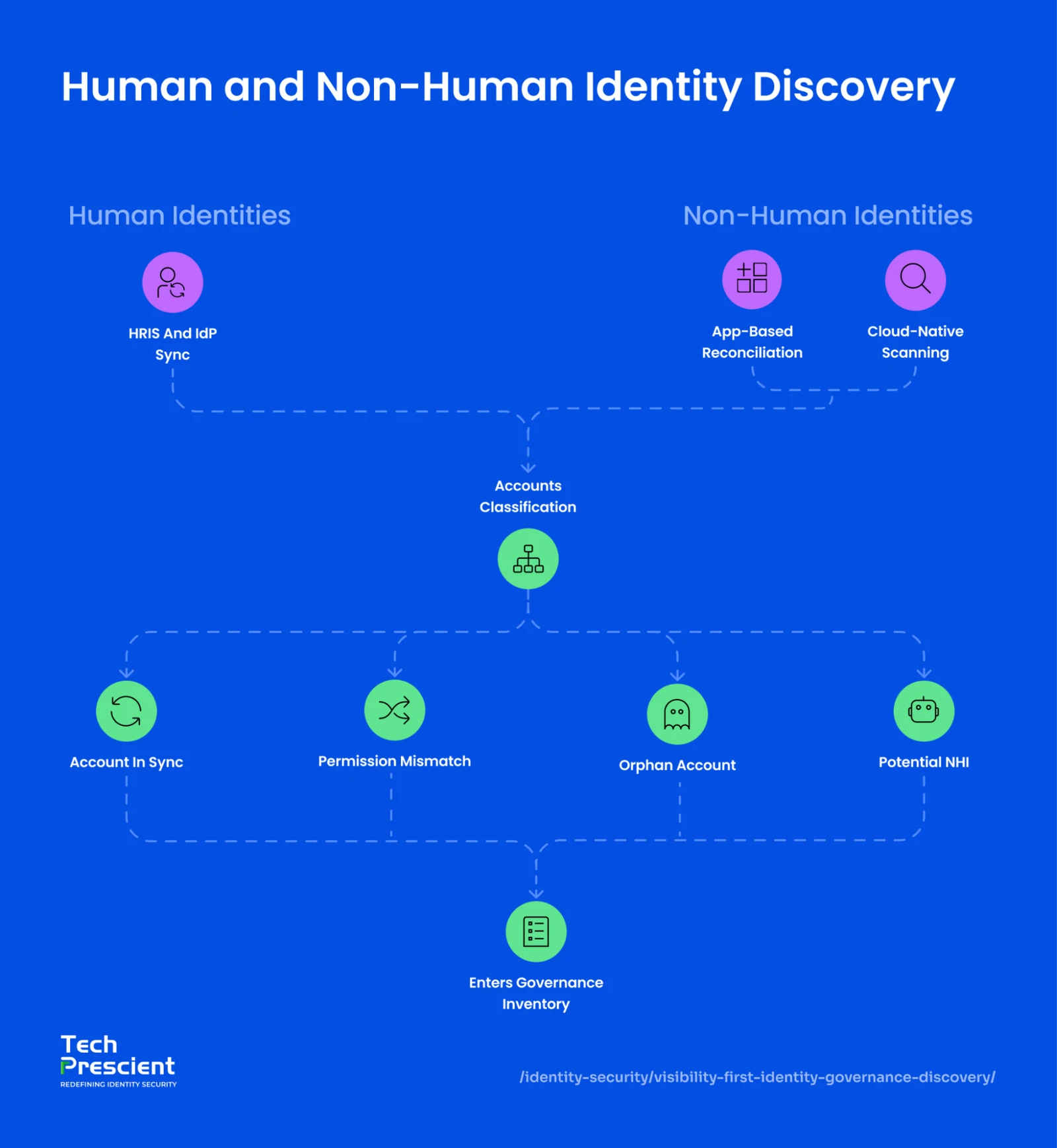
Two Discovery Methods
Identity Confluence runs two discovery methods, one for each environment where non-human accounts live. App-based reconciliation compares every account inside a connected application against the identity provider using email correlation. Cloud-native scanning pulls directly from AWS, Azure, and GCP, where service accounts, IAM roles, and managed identities are already classified as non-human by design. Both feed the same governance inventory. The step-by-step mechanics of each method are covered in the discovery and classification deep dive.
From Discovery to a Governable Inventory: How Classification Works
Classification is where discovery becomes usable. The categories below are the handoff point, and each one carries a defined next step into governance.
Finding accounts is the first half of the job. Account classification is what turns that raw discovery feed into something governance can act on immediately. Identity Confluence sorts every reconciled account into one of four categories, each with a clear next step.
| Category | What it means | Next step |
|---|---|---|
| Account in sync | Human user, provisioned normally | No action |
| Permission mismatch | Access in the app differs from the identity provider record | Review and correct |
| Orphan account | No longer active in the identity provider | Investigate and deprovision |
| Potential non-human identity | No matching identity provider record at all | Decide: deprovision, govern, or map |
Once a potential NHI is marked as governed, it enters the same lifecycle as a human account: an assigned owner, rotation expectations, and a place in future certification campaigns. Identity Confluence carries that handoff automatically, which is exactly the step that spreadsheet-based reviews tend to drop between cycles. Nothing falls between cycles.
Continuous Discovery Keeps the Inventory Current
A discovery effort that runs once produces a snapshot, accurate on the day it finishes and gradually less so after that. New integrations create new accounts. Contractors wrap projects and leave credentials active behind them. Cloud teams spin up new service principals without a ticket. The 2026 SANS Identity Threats and Defences Survey, covering more than 500 security professionals, found non-human identities are now the fastest-growing identity category, with 3 in 4 organizations reporting growth and populations doubling or tripling inside many enterprises.
Identity governance discovery is built to keep pace with that pattern rather than catch up to it once a year.
Running discovery continuously means the identity inventory governance relies on staying current between audit cycles instead of drifting further from reality each quarter. New findings, including orphaned accounts and newly created NHIs, surface as they appear. The access review evidence an auditor eventually asks for is already sitting in the Evidence Center, built up continuously rather than assembled under a deadline. The same continuous process improves identity security posture overall, since small gaps get caught while they are still small. Discovery is the foundation everything else runs on.
Want to assess your current state first?
Score your non-human identity governance in under 10 minutes.
Why Does Discovery Come First?
The sequence matters because every control that follows inherits exactly what discovery finds.
A user access review built on a complete inventory produces a complete result, and that completeness traces directly back to the discovery step that made it possible.
Visibility first is the operating principle behind that sequence: see every identity, classify what you find, then govern it with full context. That order, discovery before control, is what identity governance discovery means in practice, and it is the foundation on which every gain in identity security posture is built.
See how Identity Confluence runs continuous discovery across human and non-human identities, classifies every account with a defined next step, and connects the results directly to your governance and audit program.
FAQs
It is the practice of finding every account that exists across connected applications, cloud platforms, and identity providers, human and non-human, and placing each one in the inventory that governance controls read from. Without it, reviews and certifications act only on the accounts that happen to be known.
A one-time discovery produces a snapshot that is accurate the day it finishes and decays after that. New integrations create accounts, contractors leave credentials behind, and cloud teams create service principals without a ticket. Continuous discovery keeps pace with those changes rather than catching up once a year.
Human identities are anchored to HR systems and identity providers, so a record usually exists somewhere. Non-human identities have no HR record at all, are created during integration work, and often outlive the project that needed them, so they need their own discovery logic rather than an extension of human-identity tooling.
It is classified into one of four categories, each with a defined next step: no action, review and correct, investigate and deprovision, or decide whether to govern, map, or remove it. Once a non-human identity is marked as governed, it enters the same lifecycle as a human account, with an assigned owner and a place in future certification campaigns.


GET A PERSONALIZED DEMO
See Identity Confluence in Action
“One platform to govern identities, automate access decisions, and prove compliance; across every app, user, and system in your environment.”



Murli Ramsunder
Senior Architect, Vonage