
What Is FedRAMP? Complete Guide to Compliance, Authorization & Security
Last Updated date: July 16, 2026
On this page
See Tech Prescient in Action
Automate access, reduce risk, and stay audit-ready
FedRAMP, short for the Federal Risk and Authorization Management Program, is a U.S. government initiative created to standardize cloud security assessments for federal agencies. Before its launch in 2011, every agency evaluated cloud service providers independently, leading to duplicated security reviews, higher costs, and slower cloud adoption. FedRAMP introduced a unified framework that allows agencies to reuse authorized security assessments across departments.
Developed under the Federal Information Security Management Act (FISMA), FedRAMP helps ensure that cloud services used by the government meet strict cybersecurity and risk management requirements. It applies to SaaS, PaaS, and IaaS providers seeking federal contracts and includes continuous monitoring, standardized security controls, and ongoing compliance validation. For cloud providers, achieving FedRAMP authorization improves trust, strengthens security posture, and opens access to government business opportunities.
According to the official FedRAMP Program Management Office, the FedRAMP Marketplace currently includes hundreds of authorized and in-process cloud offerings used across U.S. federal agencies, highlighting the growing reliance on secure cloud infrastructure for government operations. In this guide, we'll explore what FedRAMP is, how the authorization process works, and why it has become one of the most important cloud security frameworks for government and regulated industries.
Key Takeaways:
- Understand what FedRAMP is and how it standardizes cloud security for U.S. federal agencies.
- Learn the core requirements of FedRAMP compliance, including security controls, documentation, and continuous monitoring.
- Explore the FedRAMP authorization process, including 3PAO assessments, JAB approval, and Authority to Operate (ATO).
- Discover the differences between FedRAMP Low, Moderate, and High impact levels and their use cases.
- See why FedRAMP is important for cybersecurity, government cloud adoption, and cloud providers seeking federal contracts.
What Is FedRAMP?
FedRAMP is a U.S. government framework that standardizes security assessments, authorization, and continuous monitoring for cloud services used by federal agencies. Built on NIST 800-53 security controls, FedRAMP helps ensure that cloud service providers (CSPs) meet strict cybersecurity and risk management requirements before handling government data. It applies to SaaS, PaaS, and IaaS platforms and is mandatory for cloud vendors working with U.S. federal agencies.
To better understand how FedRAMP works, it's important to explore why it was created, what compliance involves, and which organizations require authorization.
Why FedRAMP Was Created
FedRAMP was introduced in 2011 to simplify and standardize cloud security reviews across federal agencies. Before FedRAMP, every agency evaluated cloud vendors independently, resulting in duplicated assessments, inconsistent security standards, and delayed procurement processes.
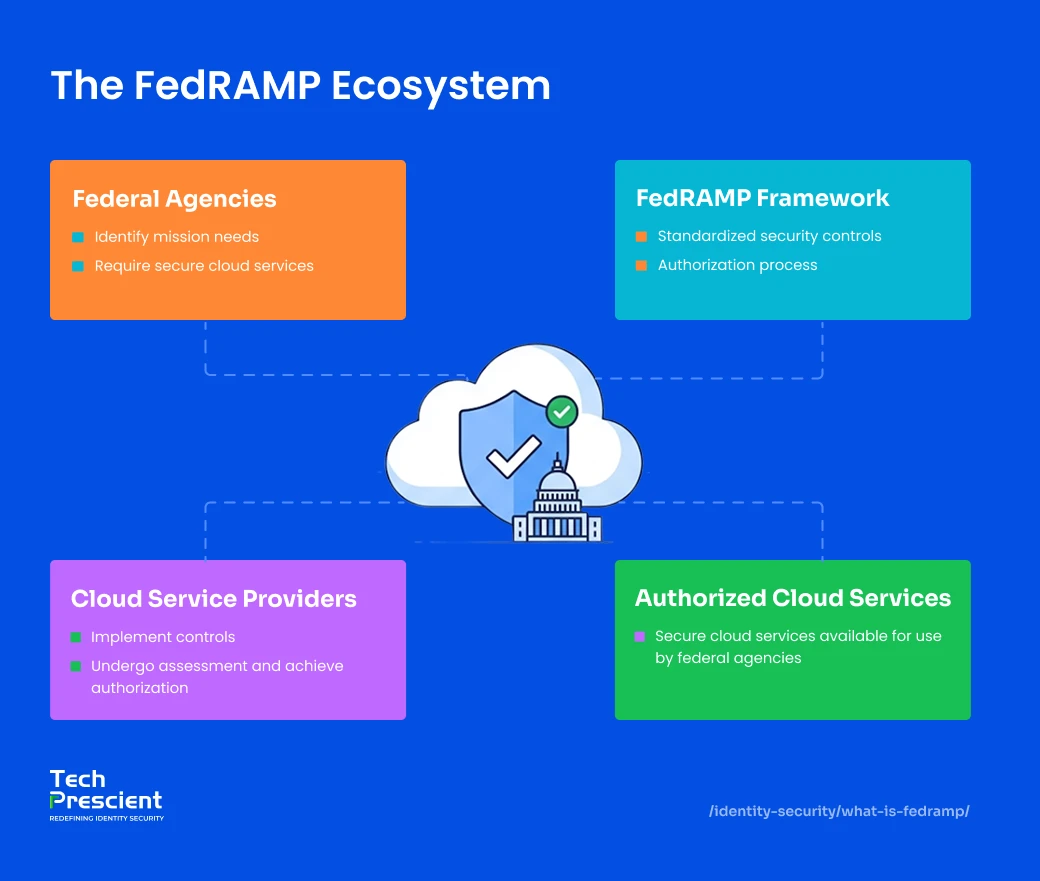
1. Eliminate Duplicate Security Reviews
Cloud providers previously had to complete separate security assessments for each federal agency. FedRAMP introduced a reusable authorization process that reduced repeated evaluations and improved efficiency.
2. Accelerate Government Cloud Adoption
The program created a consistent security framework that allowed agencies to adopt cloud technologies faster while maintaining strong cybersecurity standards.
3. Improve Federal Risk Management
FedRAMP established standardized security requirements based on NIST controls, helping agencies manage cybersecurity risks more effectively across cloud environments.
What Is FedRAMP Compliance?
FedRAMP compliance refers to implementing the security controls, documentation, and continuous monitoring practices required under the FedRAMP framework. CSPs must demonstrate that their cloud environments can securely protect federal information systems and data.
1. Security Controls
FedRAMP requires providers to implement NIST 800-53 security controls covering areas such as access management, encryption, vulnerability management, and incident response.
2. Continuous Monitoring
Authorized providers must continuously monitor their systems through monthly vulnerability scans, security reporting, and ongoing risk assessments to maintain compliance.
3. Risk Management Documentation
Cloud providers must maintain detailed documentation, including System Security Plans (SSPs), risk assessments, contingency plans, and incident response procedures.
4. Security Assessment Reports
Independent Third-Party Assessment Organizations (3PAOs) evaluate cloud environments and prepare Security Assessment Reports (SARs) as part of the authorization process.

Pro Tip
FedRAMP compliance is not a one-time checklist. Continuous monitoring is what separates FedRAMP from many traditional compliance frameworks.
Who Requires FedRAMP Compliance?
Any cloud service provider that stores, processes, or transmits U.S. federal government data typically needs FedRAMP authorization. Compliance is essential for vendors offering cloud-based products or services to federal agencies.
1. SaaS and Cloud Application Providers
Software vendors serving government agencies must achieve FedRAMP authorization to demonstrate secure handling of federal data.
2. Cloud Infrastructure Platforms
IaaS and PaaS providers offering hosting, storage, or computing services for federal workloads are required to meet FedRAMP standards.
3. GovTech and Cybersecurity Vendors
Government technology platforms, cybersecurity providers, and analytics solutions supporting federal operations often require FedRAMP compliance.
4. Major FedRAMP-Authorized Providers
Several leading cloud providers maintain FedRAMP-authorized offerings, including Amazon Web Services, Microsoft, Google, and Salesforce.
What Is FedRAMP Authorization?
FedRAMP authorization is the official approval process that allows a cloud service provider (CSP) to operate within U.S. federal government environments. It confirms that the provider has implemented the required FedRAMP security controls, completed independent security assessments, and met federal cybersecurity and risk management standards. Once authorized, federal agencies can use the cloud service to store, process, or manage government data securely.
FedRAMP offers two primary authorization paths depending on how the cloud provider plans to work with federal agencies.
1. JAB Authorization
JAB Authorization is a government-wide authorization path managed by the Joint Authorization Board (JAB). This process is typically used by cloud providers offering services that may be adopted across multiple federal agencies.
The JAB includes Chief Information Officers (CIOs) from:
- Department of Defense (DoD)
- Department of Homeland Security (DHS)
- General Services Administration (GSA)
Under this path, the cloud provider undergoes a detailed security review and assessment process. If approved, the provider receives a Provisional Authority to Operate (P-ATO), which indicates that the service meets federal security expectations and can be considered by agencies for broader adoption.
2. Agency Authorization
Agency Authorization is a FedRAMP path where a specific federal agency sponsors the cloud provider throughout the authorization process. This approach is commonly used when a cloud provider is working directly with a particular government agency.
In this model, the sponsoring agency reviews the provider's security documentation, assessment reports, and risk posture before making an authorization decision.
Once approved, the agency issues an Authority to Operate (ATO), confirming that the cloud service is authorized for use within that agency's environment. Agency Authorization is often faster and more targeted because it focuses on the needs of a single federal organization rather than government-wide adoption.
What Is the FedRAMP Process?
The FedRAMP process is a structured framework that cloud service providers (CSPs) must follow to achieve authorization for working with U.S. federal agencies. It includes multiple stages such as preparation, independent security assessments, authorization reviews, and ongoing continuous monitoring. The goal of the process is to ensure that cloud environments meet strict federal cybersecurity and risk management requirements before handling government data.
The FedRAMP authorization journey typically follows four key steps.
Preparation
The first stage focuses on defining the cloud service offering and preparing for the authorization process. During this phase, the cloud provider identifies the system boundaries, deployment model, security responsibilities, and the federal data the environment will handle.
Providers also perform a readiness assessment to evaluate whether their security controls, documentation, and internal processes align with FedRAMP requirements. Many organizations work with a Third-Party Assessment Organization (3PAO) at this stage to identify security gaps before moving forward.
Security Assessment
Once the environment is prepared, the cloud provider undergoes a formal security assessment conducted by an accredited 3PAO. The assessor evaluates the implementation of FedRAMP security controls based on NIST 800-53 standards.
This phase includes vulnerability testing, configuration reviews, penetration testing, risk analysis, and detailed security documentation reviews. The 3PAO then prepares a Security Assessment Report (SAR) that outlines findings, risks, and recommendations for authorization.
Authorization
After the assessment is completed, the security package is reviewed by either the Joint Authorization Board (JAB) or a sponsoring federal agency. The reviewing authority evaluates the provider's security posture, risk management practices, and assessment results before making an authorization decision.
If approved, the provider receives a Provisional Authority to Operate (P-ATO) through the JAB path or an Authority to Operate (ATO) through the agency authorization path. This approval allows the cloud service to be used within federal government environments.
Continuous Monitoring
FedRAMP authorization is not a one-time process. Authorized providers must continuously monitor their cloud environments to maintain compliance and ensure ongoing security effectiveness.
This stage includes monthly vulnerability scans, incident reporting, system change management, and annual security assessments. CSPs are also required to submit regular compliance reports and remediation updates to demonstrate that security controls remain operational and effective over time.
FedRAMP readiness depends on more than documentation.
Assess identity governance, least privilege, and audit readiness with a structured security framework.
FedRAMP Impact Levels Explained
FedRAMP classifies cloud systems into Low, Moderate, and High impact levels based on the sensitivity of the federal data they handle. These impact levels determine the security requirements, monitoring standards, and risk management controls a cloud service provider must implement to achieve FedRAMP authorization.
Understanding these impact levels helps organizations choose the appropriate compliance category based on the type of government data being processed and the potential impact of a security incident.
1. FedRAMP Low
FedRAMP Low applies to systems handling public or low-risk government data where a security breach would have minimal impact on agency operations or public trust. Common examples include informational government websites and public-facing applications.
2. What Is FedRAMP Moderate?
FedRAMP Moderate is the most widely used impact level and is designed for systems processing controlled or sensitive government data. Most federal business applications fall under this category and require stronger security controls for access management, encryption, monitoring, and incident response.
3. What Is FedRAMP High?
FedRAMP High is used for cloud environments handling highly sensitive federal data related to law enforcement, healthcare, emergency services, or national security. These systems require the highest level of security controls, continuous monitoring, and risk management practices.
The table below highlights the three FedRAMP impact levels, their data sensitivity classifications, and common use cases.
| Sr. No | Impact Level | Data Sensitivity | Example |
|---|---|---|---|
| 1 | Low | Public or low-risk government data | Government websites and public information portals |
| 2 | Moderate | Controlled or sensitive federal data | Most federal business and operational systems |
| 3 | High | Highly sensitive government data | Law enforcement, healthcare, and defense systems |
What Is FedRAMP Certification?
FedRAMP certification is a term commonly used to describe the successful completion of the FedRAMP authorization process. In official terms, FedRAMP refers to this approval as "authorization" rather than certification. It confirms that a cloud service provider (CSP) has implemented the required security controls, passed independent security assessments, and met the cybersecurity standards needed to work with U.S. federal agencies.
To achieve FedRAMP authorization, cloud providers must complete security assessments, submit detailed documentation, and obtain approval from federal reviewers.
1. Certification vs Authorization
Although people often use the terms interchangeably, FedRAMP certification and FedRAMP authorization are different. FedRAMP compliance means a provider has implemented the required security controls and processes, while authorization is the formal approval granted after the system has been independently assessed and accepted by a federal agency or the Joint Authorization Board (JAB).
Once authorized, the cloud service can be listed in the FedRAMP Marketplace and considered for use by federal agencies.
2. Role of 3PAO
A Third-Party Assessment Organization (3PAO) is an independent assessor accredited to evaluate cloud providers during the FedRAMP process. The 3PAO conducts security testing, validates implemented controls, performs vulnerability assessments, and reviews system documentation.
These assessments help federal agencies understand the provider's security posture and identify any potential risks before authorization is granted.
3. Security Package Approval
After the assessment is completed, the cloud provider submits a security package containing documents such as the System Security Plan (SSP), Security Assessment Report (SAR), risk findings, and remediation plans.
Federal reviewers then examine the package to determine whether the cloud environment meets FedRAMP security and risk management requirements. If approved, the provider receives either an Authority to Operate (ATO) from a federal agency or a Provisional Authority to Operate (P-ATO) through the JAB authorization path.
What Is the FedRAMP Marketplace?
The FedRAMP Marketplace is the official public directory of cloud service providers that have achieved or are pursuing FedRAMP authorization. Managed by the FedRAMP Program Management Office (PMO), the marketplace helps federal agencies identify cloud services that meet federal security and compliance requirements.
The marketplace provides visibility into authorized cloud offerings, vendors currently undergoing assessment, and reusable security documentation that agencies can leverage during procurement and risk evaluation.
1. Authorized Providers
The marketplace includes cloud service providers that have successfully completed the FedRAMP authorization process and received an Authority to Operate (ATO) or Provisional Authority to Operate (P-ATO). These listings allow federal agencies to quickly identify approved cloud solutions that already meet government security standards.
Authorized providers may include SaaS, PaaS, and IaaS platforms serving different federal use cases such as cloud hosting, collaboration, cybersecurity, analytics, and data management.
2. In-Process Vendors
The FedRAMP Marketplace also lists vendors currently working toward authorization. These providers are actively completing readiness assessments, security testing, documentation reviews, or authorization evaluations with a sponsoring agency or the Joint Authorization Board (JAB).
This section helps agencies track upcoming cloud solutions that may soon become available for federal use.
3. Reusable Security Packages
One of the most valuable features of the FedRAMP Marketplace is the ability to reuse security packages. Authorized providers submit detailed documentation such as System Security Plans (SSPs), Security Assessment Reports (SARs), and risk management materials that can be shared across agencies.
This reusable authorization model reduces duplicate security reviews, accelerates procurement timelines, and improves consistency in federal cloud security assessments.
Did You Know?
FedRAMP authorizations can be reused across federal agencies, helping reduce duplicate security assessments and accelerating cloud procurement.
Challenges in Achieving FedRAMP Authorization
Achieving FedRAMP authorization can be a complex and resource-intensive process for cloud service providers. While the framework strengthens federal cloud security and builds trust with government agencies, organizations often face operational, technical, and financial challenges throughout the authorization journey.
Cloud providers must not only implement extensive security controls but also maintain ongoing compliance through continuous assessments and monitoring activities.
1. High Compliance Costs
FedRAMP authorization requires significant investment in cybersecurity infrastructure, security tools, consulting services, and third-party assessments. Costs can increase further depending on the chosen impact level, especially for FedRAMP Moderate and High environments that require more advanced security controls.
In addition to assessment expenses, organizations often need dedicated compliance teams, governance programs, and specialized security personnel to support the authorization process.
2. Long Authorization Timelines
The FedRAMP process can take several months or even more than a year to complete, depending on the complexity of the cloud environment and the readiness of the provider. Security assessments, documentation reviews, remediation efforts, and federal approval stages can extend project timelines significantly.
Delays may also occur if vulnerabilities are identified during testing or if additional documentation is requested by reviewers.
3. Complex Documentation Requirements
FedRAMP requires extensive documentation covering security architecture, risk management practices, incident response procedures, contingency planning, and control implementation details. Preparing and maintaining these documents can be time-consuming, especially for organizations new to federal compliance frameworks.
Key documents such as the System Security Plan (SSP), Security Assessment Report (SAR), and Plan of Action and Milestones (POA&M) require detailed technical and operational information.
4. Continuous Monitoring Requirements
FedRAMP authorization is not a one-time approval. Authorized providers must continuously monitor their cloud environments to ensure ongoing compliance and security effectiveness.
This includes monthly vulnerability scans, annual assessments, incident reporting, configuration management reviews, and regular security updates. Maintaining these monitoring activities requires continuous operational effort and long-term compliance management.
Reality Check
Achieving FedRAMP authorization can take 12–18 months depending on the cloud environment, security maturity, and impact level.
Why FedRAMP Matters for Cybersecurity
FedRAMP plays a critical role in strengthening cloud security across the U.S. federal ecosystem. By creating a standardized framework for security assessment, authorization, and continuous monitoring, FedRAMP helps federal agencies adopt cloud technologies more securely while ensuring cloud providers follow consistent cybersecurity practices. The framework reduces security risks, improves compliance visibility, and increases trust in cloud-based government operations.
FedRAMP delivers important benefits for both federal agencies and cloud service providers operating in regulated environments.
For Federal Agencies
Federal agencies rely on FedRAMP to adopt cloud technologies while maintaining strict security and compliance standards for government data and systems.
1. Secure Cloud Adoption
FedRAMP enables agencies to transition from legacy infrastructure to cloud-based environments with stronger security assurance. Standardized security assessments help agencies evaluate cloud services more efficiently and confidently.
2. Standardized Security Framework
The framework provides a common set of security controls and risk management practices based on NIST standards. This consistency simplifies procurement, improves interoperability, and reduces duplicated security reviews across agencies.
3. Reduced Cybersecurity Risk
FedRAMP helps agencies reduce the risk of data breaches, unauthorized access, and compliance gaps by enforcing continuous monitoring, vulnerability management, and strict security controls for cloud environments.
For Cloud Providers
For cloud service providers, FedRAMP authorization is more than a compliance requirement. It is also a strategic advantage in the government and enterprise cybersecurity market.
1. Access to Government Contracts
FedRAMP authorization is mandatory for cloud providers serving federal agencies. Achieving authorization allows providers to compete for government contracts and expand into the federal market.
2. Stronger Security Credibility
FedRAMP demonstrates that a provider has implemented rigorous cybersecurity controls and passed independent security assessments. This improves credibility with government customers and highly regulated industries.
3. Increased Enterprise Trust
Many private-sector organizations also view FedRAMP as a benchmark for cloud security maturity. Providers with FedRAMP authorization often gain stronger trust from enterprise customers looking for secure and compliant cloud services.
Why This Matters
Many private-sector enterprises now view FedRAMP authorization as a benchmark for enterprise-grade cloud security, even outside government environments.
FedRAMP and Identity Security
Identity security is a critical part of FedRAMP compliance because federal cloud environments require strict control over user access, permissions, and security monitoring. FedRAMP security controls emphasize access management, auditability, continuous monitoring, and least privilege principles to protect sensitive government systems and data.
Identity governance solutions help organizations strengthen access security and simplify compliance management.
1. Access Control
FedRAMP requires organizations to implement strict access control policies to ensure that only authorized users can access federal systems and sensitive data. Identity governance platforms help enforce role-based access control (RBAC), multi-factor authentication (MFA), and user lifecycle management across cloud environments.
2. Least Privilege
The principle of least privilege is a core component of FedRAMP security requirements. Organizations must limit user access to only the resources necessary for their job responsibilities. IGA solutions help enforce least privilege policies through automated role assignments, privileged access reviews, and continuous monitoring of user permissions.
3. Audit Readiness
FedRAMP authorization requires detailed audit trails and visibility into user activities, privileged access, and security events. Identity governance tools help organizations maintain centralized logs, monitor access changes, and prepare audit-ready reports for security assessments and compliance reviews.
4. Compliance Reporting
Continuous monitoring is a major part of FedRAMP compliance, and organizations must regularly demonstrate that security controls remain effective. Identity governance solutions simplify compliance reporting by automating access certifications, policy enforcement, risk reviews, and user access reporting across cloud systems.
Identity security gaps often surface during audits and compliance reviews.
Measure access governance maturity and strengthen continuous FedRAMP readiness.
Future of FedRAMP (FedRAMP 20x)
FedRAMP is evolving to support faster, more automated, and cloud-native approaches to federal cybersecurity compliance. Through the FedRAMP 20x initiative, the program is shifting away from heavily manual processes toward continuous validation, automation, and real-time security monitoring. The goal is to simplify the authorization process while maintaining strong security standards for federal cloud environments.
FedRAMP 20x focuses on modernizing compliance by improving automation, reducing authorization timelines, and supporting cloud-native technologies.
1. FedRAMP 20x Initiative
FedRAMP 20x is a modernization effort designed to make FedRAMP authorization faster, simpler, and more scalable for cloud service providers. The initiative introduces a cloud-native approach to authorization that emphasizes automation, transparency, and reusable security validation processes. Early pilot programs have demonstrated significantly shorter authorization timelines compared to traditional FedRAMP processes.
2. Automated Compliance
One of the biggest goals of FedRAMP 20x is to reduce manual compliance work through automation. The framework is moving toward machine-readable security evidence, automated reporting, API-driven monitoring, and continuous validation of security controls.
This automation-first model helps providers streamline security assessments, accelerate remediation processes, and maintain ongoing compliance more efficiently.
3. Cloud-Native Security
FedRAMP 20x is also designed to better align with modern cloud-native environments and DevSecOps practices. Instead of relying only on static documentation and periodic reviews, the framework encourages continuous monitoring, real-time security validation, and integration with cloud-native security tools.
This shift supports faster innovation while improving visibility into security posture across dynamic cloud infrastructures.
Final Thoughts
FedRAMP establishes a standardized framework for securing cloud services used by U.S. federal agencies through security assessments, authorization processes, and continuous monitoring requirements. By defining clear cybersecurity standards based on NIST controls, FedRAMP helps organizations strengthen cloud security, reduce operational risks, and maintain consistent compliance across federal environments.
Tech Prescient helps organizations strengthen identity governance, enforce least-privilege access, and simplify FedRAMP compliance across complex cloud infrastructures.
Identity security gaps often surface during audits and compliance reviews.
Measure access governance maturity and strengthen continuous FedRAMP readiness.
FAQs
FedRAMP, short for the Federal Risk and Authorization Management Program, is a U.S. government cybersecurity framework for cloud services used by federal agencies. It standardizes security assessment, authorization, and continuous monitoring processes to ensure cloud providers meet federal security requirements. FedRAMP is based on NIST 800-53 security controls and helps agencies adopt cloud technologies securely.
Any cloud service provider (CSP) that wants to store, process, or manage data for U.S. federal agencies typically requires FedRAMP authorization. This includes SaaS, PaaS, and IaaS providers working with government customers. Without FedRAMP approval, vendors generally cannot offer cloud services to federal agencies.
FedRAMP certification is a commonly used term for achieving FedRAMP authorization after completing independent security assessments and compliance reviews. The process involves implementing required security controls, undergoing evaluation by a Third-Party Assessment Organization (3PAO), and obtaining approval from a federal agency or the Joint Authorization Board (JAB). Officially, FedRAMP refers to this approval as authorization rather than certification.
FedRAMP High is the highest impact level within the FedRAMP framework and is designed for systems handling highly sensitive federal government data. It applies to environments where a cybersecurity incident could severely affect national security, public safety, or critical government operations. Systems at this level require the most rigorous security controls and continuous monitoring practices.
The FedRAMP process includes preparation, security assessment, authorization, and continuous monitoring stages. Cloud providers first prepare their environment and documentation, then undergo security testing by an accredited 3PAO. After review and approval by a federal agency or the JAB, providers must continuously monitor their systems to maintain compliance.


GET A PERSONALIZED DEMO
See Identity Confluence in Action
“One platform to govern identities, automate access decisions, and prove compliance; across every app, user, and system in your environment.”



Murli Ramsunder
Senior Architect, Vonage