
What Is ISO 27001? A Complete Beginner-Friendly Guide
Last Updated date: July 14, 2026
On this page
See Tech Prescient in Action
Automate access, reduce risk, and stay audit-ready
ISO 27001 is an international information security standard that helps organizations manage cybersecurity risks through policies, controls, risk assessments, and continuous security improvement. It provides the foundation for building an Information Security Management System (ISMS).
As cyber threats, compliance requirements, and third-party risks continue to grow, organizations need a reliable framework for protecting customer data, intellectual property, financial information, and critical systems. This is where ISO/IEC 27001 plays a major role.
Whether you are a SaaS company, healthcare provider, financial institution, or enterprise handling sensitive information, ISO 27001 helps establish a strong foundation for cybersecurity governance, risk management, and compliance.
In this guide, we'll explain what ISO 27001 is, how an Information Security Management System (ISMS) works, certification requirements, Annex A controls, implementation steps, and why the framework matters for modern cybersecurity programs.
Key Takeaways:
- ISO 27001 is the international standard for building an Information Security Management System (ISMS)
- The framework focuses on risk assessment, security controls, and continuous improvement
- ISO 27001 helps organizations protect data confidentiality, integrity, and availability
- Certification demonstrates strong security and compliance practices to customers and partners
- The framework supports broader cybersecurity and compliance initiatives such as GDPR, HIPAA, and SOC 2
What is ISO 27001? (Simple Explanation)
ISO 27001 is an international standard for information security management that helps organizations identify risks, implement security controls, and continuously protect sensitive information.
So, what is ISO 27001?
ISO/IEC 27001 is an international standard for information security management published jointly by the International Organization for Standardization (ISO) and the International Electrotechnical Commission (IEC). It provides organizations with a structured framework for identifying security risks, implementing controls, and protecting sensitive information.
The standard is designed to help organizations secure:
- Customer data
- Financial information
- Employee records
- Intellectual property
- Business systems and applications
Instead of focusing only on technology, ISO 27001 takes a broader risk management approach that includes people, processes, policies, and technical controls.
Understanding ISO 27001 in Simple Terms
A simple way to understand ISO 27001 is to think of it as a layered security system for protecting sensitive business information. A bank does not rely on just one lock for security. It uses:
- Physical barriers
- Surveillance systems
- Access controls
- Monitoring
- Security procedures
- Employee training
Similarly, ISO 27001 helps organizations build multiple layers of protection around sensitive information to reduce cybersecurity and operational risks.
The CIA Triad: Core Principle of ISO 27001
At the center of ISO 27001 compliance is the CIA triad, which represents the three core principles of information security:
Confidentiality
Confidentiality ensures that sensitive information is only accessible to authorized users. This includes access controls, authentication, encryption, and identity management practices.
Integrity
Integrity ensures that data remains accurate, complete, and protected from unauthorized modification or tampering.
Availability
Availability ensures that systems, applications, and data remain accessible when needed, even during disruptions, incidents, or cyberattacks.
Together, these three principles form the foundation of the Information Security Management System (ISMS) used in ISO 27001.
Why ISO 27001 Matters
Organizations adopt ISO 27001 certification because it helps:
- Reduce cybersecurity and operational risks
- Improve security governance
- Build customer and partner trust
- Support compliance requirements
- Strengthen incident response and resilience
Today, ISO 27001 is widely used across SaaS companies, healthcare organizations, financial institutions, government environments, and enterprises handling sensitive data.

Pro Tip
Organizations often focus heavily on confidentiality, but ISO 27001 is equally concerned with maintaining data integrity and system availability, especially during cyber incidents or operational disruptions.
What is an Information Security Management System (ISMS)?
An Information Security Management System (ISMS) is the foundation of ISO 27001. It is a structured framework of policies, processes, controls, and governance practices used to manage information security risks.
At the core of ISMS ISO 27001 is the idea that information security should be managed systematically, not through isolated security tools or one-time fixes. An Information Security Management System (ISMS) helps organizations identify sensitive information, assess risks, implement appropriate security controls, and continuously improve security practices over time.
Rather than focusing only on technology, an ISMS covers:
- People
- Processes
- Policies
- Applications
- Infrastructure
- Data handling practices
The goal is to protect information confidentiality, integrity, and availability across the organization.
Key Components of an ISMS
A strong information security management system typically includes:
- Security policies and governance frameworks
- Risk assessment and treatment processes
- Access control and identity management
- Incident response procedures
- Employee security awareness training
- Monitoring and audit mechanisms
- Business continuity and disaster recovery planning
These components work together to create a repeatable and measurable approach to managing cybersecurity and operational risk.
The ISMS Lifecycle: Plan-Do-Check-Act (PDCA)
ISO 27001 follows a continuous improvement model known as the Plan-Do-Check-Act (PDCA) cycle.
1. Plan
Organizations identify security risks, define policies, establish objectives, and determine which controls are needed.
2. Do
Security controls, processes, and procedures are implemented across systems, users, and operations.
3. Check
Organizations monitor performance, conduct audits, review incidents, and evaluate whether controls are working effectively.
4. Act
Based on findings and changing risks, organizations improve policies, controls, and operational processes continuously.
This lifecycle approach helps organizations adapt to evolving threats, regulatory requirements, and business changes over time.
Why ISMS Matters
An ISMS helps organizations move from reactive security practices to a structured, risk-driven security program.
It improves:
- Cybersecurity governance
- Risk visibility
- Compliance readiness
- Operational resilience
- Security accountability across teams
For many organizations, the ISMS becomes the operational foundation for broader cybersecurity, compliance, and risk management initiatives.
ISO 27001 Controls Made Practical
Understand controls, audit evidence, and governance workflows
Why ISMS Is Important in ISO 27001
The ISMS is the operational foundation of ISO 27001. Without an ISMS, organizations cannot systematically manage security risks, monitor controls, or demonstrate compliance. The ISMS connects governance, risk management, policies, monitoring, and continuous improvement into a unified security framework.
How Does ISO 27001 Work?
ISO 27001 works by identifying information security risks, applying appropriate controls, and continuously improving security practices through ongoing monitoring and risk management.
The foundation of ISO 27001 compliance is a risk-based approach to information security. Instead of applying the same controls everywhere, organizations first identify their unique risks and then implement controls based on the level of impact and likelihood.
This allows organizations to focus security efforts on the areas that matter most while continuously adapting to new threats, technologies, and business changes.
1. Risk Assessment & Treatment
Risk assessment is one of the most important parts of ISO 27001.
Organizations begin by identifying:
- Sensitive information assets
- Potential threats and vulnerabilities
- Business impact of security incidents
- Existing security gaps and weaknesses
After risks are identified, organizations decide how to treat them. This may involve:
- Implementing security controls
- Reducing risk through policies or technologies
- Transferring risk through vendors or insurance
- Accepting low-risk scenarios when appropriate
This structured risk assessment ISO 27001 process helps organizations prioritize security investments and operational controls based on actual business risk.
2. Security Controls (Annex A Overview)
Once risks are identified, organizations apply security controls to reduce or manage them. ISO 27001:2022 includes 93 Annex A security controls organized into four categories: organizational, people, physical, and technological controls.
These ISO 27001 controls cover areas such as:
- Access management
- Encryption
- Incident response
- Asset management
- Security awareness training
- Backup and recovery
- Supplier security
Organizations select controls based on their risk environment rather than implementing every control uniformly.
3. Continuous Monitoring & Improvement
ISO 27001 is not a one-time security project. It is built around continuous monitoring and improvement.
Organizations are expected to:
- Monitor security events and risks
- Conduct internal audits
- Review control effectiveness
- Update policies and procedures
- Improve controls based on incidents or new threats
This continuous improvement cycle helps organizations maintain long-term security resilience and adapt to evolving cybersecurity risks over time.
Expert Insight
Organizations often fail with ISO 27001 when they focus only on passing audits. The framework delivers the most value when risk assessment and continuous improvement become part of everyday operational decision-making.
What is ISO 27001 Certification?
ISO 27001 certification is a formal validation that an organization's Information Security Management System (ISMS) meets the requirements of the ISO/IEC 27001 standard through an independent external audit.
So, what is ISO 27001 certification?
It is an official certification issued by an accredited certification body after verifying that an organization has implemented and maintains an effective ISMS aligned with ISO 27001 requirements. Certification demonstrates that the organization follows structured information security practices for managing risks, protecting sensitive data, and continuously improving security controls.
ISO 27001 Certification vs Compliance
Many organizations confuse ISO 27001 compliance with certification, but they are not the same.
- Compliance means an organization aligns its security practices with ISO 27001 requirements internally.
- Certification means an external auditor has independently verified that the organization meets the standard.
An organization can follow ISO 27001 practices without being formally certified, but certification provides third-party validation that is often required by customers, regulators, or enterprise contracts.
The ISO 27001 Audit Process
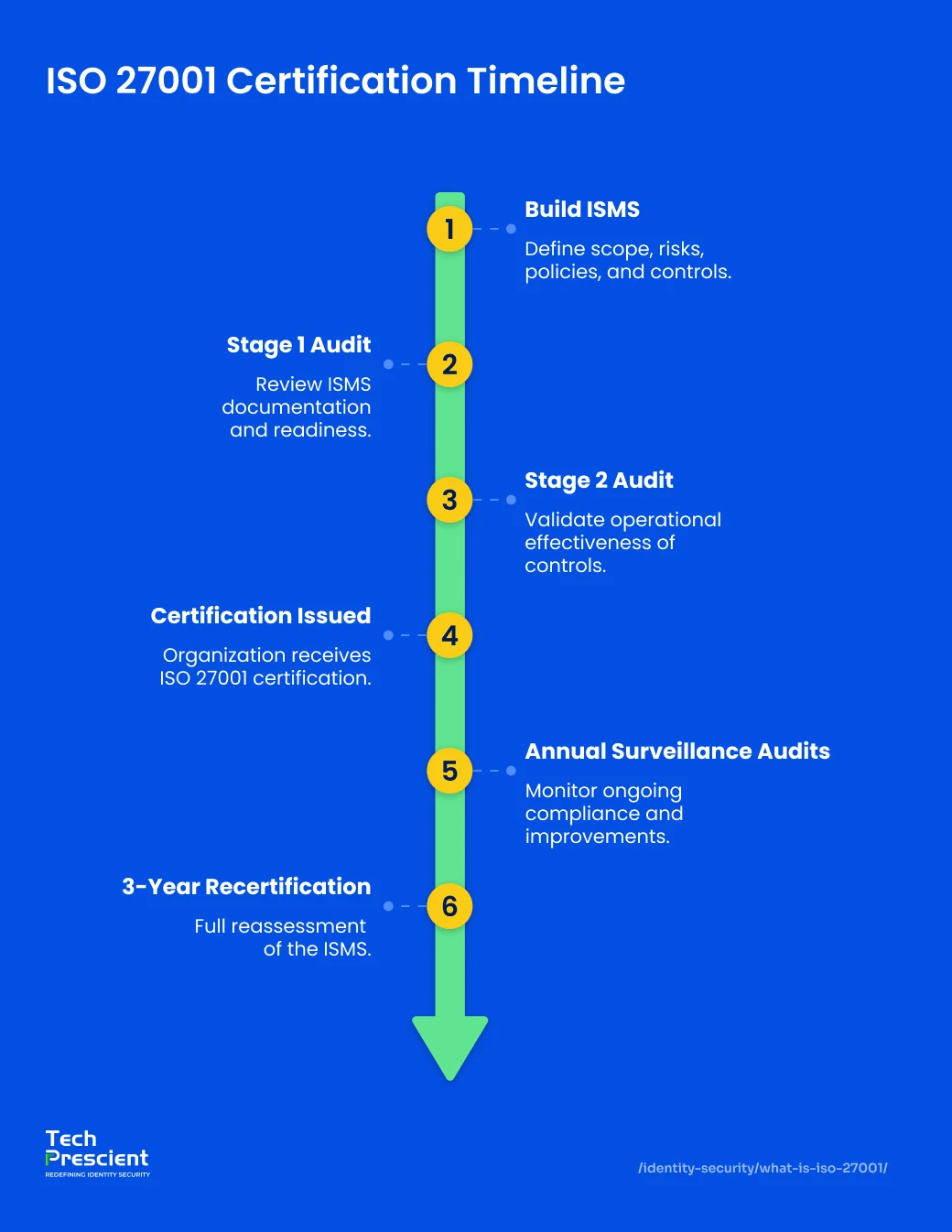
The certification process typically involves two formal audit stages.
Stage 1 Audit
Auditors review the organization's ISMS documentation, policies, scope, risk assessment process, and readiness for certification. This stage verifies whether the organization has established the required framework and controls before the full assessment begins.
Stage 2 Audit
During Stage 2, auditors evaluate how the ISMS operates in practice.
This includes reviewing:
- Security controls
- Operational processes
- Risk treatment activities
- Incident management
- Access management
- Monitoring and audit evidence
The goal is to confirm that controls are implemented effectively and functioning as intended.
The 3-Year Certification Cycle
ISO 27001 certification is not permanent.
Organizations typically follow a 3-year certification cycle:
- Initial certification audit
- Annual surveillance audits
- Full recertification after three years
This ensures organizations continuously maintain and improve their information security practices rather than treating certification as a one-time exercise.
Why Organizations Pursue ISO 27001 Certification
Organizations pursue ISO 27001 certification to:
- Build customer and partner trust
- Demonstrate strong cybersecurity governance
- Meet contractual or regulatory requirements
- Improve risk management maturity
- Strengthen competitive positioning
Certification is especially valuable for SaaS providers, cloud companies, healthcare organizations, financial institutions, and businesses handling sensitive customer data.
What is ISO 27001 Compliance?
ISO 27001 compliance means aligning an organization's security practices, policies, and controls with ISO 27001 requirements, even if the organization is not formally certified.
So, what is ISO 27001 compliance?
It refers to implementing the processes, controls, and risk management practices defined in the ISO/IEC 27001 standard to improve information security and reduce cybersecurity risk. An organization can be ISO 27001 compliant without undergoing formal certification. Many companies adopt the framework internally to strengthen security governance, meet customer expectations, or support broader compliance initiatives.
Compliance vs Certification
A common misconception is that compliance and certification are the same.
- ISO 27001 compliance means following the framework's requirements internally.
- ISO 27001 certification means an accredited external auditor has officially verified compliance through a formal audit process.
Some organizations choose compliance-only approaches due to budget, timelines, or operational priorities, while others pursue certification for customer trust and regulatory assurance.
How ISO 27001 Supports Other Compliance Requirements
One of the biggest advantages of ISO 27001 is that it aligns well with other cybersecurity and data protection regulations. Organizations often use ISO 27001 to strengthen compliance initiatives related to GDPR, HIPAA, PCI DSS, SOC 2, and other data privacy and cybersecurity regulations. Because the framework focuses on risk management, access control, monitoring, and governance, it provides a strong foundation for broader compliance programs.
Internal vs External Validation
Organizations can assess ISO 27001 compliance internally through:
- Internal audits
- Risk assessments
- Control reviews
- Gap assessments
External validation occurs when independent auditors or certification bodies review the organization's ISMS and security controls. Even without certification, demonstrating alignment with ISO 27001 practices can improve customer confidence and strengthen vendor security assessments.
Why ISO 27001 Compliance Matters
Implementing ISO 27001 compliance helps organizations:
- Improve cybersecurity governance
- Reduce operational and data security risks
- Standardize security processes
- Strengthen third-party trust
- Prepare for future certification efforts
For many organizations, compliance becomes the first step toward building a mature and scalable information security program.
Key Requirements of ISO 27001
ISO 27001 includes mandatory clauses and Annex A controls that help organizations implement, manage, and continuously improve information security using a risk-based approach.
The ISO 27001 standard is built around two major components:
- Mandatory clauses that define ISMS requirements
- Annex A security controls used to treat and manage risks
Together, these requirements help organizations create a structured and measurable approach to information security management.
Rather than prescribing identical controls for every organization, ISO 27001 uses a risk-driven model where controls are selected based on the organization's unique threat landscape, business environment, and compliance needs.
Mandatory Clauses (0–10 Overview)
The main body of ISO/IEC 27001 contains clauses that define how organizations establish, operate, monitor, and improve their ISMS.
Clauses 0–3: Introduction & Scope
These clauses provide background information, terminology, principles, and the scope of the standard.
Clause 4: Context of the Organization
Organizations must identify internal and external factors that impact information security, including stakeholders, regulatory obligations, and business requirements.
Clause 5: Leadership
Leadership must establish security policies, assign responsibilities, and demonstrate commitment to the ISMS.
Clause 6: Planning
Organizations conduct risk assessments, define security objectives, and create risk treatment plans.
Clause 7: Support
This clause focuses on resources, employee awareness, training, communication, and documentation requirements.
Clause 8: Operation
Organizations implement risk treatment plans, controls, and operational security processes.
Clause 9: Performance Evaluation
The ISMS must be monitored, measured, audited, and reviewed regularly to ensure effectiveness.
Clause 10: Improvement
Organizations must continuously improve the ISMS by addressing incidents, audit findings, and changing risks.
Annex A Controls Categories
Alongside the mandatory clauses, ISO 27001:2022 includes 93 Annex A controls designed to help organizations reduce and manage information security risks.
These controls are grouped into four major categories.
1. Organizational Controls
These controls focus on governance, policies, supplier security, asset management, and security responsibilities across the organization.
2. People Controls
People-related controls address employee awareness, training, background verification, acceptable use policies, and insider risk management.
3. Physical Controls
Physical controls help protect offices, facilities, devices, and infrastructure from unauthorized physical access or environmental threats.
4. Technological Controls
Technical controls include areas such as access management, encryption, monitoring, backup, malware protection, logging, and network security.
Risk-Driven Security Structure
One of the most important aspects of ISO 27001 is that organizations are not required to implement every Annex A control blindly.
Instead:
- Risks are identified first
- Controls are selected based on business impact and threat exposure
- Organizations document why controls are applied, modified, or excluded
This flexibility makes ISO 27001 adaptable across different industries, company sizes, and operational environments.
| ISO 27001 Clauses | Purpose |
|---|---|
| Clauses 4–10 | ISMS governance, planning, operations, monitoring, and improvement |
| Annex A Control Categories | Focus Area |
|---|---|
| Organizational | Governance and policies |
| People | Employee security practices |
| Physical | Facility and device protection |
| Technological | Technical security controls |
Benefits of ISO 27001 for Organizations
ISO 27001 helps organizations reduce cybersecurity risks, strengthen compliance, improve operational resilience, and build trust with customers, partners, and regulators.
One of the biggest ISO 27001 benefits is that it provides organizations with a structured and repeatable approach to managing information security risks. Instead of relying on reactive security practices, organizations build long-term governance, risk management, and continuous improvement processes.
As cyber threats, regulatory requirements, and third-party security expectations continue to grow, ISO 27001 helps organizations establish stronger security maturity while improving business credibility.
1. Risk Reduction
ISO 27001 helps organizations identify, assess, and manage cybersecurity and operational risks systematically.
By implementing risk assessments, security controls, access management, monitoring, and incident response processes, organizations can reduce the likelihood and impact of data breaches, insider threats, ransomware attacks, and operational disruptions.
The framework also improves visibility into security gaps and helps organizations prioritize remediation efforts based on business risk.
2. Competitive Advantage
For many organizations, ISO 27001 certification becomes a business differentiator. Customers, enterprise buyers, and partners increasingly expect vendors to demonstrate strong cybersecurity and data protection practices before sharing sensitive information or signing contracts. ISO 27001 certification helps organizations prove that they follow internationally recognized security standards.
This is especially valuable for:
- SaaS providers
- Cloud companies
- Managed service providers
- Healthcare and financial organizations
- Businesses handling sensitive customer data
In many cases, ISO 27001 can accelerate vendor approvals and improve enterprise sales opportunities.
3. Regulatory Compliance Support
ISO 27001 aligns well with many cybersecurity and privacy regulations, making compliance management more efficient. The framework supports organizations in areas such as:
- Data protection governance
- Access control
- Risk management
- Monitoring and audit readiness
- Incident response and documentation
Organizations often use ISO 27001 to strengthen compliance initiatives related to GDPR, HIPAA, PCI DSS, SOC 2, and other industry-specific regulations.
4. Customer and Partner Trust
Trust has become a major factor in cybersecurity and vendor relationships. ISO 27001 demonstrates that an organization takes information security seriously and follows structured processes for protecting sensitive data. This helps improve confidence among:
- Customers
- Business partners
- Investors
- Regulators
- Third-party vendors
For many organizations, the framework strengthens both security posture and brand reputation.
5. Operational Consistency and Security Maturity
Another important benefit of ISO 27001 is operational standardization.
The framework helps organizations establish:
- Clear security policies
- Defined responsibilities
- Repeatable processes
- Continuous monitoring practices
- Ongoing improvement cycles
Over time, this creates a more mature and resilient security program that can adapt to changing business and threat environments.
Who Needs ISO 27001?
Any organization that handles sensitive data can benefit from ISO 27001, regardless of its size, industry, or technical maturity. ISO 27001 is often associated with large enterprises, but in reality, the framework is relevant for organizations of all sizes that need to protect customer information, business data, intellectual property, or regulated information.
As cybersecurity risks, third-party requirements, and compliance expectations continue to increase, organizations are adopting ISO 27001 to strengthen security governance, improve trust, and standardize information security practices.
1. SaaS and Technology Companies
SaaS providers and technology companies frequently pursue ISO 27001 because they manage large amounts of customer and business data across cloud environments.
Enterprise customers increasingly expect software vendors to demonstrate strong security practices before sharing sensitive information or approving procurement processes. ISO 27001 certification helps SaaS companies strengthen customer trust, improve vendor assessments, and support enterprise sales cycles.
2. Healthcare Organizations
Healthcare organizations handle highly sensitive patient and medical data, making information security and privacy critical. ISO 27001 helps healthcare providers improve:
- Data protection practices
- Access management
- Risk management
- Incident response readiness
- Regulatory compliance support
The framework also aligns well with broader healthcare security and privacy initiatives.
3. Financial Services and Banking
Financial institutions are frequent targets for cyberattacks, fraud, insider threats, and data breaches. ISO 27001 helps financial organizations establish structured controls around:
- Access governance
- Risk assessments
- Monitoring and auditing
- Third-party risk management
- Operational resilience
This is especially important in highly regulated financial environments where trust and security are essential.
4. Small Businesses and Startups
Many small and mid-sized businesses assume ISO 27001 is only for large enterprises, but smaller organizations often benefit significantly from implementing structured security processes early.
For SMBs and startups, ISO 27001 can help:
- Build security maturity
- Prepare for enterprise customers
- Improve operational consistency
- Reduce security risks as the business scales
Smaller organizations often adopt phased implementations based on risk and business priorities.
5. Enterprises and Global Organizations
Large enterprises typically use ISO 27001 to standardize security governance across departments, regions, cloud environments, and third-party ecosystems.
The framework helps enterprises manage:
- Complex risk environments
- Vendor and supply chain security
- Cross-border compliance requirements
- Internal governance and audit processes
ISO 27001 also improves coordination between security, compliance, IT, and business leadership teams.
6. Organizations with Vendor or Contractual Security Requirements
In many industries, ISO 27001 certification is increasingly becoming a customer or vendor requirement.
Organizations may need ISO 27001 to:
- Qualify for enterprise contracts
- Meet procurement security requirements
- Pass vendor risk assessments
- Demonstrate cybersecurity maturity to partners and regulators
For many businesses, ISO 27001 is no longer just a security initiative, it is becoming a competitive business requirement.
ISO 27001:2013 vs ISO 27001:2022
The ISO 27001:2022 update modernizes the framework by restructuring controls, simplifying categories, and aligning the standard with modern cybersecurity risks such as cloud security, threat intelligence, and remote work environments.
Organizations often ask, what is ISO 27001:2013, and how does it differ from the newer 2022 version?
ISO 27001:2013 was the previous version of the standard and remained widely adopted for nearly a decade. However, cybersecurity threats, cloud adoption, hybrid work, and digital transformation changed significantly during that period.
To address these evolving risks, ISO released ISO 27001:2022, introducing updated controls, revised terminology, and a more modern security structure.
Key Differences Between ISO 27001:2013 and ISO 27001:2022
One of the biggest updates in ISO 27001:2022 is the restructuring of Annex A controls.
The 2013 version included:
- 114 controls
- 14 control domains
The 2022 version streamlined the structure into:
- 93 controls
- 4 broader control categories
The updated categories are:
- Organizational controls
- People controls
- Physical controls
- Technological controls
This simplified structure improves usability and better reflects how modern organizations manage cybersecurity and operational risks.
New and Updated Controls
ISO 27001:2022 also introduced new controls designed to address modern cybersecurity challenges.
Examples include:
- Threat intelligence
- Cloud service security
- Data masking
- Secure coding practices
- Information deletion
- Monitoring activities
- Web filtering
These additions align the framework more closely with current security environments, including cloud infrastructure, SaaS ecosystems, and hybrid work models.
Why the Upgrade Matters
The transition from ISO 27001:2013 to ISO 27001:2022 reflects how modern cybersecurity risks, cloud environments, and operational models have evolved.
The updated framework helps organizations:
- Improve cloud and third-party security governance
- Strengthen monitoring and threat visibility
- Modernize risk management practices
- Align controls with current attack techniques and operational models
Organizations certified under ISO 27001:2013 were required to transition to the 2022 version within the official migration timeline established by certification bodies.
ISO 27001:2022 and Modern Cybersecurity
The 2022 update places stronger emphasis on:
- Continuous monitoring
- Security automation
- Threat intelligence
- Cloud governance
- Identity and access management
- Operational resilience
This makes the framework more practical for organizations managing modern distributed environments and evolving cyber threats.
| Area | ISO 27001:2013 | ISO 27001:2022 |
|---|---|---|
| Controls | 114 | 93 |
| Structure | 14 domains | 4 categories |
| Focus Areas | Traditional security controls | Modern cybersecurity risks |
| New Topics | Limited cloud focus | Cloud, threat intelligence, monitoring |
| Alignment | Legacy infrastructure | Hybrid & cloud environments |
ISO 27001 in Cybersecurity Strategy
ISO 27001 serves as a foundational cybersecurity framework for managing information security risks, identity governance, access control, and continuous security operations.
Modern cybersecurity strategies now focus on identity, cloud access, continuous monitoring, and operational resilience rather than relying only on perimeter-based security. Organizations now operate across cloud environments, SaaS applications, remote work ecosystems, third-party integrations, and distributed identities. In this environment, frameworks like ISO 27001 help organizations build a structured and risk-driven cybersecurity program.
Rather than functioning as just a compliance standard, ISO 27001 provides the governance and operational foundation needed to support broader cybersecurity initiatives such as Zero Trust, identity security, continuous monitoring, and risk management.
1. ISO 27001 and Zero Trust Security
The principles of Zero Trust security align closely with ISO 27001's risk-based approach.
Zero Trust assumes that no user, device, or application should be trusted automatically, even inside the corporate network. ISO 27001 supports this model by emphasizing:
- Least privilege access
- Access control policies
- Continuous monitoring
- Risk assessments
- User accountability
- Security governance
Together, these practices help organizations reduce unauthorized access and improve visibility into security risks across distributed environments.
2. Role of Identity Governance in ISO 27001
Identity and access management are central to many ISO 27001 controls. Organizations must manage user provisioning and deprovisioning, role-based access control, privileged accounts, access reviews, and third-party access governance consistently across environments.
This is where Identity Governance and Administration (IGA) platforms become highly relevant. IGA solutions help organizations automate access management, enforce least privilege principles, improve audit readiness, and strengthen compliance with ISO 27001 requirements.
For organizations building identity-first security strategies, understanding the differences between IAM and IGA is critical. See: IGA vs IAM explained
3. Integration with IAM, SIEM, and Security Operations
ISO 27001 also supports integration across broader cybersecurity ecosystems. Organizations often integrate ISO 27001 governance processes with IAM platforms, SIEM solutions, endpoint security tools, and cloud security platforms to create a more unified approach to monitoring and risk management.
This creates a more unified approach to risk management, monitoring, incident response, and compliance operations.
4. Why ISO 27001 Matters in Modern Cybersecurity
As cyber threats become more identity-driven and compliance requirements become more complex, organizations need frameworks that connect governance, risk management, and operational security.
ISO 27001 helps organizations:
- Build structured cybersecurity governance
- Strengthen identity and access security
- Improve continuous monitoring practices
- Support compliance and audit readiness
- Create long-term operational resilience
For many organizations, ISO 27001 becomes the foundation upon which broader cybersecurity and identity governance strategies are built.
How to Get ISO 27001 Certified (Step-by-Step)
Organizations achieve ISO 27001 certification by building an Information Security Management System (ISMS), implementing risk-based security controls, and successfully completing external audits.
Getting ISO 27001 certified is not just about passing an audit. The process involves building a structured security and governance program that can continuously manage information security risks across the organization.
While the complexity varies depending on company size and environment, most organizations follow a similar implementation lifecycle.
Define the Scope of the ISMS
The first step is defining the scope of the Information Security Management System (ISMS).
Organizations identify:
- Which business units, systems, applications, and data will be included
- Regulatory and contractual requirements
- Internal and external stakeholders
- Critical assets and operational boundaries
A clearly defined scope ensures the ISMS is manageable and aligned with business objectives.
Conduct a Risk Assessment
Organizations then perform a structured ISO 27001 risk assessment to identify threats, vulnerabilities, and potential business impacts.
This process helps determine:
- Which risks need treatment
- Which controls are necessary
- Where security gaps exist
- Which assets require stronger protection
The framework's risk-driven approach ensures controls are implemented based on actual business risk rather than generic security assumptions.
Implement Security Controls
Once risks are identified, organizations implement appropriate security controls and governance processes. These controls may include access management, encryption, monitoring, incident response procedures, backup strategies, vendor security controls, and employee awareness training. Organizations also document policies, procedures, and risk treatment plans required for the ISMS.
Conduct an Internal Audit
Before the certification audit, organizations conduct internal reviews to evaluate whether the ISMS is functioning effectively.
Internal audits help identify:
- Control gaps
- Documentation issues
- Process weaknesses
- Areas requiring remediation
This step is critical for improving audit readiness and reducing compliance issues during certification.
Complete the Certification Audit
An accredited certification body performs the formal audit process in two stages. Stage 1 focuses on reviewing ISMS documentation and organizational readiness, while Stage 2 evaluates operational effectiveness and control implementation in practice. If the organization meets the standard's requirements, it receives ISO 27001 certification.
Continuous Improvement After Certification
Certification is not the end of the process. Organizations must continuously monitor, maintain, and improve their ISMS through:
- Surveillance audits
- Risk reviews
- Policy updates
- Control improvements
- Ongoing monitoring activities
This continuous improvement model helps organizations maintain long-term security maturity and compliance readiness.
Common Challenges in ISO 27001 Implementation
Many organizations struggle with ISO 27001 implementation because the framework requires ongoing coordination across security, IT, compliance, leadership, and operational teams. While ISO 27001 provides a structured framework for managing information security, implementation can become difficult if organizations approach it only as a compliance exercise rather than an operational security program.
1. Resource Constraints
One of the biggest implementation challenges is limited time, staffing, and security expertise. Small and mid-sized organizations often struggle to dedicate internal resources for risk assessments, policy management, audits, documentation, and ongoing monitoring activities. Even larger enterprises may face coordination challenges across security, IT, compliance, and business teams. Without clear ownership and executive support, ISO 27001 initiatives can slow down significantly.
2. Over-Documentation
Many organizations become overly focused on creating large volumes of documentation instead of building practical and effective security processes.
ISO 27001 does require policies, procedures, and audit evidence, but excessive documentation can create operational overhead without improving actual security posture. The goal of the framework is not to produce paperwork, it is to establish repeatable and measurable security practices. Organizations are generally more successful when documentation supports operational security rather than becoming the primary objective.
3. Lack of Automation
Managing ISO 27001 manually through spreadsheets and disconnected processes often becomes difficult as environments grow more complex.
Without automation, organizations may struggle with:
- Access reviews
- Audit evidence collection
- Risk tracking
- Vendor assessments
- Policy management
- Continuous monitoring
This increases operational workload and makes it harder to maintain consistent compliance over time.
4. Continuous Monitoring Challenges
ISO 27001 is based on continuous improvement, which means organizations must continuously review risks, monitor controls, and update processes as threats evolve. Many organizations initially focus heavily on achieving certification but later struggle to maintain monitoring, auditing, and ongoing control validation. As cloud environments, SaaS applications, and identities continue to expand, maintaining visibility and governance becomes increasingly challenging.
5. Managing Organizational Change
Implementing ISO 27001 often requires changes in how employees handle information, access systems, and follow security procedures. Resistance to process changes, inconsistent adoption across departments, and limited employee awareness can reduce the effectiveness of the ISMS if security culture is not reinforced continuously.
Final Thoughts
ISO 27001 is more than a compliance standard—it is a long-term framework for improving cybersecurity governance, reducing operational risk, and building trust in increasingly complex digital environments. Organizations that successfully integrate ISO 27001 into everyday operations gain stronger resilience, better visibility into security risks, and a more mature approach to protecting sensitive information.
Operationalize ISO 27001 Controls
Map ISO controls to identity governance and continuous compliance
FAQs
Having ISO 27001 certification means an organization follows a globally recognized framework for managing and protecting information security. It demonstrates that the organization has implemented an Information Security Management System (ISMS) with structured policies, risk management processes, and security controls.
The cost of ISO 27001 certification varies based on factors such as company size, scope, infrastructure complexity, and audit requirements. Costs can range from a few thousand dollars for smaller organizations to significantly higher amounts for large enterprises with complex environments and multiple locations.
ISO 27001 requires organizations to establish and maintain an ISMS, conduct risk assessments, implement appropriate security controls, perform internal audits, and continuously improve security processes. Organizations must also apply relevant Annex A controls based on their risk environment.
No, ISO 27001 is not legally mandatory for most organizations. However, many businesses pursue ISO 27001 compliance or certification to meet customer expectations, support regulatory requirements, strengthen cybersecurity governance, and qualify for enterprise contracts.
The timeline for ISO 27001 certification typically ranges from 3 to 12 months, depending on the organization's size, existing security maturity, resource availability, and implementation scope. Organizations with mature security processes generally achieve certification faster.


GET A PERSONALIZED DEMO
See Identity Confluence in Action
“One platform to govern identities, automate access decisions, and prove compliance; across every app, user, and system in your environment.”



Murli Ramsunder
Senior Architect, Vonage