




On this page
See Tech Prescient in Action
Automate access, reduce risk, and stay audit-ready
Most cyberattacks don't rely on advanced techniques. They succeed because of common cybersecurity mistakes that organizations repeat across systems, users, and processes.
Weak passwords, missing updates, poor access controls, and limited visibility create easy entry points for attackers. These gaps are preventable but persist due to inconsistent security practices and over-reliance on basic tools.
In this guide, we'll break down the most common cybersecurity mistakes businesses make, explain why breaches happen, and show how to fix them before they lead to real damage.
Key Takeaways
- Most breaches occur due to basic security mistakes rather than advanced attacks.
- Weak credentials and human error remain the biggest risk factors.
- SMBs face the same threats as enterprises, but often lack visibility and controls.
- Identity security, access control, and user awareness are critical to preventing breaches.
What Are the Most Common Cybersecurity Mistakes?
The most common cybersecurity mistakes start with weak or poorly managed passwords. Simple or reused passwords like "123456" can be easily cracked, giving attackers direct access to systems.
Other frequent issues include not updating systems, a lack of proper security controls, poor visibility into access, and inadequate employee training. These mistakes are repeated across organizations and often become the starting point for security breaches.
These are not rare or advanced issues. They are repeated across environments, often due to gaps in processes, visibility, or enforcement. Attackers rely on these weaknesses because they are easy to exploit and widely present across organizations.
Some of the mistakes include:
- Using weak or reused passwords across systems and applications
- Not enabling 2FA, especially for critical accounts
- Delaying software updates and patching
- Falling for phishing and social engineering attacks
- Lack of employee security awareness and training
- Over-permissioned users and poor access controls
These issues may seem basic, but when combined, they create significant risk. Most breaches occur not because organizations lack tools, but because fundamental controls are not consistently applied or monitored.
This is why understanding and fixing these common cybersecurity gaps is a critical first step in reducing overall cyber risk.
Why Cybersecurity Breaches Happen So Often
Cybersecurity breaches typically happen when attackers exploit basic gaps such as weak credentials, outdated systems that haven't been patched, poor visibility into access, and inadequate access control.
These are not advanced vulnerabilities; they are common issues that persist due to inconsistent security practices. Attackers look for these gaps because they are easy to exploit and widely present across systems. Organizations often invest in security tools, but gaps in processes, visibility, and user behavior reduce their effectiveness.
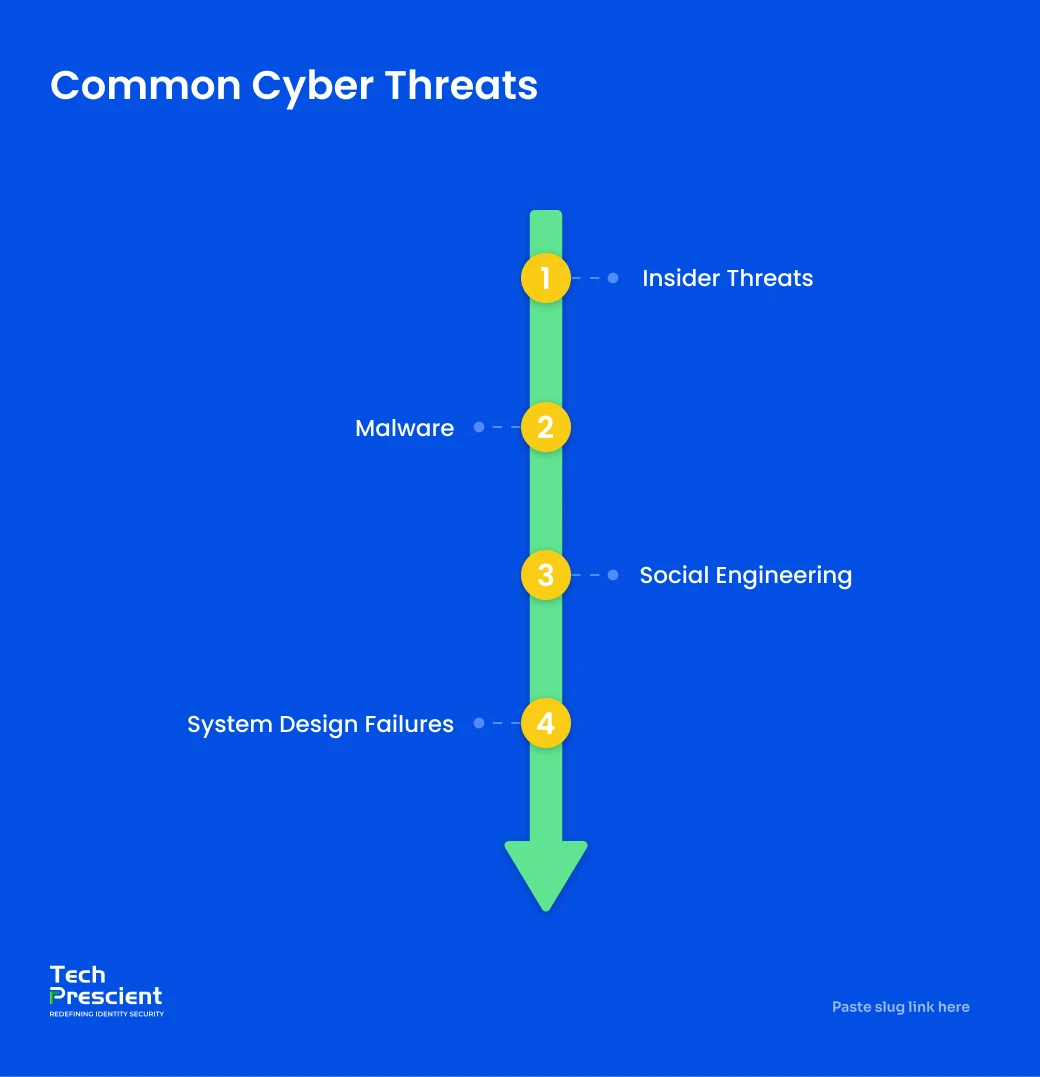
1. Human Error as the Primary Cause
Human error remains one of the leading causes of breaches. Employees may reuse passwords, click on phishing links, or misconfigure systems without realizing the impact. Since users interact with systems daily, even small mistakes can create entry points for attackers.
Another common issue is ignoring routine maintenance of devices. Many users delay software updates or postpone installing security patches and antivirus updates. When updates are not applied, known vulnerabilities remain open, making it easier for attackers to exploit systems.
2. Over-Reliance on Single Security Tools
Many organizations depend heavily on a single solution, such as an antivirus or a firewall, assuming it will prevent all threats. However, modern attacks often target identity and access, which traditional tools alone cannot fully protect. Without layered controls, attackers can bypass defenses using compromised credentials.
3. Lack of Visibility into Access and Behavior
A major gap in many environments is the lack of visibility into who has access to what systems and how that access is being used. Without clear visibility, organizations cannot detect unusual behavior, over-privileged users, or unauthorized access. This makes it easier for attackers to move within systems without being noticed.
Are You Making These Cybersecurity Mistakes?
Assess your security gaps across MFA, access, and visibility in minutes
Biggest Cybersecurity Mistakes Businesses Make
These are the most common cybersecurity mistakes businesses make, and the ones most frequently exploited in real-world attacks. These are not complex failures, but basic security gaps that remain unaddressed over time.
Using Weak or Reused Passwords
Weak or reused passwords significantly increase the risk of unauthorized access. Attackers use automated tools to guess simple passwords or reuse stolen credentials across multiple platforms in credential stuffing attacks. If one account is compromised, reused passwords can expose multiple systems, applications, and sensitive data. This creates a chain effect where a single weak password leads to widespread access.
How to fix it:
- Enforce strong, unique passwords across all systems
- Use password managers to reduce reuse
- Enable MFA wherever possible
Skipping Multi-Factor Authentication (MFA)
Relying only on passwords is no longer sufficient to secure accounts. Even strong passwords can be compromised through phishing or data breaches. Multi-factor authentication adds an additional layer of security by requiring a second form of verification, such as a code or biometric factor. Without MFA, attackers who obtain credentials can access systems without any additional barrier.
How to fix it:
- Enforce MFA across all users, especially for admins
- Apply MFA to critical applications and remote access
- Avoid exceptions unless strictly necessary
Ignoring Software Updates and Patch Management
Patch management refers to the process of regularly updating software, systems, and applications to fix known vulnerabilities. When updates are delayed or ignored, systems remain exposed to publicly known exploits that attackers actively target. Many breaches occur not because vulnerabilities are unknown, but because patches were not applied in time.
How to fix it:
- Automate patching wherever possible
- Define clear ownership for updates
- Prioritize critical security patches
Falling for Phishing and Social Engineering
Phishing and social engineering attacks exploit human psychology rather than technical weaknesses. Attackers trick users into revealing credentials, clicking malicious links, or granting unauthorized access. These attacks often appear legitimate and create urgency, making them difficult to detect without awareness. Because they target people instead of systems, they can bypass even strong technical controls.
How to fix it:
- Conduct regular phishing simulations
- Train employees to recognize suspicious activity
- Create simple reporting processes for phishing attempts
Inadequate Employee Security Training
Employees are the first point of interaction with systems, data, and external communication. Without proper training, they may not recognize threats such as phishing emails, suspicious links, or unusual requests. Lack of awareness leads to poor security decisions, delayed reporting, and increased exposure. Continuous training ensures employees understand risks and know how to respond appropriately.
How to fix it:
- Provide continuous security awareness training
- Set clear policies for device usage and data handling
- Reinforce training with real-world scenarios
Over-Reliance on Antivirus Alone
Many organizations assume that installing antivirus software is enough to stay secure. While antivirus tools can detect known threats, they do not protect against modern attack methods such as phishing, credential misuse, or identity-based attacks.
This creates a false sense of security. Once antivirus is in place, organizations may overlook other critical controls like access management, monitoring, and user behavior analysis, leaving significant gaps unaddressed.
How to fix it:
- Implement layered security controls
- Combine endpoint detection (EDR), monitoring, and identity security
- Continuously monitor user behavior and access patterns
Unsecured Mobile Devices
Mobile devices such as smartphones and tablets are widely used for accessing business applications and data, making them attractive targets for attackers. Unsecured devices connected to corporate systems can introduce malware, expose sensitive data, or provide unauthorized access.
Risks increase when devices are lost, connected to public Wi-Fi, or used without proper authentication. Attacks like smishing (SMS phishing) are also becoming more common. Without proper device management and employee awareness, these devices can significantly expand the attack surface.
How to fix it:
- Implement Mobile Device Management (MDM) to enforce security policies
- Require device encryption, strong authentication, and auto-lock settings
- Enable remote wipe capabilities for lost or stolen devices
- Restrict access from unknown or unmanaged devices
Use of Unauthorized Software (Shadow IT)
Mobile devices such as smartphones and tablets are widely used for accessing business applications and data, making them attractive targets for attackers. Unsecured devices connected to corporate systems can introduce malware, expose sensitive data, or provide unauthorized access.
Risks increase when devices are lost, connected to public Wi-Fi, or used without proper authentication. Attacks like smishing (SMS phishing) are also becoming more common. Without proper device management and employee awareness, these devices can significantly expand the attack surface.
How to fix it:
- Establish clear policies on approved tools and software usage
- Gain visibility into all applications being used across the organization
- Monitor and control SaaS access through centralized management
- Provide secure, approved alternatives to commonly used unauthorized tools
Common Configuration and Technical Security Mistakes
Misconfigurations and poor security hygiene often expose systems without organizations realizing it. These are repeated mistakes because they occur during setup, development, or maintenance, and are not always continuously monitored. These issues often go unnoticed while creating exposure that attackers can easily discover and exploit.
1. Configuration Mistakes in Cybersecurity
Configuration errors are one of the most frequent causes of unintended exposure. Even well-secured systems can become vulnerable if settings are not properly configured.
Common examples include:
- Open ports that allow unnecessary external access
- Default credentials left unchanged
- Publicly exposed cloud storage, databases, or services
These mistakes often occur due to rushed deployments or a lack of regular configuration reviews.
2. Developer Mistakes in Cybersecurity
Security issues often originate during application development. When secure coding practices are not followed, vulnerabilities are introduced directly into systems.
Common examples include:
- Hardcoded credentials within code or configuration files
- Insecure APIs that lack proper authentication or authorization
- Missing input validation, leading to injection attacks
Addressing these issues requires integrating security into the development lifecycle rather than testing only at the end.
3. Cybersecurity Audit Mistakes
Even when audits are conducted, poor execution can reduce their effectiveness and create a false sense of security.
Common mistakes include:
- Treating audits as one-time checkbox exercises instead of continuous processes
- Performing incomplete audits that do not cover the full hybrid or cloud environment
- Ignoring or failing to remediate findings from access reviews and entitlement audits
- Lacking risk-based prioritization and treating all issues equally
- Relying only on self-audits without independent validation
- Failing to collect sufficient evidence or measure actual security improvements
Without proper follow-through and continuous monitoring, audits fail to improve real security posture.

Pro Tip:
Misconfigurations are one of the easiest issues to detect, but only if you check for them continuously. Regular configuration audits and automated scanning can catch exposures before attackers do.
Common Cybersecurity Mistakes in SMBs
Small and mid-sized businesses (SMBs) are especially vulnerable due to limited resources and a lack of formal security processes. As a result, many common cybersecurity mistakes are more pronounced in SMB environments. Attackers frequently target SMBs because they are easier to compromise and less likely to detect attacks early.
1. Limited Security Budgets
SMBs often operate with constrained budgets, which can limit investment in advanced security tools, dedicated teams, or continuous monitoring. This can lead to gaps in areas such as endpoint protection, identity security, and threat detection, increasing overall risk exposure.
2. Lack of Formal Policies
Many SMBs do not have well-defined security policies or standardized processes for access control, data handling, or incident response. Without clear policies, security practices become inconsistent, making it harder to enforce controls and maintain compliance.
3. Overconfidence in Size-Based Safety
A common misconception is that smaller organizations are less likely to be targeted. In reality, attackers often prefer SMBs because they tend to have weaker defenses. This false sense of security leads to delayed investments in cybersecurity, leaving systems and data exposed.
How to Avoid Cybersecurity Mistakes
Avoiding cybersecurity mistakes requires a proactive approach focused on identity security, access control, and continuous monitoring. Most risks can be reduced significantly by strengthening a few core controls.
1. Strengthen Identity and Access Controls
Most attacks today target identities rather than systems. Controlling who has access and ensuring that access is appropriate is critical.
- Enforce least-privilege access so users only have what they need
- Conduct regular access reviews to remove unnecessary permissions
- Enable automated deprovisioning when users change roles or leave
2. Invest in Employee Security Awareness Training
Employees play a key role in preventing security incidents. Without proper training, even strong technical controls can be bypassed.
- Train users to recognize phishing and social engineering attacks
- Use real-world simulations to reinforce learning
- Provide clear guidelines for handling data and reporting suspicious activity
3. Use Layered Security Controls
No single tool can prevent all attacks. A layered approach ensures that if one control fails, others can still provide protection.
- Combine MFA, monitoring, and endpoint protection
- Add identity-based controls alongside traditional security tools
- Continuously monitor user activity and system behavior
4. Create and Test an Incident Response Plan
Even with strong defenses, incidents can still occur. Having a clear response plan reduces impact and recovery time.
- Define roles and responsibilities during a security incident
- Establish clear communication and escalation paths
- Conduct regular tabletop exercises to test readiness
Strengthening Security with Identity Governance
Many organizations underestimate identity-related risks until a breach occurs. Since most modern attacks begin with compromised credentials, managing identity and access is critical to reducing exposure.
Strong identity governance practices help organizations maintain control over who has access to what and why. This includes continuous access monitoring, automated provisioning and deprovisioning, and enforcing least-privilege access. These controls reduce risks such as orphan accounts, excessive permissions, and unauthorized access.
While assessments provide visibility into gaps, long-term security requires continuous governance. Solutions like Tech Prescient's Identity Confluence enable organizations to move beyond one-time audits by providing ongoing access visibility, automated remediation, and consistent policy enforcement, helping maintain security and compliance over time.
Final Thoughts
Most cybersecurity incidents are the result of preventable mistakes, not sophisticated attacks.
The real risk isn't a lack of tools, but gaps in how identity, access, and security practices are managed day to day. When these basics are inconsistent, even well-secured environments become vulnerable.
Organizations that focus on strengthening access controls, improving visibility, and reducing human error are far better positioned to prevent breaches before they happen.
Find and Fix Your Biggest Security Gaps Today
Score your risk and identify critical gaps before attackers exploit them
FAQs
Common cybersecurity mistakes include weak or reused passwords, lack of MFA, delayed patching, and inadequate employee training. These gaps create easy entry points for attackers and are responsible for many breaches.
Companies fail at cybersecurity when they rely on single tools, underestimate human error, and fail to manage access and identity effectively. These cybersecurity mistakes businesses make often result in poor visibility, over-privileged users, and weak enforcement of security controls.
Cybersecurity breaches happen frequently because attackers exploit common cybersecurity mistakes such as weak credentials, lack of MFA, misconfigurations, and missing patches. These basic gaps are easier to exploit than advanced vulnerabilities and are widely present across organizations.
Organizations can avoid these mistakes by enforcing MFA, implementing strong access controls, conducting regular training, and adopting layered security strategies. Continuous monitoring and regular access reviews also help reduce cyber risk.
Yes, small and mid-sized businesses (SMBs) are highly vulnerable to common cybersecurity mistakes. Limited budgets, lack of formal security policies, and reduced visibility make SMBs easier targets for attackers compared to larger enterprises.
Share



Rashmi Ogennavar
Content Strategist
A content strategist translating complex Tech and SaaS concepts into compelling narratives for business and technical audiences. With a strategic, data-informed approach, the work bridges content and product storytelling, crafting messaging that resonates and drives decisions across the buyer journey.
Most Popular Blogs
Identity Security· 21 min read
Data Access Governance Solutions: How to Secure Sensitive Data at Scale
Compare data access governance solutions for 2026: how DAG platforms discover sensitive data, run access reviews, automate remediation, and prove compliance.
Brinda Bhatt· September 7, 2026
Identity Security· 24 min read
What Is Zero Trust Network Access (ZTNA)?
Learn what Zero Trust Network Access (ZTNA) is, how it works, and why it’s replacing VPNs for secure, identity-based access control.
Yatin Laygude· August 14, 2026
Identity Security· 24 min read
Cyber Essentials Certification: Complete Guide
Learn Cyber Essentials certification, cost, requirements, and steps. Compare Cyber Essentials vs Plus and get certified faster.
Yatin Laygude· August 10, 2026