




On this page
See Tech Prescient in Action
Automate access, reduce risk, and stay audit-ready
FedRAMP continuous monitoring requirements are a critical part of maintaining cloud authorization for U.S. federal use. Achieving an Authority to Operate (ATO) is only the beginning. Cloud Service Providers (CSPs) must continuously monitor security controls, track vulnerabilities, submit reports, and demonstrate ongoing compliance to keep their authorization active.
Built around NIST SP 800-53 controls, FedRAMP continuous monitoring focuses on preventing control drift, improving risk visibility, and ensuring rapid remediation of emerging threats. From monthly vulnerability scans and POA&M updates to annual assessments and incident reporting, continuous monitoring plays a central role in sustaining FedRAMP compliance requirements.
According to the official FedRAMP program, Moderate Impact systems account for nearly 80% of cloud service applications receiving FedRAMP authorization, highlighting how important ongoing monitoring and compliance maintenance are across the federal cloud ecosystem. In this guide, we'll break down FedRAMP continuous monitoring requirements, reporting expectations, key tools, and best practices for maintaining compliance and ATO readiness.
Key Takeaways:
- Understand FedRAMP continuous monitoring and its role in maintaining compliance and ATO.
- Learn the key ConMon requirements, including monthly, annual, and ongoing monitoring activities.
- Explore FedRAMP reporting requirements, from vulnerability scans and POA&M updates to incident reporting.
- Discover the tools and automation strategies that support continuous compliance and reporting.
- Gain practical insights into building a strong monitoring strategy and overcoming common compliance challenges.
What Is FedRAMP Continuous Monitoring?
FedRAMP continuous monitoring is the ongoing practice of monitoring, assessing, and reporting a cloud system's security posture to ensure it remains compliant after authorization. In the FedRAMP ecosystem, authorization is not a one-time event. Cloud Service Providers (CSPs) must continuously prove that their environments maintain required security standards, controls, and risk management processes.
Understanding FedRAMP continuous monitoring requires looking at why it exists, how it supports authorization, and how it connects to established security frameworks.
1. Purpose of FedRAMP Continuous Monitoring
The goal of continuous monitoring is to preserve security and compliance in environments that are constantly changing. New vulnerabilities, infrastructure updates, configuration changes, and emerging threats can affect a system's risk profile over time. Continuous monitoring helps organizations maintain visibility into these changes, validate control effectiveness, and support timely remediation to meet ongoing FedRAMP compliance requirements.
2. Role in the ATO Lifecycle
Continuous monitoring plays a critical role in maintaining an Authority to Operate (ATO). After a cloud service is authorized, CSPs must continue demonstrating that security controls remain operational and risks are actively managed. Activities such as vulnerability scanning, change management, POA&M tracking, and incident reporting provide the evidence needed to support ongoing authorization and operational accountability.
3. Alignment with NIST 800-53 Controls
FedRAMP continuous monitoring is built on the control framework defined in NIST SP 800-53. CSPs are expected to continuously monitor and maintain controls related to areas such as access control, audit logging, vulnerability management, incident response, and system configuration. These controls vary across Low, Moderate, and High baselines but collectively form the foundation of FedRAMP security and compliance management.
Reality Check
An ATO Is Not a Set-and-Forget Achievement. Receiving authorization is only the start. Continuous monitoring is what keeps your cloud environment compliant and your ATO intact.
Why Continuous Monitoring Is Critical for FedRAMP Compliance
FedRAMP authorization is not designed to be a one-and-done exercise. Cloud environments change continuously, and without ongoing oversight, security controls can weaken, vulnerabilities can accumulate, and compliance gaps can emerge. Continuous monitoring helps ensure that cloud systems remain secure, compliant, and operationally trustworthy long after initial authorization.
Its importance in FedRAMP compliance requirements comes down to maintaining authorization, managing risk, and reinforcing confidence across federal stakeholders.
1. Supporting ATO Maintenance
An Authority to Operate (ATO) must be sustained through ongoing security and compliance activities. After authorization, CSPs are expected to continuously monitor their environments, validate controls, track system changes, and provide recurring compliance evidence. These activities help demonstrate that security requirements are still being met and that the system remains fit for federal use.
2. Improving Risk Detection and Remediation
Cloud environments are exposed to evolving threats, newly discovered vulnerabilities, and operational changes that can affect security posture. Continuous monitoring provides ongoing visibility into these risks through mechanisms such as vulnerability assessments, audit reviews, and remediation tracking. By identifying issues earlier and addressing them faster, organizations can reduce exposure and strengthen overall resilience.
3. Strengthening Government Trust and Compliance Assurance
Federal agencies need confidence that authorized cloud systems continue to protect sensitive workloads and data. Continuous monitoring supports this confidence by providing structured reporting, measurable remediation progress, and transparency into ongoing security operations. Consistent monitoring and reporting not only support compliance obligations but also help CSPs maintain long-term trust with government stakeholders.
Core FedRAMP Continuous Monitoring Requirements
FedRAMP continuous monitoring requirements are built around recurring activities that help Cloud Service Providers (CSPs) maintain compliance and keep their authorization active. These responsibilities typically fall into three categories: monthly deliverables, annual assessments, and ongoing operational activities that provide continuous visibility into system security and risk.
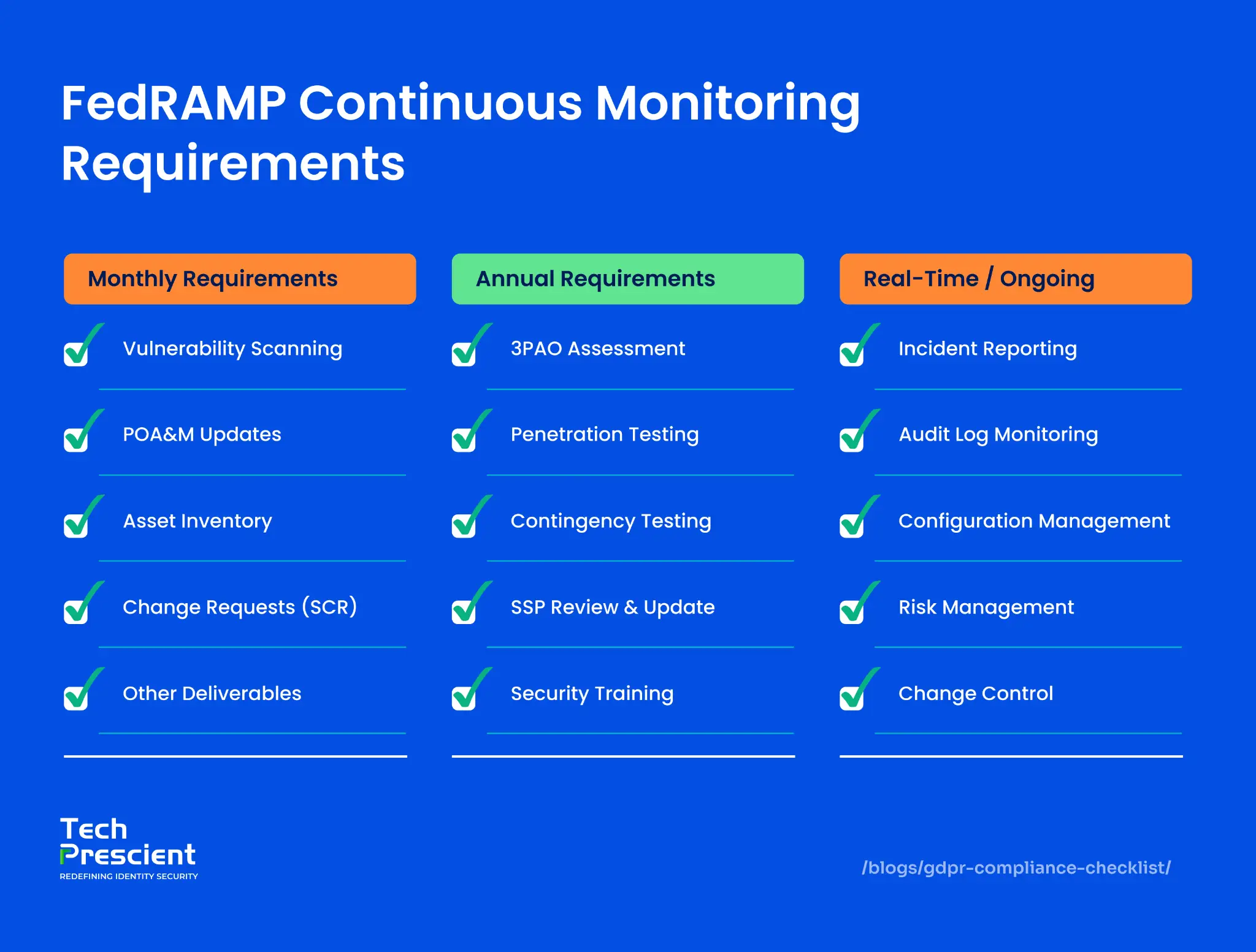
Let's break down the core requirements that support ongoing FedRAMP continuous monitoring.
Monthly Requirements & Deliverables
Monthly reporting forms the foundation of the FedRAMP continuous monitoring program. CSPs are expected to regularly evaluate their environment, document findings, and share updates with authorizing stakeholders.
Key monthly activities commonly include:
- Vulnerability scanning across the full authorization boundary to identify security weaknesses and exposure points.
- Authenticated scans for Moderate and High baselines, providing deeper visibility into system configurations and control effectiveness.
- POA&M updates to document identified issues, remediation status, timelines, and risk ownership.
- Inventory reporting to maintain an accurate record of assets, components, and system changes within scope.
- Security Change Requests (SCRs) for significant modifications that could impact the authorized environment.
These recurring deliverables play a central role in meeting FedRAMP continuous monitoring requirements and supporting ongoing risk management.
Annual Requirements
In addition to monthly obligations, FedRAMP requires periodic validation activities to confirm that controls remain effective over time. Annual reviews provide a deeper assessment of the system's security posture and compliance maturity.
Common annual requirements include:
- Independent assessments by a 3PAO to evaluate selected security controls and validate implementation effectiveness.
- Penetration testing to assess how the environment withstands simulated attack scenarios.
- Incident response and contingency plan testing to verify preparedness for disruptions, cyber incidents, and recovery events.
- System Security Plan (SSP) reviews and updates to ensure documentation reflects the current environment and control landscape.
The scope and depth of these activities can vary based on FedRAMP Moderate requirements or FedRAMP High requirements.
Operational & Real-Time Responsibilities
Some FedRAMP responsibilities extend beyond scheduled reporting cycles and require continuous operational oversight. These activities help organizations respond to issues as they occur and maintain day-to-day compliance.
Key ongoing responsibilities include:
- Timely incident reporting, including notification of significant security events within required reporting windows.
- Audit log monitoring and review to detect suspicious behavior, unauthorized access, or control anomalies
- Change control management to evaluate, approve, and track system modifications that may affect the authorized environment.
Together, these operational practices help CSPs maintain continuous awareness, strengthen security governance, and support sustained compliance across the FedRAMP lifecycle.
Assess your FedRAMP readiness and uncover compliance gaps before audits.
Measure control maturity across documentation, monitoring, and security processes.
FedRAMP Continuous Monitoring Reporting Framework
A core part of FedRAMP continuous monitoring is structured reporting. Cloud Service Providers (CSPs) are expected to submit recurring compliance evidence that gives federal stakeholders clear visibility into security posture, identified risks, remediation progress, and operational changes. These reports help support informed oversight and ongoing authorization decisions.
A typical FedRAMP ConMon reporting framework consists of several key components.
1. Vulnerability and Scan Reports
Security scanning is a foundational reporting requirement within the ConMon process. CSPs must regularly provide scan outputs that highlight vulnerabilities, configuration issues, and potential security gaps across the authorized environment. These reports help Authorizing Officials and program stakeholders understand current risk exposure and track remediation priorities over time.
2. POA&M Tracking and Remediation Updates
The Plan of Action and Milestones (POA&M) serves as a central mechanism for documenting known weaknesses and corrective actions. It typically includes identified findings, remediation timelines, ownership details, and status updates. Maintaining an accurate and up-to-date POA&M helps demonstrate accountability and ongoing risk management.
3. Inventory and Configuration Reporting
FedRAMP reporting also requires visibility into the assets and components operating within the authorization boundary. Inventory reporting helps ensure that hardware, software, and system changes are properly documented and aligned with the approved environment. This supports stronger change management and improves control over compliance scope.
4. Incident Logs and Security Event Reporting
Organizations must maintain and report information related to security incidents, operational disruptions, or significant events affecting the environment. Incident reporting provides transparency into how issues are identified, investigated, and addressed, helping agencies assess response effectiveness and ongoing security readiness.
5. Reporting to Authorizing Stakeholders
ConMon deliverables are typically submitted to oversight parties such as the Authorizing Official (AO), sponsoring agency, or FedRAMP Program Management Office (PMO), depending on the authorization model. Consistent, accurate reporting helps maintain trust, supports compliance validation, and forms an essential part of an effective FedRAMP continuous monitoring strategy guide.
FedRAMP Continuous Monitoring Tools & Solutions
Managing FedRAMP continuous monitoring manually can be resource intensive, especially when organizations must handle recurring scans, remediation tracking, reporting, and audit readiness. This is where technology plays a critical role. The right mix of tools and platforms can help CSPs improve visibility, reduce manual effort, and maintain ongoing compliance more efficiently.
Several categories of FedRAMP continuous monitoring tools are commonly used to support ConMon programs.
1. Vulnerability Scanning Tools
Vulnerability scanners help organizations identify security weaknesses, misconfigurations, and outdated components across their cloud environments. These tools support recurring assessments of the authorized boundary and help teams prioritize remediation activities based on risk severity. For organizations operating under Moderate or High baselines, authenticated scanning capabilities are especially important for deeper system visibility.
2. SIEM and Security Monitoring Platforms
Security Information and Event Management (SIEM) tools help centralize and analyze logs, alerts, and security events from across the environment. They support continuous oversight by enabling real-time monitoring, anomaly detection, audit log analysis, and faster investigation of suspicious activity. These capabilities are valuable for meeting operational monitoring and incident response expectations.
3. Compliance Management Platforms
Compliance platforms help organizations organize compliance workflows, evidence collection, remediation tracking, and reporting processes in one place. Many FedRAMP continuous monitoring software solutions provide dashboards for POA&M management, asset tracking, documentation updates, and recurring deliverables, helping reduce administrative complexity.
4. Benefits of Automation in Continuous Monitoring
Automation can significantly improve the efficiency of a FedRAMP program. Automated scanning, alerting, evidence collection, and reporting workflows help organizations reduce manual tasks, accelerate remediation, and maintain more consistent compliance operations. It also improves visibility into risks and supports faster response to security findings and operational changes.
5. Choosing FedRAMP-Ready Tooling
Not every platform is designed for regulated cloud environments. When evaluating FedRAMP continuous monitoring solutions, organizations should look for capabilities such as continuous security monitoring, reporting support, audit readiness, integration with cloud infrastructure, and alignment with FedRAMP and NIST control expectations. Selecting tools that fit the organization's environment and compliance model can make long-term monitoring more scalable and sustainable.

Pro Tip
Automate Before Reporting Becomes a Bottleneck. If your team is still stitching together scans, POA&M updates, and reports manually, automation can save serious time and reduce compliance fatigue.
How to Build a FedRAMP Continuous Monitoring Strategy
An effective FedRAMP continuous monitoring strategy goes beyond meeting reporting deadlines. It requires a structured approach that combines visibility, ongoing assessment, remediation discipline, and automation. By building repeatable processes around monitoring and reporting, CSPs can strengthen compliance operations and reduce the burden of maintaining authorization.
Here's a practical FedRAMP continuous monitoring strategy guide for building a sustainable ConMon program.
1. Start with a Complete Asset Inventory
A strong monitoring strategy begins with understanding what exists inside the authorized environment. Organizations should maintain an accurate inventory of cloud assets, systems, applications, software, and supporting components within the authorization boundary. Clear asset visibility helps define monitoring scope, supports reporting accuracy, and reduces blind spots.
2. Implement Continuous Scanning and Monitoring
Ongoing security monitoring is essential for identifying vulnerabilities, configuration issues, and emerging threats. Regular vulnerability scans, log monitoring, and security assessments help organizations maintain visibility into the health of their environment. Consistent monitoring also supports faster detection of changes that could impact compliance or security posture.
3. Prioritize Risks Based on Impact
Not every finding carries the same level of urgency. A mature strategy includes a process for evaluating vulnerabilities, control gaps, and operational issues based on severity, business impact, and compliance implications. Risk prioritization helps security teams focus remediation efforts on the issues that pose the greatest threat to security or authorization status.
4. Establish Clear Remediation Workflows
Finding issues is only part of the process; organizations also need a reliable way to resolve them. Defined remediation workflows help assign ownership, track corrective actions, manage timelines, and maintain accountability. Integrating these workflows with POA&M management can improve consistency and provide clearer visibility into remediation progress.
5. Automate Reporting and Compliance Tasks
Manual reporting can quickly become difficult to scale in a continuous monitoring environment. Automation helps streamline activities such as evidence collection, scan aggregation, alerting, dashboard creation, and compliance reporting. Automating repetitive tasks not only reduces operational overhead but also improves reporting consistency and audit readiness.
By combining asset visibility, continuous monitoring, risk-driven remediation, and reporting automation, organizations can build a stronger and more scalable FedRAMP continuous monitoring program.
Identify gaps across NIST controls, SSP readiness, and continuous monitoring.
Build measurable, audit-ready visibility into your FedRAMP compliance posture.
FedRAMP 20x & The Future of Continuous Monitoring
FedRAMP's approach to continuous monitoring is evolving. With the emergence of FedRAMP 20x, the focus is shifting toward faster, more automated, and more scalable compliance practices. The goal is to reduce manual overhead, improve transparency, and enable cloud providers and federal stakeholders to work from more continuous and data-driven security assurance models.
This evolution is reshaping how organizations approach FedRAMP continuous monitoring.
1. A More Collaborative Monitoring Model
Traditional compliance processes often rely on periodic reviews and document-heavy workflows. Emerging FedRAMP models are moving toward a more collaborative approach where cloud providers, agencies, and oversight stakeholders share clearer visibility into security posture, risks, and remediation activities. This model aims to improve coordination while reducing friction in ongoing compliance management.
2. Changes in Reporting Expectations
FedRAMP modernization efforts are also influencing reporting practices. Instead of relying exclusively on traditional reporting cycles, there is growing emphasis on more streamlined, data-driven reporting approaches that can provide stakeholders with timely operational insight. The direction points toward reducing reporting complexity while maintaining strong security oversight.
3. Faster Vulnerability Remediation Timelines
Another notable shift is the increasing focus on accelerated remediation. Shorter turnaround expectations for addressing vulnerabilities encourage organizations to move from reactive fixes to faster, more operationalized response processes. This places greater importance on continuous visibility, prioritization, and well-defined remediation workflows.
4. Automation-First Compliance
Automation is expected to play a much larger role in the future of FedRAMP compliance. Automated scanning, evidence collection, control validation, and reporting workflows can help organizations maintain compliance with greater efficiency and consistency. As compliance environments become more dynamic, automation-first approaches are likely to become a foundational part of scalable continuous monitoring programs.
For CSPs, the future of FedRAMP continuous monitoring is increasingly centered on continuous assurance, operational agility, and automation-driven compliance management. Organizations that invest early in modern monitoring and reporting practices may be better positioned to adapt as the framework continues to evolve.
Common Challenges in FedRAMP Continuous Monitoring
While FedRAMP continuous monitoring is essential for maintaining compliance and authorization, executing it consistently can be challenging. Many Cloud Service Providers (CSPs) must manage recurring assessments, reporting obligations, remediation timelines, and operational monitoring simultaneously. Without the right processes and tooling, maintaining an effective ConMon program can become difficult to scale.
Below are some of the most common obstacles organizations encounter.
High Manual Reporting Effort
FedRAMP requires frequent submission of scans, remediation updates, inventories, and other compliance deliverables. When these activities depend heavily on spreadsheets, disconnected workflows, or manual evidence gathering, they can consume significant time and resources. This administrative burden can slow down compliance operations and increase the risk of reporting errors or missed deadlines.
Disconnected Security and Compliance Tools
Many organizations rely on multiple platforms for scanning, logging, ticketing, asset tracking, and compliance management. When these tools operate in isolation, teams may struggle to consolidate findings, maintain consistent data, or gain a unified view of security posture. Tool fragmentation can also make reporting and remediation coordination more complex.
Slow Remediation Processes
Identifying vulnerabilities is only one part of continuous monitoring; resolving them efficiently is equally important. Delays in assigning ownership, prioritizing findings, or tracking corrective actions can extend remediation timelines and increase exposure to risk. Without clearly defined workflows, organizations may find it difficult to keep pace with ongoing compliance expectations.
Limited Visibility into Security Posture
Continuous monitoring depends on timely, accurate insight into assets, vulnerabilities, changes, and operational risks. Incomplete inventories, inconsistent monitoring coverage, or limited reporting visibility can create blind spots within the environment. These gaps make it harder for organizations to detect issues early, measure compliance status, and make informed risk decisions.
Addressing these challenges often requires a combination of stronger governance, integrated tooling, clearer workflows, and increased automation to support a more sustainable continuous monitoring program.
Best Practices to Maintain Continuous Compliance
Maintaining FedRAMP continuous compliance requires more than completing scheduled monitoring tasks. Organizations need consistent processes, operational discipline, and strong visibility across their cloud environments to keep security controls effective over time. Adopting the right practices can help reduce compliance fatigue, improve responsiveness, and strengthen long-term authorization readiness.
Here are some practical approaches for sustaining an effective continuous monitoring program.
1. Automate Reporting and Routine Compliance Tasks
Recurring activities such as evidence collection, scan aggregation, status tracking, and report preparation can quickly become time-consuming when handled manually. Automating these workflows helps reduce administrative overhead, improve consistency, and support faster reporting cycles. It also allows security and compliance teams to spend more time on analysis and remediation rather than repetitive operational work.
2. Centralize Risk and Compliance Visibility
Continuous monitoring is more effective when teams can view risks, findings, and compliance status in one place. Consolidating information from scanning tools, monitoring platforms, asset inventories, and remediation workflows helps organizations gain a clearer picture of their security posture. Centralized visibility also improves decision-making and makes it easier to track progress across the environment.
3. Establish and Enforce Remediation SLAs
Clear remediation expectations are essential for keeping vulnerabilities and control gaps under control. Organizations should define service level agreements (SLAs) based on issue severity, risk impact, and compliance priorities. Enforcing remediation timelines helps maintain accountability, supports timely corrective action, and reduces the likelihood of unresolved findings accumulating over time.
4. Conduct Ongoing Reviews and Internal Audits
Continuous compliance benefits from regular validation, not just periodic assessments. Internal reviews, control checks, and audit activities help organizations verify that monitoring processes, security controls, and documentation remain aligned with current requirements. These evaluations can also uncover gaps early, enabling teams to address issues before they affect compliance or authorization status.
By combining automation, centralized oversight, disciplined remediation, and recurring validation, organizations can build a more resilient and sustainable approach to FedRAMP continuous monitoring and long-term compliance maintenance.
Quick Win
Centralize Your Compliance Visibility. Pulling data from disconnected tools slows down remediation. A unified view of risks, assets, and findings makes ConMon far easier to manage.
Final Thoughts
FedRAMP continuous monitoring requirements play a critical role in maintaining cloud security, ongoing compliance, and Authority to Operate (ATO) readiness. Through continuous assessments, structured reporting, risk remediation, and operational oversight, organizations can sustain a strong security posture and meet evolving federal expectations.
Tech Prescient helps organizations simplify FedRAMP continuous monitoring through identity governance, automated access controls, compliance visibility, and audit-ready reporting across complex cloud environments.
FAQs
FedRAMP continuous monitoring requirements include the ongoing security and compliance activities organizations must perform after receiving an Authority to Operate (ATO). These typically include vulnerability scanning, POA&M updates, incident reporting, inventory management, and annual assessments. The goal is to ensure security controls remain effective and the cloud environment stays compliant over time.
FedRAMP ConMon reports are generally submitted on a monthly basis, although some requirements follow annual or event-driven timelines. Monthly deliverables often include scan results, POA&M updates, and inventory reports, while incidents, major changes, or assessments may trigger additional reporting obligations.
A typical FedRAMP ConMon package contains documentation that demonstrates ongoing security and remediation efforts. This commonly includes vulnerability scan reports, POA&M updates, inventory reports, incident logs, and change requests. These deliverables help Authorizing Officials and oversight teams monitor risk and compliance status.
Organizations typically rely on a combination of vulnerability scanners, SIEM platforms, and compliance automation tools for FedRAMP continuous monitoring. These tools help with activities such as security monitoring, audit log analysis, risk tracking, reporting, and evidence collection. The right tooling can also reduce manual effort and improve compliance visibility.
Failing to meet FedRAMP continuous monitoring requirements can create compliance gaps and increase security risk. Depending on the severity of the issue, organizations may face remediation actions, heightened scrutiny from federal stakeholders, or even loss of their ATO, which can impact eligibility for federal business opportunities.
Share



Yatin Laygude
Content Writer
A content writer with 6 years of experience turning complex topics into clear, engaging, and meaningful content. From blogs and web pages to whitepapers and thought pieces, he creates content that not only explains but also connects with both the audience and business goals.
Most Popular Blogs
Identity Security· 21 min read
Data Access Governance Solutions: How to Secure Sensitive Data at Scale
Compare data access governance solutions for 2026: how DAG platforms discover sensitive data, run access reviews, automate remediation, and prove compliance.
Brinda Bhatt· September 7, 2026
Identity Security· 24 min read
What Is Zero Trust Network Access (ZTNA)?
Learn what Zero Trust Network Access (ZTNA) is, how it works, and why it’s replacing VPNs for secure, identity-based access control.
Yatin Laygude· August 14, 2026
Identity Security· 24 min read
Cyber Essentials Certification: Complete Guide
Learn Cyber Essentials certification, cost, requirements, and steps. Compare Cyber Essentials vs Plus and get certified faster.
Yatin Laygude· August 10, 2026