




On this page
See Tech Prescient in Action
Automate access, reduce risk, and stay audit-ready
The General Data Protection Regulation (GDPR) reshaped how organizations handle personal data, pushing businesses to rethink privacy, security, and trust. Its seven core principles form the foundation of ethical data processing, guiding how data is collected, used, and protected. These principles are not just legal requirements but define modern data governance. For any organization dealing with EU data, they are essential to long-term compliance.
Understanding the principles of GDPR helps organizations move beyond checkbox compliance toward building transparent and accountable systems. From limiting unnecessary data collection to enforcing strong access controls, these principles influence every stage of the data lifecycle. When implemented effectively, they reduce risk, improve security, and strengthen customer trust. In today's digital economy, they are central to responsible data practices.
According to the European Commission, GDPR violations can result in fines of up to €20 million or 4% of global annual turnover, whichever is higher. Additionally, a Cisco Data Privacy Benchmark study found that over 90% of organizations report measurable business benefits from strong privacy practices, including increased customer trust and reduced breaches. These numbers highlight why GDPR principles are critical and not optional for modern businesses.
Let's explore the 7 GDPR principles in detail and see how organizations can apply them in practice to achieve compliance, strengthen security, and build lasting trust.
Key Takeaways:
- GDPR is built on seven core principles that define how organizations must handle personal data.
- These principles guide the entire data lifecycle, from collection and usage to storage and deletion.
- They ensure personal data is processed lawfully, securely, and with full transparency.
- Organizations are required to demonstrate accountability through policies, controls, and audits.
- Identity governance and access controls help enforce these principles at scale and reduce compliance risk.
What Are the GDPR Principles?
The GDPR principles are seven foundational rules defined in Article 5 of the General Data Protection Regulation (GDPR). They guide how organizations process and protect personal data in a lawful, secure, and transparent way. These principles apply to both data controllers and data processors and are legally binding for any organization handling the personal data of EU individuals. Together, they form the foundation of responsible data governance, ensuring privacy, accountability, and compliance across the entire data lifecycle.
These seven principles work together as a unified framework that governs every stage of data processing, from collection to storage and security. Below is a quick overview of each principle:
1. Lawfulness, Fairness, and Transparency
Personal data must be processed legally, fairly, and in a transparent manner, with clear communication to individuals about how their data is used.
2. Purpose Limitation
Data should be collected for specific, explicit, and legitimate purposes and not used for activities beyond those purposes.
3. Data Minimization
Organizations must collect only the data that is necessary for a defined purpose, avoiding excessive or irrelevant data collection.
4. Accuracy
Personal data must be kept accurate and up to date, with mechanisms in place to correct or delete incorrect information.
5. Storage Limitation
Data should be retained only for as long as necessary and securely deleted or anonymized when no longer needed.
6. Integrity and Confidentiality
Organizations must protect personal data through appropriate security measures such as encryption, access controls, and monitoring.
7. Accountability
Organizations are responsible for demonstrating compliance with GDPR through policies, documentation, and audit mechanisms.
Are you confident your GDPR controls will stand up to an audit?
A structured framework to map GDPR principles to controls and measure compliance maturity.
Why Are GDPR Principles Important for Data Protection?
The GDPR principles create a structured framework for protecting personal data while giving individuals greater control over how their information is used. Beyond avoiding penalties of up to €20 million or 4% of global annual turnover, they help organizations ensure lawful processing, reduce breach risks, and maintain audit readiness. These principles also strengthen transparency, build customer trust, and align businesses with global data protection standards, making them essential for sustainable and responsible data governance.
These principles not only define compliance requirements but also drive practical security and governance outcomes across organizations:
1. Protects Individual Privacy Rights
GDPR principles ensure that personal data is handled with transparency and fairness, giving individuals control over how their data is collected, used, and shared.
2. Creates Global Data Protection Standards
They establish a consistent framework that organizations can follow to align with international privacy regulations and industry expectations.
3. Reduces Data Breach Risks
By enforcing data minimization, security controls, and proper data handling practices, these principles help lower the likelihood of data exposure and breaches.
4. Ensures Compliance and Audit Readiness
Organizations can demonstrate accountability through documented policies, audit logs, and continuous monitoring aligned with GDPR requirements.
5. Supports Identity Governance and Access Control
Access governance prevents overexposed data, identity lifecycle management enforces data minimization, and access reviews ensure accountability and compliance.
The 7 GDPR Principles Explained
The following seven principles form the foundation of GDPR data protection and privacy compliance. Together, they guide how organizations collect, process, secure, and govern personal data across their entire lifecycle.
Lawfulness, Fairness, and Transparency
Organizations must process personal data on a valid legal basis such as consent, contract fulfillment, legal obligation, legitimate interests, public task, or vital interests. Processing must be fair, meaning it should not mislead or harm individuals, and transparent, with clear communication about how and why data is used. This is typically achieved through accessible privacy policies and notices.
Example: A website clearly explaining cookie tracking and data usage before collecting user data.
Purpose Limitation
Personal data must be collected for specific, explicit, and legitimate purposes and used only within those defined boundaries. Organizations must clearly state these purposes at the time of data collection and avoid secondary usage unless additional consent or a valid legal basis exists.
Example: An email collected for a newsletter cannot be reused for advertising without consent.
Data Minimization
Organizations should collect only the minimum personal data necessary to achieve a defined purpose. Excessive or irrelevant data collection increases risk and complicates compliance. Limiting data collection helps reduce exposure and improves data management efficiency.
Identity governance supports this by enforcing controlled access and role-based access, ensuring users only access what is required.
Quick Insight
Data minimization is not just about collection, it's about continuous access control. Limiting who can access data is just as critical as limiting what you collect.
Accuracy
Personal data must be accurate and kept up to date. Organizations are responsible for implementing mechanisms that allow individuals to correct or update their data and for regularly monitoring data quality.
Example: Customer portals that allow users to update their profile information.
Storage Limitation
Personal data should be retained only for as long as necessary for its intended purpose. Organizations must define data retention policies and implement processes for secure deletion or anonymization once data is no longer required, while also considering legal retention requirements.
Integrity and Confidentiality (Security)
Organizations must ensure the security of personal data by protecting it from unauthorized access, breaches, or accidental loss. This requires both technical and organizational measures such as encryption, access controls, multi-factor authentication, and monitoring systems.
Identity governance strengthens this principle through least privilege access, access reviews, and zero trust verification.
Accountability
Organizations must be able to demonstrate compliance with all GDPR principles. This includes maintaining documentation, audit logs, and policies, and in some cases appointing a Data Protection Officer (DPO). Regulators may request evidence at any time, making accountability a continuous requirement.
Identity governance platforms support this through access certification reviews, compliance reporting, and identity lifecycle governance.
How Organizations Implement GDPR Principles in Practice
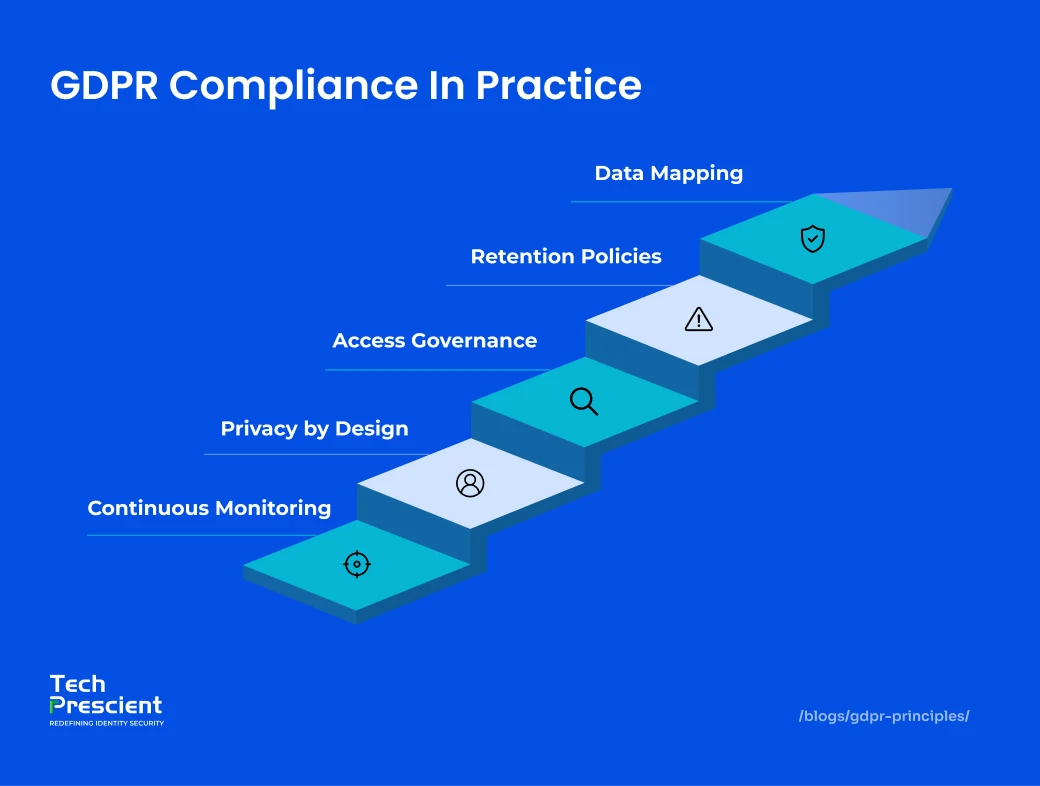
Organizations translate GDPR principles into action by embedding them into governance frameworks, security controls, and everyday data management processes. This means moving beyond policy documents and ensuring that data protection is actively enforced across systems, workflows, and teams. By aligning operations with GDPR requirements, businesses can manage personal data more responsibly while maintaining continuous compliance.
To do this effectively, organizations follow a structured approach that turns regulatory requirements into practical implementation steps:
1. Conduct Data Mapping
Organizations begin by identifying what personal data they collect, where it resides, and how it flows across systems, applications, and third parties. Creating a clear data inventory and mapping data flows helps uncover risks, establish legal bases for processing, and support regulatory reporting and user rights requests.
Best Practice
Map your data flows early and revisit them regularly. As systems evolve, outdated data mapping becomes a major compliance risk.
2. Define Data Retention Policies
To meet storage limitation requirements, organizations establish clear retention timelines for different types of data. This includes defining how long data should be stored, when it should be deleted or anonymized, and implementing automated processes to enforce these policies consistently.
3. Implement Access Governance
Controlling access to personal data is essential for reducing exposure. Organizations enforce role-based access controls, apply the principle of least privilege, and monitor user activity to ensure only authorized individuals can access sensitive information. Regular access reviews and audit logs further strengthen accountability.
4. Enable Privacy by Design
GDPR requires privacy to be integrated into systems and processes from the outset. Organizations adopt a privacy-by-design and by-default approach, ensuring that data protection measures such as minimal data collection, secure configurations, and built-in safeguards are part of the development and operational lifecycle.
5. Monitor Compliance Continuously
Compliance is not a one-time effort but an ongoing process. Organizations continuously monitor their data practices through audits, reporting, and risk assessments. Maintaining documentation, tracking processing activities, and regularly updating policies help ensure sustained compliance as business and regulatory environments evolve.

Pro Tip
Automate access reviews and identity lifecycle management to enforce least privilege at scale. This reduces manual effort while strengthening GDPR accountability.
Common Challenges in Applying GDPR Principles
Applying GDPR principles in real-world environments is often more complex than it appears on paper. Organizations struggle with fragmented systems, unclear data ownership, and evolving access risks across cloud and hybrid infrastructures. As data volumes grow and compliance expectations increase, maintaining visibility, control, and accountability becomes a continuous challenge rather than a one-time effort.
These challenges typically fall into a few key areas that directly impact GDPR compliance:
1. Data Sprawl Across Systems
Personal data is often scattered across multiple environments such as cloud platforms, SaaS applications, emails, and file shares. This data sprawl makes it difficult to track where sensitive information resides and apply consistent security controls. As a result, organizations may lose visibility and fail to enforce GDPR requirements effectively.
2. Lack of Visibility into Access Rights
Many organizations lack a centralized view of who has access to what data. Without clear visibility into user identities and permissions, it becomes difficult to enforce least privilege or detect unauthorized access. This gap creates compliance risks, especially during audits or breach investigations.
3. Over-Permissioned Users
Users often accumulate excessive access rights over time, especially in dynamic environments. These over-permissioned accounts increase the risk of data exposure and insider threats, making it harder to meet GDPR principles like data minimization and integrity.
4. Manual and Inefficient Compliance Processes
Many organizations still rely on manual workflows for managing consent, handling data subject requests, and maintaining records of processing. These processes are time-consuming, error-prone, and difficult to scale, leading to delays and compliance gaps.
Expert Insight
Most GDPR failures don't come from lack of policies but from poor visibility into data access. Centralized identity governance is key to closing this gap.
How Identity Governance Solves These Challenges
Identity governance platforms address these issues by bringing visibility, control, and automation into data access and compliance processes:
- Centralized visibility into users, roles, and access rights helps organizations understand who can access sensitive data.
- Least privilege enforcement ensures users only have access to the data necessary for their role, reducing overexposure.
- Automated access reviews and certifications improve accountability and make audits easier.
- Continuous monitoring and policy enforcement help detect risks in real time and maintain compliance across systems.
By integrating identity governance into their security strategy, organizations can overcome these challenges and enforce GDPR principles more effectively at scale.
How Identity Governance Helps Enforce GDPR Principles
Identity governance plays a critical role in turning GDPR principles into enforceable controls across an organization. While GDPR defines how personal data should be handled, identity governance ensures that only the right individuals have access to that data, at the right time, and for the right purpose. By combining visibility, automation, and policy enforcement, it helps organizations reduce risk, strengthen security, and demonstrate continuous compliance.
Below is how key GDPR principles align with identity governance capabilities:
| Sr. No | GDPR Principle | Identity Governance Role |
|---|---|---|
| 1 | Data Minimization | Restricts access to only necessary data using least privilege and role-based access controls. |
| 2 | Integrity & Confidentiality | Enforces strong access controls, authentication, and monitoring to prevent unauthorized access. |
| 3 | Accountability | Maintains audit logs, access reviews, and compliance reports for regulatory evidence. |
| 4 | Accuracy | Supports automated identity lifecycle processes to keep user data and access rights up to date. |
| 5 | Storage Limitation | Enables data lifecycle governance by removing or adjusting access as data becomes obsolete. |
In practice, identity governance solutions help organizations continuously monitor access, detect anomalies, and enforce policies aligned with GDPR requirements. Capabilities such as access certification, role management, and identity lifecycle automation ensure that permissions remain accurate and up to date over time.
By integrating identity governance into their compliance strategy, organizations can move beyond static controls and establish a dynamic, audit-ready approach to enforcing GDPR principles across their entire data ecosystem.
Do you know if your access controls truly align with GDPR principles?
A structured framework to map GDPR principles to controls and measure compliance maturity.
Final Thoughts
The GDPR principles establish a clear framework for handling personal data through transparency, accountability, and security. By defining how data should be collected, processed, and protected, they help organizations reduce risk, strengthen governance, and ensure consistent compliance across systems.
Tech Prescient helps organizations implement identity governance, enforce least-privilege access, and operationalize GDPR compliance across complex digital environments.
FAQs
The seven GDPR principles define how personal data should be handled responsibly. They include lawfulness, fairness and transparency; purpose limitation; data minimization; accuracy; storage limitation; integrity and confidentiality; and accountability. Together, they form the foundation of GDPR compliance and data protection.
GDPR is built on seven core principles that guide data processing and protection. These principles apply across the entire data lifecycle, from collection to deletion. They act as a framework for ensuring privacy, security, and regulatory compliance.
GDPR principles ensure that personal data is processed lawfully, securely, and transparently. They help organizations reduce risks like data breaches while protecting individuals' privacy rights. At the same time, they build trust and support long-term compliance.
Any organization that processes personal data of EU residents must follow GDPR principles, regardless of where the organization is located. This applies to both data controllers and processors. If you handle EU data, GDPR compliance is mandatory.
The accountability principle requires organizations to demonstrate compliance with GDPR at all times. This includes maintaining policies, documentation, audit logs, and implementing security controls. It ensures organizations are not just compliant, but can prove it when required.
Share



Yatin Laygude
Content Writer
A content writer with 6 years of experience turning complex topics into clear, engaging, and meaningful content. From blogs and web pages to whitepapers and thought pieces, he creates content that not only explains but also connects with both the audience and business goals.
Most Popular Blogs
Identity Security· 21 min read
Data Access Governance Solutions: How to Secure Sensitive Data at Scale
Compare data access governance solutions for 2026: how DAG platforms discover sensitive data, run access reviews, automate remediation, and prove compliance.
Brinda Bhatt· September 7, 2026
Identity Security· 24 min read
What Is Zero Trust Network Access (ZTNA)?
Learn what Zero Trust Network Access (ZTNA) is, how it works, and why it’s replacing VPNs for secure, identity-based access control.
Yatin Laygude· August 14, 2026
Identity Security· 24 min read
Cyber Essentials Certification: Complete Guide
Learn Cyber Essentials certification, cost, requirements, and steps. Compare Cyber Essentials vs Plus and get certified faster.
Yatin Laygude· August 10, 2026