




On this page
See Tech Prescient in Action
Automate access, reduce risk, and stay audit-ready
A HIPAA compliance checklist helps healthcare organizations and business associates systematically protect patient data, reduce security risks, and meet regulatory requirements under HIPAA. From administrative safeguards to technical controls, a structured checklist makes it easier to stay audit-ready and maintain long-term compliance.
In this guide, we'll break down HIPAA Privacy, Security, and Breach Notification requirements into actionable checklist sections covering IT systems, software security, access governance, vendor management, and ePHI protection.
Key Takeaways
- Covers HIPAA Privacy, Security, and Breach Notification Rules
- Includes IT, software, and security-specific checklist items
- Helps improve audit readiness and risk management
- Supports ePHI protection across healthcare environments
- Useful for covered entities and business associates
What Is a HIPAA Compliance Checklist?
A HIPAA compliance checklist is a structured set of security, privacy, and operational requirements that helps organizations meet HIPAA Privacy, Security, and Breach Notification standards. A compliance checklist is essentially a practical framework organizations use to evaluate whether their policies, systems, processes, and security controls align with HIPAA regulations for protecting protected health information (PHI) and electronic protected health information (ePHI).
Rather than approaching compliance as a one-time audit exercise, organizations use checklists to continuously monitor gaps, track remediation efforts, and maintain ongoing compliance readiness.
Why HIPAA Compliance Checklists Matter
HIPAA regulations contain multiple administrative, technical, and physical safeguard requirements that can be difficult to manage without a structured approach.
A checklist helps organizations:
- Identify compliance gaps
- Standardize security practices
- Maintain documentation consistency
- Improve audit preparedness
- Reduce regulatory risk
- Strengthen ePHI protection
Without a centralized compliance process, healthcare organizations often struggle with inconsistent access controls, missing audit documentation, weak vendor oversight, or incomplete risk assessments. A structured checklist turns complex HIPAA requirements into actionable operational tasks that security, compliance, and IT teams can manage more effectively.
Move Beyond HIPAA Documentation
Operationalize access governance and audit-ready enforcement
Who Needs a HIPAA Compliance Checklist?
HIPAA compliance requirements apply to both covered entities and business associates that handle protected health information.
Covered entities typically include:
- Healthcare providers
- Hospitals and clinics
- Health insurance companies
- Healthcare clearinghouses
Business associates include third-party organizations that process, store, transmit, or access PHI on behalf of covered entities. This may include:
- SaaS vendors
- Cloud providers
- Billing companies
- IT service providers
- Healthcare software platforms
- Managed service providers
Because healthcare ecosystems increasingly rely on cloud services, APIs, remote access, and third-party integrations, HIPAA compliance now extends far beyond traditional healthcare organizations alone.
What a HIPAA Checklist Typically Covers
A HIPAA compliance checklist generally maps requirements across three major regulatory areas:
- Privacy safeguards
- Security safeguards
- Breach notification obligations
These checklists often include controls related to:
- Access management
- Encryption
- Workforce training
- Risk assessments
- Audit logging
- Incident response
- Vendor compliance
- Business Associate Agreements (BAAs)
Modern HIPAA programs also increasingly incorporate identity governance, MFA enforcement, and continuous access monitoring to strengthen healthcare security posture.
How Checklists Reduce Audit Risk
One of the biggest benefits of a HIPAA compliance checklist is improved audit readiness.
HIPAA audits and investigations often focus heavily on whether organizations can demonstrate:
- Documented policies
- Ongoing risk assessments
- Access governance controls
- Employee training records
- Audit logs and monitoring
- Breach response procedures
Organizations that rely on informal or inconsistent compliance processes may struggle to provide evidence during audits or incident investigations. A structured checklist creates accountability, improves visibility into compliance gaps, and helps organizations maintain continuous rather than reactive compliance practices.
HIPAA Compliance Is Ongoing
HIPAA compliance is not a one-time certification. Organizations must continuously review, update, and improve their security and privacy controls as systems, threats, and operational environments evolve.
This is especially important in modern healthcare ecosystems where:
- Cloud applications are widely used
- Remote access is common
- Third-party vendors handle ePHI
- APIs exchange healthcare data
- Cyberattacks increasingly target healthcare organizations
A well-maintained HIPAA compliance checklist helps organizations adapt to these changes while maintaining stronger long-term security governance.
HIPAA Compliance Requirements Checklist (Core Rules)
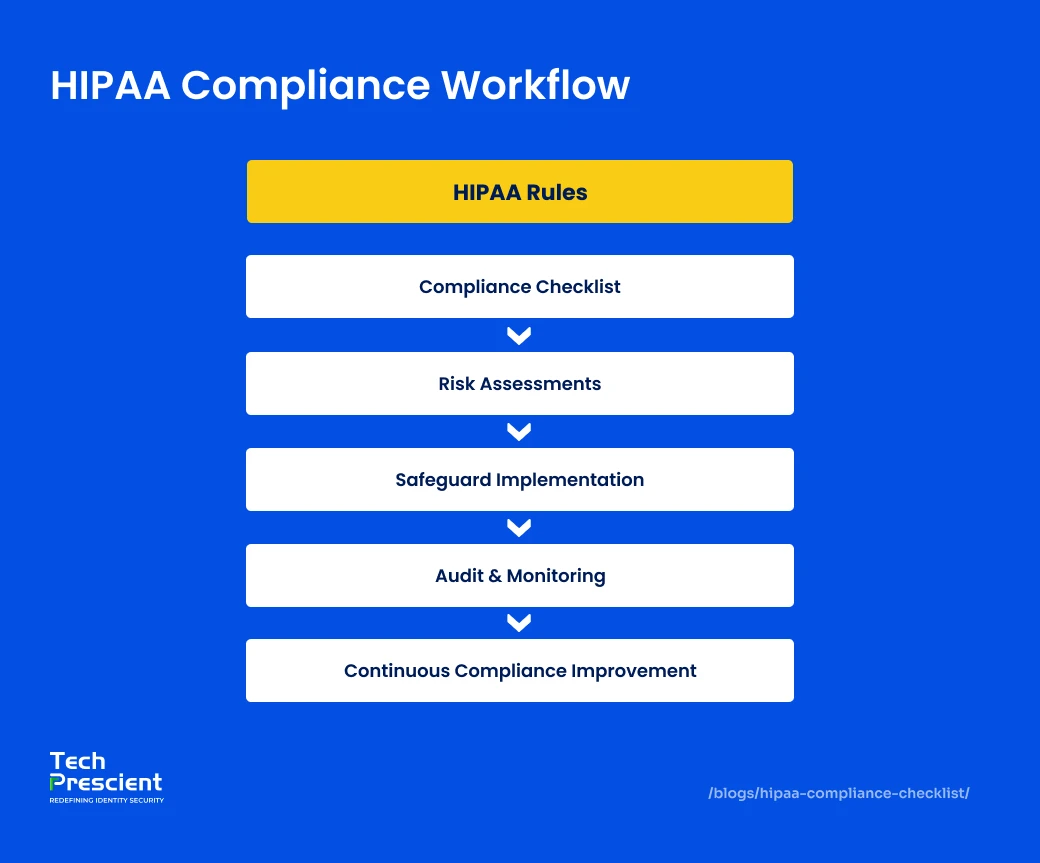
HIPAA compliance is built around three core rules: the Privacy Rule, Security Rule, and Breach Notification Rule. Together, these rules define how organizations protect, manage, and report incidents involving PHI and ePHI. A strong HIPAA compliance requirements checklist helps healthcare organizations translate these regulatory requirements into actionable security, governance, and audit practices.
Privacy Rule Checklist
The HIPAA Privacy Rule governs how protected health information (PHI) is used, shared, and accessed. Its primary focus is protecting patient privacy while ensuring patients maintain rights over their healthcare data.
Organizations must enforce minimum necessary access, meaning users should only access the information required for their role. They must also support patient rights such as record access, correction requests, and privacy disclosures through a Notice of Privacy Practices (NPP). Role-based access controls and identity governance are commonly used to enforce Privacy Rule requirements consistently.
Security Rule Checklist
The HIPAA Security Rule focuses on protecting electronic protected health information (ePHI) through administrative, physical, and technical safeguards.
Organizations are expected to implement controls such as:
- Risk assessments and mitigation
- Workforce security policies
- Encryption and secure transmission
- Access controls and MFA
- Audit logging and monitoring
Continuous risk analysis is a core requirement because HIPAA expects organizations to regularly identify and address security vulnerabilities.
Breach Notification Rule Checklist
The Breach Notification Rule defines how organizations must respond when PHI is exposed or compromised. Organizations must notify affected individuals without unreasonable delay and generally within 60 days of discovering a breach. Depending on the severity of the incident, reporting to the U.S. Department of Health and Human Services (HHS) may also be required.
To support compliance, organizations should maintain:
- Incident response procedures
- Breach investigation workflows
- Audit logs and monitoring
- Documentation for reporting and remediation
| HIPAA Rule | Primary Focus | Example Requirements |
|---|---|---|
| Privacy Rule | Patient data usage and disclosure | Minimum necessary access, patient rights |
| Security Rule | Protection of ePHI | Encryption, MFA, audit logging |
| Breach Notification Rule | Incident response and reporting | 60-day notification, HHS reporting |
Expert Insight:
Many HIPAA failures occur because organizations treat privacy, security, and incident response separately instead of managing them as part of one continuous compliance program.
Administrative Safeguards Checklist
Administrative safeguards focus on the policies, governance processes, workforce controls, and risk management practices required to protect electronic protected health information (ePHI). Under the HIPAA Security Rule, administrative safeguards form the operational foundation of compliance. They help organizations define how healthcare data is managed, who is responsible for protecting it, and how security risks are identified and mitigated over time.
Strong administrative safeguards are essential because many HIPAA violations stem from weak governance, inconsistent access management, inadequate training, or poor documentation practices rather than purely technical failures.
1. Assign Privacy and Security Officers
Organizations should formally assign individuals responsible for overseeing HIPAA privacy and security programs.
These roles typically manage:
- Compliance oversight
- Risk management initiatives
- Policy enforcement
- Workforce security coordination
- Incident response governance
Clear ownership improves accountability and helps ensure HIPAA requirements are monitored consistently across departments and systems.
2. Conduct Regular Risk Assessments
HIPAA requires organizations to regularly identify and evaluate risks that could affect the confidentiality, integrity, or availability of ePHI.
Risk assessments should review:
- Access control weaknesses
- System vulnerabilities
- Third-party risks
- Insider threat exposure
- Data handling processes
- Cloud and remote access environments
Organizations are also expected to document mitigation efforts and continuously address identified security gaps.
3. Implement Workforce Training Programs
Employees remain one of the biggest sources of HIPAA-related risk, making security awareness and compliance training critical.
Training programs should educate workforce members on:
- Handling PHI securely
- Recognizing phishing attacks
- Password and MFA practices
- Reporting security incidents
- Access control responsibilities
Regular training helps reduce accidental disclosures, credential compromise, and non-compliant data handling practices.
4. Maintain Policy Documentation
HIPAA requires organizations to maintain documented policies, procedures, and compliance evidence.
This documentation often includes:
- Access management policies
- Incident response procedures
- Workforce security guidelines
- Vendor management practices
- Risk assessment records
- Audit and monitoring processes
Well-maintained documentation improves audit readiness and demonstrates ongoing compliance efforts during investigations or assessments.
5. Establish Contingency and Recovery Plans
Organizations must prepare for events that could disrupt access to ePHI, including cyberattacks, outages, natural disasters, or system failures.
Contingency planning should address:
- Data backup procedures
- Disaster recovery plans
- Emergency access processes
- System restoration workflows
- Business continuity planning
Healthcare organizations are expected to maintain availability of critical systems even during security incidents or operational disruptions.
Expert Insight:
Many HIPAA audit failures originate from weak governance processes such as inconsistent access reviews, incomplete documentation, or inadequate workforce training, not just missing technical controls.
Physical Safeguards Checklist
Physical safeguards protect the facilities, systems, devices, and media that store or access protected health information (PHI) and electronic protected health information (ePHI).
The HIPAA Security Rule requires organizations to secure physical access to healthcare environments and prevent unauthorized individuals from accessing sensitive systems or patient data. While many organizations focus heavily on digital security, physical security controls remain equally important for maintaining HIPAA compliance.
A strong HIPAA computer compliance checklist should include controls for facilities, workstations, devices, and physical media handling.
1. Facility Access Controls
Healthcare organizations must restrict physical access to locations where PHI or ePHI is stored, processed, or accessed.
This includes securing:
- Data centers
- Server rooms
- Administrative offices
- Clinical workspaces
- Records storage areas
Organizations should implement controlled entry mechanisms such as badge access, visitor logs, surveillance systems, and restricted access zones to reduce the risk of unauthorized physical access. Emergency access procedures should also be documented to ensure authorized personnel can access critical systems during operational disruptions.
2. Workstation Security
Workstations used to access patient records or healthcare systems must be physically secured to prevent unauthorized viewing or misuse.
Organizations should establish policies for:
- Screen locking and session timeouts
- Secure workstation placement
- Shared device usage controls
- Remote work device security
- Portable laptop protection
Healthcare environments often involve shared workstations and high user mobility, making workstation governance especially important for protecting patient data confidentiality.
3. Device and Media Controls
Devices and storage media containing PHI must be tracked, secured, and managed throughout their lifecycle.
This includes:
- Laptops and desktops
- External drives and USB devices
- Backup media
- Mobile devices
- Printed records containing PHI
Organizations should maintain inventory controls, device tracking procedures, and secure transport processes for systems or media that contain sensitive healthcare data. Encryption is also commonly used to reduce exposure if devices are lost or stolen.
4. Secure Disposal Practices
HIPAA requires organizations to properly dispose of devices and media containing PHI to prevent unauthorized data recovery. Improper disposal remains a common compliance gap, especially when organizations retire hardware, replace systems, or discard storage media without secure sanitization.
Secure disposal practices may include:
- Data wiping and destruction
- Physical shredding of drives or documents
- Certified disposal processes
- Media sanitization verification
Organizations should also maintain disposal records for audit and compliance purposes.
Technical Safeguards Checklist (IT & Security Focus)
Technical safeguards protect electronic protected health information (ePHI) by securing access, encrypting data, and continuously monitoring healthcare IT systems for unauthorized activity.
The HIPAA Security Rule requires organizations to implement technical controls that ensure ePHI remains confidential, secure, and accessible only to authorized users. A strong HIPAA compliance IT checklist helps healthcare organizations establish secure identity management, protect sensitive data, and maintain audit visibility across systems and applications. As healthcare environments become more cloud-connected and API-driven, technical safeguards now play a central role in modern compliance checklist programs.
1. Access Control Checklist
Access controls ensure that only authorized users can access systems containing PHI or ePHI.
Organizations should implement unique user IDs so every user action can be individually tracked and audited. Shared accounts create visibility gaps and increase compliance risk. Role-based access control (RBAC) is also critical because it limits access according to job responsibilities. For example, clinical staff, billing teams, and administrators should only access the systems and records necessary for their role.
Multi-factor authentication (MFA) adds another important security layer by reducing the risk of unauthorized access caused by stolen credentials or phishing attacks. MFA is especially important for:
- Remote access
- Cloud applications
- Administrative accounts
- Privileged systems
Strong access governance reduces excessive permissions and supports least-privilege enforcement across healthcare environments.
2. Data Protection Checklist
HIPAA requires organizations to protect ePHI both when stored and when transmitted across systems.
Encryption is one of the most important safeguards for reducing exposure if devices, databases, or communications are compromised. Organizations should encrypt data:
- At rest in databases and storage systems
- In transit across networks, APIs, and cloud environments
Healthcare systems increasingly rely on interconnected applications, cloud platforms, and third-party integrations, making API security equally important. Weak or insecure integrations can expose patient data and create compliance gaps.
Organizations should also ensure:
- Secure authentication for APIs
- Protected data transfer protocols
- Cloud storage security controls
- Secure backup and recovery mechanisms
Strong data protection controls help reduce breach impact and improve healthcare data resilience.
3. Monitoring & Audit Checklist
Continuous monitoring is essential for detecting suspicious activity and maintaining HIPAA audit readiness.
Organizations should maintain detailed audit logs that record:
- Login activity
- Access attempts
- Privileged actions
- Data access events
- System changes
Security Information and Event Management (SIEM) platforms help centralize and analyze these logs for security investigations and compliance reporting.
Modern healthcare security programs also increasingly use anomaly detection and behavior analytics to identify:
- Unusual login behavior
- Excessive access attempts
- Suspicious privilege escalation
- Insider threat indicators
- Abnormal access patterns
Continuous monitoring helps organizations respond faster to security incidents and demonstrate ongoing compliance efforts during audits.
How Identity Governance Strengthens HIPAA Technical Safeguards
Identity Governance & Administration (IGA) improves HIPAA technical safeguards by automating access governance and enforcing least-privilege access consistently across systems.
IGA platforms help organizations:
- Conduct continuous access reviews
- Remove excessive permissions
- Automate provisioning and deprovisioning
- Maintain audit-ready access records
- Enforce role-based access policies
This strengthens both security posture and long-term compliance readiness across healthcare IT environments.
Move Beyond HIPAA Documentation
Operationalize access governance and audit-ready enforcement
HIPAA Compliance Checklist for Software & SaaS
Software vendors and SaaS providers must implement secure development, access governance, encryption, and monitoring controls to meet HIPAA compliance requirements for protecting ePHI.
Modern healthcare organizations increasingly rely on cloud platforms, SaaS applications, APIs, and third-party software providers to process and store protected health information. As a result, a strong HIPAA software compliance checklist is essential for ensuring applications are designed, deployed, and managed securely. It extends beyond infrastructure security alone. Organizations must also secure the full software lifecycle, user access, integrations, and ongoing monitoring processes.
1. Secure SDLC Practices
Healthcare software providers should integrate security throughout the Software Development Lifecycle (SDLC) rather than treating compliance as a final-stage audit activity.
Secure development practices typically include:
- Secure coding standards
- Vulnerability testing
- Code reviews
- Dependency management
- Security testing before deployment
- Patch and remediation processes
Embedding security into development workflows helps reduce vulnerabilities that could expose ePHI or create compliance risks later in production environments.
2. Data Encryption and Storage Protection
HIPAA expects organizations to protect ePHI both in storage and during transmission.
Software and SaaS environments should implement encryption:
- At rest within databases and cloud storage
- In transit across APIs, applications, and networks
Encryption significantly reduces breach impact if systems, devices, or cloud environments are compromised. Organizations should also establish secure backup, recovery, and key management processes to maintain long-term data protection and availability.
3. API Security and Third-Party Integrations
Modern healthcare applications rely heavily on APIs and interconnected cloud services. Weak integrations can create major HIPAA exposure points if authentication, authorization, or data transmission controls are poorly implemented.
Organizations should secure APIs through:
- Strong authentication controls
- Access token management
- Encrypted communications
- Role-based authorization
- Continuous monitoring of API activity
Third-party integrations should also undergo security and compliance reviews before accessing healthcare data environments.
4. Logging and Continuous Monitoring
HIPAA compliance requires organizations to maintain visibility into how systems and data are accessed.
Software providers should implement centralized logging and monitoring capabilities that track:
- Authentication activity
- Data access events
- Administrative actions
- System changes
- Security alerts
Continuous monitoring improves incident detection, supports forensic investigations, and helps organizations maintain audit readiness. Many SaaS environments now integrate SIEM platforms and behavior analytics tools to strengthen threat detection across cloud systems and applications.
5. Cloud Compliance Controls
Because most modern healthcare software platforms operate in cloud environments, cloud governance has become a critical part of HIPAA compliance.
Organizations should ensure:
- Cloud providers support HIPAA requirements
- Business Associate Agreements (BAAs) are in place
- Access controls are centrally managed
- Backup and disaster recovery processes are documented
- Sensitive workloads are continuously monitored
Identity-centric security controls such as MFA, least-privilege access, and automated access reviews are especially important in distributed SaaS environments.
Why SaaS HIPAA Compliance Is Different
Unlike traditional on-premises healthcare systems, SaaS environments involve:
- Shared cloud infrastructure
- Remote access
- Third-party integrations
- Continuous deployments
- Dynamic user provisioning
This makes continuous governance, access monitoring, and identity security essential for maintaining long-term HIPAA compliance. A robust software compliance checklist helps organizations operationalize these requirements consistently across cloud-native healthcare platforms.
Business Associate & Vendor Compliance Checklist
Organizations must ensure that third-party vendors handling protected health information (PHI) comply with HIPAA requirements through formal agreements, risk assessments, and continuous monitoring.
Healthcare organizations increasingly depend on external vendors for cloud hosting, SaaS applications, billing services, IT support, analytics, and data processing. Any third party that stores, processes, transmits, or accesses PHI may qualify as a Business Associate under HIPAA. Because vendor-related breaches remain a major healthcare security risk, organizations must extend HIPAA governance beyond internal systems and users.
1. Identify All Vendors Handling PHI
Organizations should maintain a complete inventory of vendors and third parties that interact with PHI or electronic protected health information (ePHI).
This may include:
- Cloud providers
- SaaS platforms
- IT service providers
- Healthcare software vendors
- Billing and claims processors
- Managed security providers
- Analytics and integration platforms
Many organizations underestimate how many third parties have indirect access to healthcare data through APIs, support workflows, backups, or administrative integrations. Maintaining visibility into vendor access is the first step toward stronger HIPAA compliance and third-party risk management.
2. Sign Business Associate Agreements (BAAs)
HIPAA requires covered entities to establish Business Associate Agreements (BAAs) with vendors that handle PHI.
A BAA defines:
- How PHI can be used and disclosed
- Security responsibilities
- Breach reporting obligations
- Data protection expectations
- Compliance requirements
Without a properly executed BAA, organizations may face significant compliance exposure even if technical safeguards are implemented correctly. BAAs should also be reviewed periodically as systems, services, and data-sharing relationships evolve.
3. Conduct Vendor Risk Assessments
Not all vendors carry the same level of risk.
Organizations should evaluate vendors based on:
- Type of PHI accessed
- Level of system integration
- Security maturity
- Access privileges
- Cloud and infrastructure dependencies
- Compliance posture
Vendor risk assessments help identify weak controls, excessive access exposure, or gaps in encryption, monitoring, and governance practices. Many healthcare organizations now include identity governance reviews and access certification checks as part of third-party risk management programs.
4. Continuously Monitor Vendor Access
Vendor compliance should not end after onboarding or contract signing.
Organizations should continuously monitor:
- Third-party access activity
- Privileged vendor accounts
- API integrations
- Login behavior
- Security incidents and alerts
- Changes in vendor risk posture
Continuous monitoring helps reduce the risk of unauthorized access, credential misuse, and vendor-related breaches. Identity-centric controls such as MFA, least-privilege access, and periodic access reviews are especially important for managing external users and service providers securely.
Documentation, Audit & Monitoring Checklist
HIPAA requires organizations to maintain compliance documentation, monitor system activity continuously, and preserve audit evidence to demonstrate ongoing security and privacy governance.
HIPAA compliance is not only about implementing safeguards, it is also about proving those safeguards are functioning consistently over time. During audits, investigations, or breach reviews, organizations must demonstrate documented evidence of their security, privacy, and operational practices. A strong compliance security checklist should therefore include documentation management, audit logging, monitoring processes, and incident response governance.
1. Maintain Compliance Documentation
HIPAA requires organizations to retain policies, procedures, risk assessments, and compliance-related records for at least six years.
Documentation may include:
- Security and privacy policies
- Workforce training records
- Risk assessment reports
- Incident response procedures
- Access review records
- Vendor agreements and BAAs
- Audit findings and remediation plans
Well-maintained documentation improves audit readiness and helps organizations demonstrate that compliance processes are operational rather than purely theoretical.
2. Review Audit Logs Regularly
Organizations must maintain and review audit logs that track access to systems containing PHI and ePHI.
Audit logs help security and compliance teams identify:
- Unauthorized access attempts
- Suspicious authentication behavior
- Privileged account activity
- Data access anomalies
- System configuration changes
Many organizations centralize logging through SIEM platforms to improve monitoring visibility and support faster investigations during security incidents. Simply collecting logs is not sufficient; HIPAA expects organizations to actively review and analyze security events over time.
3. Maintain Incident Response Plans
Healthcare organizations should establish documented incident response procedures for handling security events, data exposure incidents, and potential HIPAA breaches.
An effective incident response plan should define:
- Escalation workflows
- Investigation procedures
- Containment actions
- Breach notification processes
- Recovery and remediation steps
Because ransomware and credential-based attacks increasingly target healthcare organizations, rapid incident response capabilities have become critical for minimizing operational disruption and compliance exposure.
4. Support Ongoing Compliance Reporting
HIPAA compliance requires continuous governance rather than periodic audit preparation. Organizations should regularly generate compliance and security reports covering:
- Access reviews
- Risk assessments
- Security incidents
- Audit findings
- Vendor compliance status
- Policy updates and training completion
Identity governance and monitoring platforms often help automate reporting workflows and provide audit-ready visibility into user access and security activities.
Common HIPAA Compliance Gaps to Avoid
Many organizations fail HIPAA compliance not because they lack security tools, but because of inconsistent governance, weak access controls, and poor visibility into risks and third-party activity.
Healthcare environments are highly dynamic, with cloud systems, remote access, SaaS applications, APIs, and third-party vendors all interacting with protected health information (PHI). As these environments grow more complex, even small governance gaps can create major compliance and security risks. Understanding the most common HIPAA compliance failures helps organizations proactively strengthen controls before audits or security incidents occur.
1. No Formal Risk Assessment Process
One of the most common HIPAA compliance gaps is failing to conduct regular risk assessments. HIPAA requires organizations to continuously identify, evaluate, and address risks affecting the confidentiality, integrity, and availability of ePHI. Many organizations either skip formal assessments entirely or perform them only during audits.
Without ongoing risk analysis, organizations may overlook:
- Excessive user access
- Unsecured systems
- Cloud misconfigurations
- Third-party exposure risks
- Weak authentication controls
Risk assessments should be treated as continuous security governance activities rather than one-time compliance exercises.
2. Weak Encryption Practices
Encryption remains a critical safeguard for protecting ePHI, yet many healthcare organizations still rely on inconsistent or incomplete encryption controls.
Common gaps include:
- Unencrypted portable devices
- Weak cloud storage protection
- Insecure API communications
- Legacy systems without encryption support
Weak encryption increases the likelihood of reportable breaches if devices are lost, stolen, or compromised. Organizations should ensure ePHI is protected both at rest and in transit across healthcare systems, cloud platforms, and third-party integrations.
3. Lack of Audit Logging and Monitoring
Many organizations collect logs but fail to actively monitor or review them.
Without proper audit visibility, organizations may miss:
- Unauthorized access attempts
- Privileged account misuse
- Suspicious login activity
- Insider threats
- Data access anomalies
HIPAA expects organizations to maintain and review audit logs regularly as part of ongoing compliance and security monitoring efforts. Continuous monitoring is especially important because healthcare organizations are increasingly targeted by ransomware and credential-based attacks.
4. Vendor and Third-Party Blind Spots
Third-party vendors remain one of the biggest HIPAA risk areas. Organizations often underestimate how many external vendors, cloud services, APIs, or contractors have direct or indirect access to PHI.
Common vendor-related gaps include:
- Missing Business Associate Agreements (BAAs)
- Excessive third-party access
- Weak vendor security reviews
- Poor monitoring of vendor activity
As healthcare ecosystems become more interconnected, vendor identity governance and continuous access monitoring are becoming essential parts of HIPAA compliance programs.
How Identity Governance (IGA) Simplifies HIPAA Compliance
Identity Governance & Administration (IGA) platforms simplify HIPAA compliance by automating access reviews, enforcing least-privilege access, and improving audit readiness across healthcare systems.
Managing access manually across healthcare environments is difficult, especially as organizations adopt cloud applications, remote work, third-party integrations, and distributed healthcare systems. Over time, users often accumulate excessive permissions, outdated access rights, and unmanaged accounts that increase both compliance and security risk. IGA platforms help healthcare organizations centralize and automate identity governance processes so access remains controlled, traceable, and continuously reviewed.
1. Role-Based Access Control Improves ePHI Protection
IGA platforms strengthen HIPAA compliance by enforcing Role-Based Access Control (RBAC). Instead of assigning permissions individually, organizations can define access based on job roles and responsibilities. This helps ensure users only access the systems and patient data necessary for their work.
For example:
- Clinicians receive access to patient care systems
- Billing teams access financial workflows
- IT administrators receive limited privileged access
This approach supports HIPAA's minimum necessary access principle while reducing excessive permission exposure across healthcare environments.
2. Automated Access Reviews Improve Audit Readiness
HIPAA expects organizations to regularly review and validate user access to sensitive systems.
IGA platforms automate access certification campaigns by helping managers and compliance teams review:
- User permissions
- Privileged access rights
- Third-party access
- Orphaned accounts
- Excessive permissions
Automated reviews improve visibility into who has access to ePHI and help organizations identify compliance gaps earlier. They also create audit-ready evidence that demonstrates ongoing governance and access oversight during HIPAA assessments or investigations.
3. Provisioning and Deprovisioning Reduce Risk
Healthcare environments experience frequent workforce and access changes involving employees, clinicians, contractors, and third-party vendors. IGA platforms automate onboarding and offboarding processes so users receive appropriate access quickly while outdated permissions are removed consistently.
This helps reduce:
- Stale accounts
- Excessive access accumulation
- Delayed deprovisioning risks
- Unauthorized access exposure
Automated lifecycle management is especially important in healthcare environments where access changes occur frequently across multiple systems and applications.
4. Audit-Ready Reporting Simplifies Compliance
HIPAA audits often require organizations to demonstrate:
- Who has access to ePHI
- Why access exists
- When permissions changed
- Whether reviews were completed
- How privileged access is governed
IGA platforms centralize this visibility through automated reporting and compliance dashboards. This reduces the operational burden on IT and compliance teams while improving consistency across audit preparation processes.
Final Thoughts
A structured HIPAA compliance checklist helps organizations move beyond reactive audit preparation toward continuous healthcare security and compliance governance. By combining administrative, physical, and technical safeguards with strong access control and monitoring practices, organizations can better protect ePHI, reduce regulatory risk, and maintain long-term audit readiness.
Build Enforced HIPAA Governance
Automate Minimum Necessary access and continuous compliance
FAQs
A HIPAA compliance checklist is a structured framework of security, privacy, and administrative requirements organizations use to protect PHI and maintain HIPAA compliance. It helps healthcare organizations track safeguards, identify gaps, and prepare for audits.
The five main HIPAA rules are the Privacy Rule, Security Rule, Breach Notification Rule, Enforcement Rule, and Omnibus Rule. Together, these rules govern how healthcare data is protected, accessed, and reported during security incidents.
HIPAA compliance requirements include administrative, physical, and technical safeguards designed to secure PHI and ePHI. This includes access controls, encryption, workforce training, audit logging, breach response procedures, and vendor governance.
Cloud software can be HIPAA compliant if it includes appropriate safeguards such as encryption, access control, audit logging, secure data handling, and signed Business Associate Agreements (BAAs) with vendors.
HIPAA risk assessments should typically be conducted at least once a year and whenever major system, infrastructure, workflow, or operational changes occur that could affect ePHI security.
Share



Rashmi Ogennavar
Content Strategist
A content strategist translating complex Tech and SaaS concepts into compelling narratives for business and technical audiences. With a strategic, data-informed approach, the work bridges content and product storytelling, crafting messaging that resonates and drives decisions across the buyer journey.
Most Popular Blogs
Identity Security· 21 min read
Data Access Governance Solutions: How to Secure Sensitive Data at Scale
Compare data access governance solutions for 2026: how DAG platforms discover sensitive data, run access reviews, automate remediation, and prove compliance.
Brinda Bhatt· September 7, 2026
Identity Security· 24 min read
What Is Zero Trust Network Access (ZTNA)?
Learn what Zero Trust Network Access (ZTNA) is, how it works, and why it’s replacing VPNs for secure, identity-based access control.
Yatin Laygude· August 14, 2026
Identity Security· 24 min read
Cyber Essentials Certification: Complete Guide
Learn Cyber Essentials certification, cost, requirements, and steps. Compare Cyber Essentials vs Plus and get certified faster.
Yatin Laygude· August 10, 2026