




On this page
See Tech Prescient in Action
Automate access, reduce risk, and stay audit-ready
India's Digital Personal Data Protection Act, 2023 (DPDP Act) marks a major shift in how organizations handle personal data. It introduces a rights-based framework that governs how digital personal data is collected, processed, and secured. The law applies across industries and extends beyond borders to any organization dealing with data of individuals in India. This makes it highly relevant for both domestic and global businesses.
Under the Act, organizations are classified as Data Fiduciaries and Data Processors, each with defined responsibilities. These include obtaining valid consent, ensuring purpose limitation, implementing security safeguards, and enabling data principal rights such as access, correction, and erasure. The framework also mandates breach notifications and regulatory oversight through the Data Protection Board of India, strengthening accountability and enforcement.
According to Ministry of Electronics and Information Technology (MeitY), India had over 850 million internet users in 2024, significantly increasing the scale of personal data being processed across digital platforms. This rapid growth amplifies the need for strong data protection frameworks like the DPDP Act. With penalties reaching up to ₹250 crore, compliance is now a critical business priority. Let's explore the latest DPDP Act rules, notification updates, and implementation timeline in detail.
Key Takeaways:
- The DPDP Act Rules operationalize the Digital Personal Data Protection Act 2023, defining how organizations handle personal data in India
- A phased implementation timeline (2025–2027) outlines when businesses must meet compliance requirements
- Core provisions include consent management, data principal rights, and fiduciary obligations under MeitY guidelines
- Mandatory breach notification and cross-border data transfer rules impact both Indian and global organizations
- Penalties for non-compliance can go up to ₹250 crore, making strong data protection practices essential
DPDP Act Rules: Latest News and Notification Status
The DPDP Act Rules define how businesses must operationalize India's data protection law, including consent management, breach reporting, and compliance enforcement.
It marks a critical step in bringing India's data protection law into operation. Notified by the Ministry of Electronics and Information Technology (MeitY), these rules translate the DPDP Act, 2023, into actionable compliance requirements for organizations handling digital personal data.
The rules were formally introduced in 2025, providing much-needed clarity on how businesses must implement consent mechanisms, manage data securely, and respond to breaches. They establish the operational backbone of the law by defining processes, timelines, and accountability structures that organizations must follow to remain compliant.
What the Notification Means for Businesses
With the notification of the DPDP Rules, compliance is no longer theoretical. Organizations are now expected to align their data practices with defined regulatory standards, including:
- Implementing clear, purpose-based consent frameworks
- Enabling data principal rights such as access, correction, and erasure
- Setting up grievance redressal and complaint mechanisms
- Establishing data breach detection and reporting processes
This shift requires businesses to move from policy-level readiness to operational execution, supported by technology, governance frameworks, and internal controls.
What this means for your business?
Organizations must now move from policy-level readiness to fully operational data protection systems.
Scope: Who Needs to Comply?
The DPDP Rules apply broadly to any entity processing digital personal data of individuals in India. This includes:
- Indian organizations across all sectors
- Global companies offering goods or services to individuals in India
- Entities processing data on behalf of other organizations
This extraterritorial applicability means that even companies without a physical presence in India must comply if they handle Indian user data.
Current Enforcement Status (2026)
As of 2026, the DPDP Rules are in the early stages of implementation, with a phased compliance approach in place. Regulators are focusing on enabling organizations to build required capabilities such as consent management systems and breach response frameworks before full enforcement.
At the same time, the government is expected to gradually strengthen oversight through the Data Protection Board of India, which will be responsible for monitoring compliance, addressing grievances, and enforcing penalties.

Pro Tip
Start with a quick data audit to map where personal data exists across your systems. This makes DPDP compliance faster and more accurate from day one.
DPDP Implementation Timeline (2025–2027)
The DPDP implementation timeline follows a phased approach from 2025 to 2027, allowing organizations to gradually achieve full compliance.
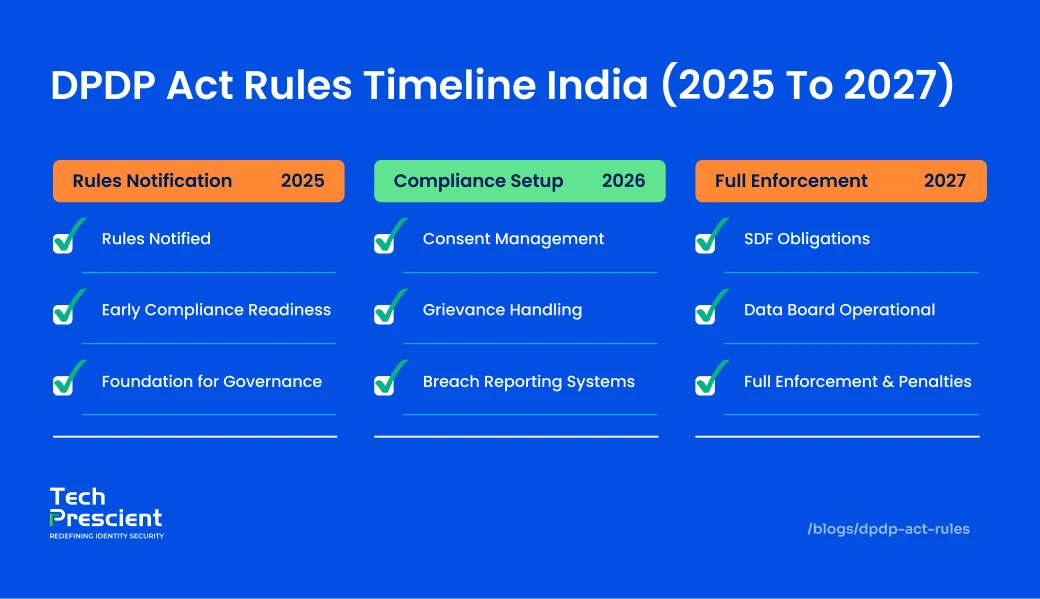
Introduced by the Ministry of Electronics and Information Technology (MeitY), this timeline ensures a gradual transition from policy awareness to full regulatory enforcement.
Phase 1: Initial Rules Notification (2025)
The first phase begins with the formal release of the DPDP Rules, which provide clarity on how the Act must be implemented in practice. During this stage, organizations are expected to:
- Review and interpret the notified rules
- Identify gaps in existing data protection practices
- Begin aligning internal policies with consent, purpose limitation, and data security requirements
This phase focuses on awareness and preparation, helping businesses understand their obligations under the new framework.
Phase 2: Organizational Compliance (2026)
In 2026, the focus shifts to active implementation of compliance measures. Organizations are required to operationalize key elements of the DPDP framework, including:
- Deploying consent management systems to capture and manage user permissions
- Establishing grievance redressal mechanisms for data principals
- Building data breach detection and reporting workflows
- Strengthening internal governance, audit trails, and accountability structures
This phase is critical as businesses move from planning to execution, embedding privacy controls into day-to-day operations.
Phase 3: Full Enforcement (2027)
By 2027, the DPDP framework is expected to be fully enforced, with stricter regulatory oversight and accountability. Key developments in this phase include:
- Enhanced obligations for Significant Data Fiduciaries, including risk assessments and additional compliance requirements
- Full operationalization of the Data Protection Board of India as the enforcement authority
- Increased scrutiny, audits, and enforcement actions for non-compliance
At this stage, organizations are expected to demonstrate end-to-end compliance, supported by mature data protection practices and governance frameworks.
Are you ready for DPDP enforcement?
Check your compliance score before gaps become penalties.

Key Provisions of the DPDP Act Rules
The Digital Personal Data Protection (DPDP) Rules establish a structured framework that defines how organizations must handle personal data while strengthening individual rights. Notified by the Ministry of Electronics and Information Technology, these provisions ensure that data processing is transparent, accountable, and grounded in user consent.
Consent Architecture
The DPDP framework is built around a consent-first approach, where organizations can process personal data only after obtaining clear and informed permission from individuals. Consent must be specific to a defined purpose and communicated in a way that users can easily understand.
Equally important is the ability for individuals to withdraw consent at any time. The process for withdrawal must be as simple as granting consent, ensuring that users retain ongoing control over their data. The rules also introduce the concept of consent managers, independent entities that allow individuals to manage, review, and revoke their consent across multiple platforms through a unified interface.
Data Principal Rights
The rules empower individuals, referred to as data principals, with enforceable rights over their personal data. These rights are designed to improve transparency and accountability while giving users greater control over how their information is used.
- Individuals can request access to their personal data and understand how it is being processed
- They have the right to correct inaccurate data or request deletion when it is no longer required
- They can raise complaints through grievance redressal mechanisms if their rights are not upheld
This rights-based approach ensures that individuals are not passive participants but active stakeholders in the data ecosystem.
Obligations of Data Fiduciaries
Organizations that determine the purpose and means of processing personal data, known as data fiduciaries, are required to follow strict compliance measures. They must maintain transparency in their data practices and implement safeguards to prevent misuse or unauthorized access.
Key responsibilities include providing clear privacy notices, implementing appropriate security controls, and ensuring that personal data is not retained longer than necessary. Once the purpose for which the data was collected is fulfilled, organizations are expected to securely delete it. These obligations reinforce the shift toward responsible data governance, where accountability and trust become central to business operations.
Data Breach Notification Requirements
The DPDP Act mandates immediate data breach reporting to both regulators and affected individuals, with strict timelines for disclosure.
Organizations handling personal data are required to act immediately once a breach is identified, ensuring that both regulators and affected individuals are informed without delay. This requirement reinforces accountability and helps reduce the potential impact on users.
1. Mandatory Reporting Obligations
Under the DPDP Act, any incident involving unauthorized access, disclosure, loss, or misuse of personal data must be treated as a reportable breach. Unlike some global frameworks, the obligation applies broadly, meaning organizations cannot delay reporting based on severity or impact.
Data fiduciaries are required to notify both the regulatory authority and the individuals affected. This dual reporting requirement ensures that users are aware of risks to their data while regulators can take necessary action to investigate and enforce compliance.
2. Breach Disclosure Timeline
The rules introduce a strict reporting timeline, making speed a critical factor in compliance. Organizations must provide an initial notification as soon as they become aware of a breach, followed by a detailed report within a defined period.
- Initial notification must be sent without delay after detection
- A detailed report must typically be submitted within 72 hours of becoming aware of the breach
This timeline aligns with global best practices and ensures that incidents are addressed quickly to minimize damage.
3. Notification to the Data Protection Authority
Organizations must report breaches to the Data Protection Board of India, which serves as the central enforcement authority under the DPDP framework. The notification must include key details such as the nature of the breach, its impact, and the remedial actions taken.
The Board uses this information to assess risk, guide corrective actions, and determine whether enforcement measures or penalties are required. Failure to notify the Board can lead to significant financial penalties under the Act.
4. Communication with Affected Individuals
In addition to regulatory reporting, organizations must inform affected users about the breach. This communication is essential to help individuals take preventive measures, such as securing accounts or monitoring misuse of their data.
The notification to users must be clear and timely, outlining what happened, what data was impacted, and what steps are being taken to address the issue. This requirement strengthens transparency and builds trust, even in the event of a security incident.
DPDP Breach Response Checklist:
- Detect breach immediately
- Notify authority without delay
- Submit detailed report within 72 hours
- Inform affected users clearly
Cross-Border Data Transfer and Localization Rules
The DPDP Act adopts a flexible approach to cross-border data transfers, allowing organizations to move personal data outside India while retaining regulatory control. Instead of enforcing strict data localization, the law enables global data flows but gives the government the authority to impose restrictions when necessary. This ensures a balance between supporting international business operations and protecting national data interests.
1. Default Cross-Border Data Transfer Policy
Under the DPDP framework, organizations are generally allowed to transfer personal data across borders as part of their normal operations. This includes use cases such as cloud storage, global analytics, and third-party service providers.
The law follows a "blacklist" model, meaning data transfers are permitted to all countries unless specifically restricted by the government. This is a notable shift from stricter localization approaches, making the framework more aligned with global digital ecosystems while still maintaining oversight. At the same time, organizations must ensure that all transfers comply with core DPDP principles such as consent, purpose limitation, and data security, regardless of where the data is processed.
2. Restricted Countries and Government Oversight
While transfers are broadly allowed, the Central Government retains the power to restrict data flows to certain jurisdictions based on policy, security, or regulatory considerations.
- Specific countries or entities may be placed on a restricted list
- Additional conditions may be imposed for transferring sensitive or high-risk data
- Certain categories of data may require stricter controls or approvals
The Act empowers regulators to adapt these restrictions over time, ensuring that cross-border data movement remains aligned with India's legal and strategic priorities.
3. Compliance Considerations for Global Companies
For organizations operating across multiple geographies, cross-border data transfers under DPDP require careful planning and governance. Businesses must evaluate where data is stored, how it is accessed internationally, and whether any transfer restrictions apply.
Compliance involves implementing safeguards such as secure data transfer mechanisms, contractual controls with overseas partners, and continuous monitoring of regulatory updates. Since the DPDP Act applies extraterritorially, even companies without a physical presence in India must comply if they process data of individuals in India. In practice, this means global companies need to treat cross-border data governance as a core part of their compliance strategy, not just an operational necessity.
Penalties and Enforcement Under DPDP Rules
DPDP penalties enforce strict accountability, with fines up to ₹250 crore for data protection failures and non-compliance.
Compliance is mandatory, and failure to meet obligations can lead to substantial financial and regulatory consequences. The enforcement model is designed to drive accountability and strengthen data governance across organizations.
1. ₹250 Crore Failure to Protect Personal Data
Organizations that fail to implement adequate security safeguards to protect personal data can face penalties of up to ₹250 crore. This includes lapses in data security, unauthorized access, or inadequate protection measures leading to breaches.
2. ₹200 Crore Failure to Report Data Breach
Failure to notify regulators and affected individuals about a data breach can result in penalties of up to ₹200 crore. Timely breach reporting is a critical requirement under the DPDP framework.
3. ₹50 Crore Other Violations
Other non-compliance issues, such as failure to meet obligations related to consent, transparency, or data handling practices, may attract penalties of up to ₹50 crore.
Penalty Breakdown Table:
| Violation | Penalty |
|---|---|
| Failure to protect data | Up to ₹250 crore |
| Failure to report breach | Up to ₹200 crore |
| Other violations | Up to ₹50 crore |
How Businesses Can Prepare for DPDP Compliance
Businesses must implement data governance frameworks, including data mapping, consent management, and breach response systems, to comply with DPDP.
This involves understanding how personal data flows across systems, ensuring valid consent mechanisms, and establishing controls to manage risk proactively.
1. Conduct Data Mapping and Audit
The first step is gaining visibility into how personal data is collected, stored, and processed across the organization. Businesses should perform a detailed data mapping exercise to identify data sources, processing activities, and third-party involvement.
This helps uncover compliance gaps and ensures that data processing aligns with defined purposes and legal requirements. Data mapping also supports audit readiness by creating a clear record of data flows and responsibilities.
2. Implement Consent Management and Governance Controls
Since consent is central to the DPDP framework, organizations must establish systems to capture, manage, and track user consent across all touchpoints. Consent must be specific, informed, and tied to a clear purpose, requiring businesses to move beyond static notices to dynamic consent management workflows.
In addition, companies should:
- Deploy consent management platforms to track consent lifecycle
- Appoint a Data Protection Officer or responsible authority for oversight
- Define internal policies for handling data principal requests
These measures ensure that consent and governance are embedded into everyday operations rather than treated as one-time compliance tasks.
3. Strengthen Data Retention and Breach Response Readiness
Organizations must also focus on how long data is retained and how incidents are handled. The DPDP Act requires that personal data be stored only for as long as necessary, followed by secure deletion once the purpose is fulfilled.
At the same time, businesses need a well-defined breach response plan that enables quick detection, reporting, and mitigation of incidents. Automating these processes can improve response times and ensure compliance with reporting obligations.
Overall, DPDP readiness is an ongoing process that requires continuous monitoring, governance, and adaptation as regulations evolve. Organizations that invest early in structured compliance frameworks are better positioned to reduce risk and build long-term trust.
DPDP Compliance Checklist for Businesses:
- Map all personal data flows
- Implement consent management systems
- Enable data principal rights workflows
- Set up breach detection and reporting
- Enforce data retention and deletion policies
Turn compliance steps into measurable action.
See exactly where you stand with a DPDP scorecard.
Impact of DPDP Rules on Cybersecurity and Identity Governance
DPDP compliance makes identity governance critical, ensuring controlled access to personal data and enforcing least privilege principles.
1. Identity Governance in DPDP Compliance
Identity governance plays a central role in ensuring that only the right individuals have access to personal data. Under DPDP, organizations must clearly define who can access data, for what purpose, and under what conditions.
This requires centralized identity visibility, role-based access controls, and continuous monitoring of user activities. Without strong identity governance, enforcing consent, purpose limitation, and accountability becomes difficult at scale.
2. Access Governance for Personal Data
The DPDP Act emphasizes controlled and lawful data processing, which makes access governance critical. Organizations must ensure that access to personal data is limited to authorized users and aligned with business needs.
Implementing least privilege access models helps reduce the risk of misuse, insider threats, and unauthorized exposure of sensitive data. This approach also supports compliance by ensuring that data is accessed only when necessary and for defined purposes.
3. Audit Trails and Compliance Reporting
To demonstrate compliance, organizations must maintain clear audit trails of how personal data is accessed, processed, and shared. These records are essential for internal audits as well as regulatory investigations.
Strong audit capabilities enable organizations to track user actions, detect anomalies, and provide evidence of compliance when required. This level of visibility is key to meeting DPDP obligations and responding effectively to incidents or complaints.
4. Enforcing Least Privilege and Continuous Monitoring
DPDP pushes organizations toward a least privilege security model, where users are granted only the minimum access required to perform their roles. Combined with continuous monitoring, this helps identify unusual behavior and prevent potential data breaches.
In practice, this means integrating identity governance with cybersecurity tools to enable real-time risk detection, automated access reviews, and policy enforcement. As identity becomes the new security perimeter, organizations must treat it as a foundational element of their data protection strategy.
Final Thoughts
The DPDP Act Rules establish a clear framework for how organizations must collect, process, and protect digital personal data in India. By defining consent requirements, data principal rights, compliance obligations, and enforcement mechanisms, they bring structure, accountability, and trust to modern data governance. As organizations handle increasing volumes of personal data, aligning with these rules becomes essential to reducing risk, ensuring compliance, and maintaining customer confidence.
Tech Prescient helps organizations strengthen identity governance, enforce access controls, and operationalize DPDP compliance across complex digital environments.
Turn compliance steps into measurable action.
See exactly where you stand with a DPDP scorecard.
FAQs
DPDP Act rules define how businesses must collect, process, and protect personal data in India, including consent and breach reporting requirements.
The DPDP Act rules were notified in 2025 and are being implemented in phases through 2027.
Organizations can face penalties up to ₹250 crore for failing to protect personal data or comply with regulations.
Any organization processing personal data of individuals in India must comply, including global companies.
The DPDP framework follows a phased implementation timeline from 2025 to 2027. Organizations are given time to align their systems, processes, and governance. This gradual rollout helps businesses achieve full compliance step by step.
Share



Yatin Laygude
Content Writer
A content writer with 6 years of experience turning complex topics into clear, engaging, and meaningful content. From blogs and web pages to whitepapers and thought pieces, he creates content that not only explains but also connects with both the audience and business goals.
Most Popular Blogs

Identity Security· 21 min read
Data Access Governance Solutions: How to Secure Sensitive Data at Scale
Compare data access governance solutions for 2026: how DAG platforms discover sensitive data, run access reviews, automate remediation, and prove compliance.
Brinda Bhatt· September 7, 2026
Identity Security· 24 min read
What Is Zero Trust Network Access (ZTNA)?
Learn what Zero Trust Network Access (ZTNA) is, how it works, and why it’s replacing VPNs for secure, identity-based access control.
Yatin Laygude· August 14, 2026

Identity Security· 24 min read
Cyber Essentials Certification: Complete Guide
Learn Cyber Essentials certification, cost, requirements, and steps. Compare Cyber Essentials vs Plus and get certified faster.
Yatin Laygude· August 10, 2026