




On this page
See Tech Prescient in Action
Automate access, reduce risk, and stay audit-ready
HIPAA risk assessment is a mandatory process for healthcare organizations and their business associates to identify, evaluate, and mitigate risks to electronic Protected Health Information (ePHI). Required under the HIPAA Security Rule, it helps ensure the confidentiality, integrity, and availability of sensitive patient data while supporting compliance and audit readiness.
Although HIPAA defines what organizations must assess, it does not prescribe a fixed methodology for how assessments should be conducted. This flexibility can create uncertainty around scoping, risk analysis, documentation, and remediation. A structured HIPAA security risk assessment helps organizations understand how ePHI is created, stored, transmitted, and accessed across systems, devices, cloud environments, and third parties.
According to the U.S. Department of Health and Human Services (HHS), conducting an accurate and thorough risk analysis is a foundational HIPAA Security Rule requirement, and gaps in risk analysis continue to surface in enforcement actions and settlements. In this blog, we'll break down HIPAA risk assessment requirements, steps, checklists, tools, templates, and best practices for stronger compliance and ePHI protection.
Key Takeaways:
- Understand what a HIPAA risk assessment is, why it is required, and how it protects ePHI and supports compliance.
- Learn the key steps of a HIPAA risk assessment, from scoping and threat analysis to risk scoring and documentation.
- Explore HIPAA risk assessment checklists, templates, tools, and software to streamline assessments.
- Discover how to assess vendor risks, avoid common compliance gaps, and improve audit readiness.
- See how [Identity Governance](/identity-security/identity-governance-framework/) and access controls can strengthen HIPAA compliance and ePHI security.
What Is a HIPAA Risk Assessment?
A HIPAA risk assessment is the process of identifying, evaluating, and documenting risks to electronic Protected Health Information (ePHI). Required under the HIPAA Security Rule, it helps organizations understand where sensitive data resides, what threats could impact it, and whether existing safeguards are sufficient to protect confidentiality, integrity, and availability.
Understanding the regulatory basis, purpose, and scope of the assessment is key to building an effective compliance program.
1. HIPAA Risk Assessment Under 45 CFR §164.308
Under 45 CFR §164.308(a)(1)(ii)(A), covered entities and business associates must conduct an "accurate and thorough" assessment of potential risks and vulnerabilities affecting ePHI. In practice, this means identifying where ePHI is created, stored, processed, or transmitted and evaluating the security controls protecting it. A HIPAA compliance risk assessment is not limited to IT systems alone. It can include users, devices, applications, cloud platforms, vendors, and operational workflows that interact with sensitive health data.
2. Risk Analysis vs. Risk Management
While often used interchangeably, risk analysis and risk management serve different functions. Risk analysis focuses on identifying threats, vulnerabilities, likelihood, and potential impact to ePHI. Risk management takes the next step by prioritizing findings, implementing safeguards, and continuously monitoring risks. Both are critical components of a mature HIPAA security risk assessment and broader compliance strategy.
3. Who Needs to Perform a HIPAA Risk Assessment?
HIPAA risk assessment requirements apply to both covered entities and business associates. Covered entities include healthcare providers, health plans, and healthcare clearinghouses, while business associates include third parties that create, receive, maintain, or transmit ePHI on behalf of healthcare organizations. Any organization handling ePHI should treat security risk assessment HIPAA activities as an ongoing process rather than a one-time compliance task.
Is a HIPAA Risk Assessment Mandatory?
The short answer is yes. A HIPAA risk assessment is a legal requirement under the HIPAA Security Rule for organizations that create, receive, maintain, or transmit electronic Protected Health Information (ePHI). It is not a recommended best practice or an optional compliance activity. It is a foundational requirement for protecting sensitive healthcare data.
Understanding what the law requires, and the consequences of failing to comply, is critical for any organization handling ePHI.
1. HIPAA Risk Assessment Requirements Under the Security Rule
The HIPAA risk assessment requirements stem from the Administrative Safeguards section of the HIPAA Security Rule, specifically 45 CFR §164.308(a)(1)(ii)(A). Covered entities and business associates must conduct an accurate and thorough evaluation of risks and vulnerabilities affecting the confidentiality, integrity, and availability of ePHI.
This requirement applies across environments where ePHI is handled, including internal systems, cloud platforms, mobile devices, third-party vendors, and operational workflows. Organizations are also expected to revisit assessments when major changes occur, such as new technologies, mergers, system upgrades, or security incidents.
2. What Happens If You Don't Comply?
Failing to meet HIPAA risk assessment requirements can expose organizations to regulatory penalties, corrective action plans, reputational damage, and increased breach risk. Regulators frequently identify missing or incomplete risk analyses as a recurring compliance issue during investigations and enforcement actions.
Non-compliance does not only refer to skipping an assessment entirely. Outdated documentation, incomplete scope, inadequate remediation efforts, or failure to assess third-party risks can also create compliance gaps.
3. HIPAA Audits and Enforcement Implications
A documented risk assessment often becomes one of the first pieces of evidence requested during a HIPAA audit, breach investigation, or compliance review. Organizations must be able to demonstrate not only that an assessment was completed, but also how risks were identified, evaluated, prioritized, and addressed.
Maintaining a current and well-documented assessment process supports audit readiness, strengthens security posture, and helps organizations show ongoing compliance with HIPAA obligations.
Quick Reality Check
Completing a risk assessment once does not automatically keep you compliant. If your organization adds a new cloud app, vendor, workflow, or remote access model, your risk profile changes too.
Step-by-Step HIPAA Risk Assessment Process
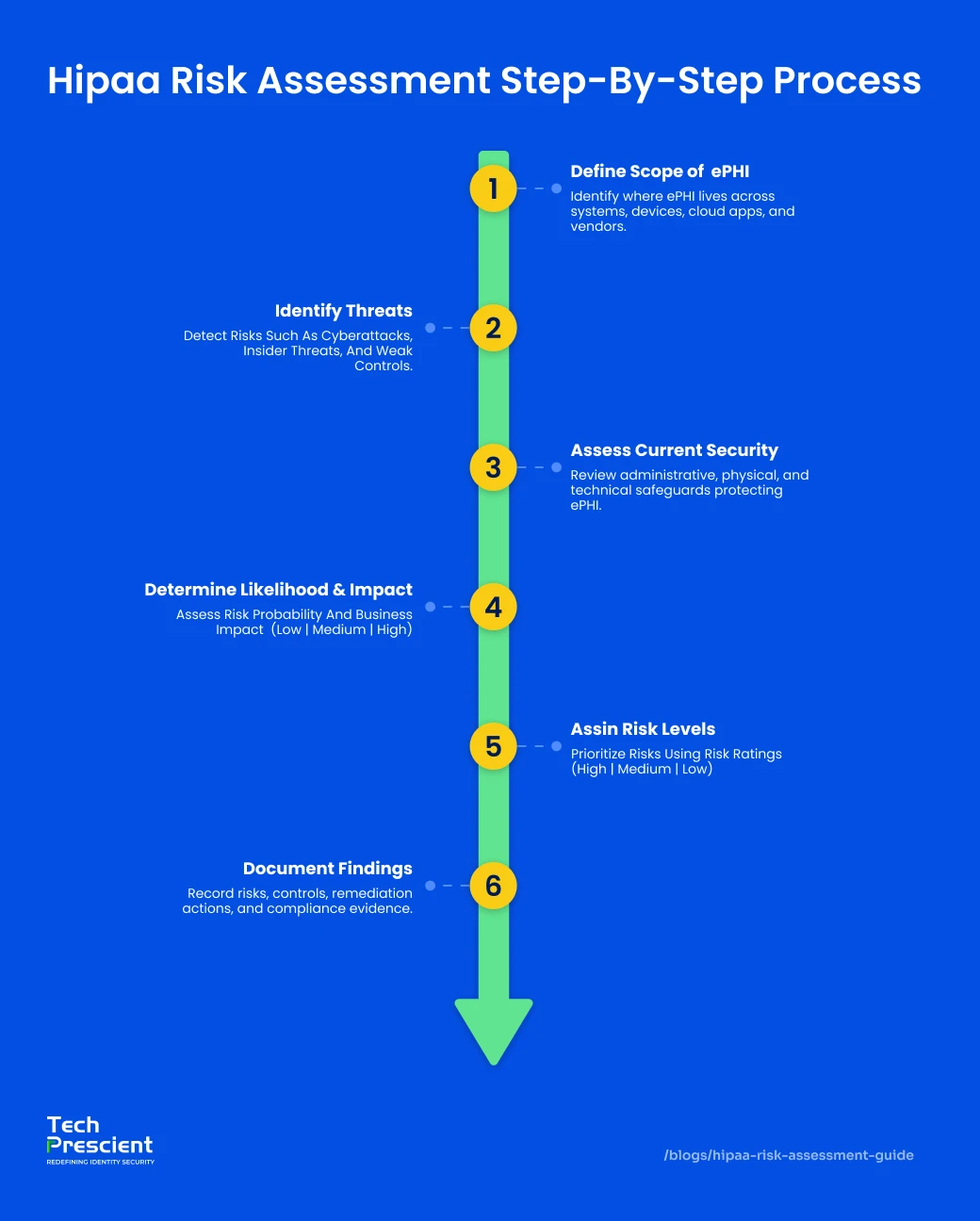
Conducting a HIPAA security risk assessment is not a one-step exercise. It requires a systematic approach that examines where ePHI exists, what could compromise it, and how effectively risks are being managed. While organizations may tailor the methodology to their environment, most assessments follow a similar framework.
Define the Scope of ePHI
Start by identifying where electronic Protected Health Information is created, stored, processed, accessed, or transmitted. This includes on-premises systems, cloud applications, endpoints, mobile devices, databases, and third-party environments.
Data flow mapping is equally important. Understanding how ePHI moves between users, applications, departments, and vendors helps ensure no systems, workflows, or storage locations are overlooked during the risk assessment HIPAA process.

Pro Tip
Start your assessment with a simple ePHI data map before jumping into controls or scoring. Knowing where sensitive data lives and how it moves often uncovers hidden systems, shadow tools, and overlooked vendor dependencies.
Identify Threats and Vulnerabilities
Once the scope is established, identify the internal and external factors that could expose ePHI to harm. Common threats include ransomware attacks, phishing, unauthorized access, insider misuse, device theft, system outages, and misconfigured cloud resources.
Vulnerabilities are the weaknesses that make these threats possible. Examples include weak passwords, outdated software, excessive permissions, poor encryption practices, or gaps in employee awareness and training.
Assess Current Security Measures
The next step is to evaluate the safeguards already in place to protect ePHI. This includes reviewing administrative safeguards such as policies, training, and access governance, physical safeguards like facility and device controls, and technical safeguards including authentication, encryption, logging, and monitoring.
The goal is to determine whether current controls adequately reduce identified risks or if additional protections are required.
Determine Likelihood and Impact
After identifying risks and existing controls, assess how likely each threat scenario is to occur and what impact it could have on the organization. Consider operational disruption, financial consequences, regulatory exposure, and potential effects on patient privacy and care delivery.
Many organizations use a simple risk matrix that categorizes risks as high, medium, or low based on likelihood and severity.
Assign Risk Levels and Prioritize Action
Not every risk requires the same response. Assigning risk levels helps organizations rank issues and focus remediation efforts where they matter most. High-priority risks may demand immediate corrective action, while lower-risk findings can be addressed through longer-term improvement plans.
This prioritization step helps make the HIPAA security risk assessment more actionable and aligned with available resources.
Document Findings and Maintain Records
Documentation is a critical part of the process. Organizations should maintain records of assessment scope, identified risks, evaluation methods, control reviews, risk ratings, and remediation decisions.
Clear documentation supports compliance, improves audit readiness, and provides evidence that the organization has conducted an accurate and thorough risk assessment HIPAA review. Since environments change over time, assessments should also be updated periodically and after major operational or technology changes.
Assess Your HIPAA Risks Before Compliance Gaps Become Audit Findings.
A structured framework to identify HIPAA compliance gaps, assess ePHI risks, and strengthen healthcare security governance.
HIPAA Risk Assessment Checklist
A HIPAA risk assessment checklist provides a practical way to organize and validate your assessment process. Rather than relying on assumptions or isolated reviews, a checklist helps teams consistently evaluate key security, operational, and compliance areas that influence the protection of electronic Protected Health Information (ePHI).
While every organization's environment is different, most assessments should address the following core areas.
1. Data Inventory and ePHI Mapping
Start by identifying where ePHI exists across your organization. This includes applications, databases, cloud platforms, endpoints, collaboration tools, backups, and third-party systems.
A complete inventory should also document how data moves between users, departments, systems, and external vendors. Without visibility into data locations and flows, important risk areas can easily be missed.
2. Access Controls and User Permissions
Review who can access ePHI, how access is granted, and whether permissions align with job responsibilities. Strong access governance practices such as least privilege, role-based access, multi-factor authentication, and regular access reviews help reduce unauthorized exposure.
This is a critical component of any HIPAA security risk assessment checklist, especially in environments with changing users, contractors, or vendors.
3. Encryption and Data Protection Controls
Assess the safeguards protecting ePHI at rest and in transit. Review encryption practices, secure communication methods, endpoint protections, backup security, and key management processes.
Organizations should also evaluate whether sensitive data is adequately protected across mobile devices, cloud services, and remote access environments.
4. Vendor and Third-Party Risk Management
Third parties that store, process, or access ePHI can introduce significant compliance and security risks. A strong HIPAA risk assessment checklist should include vendor reviews, Business Associate Agreement (BAA) validation, security posture evaluations, and ongoing monitoring of external partners.
Ignoring third-party risk can create blind spots in an otherwise mature assessment program.
5. Incident Response and Recovery Readiness
A risk assessment should also examine how prepared the organization is to detect, respond to, and recover from security incidents. This includes reviewing incident response procedures, breach notification readiness, disaster recovery planning, logging, monitoring, and employee reporting processes.
Strong response capabilities help reduce operational disruption and improve resilience when security events occur.
Using a structured HIPAA security risk assessment checklist helps organizations create a more repeatable, complete, and audit-ready assessment process while reducing the likelihood of overlooked compliance gaps.
HIPAA Risk Assessment Templates & Examples
A HIPAA risk assessment template helps organizations organize findings, standardize evaluation criteria, and maintain clear compliance records. Instead of building an assessment framework from scratch, teams can use templates to capture risks, safeguards, scoring methods, remediation actions, and supporting documentation in a repeatable format.
The right template should balance flexibility with enough structure to support ongoing compliance and audit readiness.
1. Using a HIPAA Risk Assessment Template Excel Format
Many organizations begin with a HIPAA risk assessment template Excel file because it is familiar, customizable, and easy to maintain. Spreadsheet-based templates can be used to track ePHI locations, identified threats, existing safeguards, likelihood scores, impact ratings, and remediation status.
For smaller healthcare practices or teams with limited tooling, Excel templates can provide a practical starting point for documenting assessments and monitoring risk activities.
2. What a Sample Risk Register Looks Like
A common component of a sample HIPAA risk assessment is the risk register. This document records identified risks alongside important details such as affected systems, threat sources, control gaps, risk severity, mitigation plans, ownership, and target resolution timelines.
For example, a risk register entry may list an unencrypted laptop storing ePHI, note the associated risk of unauthorized access from device theft, assign a high risk rating, and define corrective actions such as device encryption and access restrictions.
A structured risk register helps teams move from risk identification to measurable remediation and accountability.
3. Example Scenario: Clinic Email Security Risk
Consider a healthcare clinic that uses standard email to share patient records internally and with external providers. During the assessment, the organization identifies the absence of secure email controls and inconsistent user practices as potential vulnerabilities.
The risk analysis may determine that the likelihood of accidental exposure is moderate to high, particularly when sensitive files are shared outside the organization. Recommended mitigation actions could include implementing encrypted email, strengthening access controls, updating policies, and providing employee awareness training.
Practical examples like this help translate a HIPAA risk assessment template from a documentation exercise into a usable framework for identifying and reducing real-world ePHI risks.
HIPAA Risk Assessment Tools & Software
Managing a HIPAA risk assessment manually can become difficult as environments grow more complex. Multiple systems, cloud applications, vendors, and evolving compliance requirements can make tracking risks and remediation efforts time-consuming. This is where a HIPAA risk assessment tool or software platform can help simplify the process.
Different tools support different levels of maturity, from basic assessment frameworks to automated compliance and continuous monitoring capabilities.
1. HHS Security Risk Assessment (SRA) Tool
One of the most widely used starting points is the HHS Security Risk Assessment (SRA) Tool, developed to help organizations evaluate risks related to electronic Protected Health Information (ePHI). The tool guides users through questions covering administrative, physical, and technical safeguards aligned with HIPAA Security Rule expectations.
While it can support initial assessments and documentation efforts, organizations with larger or more complex environments may require additional capabilities for workflow management, evidence collection, and ongoing monitoring.
2. Automation Platforms for Risk and Compliance Management
Many organizations use automation platforms to make assessments more scalable and repeatable. These platforms can centralize risk inventories, control evaluations, remediation tracking, policy management, and compliance reporting in a single environment.
An advanced HIPAA risk assessment tool may also support third-party risk reviews, task assignments, audit evidence collection, and real-time visibility into outstanding compliance issues.
Automation can help reduce manual effort while improving consistency across assessment cycles.
3. Benefits of HIPAA Risk Assessment Software
Using HIPAA risk assessment software can provide operational and compliance advantages beyond simple documentation. SaaS-based tools often help organizations standardize assessment workflows, maintain version-controlled records, and generate reports for audits or internal reviews.
Common benefits include:
- Centralized risk tracking and remediation management
- Faster documentation and compliance reporting
- Improved visibility into vendor and third-party risks
- Better collaboration across compliance, IT, and security teams
- Support for continuous monitoring and recurring assessments
The right HIPAA risk assessment software depends on organizational size, regulatory complexity, internal resources, and long-term compliance goals. For some teams, lightweight assessment tools may be sufficient. Others may benefit from broader governance, risk, and compliance platforms that support ongoing HIPAA program management.
HIPAA Vendor & Third-Party Risk Assessment
A HIPAA vendor risk assessment is a critical part of the broader HIPAA compliance process. Healthcare organizations rarely manage ePHI entirely within their own environments. Cloud providers, billing platforms, IT service providers, communication tools, consultants, and other external partners may all create, access, store, or transmit sensitive health information.
Because third-party relationships can expand an organization's attack surface, vendor risks should be evaluated alongside internal security controls.
1. Business Associate Agreements (BAAs)
When a vendor handles ePHI on behalf of a covered entity, HIPAA may classify that organization as a business associate. In these cases, a Business Associate Agreement (BAA) helps define responsibilities related to data protection, permitted data use, breach reporting, and compliance obligations.
However, signing a BAA alone does not eliminate risk. Organizations should still validate whether vendors maintain appropriate administrative, physical, and technical safeguards to protect sensitive healthcare data.
2. Vendor Risk Scoring and Evaluation
A strong HIPAA third party risk assessment includes a structured approach to evaluating vendor security posture. This often involves reviewing factors such as access to ePHI, security controls, compliance history, incident response capabilities, data handling practices, and dependency on subcontractors.
Many organizations use vendor risk scoring models to rank third parties based on likelihood and business impact. Higher-risk vendors may require deeper assessments, stricter contractual requirements, or additional control validation.
Risk scoring can help teams prioritize oversight efforts instead of treating every vendor relationship the same way.
3. Continuous Monitoring of Third-Party Risk
Vendor risk management should not end after onboarding or contract signing. Security environments, business operations, and threat landscapes change over time, making continuous oversight important.
An effective HIPAA vendor risk assessment program includes periodic reviews, policy updates, security questionnaires, evidence collection, and monitoring for changes that could affect compliance or ePHI exposure. Organizations may also reassess vendors after major incidents, service changes, or regulatory developments.
Ongoing monitoring helps reduce blind spots, improve audit readiness, and strengthen long-term management of third-party compliance risk.
Did You Know?
A signed Business Associate Agreement (BAA) does not automatically mean a vendor is low risk. Access levels, security controls, incident response maturity, and ongoing monitoring still matter.
How Often Should You Perform a HIPAA Risk Assessment?
There is no fixed HIPAA rule that mandates assessments on a specific calendar date. However, organizations are expected to keep their risk analysis current as systems, threats, and business operations evolve. For most organizations, an annual HIPAA risk assessment serves as a practical baseline for maintaining compliance and validating existing safeguards.
A one-time assessment is rarely enough in dynamic healthcare environments where technology, vendors, and data flows continuously change.
1. Annual HIPAA Risk Assessment Reviews
Conducting an annual HIPAA risk assessment helps organizations reassess risks, review existing controls, update documentation, and identify new vulnerabilities that may have emerged over time.
Yearly reviews can also support compliance reporting, internal governance efforts, and audit preparedness. Even if no major incidents occur, periodic reassessment helps confirm that security measures continue to align with current operational realities and HIPAA requirements.
2. Event-Driven Risk Assessment Triggers
In addition to scheduled reviews, organizations should perform assessments when significant changes could affect the security of ePHI. These event-driven triggers help ensure that new risks are evaluated before they become compliance or security problems.
Common triggers include:
- Deployment of new applications, cloud services, or infrastructure
- Mergers, acquisitions, or organizational restructuring
- Major workflow, operational, or system changes
- Security incidents, ransomware attacks, or suspected breaches
- Changes involving vendors, business associates, or third-party access
- Expansion into remote work, mobile access, or new data environments
These situations can alter how ePHI is stored, accessed, or transmitted, which may introduce previously unassessed risks.
3. Why Ongoing Assessments Matter
HIPAA risk assessment is best viewed as an ongoing process rather than an annual checklist item. Regular reviews help organizations adapt to changing threats, maintain stronger visibility into risk exposure, and demonstrate continued compliance efforts.
By combining scheduled assessments with event-based reviews, organizations can create a more resilient and audit-ready approach to protecting ePHI.
Assess Your HIPAA Risks Before Compliance Gaps Become Audit Findings.
A structured framework to identify HIPAA compliance gaps, assess ePHI risks, and strengthen healthcare security governance.
Common Mistakes to Avoid
A HIPAA risk assessment is only effective when it reflects the organization's real-world environment and is maintained over time. In practice, many compliance gaps arise not because organizations skip assessments entirely, but because important elements are incomplete, outdated, or inconsistently managed.
Avoiding the following mistakes can help strengthen both compliance outcomes and ePHI protection.
Treating Risk Assessments as a One-Time Exercise
One of the most common issues is conducting an assessment once and assuming the work is complete. Healthcare environments change constantly through new systems, evolving threats, operational shifts, and third-party relationships.
A risk assessment that is not regularly reviewed can quickly lose relevance. Organizations should approach assessments as an ongoing process supported by periodic reviews and updates tied to business or technology changes.
Incomplete or Weak Documentation
Even a thorough assessment can create compliance challenges if documentation is missing or inconsistent. Organizations should be able to show what was assessed, which risks were identified, how risks were evaluated, and what remediation actions were planned or completed.
Incomplete records, outdated evidence, or undocumented decisions can create problems during audits, investigations, or internal reviews. Strong documentation also makes it easier to track progress and maintain accountability over time.
Overlooking Mobile, Cloud, and Remote Access Risks
Modern healthcare operations rely heavily on cloud platforms, mobile devices, collaboration tools, and remote access technologies. Focusing only on traditional on-premises systems can leave major exposure points unaddressed.
Organizations should assess how ePHI is accessed and transmitted across laptops, mobile applications, cloud services, remote users, and connected environments. Security controls, access management, encryption practices, and monitoring capabilities should be reviewed across these areas.
Ignoring Vendor and Third-Party Exposure
Third-party providers can introduce significant security and compliance risks, especially when they handle or access ePHI. Failing to evaluate vendors, validate Business Associate Agreements, or monitor external partners can create blind spots in the assessment process.
Vendor oversight should be integrated into the broader risk assessment framework rather than treated as a separate or occasional activity.
Recognizing and avoiding these common mistakes can help organizations build a more accurate, defensible, and audit-ready HIPAA risk assessment program.
HIPAA Risk Assessment Cost & Services
The HIPAA risk assessment cost can vary significantly from one organization to another. Factors such as the number of systems in scope, volume of ePHI, cloud usage, vendor ecosystem, internal expertise, and compliance maturity all influence pricing and effort.
Some organizations manage assessments internally, while others rely on specialized HIPAA risk assessment services or software platforms to streamline the process.
1. DIY vs. Consultant vs. SaaS Approaches
Organizations typically choose from three common assessment models depending on resources, risk profile, and compliance needs.
- DIY assessments are often handled by internal compliance, IT, or security teams using spreadsheets, templates, or basic assessment tools. This approach may reduce direct spending but can require substantial internal time, technical knowledge, and ongoing documentation effort.
- Consultant-led assessments involve external experts who guide or conduct the evaluation process. These engagements can provide deeper compliance expertise, independent validation, and structured reporting, especially for organizations with limited internal resources or complex environments.
- SaaS-based platforms use automation to support risk tracking, evidence collection, compliance reporting, and remediation management. Many organizations use these tools to improve consistency, reduce manual work, and maintain recurring assessment cycles.
The right approach depends on organizational needs, available expertise, and long-term compliance strategy.
2. What Influences HIPAA Risk Assessment Cost?
Several variables can affect the overall HIPAA risk assessment cost, including:
- Organization size and number of users or locations
- Complexity of IT systems, cloud infrastructure, and connected environments
- Number of vendors, business associates, and third-party integrations
- Internal compliance and security capabilities
- Assessment frequency and reporting requirements
- Need for ongoing monitoring, remediation support, or audit preparation
A smaller healthcare practice with limited infrastructure may face different cost considerations than a multi-site healthcare network with complex data flows and third-party dependencies.
3. When Should You Use HIPAA Risk Assessment Services?
External HIPAA risk assessment services can be valuable when organizations lack in-house expertise, need independent review, or are preparing for audits, rapid growth, mergers, or technology changes.
Consultants and managed service providers can help with scoping, risk analysis, documentation, remediation planning, and compliance guidance. Organizations may also seek outside support after security incidents or when modernizing legacy compliance processes.
Whether managed internally or through external partners, the objective remains the same: conduct an accurate, repeatable, and well-documented assessment that supports stronger compliance and ePHI protection.
How IGA Solutions Simplify HIPAA Risk Assessments
Managing access to electronic Protected Health Information (ePHI) is a critical part of any HIPAA risk assessment. As healthcare environments grow more distributed across cloud platforms, applications, vendors, and remote users, manual access management can become difficult to scale. This is where Identity Governance and Administration (IGA) solutions can help strengthen both compliance and operational efficiency.
By improving visibility into identities, permissions, and access activity, IGA platforms support a more controlled and measurable security posture.
1. The Role of Identity Governance in HIPAA Compliance
HIPAA compliance depends heavily on ensuring that only authorized users can access sensitive healthcare information. IGA solutions help organizations manage this by centralizing identity lifecycle processes, enforcing role-based access, and applying least privilege principles.
These capabilities help reduce risks associated with excessive permissions, orphaned accounts, inconsistent access provisioning, and unauthorized data exposure. From a compliance perspective, stronger identity governance can make it easier to demonstrate control over who has access to ePHI and why.
2. Access Certification and Review Automation
Access reviews are an important component of maintaining HIPAA compliance, but conducting them manually can be time-consuming and error-prone.
IGA platforms simplify this process through automated access certification workflows. Organizations can schedule recurring reviews, validate user permissions, flag anomalous access, and maintain evidence of approval decisions across applications and systems.
Automated reviews help organizations continuously validate access rights instead of relying on infrequent, manual verification exercises.
3. Supporting Continuous Compliance and Audit Readiness
HIPAA risk assessments are not static exercises. Changes in users, roles, systems, vendors, and business operations can quickly alter risk exposure. IGA solutions help organizations move toward a more continuous compliance model by providing ongoing visibility into identity-related risks and access changes.
Many platforms also support reporting, audit trails, policy enforcement, and remediation tracking. These capabilities can simplify evidence collection during audits and strengthen the organization's ability to demonstrate ongoing compliance efforts.
By automating identity controls and access governance processes, IGA solutions can make HIPAA risk assessments more consistent, scalable, and aligned with long-term ePHI protection goals.
Final Thoughts
A HIPAA risk assessment is more than a compliance requirement. It is a critical process for identifying threats to ePHI, validating security controls, and strengthening audit readiness. From incomplete documentation and vendor exposure to weak access controls and outdated assessments, overlooked risks can lead to compliance gaps, breaches, and operational disruption.
Tech Prescient helps healthcare organizations improve HIPAA compliance through stronger identity governance, access visibility, and continuous security controls. With automated access reviews, least-privilege enforcement, and compliance-focused governance practices, organizations can simplify risk assessments and better protect sensitive healthcare data.
Assess Your HIPAA Risks Before Compliance Gaps Become Audit Findings.
A structured framework to identify HIPAA compliance gaps, assess ePHI risks, and strengthen healthcare security governance.
FAQs
A HIPAA risk assessment is the process of identifying, analyzing, and documenting risks to electronic Protected Health Information (ePHI). It helps organizations understand where sensitive data is exposed and whether existing safeguards adequately protect its confidentiality, integrity, and availability under the HIPAA Security Rule.
The five core components of a HIPAA risk assessment typically include defining the scope of ePHI, identifying threats and vulnerabilities, performing risk analysis, and developing a mitigation plan. Together, these steps help organizations evaluate risk levels and prioritize actions to strengthen ePHI security.
HIPAA risk assessments should be performed at least annually and whenever significant changes affect the environment. Common triggers include new systems, cloud migrations, mergers, vendor changes, security incidents, or updates to how ePHI is stored, accessed, or transmitted.
Yes, a HIPAA risk assessment is mandatory under the HIPAA Security Rule for covered entities and business associates that handle ePHI. Organizations must conduct an accurate and thorough evaluation of risks and maintain documentation to demonstrate ongoing compliance.
Organizations can use tools such as the HHS Security Risk Assessment (SRA) Tool, compliance automation platforms, and broader risk management software. These tools can help streamline risk tracking, documentation, reporting, vendor assessments, and ongoing compliance activities.
A HIPAA risk assessment checklist typically covers areas such as data inventory, access controls, encryption, vendor risks, and incident response readiness. It helps organizations ensure that critical security, operational, and compliance factors are reviewed during the assessment process.
Share



Yatin Laygude
Content Writer
A content writer with 6 years of experience turning complex topics into clear, engaging, and meaningful content. From blogs and web pages to whitepapers and thought pieces, he creates content that not only explains but also connects with both the audience and business goals.
Most Popular Blogs

Identity Security· 21 min read
Data Access Governance Solutions: How to Secure Sensitive Data at Scale
Compare data access governance solutions for 2026: how DAG platforms discover sensitive data, run access reviews, automate remediation, and prove compliance.
Brinda Bhatt· September 7, 2026
Identity Security· 24 min read
What Is Zero Trust Network Access (ZTNA)?
Learn what Zero Trust Network Access (ZTNA) is, how it works, and why it’s replacing VPNs for secure, identity-based access control.
Yatin Laygude· August 14, 2026
Identity Security· 24 min read
Cyber Essentials Certification: Complete Guide
Learn Cyber Essentials certification, cost, requirements, and steps. Compare Cyber Essentials vs Plus and get certified faster.
Yatin Laygude· August 10, 2026