




On this page
See Tech Prescient in Action
Automate access, reduce risk, and stay audit-ready
Organizations handling personal data of EU users face growing pressure to comply with GDPR requirements, but managing consent, data requests, and privacy operations manually quickly becomes difficult at scale. GDPR compliance software automates privacy workflows and improves visibility into how personal data is collected, processed, stored, and accessed.
For SaaS companies, enterprises, and even small businesses, the challenge extends beyond compliance to maintaining visibility into where personal data exists and who can access it. The right platform centralizes privacy operations through integrations, automation, and continuous monitoring.
In this blog, we'll break down what GDPR compliance software is, the key features to look for, the best tools available, and how to choose the right solution for your organization.
Key Takeaways:
- GDPR compliance software automates privacy workflows like consent tracking and DSAR handling
- Helps organizations manage data mapping, reporting, and regulatory requirements
- Reduces compliance risk and improves audit readiness
- Widely used by SaaS companies, enterprises, and growing businesses
- Platform selection should prioritize integrations, automation, and scalability
What Is GDPR Compliance Software?
GDPR compliance software is a privacy management platform designed to help organizations comply with the European Union's General Data Protection Regulation (GDPR). It centralizes and automates the processes required to manage personal data responsibly, maintain compliance records, and efficiently meet regulatory obligations.
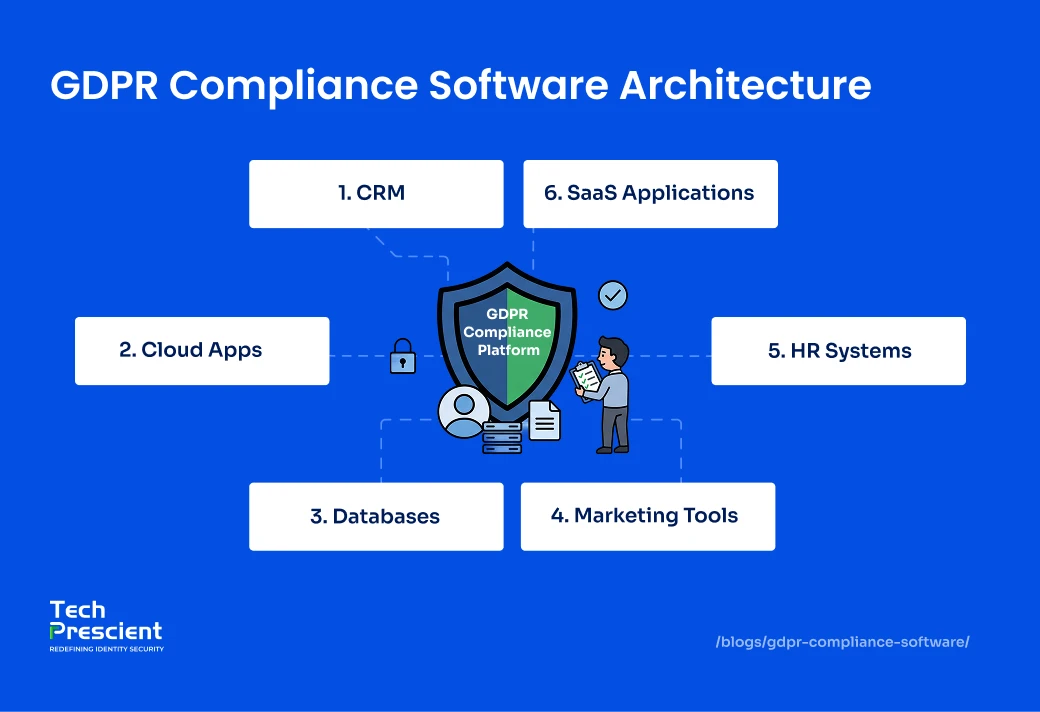
As organizations grow, personal data becomes distributed across cloud applications, CRMs, databases, marketing tools, support systems, and third-party platforms. Managing this manually becomes difficult, especially when organizations need to track where personal data exists, who has access to it, and how it is being processed.
This is where software for GDPR compliance becomes essential.
Why Companies Need GDPR Compliance Software
GDPR requires organizations to demonstrate accountability for how personal data is collected, stored, processed, and shared. These platforms are particularly important for organizations operating across SaaS, cloud, and third-party environments. This includes responsibilities such as:
- Managing user consent
- Responding to Data Subject Access Requests (DSARs)
- Maintaining Records of Processing Activities (RoPA)
- Conducting Data Protection Impact Assessments (DPIAs)
- Reporting breaches within required timelines
Without automation, these processes become difficult to scale consistently, especially for SaaS companies and enterprises operating across multiple systems and regions. A mature platform reduces operational overhead while improving governance visibility and workflow consistency.
Problems GDPR Compliance Software Solves
A primary compliance challenge is fragmented visibility into personal data. Data often exists across disconnected systems, making it difficult to understand where sensitive information is stored or processed.
GDPR software addresses this by:
- Discovering and mapping personal data across systems
- Automating consent and privacy workflows
- Centralizing compliance documentation
- Streamlining DSAR request handling
- Supporting audits and regulatory reporting
This improves operational consistency and reduces compliance gaps.
Key Functions of GDPR Compliance Software
Most GDPR tools include capabilities such as:
- Data Discovery & Mapping: Identify where personal data exists across applications, databases, and cloud environments.
- Consent Management: Track user consent preferences and maintain records of when and how consent was provided.
- DSAR Automation: Automate workflows for access, deletion, correction, or export requests from users.
- Compliance Reporting: Generate audit trails, policy documentation, and compliance reports for regulators.
- Risk & Vendor Management: Monitor third-party access and assess privacy risks across integrations and vendors.
Who Uses GDPR Compliance Software?
GDPR compliance tools are used by:
- SaaS companies handling customer data
- Enterprises managing large-scale privacy operations
- Healthcare and financial organizations handling sensitive information
- Small businesses collecting data from EU users
- Privacy teams, compliance officers, and Data Protection Officers (DPOs)
As privacy regulations continue to expand globally, these platforms are increasingly becoming part of broader governance and cybersecurity strategies.
Key Features to Look for in GDPR Compliance Software
The best compliance software platforms automate data discovery, consent management, DSAR workflows, compliance reporting, and continuous monitoring.
Not all GDPR compliance management software platforms offer the same capabilities. Some focus only on cookie consent, while others provide full privacy governance across systems, users, and third-party vendors. The right platform should continuously manage privacy operations, improve visibility, and reduce manual coordination across teams and systems.
1. Data Mapping & Inventory
One of the most important features in this software is the ability to discover and map personal data across systems. Organizations often store personal data across CRMs, cloud platforms, SaaS applications, databases, support tools, and internal systems. Without visibility into where this data exists, maintaining compliance becomes extremely difficult.
A strong platform should automatically:
- Discover personal data across environments
- Track how data moves between systems
- Maintain a centralized data inventory
- Identify sensitive or high-risk data locations
Data visibility forms the foundation of effective privacy governance.
2. Consent Management
GDPR requires organizations to obtain and manage valid user consent for data collection and processing.
A good compliance software platform should include:
- Cookie consent banners
- Consent preference management
- Audit trails for consent activity
- User opt-in and opt-out tracking
Consent management becomes especially important for websites, SaaS applications, and marketing platforms handling EU user data.
3. DSAR Automation
Under GDPR, individuals have the right to request access to their personal data, ask for corrections, or request deletion.
Managing these Data Subject Access Requests (DSARs) manually can be time-consuming, especially at scale. GDPR software helps automate these workflows by:
- Tracking incoming requests
- Locating related personal data
- Automating deletion or export processes
- Maintaining response timelines and documentation
This improves response consistency and supports regulatory timelines.
4. Records of Processing Activities (RoPA)
GDPR Article 30 requires organizations to maintain detailed records of how personal data is processed.
A strong platform should help maintain Records of Processing Activities (RoPA) by documenting:
- Categories of personal data processed
- Purpose of processing
- Data retention timelines
- Third-party sharing and transfers
Automating RoPA management improves audit readiness and reduces documentation overhead.
5. Data Protection Impact Assessments (DPIA)
Organizations processing high-risk or sensitive data may be required to conduct Data Protection Impact Assessments (DPIAs).
GDPR compliance tools should support DPIA workflows by helping teams:
- Identify high-risk processing activities
- Assess privacy impact
- Document mitigation measures
- Maintain approval and review records
This is particularly important for organizations handling large-scale behavioral, health, or financial data.
6. Continuous Monitoring & Audits
GDPR compliance is not a one-time activity. Organizations need continuous visibility into privacy risks, compliance status, and potential breaches.
Modern data privacy compliance software should include:
- Real-time compliance dashboards
- Automated compliance reporting
- Breach monitoring and alerting
- Audit trails and activity logs
Continuous monitoring improves visibility into emerging privacy and compliance risks.
Best GDPR Compliance Software Tools in 2026
Several platforms support privacy operations through automation, governance workflows, and compliance monitoring. Platform selection depends on organizational scale, compliance maturity, and operational complexity. Some platforms focus heavily on consent management, while others provide broader privacy governance capabilities such as DSAR automation, data mapping, vendor risk management, and continuous compliance monitoring.
Which GDPR Compliance Tool Is Right for You?
Different organizations prioritize different aspects of privacy management.
- Enterprises typically need advanced governance, vendor risk management, and global compliance reporting
- SaaS companies often prioritize automation, integrations, and continuous monitoring
- Small businesses usually focus on cookie consent, privacy policies, and simplified DSAR workflows
The right GDPR compliance management software should align with your operational complexity, regulatory exposure, and existing technology stack.
What to Evaluate Beyond Features
When comparing software for GDPR compliance, organizations should also assess:
- Ease of integration with existing systems
- Scalability across regions and teams
- Automation depth for DSARs and reporting
- Audit readiness and evidence tracking
- Vendor support and implementation complexity
Privacy operations require continuous visibility into personal data, access, and third-party exposure.
Open Source vs Enterprise GDPR Compliance Software: What's the Difference?
Organizations typically choose between open-source tools focused on flexibility and enterprise platforms designed for automation and scale. Both approaches help manage privacy requirements, but they differ significantly in terms of automation, scalability, integrations, and operational effort. Selection depends on operational complexity, internal expertise, and long-term governance requirements.
1. Open Source GDPR Tools
Open-source GDPR tools are typically preferred by smaller organizations or technically mature teams that want more customization and control.
These tools often focus on specific privacy functions such as:
- Cookie consent management
- Privacy documentation
- Basic DSAR handling
- Consent tracking
Because the source code is publicly available, organizations can customize workflows and integrate the tools into their existing environments more flexibly.
However, open-source solutions usually require:
- Internal technical expertise
- Manual configuration and maintenance
- Custom integrations
- Ongoing monitoring and updates
While the upfront cost may be lower, operational overhead can increase significantly as compliance requirements grow.
2. Enterprise GDPR Platforms
Enterprise compliance management software is designed for organizations managing privacy operations at scale.
These platforms provide centralized privacy management with built-in automation for:
- Data discovery and mapping
- DSAR workflows
- DPIA and RoPA management
- Compliance reporting
- Vendor risk management
- Continuous monitoring and alerts
Enterprise platforms also integrate more easily with cloud applications, identity systems, CRMs, and SaaS environments, making them more suitable for complex or global organizations.
Although they involve higher licensing costs, they significantly reduce manual effort and improve audit readiness.
Comparison: Open Source vs Enterprise GDPR Software
| Feature | Open Source GDPR Tools | Enterprise GDPR Platforms |
|---|---|---|
| Cost | Lower upfront cost | Higher licensing cost |
| Customization | Highly customizable | Configurable but structured |
| Setup & Maintenance | Requires technical setup | Vendor-supported deployment |
| Automation | Limited | Extensive automation |
| Integrations | Manual/custom integrations | Broad native integrations |
| Compliance Reporting | Basic/manual | Advanced automated reporting |
| Scalability | Limited for large environments | Built for enterprise scale |
| Best For | Small technical teams | Enterprises & SaaS companies |
Which Option Is Better?
There is no universal "best" option; it depends on operational needs.
- Open-source tools are often suitable for smaller teams with simpler compliance requirements and strong technical resources
- Enterprise platforms are better for organizations needing scalability, automation, governance, and continuous compliance visibility
As privacy regulations become more complex, many organizations eventually move toward enterprise-grade platforms to reduce operational burden and improve consistency.
GDPR Compliance Software for Small Businesses
Small businesses processing EU personal data face the same regulatory obligations as larger organizations but often operate with fewer privacy resources.
The challenge for smaller organizations is that they often operate with:
- Limited compliance resources
- Smaller IT and privacy teams
- Lower budgets
- Less operational visibility across tools and data
This makes manual privacy management difficult to sustain. As a result, many small businesses adopt lightweight GDPR compliance software for small business environments that simplify privacy operations without requiring large teams or complex deployments.
Why Small Businesses Need GDPR Software
Small businesses still collect and process significant amounts of personal data through:
- Websites and forms
- CRM systems
- Marketing tools
- SaaS applications
- Customer support platforms
Without proper visibility and controls, even smaller environments can face compliance gaps, privacy complaints, or regulatory penalties. A good GDPR compliance management software solution helps smaller teams automate repetitive tasks and maintain consistency without needing dedicated privacy specialists.
Key Features Small Businesses Should Prioritize
Unlike large enterprises, small businesses usually do not need highly complex governance platforms. Instead, they benefit most from tools that are easy to deploy, automate repetitive tasks, and provide clear visibility.
Important features include:
1. Cookie Consent Management
For many small businesses, website consent is the first GDPR requirement they encounter. A good platform should provide:
- GDPR-compliant cookie banners
- User consent tracking
- Preference management
- Consent audit logs
This helps ensure transparency around how user data is collected and processed.
2. Automated Privacy Policies
Maintaining privacy policies manually can quickly become difficult as tools and processes change. Many software for GDPR compliance platforms now help automate:
- Privacy policy generation
- Policy updates
- Legal disclosures
- Compliance documentation
This reduces administrative overhead and improves consistency.
3. DSAR Workflows
Even smaller organizations must respond to Data Subject Access Requests (DSARs) within required timelines. Automated workflows help businesses:
- Track incoming requests
- Locate related user data
- Process deletion or export requests
- Maintain audit records
Without automation, these requests can become difficult to manage efficiently.
4. Integration with CRM & SaaS Tools
Small businesses rely heavily on SaaS applications such as CRMs, marketing platforms, and support systems. The right GDPR compliance software for companies should integrate easily with these tools to:
- Discover personal data
- Monitor consent activity
- Centralize compliance workflows
- Reduce manual tracking
Integrations improve visibility without requiring complex infrastructure.
5. Simple Dashboards & Reporting
Smaller teams need simplicity, not complexity. Clear dashboards help businesses quickly understand:
- Compliance status
- Open DSAR requests
- Consent activity
- Potential privacy risks
This makes compliance management more practical for lean teams.
GDPR Compliance Checklist for Software Development
Software teams must integrate privacy-by-design practices and GDPR requirements throughout the development lifecycle to reduce compliance and security risks.
GDPR requirements must be integrated into software design, development, testing, and operational workflows. GDPR emphasizes privacy by design and default configuration controls, requiring organizations to consider data protection at every stage of development.
For development teams, this means understanding what personal data is collected, how it flows through applications, who can access it, and how it is protected. A structured GDPR compliance checklist for software development helps ensure privacy controls are integrated early instead of being added later as reactive fixes.
1. Identify Personal Data Collected
The first step is understanding exactly what personal data the application collects and processes.
This includes:
- User names and email addresses
- IP addresses and device identifiers
- Payment or financial information
- Behavioral and analytics data
- Sensitive personal information
Development teams should clearly document:
- Why is the data collected?
- Where is it stored?
- How long is it retained?
- Which systems or third parties can access it?
Without data visibility, privacy governance becomes difficult to maintain.
2. Implement Encryption and Access Control
Applications should protect personal data both at rest and in transit.
This includes:
- Encrypting databases and backups
- Using HTTPS/TLS for secure communication
- Enforcing strong authentication and MFA
- Applying role-based access control (RBAC)
- Restricting privileged access
Strong access controls help reduce risks related to unauthorized access, insider threats, and credential compromise.
3. Conduct Data Protection Impact Assessments (DPIA)
Applications handling sensitive or high-risk processing activities may require a Data Protection Impact Assessment (DPIA) under GDPR.
DPIAs help teams:
- Identify privacy risks early
- Evaluate how data processing affects users
- Assess the likelihood and impact of exposure
- Document mitigation measures
Conducting DPIAs during development ensures privacy risks are addressed before deployment.
4. Maintain Records of Processing Activities (RoPA)
Development teams should maintain accurate Records of Processing Activities (RoPA) for the applications they build and manage.
This documentation should include:
- Categories of personal data processed
- Purpose of processing
- Data retention timelines
- Third-party integrations
- Cross-border data transfers
Maintaining RoPA documentation improves transparency and supports audit readiness.
5. Enable Data Subject Request Workflows
Applications should be designed to support GDPR user rights efficiently.
This includes enabling workflows for:
- Data access requests
- Data correction requests
- Data deletion requests
- Data portability/export requests
If applications cannot support these requests operationally, organizations may struggle to meet GDPR response timelines.
6. Monitor Third-Party Vendors & APIs
Modern applications depend heavily on third-party APIs, SaaS tools, analytics platforms, and cloud providers.
Development teams should evaluate:
- What data third parties can access
- Whether vendors meet GDPR requirements
- Data sharing and retention practices
- Security and privacy controls
Third-party integrations often become hidden privacy risks if they are not monitored properly.
7. Integrate Privacy-by-Design into the SDLC
GDPR compliance should not happen only before audits; it should be integrated throughout the software development lifecycle (SDLC).
This includes:
- Secure coding practices
- Privacy reviews during design phases
- Security testing before release
- Ongoing monitoring after deployment
Embedding privacy early reduces remediation costs and improves long-term compliance.

Pro Tip
Most GDPR risks in software development come from data that teams forgot they were collecting, storing, or sharing. Visibility into data flows is often more important than the compliance policy itself.
Common GDPR Compliance Challenges
GDPR operations become increasingly complex as data spreads across SaaS, cloud, and third-party environments. Maintaining GDPR compliance becomes increasingly difficult as organizations adopt more cloud applications, third-party integrations, and distributed data environments. Below are some of the most common challenges organizations face when managing GDPR compliance.
1. Fragmented Data Visibility
Personal data is often spread across CRMs, SaaS applications, cloud storage, support platforms, databases, and internal systems.
Without centralized visibility, organizations may not fully understand:
- Where personal data exists
- How it moves across systems
- Who has access to it
- Which vendors process it
This fragmentation makes it difficult to maintain accurate records, respond to DSARs, or identify privacy risks quickly.
2. SaaS Sprawl
Modern organizations rely on dozens, or even hundreds, of SaaS applications. Over time, teams adopt tools independently, creating SaaS sprawl, where personal data becomes distributed across unmanaged or poorly monitored platforms. This increases compliance complexity and creates blind spots around consent, retention, and access control. Organizations often underestimate how much regulated data exists outside centrally managed systems.
3. Manual DSAR Handling
Managing Data Subject Access Requests (DSARs) manually is one of the biggest operational challenges for privacy teams.
Without automation, teams often rely on spreadsheets, emails, and manual coordination to:
- Locate user data
- Validate identities
- Export or delete records
- Track response deadlines
As request volumes increase, manual processes become difficult to scale and increase the risk of delays or incomplete responses.
4. Consent Tracking Complexity
Consent tracking becomes difficult when privacy operations span disconnected systems and regions.
Organizations must maintain accurate records of:
- When consent was given
- What users agreed to
- How preferences changed over time
Disconnected systems and inconsistent consent mechanisms make this difficult, especially across global environments.
5. Third-Party Risk
Third-party vendors, SaaS providers, analytics tools, and external integrations often process personal data on behalf of organizations. If vendors lack proper privacy controls, organizations may still be held accountable under GDPR. This makes vendor assessments, data-sharing visibility, and continuous monitoring critical parts of compliance management.
6. Shadow Data
Shadow data refers to personal data that exists outside officially managed or monitored systems.
This can include:
- Unused databases
- Exported spreadsheets
- Backup files
- Personal copies of customer data
- Unmanaged cloud storage
Shadow data creates major compliance and security risks because organizations often do not know it exists until an audit or incident occurs.
7. Audit Preparation Overhead
Preparing for GDPR audits often requires collecting evidence from multiple teams, systems, and vendors. Without centralized compliance workflows, organizations spend significant time gathering:
- Consent records
- RoPA documentation
- Vendor agreements
- DSAR logs
- Access and activity records
Manual audit preparation increases operational overhead and makes demonstrating compliance more difficult.
How to Choose the Right GDPR Compliance Software
The right GDPR compliance software depends on automation capabilities, integrations, scalability, reporting features, and the organization's overall privacy requirements. Selecting a GDPR platform requires evaluating long-term operational and governance needs.
Some tools are designed mainly for website consent management, while others provide enterprise-wide privacy governance with automation, reporting, and risk monitoring. Requirements vary based on data architecture, regulatory exposure, and operational scale.
Evaluate Integration Capabilities
Modern organizations use dozens of cloud applications, SaaS platforms, CRMs, HR systems, and databases that process personal data. A strong GDPR compliance management software platform should integrate easily with:
- Cloud applications
- Identity and access management systems
- CRM and marketing platforms
- Ticketing and workflow systems
- Security monitoring tools
Without integrations, privacy teams may struggle with fragmented visibility and manual processes.
Assess the Level of Automation
Automation is essential for scaling privacy operations across distributed systems.
Evaluate how much the platform can automate:
- Data discovery and mapping
- DSAR workflows
- Consent tracking
- Compliance reporting
- Vendor assessments
- Breach notifications
Automation becomes especially important for organizations operating across multiple systems or regions.
Review Supported Compliance Frameworks
Many organizations must comply with more than just GDPR. The platform should ideally support additional frameworks and regulations, such as:
Unified compliance capabilities reduce operational complexity and help organizations manage privacy and security requirements from a centralized platform.
Evaluate Reporting & Audit Capabilities
Compliance teams need clear visibility into privacy operations and risk posture.
Look for platforms that provide:
- Real-time dashboards
- Automated audit trails
- Compliance reporting
- Evidence collection
- Activity logs
Strong reporting capabilities improve audit readiness and help demonstrate accountability during regulatory reviews.
Consider Scalability & Operational Growth
The platform should be able to scale as your organization grows.
Consider:
- Multi-region compliance support
- Multi-tenant or multi-business unit capabilities
- Increasing DSAR volumes
- Expanding SaaS and cloud environments
- Growth in user and data volumes
A tool that works for a small environment today may become difficult to manage as operations expand.
Important Questions to Ask Vendors
Before selecting a GDPR compliance software platform, organizations should ask vendors practical questions such as:
- Does the platform support DSAR automation?
- Can it integrate with our existing security and identity tools?
- Does it support multiple compliance frameworks?
- Can it scale across multiple regions and teams?
- How does it handle data discovery and mapping?
- What reporting and audit capabilities are included?
These questions help evaluate whether the platform can support long-term privacy operations, not just short-term compliance requirements.
Expert Insight
The best GDPR platforms reduce operational friction, not just compliance risk. If teams still rely heavily on spreadsheets and manual coordination after implementation, the platform is likely solving the wrong problem.
Future of GDPR Compliance Automation
Modern privacy platforms increasingly use automation for monitoring, risk analysis, and compliance operations. As personal data expands across cloud and SaaS environments, manual privacy operations become operationally inefficient.
AI-Driven Privacy Automation
Modern GDPR compliance software increasingly uses AI to automate tasks such as data discovery, risk scoring, policy enforcement, and compliance monitoring. Instead of relying on periodic reviews, organizations can continuously identify sensitive data, detect unusual access patterns, and monitor privacy risks in real time. This improves both operational efficiency and visibility into compliance posture.
Rise of Privacy Engineering & Unified Compliance
Privacy is also becoming embedded directly into development and infrastructure workflows through privacy engineering practices. Future platforms will integrate more closely with DevSecOps pipelines, cloud environments, and application development processes to support privacy-by-design from the start.
At the same time, organizations are moving toward unified compliance platforms that combine GDPR, CCPA, HIPAA, ISO 27001, and security governance into a centralized system. This reduces operational silos and simplifies compliance management across multiple frameworks.
Integration with Identity Governance Systems
A major shift is the integration of privacy platforms with identity governance systems. Privacy risks are increasingly linked to excessive permissions, unmanaged identities, and a lack of visibility into who can access personal data.
By integrating identity governance, organizations can enforce least privilege access, automate provisioning and deprovisioning, monitor risky access behavior, and improve audit reporting. This identity-first approach is becoming a key part of long-term GDPR risk management.
What the Future Looks Like
The future of software to manage GDPR compliance will focus less on static documentation and more on continuous, automated governance. Organizations are moving toward AI-driven privacy operations, real-time compliance visibility, and integrated security and privacy workflows that improve both trust and operational resilience.
Final Thoughts
GDPR compliance is becoming increasingly operational, continuous, and identity-driven. Organizations that rely on manual privacy processes often struggle to maintain visibility as data spreads across SaaS, cloud, and third-party environments.
The right GDPR compliance platform helps centralize privacy operations, automate workflows, and improve long-term governance, making compliance more scalable and sustainable.
FAQs
GDPR compliance software helps organizations manage data privacy requirements under GDPR by automating tasks such as consent tracking, data mapping, DSAR management, and compliance reporting. It provides visibility into where personal data exists, how it is processed, and who can access it—helping organizations reduce compliance risk and improve audit readiness.
Some of the best GDPR compliance software tools include OneTrust, TrustArc, Osano, Vanta, Sprinto, and CookieYes. These platforms offer features such as consent management, privacy automation, compliance dashboards, DSAR workflows, and continuous monitoring. The right platform depends on the organization's size, automation needs, and compliance complexity.
Yes. Any business that collects or processes personal data of EU citizens must comply with GDPR, regardless of company size. Many small businesses use lightweight GDPR compliance software for small business environments to manage cookie consent, privacy policies, DSAR requests, and compliance documentation without requiring large privacy teams.
Yes, several open source GDPR compliance software tools are available for organizations that want more flexibility and lower upfront costs. These tools can help manage consent, privacy documentation, and basic compliance workflows, but they often require technical setup, maintenance, and manual integrations compared to enterprise platforms.
A strong GDPR compliance management software platform should include features such as data mapping, consent management, DSAR automation, DPIA workflows, RoPA documentation, audit reporting, and continuous compliance monitoring. Integration with cloud applications, identity systems, and SaaS tools is also important for maintaining visibility and operational efficiency.
Share



Rashmi Ogennavar
Content Strategist
A content strategist translating complex Tech and SaaS concepts into compelling narratives for business and technical audiences. With a strategic, data-informed approach, the work bridges content and product storytelling, crafting messaging that resonates and drives decisions across the buyer journey.
Most Popular Blogs
Identity Security· 21 min read
Data Access Governance Solutions: How to Secure Sensitive Data at Scale
Compare data access governance solutions for 2026: how DAG platforms discover sensitive data, run access reviews, automate remediation, and prove compliance.
Brinda Bhatt· September 7, 2026
Identity Security· 24 min read
What Is Zero Trust Network Access (ZTNA)?
Learn what Zero Trust Network Access (ZTNA) is, how it works, and why it’s replacing VPNs for secure, identity-based access control.
Yatin Laygude· August 14, 2026
Identity Security· 24 min read
Cyber Essentials Certification: Complete Guide
Learn Cyber Essentials certification, cost, requirements, and steps. Compare Cyber Essentials vs Plus and get certified faster.
Yatin Laygude· August 10, 2026