




On this page
See Tech Prescient in Action
Automate access, reduce risk, and stay audit-ready
The Health Insurance Portability and Accountability Act (HIPAA) was enacted in 1996 to establish national standards for protecting sensitive health data, known as Protected Health Information (PHI). It ensures that personally identifiable medical information is not disclosed without patient consent or proper authorization. To enforce these protections, HIPAA introduced key regulatory frameworks, including the Privacy Rule, Security Rule, and Breach Notification Rule.
The HIPAA Privacy Rule specifically governs how patient information can be used and shared by covered entities and business associates. It sets clear boundaries on data access while granting individuals rights over their health information, such as accessing records and requesting corrections. This guide explores the rule’s purpose, scope, compliance requirements, and the responsibilities organizations must uphold to protect patient data.
According to the U.S. Department of Health & Human Services, the Office for Civil Rights has received over 350,000 HIPAA complaints and resolved over 99% of cases through enforcement and corrective actions. Additionally, millions of breach records are reported annually, highlighting the ongoing risks to healthcare data. Let’s explore how the HIPAA Privacy Rule works, who it applies to, and what organizations must do to stay compliant.
Key Takeaways:
- The HIPAA Privacy Rule defines how PHI is used, shared, and protected.
- It applies to healthcare providers, insurers, and third-party vendors handling PHI across the ecosystem.
- Patients have rights to access, correct, and control how their health data is used and disclosed.
- Compliance requires minimum necessary access, strong controls, and workforce training.
- Violations can lead to penalties and enforcement by the Office for Civil Rights under HIPAA.
What Is the HIPAA Privacy Rule?
The HIPAA Privacy Rule is a federal regulation that protects Protected Health Information (PHI) and defines how health data can be used, disclosed, and accessed across healthcare systems.
The HIPAA Privacy Rule, introduced under the Health Insurance Portability and Accountability Act, sets the foundation for how sensitive health data is handled across the U.S. healthcare system. It governs how Protected Health Information (PHI) can be accessed, used, and disclosed, ensuring patient privacy while still enabling the flow of information necessary for treatment, payment, and operations. Enforced by the Office for Civil Rights, the rule creates a structured balance between protecting individual rights and supporting effective healthcare delivery.
To understand how the HIPAA Privacy Rule operates in practice, it can be broken down into four essential components:
1. Regulatory Scope and Legal Foundation
The HIPAA Privacy Rule is formally established under 45 CFR Parts 160 and 164, where it defines the legal standards for protecting individually identifiable health information. These provisions outline what constitutes PHI, specify when it can be used or disclosed, and impose clear compliance obligations on organizations that handle such data. This regulatory foundation ensures that privacy protections are not optional but enforceable requirements embedded within federal law.
2. Nationwide Applicability Across Healthcare
The Privacy Rule applies uniformly across the United States to healthcare providers, health plans, clearinghouses, and their business associates. This broad applicability creates a consistent baseline for how patient data must be protected, regardless of the organization’s size or technological maturity. Whether data is stored digitally, on paper, or communicated verbally, the same privacy standards apply across the entire healthcare ecosystem.
3. Individual Rights Over Health Information
A key purpose of the Privacy Rule is to give individuals meaningful control over their health data. Patients have the right to access their medical records, request corrections to inaccurate information, and understand how their data is being used or shared. These rights are designed to increase transparency, build trust, and ensure that individuals are not excluded from decisions involving their own health information.
4. Relationship with the HIPAA Security Rule
The Privacy Rule works alongside the HIPAA Security Rule to provide comprehensive protection for health information. While the Privacy Rule governs all forms of PHI, the Security Rule focuses specifically on electronic PHI (ePHI), requiring organizations to implement technical, administrative, and physical safeguards. Together, these rules ensure that healthcare data is not only used appropriately but also protected against unauthorized access, breaches, and misuse.

Pro Tip
PHI risk usually comes from overexposed access, not just data leaks. Regularly review who has access and remove anything that is no longer needed.
Not sure who has access to PHI?
Assess access risks, detect over-permissioned users, and identify compliance gaps in minutes.
Purpose of the HIPAA Privacy Rule
The purpose of the HIPAA Privacy Rule is to protect patient privacy while enabling the secure and necessary flow of health information for treatment, payment, and operations.
The HIPAA Privacy Rule was created to introduce a consistent national standard for safeguarding health information in a system that previously relied on fragmented state regulations. It establishes a federal baseline for privacy protection while still allowing healthcare organizations to share information when necessary for treatment, payment, and operations. By defining clear rules around how Protected Health Information (PHI) is handled, the Privacy Rule ensures that patient trust is preserved without disrupting the delivery of care.
To support this balance, the rule is built on several core principles that guide how PHI is managed across the healthcare ecosystem:
1. Controlled Use and Disclosure of PHI
The Privacy Rule clearly defines the circumstances under which PHI can be used or disclosed, restricting access to specific, legitimate purposes such as treatment, payment processing, healthcare operations, public health reporting, and legal obligations. Any disclosure outside these defined scenarios typically requires explicit patient authorization. This structured approach ensures that sensitive health information is not shared arbitrarily and that every use of data is tied to a valid and necessary purpose within the healthcare system.
2. Minimum Necessary Standard
A central requirement of the Privacy Rule is the Minimum Necessary Standard, which requires organizations to limit access, use, and disclosure of PHI to only what is needed to accomplish a specific task. This means employees, systems, and third parties should not have unrestricted access to full patient records unless absolutely required. By enforcing this principle, the rule minimizes unnecessary data exposure and reduces the risk of misuse, breaches, or over-permissioning within healthcare environments.
3. Transparency Through Notice of Privacy Practices
The rule mandates that covered entities provide individuals with a Notice of Privacy Practices (NPP), which explains in clear terms how their health information is collected, used, and disclosed. It also outlines the rights individuals have under the Privacy Rule, including the ability to access their records, request corrections, and understand how their data is shared. This transparency ensures that patients are informed participants in how their information is handled rather than passive subjects of data processing.
4. Accountability and Administrative Responsibility
The Privacy Rule goes beyond defining data usage and establishes clear accountability requirements for organizations handling PHI. Covered entities and business associates must implement formal policies and procedures, train their workforce on proper data handling practices, and maintain agreements that define responsibilities for data protection. These administrative safeguards ensure that privacy is consistently enforced across people, processes, and systems, making compliance an ongoing operational responsibility rather than a one-time effort.
Main Goals of the HIPAA Privacy Rule:
- Protect PHI from unauthorized disclosure
- Limit the use and sharing of patient data
- Grant individuals control over their health information
- Standardize privacy protections across the healthcare system
Together, these principles ensure that healthcare organizations can operate efficiently while maintaining strong, consistent protections for patient data.
Who Must Comply? HIPAA Privacy Rule Covered Entities
The HIPAA Privacy Rule applies to covered entities and business associates that create, receive, maintain, or transmit Protected Health Information (PHI).
It defines a clear scope of responsibility for protecting PHI across the healthcare ecosystem. Compliance is not limited to organizations delivering care but extends to any entity involved in processing, storing, or transmitting health data. This ensures that PHI remains protected throughout its lifecycle, regardless of how many systems or third parties are involved.
To understand how responsibility is distributed, it helps to break it down into the two primary groups:
1. Covered Entities
Covered entities are the organizations directly responsible for handling PHI within the healthcare system. This includes healthcare providers, health plans, and healthcare clearinghouses that use health information for treatment, billing, or administrative purposes.
Healthcare providers such as hospitals, clinics, physicians, and pharmacies fall under this category when they conduct electronic transactions. Health plans include insurance companies, HMOs, and employer-sponsored plans that manage or pay for care. Healthcare clearinghouses process and standardize data between providers and payers. These entities are required to implement safeguards, enforce access controls, and ensure PHI is only used or disclosed in permitted ways.
2. Business Associates
Business associates are third-party organizations that handle PHI on behalf of covered entities. While they do not provide healthcare services directly, they support critical operations that involve sensitive health data.
This includes cloud providers, billing vendors, IT service providers, and data processors that store, manage, or analyze PHI. Their responsibilities are defined through Business Associate Agreements (BAAs), which outline how data must be protected and what obligations they must meet. This structure ensures that privacy and compliance extend beyond the primary organization to every partner involved in handling PHI.
What Information Is Protected Under the HIPAA Privacy Rule?
The HIPAA Privacy Rule protects Protected Health Information (PHI), which means any health-related information that can be linked to a specific person. This includes details about someone’s condition, treatment, or payment for care, along with any information that can identify who they are. The rule applies to all formats, including digital records, paper files, and verbal communication.
To understand this clearly, here are the key components:
1. 18 identifiers
PHI must include at least one identifier that can be used to recognize a person. These identifiers include details like name, address, phone number, email, Social Security number, and medical record number. When any of these identifiers are connected to health-related information, the data becomes PHI and must be protected under the Privacy Rule.
2. Examples of PHI
PHI is not limited to medical reports or test results. It also includes other personal details when they are connected to health information. For example, if a record contains a patient’s diagnosis along with their contact details, partner’s name, and billing information, all of that data is treated as PHI because it is tied to that individual’s health information within the same record.
3. De-identified data vs PHI
Data is no longer considered PHI when it cannot be linked back to a specific person. This happens when identifiers are removed or separated from the health information. Once the data is de-identified and there is no reasonable way to identify the individual, it is no longer protected under the HIPAA Privacy Rule.
4. Electronic vs paper records
The Privacy Rule protects PHI in every form. Whether the information is stored in electronic systems, written in paper files, or shared through conversations, the same level of protection applies. The format does not change how the data is treated as long as it meets the definition of PHI.
In simple terms, information is protected under HIPAA only when it is both related to health and can be used to identify a specific person.
HIPAA Privacy Rule Requirements
The HIPAA Privacy Rule requires organizations to put in place administrative, physical, and procedural safeguards to ensure that Protected Health Information (PHI) is handled responsibly. These requirements are not just about restricting access but about building a structured approach to how PHI is used, disclosed, protected, and monitored across the organization.
To meet these expectations, organizations must address the following core requirements:
Minimum Necessary Standard
Organizations must ensure that only the minimum amount of PHI needed is used or disclosed for a specific purpose. This limits unnecessary exposure of sensitive data and reduces the risk of misuse, especially during routine operations like billing, reporting, or care coordination.
Notice of Privacy Practices (NPP)
Covered entities are required to provide individuals with a Notice of Privacy Practices, which clearly explains how their PHI may be used and disclosed, along with their rights under HIPAA. This notice must be accessible and shared at the time of first interaction or service.
Access control policies
Organizations must define and enforce access controls to ensure that only authorized individuals can view or handle PHI. This includes measures such as role-based access, password protection, and physical safeguards like locked storage for paper records.
Documentation retention
All privacy-related documentation, including policies, procedures, notices, and records of complaints, must be maintained for a minimum of six years. This ensures accountability and provides a clear audit trail for compliance purposes.
Complaint handling process
Organizations must establish a process for individuals to file complaints regarding privacy violations. They must also designate a responsible contact person to receive, investigate, and respond to these complaints in a timely manner.
Workforce training
All employees and relevant personnel must be trained on HIPAA privacy policies and procedures based on their roles. Training ensures that staff understand how to properly handle PHI and what actions may lead to violations. Organizations are also expected to enforce disciplinary measures when policies are not followed.
Policy development and enforcement
Covered entities must develop written privacy policies that define how PHI is used, disclosed, and protected. These policies must be actively enforced, regularly updated, and supported by designated privacy personnel responsible for overseeing compliance.
Many of these requirements align closely with established frameworks such as HITRUST, SOC 2, and ISO 27001. Organizations that already follow these standards often have a strong foundation in place, making it easier to meet HIPAA Privacy Rule requirements.
Turn HIPAA requirements into actionable controls
Evaluate PHI access, enforce least privilege, and stay audit-ready with a structured assessment framework.
HIPAA Privacy Rule Patient Rights
The HIPAA Privacy Rule gives patients clear rights over how their health information is accessed, shared, and managed. These rights are designed to give individuals more transparency and control over their Protected Health Information (PHI), while also holding healthcare organizations accountable for how they handle sensitive data.
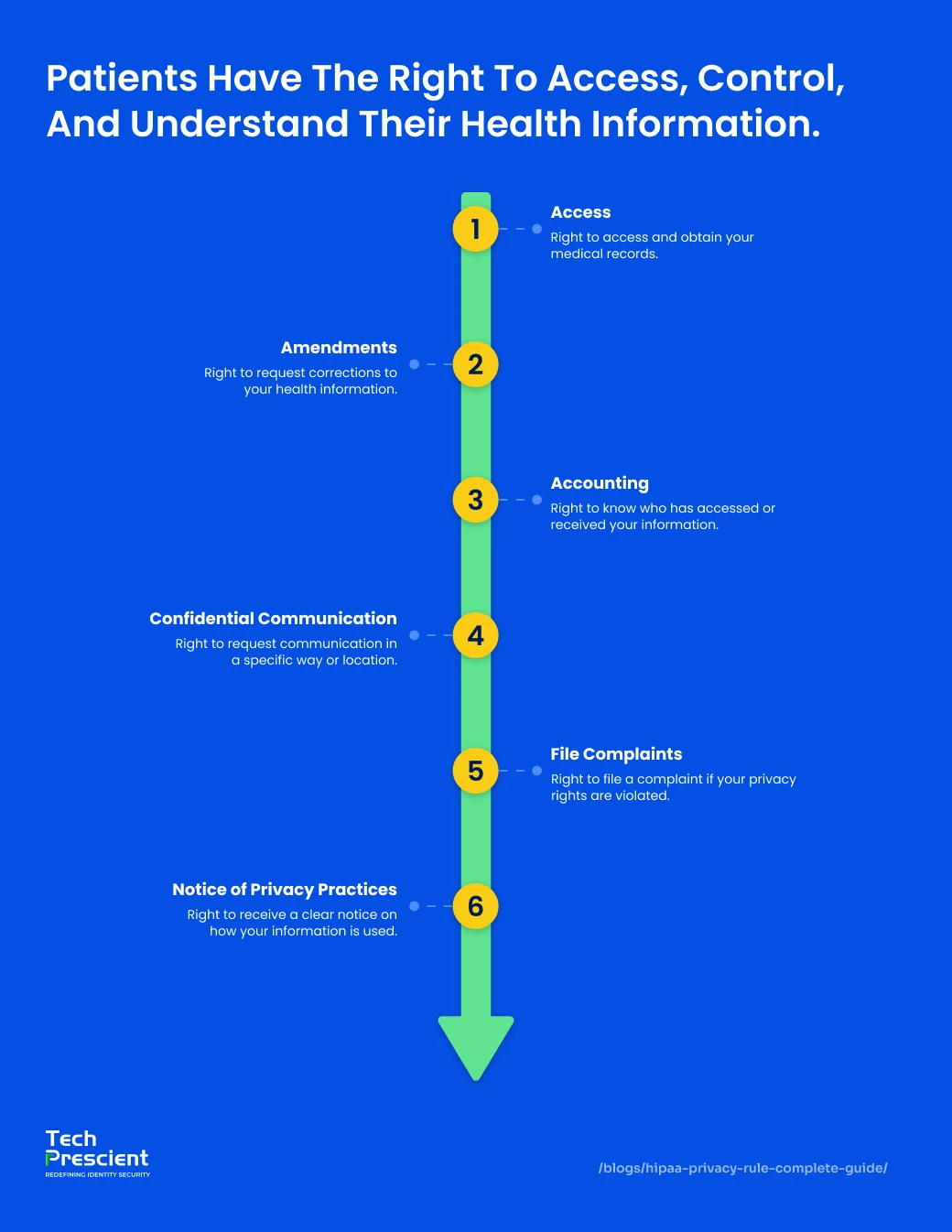
Here are the key rights patients are entitled to:
1. Right to access medical records
Patients have the right to view and obtain copies of their medical records and other PHI held by covered entities. This includes the ability to request records in a preferred format, with only reasonable fees allowed for copying or delivery.
2. Right to request amendments
If a patient believes their health information is incorrect or incomplete, they can request a correction. While organizations are not required to approve every request, they must review it and respond. If denied, the patient can submit a statement of disagreement that becomes part of the record.
3. Right to request accounting of disclosures
Patients can ask for a record of how their PHI has been disclosed over a specific period, typically up to six years. This does not include routine disclosures for treatment, payment, or healthcare operations.
4. Right to request confidential communication
Patients can request that healthcare providers communicate with them through specific channels or at certain locations, such as a different mailing address or phone number. Organizations must accommodate reasonable requests, especially when privacy or safety is a concern.
5. Right to file complaints
Patients have the right to file complaints if they believe their privacy rights have been violated. Complaints can be submitted to the organization directly or to regulatory authorities, and individuals must not face retaliation for doing so.
6. Right to receive Notice of Privacy Practices
Patients are entitled to receive a Notice of Privacy Practices that explains how their information will be used and disclosed, along with their rights under HIPAA. This helps ensure transparency from the beginning of the patient-provider relationship.
Quick Overview of Patient Rights
| Sr. No | Patient Right | Description |
|---|---|---|
| 1 | Right to access medical records | Patients can view and obtain copies of their health information |
| 2 | Right to request amendments | Patients can request corrections to inaccurate or incomplete data |
| 3 | Right to request accounting of disclosures | Patients can track how their information has been shared |
| 4 | Right to request confidential communication | Patients can choose how and where they are contacted |
| 5 | Right to file complaints | Patients can report violations without fear of retaliation |
| 6 | Right to receive NPP | Patients receive clear information on how their data is used and protected |
This set of HIPAA Privacy Rule patient rights ensures that individuals are not just passive subjects of data collection but active participants in how their health information is handled.
Struggling to enforce least privilege and access controls for PHI?
See how automated identity governance can simplify HIPAA compliance and reduce risk.
HIPAA Privacy Rule Administrative Staff Training
The HIPAA Privacy Rule requires organizations to train their workforce so they can properly handle Protected Health Information (PHI). Training is a key administrative safeguard that ensures employees understand privacy responsibilities, reduces the risk of violations, and supports overall compliance.
To meet these requirements, organizations must address the following areas:
1. Mandatory privacy training
All employees who have access to PHI must receive training on the organization’s privacy policies and procedures. This training explains how PHI can be used, disclosed, and protected, and ensures that every workforce member understands the basic requirements of HIPAA before handling sensitive information.
2. Role-based training requirements
Training must be tailored to the employee’s role and level of access to PHI. For example, clinical staff, administrative teams, and IT personnel interact with data differently, so each group must be trained on the specific risks, responsibilities, and controls relevant to their job functions.
3. Onboarding training
New hires must receive privacy training within a reasonable time after joining the organization. This ensures they are aware of compliance expectations from the start and can handle PHI correctly as soon as they begin their responsibilities.
4. Ongoing refresher training
Training must be continuous and updated regularly. Organizations are expected to provide refresher sessions and additional training whenever there are changes in policies, systems, or job roles, ensuring that employees stay aligned with current requirements and practices.
5. Documentation of training
Organizations must maintain records of all training activities, including what was covered, when it was conducted, and who attended. This documentation is important for demonstrating compliance during audits and for tracking whether employees have met training requirements.
6. Disciplinary policies
Organizations must enforce clear disciplinary actions when employees fail to follow privacy policies. These policies ensure accountability and reinforce the importance of handling PHI correctly, helping prevent repeated violations.
Real-world angle: Common staff mistakes leading to violations
In real-world scenarios, many HIPAA violations occur due to everyday mistakes rather than intentional misuse. Common issues include accessing patient records without a valid reason, discussing PHI in public areas, sending sensitive information to the wrong recipient, or leaving systems unsecured. These examples show why training must be practical and ongoing, helping employees understand how their daily actions impact data privacy and compliance.
Real-world example:
A healthcare organization faced a HIPAA violation when an employee accessed patient records without a valid reason. The issue occurred due to lack of role-based access controls and insufficient training.
Lesson: Implement least privilege access and continuous monitoring to prevent unauthorized access.
Exceptions to HIPAA Privacy Rule
The HIPAA Privacy Rule allows certain disclosures of Protected Health Information (PHI) without patient authorization when there is a valid legal, medical, or public interest reason. These HIPAA Privacy Rule exceptions ensure that critical activities like patient care, public safety, and regulatory compliance are not delayed, while still requiring organizations to apply safeguards and limit unnecessary exposure of data.
To understand where these exceptions apply, here are the key scenarios:
Treatment
PHI can be shared between healthcare providers when it is necessary to deliver, coordinate, or manage patient care. This includes consultations, referrals, and sharing medical history to ensure accurate diagnosis and treatment decisions.
Payment
PHI may be used and disclosed to process healthcare payments. This includes activities such as billing patients or insurers, verifying coverage, and managing claims so that providers can be reimbursed for services.
Healthcare operations
Organizations can use PHI for internal functions that support healthcare delivery. This includes quality improvement, performance evaluation, audits, staff training, and other operational activities that help maintain and improve care standards.
Public health activities
PHI can be disclosed to authorized public health authorities to monitor, prevent, or control diseases. This includes reporting infections, tracking outbreaks, and supporting public health investigations.
Law enforcement requests
PHI may be shared with law enforcement when required by law or under specific conditions, such as reporting certain injuries, identifying individuals involved in a crime, or assisting in investigations.
Court orders
Disclosures are permitted when PHI is requested through a valid legal process, such as a court order or subpoena. Organizations must ensure that the request meets legal requirements before sharing the information.
Preventing serious threats
PHI can be used or disclosed when necessary to prevent or reduce a serious and immediate threat to an individual or the public. This may include situations where there is a risk of harm or danger.
Workers’ compensation
PHI may be disclosed as needed to comply with workers’ compensation laws and programs that provide benefits for job-related injuries or illnesses.
Common Exceptions to HIPAA Privacy Rule
Public health reporting allows organizations to share information with authorities to control disease spread. Legal compliance requires disclosures when mandated by laws, regulations, or court orders. Emergency situations permit the use or sharing of PHI when immediate action is needed to protect health or safety.
These exceptions to HIPAA Privacy Rule requirements do not remove the responsibility to protect data. Organizations must still follow the minimum necessary principle and ensure that PHI is only shared appropriately and securely.
HIPAA Privacy Rule Compliance Best Practices
Staying compliant with the HIPAA Privacy Rule requires more than just policies on paper. Organizations need a continuous approach that combines risk awareness, access control, monitoring, and strong governance. In practice, compliance is an ongoing process that depends on identifying risks early, enforcing controls consistently, and maintaining clear documentation for audits.
To build a resilient compliance program, organizations should focus on the following best practices:
1. Conduct risk assessments
Regular risk assessments help organizations identify gaps in how PHI is stored, accessed, and shared. These assessments are not one-time activities. They must be repeated periodically to detect new vulnerabilities, evaluate existing safeguards, and ensure policies remain effective as systems and workflows evolve.
2. Maintain access logs
Organizations should track who accesses PHI, when, and for what purpose. Maintaining detailed access logs creates visibility into user activity, helps detect suspicious behavior, and provides an audit trail that is essential during compliance reviews or investigations.
3. Implement least privilege
Access to PHI should be limited to only what is necessary for a user’s role. Enforcing least privilege reduces the risk of unnecessary exposure and ensures that employees, contractors, and systems only have access to the data they truly need to perform their tasks.
4. Automate access reviews
Manual access reviews are often inconsistent and error-prone. Automating these reviews helps organizations regularly validate user permissions, identify outdated or excessive access, and ensure compliance with regulatory standards like HIPAA. Automated access reviews also improve audit readiness and reduce administrative overhead.
5. Audit vendor compliance
Third-party vendors and business associates often handle PHI, which makes them part of the compliance scope. Organizations must regularly assess vendor security practices, review agreements, and ensure that partners follow the same privacy and security standards required under HIPAA.
6. Incident response planning
Organizations need a clear and tested incident response plan to handle potential breaches or unauthorized disclosures. This includes identifying incidents, containing the impact, notifying affected parties when required, and documenting corrective actions to prevent recurrence. Regular testing ensures the plan works in real-world scenarios.
What Happens If You Violate the HIPAA Privacy Rule?
Violating the HIPAA Privacy Rule can lead to serious consequences, including financial penalties, legal action, and reputational damage. Enforcement is primarily handled by the HHS Office for Civil Rights, which reviews complaints, investigates potential violations, and determines corrective or punitive actions based on the severity of the incident.
To understand how enforcement works, here are the key aspects:
1. Tiered penalty structure
HIPAA violations are assessed under a tiered system based on the level of responsibility and intent. Penalties range from unintentional violations, where the organization was unaware, to cases of willful neglect where there was a clear failure to comply. The more serious the violation and the higher the level of negligence, the stricter the penalties.
2. Maximum fines
Financial penalties can vary significantly depending on the nature and scale of the violation. Fines are typically calculated per violation and can accumulate quickly in cases involving multiple records or repeated noncompliance. Large-scale breaches or repeated failures to implement safeguards often result in the highest settlements.
3. Criminal consequences
In more severe cases, especially where there is intentional misuse of Protected Health Information (PHI), criminal charges may apply. These can include fines and, in some situations, imprisonment depending on the level of intent and harm caused.
4. OCR investigations
When a complaint is filed, the Office for Civil Rights reviews the case and may initiate an investigation if a potential violation is identified. During this process, covered entities are required to provide access to relevant PHI and documentation. Most cases are resolved through corrective action plans, which may involve updating policies, retraining staff, and undergoing compliance monitoring.
5. Real-world enforcement trends
In practice, many violations are addressed through guidance and corrective measures rather than immediate penalties. However, enforcement has become stricter over time, especially in cases involving repeated noncompliance, denial of patient rights, or large data breaches. Impermissible disclosures of PHI can also trigger breach notification requirements and further investigation, even if the incident initially appears minor.
Overall, the impact of a violation depends on factors such as the nature of the incident, the harm caused, and the organization’s compliance history. This makes proactive compliance and strong privacy controls essential for avoiding both regulatory and operational risks.
Final Thoughts
The HIPAA Privacy Rule establishes a clear framework for protecting Protected Health Information (PHI) while enabling the secure flow of data across healthcare systems. By defining covered entities, patient rights, compliance requirements, and key exceptions, it brings consistency, accountability, and trust to healthcare data governance. As organizations handle growing volumes of sensitive health data, aligning with the Privacy Rule becomes essential to reducing risk, ensuring compliance, and maintaining patient confidence.
Tech Prescient helps organizations strengthen identity governance, enforce access controls, and operationalize HIPAA Privacy Rule compliance across critical healthcare environments.
Turn HIPAA requirements into actionable controls
Evaluate PHI access, enforce least privilege, and stay audit-ready with a structured assessment framework.
FAQs
HIPAA is built around five core rules that work together to protect health data. These include the Privacy Rule, Security Rule, Breach Notification Rule, Enforcement Rule, and Omnibus Rule. Together, they define how Protected Health Information (PHI) is used, secured, and regulated across healthcare systems.
The three primary rules most organizations focus on are the Privacy Rule, Security Rule, and Breach Notification Rule. These cover how PHI is handled, how electronic PHI (ePHI) is secured, and what happens when a data breach occurs. They form the foundation of day-to-day HIPAA compliance.
Under HIPAA, individually identifiable health information cannot be disclosed without patient authorization. This includes any data that can directly or indirectly identify a patient. The only exceptions are specific situations like treatment, legal requirements, or public health needs.
The HIPAA Privacy Rule applies to covered entities and business associates that handle PHI. This includes healthcare providers, health plans, clearinghouses, and third-party vendors. If an organization creates, receives, or processes PHI, it falls under HIPAA compliance requirements.
The Privacy Rule focuses on protecting all forms of PHI, including verbal, paper, and electronic data. The Security Rule, on the other hand, is specific to electronic PHI (ePHI) and outlines technical and security safeguards. In simple terms, one defines what to protect, while the other defines how to protect it.
Share



Yatin Laygude
Content Writer
A content writer with 6 years of experience turning complex topics into clear, engaging, and meaningful content. From blogs and web pages to whitepapers and thought pieces, he creates content that not only explains but also connects with both the audience and business goals.
Most Popular Blogs
Identity Security· 21 min read
Data Access Governance Solutions: How to Secure Sensitive Data at Scale
Compare data access governance solutions for 2026: how DAG platforms discover sensitive data, run access reviews, automate remediation, and prove compliance.
Brinda Bhatt· September 7, 2026
Identity Security· 24 min read
What Is Zero Trust Network Access (ZTNA)?
Learn what Zero Trust Network Access (ZTNA) is, how it works, and why it’s replacing VPNs for secure, identity-based access control.
Yatin Laygude· August 14, 2026
Identity Security· 24 min read
Cyber Essentials Certification: Complete Guide
Learn Cyber Essentials certification, cost, requirements, and steps. Compare Cyber Essentials vs Plus and get certified faster.
Yatin Laygude· August 10, 2026