




On this page
See Tech Prescient in Action
Automate access, reduce risk, and stay audit-ready
NIST CSF vs 800-53 is a common comparison for organizations looking to strengthen cybersecurity programs while meeting evolving compliance and regulatory requirements. Both frameworks are developed by the National Institute of Standards and Technology (NIST), but they serve different purposes in cybersecurity governance, risk management, and security implementation.
While NIST CSF focuses on high-level cybersecurity strategy, risk management, and business outcomes, NIST SP 800-53 provides a detailed catalog of technical and operational security controls. Understanding the difference between these frameworks helps organizations choose the right approach for improving security maturity, achieving compliance, and managing cyber risks effectively.
According to IBM's Cost of a Data Breach Report 2024, the global average cost of a data breach reached USD 4.88 million in 2024, marking a 10% increase from the previous year. As cybersecurity threats and compliance expectations continue to grow, frameworks like NIST CSF and NIST 800-53 help organizations build structured, scalable, and resilient cybersecurity programs. Let's explore their differences, similarities, and practical use cases in detail.
Key Takeaways:
- Understand the core difference between NIST CSF and NIST SP 800-53.
- Learn how NIST CSF focuses on cybersecurity strategy and risk management.
- Explore how NIST 800-53 provides detailed security and compliance controls.
- Discover when organizations should use NIST CSF, NIST 800-53, or both together.
- See how NIST CSF maps to NIST 800-53 for stronger cybersecurity governance and compliance.
What Is the NIST Cybersecurity Framework (CSF)?
The NIST Cybersecurity Framework (CSF) is a voluntary cybersecurity framework developed by the National Institute of Standards and Technology (NIST) to help organizations identify, assess, and reduce cybersecurity risks.
Originally created to strengthen critical infrastructure security, the framework is now widely adopted across industries because of its flexible and scalable approach to cybersecurity risk management. Instead of prescribing specific technical controls, NIST CSF focuses on high level cybersecurity outcomes that organizations can align with their business goals, compliance requirements, and security maturity. Many organizations also map NIST SP 800-53 controls to CSF categories and subcategories to support implementation and continuous improvement efforts.
The framework is built around five core functions that guide organizations through different stages of cybersecurity risk management.
1. Identify
The Identify function helps organizations understand their business environment, critical assets, systems, data, and cybersecurity risks. It establishes the foundation for effective risk management and security governance.
2. Protect
The Protect function focuses on implementing safeguards and security measures to reduce the impact of potential cybersecurity incidents. This includes access control, employee awareness training, data protection, and protective technologies.
3. Detect
The Detect function enables organizations to identify cybersecurity threats, anomalies, and suspicious activities in a timely manner. Continuous monitoring and detection processes help improve incident visibility and response readiness.
4. Respond
The Respond function outlines the actions organizations should take after identifying a cybersecurity incident. It includes incident response planning, communication, analysis, mitigation, and containment activities.
5. Recover
The Recover function supports business continuity by helping organizations restore systems, operations, and services after a cybersecurity incident. It focuses on recovery planning, resilience improvement, and operational restoration.
Simplify NIST Framework Alignment Before Compliance Gaps Appear
Download the NIST CSF to 800-53 Mapping Checklist to align cybersecurity strategy with actionable security controls.
What Is NIST SP 800-53?
NIST SP 800-53 is a comprehensive cybersecurity and privacy framework that provides a detailed catalog of security controls for protecting federal information systems and organizational operations.
Published as part of the NIST 800 series, the framework was originally developed to support compliance with the Federal Information Security Modernization Act (FISMA) and is widely used by federal agencies, government contractors, and organizations operating in highly regulated industries. Unlike broader cybersecurity frameworks focused on strategy and outcomes, NIST SP 800-53 provides prescriptive guidance for selecting, implementing, and assessing security and privacy controls that help organizations maintain the confidentiality, integrity, and availability of systems and data.
The framework organizes its security and privacy requirements into multiple control families that address different aspects of cybersecurity governance, risk management, and operational security.
1. Access Control (AC)
The Access Control family focuses on managing user identities, permissions, and system access to ensure that only authorized individuals can access sensitive systems and data.
2. Incident Response (IR)
The Incident Response family provides guidance for detecting, managing, reporting, and recovering from cybersecurity incidents to minimize operational and security impacts.
3. Risk Assessment (RA)
The Risk Assessment family helps organizations identify, analyze, and evaluate cybersecurity risks that could affect systems, operations, and organizational assets.
4. System and Information Integrity (SI)
The System and Information Integrity family focuses on monitoring systems, identifying vulnerabilities, detecting malicious activities, and maintaining system integrity through continuous protection measures.
5. Audit and Accountability (AU)
The Audit and Accountability family supports logging, monitoring, and auditing activities to improve visibility, ensure accountability, and support compliance and forensic investigations.
NIST CSF vs NIST 800-53: Key Differences
NIST CSF vs 800-53 is a common comparison for organizations evaluating cybersecurity frameworks for risk management, compliance, and security implementation. While both frameworks are developed by NIST and share the goal of improving cybersecurity resilience, they differ in purpose, structure, flexibility, and implementation approach. NIST CSF focuses on high level cybersecurity outcomes and risk management strategy, whereas NIST SP 800-53 provides detailed security and privacy controls that organizations can implement to secure systems and meet regulatory requirements.
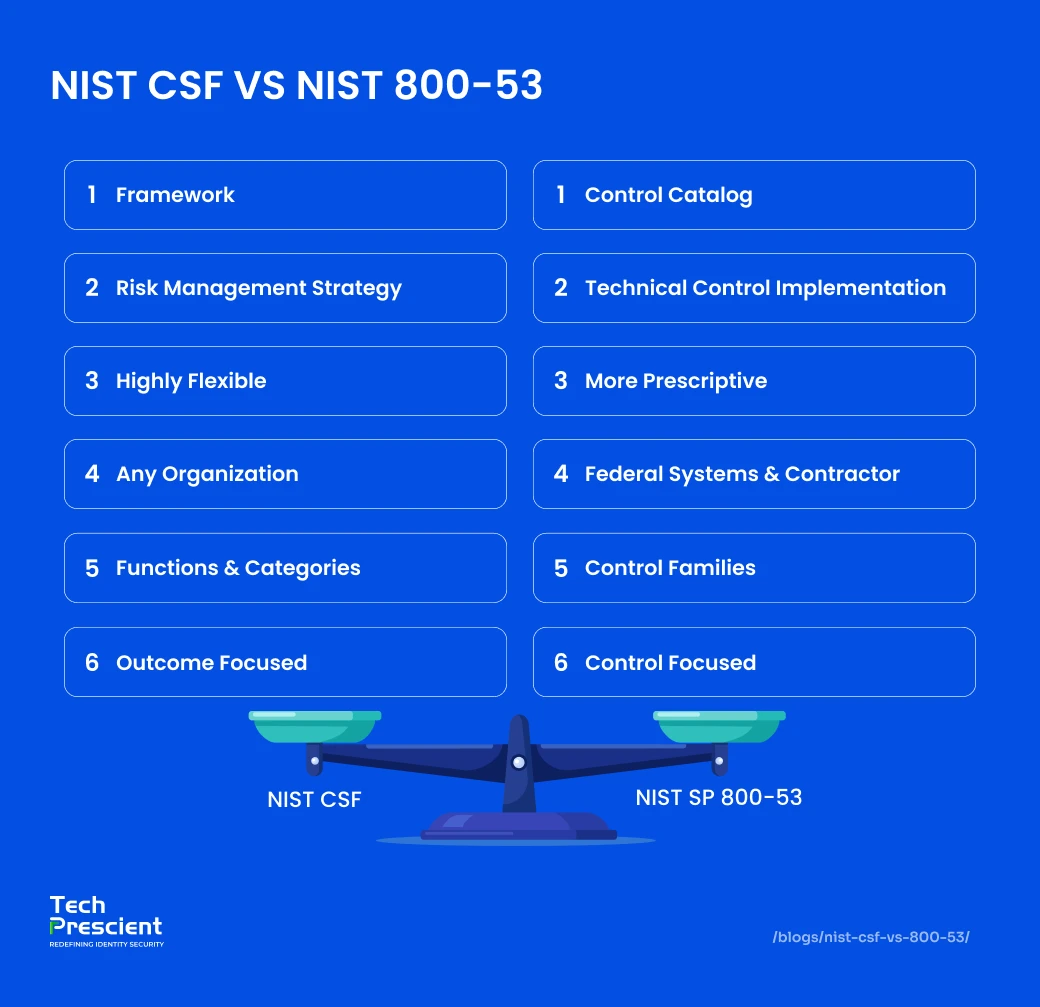
These differences become more apparent when comparing how each framework supports cybersecurity governance, compliance initiatives, and operational security programs.
Purpose
NIST CSF helps organizations manage cybersecurity risks through a flexible and outcome driven approach. It supports the development of cybersecurity strategies aligned with business objectives and organizational risk tolerance.
NIST SP 800-53 is designed to provide detailed technical and operational security controls that help organizations protect systems, manage risks, and maintain compliance with federal cybersecurity requirements.
Applicability
NIST CSF is intended for organizations of all sizes and industries, making it widely used across private sector businesses, healthcare organizations, and critical infrastructure environments.
NIST SP 800-53 is primarily used by federal agencies, government contractors, and organizations handling federal information systems, although many enterprises adopt it voluntarily because of its comprehensive security guidance.
Requirements
NIST CSF does not prescribe specific implementation steps or controls. Instead, it provides a framework of cybersecurity functions, categories, and outcomes that organizations can customize based on their cybersecurity maturity and risk profile.
NIST SP 800-53 includes prescriptive security and privacy controls along with implementation guidance, assessment procedures, and control baselines that organizations use to strengthen security and support compliance initiatives.
Structure
NIST CSF is organized around six core functions in CSF 2.0 including Govern, Identify, Protect, Detect, Respond, and Recover. These functions help organizations manage cybersecurity activities throughout the risk management lifecycle.
NIST SP 800-53 organizes security requirements into detailed control families such as Access Control, Incident Response, Risk Assessment, and Audit and Accountability, providing granular guidance for cybersecurity implementation.
The following table highlights the major differences between NIST CSF and NIST SP 800-53 across key cybersecurity and compliance areas.
| Sr. No | Feature | NIST CSF | NIST 800-53 |
|---|---|---|---|
| 1 | Type | A flexible cybersecurity framework focused on improving organizational cybersecurity outcomes | A comprehensive catalog of security and privacy controls for system protection |
| 2 | Purpose | Helps organizations manage cybersecurity risk and strengthen security strategy | Provides detailed technical and operational controls for security implementation |
| 3 | Flexibility | Highly adaptable and customizable based on business needs and risk maturity | More prescriptive with defined control requirements and implementation guidance |
| 4 | Use | Suitable for organizations across industries and business sizes | Primarily designed for federal agencies and government contractors |
| 5 | Structure | Organized into cybersecurity functions, categories, and subcategories | Organized into multiple control families with detailed security controls |

Pro Tip
Many organizations use NIST CSF to define cybersecurity strategy first and later implement NIST SP 800-53 controls as compliance and security requirements mature.
Similarities Between NIST CSF and NIST 800-53
Although NIST CSF and NIST SP 800-53 differ in structure and implementation, both frameworks share the same goal of helping organizations improve cybersecurity, manage risks, and strengthen security resilience. Developed by NIST, both frameworks are widely used across industries to support risk based cybersecurity programs and continuous security improvement.
1. Both Support Risk Based Cybersecurity Management
NIST CSF and NIST SP 800-53 both follow a risk based approach to cybersecurity rather than applying security measures uniformly across every environment. Organizations using either framework assess threats, vulnerabilities, operational priorities, and business risks to determine the most appropriate security measures and controls.
2. Both Can Be Mapped Together
One of the strongest similarities between the two frameworks is their ability to work together. NIST CSF provides high level cybersecurity outcomes through its functions, categories, and subcategories, while NIST SP 800-53 offers the detailed security and privacy controls needed to implement those outcomes. NIST also provides official mappings between CSF categories and 800-53 controls, helping organizations align strategy with technical implementation.
3. Both Are Widely Used Beyond Federal Agencies
Although NIST SP 800-53 was originally developed for federal information systems and NIST CSF was introduced to improve critical infrastructure security, both frameworks are now widely adopted across industries. Private-sector organizations, healthcare providers, financial institutions, and critical infrastructure operators often use these frameworks to strengthen cybersecurity governance and demonstrate security maturity.
4. Both Support Continuous Improvement
NIST CSF and NIST SP 800-53 encourage organizations to continuously monitor, assess, and improve cybersecurity programs over time. Both frameworks promote ongoing risk assessments, security reviews, continuous monitoring, and updates to security controls in response to changing threats, technologies, and business requirements.
Both Are Flexible and Adaptable
- Despite their structured guidance, both frameworks are designed to be adaptable to different organizational needs and cybersecurity maturity levels. Organizations can tailor implementation approaches, prioritize controls, and customize security programs based on their operational environment, industry requirements, and risk tolerance.
When Should Organizations Use NIST CSF vs 800-53?
Organizations typically choose NIST CSF for cybersecurity strategy and risk management, while NIST SP 800-53 is used for detailed security control implementation and federal compliance. The right choice depends on business goals, compliance requirements, and security maturity.
Best Use Cases for NIST CSF
1. Security Program Development
NIST CSF is ideal for organizations building or improving cybersecurity programs because it provides a flexible framework focused on risk management outcomes rather than prescriptive technical requirements.
2. Risk Assessments
Organizations use NIST CSF to identify cybersecurity gaps, assess organizational risks, and prioritize security initiatives based on operational and business impact.
3. Executive Reporting
The framework's high level structure makes it easier for leadership teams and stakeholders to understand cybersecurity priorities, risks, and overall security maturity.
4. Enterprise Cybersecurity Strategy
NIST CSF helps organizations align cybersecurity initiatives with broader business goals, making it suitable for enterprises seeking long term cybersecurity governance and resilience.
Best Use Cases for NIST 800-53
1. Federal Compliance
NIST SP 800-53 is essential for federal agencies, government contractors, and organizations required to comply with FISMA, DFARS, or other federal cybersecurity mandates.
2. Security Audits
Organizations adopt NIST SP 800-53 to support detailed security assessments, audits, and compliance reviews because of its comprehensive control baselines and implementation guidance.
3. Technical Control Implementation
The framework provides granular security and privacy controls that organizations can implement to strengthen system security, data protection, and operational resilience.
4. Government Contractors
Businesses supporting federal systems or handling government information often use NIST SP 800-53 to meet contractual security obligations and demonstrate cybersecurity compliance.
How NIST CSF Maps to NIST 800-53
NIST provides official mappings that connect NIST CSF functions, categories, and subcategories with corresponding NIST SP 800-53 security controls. This mapping helps organizations combine the strategic and risk based approach of NIST CSF with the detailed technical controls provided by NIST 800-53. By using both frameworks together, organizations can align cybersecurity goals with practical security implementation and compliance requirements.
The mapping process typically follows a structured workflow that helps organizations move from cybersecurity strategy to operational security controls.
1. Identify Risks Using NIST CSF
Organizations begin by using NIST CSF to evaluate their cybersecurity posture, identify critical assets, assess risks, and understand potential vulnerabilities. The framework's functions such as Identify, Protect, Detect, Respond, and Recover help organizations define cybersecurity priorities based on business and operational risks.
2. Map CSF Categories and Subcategories
Once risks are identified, organizations map relevant CSF categories and subcategories to corresponding NIST SP 800-53 controls. This helps translate high level cybersecurity objectives into specific technical and operational security requirements that can be implemented across systems and processes.
3. Implement Controls Through NIST 800-53
After the mapping process, organizations implement the applicable NIST SP 800-53 controls to strengthen security operations and compliance readiness. These controls support areas such as access control, incident response, audit logging, risk assessment, and system integrity management.
4. Perform Continuous Monitoring
The final step involves continuously monitoring security controls, assessing their effectiveness, and improving cybersecurity measures over time. Continuous monitoring helps organizations adapt to evolving threats, maintain compliance, and strengthen long term cybersecurity resilience.
Did You Know?
NIST provides official mappings between CSF categories and NIST SP 800-53 controls, making it easier for organizations to align risk management with technical security implementation.
Why Many Organizations Use Both Frameworks
Many organizations use both NIST CSF and NIST SP 800-53 together because NIST CSF supports cybersecurity strategy and risk management, while NIST SP 800-53 provides the detailed controls needed for implementation and compliance.
1. NIST CSF as the Strategy Layer
Organizations often use NIST CSF as the foundation for cybersecurity governance and risk management. Its high level structure helps security teams identify risks, prioritize cybersecurity initiatives, improve decision making, and measure overall security maturity across the organization.
2. NIST 800-53 as the Control Implementation Layer
Once cybersecurity priorities are established through NIST CSF, organizations implement NIST SP 800-53 controls to operationalize those objectives. The framework provides detailed guidance for implementing technical, operational, and administrative security controls across systems and processes.
3. Government Contractors
Government contractors commonly use NIST CSF to manage enterprise cybersecurity strategy while relying on NIST SP 800-53 controls to meet federal security and compliance requirements tied to government contracts.
4. Healthcare Systems
Healthcare organizations use NIST CSF to strengthen cybersecurity governance and risk management practices, while NIST SP 800-53 helps implement controls that protect sensitive healthcare data and critical systems.
5. Critical Infrastructure
Critical infrastructure organizations such as energy, transportation, and utility providers use NIST CSF to improve cyber resilience and risk visibility, while NIST SP 800-53 supports the implementation of detailed security controls for protecting operational technology and critical infrastructure systems.
Quick Insight
NIST CSF focuses on cybersecurity outcomes and governance, while NIST SP 800-53 focuses on implementing the controls needed to achieve those outcomes.
Move Beyond Framework Understanding to Compliance Execution
Get the NIST CSF to 800-53 Mapping Checklist to identify control gaps, improve governance, and strengthen audit readiness.
Final Thoughts
NIST CSF and NIST SP 800-53 help organizations strengthen cybersecurity through risk management, governance, and security controls. While NIST CSF focuses on cybersecurity strategy and outcomes, NIST SP 800-53 provides detailed controls for compliance and implementation across complex environments.
Tech Prescient helps organizations improve cybersecurity governance, strengthen identity and access management, and align security operations with NIST-based compliance frameworks.
FAQs
NIST CSF is a high level cybersecurity framework designed to help organizations manage and reduce cybersecurity risks through strategic guidance and risk management outcomes. NIST SP 800-53, on the other hand, is a detailed catalog of security and privacy controls used primarily by federal agencies and regulated organizations to implement and maintain security measures.
NIST SP 800-53 is widely used because it provides a comprehensive set of security and privacy controls that help organizations protect systems, data, and operations. It is also required for federal information systems under FISMA, making it a trusted framework for government agencies, contractors, and regulated industries.
NIST SP 800-53 defines the security and privacy controls organizations should implement to strengthen cybersecurity and compliance. NIST SP 800-53A complements it by providing assessment procedures and testing methods used to evaluate whether those controls are properly implemented and operating effectively.
NIST CSF is a cybersecurity risk management framework that helps organizations improve security posture through functions such as Identify, Protect, Detect, Respond, and Recover. The NIST Risk Management Framework (RMF) is a structured lifecycle process used to categorize systems, implement controls, assess risks, and continuously monitor security operations.
Yes, NIST provides official mappings that connect NIST CSF categories and subcategories with relevant NIST SP 800-53 controls. This mapping helps organizations align cybersecurity strategy with detailed control implementation and simplifies compliance and risk management efforts.
Share



Yatin Laygude
Content Writer
A content writer with 6 years of experience turning complex topics into clear, engaging, and meaningful content. From blogs and web pages to whitepapers and thought pieces, he creates content that not only explains but also connects with both the audience and business goals.
Most Popular Blogs

Identity Security· 21 min read
Data Access Governance Solutions: How to Secure Sensitive Data at Scale
Compare data access governance solutions for 2026: how DAG platforms discover sensitive data, run access reviews, automate remediation, and prove compliance.
Brinda Bhatt· September 7, 2026
Identity Security· 24 min read
What Is Zero Trust Network Access (ZTNA)?
Learn what Zero Trust Network Access (ZTNA) is, how it works, and why it’s replacing VPNs for secure, identity-based access control.
Yatin Laygude· August 14, 2026
Identity Security· 24 min read
Cyber Essentials Certification: Complete Guide
Learn Cyber Essentials certification, cost, requirements, and steps. Compare Cyber Essentials vs Plus and get certified faster.
Yatin Laygude· August 10, 2026