




On this page
See Tech Prescient in Action
Automate access, reduce risk, and stay audit-ready
The NIST Cybersecurity Framework (CSF) and the NIST Risk Management Framework (RMF) are widely adopted security models that serve different operational purposes. NIST CSF helps organizations manage cybersecurity strategy and governance at an enterprise level, while NIST RMF provides a structured process for implementing, assessing, and monitoring security controls.
In this blog, we'll compare NIST CSF vs RMF, explain the RMF 7-step process, and explore when organizations should use each framework.
Key Takeaways:
- NIST CSF is a flexible cybersecurity framework designed for organizations of all sizes
- NIST RMF is a prescriptive risk management process commonly used by federal systems
- RMF includes a structured 7-step lifecycle for implementing security controls
- CSF focuses on governance, risk alignment, and strategic security outcomes
- Many organizations use both approaches together to align governance with operational security execution
NIST CSF vs RMF at a Glance
| NIST CSF | NIST RMF |
|---|---|
| Strategic cybersecurity framework | Operational risk management process |
| Flexible and outcome-driven | Prescriptive and control-driven |
| Focuses on governance and security maturity | Focuses on system authorization and control validation |
| Used across industries | Common in federal environments |
What Is the NIST Cybersecurity Framework (CSF)?
The NIST Cybersecurity Framework (CSF) is a flexible risk management model developed by the National Institute of Standards and Technology (NIST) to help organizations identify, manage, and reduce cybersecurity risk through governance, protection, detection, response, and recovery practices.
Over time, it has become one of the most widely adopted cybersecurity governance frameworks across private enterprises, healthcare organizations, financial institutions, SaaS companies, and government agencies.
Unlike highly prescriptive compliance standards, CSF focuses on security outcomes rather than mandating specific technologies. This flexibility allows organizations to adapt controls based on operational requirements and risk exposure.
The framework helps organizations:
- Identify cybersecurity risks
- Improve security governance
- Build resilience against cyber threats
- Align cybersecurity with business objectives
- Establish continuous risk management practices
With the release of CSF 2.0, the framework expanded its focus on governance, leadership accountability, supply chain security, and enterprise-wide cybersecurity risk management.
The 6 Core Functions of NIST CSF (CSF 2.0)
The framework is built around six core functions that represent the lifecycle of cybersecurity risk management.
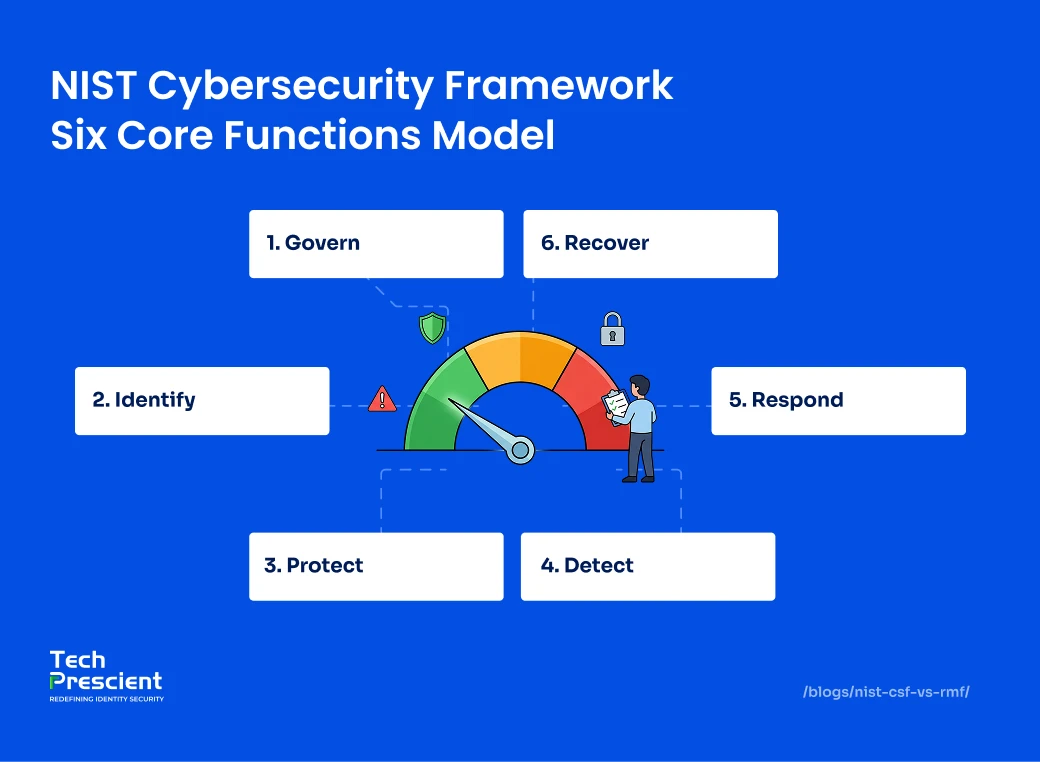
The six NIST CSF functions are:
- Govern — cybersecurity governance and oversight
- Identify — asset and risk visibility
- Protect — safeguards and access control
- Detect — threat monitoring and anomaly detection
- Respond — incident handling and containment
- Recover — restoration and resilience
Govern (GV)
The Govern function focuses on cybersecurity governance, risk oversight, policies, roles, and enterprise-wide accountability. It helps organizations align cybersecurity strategy with business and risk management objectives.
Identify (ID)
The Identify function helps organizations understand their assets, systems, users, data, and cybersecurity risks. This includes asset inventories, risk assessments, and supply chain visibility.
Protect (PR)
The Protect function focuses on safeguards that secure systems, applications, identities, and sensitive data. This includes access control, security awareness training, encryption, and protective technologies.
Detect (DE)
The Detect function helps organizations quickly identify cybersecurity events and suspicious activity through monitoring, anomaly detection, and threat visibility.
Respond (RS)
The Respond function focuses on actions taken after a cybersecurity incident occurs, including containment, investigation, communication, and incident response coordination.
Recover (RC)
The Recover function focuses on restoring systems, improving resilience, and maintaining business continuity after cybersecurity incidents.
Why Organizations Use NIST CSF
One of the biggest advantages of the NIST CSF risk management model is its flexibility. Organizations can use the framework to:
- Build cybersecurity programs
- Improve security maturity
- Support compliance initiatives
- Align with Zero Trust strategies
- Map controls to frameworks like ISO 27001 or NIST 800-53
Its outcome-driven structure makes it effective across both technical operations and executive governance initiatives.
What Is the NIST Risk Management Framework (RMF)?
The NIST Risk Management Framework (RMF) is a structured lifecycle for implementing, assessing, authorizing, and monitoring security controls across information systems. It is formally documented in NIST SP 800-37 and closely aligned with security control catalogs such as NIST SP 800-53. Unlike the broader and more flexible CSF approach, RMF is highly process-driven and operational.
The framework is widely used by:
- U.S. federal agencies
- Government contractors
- Defense organizations
- Highly regulated industries
For federal systems, RMF implementation is mandatory under federal cybersecurity requirements.
Key Characteristics of NIST RMF
The NIST RMF focuses heavily on:
- System-level risk management
- Security control implementation
- Formal authorization processes
- Continuous monitoring
- Compliance documentation and evidence collection
A major part of RMF is the concept of an Authority to Operate (ATO), where authorizing officials review security risks before approving system operations. RMF is significantly more documentation-intensive and operationally structured than CSF.
The RMF 7-Step Process
The RMF 7-step process defines the operational lifecycle for implementing and managing security controls.
1. Prepare
Organizations establish the context, scope, roles, resources, and risk management strategy needed to support RMF implementation.
2. Categorize Information Systems
Systems are categorized based on the sensitivity and impact level of the information they process, store, or transmit.
3. Select Security Controls
Organizations select appropriate security controls from frameworks such as NIST SP 800-53 based on system risk levels and compliance requirements.
4. Implement Controls
Selected security controls are implemented across systems, applications, infrastructure, and operational processes.
5. Assess Controls
Security controls are tested and evaluated to determine whether they are implemented correctly and operating effectively.
6. Authorize System Operation
Authorizing officials review risk assessments and determine whether the system can operate within acceptable risk thresholds.
7. Monitor Continuously
Organizations continuously monitor controls, vulnerabilities, configurations, and system activity to maintain security posture over time.
Why Organizations Use RMF
Organizations adopt RMF because it provides:
- Structured security governance
- Detailed security control implementation
- Continuous monitoring processes
- Strong compliance and audit support
- Formalized risk management workflows
It is especially valuable in environments where formal authorization, auditability, and regulatory oversight are mandatory.
NIST CSF vs RMF: Key Differences
The NIST Cybersecurity Framework (CSF) focuses on improving cybersecurity posture and governance outcomes, while the NIST Risk Management Framework (RMF) provides a structured lifecycle for implementing, assessing, and monitoring security controls.
CSF is designed as a flexible governance model that organizations can adapt based on business priorities and risk exposure. In contrast, the NIST RMF is a prescriptive operational process focused on system-level risk management, security control implementation, and compliance authorization.
Many organizations use both approaches together, with CSF guiding cybersecurity strategy and RMF driving operational execution.
NIST CSF vs RMF Comparison
| Feature | NIST CSF | NIST RMF |
|---|---|---|
| Primary Purpose | Improve overall cybersecurity posture and risk management | Manage and authorize system-level cybersecurity risk |
| Framework Type | Strategic and outcome-driven framework | Prescriptive operational risk management process |
| Primary Users | Private companies, enterprises, public sector organizations | U.S. federal agencies, defense organizations, government contractors |
| Structure | Functions, categories, and subcategories | 7-step lifecycle process |
| Core Focus | Cybersecurity governance and risk outcomes | Security control implementation and authorization |
| Compliance Model | Voluntary framework | Mandatory for many federal systems |
| Main Guidance Source | NIST CSF 2.0 | NIST SP 800-37 |
| Security Controls | Flexible outcomes-based controls | Uses detailed controls from NIST SP 800-53 |
| Best Use Cases | Improving security maturity and governance | Federal compliance and regulated environments |
| Complexity Level | Easier to adopt and scale | More resource-intensive and operationally complex |
Choosing the Wrong Framework Creates Complexity
Use the decision framework to identify the right governance model.
Strategic Framework vs Operational Process
One of the biggest differences between NIST CSF and RMF is the level at which they operate. The NIST CSF focuses on enterprise-level cybersecurity governance and risk management. It helps organizations define security objectives, improve maturity, and align initiatives with business priorities.
The NIST RMF, however, operates at a more detailed operational level. It provides a formal process for selecting, implementing, assessing, authorizing, and continuously monitoring security controls for specific systems.
Governance and Risk Management Approach
The NIST CSF focuses on enterprise-level cybersecurity governance and business risk alignment, while the NIST RMF emphasizes operational risk management and formal security authorization for individual systems. One of the biggest differences between CSF and RMF is how they approach enterprise risk and operational oversight.
CSF is designed to help organizations manage cybersecurity as an enterprise risk function. It provides strategic guidance for aligning security initiatives with operational resilience and business priorities.
The NIST RMF, on the other hand, focuses more on operational governance at the system level. It provides a formal process for assessing, authorizing, and continuously monitoring security controls within specific information systems.
CSF Governance Approach
The NIST CSF risk management model emphasizes flexibility, business alignment, and enterprise-wide cybersecurity maturity.
Organizations use CSF to:
- Align cybersecurity initiatives with business objectives
- Improve cybersecurity governance across departments
- Build enterprise risk management programs
- Establish cybersecurity policies and accountability
- Improve communication between technical and executive teams
Because the framework is outcome-focused, it works well for organizations looking to strengthen governance without being tied to highly prescriptive compliance processes.
RMF Governance Approach
The NIST RMF uses a more formalized governance structure centered around system authorization and operational accountability.
RMF governance is typically:
- Driven by authorizing officials and risk executives
- Focused on system-specific risk decisions
- Closely tied to compliance and audit requirements
- Based on documented assessments and control validation
A major part of RMF is the Authority to Operate (ATO) process, where leadership formally reviews cybersecurity risks before approving system operations. This governance model is especially important in regulated environments where formal authorization is required.
Expert Insight: Organizations often fail to connect cybersecurity governance with operational execution. CSF and RMF are most effective when strategic risk priorities are directly tied to operational controls, monitoring, and accountability.
Enterprise Applicability: Which Framework Should You Use?
Organizations often use both frameworks together, NIST CSF for strategic cybersecurity governance and NIST RMF for operational risk management and compliance implementation. The decision between NIST CSF vs RMF depends largely on the organization's industry, regulatory requirements, operational complexity, and cybersecurity maturity goals.
For many private organizations, the NIST Cybersecurity Framework is the preferred starting point because it provides flexible guidance for improving cybersecurity posture without requiring a rigid compliance process. RMF is more suitable for environments requiring formalized controls, authorization processes, and continuous compliance oversight.
When to Use NIST CSF
Organizations typically adopt NIST CSF when they want to:
- Build or improve cybersecurity strategy
- Align cybersecurity with business objectives
- Improve overall security maturity
- Strengthen enterprise risk management
- Implement flexible cybersecurity governance
Because the framework is scalable and adaptable, it is widely used across private enterprises, SaaS companies, healthcare organizations, and critical infrastructure environments.
When to Use NIST RMF
Organizations generally adopt NIST RMF when they need:
- Federal cybersecurity compliance
- Formal system authorization processes
- Detailed control implementation guidance
- Continuous monitoring and audit readiness
- Structured risk management workflows
RMF is especially common among:
- U.S. federal agencies
- Defense organizations
- Government contractors
- Highly regulated industries
Its prescriptive nature makes it well-suited for environments where documentation, assessments, and compliance evidence are mandatory.
Choosing the Right Approach
In practice, many organizations do not choose one framework exclusively.
Instead:
- CSF provides the strategic cybersecurity roadmap
- RMF operationalizes that strategy through detailed security controls and monitoring processes
This combined approach connects executive governance with operational security execution.
Which Framework Should Organizations Start With?
Most private organizations begin with NIST CSF because it is easier to adopt and provides flexible guidance for improving cybersecurity maturity. Organizations operating in federal or highly regulated environments often adopt RMF to meet compliance and authorization requirements. Many enterprises eventually use both frameworks together, using CSF for governance and RMF for operational implementation.
How NIST CSF and RMF Work Together
Many organizations use CSF to guide security strategy while using RMF to operationalize and monitor security controls. Although the frameworks serve different purposes, they are highly complementary when used together.
The NIST CSF helps organizations define cybersecurity objectives, risk management priorities, and governance strategies. The NIST RMF then provides the operational structure needed to implement and validate those objectives through formal security controls and monitoring processes. This approach connects enterprise governance with operational controls and compliance activities.
Example Workflow
A common implementation model looks like this:
- CSF defines cybersecurity objectives and risk priorities
Organizations define the security outcomes they want to achieve across governance, protection, detection, response, and recovery. - RMF implements security controls using NIST SP 800-53
Security teams select, implement, assess, and authorize controls aligned with organizational risk requirements. - Continuous monitoring maintains security and compliance
Organizations continuously monitor systems, identities, vulnerabilities, and control effectiveness to maintain operational resilience.
Why Organizations Combine CSF and RMF
Using both frameworks together helps organizations:
- Connect cybersecurity governance with operational controls
- Improve compliance readiness
- Standardize risk management processes
- Strengthen continuous monitoring capabilities
- Align technical security activities with business risk management
This approach is especially valuable for enterprises operating in regulated, cloud-heavy, or hybrid environments.

Pro Tip
Organizations achieve better security outcomes when CSF defines the "why" behind cybersecurity objectives, and RMF defines the "how" for operational implementation and continuous control management.
Benefits and Limitations of Each Framework
The NIST CSF offers flexibility and scalability for cybersecurity governance, while the NIST RMF provides detailed control implementation and compliance support, but with greater operational complexity. Both approaches offer different strengths depending on operational complexity, regulatory requirements, and security maturity goals.
NIST CSF: Benefits & Limitations
CSF Advantages
One of the biggest strengths of the NIST Cybersecurity Framework is its flexibility. Organizations can adapt the framework to different industries, business models, and risk environments without being locked into rigid implementation requirements.
CSF is also:
- Easier to adopt compared to highly prescriptive frameworks
- Scalable for organizations of different sizes
- Effective for improving cybersecurity governance and maturity
- Widely applicable across both private and public sectors
Because CSF focuses on security outcomes rather than rigid technical controls, it helps organizations align cybersecurity initiatives with business objectives more effectively.
CSF Limitations
While flexibility is a major advantage, it can also become a challenge. CSF does not prescribe mandatory controls or detailed implementation guidance, which means organizations may struggle with consistency if they lack internal cybersecurity expertise or operational maturity.
As a result:
- Implementation approaches may vary significantly
- Organizations may need additional frameworks for detailed controls
- Compliance evidence and operational guidance can be less structured
CSF works best when combined with operational frameworks, standards, or governance processes.
NIST RMF: Benefits & Limitations
RMF Advantages
The NIST Risk Management Framework provides a highly structured and formalized process for managing cybersecurity risk.
RMF offers:
- Detailed security control implementation guidance
- Strong support for compliance and audit readiness
- Continuous monitoring and assessment processes
- Formal authorization and accountability structures
- Alignment with NIST SP 800-53 security controls
This makes RMF especially valuable in federal environments, government contracting, and highly regulated industries.
RMF Limitations
RMF's structured model also increases operational overhead.
Implementing RMF often requires:
- Extensive documentation and evidence collection
- Dedicated security and compliance resources
- Formalized assessment and authorization workflows
- Ongoing operational oversight and monitoring
For smaller or less regulated organizations, RMF may introduce unnecessary operational complexity.
| Area | NIST CSF | NIST RMF |
|---|---|---|
| Flexibility | High | Moderate |
| Operational Depth | Moderate | High |
| Compliance Support | Moderate | Extensive |
| Complexity | Lower | Higher |
| Governance Focus | Strong | Moderate |
Final Thoughts
NIST CSF and RMF are complementary cybersecurity frameworks that help organizations improve governance, operational security, compliance, and long-term cyber resilience. As environments become more identity-centric and cloud-driven, organizations increasingly combine CSF governance models with RMF operational controls to build scalable security programs.
Connect Governance With Operational Security
Learn when to use CSF, RMF, or both for scalable security.
FAQs
The main difference between NIST RMF and CSF is that RMF is a structured operational process for implementing and managing security controls, while CSF is a flexible cybersecurity framework focused on improving overall cybersecurity posture and governance. CSF helps organizations define cybersecurity objectives and risk management strategies, whereas RMF provides the detailed lifecycle for implementing, assessing, authorizing, and continuously monitoring controls.
The six core functions, or pillars, of NIST CSF 2.0 are Govern, Identify, Protect, Detect, Respond, and Recover. Together, these functions create a continuous lifecycle for managing cybersecurity risk, improving resilience, and aligning cybersecurity with business objectives.
The NIST RMF 7-step process includes Prepare, Categorize, Select, Implement, Assess, Authorize, and Monitor. This lifecycle helps organizations manage system-level cybersecurity risks by implementing security controls, validating effectiveness, authorizing operations, and continuously monitoring security posture over time.
Yes. The NIST Risk Management Framework (RMF) is mandatory for U.S. federal agencies and many government contractors under federal cybersecurity requirements. However, private organizations can also adopt RMF voluntarily to strengthen operational security, compliance readiness, and continuous risk management practices.
Yes. Many organizations use NIST CSF and RMF together because the frameworks are highly complementary. CSF helps define cybersecurity strategy, governance, and risk management priorities, while RMF provides the operational process for implementing security controls and maintaining compliance through continuous monitoring and assessment.
Share



Rashmi Ogennavar
Content Strategist
A content strategist translating complex Tech and SaaS concepts into compelling narratives for business and technical audiences. With a strategic, data-informed approach, the work bridges content and product storytelling, crafting messaging that resonates and drives decisions across the buyer journey.
Most Popular Blogs

Identity Security· 21 min read
Data Access Governance Solutions: How to Secure Sensitive Data at Scale
Compare data access governance solutions for 2026: how DAG platforms discover sensitive data, run access reviews, automate remediation, and prove compliance.
Brinda Bhatt· September 7, 2026
Identity Security· 24 min read
What Is Zero Trust Network Access (ZTNA)?
Learn what Zero Trust Network Access (ZTNA) is, how it works, and why it’s replacing VPNs for secure, identity-based access control.
Yatin Laygude· August 14, 2026

Identity Security· 24 min read
Cyber Essentials Certification: Complete Guide
Learn Cyber Essentials certification, cost, requirements, and steps. Compare Cyber Essentials vs Plus and get certified faster.
Yatin Laygude· August 10, 2026