




On this page
See Tech Prescient in Action
Automate access, reduce risk, and stay audit-ready
Password attacks are techniques attackers use to obtain, guess, or bypass user credentials in order to gain unauthorized access to systems or data.
Credential-based attacks remain one of the most common entry points for modern cyber incidents. Instead of exploiting complex software vulnerabilities, attackers frequently rely on stolen, reused, or weak passwords to access legitimate accounts.
Once attackers authenticate with valid credentials, they often appear indistinguishable from normal users. As a result, compromised accounts can allow attackers to move through systems without immediately triggering traditional security alerts.
Password attacks remain effective because users frequently reuse passwords and large databases of leaked credentials allow attackers to test them across services. According to IBM's Cost of a Data Breach Report, the average cost of a credential-based breach is $4.88 million.
This guide explains the most common types of password attacks, real-world breach examples, and the security controls organizations use to prevent credential-based compromise.
Key Takeaways:
- Password attacks exploit weak, reused, or stolen credentials to gain unauthorized access to systems and data
- Most breaches start with a compromised password, often undetected for weeks or months
- Stronger passwords alone won't solve the problem; you need layered defenses and identity governance
- Modern compliance standards (NIST, PCI DSS, HIPAA) now require multi-factor authentication and continuous credential monitoring
What Is a Password Attack?
A password attack is a technique used to gain unauthorized access to accounts, systems, or applications by exploiting weaknesses in password-based authentication.
Rather than targeting software vulnerabilities, these attacks focus on credentials. Attackers attempt to obtain or guess passwords through methods such as brute force attempts, credential reuse, or phishing.
Because attackers authenticate with valid credentials, malicious activity can appear indistinguishable from legitimate user behavior, allowing compromised accounts to persist undetected.
Most Common Types of Password Attacks
Brute Force Password Attack
A brute force attack systematically tests large numbers of password combinations until the correct credentials are identified. Brute force attacks can be inefficient but remain effective when login protections are absent.
Security Insight:
Password spraying is a common variation of brute force attacks. Instead of testing thousands of password combinations against a single account, attackers try the same weak password across many accounts. This approach avoids account lockouts and bypasses traditional rate-limiting protections.
Real example: In January 2024, state-sponsored actors ran a password spray attack against Microsoft. The attack relied on basic techniques. They just tested weak passwords against old systems that didn't have MFA. Within weeks, they had access to senior leadership email and source code. One basic control was missing. The compromise resulted in significant organizational exposure.
Dictionary Attack
A dictionary attack uses a pre-compiled list of common passwords rather than trying every possible combination. The attacker pulls together millions of known passwords from previous breaches, applies rule-based variations, and tests them against accounts.
The most common passwords people choose are still "password", "123456", and "letmein". Even when people try to make things complex, they follow patterns: "Password123", "Welcome2024", or the company name with a number.
Complexity requirements often push users toward predictable patterns rather than truly random passwords.
Credential Stuffing Attack
A credential stuffing attack doesn't guess anything. The attacker simply reuses username and password pairs from a previous breach and tests them against your login portal.
In 2024, attackers used previously leaked credentials to access Snowflake customer environments where multi-factor authentication had not been enabled, affecting more than 160 organizations.
Pro Tip:
If you force unique passwords and MFA, attackers can steal credentials all day. This prevents attackers from reusing stolen credentials. They can't log in without the second factor, and they can't reuse the password anywhere else.
Phishing-Based Password Attacks
Phishing does not crack passwords. It tricks users into entering credentials on fraudulent login pages. The user clicks a link, lands on a fake login page that mirrors the legitimate service, and enters their password. The attacker captures it.
The variants matter. Spear phishing targets specific individuals using information gathered from LinkedIn or previous breaches. Smishing arrives via text message. Vishing happens over a voice call where someone impersonates a support agent. Whaling specifically targets executives and high-value individuals who control sensitive systems.
In February 2024, the Change Healthcare ransomware attack began with a phishing email that captured employee credentials for a portal without multi-factor authentication. The attackers used the compromised account to deploy ransomware that disrupted healthcare services across the United States.
Phishing is effective because humans make mistakes under pressure. Even security-aware employees can fall victim to well-crafted phishing campaigns. The fix isn't more training. It's implementing multi-factor authentication that's resistant to phishing, like FIDO2 hardware keys or Windows Hello. Even if someone enters their password on a phishing page, they can't complete the authentication challenge.
Keylogging Attack
A keylogging attack uses malware to record everything you type. When you enter your password, the keylogger captures it. When you access sensitive systems, the attacker sees exactly what you're doing. The malware might arrive through a malicious email attachment, a drive-by download, or during a software update.
Keyloggers operate silently in the background, capturing every keystroke without the user's knowledge. Detection might take weeks if your organization lacks proper endpoint monitoring. A keylogger records context: not just your password, but which system you accessed, when, from where, and what you did after logging in. This is why endpoint detection and response tools matter as much as password policies do.
Man-in-the-Middle (MitM) Attack
A man-in-the-middle attack intercepts communication between you and a server, capturing credentials transmitted over unencrypted channels. They can inject malicious code into your session, perform session hijacking, or redirect you to a fraudulent site.
This attack requires unencrypted traffic or specific network conditions, so it's less common than it used to be. But it still works against legacy systems, internal networks, and users who click on lookalike domains. HTTPS encryption is now standard, but misconfigured systems remain vulnerable.
Rainbow Table Attack
A rainbow table attack targets password databases, not live login portals. When attackers breach a database and steal password hashes, they use precomputed lookup tables to reverse those hashes and recover the actual passwords.
Rainbow table attacks use precomputed lookup tables to reverse weak password hashes stored without unique salts. Modern applications use strong hashing functions like bcrypt or Argon2 plus salting, making rainbow table attacks largely obsolete for new systems. But legacy applications remain vulnerable.
Real-World Impact of Password Attacks
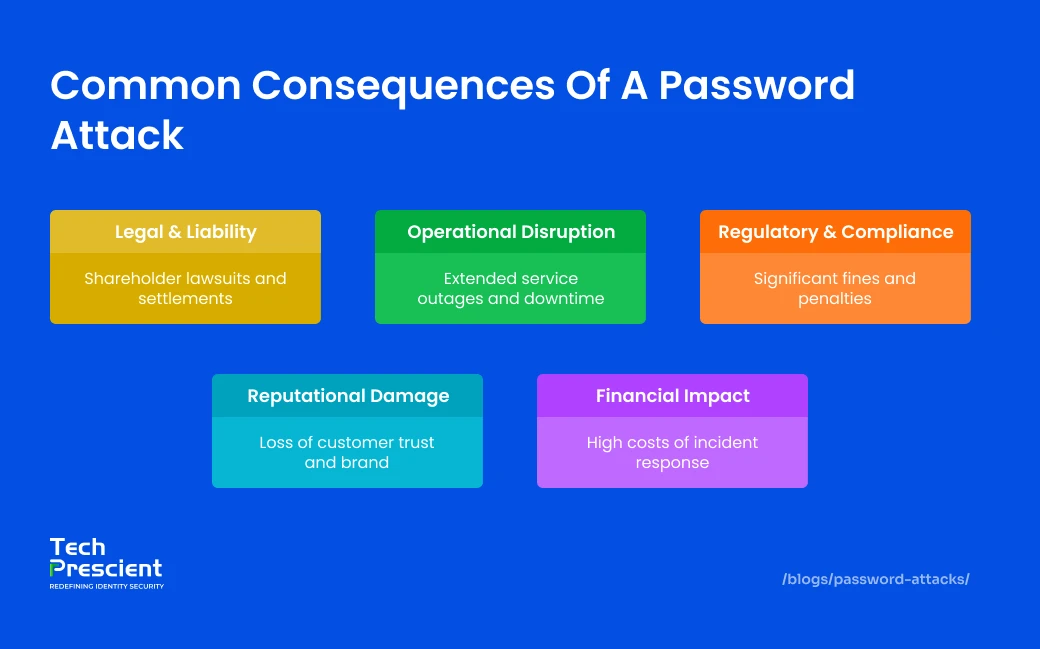
A major healthcare ransomware attack in 2024 cost a large U.S. healthcare provider $2.457 billion in direct costs and disrupted healthcare services nationwide, affecting 192.7 million people. The incident began with a compromised credential that allowed attackers to access internal systems and deploy ransomware across interconnected services.
Because attackers authenticate using legitimate credentials, security monitoring tools may initially interpret the activity as normal user behavior.
Security Insight:
Attackers authenticate with legitimate credentials; traditional security tools may not detect abnormal activity immediately. This is why identity governance and continuous access monitoring are critical to limit exposure.
Regulatory penalties are escalating. Regulators increasingly investigate organizations after credential-based breaches, especially when strong authentication controls such as multi-factor authentication were not enforced. GDPR violations now carry fines up to 20 million euros or 4% of global revenue. Healthcare organizations that fail to protect sensitive data may face significant regulatory penalties under HIPAA. SOX violations trigger mandatory breach disclosures and shareholder liability. Organizations that failed to enforce multi-factor authentication face heightened scrutiny when breaches occur.
How to Prevent Password Attacks
Enforce Strong Password Policies Correctly
Effective defense against password attacks requires layered controls. Traditional password policies emphasized complexity rules such as uppercase letters, symbols, and forced resets every 90 days. Modern guidance from security frameworks like NIST instead prioritizes password length and breach detection, because complexity rules often push users toward predictable patterns.
Long passphrases are easier for users to remember and significantly harder to crack through automated attacks.
Recommended controls:
- Require passwords with a minimum length of 12-16 characters
- A combination of uppercase, lowercase letters, numbers, and special characters
- Allow passphrases instead of forced complexity patterns
- Check passwords against known breach databases
- Require password changes only when compromise is detected
Enable Multi-Factor Authentication (MFA)
Multi-factor authentication is your strongest defense. It requires two things to log in: something you know (password), plus something you have (phone, key) or something you are (fingerprint). Even if a password is compromised, attackers cannot authenticate without the second factor.
Not all MFA methods provide equal protection. SMS-based multi-factor authentication is susceptible to SIM swapping. App-based TOTP (time-based one-time password) is more secure. Hardware security keys using FIDO2/WebAuthn provide phishing-resistant authentication.
Important Insight:
MFA is just one layer. Even with MFA, a stolen credential can give attackers too much access if you don't limit permissions. That's where identity governance comes in. You control what each password can reach. If privileges are properly restricted, compromised credentials provide minimal access.
Start with high-risk accounts: executives, IT administrators, database access. Extend to all user accounts within 6 months. Gradually migrate toward phishing-resistant methods like FIDO2 keys.
Use Password Managers
A password manager securely stores passwords and auto-fills login forms. Instead of reusing the same password, users generate unique, strong passwords for each site. The password manager remembers them. This solves the credential stuffing problem directly. If your password at Site A is stolen, attackers can't use it at Site B because it's different.
Enterprise password managers like 1Password Business, Dashlane Teams, or Bitwarden Enterprise integrate with SSO, enforce password policies, and provide audit trails. The limitation: a compromised master password exposes everything. So password managers must be paired with multi-factor authentication on the manager itself and on critical accounts.
Monitor for Compromised Credentials
Continuously scan for your organization's credentials appearing in breach databases and dark web marketplaces. When a match is found, immediately reset that user's password and alert them. Organizations can use automated credential monitoring tools that scan breach databases and alert security teams when employee credentials appear in leaked datasets.
Detecting leaked credentials early allows organizations to reset accounts quickly and prevent attackers from using stolen passwords to access internal systems. In regulated industries like healthcare and finance, credential monitoring is now a compliance requirement.
Limit Login Attempts and Enable Account Lockouts
After N failed login attempts (typically 5-10), lock the account temporarily. This prevents brute force and dictionary attacks by introducing friction and time delays. Configure your system to lock for 30 minutes to 2 hours, implement rate limiting at the IP level as well, and alert security teams when lockouts occur. This control is effective in reducing attack success rates.
Move Toward Passwordless and Zero Trust
The long-term solution is to remove passwords entirely. Passkeys (based on WebAuthn/FIDO2 standards) let users authenticate using biometrics or a PIN stored on their device. No password ever gets transmitted. Adoption of passkeys is growing as major platforms support passwordless authentication.
On the organizational side, identity governance reduces the damage even if passwords are compromised. Implement least privilege so each user has only the access they genuinely need. Run regular access reviews to validate that people still require their current permissions. Deprovision accounts immediately when employees change roles or leave. If a compromised credential grants zero standing privileges, the attacker gets zero access.
Automating access controls, enforcing policies, and maintaining an audit trail reduces the risk associated with compromised credentials. This approach shifts security strategy from protecting passwords to minimizing the impact of credential compromise.
Are Your Access Reviews Audit-Ready?
Password attacks often succeed because compromised accounts retain excessive permissions long after access should have been removed.
Final Thoughts
While organizations cannot eliminate all credential theft attempts, limiting account privileges and enforcing strong authentication controls significantly reduces the potential impact of compromised credentials.
Tech Prescient's Identity Confluence limits what each compromised password can reach. Your team gets access controls without the manual work. This helps reduce the operational impact of credential-based breaches.
Frequently Asked Questions
A password attack is any method an attacker uses to obtain, guess, or bypass user credentials. This includes phishing (tricking users into revealing passwords), credential stuffing (reusing leaked passwords from other breaches), brute force (systematically testing combinations), keylogging (malware that records keystrokes), and man-in-the-middle attacks (intercepting unencrypted communications). The goal is always unauthorized access to systems or data.
The most prevalent types are brute force (systematic guessing), dictionary attacks (testing common words and patterns), credential stuffing (reusing leaked credentials), phishing (social engineering), keylogging (malware that records typing), man-in-the-middle (intercepting unencrypted traffic), and rainbow table attacks (cracking hashes using precomputed tables). Credential stuffing is currently the highest-volume attack globally, affecting millions of accounts annually.
The Change Healthcare breach in February 2024 began with stolen credentials for a Citrix portal lacking multi-factor authentication. Attackers deployed ransomware affecting 192.7 million people. The attack showed how a single compromised credential can cascade into massive organizational damage when access controls aren't properly managed.
Hackers commonly obtain credentials through phishing, malware such as keyloggers, database breaches, and network interception attacks. Stolen passwords are then tested against multiple services, bought and sold on dark web marketplaces, and used to compromise accounts on platforms where users reused credentials.
Multi-factor authentication significantly reduces the risk of credential-based account compromise. Limiting login attempts prevents brute force, monitoring for compromised credentials enables rapid password resets, and adopting identity governance reduces the access each password unlocks. Modern organizations are also transitioning to passwordless authentication, like passkeys and hardware tokens to eliminate password theft entirely.
Share



Brinda Bhatt
Digital Marketing Strategist
A Digital Marketing Strategist who makes complex identity governance accessible to security and technology leaders through clear, data-driven content. Her insight-led, audience-focused approach supports Tech Prescient's mission of redefining identity security for modern enterprises.
Most Popular Blogs
Identity Security· 21 min read
Data Access Governance Solutions: How to Secure Sensitive Data at Scale
Compare data access governance solutions for 2026: how DAG platforms discover sensitive data, run access reviews, automate remediation, and prove compliance.
Brinda Bhatt· September 7, 2026
Identity Security· 24 min read
What Is Zero Trust Network Access (ZTNA)?
Learn what Zero Trust Network Access (ZTNA) is, how it works, and why it’s replacing VPNs for secure, identity-based access control.
Yatin Laygude· August 14, 2026
Identity Security· 24 min read
Cyber Essentials Certification: Complete Guide
Learn Cyber Essentials certification, cost, requirements, and steps. Compare Cyber Essentials vs Plus and get certified faster.
Yatin Laygude· August 10, 2026