




On this page
See Tech Prescient in Action
Automate access, reduce risk, and stay audit-ready
User Access Review (UAR) is a formal process used to verify that users have only the access required for their current role, no more and no less. It helps organizations reduce security risk, prevent privilege creep, and meet compliance requirements such as SOX, ISO 27001, SOC 2, HIPAA, and GDPR.
In modern enterprises, access management does not always evolve at the same pace as employee roles, responsibilities, or employment status. Without consistent review, organizations risk privilege creep, orphaned accounts, and access misalignment that can weaken security and compliance posture.
In this blog post, we will explore UARs, detailed process steps for review, best practices, common challenges, streamlining with automation, and the future of access governance in 2025.
Key Takeaways
- Unreviewed access can gradually increase exposure to insider risk and unauthorized data access.
- Regulatory compliance (SOX, HIPAA, GDPR, ISO 27001, PCI DSS, SOC 2) requires consistent and documented access reviews, so there are procedures in place.
- Enforcing least privilege stops employees and contractors from collecting excessive permissions.
- Automation improves review efficiency by reducing manual effort, errors, and remediation delays
- Addressing high-risk accounts makes sure the most sensitive systems are being protected.
- Documented, repeatable review processes provide audit evidence while strengthening overall security governance.
What is a User Access Review?
A user access review is a formal process used to verify that users have only the access necessary for their current job responsibilities. It involves reviewing user permissions across systems, validating business justification, and revoking unnecessary or excessive access to enforce least privilege and meet compliance requirements.
The purpose of a User Access Review is to eliminate privilege creep (the accumulation of unnecessary permissions over time). Users often retain access from previous roles, projects, or out-of-date responsibilities when they are not subjected to reviews. In a UAR, managers or administrators evaluate the permissions and privileges assigned to each user in a systematic fashion to see if they are aligned with a user's current job duties and organizational policies. The process enables the user to only have access to information and resources that are necessary for them to perform their job, which minimizes their exposure to sensitive systems and helps to close compliance gaps.
Key Objectives of User Access Reviews:

Prevent unauthorized access
UARs ensure that only approved users retain access to sensitive systems and data, reducing the risk of unauthorized access before incidents occur.
Support regulatory compliance
Many regulatory and security frameworks require periodic access reviews. Consistent, documented UARs provide evidence of control effectiveness during audits and assessments.
Control privilege creep
As employees change roles or complete projects, permissions often accumulate. UARs identify and remove excess access, limiting unnecessary exposure to critical resources.
Reduce insider risk
Both malicious and unintentional insider activity can exploit excessive permissions. UARs restrict access to what is explicitly required, reducing the potential impact of misuse.
Simplify audits and evidence collection
Well-documented and automated access reviews produce audit-ready records, reduce manual evidence gathering, and lower the operational burden on IT, security, and compliance teams.
Why User Access Reviews are Critical?
User access reviews are critical because unreviewed permissions increase the risk of data breaches, insider threats, and compliance failures. Regular reviews prevent privilege creep, reduce audit risk, and strengthen access governance.
Inconsistent or absent reviews allow outdated and unnecessary permissions to persist. As users change roles, complete projects, or leave the organization, access is often left unchanged. Over time, this erodes visibility, weakens least-privilege enforcement, and complicates both security operations and audit readiness.
Regular UARs provide a structured mechanism to validate access, remove unnecessary permissions, and demonstrate that access controls are operating effectively. They reduce long-term risk by ensuring access remains aligned with current business need and policy requirements.
The key reasons why UARs are so important are:
- Prevent unauthorized access: UARs ensure access to sensitive systems and data is limited to approved users with a documented business justification, reducing unauthorized exposure.
- Support regulatory compliance: Many frameworks (SOX, ISO 27001, HIPAA, and GDPR) require organizations to conduct periodic access reviews. Consistent user access reviews help organizations demonstrate adherence to regulatory expectations during audits and assessments. With continued UARs, organizations are less likely to incur hefty fines, suffer failed audits, and/or lose their certifications altogether.
- Prevent privilege creep: Many employees accumulate unnecessary permissions as they change roles and/or complete projects across departments, leading to privilege creep. UARs can routinely review unneeded permissions and revoke any excess permissions, stopping privilege creep and limiting unnecessary exposure to sensitive resources.
- Reduce insider threats: Not all threats are external. Permissions can be exploited by malicious insiders (or even misguidedly by well-meaning employees), leading to an even worse-case scenario. UARs help mitigate this risk by ensuring users only have access that is warranted by their current defined scope of responsibilities.
- Make audits (much) easier: Audit preparation often requires actual proof that access controls are doing what they are intended to do. Automated, well-documented user access reviews produce audit-ready reports, simplify evidence collection, and reduce the time and effort required from IT, compliance, and audit teams.
User Access Reviews for ISO 27001 and Audit Readiness
User Access Reviews are a required control within ISO 27001 and are directly tied to access control and information security governance requirements. They support an organization's ability to demonstrate that access to systems and data is appropriately restricted, reviewed, and managed over time.
ISO 27001 expects organizations to:
- Review access rights to critical systems at defined intervals
- Ensure access aligns with job roles and business responsibilities
- Remove access promptly when roles change or employment ends
- Maintain documented evidence of review decisions
From an audit perspective, user access reviews must produce:
- Access review reports showing approvals, removals, and exceptions
- Evidence of reviewer accountability and timestamps
- Proof that privileged and high-risk accounts are reviewed more frequently
Well-documented, repeatable user access reviews significantly reduce audit findings and compliance risk.
Are Your User Access Reviews Truly Audit-Ready?
Reviews happen. Audit-proof evidence doesn't. Fix the gaps before your next audit.
How Often Should User Access Reviews Be Performed?
User access review frequency depends on system risk, data sensitivity, and regulatory requirements:
- Quarterly access reviews: Required for financial systems, production environments, and SOC 2 compliance.
- Semi-annual reviews: Common for PCI DSS-regulated systems and internal business applications.
- Annual reviews: Acceptable for low-risk, non-critical systems.
- Event-based reviews: Triggered immediately by role changes, terminations, or privilege escalation.
- Continuous reviews: Enabled through IGA tools using real-time monitoring and anomaly detection.
Best practice
Combine quarterly reviews with event-based and continuous monitoring to prevent privilege creep between review cycles.
Common Types of User Access Reviews
User Access Reviews are applied in multiple forms based on system risk, regulatory requirements, and user privilege level. Mature access governance programs use a combination of review types to ensure consistent oversight and continuous compliance.
1. Periodic User Access Reviews
Periodic access reviews are conducted on a scheduled basis, most commonly quarterly or semi-annually. These reviews validate that users still require access to systems and data based on their current roles. Periodic reviews are a core requirement for SOC 2, ISO 27001, SOX, and PCI DSS compliance.
2. Privileged User Access Reviews (PAM Reviews)
Privileged access reviews focus specifically on high-risk accounts such as administrators, database owners, cloud root users, and service accounts. Because these accounts have elevated permissions, they are reviewed more frequently and require stricter approval and documentation to reduce the risk of misuse or insider threats.
3. Event-Based or Immediate Access Reviews
Event-based access reviews are triggered by changes such as role transitions, department moves, or employee exits. These reviews help prevent privilege creep by ensuring access is updated immediately when business context changes.
Most mature identity programs combine periodic, privileged, and event-based access reviews to maintain continuous compliance and reduce risk exposure.
Step-by-Step User Access Review Process
A repeatable User Access Review process is essential for accuracy, consistency, and compliance. Standardized workflows ensure each review cycle is executed consistently, reducing errors, missed accounts, and audit findings while improving overall access governance.
The following steps outline a structured, defensible approach to User Access Reviews.
Define the Scope and Policy
The initial step is to effectively define the review's scope, including which systems, applications, and users to include, such as SaaS applications, cloud providers, financial systems, HR systems, third-party connections, on-premises servers, and databases. Clearly defining the scope will help ensure the review does not miss any major systems or higher-risk user groups.

Pro Tip
Define review scope using a risk-based lens, not just system inventory. Start with privileged access, financial systems, and customer data platforms before expanding coverage.
Establish the Policy
Once the scope is clear, the next step is to define the rules that will guide the review. A strong policy outlines the frequency of reviews, risk-based prioritization, and criteria for review. Including stakeholders such as IT administrators, managers, and compliance officers early is important.
Gather Access Data from All Systems
After the initial definition phase, the next step is to compile all user access data from all interconnected systems. This should include who has access, what type of access, and when it's granted, so a complete scope can be developed, and ensure that nothing is overlooked, missed, or unclear. Centralized identity platforms and directories can automate access data collection, improving accuracy and reducing manual effort.
Validate Against Existing RBAC Policies
Evaluate each user's access against defined Role-Based Access Control (RBAC) policies and current job responsibilities. Access that no longer aligns with role requirements, departmental assignments, or business need should be flagged for remediation. This step is critical to preventing privilege accumulation over time.
Note
Standardize reviewer decisions using predefined approval criteria. This reduces subjective approvals and improves consistency across business units.
Revoke or Adjust Excess Permissions
Excessive permissions, or privilege creep, can present serious risks. At this stage, reviewers should cancel unnecessary access or change permissions to comply with the least privilege principle. This step reduces unnecessary exposure and helps limit the impact of compromised or misused credentials.
Focus on Privileged Accounts
Privileged accounts (i.e., admin-level or root accounts) have the highest risk if misused. Therefore, these accounts should be heavily scrutinized during reviews by verifying they are still necessary, acceptable to monitor, and assigned to acceptable, trusted actors.
Document All Changes
All decisions, changes, and revocations must be documented to prepare for an audit. This documentation should include timestamps, the name of the reviewer, why the changes were made, and evidence of approval. Documenting properly ensures accountability and shows that the organization has evidence of compliance during audits.
Schedule the Next Review
Finally, user access reviews shouldn't be a one-off review. User access reviews should be done with regularity, quarterly for most systems and monthly for high-risk or privileged accounts. The timelines for the next review should be set in advance to ensure consistency and that there are no gaps in compliance.
User Access Review Checklist (Audit-Ready)
A standardized User Access Review checklist supports consistent execution, reduces manual error, and produces defensible audit evidence. When applied consistently, the checklist can be reused across quarterly, annual, and event-driven reviews to support ongoing access governance.
User Access Review Checklist
- Identify all active users, privileged accounts, and service accounts
- Confirm access aligns with current job roles and documented business responsibilities
- Review privileged and high-risk accounts separately
- Remove unused, excessive, or unjustified permissions
- Validate segregation of duties (SoD) requirements
- Document approvals, access removals, and approved exceptions
- Capture reviewer identity, decision ownership, and timestamps
- Retain review records and reports for audit and compliance evidence
Using a consistent checklist helps organizations meet access control expectations across regulatory and assurance frameworks while reducing audit findings and remediation effort.
User Access Review Software vs Manual Reviews
Organizations can conduct User Access Reviews either manually or through automated access review software. While manual reviews may be manageable in small, low-complexity environments, they do not scale effectively and introduce material risk in modern enterprises.
Manual Access Reviews
Manual access reviews typically rely on spreadsheets and ad hoc coordination. As environments grow, this approach becomes difficult to maintain and increases the likelihood of errors and incomplete reviews.
Common limitations include:
- Spreadsheet-based tracking with limited validation
- High risk of human error and missed access
- Significant time burden on IT and business reviewers
- Limited visibility and weak audit traceability
Automated User Access Review Software
Automated access review platforms centralize access data and standardize review workflows across systems. They reduce manual effort while improving accuracy, consistency, and audit readiness.
Key capabilities include:
- Centralized visibility into access across cloud, SaaS, and on-premises systems
- Automated review assignments and notifications
- Built-in policy enforcement and RBAC alignment
- Audit-ready reporting with complete decision traceability
Access review software is particularly valuable for organizations operating in cloud-first environments, managing privileged access, or subject to strict regulatory and audit requirements.
12 Best Practices for User Access Reviews
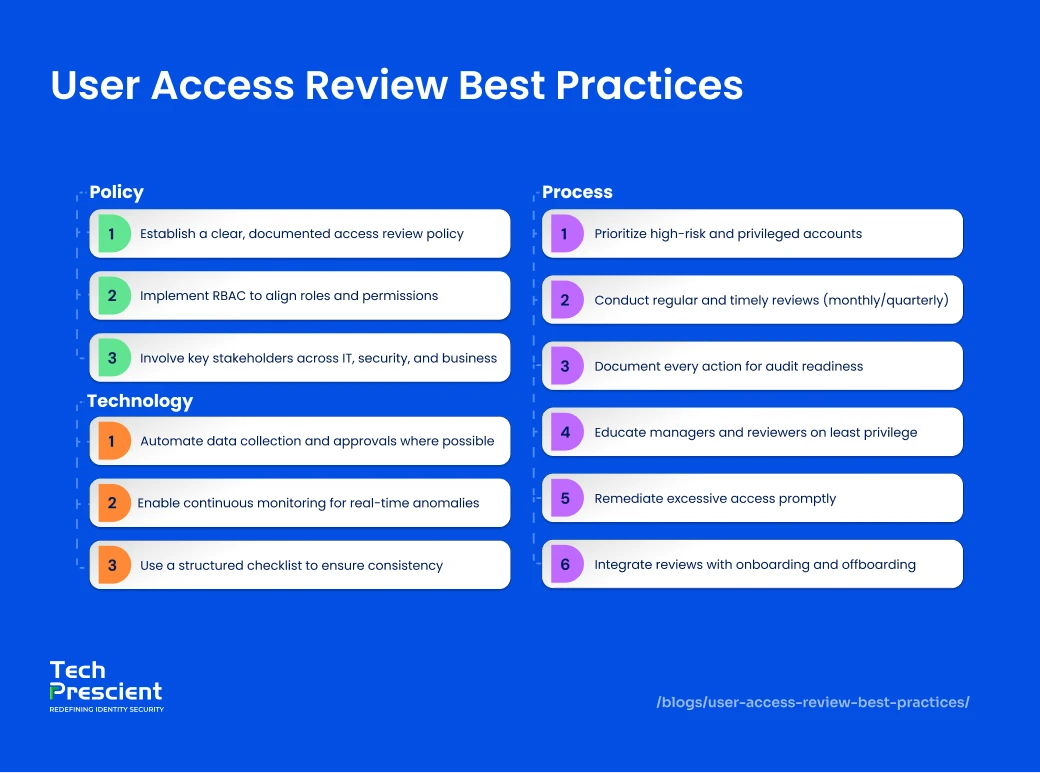
Applying consistent best practices helps organizations execute user access reviews efficiently while strengthening security and audit readiness. By following best practices, user access reviews can be efficient, repeatable, prepared for audits, and reduce the risks associated with privilege creep and insider threats.
Establish A Clear Policy
Define a formal access review policy that outlines objectives, scope, review cadence, roles, and decision ownership. A documented policy ensures consistency across review cycles and establishes accountability among all stakeholders involved.
Implement Role-Based Access Control
Use Role-Based Access Control (RBAC) so that the access review process is simplified. By aligning access rights to job roles, you will reduce permissions complexity, and it will make it easy to identify a discrepancy. RBAC also allows for the practice of least privilege, which means the user only receives needed access.
Automate Where Possible
Manual reviews take time and have a greater risk of human error. Add supporting automation tools or IAM/IGA solutions to collect access information, send reminders, and recognize licensing/access excesses. By automating the review process, you reduce the time and factors contributing to human error, allowing for scalability.
Involve Key Stakeholders
Access decisions should not be isolated within IT. Managers, system owners, security teams, and compliance leaders provide essential business context to validate whether access remains appropriate and justified.
Prioritize High-Risk Accounts
Apply a risk-based approach by reviewing privileged users, administrative accounts, and access to sensitive systems first. These accounts carry the highest potential impact and require more frequent scrutiny.
Document Everything for Audits
Auditors want to see proof. Keep details of existing access and the changes requested, approval, date, and time of the reviewer, and any notes documenting the review. Documentation is a way to demonstrate compliance, but it also leaves an audit trail, should there be a formal investigation requiring disclosure.
Conduct Timely, Regular Reviews
Be consistent. Base review frequency on the risk level of the account. Continued reviews quarterly for standard accounts and monthly for high-risk accounts will help best mitigate privilege creep, identify dormant accounts, and comply with any applicable regulatory guidelines.
Continuous Monitoring
User access reviews should not be conducted only at scheduled intervals. Continuous monitoring tools should be utilized to identify suspicious access behaviors, log-in events, or increases in end-user privileges as they happen. This proactive approach will improve security beyond compliance.
Educate Personnel
Ensure managers, reviewers, and administrators understand how to evaluate access risk, apply least privilege principles, and identify inappropriate permissions. Informed reviewers improve decision quality and reduce approval risk.
Promptly Remediate Issues
Identifying excessive permissions is only half of the job. Once excessive permissions are detected, it is imperative to act quickly to remove or adjust the permissions. The longer risk is allowed to remain, the greater the chances of an incident occurring, and the worse the security posture of the organization will become over time.
Integrate With Onboarding/Offboarding
Integrate access reviews into employee lifecycle management for consistent provisioning and timely deprovisioning of user accounts during the employee lifecycle. During the onboarding process, access should be provisioned accurately from day 1 (which means granting only what is necessary for the new hire's specific role); during the offboarding process, deprovisioning should occur immediately to close down the new hire's access and remove orphaned accounts from the system. Incorporating UARs into these processes eliminates security gaps that attackers will seek to exploit, and also tightly maintains access, in alignment with user status.
Use A Structured Checklist
A structured checklist allows reviewers to maintain consistency and ensure critical steps are not missed. The checklist can include whether to verify least privilege, whether privileged account(s) are validated, whether changes have been documented, and whether proper stakeholders have signed off.
User Access Review Tools & Templates
A structured user access review template ensures reviews are consistent, auditable, and repeatable. Templates are especially valuable during audits, where reviewers must demonstrate who approved access, why it was approved, and when it was reviewed.
A strong user access review template should include:
- User identity and role
- System or application name
- Assigned permissions or entitlements
- Business justification
- Reviewer decision (approve, revoke, modify)
- Approval date and reviewer identity
- Remediation actions and timestamps
Audit teams often request these reports in Excel or PDF format, making standardized templates essential for SOC 2, ISO 27001, and SOX audits.
Common Challenges & How to Overcome Them
Even organizations with established access review programs may encounter operational challenges as environments scale. The manual processes, lack of visibility, and misalignment between stakeholders can quickly hinder the efficiency of a UAR program and, even worse, create not only inefficiencies in the review process but also increase the likelihood of missing violations and compliance inadequacies.
Key Challenges:
- Complexity of multi-system environments: Most enterprises run a mix of on-premises, cloud, and SaaS identity systems, making it difficult to collect consistent access data from all systems, which is labor-intensive and prone to human error.
- Manual errors and delays: Organizations that rely on a spreadsheet-based review for UAR, or sole email approvals by reviewing authorities, often encounter inconsistencies, forgotten tasks, and missed deadlines, jeopardizing security and compliance.
- Lack of stakeholder participation: Without business managers, IT teams, or auditors being aligned, user access reviews can lose value and become "just a checkbox" as opposed to a worthy security control.
Solutions:
- Leverage automation tools: Automating the entire process from data collection, review notifications, and access certifications greatly reduces human error and can speed up the process.
- Improve cross-department communication: An ongoing and collegial relationship and communication between IT, compliance, and business leaders assures that access reviews are meaningful from both a security and business perspective.
- Adopt centralized IAM/IGA platforms: A central place for identity and permissioning provides a single source of truth, making it easier to become more aware of everything, simplifying reporting, and facilitating audits.
Note
Many organizations struggle with fragmented tools and manual processes for user access reviews. Tech Prescient's Identity Confluence solves this with automated reviews, continuous compliance, and unified governance, helping you move beyond box-checking to truly proactive identity security.
How Automation Improves User Access Reviews
Automation enhances user access reviews by improving consistency, visibility, and execution at scale.
User access review automation helps organizations execute reviews consistently, reduce manual errors, and maintain continuous compliance. Automated access reviews are especially valuable in environments with frequent role changes, cloud applications, and privileged access.
Automation supports user access reviews by:
- Automatically collecting access data across systems
- Highlighting excessive or unused permissions
- Enforcing review deadlines and reviewer accountability
- Generating audit-ready user access review reports
This makes automation an operational enabler rather than just a software decision.
The Key Elements to the Benefits of Automation:
- Integration with IAM/IGA tools like Identity Confluence - Centralizes identity and access data across applications, systems, and cloud environments to establish a single source of truth.
- Generates audit-ready reports - Gathers information automatically to evidence compliance, while increasing the internal and external stakeholders' ability to demonstrate compliance with various things such as SOX, HIPAA, and GDPR.
- Automates reviewer notifications - Provides review reminders and dashboards to notify managers and reviewers of the deadlines, while helping them to provide timely input and reducing the timeframe between review cycles.
Final Thoughts
User access reviews extend beyond compliance, serving as a foundational control for protecting data and managing access risk. In an environment characterized by constantly changing regulations, hybrid workplace environments, and a plethora of complex insider and external threats, UARs provide confidence that the right people have the right access at the right time and nothing more.
Organizations that utilize access reviews as a security practice rather than a compliance exercise see clear benefits in terms of fewer risk gaps, better audit/review preparedness, and a more engaged security culture across the organization. When organizations have adequate automation and clarity around policy, UARs move from a manual burden to a proactive control, creating efficiency while establishing confidence and peace of mind.
In practice, consistent user access reviews help organizations proactively manage risk while maintaining a strong, defensible identity governance posture.
FAQs
User access reviews should be performed at least quarterly for standard systems. High-risk or privileged accounts should be reviewed monthly or continuously, depending on regulatory requirements and organizational risk exposure.
User access reviews typically involve multiple stakeholders. Managers validate business necessity, IT teams verify technical access, and security or compliance teams ensure alignment with policies and audit requirements.
Yes. All user IDs for critical systems must be reviewed at defined intervals. Non-critical systems can follow a less frequent review schedule based on risk classification.
A user access review report includes current access rights, approval or revocation decisions, reviewer details, timestamps, and documented remediation actions for audit purposes.
Share



Rashmi Ogennavar
Content Strategist
A content strategist translating complex Tech and SaaS concepts into compelling narratives for business and technical audiences. With a strategic, data-informed approach, the work bridges content and product storytelling, crafting messaging that resonates and drives decisions across the buyer journey.
Most Popular Blogs
Identity Security· 21 min read
Data Access Governance Solutions: How to Secure Sensitive Data at Scale
Compare data access governance solutions for 2026: how DAG platforms discover sensitive data, run access reviews, automate remediation, and prove compliance.
Brinda Bhatt· September 7, 2026
Identity Security· 24 min read
What Is Zero Trust Network Access (ZTNA)?
Learn what Zero Trust Network Access (ZTNA) is, how it works, and why it’s replacing VPNs for secure, identity-based access control.
Yatin Laygude· August 14, 2026
Identity Security· 24 min read
Cyber Essentials Certification: Complete Guide
Learn Cyber Essentials certification, cost, requirements, and steps. Compare Cyber Essentials vs Plus and get certified faster.
Yatin Laygude· August 10, 2026